1. INTRODUCTION
Over the past two decades the focus of dialect research has shifted from phonology, lexicology and morphology to other domains of grammar, such as syntax. Corpus-based research on dialect syntax has become a particularly lively subject area where new resources and methodology are actively applied and developed (e.g. Grieve Reference Grieve2009, Szmrecsanyi Reference Szmrecsanyi2013, Wolk & Szmrecsanyi Reference Wolk, Szmrecsanyi, Côté, Knooihuizen and Nerbonne2016). New resources, i.e. large dialect corpora, enable the application of methods widely used in statistics and corpus linguistics – more generally in the usage-based framework – to complex and heterogeneous dialect data. The analysis of this kind of data presupposes rigorous statistical methodology in order to capture new information about the nature of variation, observing the effect of local language contacts and the emergence of linguistic constructions more generally.
This study continues a similar line of research and utilizes corpus data to examine syntactic variation in Estonian dialects by considering the frequency of syntactic phenomena and applying quantitative methods. We analyse Estonian ’need’-constructions, using the data drawn from the Corpus of Estonian Dialects. The main purpose of this study is to provide insight into geographic variation in syntax and its complexity, and to detect the potential sources of the variation. We demonstrate that when analysing the construction that varies, we have to consider, along with geography, language-internal syntactic and semantic factors, including construction-internal features, since some items within the construction affect variation in other parts of the same construction. Our focus, however, is on dialectal distribution; in other words, our main purpose is to determine what part of the variation can be explained by inter-dialectal differences.
By including frequencies in the research paradigm, we gain a substantial amount of new information about spatial variation in syntactic phenomena. Frequency-inferred tendencies can often be explained by language contact, and, thus, are far from coincidental. Usage patterns already existing in a language (or dialect) can acquire higher usage frequency due to similar patterns in a contact (or model) language that the speakers are frequently confronted with (Heine & Kuteva Reference Heine and Kuteva2005:47). Even if some phenomenon exists in various areas, its usage frequency can be substantially lower outside the core of the observed contact region (see Koptjevskaja-Tamm & Wälchli Reference Koptjevskaja-Tamm, Wälchli, Dahl and Koptjevskaja-Tamm2001:627). Change in the usage frequency of some (previously existing) pattern has been considered the typical example of contact-induced grammatical transfer (Heine & Kuteva Reference Heine and Kuteva2005:48). The Estonian ‘need’-constructions under investigation share many properties with Russian and Latvian (see Section 3), and we expect that relative frequencies may reflect contacts with the respective neighboring languages.
We look closely at the variation in ‘need’-constructions in Estonian dialects containing the predicates tarvis/vaja (olema) ‘need’, as in examples (1) and (2) (for abbreviations see the list at the end of this paper, immediately before References).
-
(1)


-
(2)

On the basis of form–meaning pairings, we have distinguished two basic ‘need’-constructions in the sense of Construction Grammar (e.g. Croft Reference Croft2001). The infinitival construction (1) takes an infinitival complement e.g. kooli minna ‘go to school’ and has a modal meaning, marking necessity or obligation. It is clearly grammaticalized to the modal domain: the modal adverb tarvis/vaja, copula ole- ‘be’ and the infinitival complement together act as a modal predicate. The nominal complement construction (2) expresses a need for or lack of something and is less grammaticalized in this respect; it can therefore also be called a pre-modal construction. (See Lindström & Vihman Reference Lindström and Vihman2017 for more information about the same constructions in standard Estonian.) These two basic constructions are the most common in the data.
However, there is more variation within the constructions, and it is not always easy to decide whether we are dealing with intraconstructional variation or with a different construction, because all the parts of the constructions may vary without obvious differences in meaning. In both basic constructions, the semantic core is a modal adverb, either tarvis or vaja ‘need’. They have been considered synonymous; no previous research has highlighted possible semantic and/or dialectal differences between the use of tarvis and vaja. The experiencer argument in the constructions may occur in the adessive, as mul ‘I’ in (1) and (2), but the experiencer may also be case-marked with the allative, as in (3), or may be omitted (marked by 0), as in (4).
-
(3)

-
(4)

The constructions include a copula ole- ‘be’ in the singular third person (3), but the verbs minema ‘go’ or tulema ‘come’ may act similarly to the copula. The copula may also be omitted, as is seen in (4). The complement of the construction can be clausal or may even be omitted, in addition to the basic patterns (infinitival and nominal, as in (1) and (2)).
We focus on variation that can be analysed statistically: lexical variation (using tarvis or vaja), variation in the copula (especially ellipsis of the copula), and variation in experiencer-marking (especially ellipsis of the experiencer).
Previous variationist research has emphasized the importance of individual internal variation (e.g. Van de Velde & van Hout Reference Van de Velde, van Hout and Paradis1998, Tagliamonte & Baayen Reference Tagliamonte and Baayen2012). To capture more fine-grained information about variation, we conducted all our analyses in two ways – with and without the individual speaker variable. Our hypothesis was that the construction in question has a distinct geographic distribution, and that individual differences are secondary.
The paper is organized as follows: In Section 2, we provide a brief overview of dialect syntax approaches, especially with regard to the data sources that have been used in the field, and a brief overview of work in Estonian dialect syntax to date. In Section 3, we present an overview of Estonian dialects, language contacts, and the ways in which ‘need’-constructions are used in contact languages. Section 4 describes the data and methods applied and Section 5 presents the results of the study.
2. DIALECT SYNTAX
During the past two decades, both the generativist paradigm and linguistic typology have found in dialects a useful source of new information about linguistic varieties (Kortmann Reference Kortmann, Auer and Schmidt2010, Bucheli Berger, Glaser & Seiler Reference Bucheli Berger, Glaser, Seiler, Ender, Leemann and Wälchli2012). One of the reasons why dialect syntax was a rather neglected field before the 1990s was probably the nature of syntactic variation, which – compared to phonological and lexical variation – is much subtler and less salient; it is also in many cases less categorical and rather a matter of frequency (Kortmann Reference Kortmann, Auer and Schmidt2010). Syntactic phenomena can be better described in terms of preferences and preference patterns, rather than the simple presence or absence of certain features (Kortmann Reference Kortmann, Auer and Schmidt2010), thus syntactic variation is often probabilistic rather than categorical in nature (Wolk et al. Reference Wolk, Bresnan, Rosenbach and Szmrecsanyi2013).
Methodologically, research on dialect syntax has developed in two main directions in terms of the sources of data used: studies using linguistic questionnaires and those based on dialect corpora. We will next briefly discuss these two methods.
The use of questionnaires as a method for dialect syntax research has been widespread in studying, for example, Dutch, German and the Nordic languages (Vangsnes Reference Vangsnes2007, Bucheli Berger et al. Reference Bucheli Berger, Glaser, Seiler, Ender, Leemann and Wälchli2012) but has been less common in the case of many other languages, including Estonian and Finnish. Traditionally, questionnaire data have been presented in the form of linguistic atlases, maps, etc. This method allows us to take into account rarely occurring syntactic phenomena, and to ask respondents about, for example, semantic differences, individual preferences, and different contexts. This method, however, needs adequate databases, either from some earlier period or new data. The latter presupposes the existence of vital dialect-speaking communities, who can provide reliable data. Nowadays, this is no doubt problematic for many languages, because of leveling processes affecting traditional dialects. Estonian dialects, the focus of the current paper, have undergone a rapid leveling process of traditional geographic dialects, and systematic syntactic questionnaire data from earlier periods are lacking. We can only find a few syntactic features form the Estonian Dialect Atlas, compiled by Andrus Saareste. These atlases (Saareste Reference Saareste1938, Reference Saareste1955) contain mostly lexical data.
Recently, dialect corpora have become available for many languages, which enables the study of syntactic variation in its natural context in a quantitative manner. Such a corpus has also been compiled for Estonian dialects, as we have plenty of recorded dialect interviews since the 1950s (see Section 4.1 below). Compared to questionnaires, corpus data have both advantages and disadvantages. The apparent advantage of a dialect corpus is that it affords the possibility of collecting frequency data, making statistical analysis much easier. Szmerczsanyi (Reference Szmrecsanyi2013:4) has pointed out that frequency is a better indicator of variational patterns than the traditionally used dialect atlases, where only discrete classifications are used. Using frequency data, we can more adequately explain the typical and atypical features of a particular dialect, which is especially important in areas where two or more competing patterns are attested. The apparent disadvantage of dialect corpora is the limited amount of data, especially when dealing with spoken vernaculars and texts from many different (sub-)dialects. Dialect corpora thus usually enable the analysis of frequently occurring linguistic phenomena, but are seldom useful in studying rare and infrequent phenomena. This is a problem we are faced with in the present study as well: while the total extent of annotated texts was approximately 900,000 words, we still do not have enough data from each region to study less frequently occurring variants of the construction. We also have to keep in mind that corpora never give every possible context or usage of a linguistic phenomenon; we have to work with the data we are able to retrieve.
In Estonian dialectology, syntactic phenomena have typically been outside the scope of research. There has been some work on Estonian dialect syntax, but most of it has concerned only a particular syntactic phenomenon in a particular (sub-)dialect (e.g. Koit Reference Koit, Ariste and Pall1963; Neetar Reference Neetar1964, Reference Neetar1970; Lindström et al. Reference Lindström, Kalmus, Klaus, Bakhoff and Pajusalu2009; Mets Reference Mets2010; Uiboaed Reference Uiboaed2010; Kehayov, Lindström & Niit Reference Kehayov, Lindström and Niit2011; Velsker Reference Velsker2013, Metslang & Lindström Reference Metslang, Lindström and de Groot2017). Some syntactic features are also listed in descriptions of dialects (e.g. Must Reference Must1987, Must & Univere Reference Must and Univere2002, Pajusalu et al. Reference Pajusalu, Hennoste, Niit, Päll and Viikberg2009). More exhaustive studies are available only on agreement phenomena (Nurkse Reference Nurkse1937, Neetar Reference Neetar1964) and evidential constructions (Kask Reference Kask1984). The first attempt to apply the principles of aggregate frequency-based dialectology to Estonian verbal constructions was conducted by Uiboaed (Uiboaed Reference Uiboaed2013, Uiboaed et al. Reference Uiboaed, Hasselblatt, Lindström, Muischnek and Nerbonne2013). More recently, the corpus-based approach to syntactic variation in Estonian dialects has been applied to e.g. the frequency distribution of perfect and pluperfect (Lindström et al. Reference Lindström, Pilvik, Ruutma and Uiboaed2015, Lindström et al. Reference Lindström, Pilvik, Ruutma, Uiboaed, Björklöf and Jantunen2017), variation in locative constructions marking ‘on’ (Klavan, Pilvik & Uiboaed Reference Klavan, Pilvik and Uiboaed2015), use of ambipositions (Ruutma et al. Reference Ruutma, Kyröläinen, Pilvik and Uiboaed2016), constructions with action nominal (Pilvik Reference Pilvik2016, Reference Pilvik, Lindström and Huumo2017), and use of partitive subjects (Lindström Reference Lindström, Lindström and Huumo2017).
3. ESTONIAN DIALECTS, LANGUAGE CONTACTS AND ‘NEED’-CONSTRUCTIONS IN CONTACT LANGUAGES
Estonian is a Finno-Ugric language belonging to the Finnic branch. Its closest relatives are Livonian and Votic, which at present are nearly extinct. The closest languages to Estonian still used for everyday communication are Finnish, Karelian, and Veps. Estonian has a complex morphological system, which is typical of the Finno-Ugric languages (Erelt, Erelt & Ross Reference Erelt, Erelt and Ross2000).
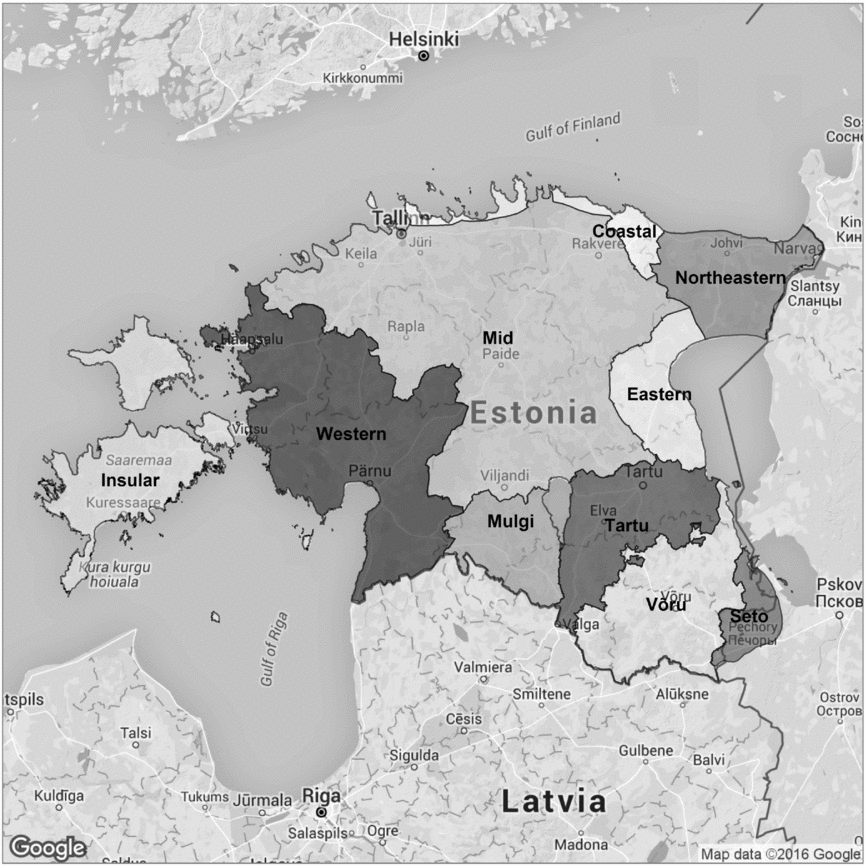
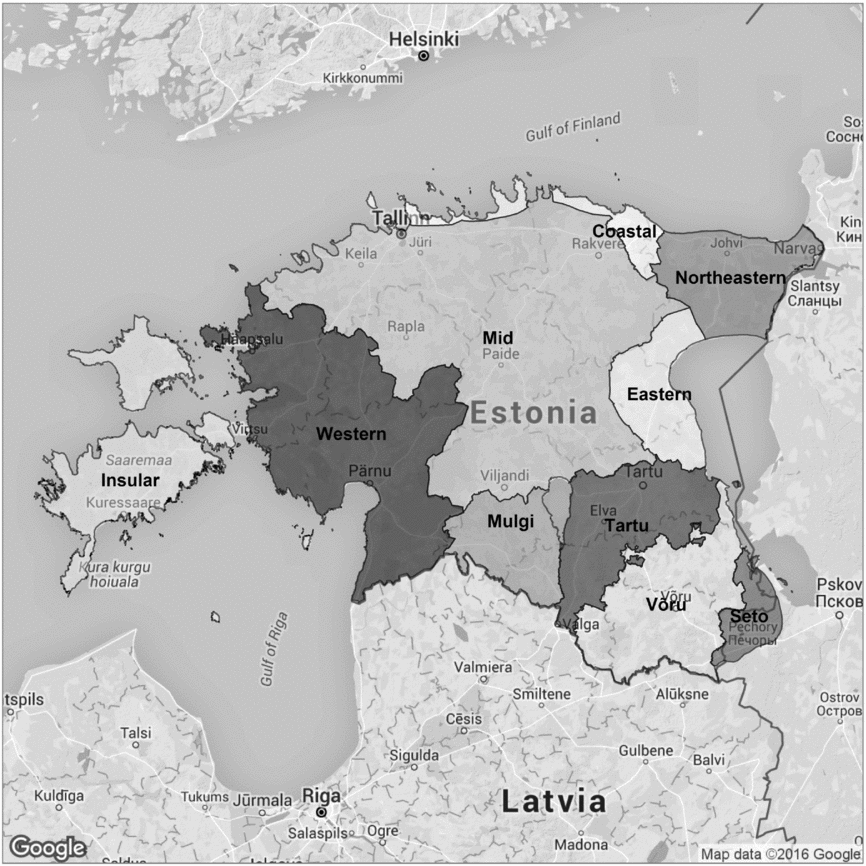
The area where Estonian is spoken is relatively small, but differences among the traditional dialects are substantial. There are slightly different classifications of Estonian dialects available. The classification that is used in the corpus of Estonian dialects establishes three main dialect groups: the North Estonian group, which includes the Insular, Western, Mid, and Eastern dialects; the South Estonian group, consisting of the Mulgi, Tartu, Seto, and Võru dialects; and the Northeastern-Coastal dialect group, which includes the Coastal and Northeastern dialects. These three groups can be divided into more than 100 sub-dialects. The map in Figure 1 shows the main Estonian dialect areas. Traditional dialect classifications distinguish most significantly between northern and southern dialects; the greatest differences are in phonology, morphology and lexis. South-Estonian dialects are sometimes treated as a separate language.
Estonian dialect areas.
Estonian has been heavily influenced by the Indo-European languages, and has acquired a number of features that are characteristic of Standard Average European (Metslang Reference Metslang2009). Estonian has also had long-lasting contacts with languages around the Baltic Sea, forming the Circum-Baltic language area (see Dahl & Koptjevskaja-Tamm Reference Dahl and Maria2001, Wälchli Reference Wälchli, Kortmann and van der Auwera2011). The Circum-Baltic area includes Finnic languages, Russian, Baltic languages (Latvian and Lithuanian), Germanic languages (particularly Swedish, German, Low German) and several other languages spoken in the region (Koptjevskaja-Tamm & Wälchli Reference Koptjevskaja-Tamm, Wälchli, Dahl and Koptjevskaja-Tamm2001, Wälchli Reference Wälchli, Kortmann and van der Auwera2011). The Circum-Baltic language area has been described as a complex linguistic community where mutual influences of individual languages are constant and there is no single dominating language; therefore, it is also referred to as a contact superposition zone rather than Sprachbund (Koptjevskaja-Tamm & Wälchli Reference Koptjevskaja-Tamm, Wälchli, Dahl and Koptjevskaja-Tamm2001:626; Wälchli Reference Wälchli, Kortmann and van der Auwera2011:325). Estonian belongs to the eastern part of the Circum-Baltic languages together with Baltic, Finnic, and Slavic languages (especially Russian). Although these languages belong to different language families, many morphosyntactic similarities have been attested among them (see e.g. Dahl & Koptjevskaja-Tamm Reference Dahl and Maria2001; Vaba Reference Vaba2011; Seržant Reference Seržant2012, Reference Seržant2015a, b; Klaas-Lang & Norvik Reference Klaas-Lang and Norvik2014).
The ‘need’-constructions discussed in this article have some obvious semantic parallels in Baltic and Slavic languages. The Latvian counterpart mainly marks necessity, both dynamic and deontic, with a preference for deontic use (see Holvoet Reference Holvoet2001:28–32, Reference Holvoet, Hansen and de Haan2009:209), similarly to Estonian; and the same appears in Russian (Wade Reference Wade2011:313). In all three languages, the modal ’need’-predicates can also be used with a nominal complement (pre-modal usage), expressing need for something or lack of something.
In addition, there are clear structural parallels between Estonian, Latvian and Russian ‘need’-constructions. Firstly, the use of modal adverbs and modal adjectives in these constructions is characteristic to Russian and other East Slavonic languages (e.g. nado, nuzhno ‘need’ in Russian), while West Slavic languages prefer modal verbs (Hansen Reference Hansen, Hansen and Karlík2005). In Balto-Finnic languages, both modal adverbs and modal verbs are used, but modal adverbs are widely used especially in Estonian as well as some eastern Balto-Finnic languages that have been under the strong influence of Russian (Kehayov & Torn-Leesik Reference Kehayov, Torn-Leesik, Hansen and de Haan2009). Another parallel between Estonian, Latvian and Russian is related to the marking of the experiencer: in Russian and Latvian ‘need’-constructions, dative case is used to mark the modal experiencer, while in Estonian and eastern Balto-Finnic languages, adessive and allative are widely used as a counterpart of the dative in experiential constructions (see also Seržant Reference Seržant, Arkadiev, Holvoet and Wiemer2015b). In all these languages, the dative(-like) experiencer can also be easily omitted in modal constructions (Kehayov & Torn-Leesik Reference Kehayov, Torn-Leesik, Hansen and de Haan2009, Hansen Reference Hansen, Leiss and Abraham2014). A third parallel can be found comparing Estonian and Latvian: both use the same stem vaja. In Estonian, vaja is used as a modal adverb, while Latvian uses the verb vajadzēt for marking necessity. The stem vaja- has been borrowed from Livonian to Latvian (Kalnača Reference Kalnača2013), and later verbalized (Seržant & Bjarnadóttir Reference Seržant, Bjarnadóttir, Judžentis, Civjan and Zavyalova2014). The Latvian verb vajadzēt can only be used in third person singular form, while the Estonian construction uses the copula olema ‘be’ in third person singular form. Russian also uses the copula in third person form, when it is present in the clause. The parallels between the languages are exemplified in (5)–(7).
-
(5)

-
(6)

-
(7)

Some of these features can also be found in Finnish necessive constructions, but to a lesser degree. Finnish mostly uses modal verbs (such as täytyy, pitää, tarvita ‘need, have to’), and fewer modal adverbs than Estonian (e.g. pakko means mainly obligation). The Finnish modal subject has non-nominative marking, but unlike Estonian, mostly genitive is used (in dialects and colloquial speech, adessive can also be used, see Laitinen Reference Laitinen1992:112–113). In Finnish, ellipsis of the experiencer argument is common, and the elliptical NP refers to people familiar from the context, either the discourse participants or the narrative protagonist, or it remains generic (see Laitinen Reference Laitinen1992:109–110). Experiencer ellipsis in necessive constructions referring to discourse participants has also been noted in the Finnish comprehensive grammar (ISK:Reference Vilkuna, Korhonen, Koivisto, Heinonen and Alho1291).
In most of the studies on language contact, Estonian is treated as a whole and the language-internal variation is not accounted for. However, a multitude of phenomena in Estonian display significant regional differences which can be explained by contacts that have taken place locally, i.e. they have affected only certain areas. Our previous findings (Lindström et al. Reference Lindström, Pilvik, Ruutma and Uiboaed2015, Lindström et al. Reference Lindström, Pilvik, Ruutma, Uiboaed, Björklöf and Jantunen2017) have shown that dialects may differ remarkably by usage frequency of relatively old, contact-induced phenomena common to all Estonian dialects: usage frequency of perfect and pluperfect is notably higher than average in dialects that have had long-lasting contacts with languages where the corresponding construction exists, and notably lower in areas with more contacts with languages where the corresponding construction is missing.
We expect that some of the variation we detect in ‘need’-constructions is due to (or reinforced by) ongoing language contact which have occurred more locally. We assume that features that are usual also in Russian and/or Latvian, are more frequent in eastern and southern part of Estonia, respectively. Language contact thus serves as an explanatory factor for construction-internal variation, and it may explain differences between the dialects. The explanatory power of language contact, however, is hard to operationalize for quantitative analysis because the relevant contact period, nature and intensity of contacts are hard to determine and may vary largely. We can estimate the role of contacts only indirectly, taking into account geographical distance and earlier information about contacts.
However, as we will show in the following sections, language contacts do not explain all the variation; construction-internal factors also play a role, as well as individual differences.
4. DATA AND METHODS
4.1 Corpus of Estonian Dialects
Our data come from the Corpus of Estonian Dialects (CED; http://www.murre.ut.ee/estonian-dialect-corpus/), compiled at the University of Tartu in collaboration with the Estonian Language Institute. The CED represents spoken dialects recorded during the years 1957–1980, and includes dialect interviews from all Estonian dialect areas. Since the recordings selected for the CED are the oldest tape-recorded dialect texts available, the corpus represents relatively old dialect speech. More recently Estonian dialects have quickly leveled, and most of them are no longer in active use. The informants have been selected on the basis of classic criteria: they are local people, typically not highly educated, and have not moved around during their lives. The texts in the corpus represent dialect interviews, which often include long monologue passages. The topics of the interviews typically deal with such topics as the respondent's personal life, family, lifestyle and working methods in the past, or episodes in their lives.
The CED consists of five parts: (i) dialect recordings, (ii) phonetically transcribed dialect texts (in Finno-Ugric transcription system), (iii) dialect texts in simplified transcription, (iv) morphologically annotated texts in XML-format, and (v) a separate database containing information about informants and recordings. The morphologically annotated part of the corpus contains 940,000 tokens.
4.2 Data
The data for tarvis and vaja olema constructions are extracted from the morphologically annotated part of the CED. The final dataset comprises 355 instances of modal predicates containing either tarvis or vaja, from 135 individuals (16 are variable individuals). The final dataset contains all sentences retrieved and possible to code for the chosen factors, so we are dealing with a holistic sample. The next sections describe the factors coded and their levels for our analysis.
4.2.1 Modal adverb
Constructions are extracted from the CED by the lexical item used in the clause. The modal adverb is the only obligatory part of the construction, and is the binary dependent variable (levels tarvis and vaja) in our first analysis. In the Estonian reference grammar (Erelt et al. Reference Erelt, Kasik, Metslang, Rajandi, Ross, Saari, Tael and Vare1993) the modal predicates tarvis and vaja olema are listed as synonymous predicates, expressing the same meanings and functions.
4.2.2 Dialect and individual
The basic geographical unit in this study is the dialect, as represented in Figure 1 above. The same division of dialects is used in the CED. For practical reasons we could not use smaller units (sub-dialects), as the number of usages of ‘need’-constructions distributed over the smaller areas is too small for quantitative study; we have therefore aggregated over the sub-dialect areas. Hence the predictor dialect has ten levels (Eastern, Coastal, Insular, Mid, Mulgi, Northeastern, Seto, Tartu, Võru, Western). In addition, all the utterances contain the code for the informant who produced the sentence (predictor individual). In order to explain potential individual preferences, informants are traditionally included in predictors set in variationist and corpus-based studies (e.g. Guy Reference Guy and Labov1980, Van de Velde & van Hout Reference Van de Velde, van Hout and Paradis1998, Tagliamonte & Baayen Reference Tagliamonte and Baayen2012). Although, including other sociolinguistic variables would follow the traditional line of research and likely contribute some interesting information, we have omitted these in the present analysis for technical reasons: the dataset is fairly small, heterogeneous and contains cells with missing information. All this would introduce additional problems in statistical analysis.
4.2.3 Copula verb
The most commonly used verb in ‘need’-constructions is the copula olema ‘be’ (as in examples (1) and (2) above). In addition, the verbs tulema ‘come’ and minema ‘go’ can also carry a copular function in the construction, but are rather infrequent. (See examples (7) and (8) in Section 5.2 below.) The copula may also be omitted. The predictor mainverb thus has four levels in our data, according to the lexical verb used (olema, minema, tulema) or ellipsis (coded as 0). The omission of the copula is common in Russian (Kehayov Reference Kehayov2009), and this is a reason why we expect frequent copula ellipsis in eastern dialects that have had more contacts with Russian.
4.2.4 Marking of the experiencer
The experiencer argument is case-marked either by the adessive (ade) or by the allative (all), but can also be left unexpressed (0); hence the predictor Experiencer consists of these three levels. To explore the factors that potentially influence the omission of the experiencer argument, we have created the variable exp_is, which shows the presence of the experiencer irrespective of its case-marking. This is thus a binary variable, with two levels (yes and no). Since the omission of the experiencer in modal constructions is common in Slavic and Baltic languages (Hansen Reference Hansen, Leiss and Abraham2014), we expect that the rate of experiencer omission is higher in eastern and southern dialects.
4.2.5 Complement
The ‘need’-construction can take a nominal complement (nom), marked mostly with the partitive case, as in example (2) above; but nominatives and infinitival complements (inf), as in (1) above, also occur. The complement may also be elided (0), in cases where the object needed or the action required is clear from the discourse or from the more general context. The infinitival complement occurs in modal constructions marking either dynamic or deontic necessity. Thus clauses with the infinitival complement represent more grammaticalized usages than clauses taking the nominal complement.
4.2.6 Polarity
All clauses were marked for polarity, with binary predictor levels: aff (affirmative polarity) and neg (negative polarity). In tarvis/vaja constructions, the negative marker can be attached only to the copula; thus the predictor could be relevant in the analysis of the occurrence of the copula verb. We expect that negative polarity increases the probability of explicit use of copula.
4.2.7 Tense
Tense markers can be attached only to the copula, and the predictor is thus expected to be relevant in the analysis of the occurrence of the copula verb. We have distinguished between present tense (pr) and past tenses (ipf). The latter includes all past tenses, i.e. simple past, perfect and pluperfect. We expect that past tense (which is marked on the copula) increases the probability of explicit use of copula.
In Section 5, we take a closer look at the choice between the modal adverbs tarvis and vaja, variation in the use of the copula (focusing on ellipsis of the copula), and variation in the marking of the experiencer argument. Our primary objective is to investigate the main predictors that best predict the choice between alternative constructions. The principal question is, whether the predictor dialect is statistically significant when it comes to predicting the construction usage, i.e. whether the chief constraints on usage are geographical or whether other (possibly) significant language-internal predictors can be identified. We use the term dependent variable for the phenomenon under investigation and the term predictor and predictor levels for explanatory variables and their levels.
4.3 Method
Like most variationist data, and natural language data in general, our dataset comes with traditional problems with regard to quantitative analysis. There are frequency fluctuations in terms of instances per informant and singletons; predictors and predictor levels are heterogeneously distributed and interrelated. All these problems have been previously described in the literature (for a compact overview see Tagliamonte & Baayen Reference Tagliamonte and Baayen2012:142–143). This reality sets boundaries for the quantitative methodology that can be applied in analysing the data. Although logistic mixed-effects modelling is frequently applied in variationist data analysis, we have to neglect this here as the assumptions for these modelling techniques are not met by our data (see also Tagliamonte & Baayen Reference Tagliamonte and Baayen2012:146, 161).
To overcome modelling restrictions posed by our data, we have chosen two non-parametric classification methods for our analyses: recursive partitioning tree models (Hothorn, Hornik & Zeileis Reference Hothorn, Hornik and Zeileis2006) and random forests (Breiman Reference Breiman2001, Strobl, Malley & Tutz Reference Strobl, Malley and Tutz2009).
Recursive partitioning in a conditional inference framework (Hothorn et al. Reference Hothorn, Hornik and Zeileis2006) is, in simple terms, a recursive binary splitting of the data. The algorithm makes binary splits, deciding locally which variables best classify the data. When there are no significant factors left for splitting, the algorithm stops. The advantage of this method is that it enables us to identify interactions between variables and allows straightforward visualization to capture these interactions. Results are represented in a tree-like graph. We use the method specifically for these purposes: to visualize our data and to identify potential interactions between coded variables.
The primary method we apply is the random forests method (Breiman Reference Breiman2001) which complements the conditional inference trees. Random forests construct a large number of conditional inference trees and then select the variables that classify the data best. The method makes it possible to measure the relative importance of the variables included in the model. During the random permuting of the predictor variable, it measures the difference in prediction accuracy before and after permutation of the predictor, and thus measures the extent to which the model is weaker without the contribution of the predictor (Strobl et al. Reference Strobl, Malley and Tutz2009). Random forests work well in situations with a relatively small number of observations and a large number of predictors (Tagliamonte & Baayen Reference Tagliamonte and Baayen2012), which is also obviously the case with the current dataset. Random forests have previously been successfully applied in linguistic studies (e.g. Tagliamonte & Baayen Reference Tagliamonte and Baayen2012, Baayen et al. Reference Baayen, Endresen, Janda, Makarova and Nesset2013, Kyröläinen Reference Kyröläinen2013).
All the computations were performed with program R (R Development CoreTeam 2013); we used the package party for both conditional inference tree (Hothorn et al. Reference Hothorn, Hornik and Zeileis2006) and random forests (Hothorn et al. Reference Hothorn, Hornik and Zeileis2006, Strobl et al. Reference Strobl, Boulesteix, Zeileis and Hothorn2007, Strobl et al. Reference Strobl, Boulesteix, Kneib, Augustin and Zeileis2008) analyses.
For supplementary visualization purposes we use polygon gradiency maps, primarily to display the frequency data (Uiboaed Reference Uiboaed2016). On these maps, darker areas indicate higher frequencies and lighter areas lower ones. The frequency data were normalized on the basis of average file size in the corpus.
5. RESULTS
5.1 Lexical variation: Tarvis or vaja
In Estonian grammars vaja and tarvis (olema) have been always described jointly, as having the same functions and meanings. In this section, we show that these two modal adverbs have different origins and different distribution in the dialects which can be explained by local language contacts.
According to the Estonian etymological dictionary (Metsmägi, Sedrik & Soosaar Reference Metsmägi, Sedrik and Soosaar2012), tarvis is a Proto-Germanic loanword, also found in other Balto-Finnic languages: Finnish, Veps, Votic, Ingrian, Livonian and Karelian. Vaja is considered to be an old Finno-Ugric stem, also found in Livonian ‘need’, Votic ‘need; missing’, Finnish vajaa ‘incomplete’, Ingrian ‘need, missing’, Lude, Veps ‘incomplete’. As a modal adverb, vaja is used in addition to Estonian, also in Votic (where the use of tarvis and vaja varies, according to the data of CED) and Livonian (Viitso Reference Viitso2014), i.e. southern Balto-Finnic languages.
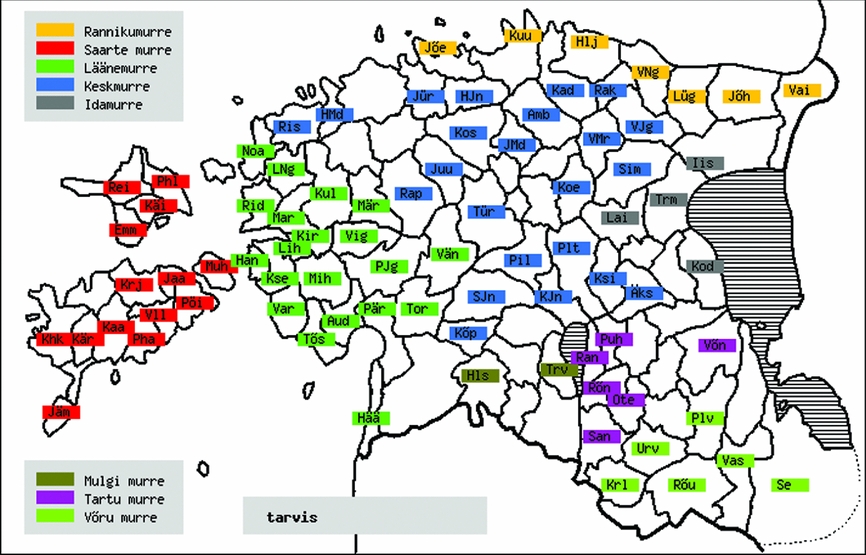
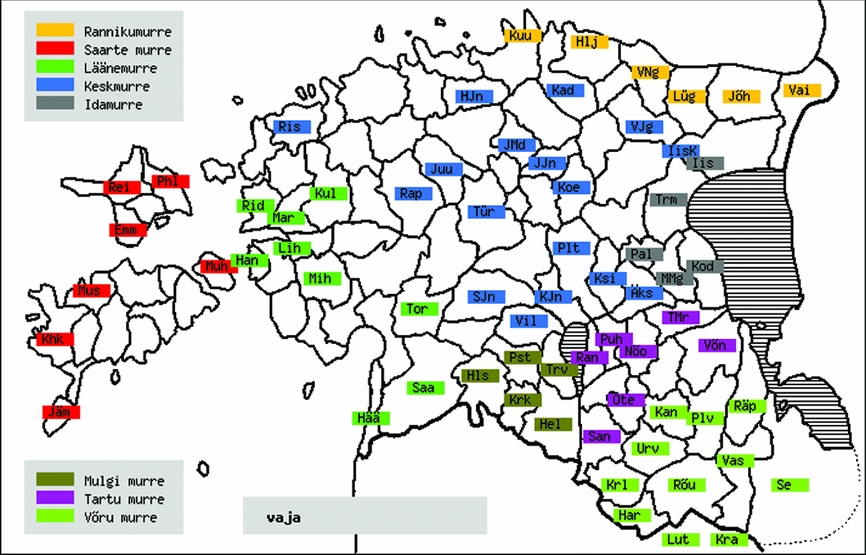
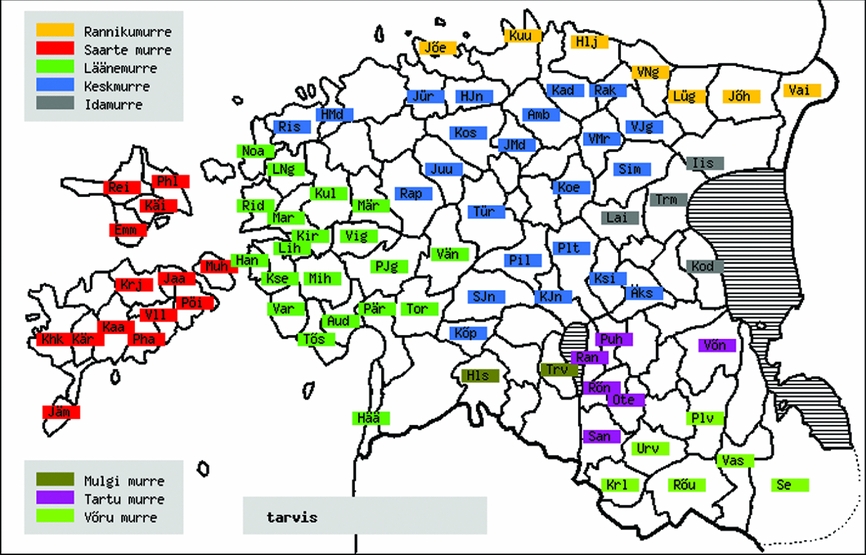
According to the dictionary of contemporary Standard Estonian, vaja is approximately 3.5 times more frequent than tarvis (see Kaalep & Muischnek Reference Kaalep and Muischnek2002). In contemporary spoken Estonian the same tendency is even more visible: vaja dominates clearly over tarvis, being used in almost 90% of the occurrences of tarvis/vaja constructions (Lindström, Uiboaed, Vihman Reference Lindström, Uiboaed and Vihman2014, Lindström & Vihman Reference Lindström and Vihman2017). There are no dialectal data where the distribution of tarvis and vaja are comprehensively described, but the Estonian dialect dictionary VMS (Haak et al. Reference Haak, Juhkam, Kallasmaa, Kask, Niit, Norvik, Oja, Sepp, Simm and Viikberg1989) contains information as to sub-dialects where these occurrences have been attested. Figures 2 and 3 were retrieved from the VMS web version (http://www.eki.ee/dict/vms/) and illustrate the distribution of tarvis and vaja in sub-dialects.
The spread of tarvis in Estonian dialects and sub-dialects (different colours mark different dialects; abreviations label sub-dialects).
The spread of vaja in Estonian dialects and sub-dialects (different colours mark different dialects; abreviations label sub-dialects).
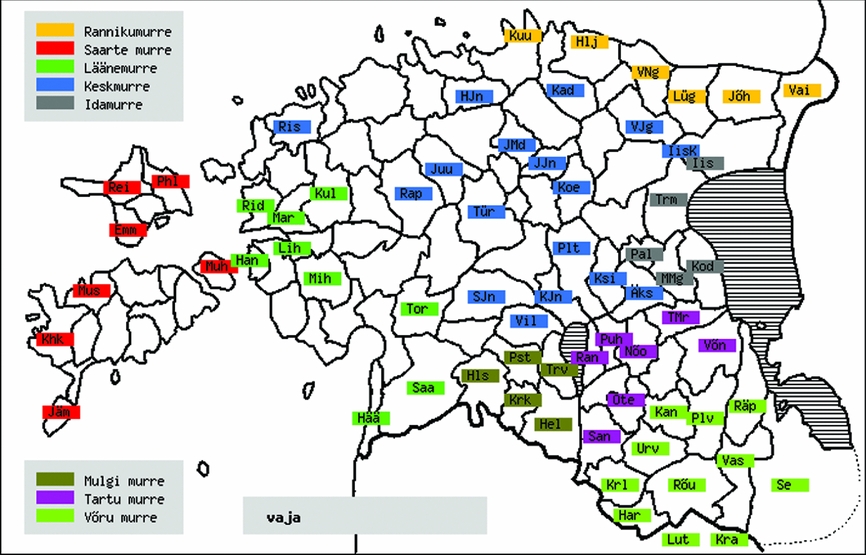
The maps in Figures 2 and 3 mark the locations (sub-dialects) where the corresponding data were collected, but the graphs do not convey frequency information; thus this kind of atlas data do not show whether the adverb occurred at that location once or a thousand times. Comparison of these maps does not reveal any crucial difference between the distribution of tarvis and vaja across Estonian dialects; rather, both adverbs seem to occur quite homogeneously all over the region.
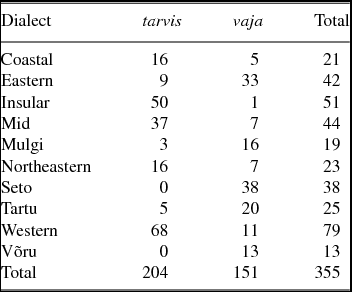
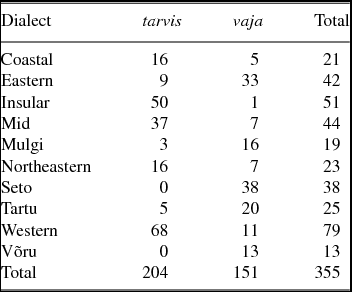
With corpus data, in addition to location information, we are also able to retrieve the frequencies of the observed forms. Table 1 and Figure 4 demonstrate the frequency differences between dialects.
Frequencies of tarvis and vaja.
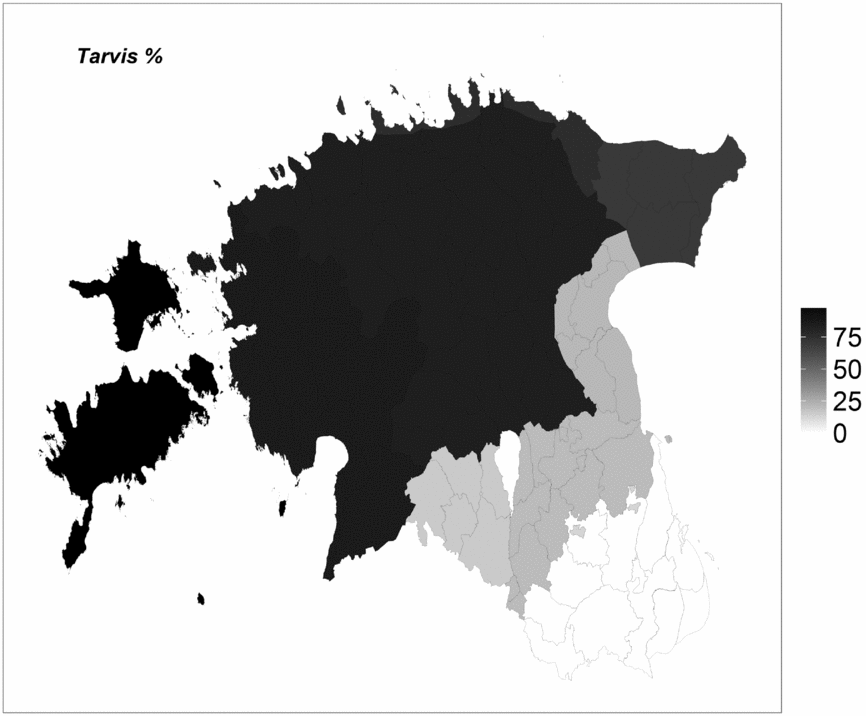
The proportions of tarvis and vaja out of all instances observed. Darker areas indicate a higher proportion of tarvis, lighter ones a preference for vaja.
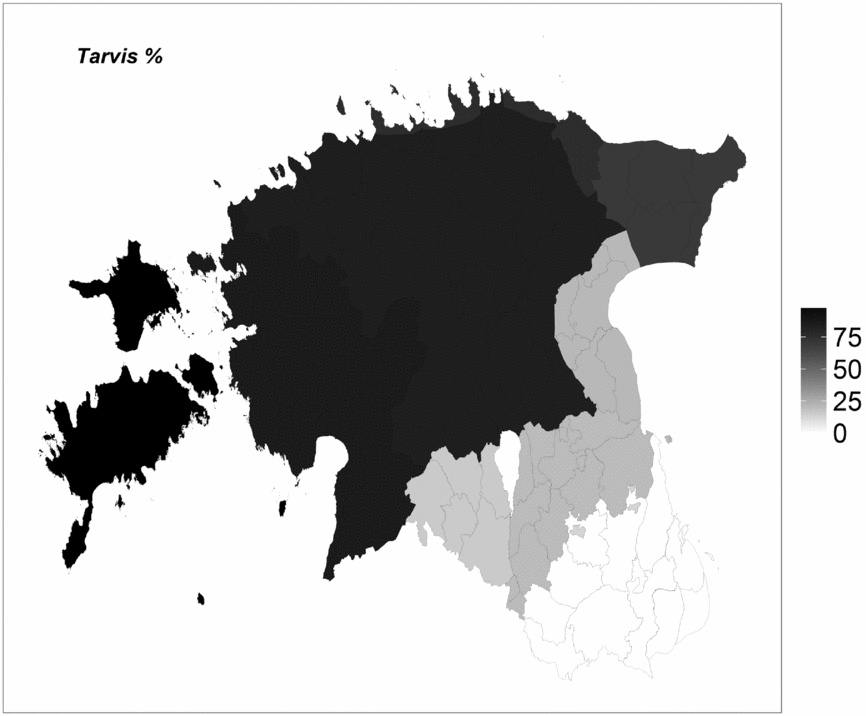
Figure 4 visualizes the proportions of tarvis constructions out of all constructions. The proportions were calculated on the basis of the frequencies of ‘need’-constructions, i.e. how many of these constructions are formed with vaja or tarvis respectively. Darker areas indicate higher proportions of tarvis, lighter areas vice versa: lower proportions of tarvis and thus higher proportions of vaja.
According to Figure 4, the use of tarvis decreases and that of vaja increases from north-west to south-east. South-Estonian dialects mainly (or only, as in Võru and Seto) use vaja, which is also dominant in the Eastern dialect, traditionally classified as belonging to the North-Estonian dialect group. The preference for vaja in the southern and eastern dialects may, on the one hand, be explained by old lexical developments in Southern Balto-Finnic languages, especially in South Estonian and Livonian; on the other hand, its use has probably been influenced by Latvian, which is a close neighbor of the South-Estonian dialects and uses the same stem as a modal verb (vajadzēt ‘need’) in similar functions. Interestingly, the Latvian verb vajadzēt has been found to be a Finnic loanword which was subsequently verbalized (Seržant & Bjarnadóttir Reference Seržant, Bjarnadóttir, Judžentis, Civjan and Zavyalova2014); thus the influence seems to be mutual: Latvian first borrowed the stem from Finnic (either Estonian or Livonian) and verbalized it, while the later Latvian vajadzēt has reinforced the preference for vaja especially in the South Estonian dialects.
In western dialects (Western, Insular, also Mid, appearing as a more homogenous group in the current analyses) the use of tarvis dominates over vaja, being almost the only option in the Insular dialect. Coastal and North-Eastern dialects, on the one hand, show a preference for tarvis; on the other hand, the frequencies indicate that the use of the adverb inclines more to variation.
Merely from observing frequencies, it is evident that lexical item (tarvis/vaja) of the construction varies across dialects and different dialects tend to prefer either one of them. Nevertheless, in most dialects both modal adverbs can occur in the construction. In order to explore how other predictors potentially contribute to the choice between modal adverb and how important these predictors are when it comes to the choosing one of the modal adverbs we applied two methods: recursive partitioning tree and random forests analysis. The first method is better for classifying sub-groups of the predictors whereas the second, random forests, measures the importance of individual variables. Every sub-analysis first presents the results of the recursive partitioning tree followed by the results of random forests analysis.
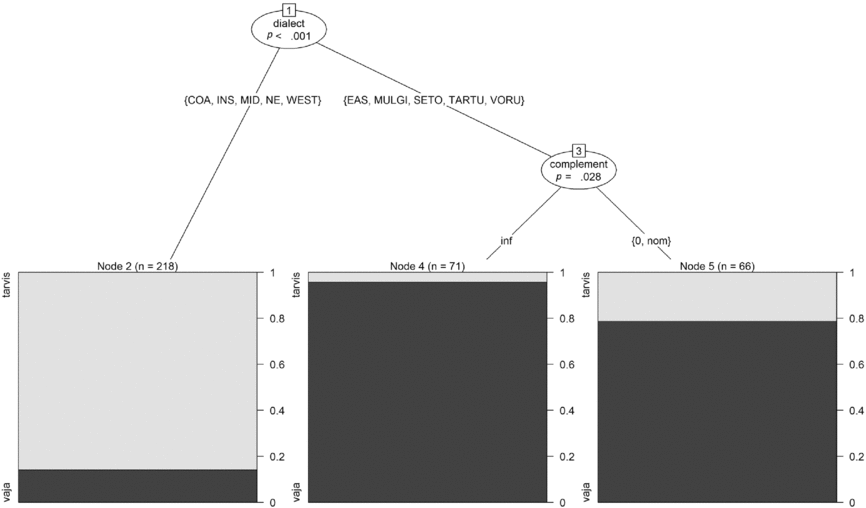
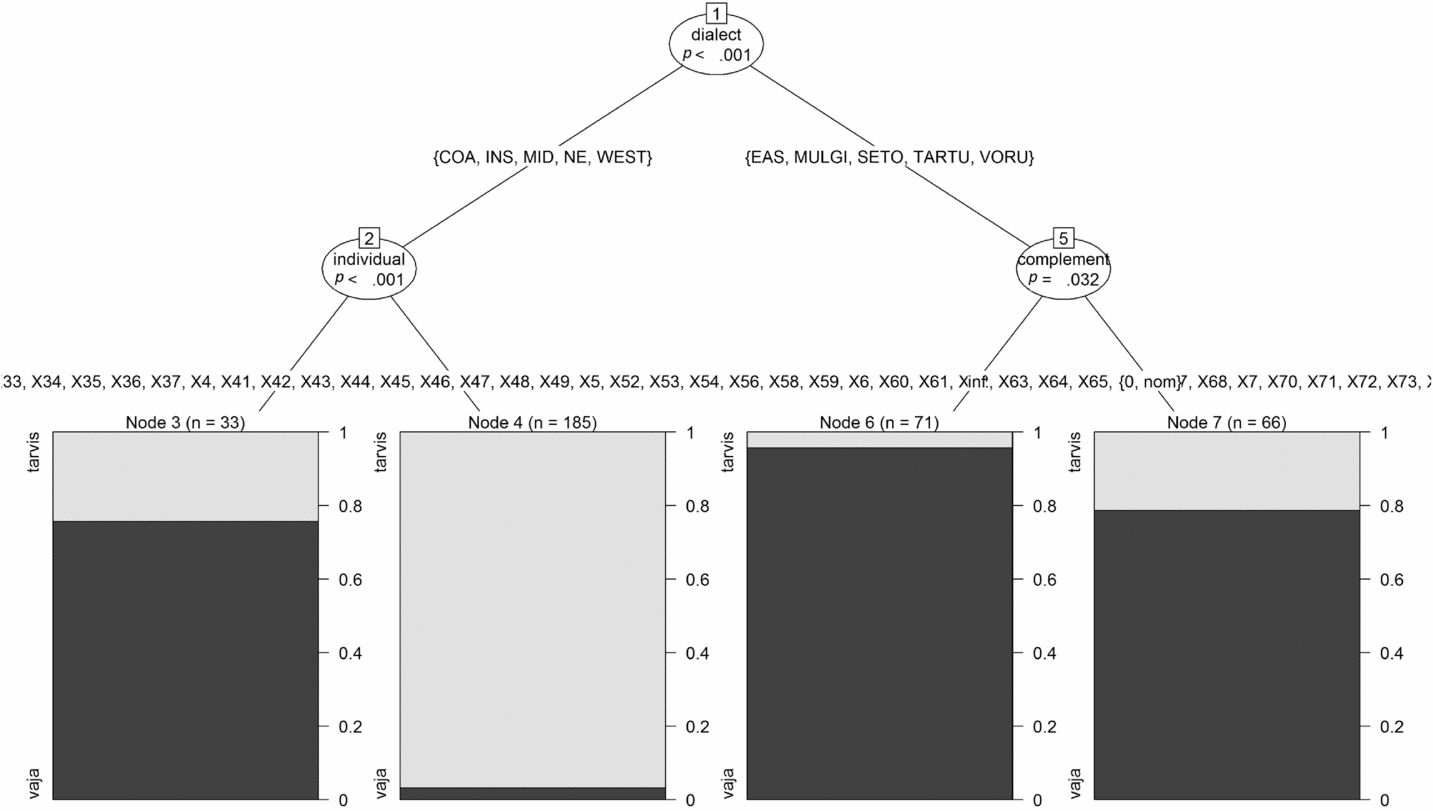
We conducted two different analyses on slightly different datasets: with the individual variable excluded and included. The individual variable is nested with the dialect variable. Our binary dependent variable in the first model is the lexical item (adverb tarvis or vaja); the purpose is to explore which predictors best explain the use of tarvis or vaja. The predictors in the model are dialect, main verb, complement, experiencer case-marking, polarity and tense. Figures 5 and 6 show the recursive partitioning tree results for lexical variation.Footnote 2 The data are split by the predictors which most strongly influence the choice between two lexical items. The first split is the most important one, and the next splits are based on the significance of other predictors. Divisions are made until there are no further significant sub-classifications. As the raw data already suggested, the most powerful explanatory predictor in both analyses is the dialect. Both trees place the Coastal, Insular, Mid, Northeastern and Western dialects in one group (clearly the tarvis group), and the Eastern, Mulgi, Seto, Tartu and Võru dialects in another (the vaja group). The results are very similar; we are clearly not primarily dealing with individual variation.
Recursive partitioning tree (lexical variation between tarvis and vaja) without the individual variable.

Recursive partitioning tree (lexical variation between tarvis and vaja) with individual variable.

Within the vaja group (containing Eastern, Mulgi, Seto, Tartu and Võru dialects), however, a separate split is made on the complement (in both analyses); in other words, the type of complement predicts the choice between tarvis and vaja in this dialect group. If a nominal or zero complement is expressed, tarvis is more likely to be used, while vaja is used more often in infinitival (modal) constructions. Thus Southern and Eastern dialects, where vaja dominates, use it more often as a modal predicate, illustrated in (8).
-
(8)

The second, tarvis group (Coastal, Insular, Mid, Northeastern and Western dialect) also exhibits large inter-individual variation.
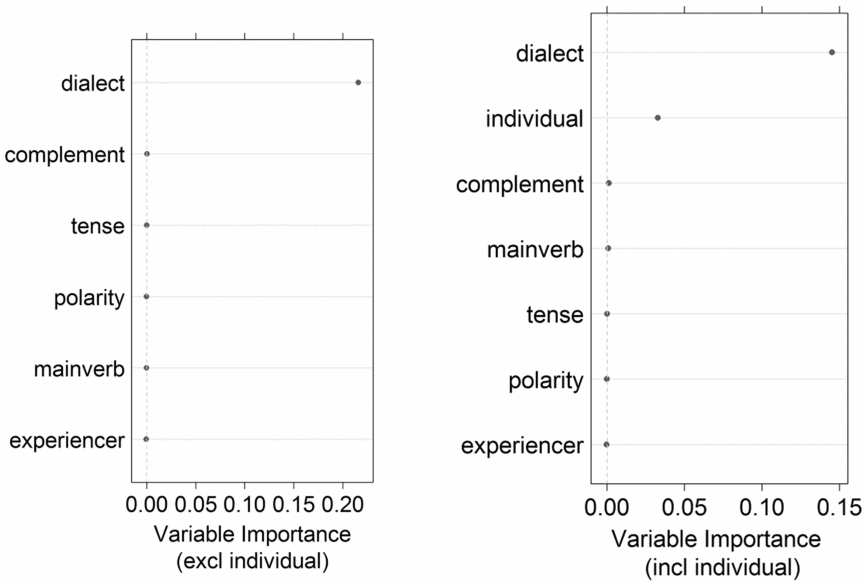
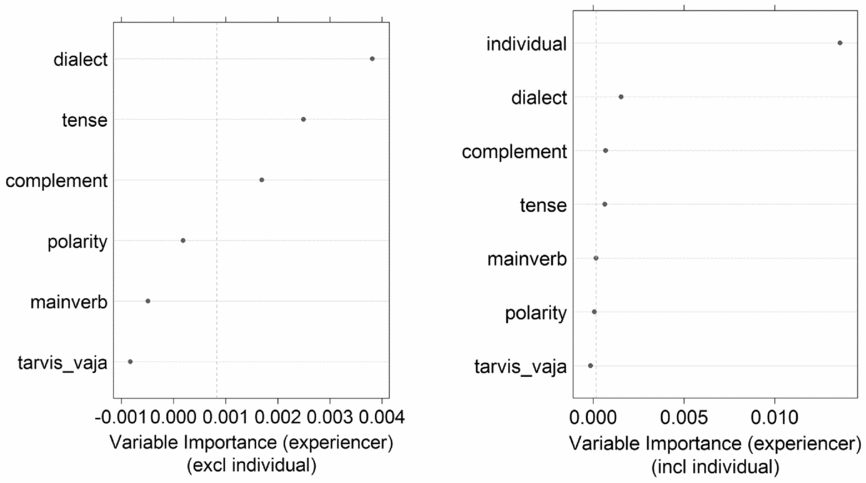
We applied random forests analyses on the same datasets. The left-hand panel in Figure 7 shows the variable importance plot when the individual was excluded from the analysis (C = 0.95),Footnote 3 the right-hand panel when it was included (C = 0.98). The figure illustrates the important variables in both analyses: variables on the right side of the light gray vertical line are important in discriminating between the two responses. Both analyses reveal that dialect is definitely the most important variable in the choice between tarvis or vaja. Surprisingly, in the second analyses the individual is a far less important variable than dialect. This gives a strong indication as to the influence of geography in deciding between tarvis or vaja.
Variable importance (lexical variation between tarvis and vaja).

Thus the distribution of tarvis and vaja is clearly determined by dialect; of the other factors, only complement type has some importance in the recursive partitioning tree models. The South-Estonian dialects (Mulgi, Tartu, Võru, Seto) and the Eastern dialect prefer vaja, while other North-Estonian dialects more often use tarvis.
At this point we can draw one methodological inference, based on the frequency data. Although our corpus sample is relatively small, differences between the dialects are clearly distinguishable and illustrate the features that are more (or less) typical of particular dialects. This is more fine-grained information than that provided by simple dictionary data with distributional statements. For practical reasons, we aggregated over relatively large areas (dialects). Given sufficient sampling data from smaller areas (sub-dialects) to yield frequency-based conclusions, we would very likely see a map with smooth transitions from South-East to North-West.
5.2 Variation in copula use
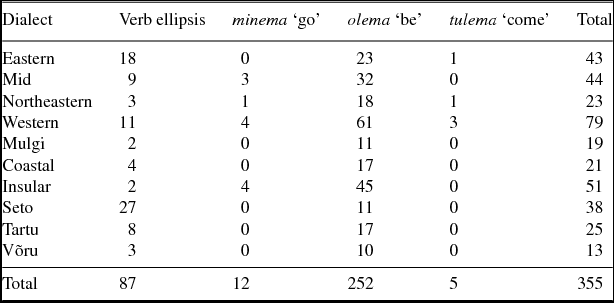
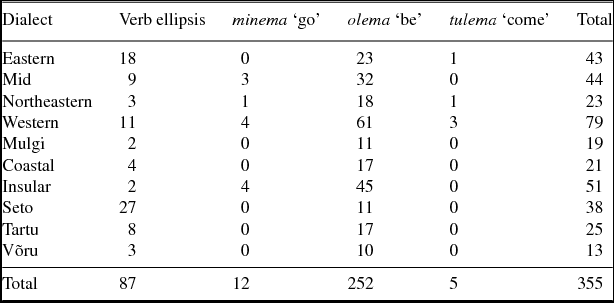
Another highly variable part of the construction across dialects is the copula verb, which is typically olema ‘be’, as in (3) (repeated below), but motion verbs used similarly to the copula tulema ‘come’, as in (9), and minema ‘go’, as in (10), can also appear in this position. Frequencies of copulas and copula ellipsis in different dialects can be observed in Table 2.
Frequencies of copulas and copula ellipsis.
-
(3)

-
(9)

-
(10)

Uses of tulema ‘come’ and minema ‘go’ are infrequent in these constructions and tend to occur mainly with the nominal complement. (Example (10) is exceptional in this respect, as it takes the infinitival complement.) The verb tulema occurred in our data only five times and minema twelve times; thus we cannot say anything conclusive about the geographical distribution of these verbs, but we can report that none of them occurred in South Estonian dialects.
A more interesting picture is revealed when we look at the ellipsis – 0 – of the copula in (11).
-
(11)

Ellipsis of the copula verb is characteristic of Russian, a contact language of Estonian. Hansen (Reference Hansen, Leiss and Abraham2014:104) states that in Russian, the copula is widely omitted in modal constructions with modal adverbs. Kehayov (Reference Kehayov2009:129) has studied many of the contexts where the ellipsis of the copula occurs in Estonian, and found that one such context consists of clauses with tarvis/vaja. He accounts for the ellipsis in terms of Russian influence. Kehayov & Torn-Leesik (Reference Kehayov, Torn-Leesik, Hansen and de Haan2009) also claim that ellipsis of the copula verb with the modal predicates on vaja/tarvis is very common in most of the eastern and southern Balto-Finnic languages (Veps, Karelian, Votic, Livonian), which can again be explained by Russian contacts.
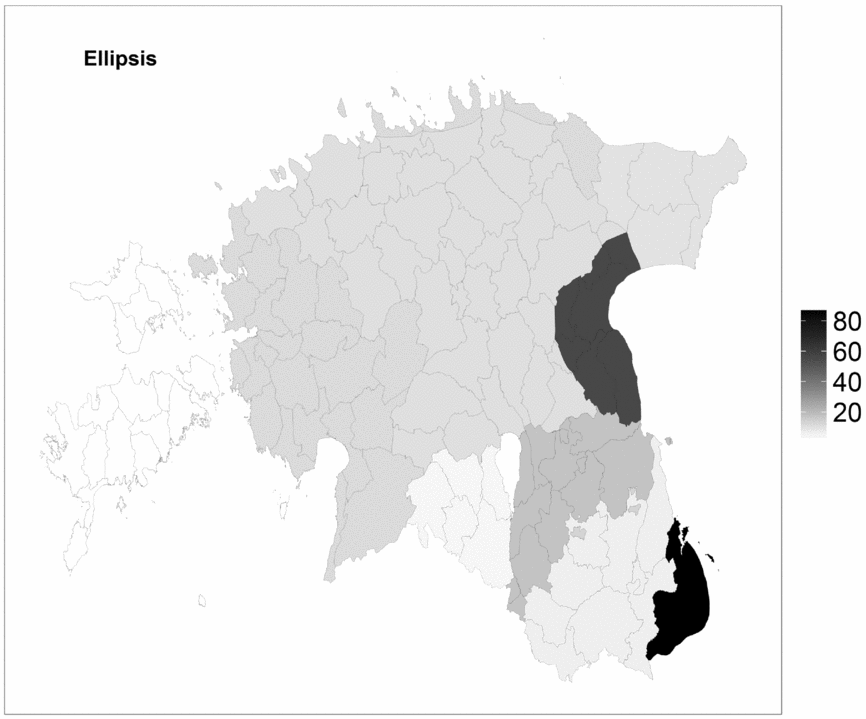
Figure 8 shows the gradience map of verb ellipsis in tarvis/vaja constructions. The frequencies are normalized on the basis of the mean file size in the corpus.
Frequency distribution of ellipsis of the copula.
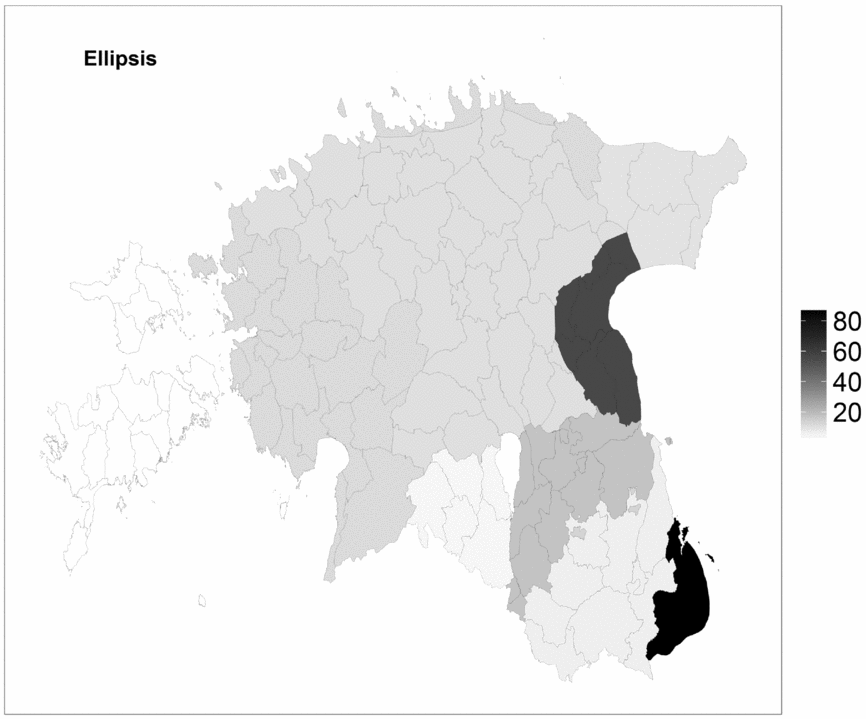
It may be noted that ellipsis of the verb occurs more frequently in the Eastern and Seto dialects, being clearly the most usual pattern in Seto. Thus it can be confirmed that ellipsis is especially common in those dialects that have had long direct contact with Russian. The Seto dialect is spoken on the border between Estonia and Russia, while the Eastern dialect has had long-lasting contact with Russian Old Believers, who have been living on the shore of Lake Peipus since the seventeenth century (Čekmonas Reference Čekmonas, Dahl and Koptjevskaja-Tamm2001). In western dialects, by contrast, ellipsis occurs rarely; for example, in the Insular dialect only about 4% of clauses with tarvis/vaja occur without the copula verb. Our data thus support Kehayov's (Reference Kehayov2009:139) findings: that ellipsis in tarvis/vaja constructions is influenced by the analogous phenomenon in Russian, and that it occurs more often in areas of close contact with Russian.
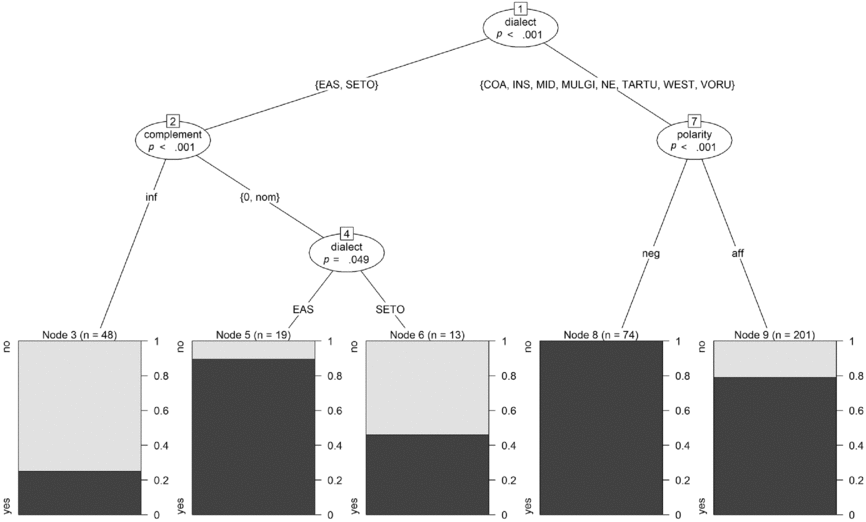
However, the copula is needed for expressing certain grammatical categories; thus there are other factors, such as polarity and tense, which may also affect the occurrence of the copula (Kehayov Reference Kehayov2009:143). In order to investigate which predictors influence the presence or absence of the copula (binary dependent variable in the following two models), we included the following predictors in our tree model: dialect, complement, polarity, tense, case-marking of experiencer argument, case-marking of nominal complement (if present). Figure 9 shows the results of the copula ellipsis analysis without the individual variable.Footnote 4 Analyses with the individual variable included produced the same classification results; thus we do not present the tree here.
Recursive partitioning tree (copula ellipsis) without individual variable.

Both analyses provided very similar results. Predictor dialect was the most important predictor for presence vs. absence of a copula verb. In the group consisting of the Coastal, Insular, Mid, Mulgi, Northeastern, Tartu, Western and Võru dialects, the split is made by the predictor polarity, while tense did not emerge as a statistically significant predictor. Thus ellipsis (0) may also occur in referring to past time, as in (12), where the clause containing the necessive construction occurs in a past context.
-
(12)

In the second dialect group, consisting of the Seto and Eastern dialects, the occurrence of the infinitival complement is a statistically important predictor with regard to verb ellipsis. Interestingly, if the infinitive occurs as a complement, the copula tends to be omitted (as it was also in example (12) from North-Eastern). The copula is more likely to be expressed if the complement is nominal or is omitted.
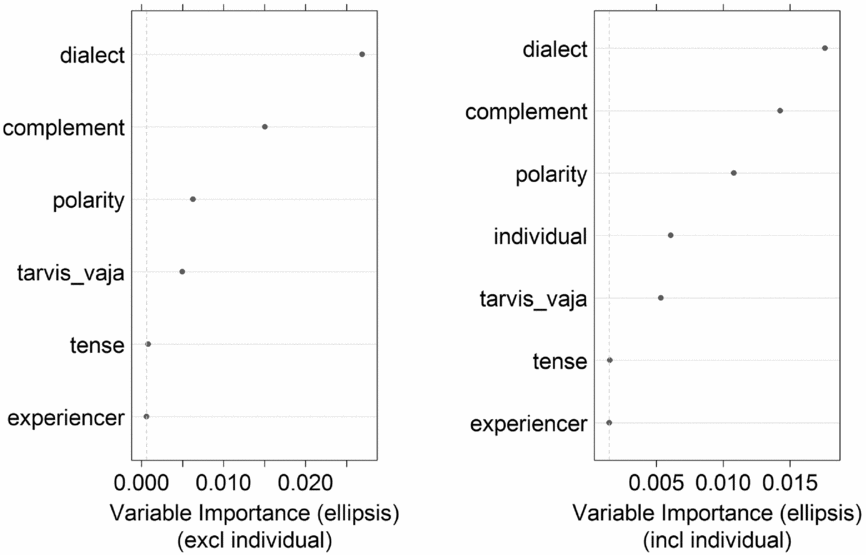
To test the importance of various factors in determining verb ellipsis, we conducted random forests analyses on these two datasets. The results are displayed in Figure 10. Again the first model (left-hand panel) excludes the individual variable (C = 0.90) while the second (right-hand panel) includes (C = 0.95) it. In both models, the most important variable is the dialect, as was also clear from the tree model. But complement type, polarity, and lexical item (tarvis/vaja) also gain importance in both models. The second model (right-hand panel) also reveals some individual variation, but it is the far less important variable, and it is clear that in the constructions observed, copula ellipsis is more strongly driven language-internally.
Variable importance (copula ellipsis).

To conclude this section, ellipsis of the copula verb shows clear dialectal divergence: ellipsis is most common in the Seto and Eastern dialects, which are direct contact areas of Russian. It occurs most rarely in the westernmost part of the region, in the Insular dialect. Within dialect groups, ellipsis is dependent on language-internal factors, such as the occurrence of the infinitival complement (with more frequent copula ellipsis) and polarity (with more frequent use of the copula).
5.3 Expressing the experiencer
The experiencer argument in Estonian ‘need’-constructions is case-marked with either the adessive (13) or the allative (14).
-
(13)

-
(14)

The omission of the experiencer (zero marking) is possible as well. Zero marking includes on the one hand an indefinite ‘zero-person’ (general or indefinite uses): in (15) below, the preceding and following clause contain an impersonal verb form, typically used for indefinite reference (see Torn-Leesik & Vihman Reference Torn-Leesik and Vihman2010); on the other hand, zero anaphora, in which reference is implied by the context in (16). These two zero types, however, are not always clearly distinguishable, and reference resolution emerges from the context. (See also Lindström & Vihman Reference Lindström and Vihman2017.)
-
(15)

-
(16)

Experiencers marked with the adessive or the allative are common in Estonian in various constructions, such as modal constructions with the verb tulema ‘come; have to’ (Penjam Reference Penjam2006) and tarvitsema ‘need’ (Penjam Reference Penjam2011), the so-called possessive perfect construction (see Lindström & Tragel Reference Lindström and Tragel2010), in some experiential constructions, and many others. In these constructions, they share certain subject properties: for instance, they are used clause-initially, they refer to human referents, they are typically pronominal, and they share certain syntactic properties characteristic of prototypical subjects (Keenan Reference Keenan and Lee1976; for Estonian, see Metslang Reference Metslang2013). Thus the experiencer of tarvis/vaja constructions is a subject-like argument, although case-marked differently from the prototypical (nominative) subject. The abundant use of non-nominative, dative-like experiencers in experiential constructions is considered to be a common feature of the Eastern Circum-Baltic languages, including Estonian, Russian and Latvian (Seržant Reference Seržant, Arkadiev, Holvoet and Wiemer2015b). Hansen (Reference Hansen, Leiss and Abraham2014) has drawn similar conclusions concerning modal constructions: a non-canonical marking of subject(-like) arguments in modal constructions is characteristic of the East Slavonic, Baltic and Balto-Finnic languages (see also Kehayov & Torn-Leesik Reference Kehayov, Torn-Leesik, Hansen and de Haan2009), and may thus be an areal feature. He also mentions that non-nominative modal subjects may often be omitted, but that the conditions of the omission in these languages are unclear (Hansen Reference Hansen, Leiss and Abraham2014). Non-nominative marking of modal subjects is found also in Finnish (the experiencer is marked mainly by genitive, but in colloquial speech and dialects also in adessive), and in Finnish, too, they are often omitted (Laitinen Reference Laitinen1992, ISK:Reference Vilkuna, Korhonen, Koivisto, Heinonen and Alho1291).
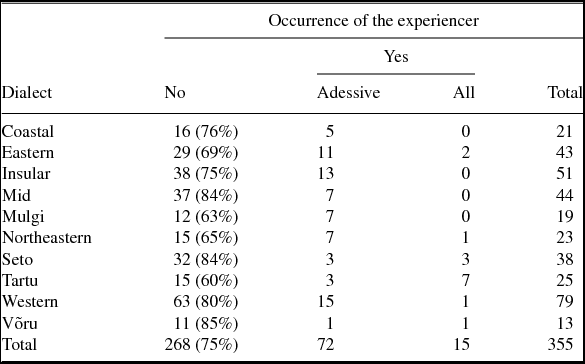
In this section, we examine the constraints on the choice between zero and overt marking of the experiencer. While the question of choice between adessive and allative marking of the experiencer is of interest, we do not analyse it here because the data are insufficient for quantitative analysis. We can only conclude that use of the allative was limited: it occurred 15 times in our data, and mostly in the eastern part of Estonia (see Table 3). Moreover, the use of allative seems to be syntactically restricted: it occurs only with a nominal complement, there was only one exception with an infinitival complement. The use of allative experiencers in eastern dialects can be explained by the influence of Russian: the semantics of dative case in Russian is closer to allative than to adessive as it has some directionality in its meaning, and it is used also for marking the recipient (Janda Reference Janda and Kustova2008), similarly to Estonian allative case. On the other hand, in western dialects the adessive and allative are often collapsed: allative ending –(l)le has been shortened to -(l)l, which is used also for adessive; eastern dialects, on the contrary, have preserved the distinction.
Frequencies of experiencer-marking.
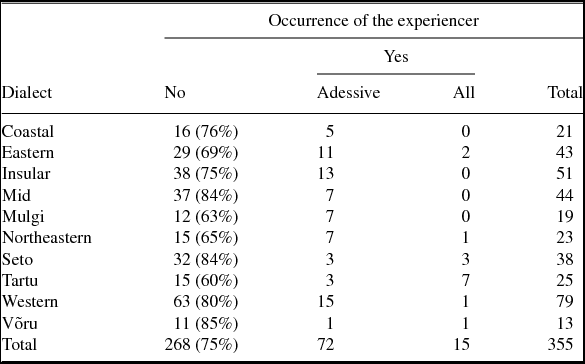
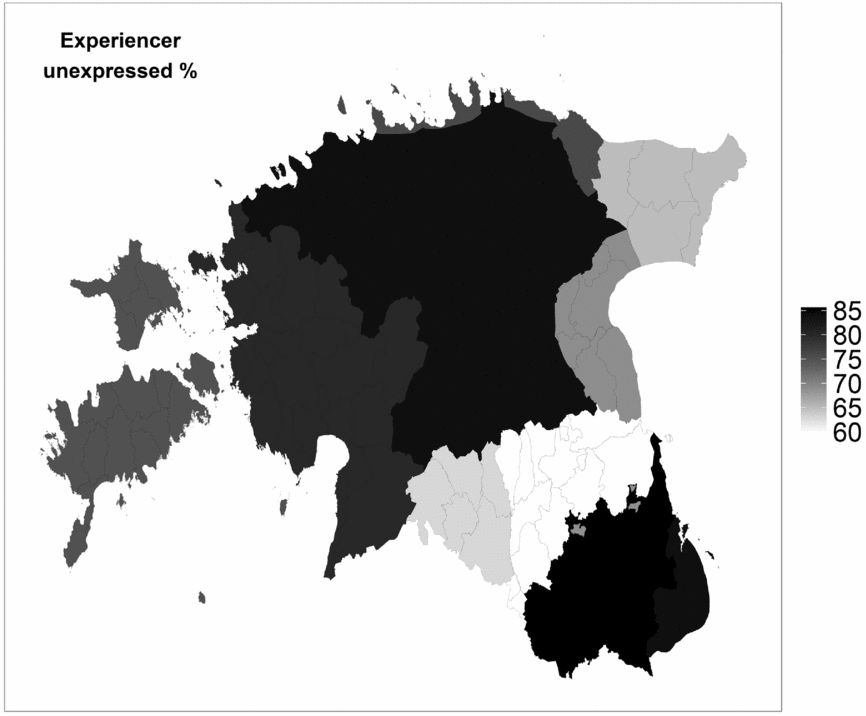
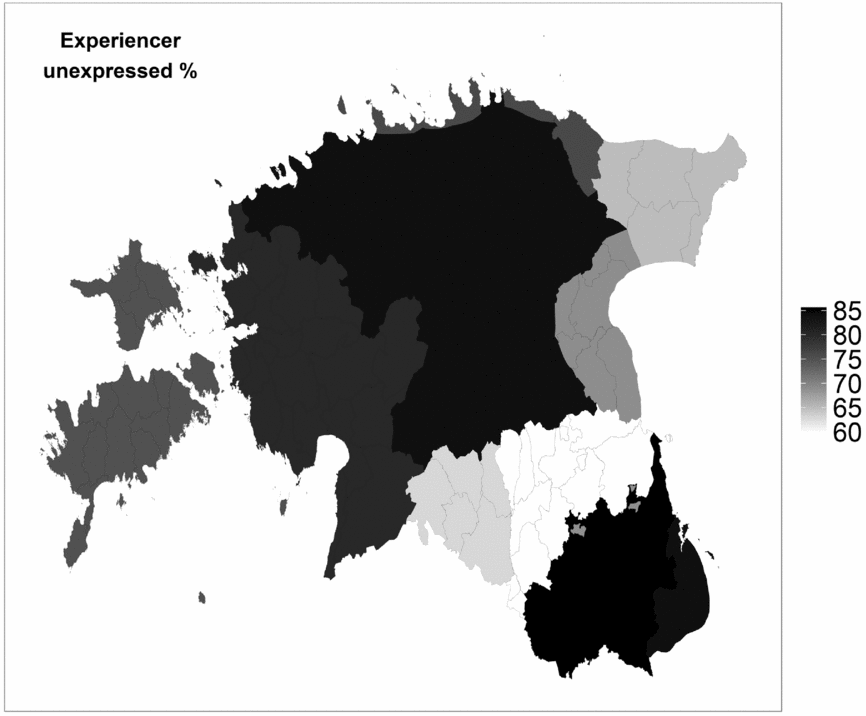
Table 3 shows that the dominating pattern is to omit the experiencer: 268 instances (75%) out of the 355 occur without an explicit experiencer argument. Figure 11 shows this in a visual form: darker areas indicate higher proportions of areas where the experiencer is not expressed.
Proportions of experiencer omission.
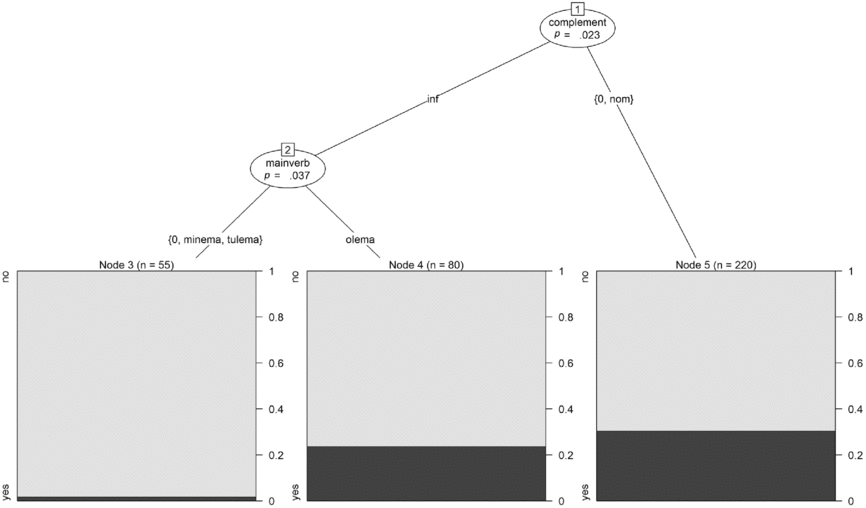
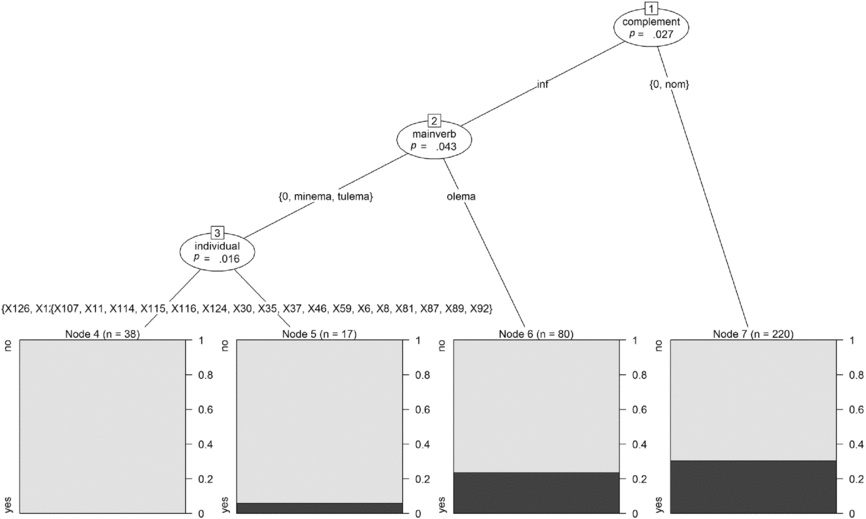
Again we ran two different analyses where our binary dependent variable was the occurrence of the experiencer argument. Figures 12 and 13 show the results of the recursive partitioning tree.Footnote 5
Recursive partitioning tree (experiencer marking) without individual variable.

Recursive partitioning tree (experiencer marking) with individual variable.

Both analyses reveal that dialect is not an important predictor when it comes to experiencer-marking. Most significant are language-internal factors, above all the complement type. When the infinitival complement occurs, the copula (predictor mainverb) emerges as a significant factor; when the copula olema ‘to be’ is present, the experiencer argument is more likely to occur. Thus the presence of the infinitival complement and absence of the copula reduces the probability of overt expression of the experiencer. The importance of the predictor complement indicates that there is a difference between the two main ‘need’-constructions: with the infinitival complement (i.e. in the modal ‘need’-construction, example (17) below, the experiencer is less often overtly expressed than with nominal, seen in (18), and zero complement. The presence or absence of the experiencer is thus syntactically determined.
-
(17)

-
(18)

The results of the random forests analyses are shown in Figure 14. The left-hand panel shows the importance of the variable for the analyses when the individual was excluded (C = 0.83), the right-hand panel shows the results with the individual included (C = 0.96).
Variable importance (marking of the experiencer).

The index of the concordance shows that the second model better explains our data, so we see substantial individual variation. Comparison of the two panels indicates that when the predictor individual is taken into account, all other variables are clearly less important in the model; thus, while complement, dialect and tense play some role in the omission of the experiencer, individual differences determine the expression of the experiencer argument, above all.
In experiencer-marking, the two methods used (recursive partitioning tree and random forest) lead to different results, which at first glance are hard to explain. However, the recursive partitioning tree better reveals the distribution and interactions within the data, while random forests measure the role of each predictor separately; thus we have to take both analyses into account. To sum up: on the one hand syntactic factors (complement type and copula) affect the use of the experiencer, on the other hand there are considerable differences among individuals. Dialect differences seem to be less important than individual ones, as shown in Figure 13 above. Hence, there is no reason to assume that the expression or omission of the experiencer is geographically based, and neither can it be explained by local language contacts. All the dialects show high rates of experiencer omission (60–85%), without clear regional differences. Therefore, we can assume that the omission of the experiencer is an old feature of Estonian and not a late contact-induced phenomenon, although the same is found in Slavic and Baltic languages as well. The rate of omission seems to be related to syntactic factors, but also varies between the individuals.
However, the differences between the results of the two methods may also be a sign that there is something else going on, not taken into account so far. Another study (Lindström & Vihman Reference Lindström and Vihman2017) reveals that in the same constructions in standard Estonian, participant-internal or -external modality has a crucial role, with participant-internal modality clearly increasing the probability of overt expression of the experiencer. In the present study modality is not analysed in detail, so we cannot further elaborate upon the idea of the effect of modality type on experiencer ellipsis in dialects.
6. DISCUSSION AND CONCLUSION
In this paper, we examined two ‘need’-constructions, consisting of the adverb (tarvis/vaja) + nominal/infinitival complement. Although it might seem that we are dealing with relatively idiosyncratic phenomena, these constructions enable us to illuminate the complexity of areal syntactic variation from a number of perspectives. These constructions showed lexical variability (modal adverb tarvis/vaja), construction-internal variability (nominal vs. infinitival complement, copula verb and ellipsis variation, experiencer-marking), and both geographical and individual variation.
Our first analyses (Section 5.1) revealed that the lexical component of the construction has a clear dialectal distribution: tarvis appears more often in the western part of the country, while vaja is clearly characteristic of southern and eastern dialects. Omission of the copula verb is more characteristic of dialects that have had long-lasting contact with Russian. The results of the quantitative analyses indicate that in addition to dialectal differences, language-internal factors play a role as well; in particular complement type and polarity have a considerable impact on copula omission. Interestingly, individual differences are much less important here than in the other analyses, suggesting that omission of the copula is strongly driven by dialectal and language-internal factors.
In marking the experiencer argument, in contrast, the variation seems to be highly individual; individual differences are more important than dialectal ones. Language-internal factors, however, also play an important role, especially complement type: constructions with a nominal complement tend to express the experiencer overtly more often than modal (infinitival) constructions. The analyses also indicated that including the individual variable definitely results in better statistical models and data variability is better explained. Interestingly, the variable individual clearly was not the most important predictor in all our analyses. This confirms that in ‘need’-constructions, individual variation is secondary and the constructions exhibit very strong dialectal variation. Moreover, different components of the constructions are very strongly connected to language-internal factors additionally to dialectal ones.
In this study, we analysed variation in complex constructions investigating each item in the constructions separately. We excluded from the analysis that part of the variation that took place at a more local level (e.g. case-marking of the nominal complement, variation between adessive and allative marking of the experiencer); the scope of the research was limited by the lack of data for quantitative methods due to the small size of the corpus.
The main purpose of the study was to ascertain what part of the variation in these constructions is geographically driven and what is determined by language-internal factors. In ‘need’-constructions, the role of the contact was the most evident in ellipsis of the verb, as the ellipsis occurred clearly more often in Eastern and Seto dialects that have had long and direct contact with Russian. In the choice of modal adverb, the inter-dialectal differences were obvious, but it is not clear whether the preference for vaja is related to specific lexical developments in Southern Balto-Finnic languages in general, or rather a result of mutual influences between South Estonian and Latvian. The role of language contact was the least evident in omission of the experiencer argument: there were no clear dialectal preferences, the omission was usual in all dialects. The experiencer can be omitted also in Finnish, which has had less recent contact with Russian and Latvian, indicating that omission is usual in Balto-Finnic languages, and it is not a contact-induced phenomenon but rather characteristic to all Balto-Finnic (or even Uralic) languages.
The study has provided new insights into areal syntactic variation and has highlighted the complexity of this kind of variation. Not merely the geographical spread of a particular linguistic item or form, but also the individual parts of a complex construction should be kept in mind; their spread and interaction vary both geographically and language-internally.
ABBREVIATIONS
- 1, 2, 3
-
first, second, third person
- ade
-
adessive
- all
-
allative
- app
-
active past participle
- CED
-
Corpus of Estonian Dialects
- cnd
-
conditional
- cng
-
connegative
- dat
-
dative
- f
-
feminine
- ill
-
illative
- imp
-
imperative
- inf
-
infinitive
- ips
-
impersonal voice
- m
-
masculine
- neg
-
negation
- part
-
particle
- pl
-
plural
- ppp
-
past passive participle
- prs
-
present tense
- prt
-
partitive
- pst
-
past tense
- ptcl
-
participle
- sg
-
singular
ACKNOWLEDGEMENTS
This study was supported by the Estonian Research Council (project PUT90 ‘Estonian Dialect syntax’) and by the (European Union) European Regional Development Fund (Centre of Excellence in Estonian Studies). We are grateful to three anonymous reviewers and editors of NJL for useful comments.