Introduction
Dicamba is a synthetic auxin that has been widely used since its discovery in 1958 (Duke and Dayan Reference Duke, Dayan and Moo-Young2011; Richter Reference Richter1958; Shaner Reference Shaner2014) for control of dicotyledonous weed species in corn (Zea mays L.), grain sorghum [Sorghum bicolor (L.) Moench. ssp. bicolor), small grains, pastures, and along roadsides and rights-of-way (Anonymous 2018). More recently, after the introduction of dicamba-resistant crops, in-season use of dicamba has rapidly increased for control of multi-resistant Palmer amaranth (Amaranthus palmeri S. Watson) and waterhemp [Amaranthus tuberculatus (Moq.) Sauer] (Cahoon et al. Reference Cahoon, York, Jordan, Everman, Seagroves, Culpepper and Eure2015; Merchant et al. Reference Merchant, Sosnoskie, Culpepper, Steckel, York, Braxton and Ford2013; Meyer et al. Reference Meyer, Norsworthy, Young, Steckel, Bradley, Johnson, Loux, Davis, Kruger, Bararpour, Ikley, Spaunhorst and Butts2015; Spaunhorst and Bradley Reference Spaunhorst and Bradley2013).
Off-target movement of dicamba to sensitive vegetation, especially soybean [Glycine max (L.) Merr.], has been extensive in recent years (Bradley Reference Bradley and Kruger2017; Dowell Reference Dowell2017; Hager Reference Hager and Kruger2017; Hartzler Reference Hartzler2017). Volatilization, particle drift, and contamination of spraying equipment are the main sources of exposure of sensitive soybean plants to dicamba (Boerboom Reference Boerboom2004). Soybean is extremely sensitive to dicamba, and even low doses of the herbicide can cause strong visible symptoms. A meta-analysis of published research articles reported that injury to soybean was observed at a dicamba rate as low as 0.03 g ae ha−1, and no evaluated dose of dicamba failed to elicit symptoms on soybean (Kniss Reference Kniss2018). The typical symptomology observed on soybean from increasing rates of dicamba is leaf cupping or crinkling, stunted growth, epinasty, stem cracking, necrotic apical meristems, and plant mortality (Griffin et al. Reference Griffin, Bauerle, Stephenson, Miller and Boudreaux2013; Solomon and Bradley Reference Solomon and Bradley2014; Thompson and Egli Reference Thompson and Egli1973).
Soybean growth stage is important when considering potential injury from dicamba (McCown et al. Reference McCown, Barber and Norsworthy2018). Soybean exposed to low-dose dicamba during vegetative stages display injury symptoms within 2 wk (Al-Khatib and Peterson Reference Al-Khatib and Peterson1999); however, damage to late reproductive soybean may be less likely to be reported, as plants often have fewer symptoms once vegetative growth ceases. For instance, researchers reported that soybean treated with 2.18 g ae ha−1 (equivalent to 1/256 of the recommended rate of 560 g ae ha−1) at V4 resulted in 24% injury, while plants treated at R4 and R5 growth stages resulted in 9% and 0% injury at 2 wk after application, respectively (McCown et al. Reference McCown, Barber and Norsworthy2018). The consequences of late-season dicamba exposure to sensitive soybean are slight leaf malformation, abnormally shaped pods, yield reduction, and a negative effect on seed quality and growth of progeny (Auch and Arnold Reference Auch and Arnold1978; Jones et al. Reference Jones, Norsworthy and Barber2019a, Reference Jones, Norsworthy, Barber, Gbur and Kruger2019b; Kelley et al. Reference Kelley, Wax, Hager and Riechers2005; Robinson et al. Reference Robinson, Simpson and Johnson2013; Weidenhamer et al. Reference Weidenhamer, Triplett and Sobotka1989).
Early studies evaluating the effect of dicamba exposure during reproduction reported symptoms in the progeny (Thompson and Egli Reference Thompson and Egli1973). Recent studies reported that simulated drift of dicamba to sensitive soybean at later reproductive stages showed high correlation with occurrence of pod malformation, and more importantly, auxin-like symptomology being exhibited by the offspring soon after emergence (Jones et al. Reference Jones, Norsworthy and Barber2019a). Seeds collected at maturity from this experiment were sent for dicamba content analysis, but the herbicide was not detected, possibly because of the high oil content of the seed (JK Norsworthy, unpublished data). Additionally, Auch and Arnold (Reference Auch and Arnold1978) reported a reduction in seed germination when dicamba was applied at 11 and 56 g ha−1 to parental plants during early pod development. Those authors hypothesized that dicamba accumulated in the seed and was remobilized in germinating seedlings, resulting in reduced emergence. During the pod-filling stage, soybean plants initiate the accumulation of storage products in seed that later supply seedlings with the nutrients required during germination (Nguyen et al. Reference Nguyen, Kisiala, Andreas, Neil Emery and Narine2016). The hypothetical dicamba accumulation may be due to the fact that it is a weak acid (Shaner Reference Shaner2014) that is mobilized by symplastic movement with photo-assimilates to the strongest metabolic sinks, which during reproductive stages are developing pods and seeds (Wardlaw Reference Wardlaw1990). However, no publication to date has documented the presence of dicamba in seed.
According to Sargent (Reference Sargent and Audus1976), dicamba readily enters plant leaves, roots, and stems. The transport of the herbicide across the plasmalemma may occur by passive diffusion as well as by active transport mediated by protein generally functioning in indoleacetic acid transport (Ashton and Crafts Reference Ashton and Crafts1981; Devine et al. Reference Devine, Duke and Fedtke1993). Furthermore, species tolerant to dicamba detoxify the herbicide into nontoxic compounds by hydroxylation to 5-hydroxy-2-methoxy-3-6-dichlorobenzoic acid, demethylation to salicylic acid derivatives, conjugation of dicamba or demethylated and hydroxylated metabolites with glucose, and decarboxylation to unidentified metabolites (Shaner Reference Shaner2014). Dicamba metabolism occurs more rapidly in tolerant species such as grasses than in susceptible broadleaf species (Ashton and Crafts Reference Ashton and Crafts1981; Broadhurst et al. Reference Broadhurst, Montgomery and Freed1966). Chang and Born (Reference Chang and Born1971a) reported that wheat (Triticum aestivum L.) and barley (Hordeum vulgare L.) metabolized 60% and 30%, respectively, of applied radiolabeled dicamba to a nontoxic metabolite at 4 d after application. Conversely, Tartary buckwheat [Fagopyrum tataricum (L.) Gaertn.], a susceptible plant species, showed little ability to metabolize dicamba (Chang and Born Reference Chang and Born1971b).
The objective of this study was to determine whether dicamba is present and in what quantity in soybean seed following exposure at the pod-fill growth stage using radiolabeled chemical. It was hypothesized that the herbicide will translocate and accumulate in soybean seed when the plant is exposed at late reproductive growth stages.
Materials and Methods
The experiment was conducted at the Altheimer Laboratory located at the Arkansas Agricultural Research and Extension Center, University of Arkansas, Fayetteville, AR. Soybean, ‘Fiskeby-III’ (PI 438471; maturity group 00), were planted in round pots of size 30 by 25 cm (diameter by height) (Classic 2000®, NSI Nursery Supplies, Jacksonville, TX) that contained approximately 14,400 cm3 of commercial potting-mix media (Sun Gro® Horticulture, Seba Beach, AB, Canada). This soybean variety was chosen to reduce the vegetative growing time before maturity. Plants (1 pot−1) were grown inside a growth chamber (model CMP 6050, Conviron, Winnipeg, MB, Canada) until the R3 growth stage. Thereafter, they were transferred to the greenhouse and maintained there until the end of the experiment. In both the growth chamber and greenhouse, plants were grown at 25/30 C night/day temperature under a 16-h photoperiod and watered daily and fertilized weekly (Miracle-Gro® Water Soluble All Purpose Plant Food, Marysville, OH). Soybean phenological stages were determined based on Fehr and Caviness (Reference Fehr and Caviness1977). The experiment was conducted twice, with the first run from November of 2017 to January 2018, and the second run from August to October 2018.
[14C]Dicamba Foliar Absorption and Translocation
When plants were at the pod-filling (R5) growth stage, they were treated with dicamba at 2.8 g ae ha−1 (1/200 of the recommended rate of 560 g ha−1) (XtendiMax®, Monsanto, St Louis, MO) plus 0.25% v/v of nonionic surfactant (Induce®, Helena Chemical, Collierville, TN). The application was made using an automated research track sprayer equipped with a boom mounted with two 800067 TeeJet® (Spraying Systems, Wheaton, IL) flat-fan nozzles calibrated to deliver the herbicide solution at 187 L ha−1. Plants were immediately taken to the radiation laboratory where radiolabeled dicamba was applied. [14C]dicamba (3,6-dichloro-2-methoxy-[U-14C]-benzoic acid) with specific activity of 7.65 MBq mg−1 was obtained from Selcia Limited (Ongar, Essex, UK). A radiolabeled solution was made using the [14C]dicamba dissolved in water with 0.25% v/v of NIS. In the laboratory, six 1-µl droplets of the solution containing radiolabeled dicamba (approximately 6.4 kBq per plant) were placed on the adaxial surface of the 4th-uppermost trifoliate leaf (2 droplets on each leaflet). After the radiolabeled treatment dried, the plants were returned to the greenhouse, where they remained until sample collection at 14 and 21 d after treatment (DAT).
To determine the amount of [14C]dicamba absorbed per plant at each collection time, the surface of the treated trifoliate was washed by gently rinsing leaflets in 10 ml of 10% (v/v) ethanol solution, a procedure that was repeated three times. Aliquots of 2 ml were taken from each vial and combined into one scintillation vial (a total of 6 ml of leaf wash) and then mixed with 10 ml of scintillation cocktail (Ultima Gold™, PerkinElmer, Waltham, MA). Quantification was performed by liquid scintillation spectrometry (TRI-CARB 2900TR, Packard Instrument, Downers Grove, IL). The radioactivity quantified by spectrometry was extrapolated to determine the total that would be contained in the 30-ml wash solution.
To determine the amount of [14C]dicamba translocated to plant parts, each soybean was sectioned into treated leaf, seeds at the treated leaf node, roots, pods, seeds, and other aboveground biomass. The seeds produced at the node of the leaf treated were immediately placed in the freezer (−20 C) for later quantification of [14C]dicamba and possible metabolites by reverse-phase high-performance liquid chromatography (HPLC). The remaining tissue were dried at 60 C for 3 d, homogenized using a blender, and later oxidized using a biological oxidizer (OX700, R.J. Harvey Instrument, Tappan, NY). Radioactivity in the oxidized samples was quantified using liquid scintillation spectrometry. No subsamples were taken, as the entire plant was oxidized in this manner, and data for each tissue part were combined.
A qualitative assessment of translocation of [14C]dicamba was also performed by phosphorimaging (Nandula and Vencill Reference Nandula and Vencill2015). This assessment was completed on 2 plants per time point (14 and 21 DAT) on the first run of the experiment. Before imaging, the treated trifoliate was washed as described previously. Roots were gently rinsed with water to remove soil material and dried with paper towels. Plants were mounted on a 28 by 40 cm plain white paper using clear tape, placed between several layers of paper and cardboard, and pressed using a wooden weed press. The samples were dried at 50 C for 48 h. Afterward, mounted plant samples were placed in a 30 by 40 cm exposure cassette (GE Healthcare Bio-Sciences, Piscataway, NJ), and a storage phosphor screen was placed on top of the plant sample. Finally, the storage cassette was tightly closed, and the phosphor screen was exposed to the sample for 48 h. An image of the radioactivity contained in the plant was developed using a phosphorimage scanner (Storm 820, Molecular Dynamics, Sunnyvale, CA).
Qualitative and Quantitative Measurement of [14C]Dicamba in Seed
All seeds from pods collected at the node of the treated leaf (n = 4 treatment−1 run−1) were briefly thawed at room temperature and then ground to a fine powder with a mortar and pestle in liquid nitrogen. The pulverized tissue was transferred to a 2-ml Eppendorf tube and 1 ml of methanol (100% v/v) was added to the tube. The mixture was shaken for 30 min and then centrifuged at 7,600 × g at 4 C for 15 min. The supernatant was pipetted to a new tube and evaporated off in laminar flow hood. When the tube was completely dry, 500 µl of 33% acetonitrile (v/v) solution was added, shaken for 15 min to resuspend the sample, and filtered (0.45 µm polytetrafluoroethylene (PTFE) membrane filter) before analysis.
Radiolabeled parent herbicide and its potential metabolites were separated by gradient HPLC (Prominence i LC-2030C 3D, Shimadzu, Kyoto, Japan). Separation was conducted on a 5-µm C18 (250-mm long by 4.6-mm inner diameter) column (Columbus, Phenomenex, Torrance, CA) heated at 40 C. The radioactivity was detected with an in-line Beta-RAM model 4 (IN/US Systems, Pine Brook, NJ) detector. The solvents used were HPLC-grade acetonitrile with 0.5% (v/v) trifluoroacetic acid (A) and HPLC-grade water containing 0.1% H3PO4 (v/v) (B), and the A:B gradient used was initially 40:60 and changed to 56:44 over a 15-min time frame. These criteria were modified from Grossmann et al. (Reference Grossmann, Caspar, Kwiatkowski and Bowe2002). The flow rate of both HPLC and the scintillant pump of the Beta-RAM detector was 1 ml min−1, and 40 µl of sample was injected using an autosampler. The detector collected the radiochromatography signal using software (Laura v. 4.2.11, LabLogic Systems, Tampa, FL). The software had a tool to integrate the peak areas that are decay-corrected to the elution time of the parent compound. Identification of each sample was based on coelution with the authentic standard, and quantification used the mentioned integrator. The concentration of dicamba found in the seed extract by the HPLC method was included in the total amount recovered in the plant (Table 1). The pods associated with these seeds were oxidized and included in the total radioactivity of the plant.
Average of the total recovery of [14C]dicamba absorbed by the soybean plants and the average recovered on the wash of the treated trifoliate leaf.a

a Recovery was pooled over experimental runs. DAT, days after treatment.
Data Analysis
The experiment was set up as a factorial arrangement of treatments in a completely randomized design with four replications. Factor A was the collection timing of 14 and 21 DAT and factor B was the plant tissue sections (treated trifoliate, root, pods, seeds, and other aboveground biomass). The experiment was conducted twice. Accumulated radioactive results determined in each plant part were converted and expressed as percentage of recovered dicamba. Data were analyzed using JMP Pro v. 14 (SAS Institute Inc., Cary, NC) to determine differences among treatments and interactions between factors. Data were pooled across replications and experimental runs, because these were considered random variables. Appropriate means were separated using Fisher’s protected LSD comparison at α = 0.05 significance level (SAS Institute 2018).
Results and Discussion
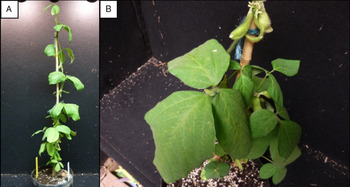
The soybean plants used in this experiment had 8 to 10 nodes at time of collection and did not display severe injury symptoms. Low levels of malformed and some empty pods were observed, generally up to 3% (Figure 1). These observations are consistent with previous research, which reported that 2.18 g ae ha−1 of dicamba resulted in less than 4% injury to soybean at R5 or R6 growth stages (McCown et al. Reference McCown, Barber and Norsworthy2018). The plants collected at 14 DAT were at the R6 growth stage, and at the beginning of maturity at 21 DAT; consequently, fallen leaves were collected and placed in identified bags as necessary to quantify [14C]dicamba.
The pictures are representative of a soybean plant at 14 d after treatment with dicamba at 2.8 g ae ha−1 (1/200 of recommended rate for POST use in dicamba-resistant soybean). (A) The general aspect of a plant that did not display severe visible injury. (B) Detail picture showing the trifoliate treated with radiolabeled solution of dicamba and malformed pod.

[14C]Dicamba Foliar Absorption and Translocation
In this experiment, we were able to recover, on average, 90.6% of the total [14C]dicamba applied. This recovery percentage was within an acceptable range and was comparable to other studies (Nandula and Vencill Reference Nandula and Vencill2015; Petersen et al. Reference Petersen, Haderlie, Hoefer and McAllister1985). The time of collection (14 and 21 DAT) did not affect the amount of [14C]dicamba absorbed by the plants (P = 0.5174). The average absorption was 86% and 88% of the total [14C]dicamba applied for samples collected at 14 and 21 DAT, respectively (Table 1). Petersen et al. (Reference Petersen, Haderlie, Hoefer and McAllister1985) investigated the influence of formulation type in the absorption of dicamba and reported that V1 soybean plants absorbed 85% of dimethylamine salt of dicamba after 60 h.
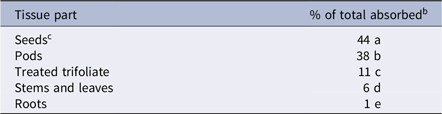
The amount of [14C]dicamba translocated to plant parts was significant (P ≤ 0.0001), but the interaction between collection timing by plant tissue was not (P = 0.8592). The majority of [14C]dicamba was translocated to seeds and pods and accumulated 44% and 38% of the total absorbed dicamba, respectively (Table 2). Additionally, 11% of [14C]dicamba was absorbed in the treated trifoliate, 6% in stems and other leaves, and the roots accumulated 1% of the absorbed radioactive herbicide. These results were expected, because during reproductive stages, plants distribute photosynthates toward the main sinks, in this case pods and seeds (Nguyen et al. Reference Nguyen, Kisiala, Andreas, Neil Emery and Narine2016). This transport would mobilize the herbicide absorbed in the foliage to pods and seeds.
Amount and partitioning of average [14C]dicamba recovered from soybean plants treated at the pod-filling stage.a

a Determined by combustion. 90.6% of the total [14C]dicamba applied was recovered.
b Means followed by the same letter are not significantly different based on Fisher’s protected LSD (α = 0.05).
c Determined by combustion and high-performance liquid chromatography.
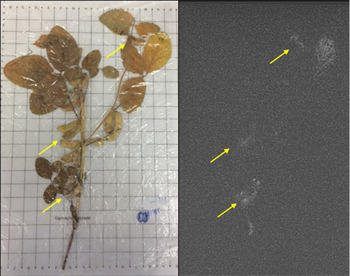
The phosphorimaging technique allows a qualitative analysis of uptake and translocation studies (Nandula and Vencill Reference Nandula and Vencill2015). It produces images that contain different coloration (signal intensity) that provides a visual result of absorption and translocation of radiolabeled pesticides. Our phosphorimage results corroborate the results obtained in the quantitative herbicide translocation experiment. Plants show accumulation of dicamba inside the pods (which included seeds) more than other parts of the plant. Figure 2 contains a phosphorimage collected at 14 DAT, with yellow arrows pointing to the bright white locations where there is accumulation of radiolabeled material in seeds and pods.
Distribution of dicamba in soybean and accumulation into pods (marked by yellow arrows in both pictures) at 21 d after application of [14C]dicamba. Plant is on the left, phosphorimage on the right.

Based on its physiochemical properties, dicamba effectively translocates from source to sink tissue similarly to how plants transport photosynthates. Soybean at the R5 growth stage are allocating all photosynthates in developing seeds and growing pods. Our results showed that seeds accumulated most of the total [14C]dicamba absorbed. The translocation of dicamba to seeds and pods was attributed to its acid dissociation constant (pKa of 1.87), where at biological pH levels it acts as a weak acid and sustains phloem mobility via ion trapping (Shaner Reference Shaner2014). This process may also explain why the roots accumulated the least amount of radioactivity. The radiolabeled compound was foliar applied on the 4th-uppermost trifoliate leaf of the plant, and root growth was likely minimal at later stages of reproductive development. Hence, it was not a strong sink for the phloem-mobile dicamba.
Researchers who used simulated drift rates applied to soybean plants at the R5 growth stage observed that seedlings produced by these plants had reduced germination the following year, as well as seedlings that exhibited auxin-like symptoms most likely attributable to the accumulation of dicamba at phytotoxic levels in the seeds (Jones et al. Reference Jones, Norsworthy and Barber2019a). Wax et al. (Reference Wax, Knuth and Slife1969) reported that soybean seeds collected from plants treated at flowering had restricted development. Thompson and Egli (Reference Thompson and Egli1973) also reported that low rates of dicamba resulted in reduced germination and emergence and caused malformation of the first trifoliate leaves in the progeny. These results can be attributed to the translocation of dicamba into the strong sinks (pods and seeds) in the plant. Chang and Born (Reference Chang and Born1971b) documented the accumulation of dicamba in young leaves and root tips of young seedlings of Tartary buckwheat.
Previous research has shown that translocation of dicamba is slower in tolerant species than in susceptible ones. Grossmann et al. (Reference Grossmann, Caspar, Kwiatkowski and Bowe2002) reported that translocation of dicamba beyond the treated leaf was 18% for the more tolerant catchweed bedstraw (Galium aparine L.) and 43% for the more sensitive redroot pigweed (Amaranthus retroflexus L.). Chang and Born (Reference Chang and Born1971a, Reference Chang and Born1971b) also reported that translocation of dicamba was slower in tolerant wheat and barley than in Tartary buckwheat and wild mustard (Sinapis arvensis L.).
[14C]Dicamba Metabolism
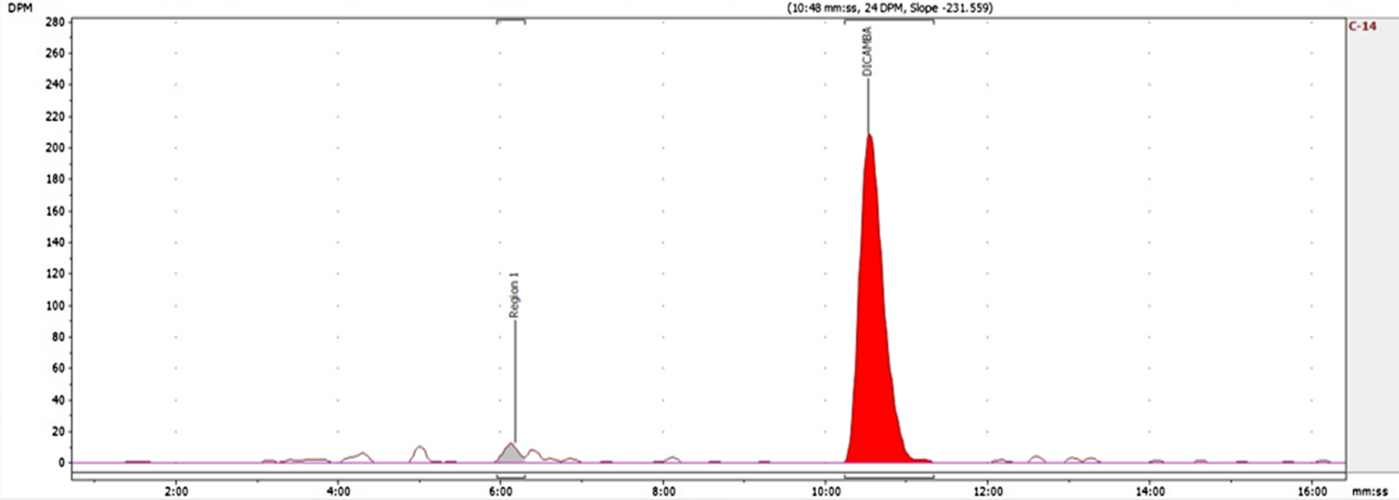
Surprisingly, our results showed that nearly 100% of the radioactive compound detected in seeds collected at 14 and 21 DAT was found in the parent form ([14C]dicamba retention time was 10.5 min) (Table 3). The average amount of [14C]dicamba detected from the extraction was 8.5 Bq for the seeds collected at 14 DAT, and 8.6 Bq for seeds collected at 21 DAT (data not shown). Only one of the total 16 samples analyzed produced a metabolite of dicamba. This would indicate the low capability of metabolism in developing seed tissue. A seed sample collected at 21 DAT had a metabolite that accounted for 4% of the total radioactivity (Figure 3), and its retention time was 6.1 min. Identification of the metabolite was not achieved, because we did not obtain analytical standards of the metabolites for comparison. Previous research reported that the hydroxylated metabolite of dicamba eluted 5 min before the elution of the free dicamba acid during chromatography (Cranston et al. Reference Cranston, Kern, Hackett, Miller, Maxwell and Dyer2001; Grossmann et al. Reference Grossmann, Caspar, Kwiatkowski and Bowe2002). Therefore, it is probable that the metabolite detected was 5-hydroxy-dicamba.
Characterization of radioactivity from seeds of [14C]dicamba-treated soybean plants after 14 and 21 d after treatment (DAT).a

a Determined by reverse-phase high-performance liquid chromatography.
A chromatograph of [14C]dicamba (parent molecule; peak marked in red) and a metabolite (peak marked in gray), possibly 5-hydroxy-dicamba, extracted from seeds of a soybean plant collected at 21 d after treatment.

A report was released by the European Food Security Authority (EFSA 2013) following the identification of 3,6-dichlororosalicylic (DCSA) metabolite present on dicamba-resistant soybean. According to this report, dicamba or other metabolites were not found in the samples tested. Current regulations allow a maximum residue limit (MRL) for dicamba of 0.05 mg kg−1 on conventional soybean, and EFSA recommended an MRL for DCSA should be set at 0.4 mg kg−1 after this finding. However, a risk assessment deemed the use of dicamba on dicamba-resistant soybean to be low toxicity and not likely to expose consumers to health risks.
Dicamba selectivity and metabolism differ by plant species. Chang and Born (Reference Chang and Born1971a) reported that the rate of metabolism of dicamba by the susceptible Tartary buckwheat was only 10% of the absorbed after 20 d; however, wheat detoxified 50% of dicamba absorbed after 1 d. In addition, previous studies have shown significant metabolism of dicamba even by susceptible species when plants are exposed to sublethal doses at vegetative growth stages (Chang and Born Reference Chang and Born1971a, Reference Chang and Born1971b; Cranston et al. Reference Cranston, Kern, Hackett, Miller, Maxwell and Dyer2001; Grossmann et al. Reference Grossmann, Caspar, Kwiatkowski and Bowe2002). Our results showed that soybean seeds do not appreciably metabolize the herbicide. This could be a function of the lower enzymatic activity of developing seeds. However, more research is needed to evaluate the herbicide metabolism in developing tissue such as seeds.
Our findings support the initial hypothesis that dicamba could be translocated and accumulated in the seed and remained in the herbicidal active parent form, even when parent plants failed to exhibit severe injury symptoms. The subsequent dicamba symptomology on progeny as observed in other research following off-target movement of the herbicide and exposure to soybean in reproductive development is not surprising (Jones et al. Reference Jones, Norsworthy and Barber2019a). According to our findings, 44% of the [14C]dicamba absorbed was recovered in the seeds produced by the plant, and in almost all samples tested, 100% of the radioactivity was in the phytotoxic form of the parent dicamba acid, which could potentially cause negative effects on the progeny. In conclusion, precautions should be made to avoid dicamba exposure over sensitive soybean fields, especially those dedicated to seed production, as this may result in low seed quality.
Acknowledgments
This research received no specific grant from any funding agency. No conflicts of interest have been declared.