In Standard Modern Spanish, attributive possession is expressed either by prenominal morphophonologically weak possessives, as in (1), or by postnominal strong possessives, as in (2) (cf. Real Academia Española, 1973:§2.5.7d). Spanish thus shows a “mixed” behavior and falls in between languages with determiner-like possessives, such as English and French, and languages with adjectival possessives, such as Italian and Portuguese. Lyons (Reference Lyons1985, Reference Lyons1986:139–140) classified languages of the English type as determiner-genitive languages and those of the Italian type as adjectival-genitive languages. According to Giorgi and Longobardi (Reference Giorgi and Longobardi1991:160), this difference is cross-linguistically parameterized.
-
(1) Salimos con mi hermana (poss+N) más grande a avisarle a los familiares … (GUA026)Footnote 1
‘We went out with my older sister to notify the family …’
-
(2) La revista mía (Def+N+POSS) o la de mi grupo fue mi revista. (GUA074)
‘The magazine of mine or that of my group was my magazine.’
Contrary to Modern Spanish, medieval Spanish permitted the co-occurrence of an article and a possessive, as reported by Company Company (Reference Company Company and Company Company2009:762, example (3a)):
-
(3)
-
a. Caualgad, Mynaya, el myo diestro braço (Def+POSS+N) (Cid, 753)Footnote 2
‘Ride, Minaya, the my right hand.’
-
b. solaz de la mi vegez, un mio heredero (Indef+POSS+N) solo (Alfonso, Reference Pidal1955, CG 555.48a)Footnote 3
‘solace of my age, a my sole heir’
-
According to Alexiadou (Reference Alexiadou, Fuß and Trips2004), building on Cardinaletti (Reference Cardinaletti, Alexiadou and Wilder1998), possessives grammaticalize from morphophonologically strong elements generated in Spec,nP into weak adjectives in Spec,AgrP and finally into clitic determiners in D°. Transferring this model to Spanish, it appears that Modern Standard Spanish has lost prenominal weak possessives in Spec,AgrP, as in (3). It has maintained postnominal strong possessives, as in (2), and prenominal clitic possessives in D°, as in (1).
Yet, some Central American varieties of Spanish, in particular those spoken in and around Guatemala, show co-occurrence of prenominal possessives with articles, demonstratives, or quantifiers, as is illustrated in the examples in (4).
-
(4)
-
a. … y llegó él y la mi madrastra (Def+Poss+N) y me dijo … (GUA011)
‘… and he and the my stepmother arrived and he said to me …’Footnote 4
-
b. Un hermano de mi esposa está casado con una mi hermana (Indef+Poss+N). (GUA080)
‘A brother of my wife is married to a my sister.’
-
c. … y sólo ese mi cuatazo (Dem+Poss+N) y- y yo nos quedamos … (GUA008)
‘… and only this my pal and I, we stayed …’
-
d. … y ahora el otro mi hermano (Def+Adj+Poss+N) vive como a unas cinco cuadras de allí. (GU019)
‘… and now the other my brother is living about five blocks from there.’
-
This construction has come to be known as the pleonastic possessive (Martin, Reference Martin and England1978, Reference Martin1985:383; Sandoval, Reference Sandoval1941:87), as it redundantly marks a possessive relationship where this can already be inferred from the context or the semantics and grammatical person of the verb.
The data in (4) might suggest that the respective varieties have retained prenominal weak possessive adjectives, perhaps as a relic of medieval Spanish (Elsig, Reference Elsig, Aboh, Schaeffer and Sleeman2015). The present paper challenges this assumption by investigating the contextual distribution of the prenominal possessive. For this purpose, sociolinguistic interview data are analyzed stemming from the Guatemalan part of the Project for the Sociolinguistic Study of Spanish for Spain and America (PRESEEA) (Moreno Fernández, Reference Moreno Fernández2005, Reference Moreno Fernández, Mancera, Martos and García2006; PRESEEA, 2014–2017; Verdugo de Lima, Palma Chacón, Fong de Rivera, & Acevedo-Halvick, Reference Verdugo de Lima, Chacón, María, de Rivera, Mayra and Acevedo-Halvick2007). The results suggest that, contrary to first expectations, the prenominal possessive appears to have the same morphosyntactic status in constructions with and without an article. I will argue that in both contexts, the possessive is a fully grammaticalized D° element and, as such, an expression of definiteness.Footnote 5 The possessive is used to make the referent of the noun familiar or identifiable to the hearer by establishing a thematic link between possessor and possessee, the former being identifiable in the discourse (Benveniste, Reference Benveniste and Benveniste1966:172–178; Coseriu, Reference Coseriu and Coseriu1955/1973:301; Costa Olid, Reference Costa Olid1981:28; Lapesa, Reference Lapesa1973/1977:22; all cited in Huerta Flores, Reference Huerta Flores and Company Company2009:622; cf. Lyons, Reference Lyons1999:2–7). The indefinite article, however, shows properties of a less grammaticalized item. It continues to express quantitative force and to have a presentative function, signaling both noteworthiness and thematic persistence of the possessee.
The paper is structured as follows. The next section reports results from previous studies on the pleonastic possessive. Thereafter, the grammaticalization clines of the indefinite article and the possessive are presented and discussed.Footnote 6 I will continue with an investigation of the possessive and indefinite article in the pleonastic possessive (Indef+Poss+N) in Guatemalan Spanish. Arguments will be presented in favor of a generalized determiner status of the prenominal possessive, and I will show that the indefinite article, on the other hand, still has important properties of a quantifier. The final section concludes that, in Indef+Poss+N constructions in Guatemalan Spanish, the indefinite article and the possessive pronoun do not compete for the same structural position, but that the former continues as a discourse-pragmatic marker in Spec,DP while the latter has grammaticalized into an exponent of definiteness in D°.
PREVIOUS RESEARCH ON THE PLEONASTIC POSSESSIVE
The pleonastic possessive in Guatemalan Spanish is largely confined to the indefinite article (Indef+Poss+N). This construction has a diachronic precursor in medieval Spanish where definite and, to a lesser extent, indefinite articles, as well as demonstratives, numerals, indefinite adjectives, and quantifiers could precede the prenominal possessive. In her diachronic survey of article-possessor combinations in Spanish, Company Company (Reference Company Company and Company Company2009:842–845) noted that in Old Spanish, indefinite articles represent only a tenth of these constructions as opposed to the definite article. In contemporary Central American varieties of Spanish, the use of Indef+Poss+N has increased twentyfold as compared to Old Spanish while its Def+Poss+N counterpart has almost disappeared. Considering the fact that Mayan languages have a parallel construction, as illustrated by jun in-tohn ‘a my necklace’ (Chujean; Buenrostro Reference Buenrostro, Pérez and Jiménez1998) and xusi paaj jun nu-xajab ‘He delivered a my shoe’ (Quichean; Pato Maldonado, Reference Pato Maldonado, Palacios and García2002; both cited in Company Company, Reference Company Company and Company Company2009:845), Company Company (Reference Company Company and Company Company2009) considered Mayan influence as a potential factor in the expansion of Indef+Poss+N (see also Martin, Reference Martin and England1978, Reference Martin1985). However, the diachronically continuous presence of this construction in the Corpus Diacrónico del Español ‘Diachronic Corpus of Spanish’ made her cautious in this regard. She interpreted it rather as a retention (“una pervivencia de la construcción a lo largo de la historia del español” ‘a persistence of the construction througout the history of Spanish’; ibid.:844) that has been reactivated and promoted by language contact with Mayan (see also Enrique-Arias [Reference Enrique-Arias, Breitbarth, Lucas, Watts and Willis2010] for a comparable case in Majorcan Spanish, and de Granda [Reference de Granda, Platero and Velarde2002] for morphosyntactic retentions in Argentinian Spanish).Footnote 7
Historically, the possessive could occur in its morphophonologically strong or weak forms in article-possessor combinations (Company Company, Reference Company Company and Company Company2009:762; Martin, Reference Martin and England1978:111), while in modern days, the relatively few remnants are largely confined to weak possessives.Footnote 8 According to Company Company (Reference Company Company and Company Company2009:784), the variation between prenominal possessives with an article (Indef/Def+Poss+N) and without it (poss+N) as well as the prevalence of the latter already in the Middle Ages led to the eventual decline and almost loss of article-possessor combinations in the 16th century. It is notable that it is the former minority variant Indef+Poss+N that has survived into modern Guatemalan Spanish rather than its definite counterpart Def+Poss+N (Company Company, Reference Company Company and Company Company2009:775).Footnote 9
As concerns Indef+Poss+N in Old Spanish, several authors report that it originally had partitive force (Kany, Reference Kany1963:43; Palacios Alcaine Reference Palacios Alcaine2004:189), which, according to Pato Maldonado (Reference Pato Maldonado, Palacios and García2002:144–145), it continues to have in modern Guatemalan Spanish. Over time, it became associated with new discourse-pragmatic functions. While Sandoval (Reference Sandoval1941:87) considered its use as purely pleonastic, Company Company (Reference Company Company2005:149) objected that it emphasizes the importance of the possessee to the possessor (see also Rosemeyer & Enrique-Arias, Reference Rosemeyer and Enrique-Arias2016). Pato Maldonado (Reference Pato Maldonado, Palacios and García2002) added that Indef+Poss+N signals high informational relevance, referring to habitual, permanent, or inalienable objects of personal possession, to essential parts, or belongings of the possessor that are crucial for his or her well-being. Nieuwenhuijsen (Reference Nieuwenhuijsen2007:336–337) added body parts, food and beverages, pieces of clothing, objects of habitual possession, kinship terms, and rather abstract items related to the character or the soul to this list. Palacios Alcaine (Reference Palacios Alcaine2004) stated that the pleonastic possessive has undergone four evolutionary stages, extending from a partitive marker over a marker of habitual and iterative meaning to that of an intensifier, before ultimately marking items of high relevance and importance to the possessor. Napoli (Reference Napoli2013), in her study on Indef+Poss+N in Old Italian, observed a similar effect and ascribed it to the indefinite article. According to her, it is a marker of discourse prominence and noteworthiness that also ensures topic continuity and thematic persistence of the possessee. In the same vein, Company Company (Reference Company Company and Company Company2009:856, 858) mentioned thematic persistence as the main function of the pleonastic possessive and attributed it to the grammaticalization of the indefinite article. As a consequence, external referential meanings, such as its partitive function or the predominant human reference of the possessee in Old Spanish (Company Company, Reference Company Company and Company Company2009:144–145), have progressively bleached out and been replaced by functions relating to discourse coherence.
Considering the fact that only indefinite articles and adjectives as well as demonstratives can precede the prenominal possessive in Central American Spanish, the question of their morphosyntactic status arises. The co-occurrence of article and possessor suggests that either of them is not a D° element.
GRAMMATICALIZATION CLINES
The possessive pronoun
Latin had possessive adjectives that were fully inflected for case, number, and gender endings and that could also be used pronominally (Penny, Reference Penny2002:139–143). The contemporary Romance languages have reached distinct stages on their grammaticalization clines. In Italian, Catalan, and Portuguese, the possessive has an adjectival status (Kupisch & Rinke, Reference Kupisch, Rinke and Siemund2011; Pérez Saldanya, Reference Pérez Saldanya and Cufí2009). Apart from strong pronominal forms, French has clitic prenominal possessors (Alexiadou, Reference Alexiadou, Fuß and Trips2004; Zribi-Hertz, Reference Zribi-Hertz1999) that occur in complementary distribution with the article and are hence considered to be determiners.
Spanish has two paradigms of possessive pronouns: a morphologically strong one exhibiting number and gender agreement with the possessee (e.g., el/los libro(s) mío(s) ‘the book(s) of mine’, la(s) carta(s) mía(s) ‘the letter(s) of mine’), and a morphologically weak one showing only number agreement (e.g., mi(s) libro(s)/carta(s) ‘my book(s)/letter(s)’) and occurring only in prenominal position. In Standard Spanish, weak possessives are mutually exclusive with the article and hence classified as determiners (Company Company, Reference Company Company and Company Company2009:774). With their rich inflectional gender and number agreement, strong possessives have all the properties of adjectival elements.
The different parts of speech of the possessive are related to each other as steps on a grammaticalization cline. Building on Cardinaletti (Reference Cardinaletti, Alexiadou and Wilder1998), Alexiadou (Reference Alexiadou, Fuß and Trips2004) stated that strong possessive adjectives are at the outset of grammaticalization, followed by weak adjectival possessives, which ultimately turn into clitic determiners (see also van Peteghem, Reference van Peteghem2012:623). Alexiadou (Reference Alexiadou, Fuß and Trips2004:34) adopted a hierarchical structure of the DP in which an agreement phrase precedes a number phrase, see (5).Footnote 10
-
(5) [DP [D’ poss [FP1=Agr Poss [Agr’ Agr° [FP2=Numb [nP POSS [n’ n° [NP]]]]]]]]
In this hierarchical structure, possessives are base-generated in Spec,nP, similar to sentential subjects, which are generated in the verbal shell (cf. Alexiadou, Haegeman, & Stavrou, Reference Alexiadou, Haegeman and Stavrou2007:556–560). This is also the position of strong adjectival possessives, indicated as POSS in (5). Weak adjectival possessives (Poss) are located in Spec,AgrP and clitic possessive determiners (poss) in the head position D° where they compete with the article (see also Alexiadou et al., Reference Alexiadou, Haegeman and Stavrou2007:575; Cardinaletti, Reference Cardinaletti, Alexiadou and Wilder1998; Ihsane, Reference Ihsane2000).
In the course of grammaticalization, possessives undergo a gradual loss of agreement morphology. This is shown by the lack of gender agreement between possessor and possessee in contemporary Spanish. In medieval Spanish, gender could still morphologically be realized on the prenominal possessive (Antrim, Reference Antrim, Smith and Nordquist2001:78; Keniston, Reference Keniston1937:242–247; cited in Martin, Reference Martin and England1978:111), which could variably be preceded by an article, as shown in (6).
-
(6) Sp.
-
a. las suas fijas (El Cid, ln. 275)
the[f.pl.] his/her[f.pl.] daughters[f.pl.]
-
b. los mios dias (El Cid, ln. 220)
the[m.pl.] my[m.pl.] days[m.pl.]
(Antrim, Reference Antrim, Smith and Nordquist2001:78, example (12))
-
This suggests that in medieval Spanish, prenominal possessives were adjectives located in Spec,AgrP, whereas in Modern Spanish, they are determiners that lack gender agreement and are incompatible with an article. They have evolved into D elements, in part due to the common features they share with D such as person and definiteness (Alexiadou, Reference Alexiadou, Fuß and Trips2004:49, citing Chomsky, Reference Chomsky, Hale and Kenstowicz2001; Ritter, Reference Ritter1995).
Importantly, Alexiadou (Reference Alexiadou, Fuß and Trips2004:48–49) argued that factors other than loss of agreement morphology such as changes in the determiner system may contribute to the change of the categorial status of the possessive. It could hence be the case that in spite of its lack of gender agreement, the Guatemalan pleonastic possessive is to be analyzed as an adjective. Its co-occurrence with an article would support such an analysis. However, Kupisch and Rinke (Reference Kupisch, Rinke and Siemund2011:97) pointed out that the presence or absence of the determiner does not directly correlate with the categorial status of the possessive either. Haspelmath (Reference Haspelmath1999) also raised doubts concerning a direct relationship between article-possessor complementarity and a determiner analysis for these two elements. I will come back to this question in the discussion.
The indefinite article
The derivation of the indefinite article from the numeral ‘one’ is a common property not only of all Romance but also of many other languages (cf. Heine, Reference Heine1997:70). Company Company (Reference Company Company and Company Company2009:764) reported cases from Old and early Modern Spanish where un-una was still showing the distributional properties of a numeral (e.g., al un soldado ‘at the one soldier’).Footnote 11 In its path of grammaticalization, the indefinite article starts out as the numeral ‘one’, derived from Latin ūnus ‘one’. As such, it refers to singular count nouns only (stage I according to Givón [Reference Givón1981], Heine [Reference Heine1997:72], and Schröder [Reference Schröder, Bernini and Schwartz2006:557]). Quantificational meaning then starts to bleach out and the article turns into a presentative or pragmatic indefinite marker of referential, specific nouns (Heine's and Schröder's stage II).Footnote 12 The items it introduces are salient and remain active as discourse topics (Givón, Reference Givón1981:38). In a subsequent step, the indefinite article loses its presentative function and extends to all specific, referential nouns (Heine's and Schröder's stage III). Once the indefinite article occurs with nonreferential, nonspecific nouns (Heine's stage IV), it has completed its grammaticalization chain according to Givón (Reference Givón1981) and Schröder (Reference Schröder, Bernini and Schwartz2006:559) and turns into an extended indefinite article (in Schröder's terminology). Heine (Reference Heine1997:73) considered the grammaticalization of the indefinite article as a generalized article only as completed when it occurs with plural and mass nouns (his stage V). In her study on Old Italian, Napoli (Reference Napoli2013) pointed out that the main competitor of the indefinite article in its initial stages of grammaticalization was the bare noun. According to Garachana Camarero (Reference Garachana Camarero and Company Company2009), this was also the case in 13th and 14th century Spanish where the indefinite article was still used as a referential marker. Its extension into nonreferential contexts took place in the 15th and 16th centuries (Garachana Camarero, Reference Garachana Camarero and Company Company2009; Leonetti Jungl, Reference Leonetti Jungl, Ariza, Salvador and Viudas1988; Pozas Loyo, Reference Pozas Loyo2012), which are considered to be the period in which Spanish has finalized a full paradigm of definite and indefinite articles. In the same period, article-possessor combinations exhibited a considerable decline and almost loss in usage. This is in fact expected, if Alexiadou (Reference Alexiadou, Fuß and Trips2004) is right in her claim that the grammaticalization of the possessive from an adjective into a D° head was facilitated by the emergence of a determiner system with distinct overt markers for definiteness and indefiniteness.
The discussion hitherto has shown that article-possessor combinations were still productive in Old Spanish where the grammaticalization clines of the indefinite article and of the possessive have not yet come to an end. Early Modern Spanish constituted a turning point in this development. With the grammaticalization of the indefinite article, Spanish obtained a full set of overt functional elements to express definiteness (and indefiniteness) in D°. At the same time, the grammaticalization of possessives reached a point where prenominal ones could be analyzed as clitic elements in D° and postnominal ones as adjectives in a lower position.Footnote 13 The question remains how to account morphosyntactically for the few remnants of prenominal article-possessor combinations, in particular for the pleonastic possessive in Guatemalan Spanish. If we are to take the determiner analysis seriously (as I am inclined to do), we would be forced to claim that in contemporary instances of Indef+Poss+N or Def+Poss+N, either the (definite or indefinite) article or the possessive do not occur in the D° position. As the location of these elements in D° indicates a completion of their grammaticalization path, this amounts to saying that either the article or the possessive (or both) have not yet fully grammaticalized in constructions of this type. Assuming that grammaticalization proceeds upward in the syntactic structure (see Roberts & Roussou, Reference Roberts and Roussou2003), it could be the case, for instance, that the possessive has not yet turned into a clitic determiner but still occurs as a morphophonologically weak element in a position below the DP. Another possibility would be to assume that the indefinite article in Indef+Poss+N constructions is not (yet) an article proper, in other words, a grammatical expression of definiteness, but a pragmatic marker with discursive import that retains some of its former functions, for example, the marking of specificity or of thematic persistence. It has been proposed that not only the left periphery of a clause but also that of a nominal expression may function as a linker and interface between discourse and syntax (see, e.g., Giusti [Reference Giusti, de Cat and Demuth2008:222] who claimed that the edge of the DP hosts reference features of the nominal expression). Following this approach, the indefinite article in occurrences of Indef+Poss+N could be analyzed as a discourse-pragmatic marker in the left periphery of the DP. It would then be compatible with a prenominal possessive, independently of whether the latter has grammaticalized into a possessive determiner expressing definiteness. I will show that this is indeed the analysis supported by the empirical evidence. In particular, the attribution of a special discourse-pragmatic function to the indefinite article in the Indef+Poss+N construction would account for the fact that it is only this construction that has been retained in Central American Spanish while its counterpart with the definite article (Def+Poss+N) has virtually disappeared.Footnote 14
PUTTING TO THE TEST THE STATE OF GRAMMATICALIZATION
The possessive pronoun
On the first view, the combinatorial properties of the possessive in the Indef+Poss+N construction, in particular its co-occurrence with the indefinite article, militate in favor of its analysis as an adjective. However, this analysis is problematic in several respects. Contrary to its postnominal strong counterpart, the prenominal possessive lacks gender agreement with the possessee. Company Company (Reference Company Company and Company Company2009:863) argued that it is the opacity of the possessive's referential properties that has led to its anaphoric weakening turning it into a mere presenter of the noun. Su, for example, refers to both masculine and feminine, third person singular and plural and, in Latin American Spanish, also to second person plural possessors.
In this regard, she concurred with Alexiadou (Reference Alexiadou, Fuß and Trips2004) who considered the loss of inflectional agreement to be a necessary, though not sufficient, condition for the grammaticalization of weak possessive adjectives into clitic determiners; another necessary condition is the emergence of unique and visible determiners in D° that lexicalize definiteness. Once these are present in a language, possessives undergoing grammaticalization into clitics compete with these determiners for the same structural position, since they bear feature specifications that are very similar to those of the determiner in D°, as for instance person, animacy, and definiteness. Evidence in favor of the grammaticalization scenario of possessives stems from their phonetic erosion in consequence of their loss of agreement morphology. Another important indicator is the emergence of two series of morphophonologically weak and strong, but not clitic, forms. Once possessives have grammaticalized into clitics and are mutually exclusive with determiners, they are inherently specified for definiteness, due to their location in D°, as Alexiadou (Reference Alexiadou, Fuß and Trips2004:33) suggested. Definiteness is hence not a feature of possessives per se but of the DP.
Applied to Spanish prenominal possessives, the diachronic decline of gender and number agreement morphology is the most conspicuous evidence against their analysis as adjectives and in favor of the determiner analysis. There is no distinction in the outer appearance between prenominal weak and clitic possessives when we follow the classification of Cardinaletti (Reference Cardinaletti, Alexiadou and Wilder1998). Furthermore, it is the postnominal strong form that is used in ellipsis and predicative contexts, as shown in (7b), an adaptation of (7a).
-
(7)
-
a. … que él era amigo de mi prima y después resultó siendo amigo mío. (GUA038)
that he was friend of my cousin and then turned.out being friend mine
‘… that he was a friend of my cousin and then he became a friend of mine.’
-
b. … siendo el mío.
being the mine
-
Finally, Spanish has a set of unique elements occupying the D° position and expressing definiteness, the definite articles el and la. Hence Modern Spanish complies with all criteria established by Alexiadou (Reference Alexiadou, Fuß and Trips2004:54) as indicators of a system with completely grammaticalized clitic possessive determiners. This conclusion is also supported by the fact that prenominal possessives are inherently definite in sentences such as (8) where no other determiner-like element co-occurs with the possessive.
-
(8) Mirá, mi papá (poss+N) me apoya un montón. (GUA039)
‘Look, my dad supports me a lot.’
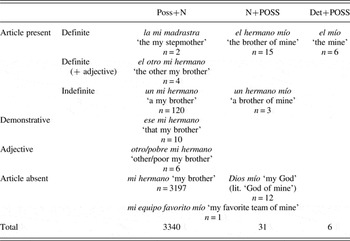
In the data analyzed for the purpose of this study, such cases account for no less than 95.7% of all noun phrases with a prenominal possessive (n = 3197 of 3340). The conclusion is that possessives in Spanish have grammaticalized into clitic determiners. The only counterevidence is provided by the remaining 142 cases (4.3%) that exhibit another determiner-like element next to the possessive. Can these be analyzed as residual cases where Central American Spanish has maintained possessive adjectives in prenominal position? If this were the case, the almost restriction to indefinite articles and demonstratives would be unexpected. Is it rather the special morphosyntactic status of demonstratives and indefinite articles that is responsible for these determiner-possessor combinations? Concerning demonstratives, Wood (Reference Wood2003) (cited in Alexiadou, Reference Alexiadou, Fuß and Trips2004:38), in her study of Old English, analyzed them as specifiers of D°. If demonstratives can indeed be located in some position higher than D°, then they do not compete with clitic possessives for the same structural position.
In the next section, I will turn to the status of the indefinite article in the Guatemalan pleonastic possessive. If a prenominal possessive co-occurs with a determiner at all, it is most often the indefinite article (84.5%, n = 120 of 142). This is why the latter deserves special attention. In particular, I will focus on the question whether the data provide evidence that the indefinite article has not fully grammaticalized into a D° element, that is, into an article proper. In such a case, it might be located to the left of D° like the demonstrative, for example, in its specifier position. The possessive could then in all cases be analyzed as a syntactic head occupying the D° position.
The indefinite article
In order to analyze the contexts of use of the pleonastic possessive in spontaneous speech, I use the language production of 36 informants from the PRESEEA Guatemala corpus (Moreno Fernández, Reference Moreno Fernández2005, Reference Moreno Fernández, Mancera, Martos and García2006; PRESEEA, 2014–2017; Verdugo de Lima et al., Reference Verdugo de Lima, Chacón, María, de Rivera, Mayra and Acevedo-Halvick2007).Footnote 15 PRESEEA is an abbreviation of Proyecto para el estudio sociolingüístico del español de España y de América ‘Project for the Sociolinguistic Study of Spanish of Spain and America’.
Presentation of the data
The informants are subdivided in 18 female and 18 male speakers, equally stratified according to age (20 to 34, 35 to 54, and older than 54 years of age) and education (primary, secondary, and postsecondary) with 12 informants (6 females and 6 males) in each group. From these data, all noun phrases with possessive pronouns have been extracted.
The overall distribution of possessive variants collected from the corpus data is shown in Table 1. Table 1 only lists cases with an overt possessive marker. The middle column shows the 3340 instances of a prenominal weak or clitic possessive (e.g., mi hermano ‘my brother’), the next column shows the 31 cases with a postnominal strong possessive (e.g., el/un hermano mío ‘the/a brother of mine’), and the last column contains the six cases of possessive pronouns (e.g., los míos ‘mine’).Footnote 16 This is a proportion of 99.1% prenominal versus 0.9% postnominal possessors and shows the marginal status of postnominal possessive marking in this variety. Of 3340 nouns with a prenominal possessive, 3197 cases are of the type mi hermano ‘my brother’. In these 95.7% of the cases, the possessive is not preceded by any other article or adjective. Only 142 cases of the pleonastic possessive could be found (cf. the upper five lines in Table 1). In 10 of these examples, the possessive combines with a demonstrative (ese mi hermano ‘this my brother’) and in another 10 with an adjective, which can be preceded or not by an article (4 and 6 cases, respectively, e.g., (el) otro mi hermano ‘(the) other my brother’).
Distribution of variants featuring attributive possession in the PRESEEA Guatemala corpus

The majority of the tokens of the pleonastic possessive have an article in initial position, which is definite in only two cases (la mi madrastra ‘the my stepmother’), and indefinite in 120 cases (un mi hermano ‘a my brother’). This confirms observations from earlier studies that in contemporary Central American Spanish this construction is largely confined to the indefinite article and, to a minor degree, to demonstratives (Company Company, Reference Company Company2005:136, Reference Company Company and Company Company2009:843; Gómez Seibane, Reference Gómez Seibane2010; Martin, Reference Martin and England1978:111, Reference Martin1985:384; Pato Maldonado, Reference Pato Maldonado, Palacios and García2002:143n114). Medieval Spanish was very different in this regard, because the definite article still prevailed over the indefinite article in this construction, as Company Company (Reference Company Company2005:136, Reference Company Company and Company Company2009:843) reported. At some point during the 16th century, the co-occurrence of the definite article with the prenominal possessive virtually disappeared, which paved the way for the current situation.
Summing up, in the vast majority of cases, Guatemalan Spanish parallels Standard Spanish in that the prenominal possessive occurs as the sole determiner. Postnominal strong possessives only occur sporadically. The pleonastic possessive, if it occurs at all, is most of the times introduced by the indefinite article and only rarely by a demonstrative or an adjective. This is why, in the following, I will restrict my attention to only those cases of the pleonastic possessive with an indefinite article (Indef+Poss+N, e.g., un mi hermano ‘a my brother’). It will be shown that this construction is a sociolinguistic variable. The question of how to circumscribe its variable context is the topic of the next section.
Circumscribing the variable context of the pleonastic possessive (Indef+Poss+N)
If the pleonastic possessive is indeed one of several alternative forms, then the other forms of ‘saying the same thing’ need to be identified. Clearly, la mi hermana ‘the my sister’ and mi hermana ‘my sister’ are not the same thing, because they are definite expressions. The analysis must therefore be limited to indefinite contexts only. These are illustrated in (9) and (10).
-
(9) Indef+Poss+N
Un hermano de mi esposa está casado con una mi hermana . (GUA080)
a brother of my wife is married to a my sister
‘A brother of my wife is married to a sister of mine.’
-
(10) Indef+N+POSS
Antes se había venido un hermano mío para acá. (GUA022)
before refl had come a brother mine over here
‘Before, a brother of mine had come over here.’
Bare nouns with postnominal strong possessives (N+POSS) had to be excluded, because they only occur in predicatives, as in (7a) (siendo amigo mío ‘being a friend of mine’), or in the fixed expression Dios mío ‘my God’ and are hence not part of the variable context. According to the principle of accountability, “any variable form (a member of a set of alternative ways of ‘saying the same thing’) should be reported with the proportion of cases in which the form did occur in the relevant environment, compared to the total number of cases in which it might have occurred” (Labov, Reference Labov1972:94; italics removed). Bare nouns do not qualify as an alternative to the pleonastic possessive. There is, however, another form that can systematically be used instead of the pleonastic possessive and that has largely gone unnoticed in the foregoing discussion. This is the use of the indefinite article in possessive contexts without an overt possessive pronoun (Indef+N).Footnote 17 The following example shows that Indef+N can indeed be used as an alternative to Indef+Poss+N.
-
(11)
-
a. Indef+Poss+N
tenía una mi bicicleta de carrera (GU021)
‘I had a my racing bike.’
-
b. Indef+N
entonces mi mamá tenía una mesa para planchar (GUA073)
‘Then my mom had an ironing board.’
-
In conclusion, Indef+N+POSS and Indef+N are the pertinent variants that need to be considered alongside Indef+Poss+N. It is difficult to determine which of the Indef+N tokens in the corpus are truly eligible candidates for the variable context, because possessive marking is not restricted to cases of physical possession (Cifuentes Honrubia, Reference Cifuentes Honrubia2015:21). As Seiler (Reference Seiler1981:6) stated, “linguistic POSSESSION consists of the representation of a relationship between a substance and another substance. Substance A, called the POSSESSOR, is prototypically [+ animate], more specifically [+ human], and still more specifically [+ EGO] or close to the speaker.” I therefore took the property of a relationship between the possessor and the possessee as a criterion for the inclusion of the individual Indef+N tokens into the analysis. This relationship can be very diverse and includes ownership, authorship, as well as places of residence and origin. As the pleonastic possessive only occurs with human possessors, this restriction has also been imposed on the Indef+N tokens.
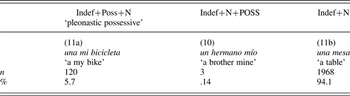
Table 2 shows that the pleonastic possessive is not only a minor variant as compared to the total number of possessive-marked noun phrases, but also within its own variable context. The overt realization of a prenominal possessive in indefinite contexts is clearly a marked variant as opposed to the unmarked Indef+N variant, which represents by far the majority of tokens. Postnominal strong possessives (Indef+N+POSS) are virtually absent from the data, occurring only in some isolated cases.
Distribution of the pleonastic possessive and its variants in the PRESEEA Guatemala corpus

However, even though the pleonastic possessive is a rare phenomenon, it occurs frequently enough not to dismiss it as mere “noise” in the data. Considering its relatively small number of tokens, the question comes up which factors favor its choice over the majority variant, Indef+N. As already set out, these factors might also inform us about the morphosyntactic status of the indefinite article in this variety. According to the Overlap Model of grammaticalization put forth in Heine (Reference Heine1993:48–53), the source and target items (i.e., the less and more grammaticalized forms) of a grammaticalization chain may coexist during a certain time span in a language. This entails that more and less grammaticalized forms of the indefinite article might coexist synchronically. My prediction is that these coexisting forms are contextually distributed. Earlier, arguments from the research literature on the pleonastic possessive were presented that supported an analysis of it in terms of a structural remnant from Old Spanish. If this is indeed the case, it could be assumed that the use of the indefinite article in this construction shows more properties of an earlier stage of grammaticalization than in all other indefinite noun phrases (Indef+N). The following analysis of factor groups shall help to verify this hypothesis. In the present study, the dependent variable consists of three different variants: Indef+Poss+N (i.e., the pleonastic possessive), as in (11a) (una mi bicicleta de carrera ‘a my racing bike’); Indef+N, as in (11b) (una mesa para planchar ‘an ironing board’); and Indef+N+POSS, as in (10) (un hermano mío ‘a brother of mine’). As the latter occurs in only three cases (see Table 1), a binary approach has been chosen comparing the pleonastic possessive with its nonoccurrences, in other words, the sum of the other two variants, Indef+N and Indef+N+POSS.
Selecting the independent variables
The preferential conditions for the occurrence of the pleonastic possessive, discussed in the literature, have been operationalized into factor groups (independent variables) whose influence on the choice of the pleonastic possessive shall be tested. Some of these allow assessing the state of grammaticalization of the indefinite article in this very construction.
The first is specificity. According to the literature reviewed, the indefinite article passes through a stage of a specificity marker on its grammaticalization path (stage III in Heine [Reference Heine1997:72–73]). If it is true that the pleonastic possessive constitutes a structurally conservative context in which the indefinite article preferentially appears in its less grammaticalized form, we would expect to find a favoring effect of specificity on this variant as opposed to the Indef+N variant, compare (12) with (13).
-
(12) specific noun
la iglesia había comprado un su terreno ahí y hicieron piscinas (GUA001)
‘The church has bought a[n its] plot of land there and they made swimming pools.’
-
(13) nonspecific noun
le digo a ella que su papá y yo tenemos que luchar para que ella sea alguien y se reciba- y tenga un su buen trabajito (GU013)
‘I tell her that her dad and I must fight so that she is someone and receives- and has a [her] good job.’
The second factor group is thematic persistence. It has been claimed that one of the main functions of the pleonastic possessive is the introduction of a thematically persistent referent into the discourse (Company Company, Reference Company Company and Company Company2009). Thematic persistence has also been claimed to be indicative of an earlier grammaticalization stage of the indefinite article, when it turns from a numeral into a presentative marker (stage II in Heine [Reference Heine1997:72]). If the indefinite article is less grammaticalized within the pleonastic possessive than within Indef+N contexts, the presentative function is expected to favor it. This is illustrated in (14) and (15). A noun phrase has been coded as thematically persistent when its referent is taken up as a discourse topic within the following three sentences. This is the case in (14) where the referent is introduced by the indefinite noun phrase un mi primo ‘a my cousin’ and serves as a topic in the following utterances. In (15), the referent of unos sus ocho años ‘some his eight years’ is not taken up in the subsequent discourse.
-
(14) presentative marker (thematic persistence)
De muy patojo de catorce años me vine, porque un mi- un mi primo tenía una su panadería y me ofreció trabajo y me dijo que- que me iba a pagar bien y que no sé qué y sí me pagaba bien porque yo era ayudante. (GUA007)
‘I came here as a very small child, at the age of fourteen, because a my- a my cousin had a his bakery and he offered me a job and he told me that- that he would pay me well and that I don't know what and indeed he paid me well because I was helpful.’
-
(15) no thematic persistence
No, con ellos no. Mis hijos no conocían el puerto, o sea R ya tendría ¿qué? R tendría que como unos sus ocho años. Entonces, bueno, caminábamos y caminábamos y “espérate ya vamos a llegar” cuando llegamos verdad al puerto de San José y todo. (GU050)
‘No, with them no. My children did not know the harbor, that is to say R already must have been what? R must have been some [his] eight years old. Then, well, we walked and walked and ‘wait, we are just arriving’ when we actually arrived at the harbor of San José and everything.’
The third factor group is postnominal modification. The argument that a relative clause, an apposition or a prepositional phrase modifying the noun indicate an early stage of grammaticalization of the indefinite article has been put forward by Company Company (Reference Company Company2005:146) who stated that “the necessity to add information about the nucleus [i.e., the noun] shows, in my view, that these NPs had a strong quantificational force in Old Spanish, that they required additional referential information in order to identify the referent, and it proves that the construction [i.e., the pleonastic possessive] must have emerged when the grammaticalization of the numeral un(o)-una as an indefinite article was quite advanced but has not yet come to fully be a mere presenter of entities, i.e., an article” (my translation).Footnote 18 I therefore expect postnominal modification, as the relative clause in (16), to favor the pleonastic possessive.
-
(16) En mi niñez <eh> recuerdo que una vez con unos mis primos que ahorita se encuentran en Michigan <eh> <time lapse> J y R son hijos de una mi hermana. Con ellos nos gustaba irnos a lo que- a las famosas cataratas … (GU021)
‘In my childhood, eh, I remember that once with some my cousins, who now reside in Michigan- J and R are children of a my sister. We liked to go with them to the- to the famous waterfalls …’
The next three factor groups relate to the discourse-functional properties of the pleonastic possessive. The first is the reference of the possessee to human or nonhuman entities. This is to verify the claim that the pleonastic possessive has actually evolved from a marker of exclusively human referents in Old Spanish, as in (17), into a marker of predominantly nonhuman referents, as in (18).
-
(17) O non sea atal commo el ome que dezían que quería leer gramática, que se fue para un su amigo que era sabio (Anónimo, 1984:92, cited in Company Company [Reference Company Company2005:144, example (6a)])
‘Or he would not be like the man about whom they said that he liked to read grammars and that he went to a his friend who was wise.’ (My translation)
-
(18) … porque un negocio de- de ver- de verduras o de frutas que se va a traer en un mi picop y irme a vender a los- a los departamentos, incluso a aquí en Guate … (GUA001)
‘… because a business of vegetables or fruits which are carried on a my pickup and which I will sell in the departments, even here in Guate …’
The person and number specifications of the possessive are also analyzed. These are lexically encoded on the possessive, if present, see (19a), (20a), and (21), but they are covert when the possessive is not expressed, as in the Indef+N construction, see (19b) and (20b). Third person singular and plural possessives were not coded separately since the possessive shows number syncretism, see (21a) and (21b).
-
(19)
-
a. First person singular
Compré un mi traje, color melón … (GUA001)
‘I bought a my melon colored suit … ’
-
b. First person plural
Gracias a Dios que tenemos un trabajito . (GUA007)
‘Thank God that we have a little job .’
-
-
(20) Second person singular
-
a. Tú tenés derecho quizás a tomarte un tu litro . (GUA002)
‘You have perhaps the right to take one your liter.’
-
b. No te mereces una novia tan fea. (GUA097)
‘You don't deserve such an ugly girlfriend.’
-
-
(21)
-
a. Third person singular
… le compramos un su hueso … (GUA073)
‘… we bought him a his bone … ’
-
b. Second and third person plural
De vez en cuando les invitamos a una su cerveza o algo así para que se pongan así bonitos, verdad. (GUA012)
‘From time to time we invite them to a their beer or something like that so that they feel at ease, right.’
-
This factor group shall verify the claim by Company Company (Reference Company Company and Company Company2009:846–853) that the former preference of third person contexts has been replaced by first and second person contexts due to the preferential use of the pleonastic possessive in narratives.
Number has also been coded as a marker of agreement between the possessive and the possessee, cf. (22). According to Lipski (Reference Lipski1994:295), combinations of the type Indef+Poss+N “are invariably singular,” a claim that is already disproved by example (22a). I will test whether at least a favoring effect of the singular can be confirmed.
-
(22)
-
a. El año nuevo casi siempre la pasábamos con- yo con unas mis amigas … (GUA064)
‘We used to spend the New Year almost always with- me with some my friends …’
-
b. Voy a ir a visitar a una mi amiga . (GUA002)
‘I will go and visit a my friend.’
-
It has been claimed by a number of authors that the pleonastic possessive expresses some kind of affective meaning (e.g., Pato Maldonado, Reference Pato Maldonado, Palacios and García2002). In this respect, Nieuwenhuijsen (Reference Nieuwenhuijsen2007) mentioned the preferential use of diminutive endings on the possessee. This has been coded as a separate factor group:
-
(23) Sí se va a comer una su gallinita- gallinita de campo, que eso sí es verdad. (GUA079)
‘Indeed one will eat a his free-range hen, that is true.’
The difference between the indefinite article un-una ‘a’ and an indefinite adjective such as algún ‘some’ is taken into account, because the latter also occurs in the pleonastic possessive, see (24).
-
(24) Voy a ir a ver a algún mi familiar a un hospital. (GUA002)
‘I will go and see some my relative at a hospital.’
Algún has a quantificational meaning. According to Alonso-Ovalle and Menéndez-Benito (Reference Alonso-Ovalle and Menéndez-Benito2010:28), it “conveys that there are at least two individuals that can satisfy the existential claim.” If the pleonastic possessive has retained some of its former partitive function (Martin, Reference Martin and England1978, Reference Martin1985), this could be reflected by a preferred use in contexts of algún.
The last linguistic factor group tested is prenominal adjectival modification. Some authors investigating the pleonastic possessive have restricted their attention to those cases in which the article-possessive-noun sequence is not interrupted by any adjective, see Nieuwenhuijsen (Reference Nieuwenhuijsen2007:332n51) who did not justify this decision, however. Cardinaletti (Reference Cardinaletti, Alexiadou and Wilder1998:18) and Alexiadou (Reference Alexiadou, Fuß and Trips2004:36) stated that in languages with prenominal weak adjectival possessives, the possessive always precedes other modifiers of the noun, such as adjectives. Instead of excluding these cases from the analysis altogether, the presence or absence of prenominal adjectives has been included as a separate factor group:
-
(25) Entonces yo le digo a ella que su papá y yo tenemos que luchar para que ella sea alguien y se reciba- y tenga un su buen trabajito . (GU013)
‘Then I tell her that her dad and I have to struggle for her to be someone and to obtain- to have a her good little job.’
The logistic regression analysis: Results and interpretation
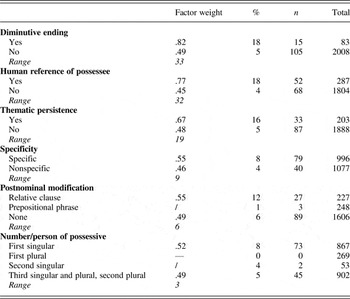
Table 3 shows the results of a variable rule analysis (Sankoff, Reference Sankoff, Ammon, Dittmar and Mattheier1988) using GoldVarb X (Sankoff, Tagliamonte, & Smith, Reference Sankoff, Tagliamonte and Smith2005) listing the linguistic independent variables according to their relative strength on the choice of the pleonastic possessive as measured by the range between the highest and the lowest factor weight.Footnote 19
Linguistic factor groups conditioning the choice of the pleonastic possessive (Indef+Poss+N) as opposed to nonpossessive marked indefinite noun phrases (Indef+N) and postnominal strong possessives (Indef+N+POSS).
Input = .06
n = 2091

Note: Nonsignificant factor group: possessor-possessee number agreement. Dashes indicate that factor weights could not be obtained due to absence of data. Slashes indicate that the respective factors have not been tested for their significance due to low token numbers.
Two factor groups had to be excluded from the variable rule analysis due to a too small number of tokens. The first is the type of determiner. Among all 2091 tokens, 155 occur with an indefinite adjective (e.g., algún ‘some’) in initial position, but only two of these occur in the Indef+Poss+N variant (cf. example (24), algún mi familiar ‘some my relative’). The reason for this might be an advanced state of lexicalization of the pleonastic possessive. It does not seem to be indefiniteness alone that triggers the use of the pleonastic possessive, since both un-una and algún-alguna are indefinite. Rather, I suppose that the pleonastic possessive is lexically limited to the word sequences un(a/s) mi(s), un(a/s) tu(s), and un(a/s) su(s). The second factor group that was excluded is the type of prenominal modification, be it by an adjective, a quantifier, or a numeral. Prenominal modification rarely occurs in the data as a whole (n = 173 of 2091, 8.3%) and only six instances of it can be found in the pleonastic possessive (3.5%).
Of the remaining seven factor groups, six turn out to have a significant effect on the choice of the pleonastic possessive while one, number agreement between possessor and possessee, is nonsignificant. Since the pleonastic possessive is represented by a total of only 120 tokens, a verification of seven factor groups might entail unreliable results. According to Harrell (Reference Harrell2015:72–73),Footnote 20 “a fitted regression model is likely to be reliable when the number of predictors (or candidate predictors if using variable selection) p is less than m/10 or m/20, where m is the ‘limiting sample size.’” In the case of a binary response variable, m is min(n 1,n 2) where “n 1 and n 2 are the marginal frequencies of the two response levels.” Applied to our case, n 1 is the number of applications of the pleonastic possessive, n = 120, and n 2 is the number of its nonapplications, n = 1971. The number of independent variables tested should therefore not exceed six (m/20, with m = 120). After a first regression analysis including all seven independent variables, the second analysis shown in Table 3 is limited to those six variables that are significant predictors of the choice of the pleonastic possessive in the first run.
Human reference and a diminutive suffix on the possessee are the strongest predictors of variant choice. Together with the slight but significant favoring effect of first person singular possessors, they constitute the preferential discourse-pragmatic context of occurrence in contemporary Guatemalan Spanish, see example (26).
-
(26) Una mi abuelita me enseñó hacer pocas comidas. (GU013)
‘A my granny taught me to prepare few dishes.’
These results confirm that the pleonastic possessive is preferentially used to refer to a person with whom the speaker entertains an affectionate relationship.
With regard to human reference, Company Company (Reference Company Company2005:144; Reference Company Company and Company Company2009:815) reported that the historical precursor of the pleonastic possessive in Old Spanish categorically occurred with human possessees. Pato Maldonado (Reference Pato Maldonado, Palacios and García2002:148–149) and Nieuwenhuijsen (Reference Nieuwenhuijsen2007:334) stated that this distribution has dramatically changed and that in contemporary Guatemalan Spanish, nonhuman possessees outweigh human possessees. Is this a contradiction to the results displayed in Table 3? An examination of the total numbers reveals that it is not. Among 120 cases of the pleonastic possessive, a minority of 52 tokens have a human possessee (43%). This is lower than the rate of human possessees in the other possessive-marked contexts (poss+N, Def+N+POSS, Indef+N+POSS, N+POSS, poss+N+POSS, Def+POSS). Here, we observe 1869 human possessees out of a total of 3234 tokens (58%). The present data hence confirm the observations made by Pato Maldonado (Reference Pato Maldonado, Palacios and García2002) and Nieuwenhuijsen (Reference Nieuwenhuijsen2007). However, the authors have not analyzed the pleonastic possessive within its variable context. The favoring effect of human reference only becomes measurable when the principle of accountability is observed and the rate of human possessees is assessed in those cases where the pleonastic possessive actually did occur compared to those cases where it could have occurred but did not. It is only when the variable context is taken into account that we see more than a triplication of the pleonastic possessive within the domain of human reference (18%, n = 52 of 287) as compared to the entire variable context (6%, n = 120 of 2091). I interpret the fact that possessees with human reference still favor the use of the pleonastic possessive within its variable context as an indicator of its evolutionary descent from the Indef+Poss+N construction in Old Spanish.
As regards the grammatical person of the possessive, the pleonastic possessive is preferentially used in reference to the speaker himself or herself. This is shown by the favoring effect of first person singular as opposed to third person possessives, thus confirming the observation made by Company Company (Reference Company Company and Company Company2009:846–853). The small range of this factor group does however not necessarily entail that it is less important than the others in the choice of the pleonastic possessive. This is so because second person singular possessives (tu ‘your’) had to be excluded from the variable rule analysis due to their too small number of occurrences. Only 2 of 53 tokens with tu ‘your’ could be found with the pleonastic possessive (4%). This is a potentially disfavoring effect whose confirmation would require an overall larger number of tokens. For now, we can only note a frequency-based tendency of an avoidance of the pleonastic possessive in speech directed at the interlocutor.Footnote 21
Thematic persistence of the noun is the factor group with the third largest range in the analysis, following diminutive endings and human reference. It is directly related to the grammaticalization of the indefinite article. The observation that thematically persistent nouns favor the use of the pleonastic possessive (factor weight: .67) can be interpreted as a case of persistence that is, according to Hopper (Reference Hopper, Traugott and Heine1991:22), a basic principle of grammaticalization: “When a form undergoes grammaticization from a lexical to a grammatical function, so long as it is grammatically viable some traces of its original lexical meanings tend to adhere to it, and details of its lexical history may be reflected in constraints on its grammatical distribution.” In the present case, it seems that the indefinite article has in part retained its former function of a presentative marker (stage II on the grammaticalization pathway of the indefinite article according to Heine [Reference Heine1997:72]).
This assumption is supported by two other effects—specificity and postnominal modification—which play, however, a less decisive role as shown because of their small ranges. If it is true, as suggested by the favoring effect of thematic persistence, that some of the functions associated with earlier grammaticalization stages of the indefinite article persist into its contemporary usage within the pleonastic possessive, we would expect that its former function of a specific marker also has its repercussions in the modern days. The results of the variable rule analysis confirm this expectation. Nouns with a specific reference and those that are postnominally modified by a relative clause favor the pleonastic possessive. The latter effect, postnominal modification, however, does not provide homogeneous results. While postnominal adjectives and prepositional phrases are virtually never used with the pleonastic possessive, the rate of the pleonastic possessive doubles in the context of postnominal relative clauses (n = 27 of 227, 12%) as compared to the overall data. Company Company (Reference Company Company and Company Company2009:848) observed that the use of postnominal modification gradually declined between the 13th and 16th centuries. Whereas in that time span more than half of the Indef+Poss+N constructions were still postnominally modified, this rate dropped down to 27% in her data from 21st-century Central American Spanish (Company Company, Reference Company Company and Company Company2009:851, cuadro 23). This is very close to the rate of 25% of postnominal modification in the present data (n = 30 of 119).Footnote 22 According to the author, “the loss of specification in Modern Indigenous Spanish means that the form un-una introducing these NPs weakened its quantificational value and consolidated the value of a simple presenter of entities” (ibid.:851, my translation).Footnote 23 In other words, un-una in the Indef+Poss+N construction has made some progress on its grammaticalization pathway toward a simple article though this process has probably not yet come to completion. The results provided by Company Company (Reference Company Company and Company Company2009:849, 851) also coincide with those reported here in that postnominal relative clauses, prepositional phrases, and adjectives are differently affected by this decline. However, the present study diverges as concerns the direction of this effect. While Company Company (Reference Company Company and Company Company2009) reported a decline of postnominal relative clauses and an increase of prepositional phrases and adjectives, in the present study, postnominal modification of Indef+Poss+N is virtually restricted to relative clauses. No postnominal adjectives and only 3 of 248 instances of postnominal prepositional phrases occur in this context (1.2%), as in (27) (and were therefore excluded from the variable rule analysis).
-
(27) Ahí saqué un mi curso de casi- de cuatro años de operador de computación. (GUA080)
‘There I took a my course of almost- of four years as a computer operator.’
For the time being, it remains an open question why the results of the present study and those of Company Company's (Reference Company Company and Company Company2009) investigation diverge in this way. Be that as it may, the combined favoring effects of thematic persistence, specificity of the possessee, and postnominal relative clauses show that the pleonastic possessive preferentially occurs in contexts that are indicative of an early step of grammaticalization of the indefinite article. It therefore seems justified to conclude that even though indefinite un-una has progressed along its grammaticalization pathway, it has not yet turned into a mere presenter of entities, but that it rather retains some of its former quantificational value, to use Company Company's words. Put differently, the pleonastic possessive constitutes a context in which un-una has not yet turned into a mere marker of indefiniteness in D°. It still occurs in some specifier position to the left of D° where it retains a discourse-pragmatic value.
The results of the variable rule analysis show, by its very nature, variable tendencies. In other words, the data also contain tokens of the pleonastic possessive in which the indefinite article behaves like a fully grammaticalized element in that it occurs with nonspecific and thematically nonpersistent nouns, as in (28).
-
(28) … entonces todavía se acostumbra eso unas sus tortillas con chicharrón con su limoncito y sus tortillas con moronga … (GUA061)
‘… then one even gets used to it, some his tortillas with greaves with its lime berry and its tortillas with blood sausage …’
The Overlap Model by Heine (Reference Heine1993) accounts for this variation in that different grammaticalization stages may coexist synchronically. The claim made here is that the synchronic distribution of these stages can be context-sensitive. Thus, the pleonastic possessive constitutes a context in which earlier stages of un-una are more likely to be represented than outside of this context. A possible reason for this special behavior might be the hypothesis that the pleonastic possessive has lexicalized to a certain extent. If the restriction of this construction to un-una and its rare occurrence not only with demonstratives but also with indefinite adjectives such as algún-alguna ‘some’ is indeed a reflex of its increasing lexicalization, it could be the case that the concurrent demotivation constitutes an obstacle for an ongoing grammaticalization of its subcomponents, in this case the indefinite article.Footnote 24
The nonsignificance of number agreement between possessor and possessee shows that not all functional constraints indicative of an early step of grammaticalization are at work. The capacity of indefinite un-una to refer to more than one item emerges at a relatively late stage in the grammaticalization pathway (Heine, Reference Heine1997:73). Obviously, the pleonastic possessive is as likely in the context of singular possessees (n = 108 of 1935, 6%) as in that of plural ones (n = 12 of 156, 8%), contradicting Lipski's claim that the pleonastic possessive is restricted to possessives with singular marking (Reference Lipski1994:295). Again, this result could only be obtained by taking into account the variable context. If we had restricted our attention to the 120 tokens of the pleonastic possessive only, we would have noted a preponderance of 90% of singular (n = 108) as opposed to only 10% of plural possessives (n = 12). Indeed, many of the claims about the pleonastic possessive made in the previous literature suffer from the fact that the authors have not taken into account the variable context. As the present analysis shows, high rates of occurrence, as in the case of singular possessives and possessees with nonhuman reference, do not necessarily imply a favoring effect of these factors, but might even turn out to disfavor the variant under consideration. This shows, pace Company Company (Reference Company Company1995, Reference Company Company and Company Company2005:133–134), that relying on rates of occurrence alone can be misleading and guide the analyst to even counterfactual conclusions (see also Poplack & Torres Cacoullos, Reference Poplack, Torres Cacoullos, MacWhinney and O'Grady2015:288; Rinke & Elsig, Reference Rinke and Elsig2010).
To sum up, the results of the variable rule analysis show that the pleonastic possessive is favored by factors indicating an early stage of grammaticalization of the indefinite article, that is, by thematically persistent and specific nouns with postnominal relative clauses. This observation conforms with the assumption that the pleonastic possessive is a relic inherited from Old Spanish. On the functional side, the pleonastic possessive preferentially occurs with a first person singular possessor who entertains an affectionate relationship with a human possessee, as evidenced by the diminutive ending. The preference of the pleonastic possessive by human possessees has also been inherited from medieval Spanish.
DISCUSSION
The present study has focused on the pleonastic possessive in Guatemalan Spanish. The unique characteristic of this construction is the co-occurrence of an indefinite article and a possessive pronoun in prenominal position, as in una mi amiga ‘a my friend’. This pattern apparently contradicts the general assumption that prenominal possessives in Modern Spanish are determiners, similar to English and French, and challenges the determiner-genitive property of prenominal possessives (cf. Lyons, Reference Lyons1985, Reference Lyons1986:139–140). Based on the assumption that D° is not a complex head hosting both the indefinite article and the possessive, the main concern of this study was to investigate which of these two elements is more likely not to be a determiner and hence not to be in D°. Considering the fact that both the indefinite article and the possessive determiner represent the end stages of two independent grammaticalization chains, it seemed appropriate to tackle this research question from an evolutionary perspective. In particular, the current position of the indefinite article and the possessive on their respective grammaticalization chains has been assessed. In doing so, I have chosen the framework of variation theory, since this framework is “ideally suited to the study of grammaticalization in progress,” as Poplack (Reference Poplack, Heine and Narrog2011:224) convincingly stated. This is because variation theory “adds … a principled way of examining not only the grammaticalizing form, but also the other layers with which it competes. Extending the focus to the entire variable context confirms that forms do not grammaticalize in isolation, but are sensitive to the variants with which they alternate” (223). The results in Table 3 and the related discussion have shown that restricting the focus to the variant under consideration alone, as so many previous studies on this phenomenon have done, would have yielded erroneous conclusions, as evidenced by the effects of morphological plural marking on the possessive and of human reference of the possessee. The true effects of these two could only be obtained by taking into account the entire variable context.
How are the stages of grammaticalization of the indefinite article and the possessive relevant when determining their syntactic position within the DP? In Alexiadou's (Reference Alexiadou, Fuß and Trips2004) model, the grammaticalization of the possessive involves a categorial change of an XP, the strong possessive in Spec,nP, into a syntactic head in D°. The weak adjectival possessive in Spec,AgrP is an intermediate step along this diachronic development. Each of these three stages targets a structurally higher position within the DP. This complies with Roberts and Roussou (Reference Roberts and Roussou2003:71) who proposed “that grammaticalization is reanalysis ‘upwards’ along the functional structure.” In particular, the type of grammaticalization proposed by Alexiadou (Reference Alexiadou, Fuß and Trips2004) conforms with the third of three patterns of grammaticalization presented in Roberts and Roussou (Reference Roberts and Roussou2003:199) whereby “the first step involves movement of a DP to a higher functional projection, giving a specifier. The second step involves reanalysis of this DP as a head,” as illustrated in (29).
-
(29) [XP YP X. . [ . . . tYP . .]] > [XP Y = X. . [. . . .]]
(Roberts & Roussou, Reference Roberts and Roussou2003:199, example (21))
With regard to prenominal possessives in Spanish, it should be mentioned that the loss of morphological gender agreement with the possessee, which, according to Alexiadou (Reference Alexiadou, Fuß and Trips2004), is one of the main triggers of the grammaticalization of possessives, was already quite advanced in Old Spanish. On weak prenominal possessives, though not on prenominal nuestro-nuestra ‘our’ and vuestro-vuestra ‘your-plural’, it has completely disappeared by today. As a side effect of the loss of agreement morphology, the possessives have become phonologically weak elements. The gradual loss of phonetic substance (erosion) is a typical mechanism in grammaticalization (Heine & Reh, Reference Heine and Reh1984:21). Parallel to the development of a paradigm of weak prenominal possessives, another paradigm of strong postnominal possessives has evolved. Only the latter can occur in contexts of noun ellipsis or coordination. In the present study, prenominal possessives occur in almost 96% of all cases without an accompanying determiner and are inherently associated with definiteness, as in mi amiga ‘my friend’. All these observations suggest that Spanish prenominal possessives have grammaticalized into clitic determiners in D°. In those exceptional cases where they still co-occur with a determiner, as in the pleonastic possessive, another explanation, not related to the syntactic status of the possessive, must be sought. Otherwise, the preponderance of indefinite un-una as the single most important prenominal companion of the possessive could not be explained. I do not assume that the co-occurrence of a possessive and another prenominal determiner, such as the indefinite article, necessarily entails that the possessive is located in some specifier position below the DP. Instead, I rather concur with Kupisch and Rinke (Reference Kupisch, Rinke and Siemund2011:118) who stated that “the presence of the article is not indicative of whether the possessive is an adjective or a determiner” (italics added). In my view, this is so because in constructions featuring both an article and a prenominal possessive, it is possible that the article has not fully grammaticalized into a mere exponent of definiteness or indefiniteness, that is, into a D° element. Kupisch and Rinke (Reference Kupisch, Rinke and Siemund2011:107, 115, 117, 120) provided diachronic evidence that the Portuguese definite article historically started out as a topic marker expressing anaphoricity. Against this backdrop and taking into consideration the model of grammaticalization proposed by Roberts and Roussou (Reference Roberts and Roussou2003), it is far from certain that a prenominal possessive preceded by an article is necessarily located in some specifier below D°. The article-possessor compatibility or complementarity rather depends on the state of grammaticalization of the article and on whether or not it has already turned into a D° element preventing the possessive from occurring in this position.
In the present study, I have discussed the question whether the co-occurrence of an indefinite article and a prenominal possessive in Guatemalan Spanish can be ascribed to an incomplete grammaticalization of the indefinite article rather than to a residual and contextually restricted maintenance of adjectival possessives. The empirical evidence indeed provides support for the former assumption. It is certainly true that fully grammaticalized instances of the indefinite article also occur among the Indef+Poss+N tokens (see the example in (28), unas sus tortillas ‘some his tortillas’), but the variable rule analysis has shown that pragmatic factors that indicate an early stage of grammaticalization of indefinite un-una, namely specificity, thematic persistence and modifying relative clauses, favor Indef+Poss+N. I have applied Heine's (Reference Heine1993) Overlap Model, suggesting that the synchronically coexisting stages of a grammaticalization cline may occur in context-sensitive distribution. In the present case, the favoring effects show that the pleonastic possessive constitutes a context in which more conservative uses of the indefinite article prevail. More precisely, it has not yet been reanalyzed as a mere exponent of indefiniteness in D° but continues as a discourse-pragmatic marker in a specifier position to the left of DP, probably Spec,DP itself considering the inseparability of the indefinite article and the possessive. I have further proposed that the reason for the decelerated grammaticalization in this context might be an increasing lexicalization along with a demotivation of the subcomponents of Indef+Poss+N.
The observations made in earlier studies conform with the assumption that the indefinite article in the pleonastic possessive has not yet turned into an article proper. Even though scholars diverge in their terminology used, they converge on the finding that the pleonastic possessive has a discourse-pragmatic function, highlighting in some way the “importance” (Pato Maldonado, Reference Pato Maldonado, Palacios and García2002) of the possessee with regard to the possessor. Nieuwenhuijsen (Reference Nieuwenhuijsen2007) referred to its subjective, evaluative, and affective functions. Palacios Alcaine (Reference Palacios Alcaine2004) reviewed its development from a partitive via a habituality marker and an intensifier to a focus marker emphasizing the importance of the possessee. Napoli (Reference Napoli2013), in her analysis of the structurally equivalent construction Indef+Poss+N in Old Italian, drew similar conclusions. According to her, this construction serves to highlight discourse prominence and noteworthiness and to mark the thematic persistence of the possessee. In her view, it is in particular the indefinite article that is responsible for this interpretation, since the same construction with a definite article, Def+Poss+N, lacks these functions. The fact that the same functional effects can be observed cross-linguistically in the Indef+Poss+N construction should not come as a surprise, if they are due to the grammaticalization of the indefinite article that proceeds along the same pathway in Italian and Spanish.
The discourse-functional embedding of the pleonastic possessive in Guatemalan Spanish speaks in favor of a language-internal origin, when compared with the results from the diachronic studies of Company Company (Reference Company Company2005, Reference Company Company and Company Company2009). The question whether contact to Mayan languages has exerted any influence, for example, in the domain of topic possessives, cannot be answered as long as a comparative quantitative study of attributive possessive marking is still outstanding.
Based on variationist quantitative research, the present study has provided evidence that the so-called pleonastic possessive in Guatemalan Spanish constitutes a context in which the indefinite article still preferentially occurs as a little-grammaticalized discourse-marker. As such, it has not yet turned into a determiner, that is, a marker of indefiniteness. Apart from surface word order, there is no evidence that two different kinds of prenominal possessives—a determiner-like and an adjectival one—should be distinguished in this variety. Instead, all prenominal possessives appear to be exponents of the D° head. The evidence hence points toward a structural analysis of the pleonastic possessive along the following lines:
-
(30) [DP un [D’ mi [AgrP hermano [NumbP hermano [nP hermano [NP hermano ]]]]]]