Although the importance of personality was studied by political scientists many years ago (for example, Adorno et al., Reference Adorno, Frenkel-Brunswik, Levinson and Sanford1950; Browning and Jacob, Reference Browning and Jacob1964; Elms, Reference Elms1976; Eysenck, Reference Eysenck1954; Greenstein, Reference Greenstein1969; Janis and Field, Reference Janis, Field, Hovland and Janis1959; Janis and King, Reference Janis, Field, Hovland and Janis1954; Lane, Reference Lane1955; Lasswell, Reference Lasswell and Seligman1930; Levinson, Reference Levinson1958; McClosky, Reference McClosky1958; Mussen and Wyszynski, Reference Mussen and Wyszynski1952; Rokeach, Reference Rokeach1960; Sniderman, Reference Sniderman1975; Tomkins, Reference Tomkins, White and Bruner1963), the topic has recently attracted the attention of political scientists, with new research using the so-called “Big Five Model.” This model has the advantage of being both comprehensive and parsimonious, which facilitates its implementation in political science research. This growing body of literature is just beginning, and although current results are encouraging, the field needs further research to better understand how these traits affect political behaviours. In particular, we have yet to verify which of these interesting findings are systematic and stable across different datasets and contexts. Luckily, the recent inclusion of the Big Five measures in national election studies in different countries, including Canada, now allows us to take this step forward, which should ultimately lead to a more integrated and comprehensive understanding of the relevance of personality traits. This article contributes to this ongoing literature by focusing on the impact of only one of the five traits in the Big Five model, openness to experience, and on one crucial variable, political knowledge, which is generally considered one of the best available indicators of political sophistication (Delli Carpini and Keeter, Reference Delli Carpini and Keeter1993; Luskin, Reference Luskin1987; Zaller, Reference Zaller1990). I also examine the impact of openness to experience on political interest, which is closely related to political sophistication and knowledge.
Recent research has suggested that openness to experience is positively related to political knowledge and interest (for example, Gerber et al., Reference Gerber, Huber, Doherty and Dowling2011b; Mondak, Reference Mondak2010; Mondak and Halperin, Reference Mondak and Halperin2008), and this investigation aims to better specify this relation by examining the two subdimensions of this personality profile: a tendency to be open to new experiences (the official label of the trait) and a tendency toward intellectualism, which may not be as obvious. Moreover, because openness to experience and cognitive skills are known to be related (for example, Ackerman and Heggestad, Reference Ackerman and Heggestad1997; Austin et al. Reference Austin, Deary, Whiteman, Fowkes, Pedersen, Rabbitt, Bent and McInnes2002; Brand, Reference Brand1994; Chamorro-Premuzic, et al., Reference Chamorro-Premuzic, Moutafi and Furnham2005; Furnham et al., Reference Furnham, Moutafi and Chamorro-Premuzic2005; McCrae Reference McCrae1994; Moutafi et al. Reference Moutafi, Furnham and Crump2003; Moutafi et al., Reference Moutafi, Furnham and Paltiel2005; Zeidner and Matthews, Reference Zeidner and Matthews2000), I test the robustness of openness to experience, as well as intellectualism, when cognitive skills are considered. Finally, since openness to experience is likely to influence how people benefit from political discussions and disagreement, I also investigate the potential role of openness to experience in that regard while also considering a similar impact for intellectualism. The results of this analysis show that political scientists interested in personality traits should not limit themselves to the Big Five general traits and that they should also investigate its subdimensions.
Openness to Experience and Political Sophistication
Using the Big Five model developed in psychology, Mondak (Reference Mondak2010) shows that personality traits play an important role in shaping a variety of political attitudes and behaviours. Open individuals are supposed to have a natural intellectual curiosity and a tendency to be interested in abstract ideas; hence, the trait that is intuitively the most likely to have an impact on political sophistication is openness to experience. Gerber et al. define openness to experience as “the degree to which a person needs intellectual stimulation and variety” (Reference Gerber, Huber, Doherty and Dowling2011b: 39), and they are certainly correct that this is an important part of the trait. From the political sophistication standpoint, this intellectual component of openness likely plays a role in fostering political knowledge. Mondak and Halperin (Reference Mondak and Halperin2008), Mondak (Reference Mondak2010) as well as Gerber et al. (Reference Gerber, Huber, Doherty and Dowling2011b) found a positive effect of openness on political knowledge. Mondak et al. (Reference Mondak, Hibbing, Canache, Seligson and Anderson2010) also found that the impact of openness on political engagement is mediated by political knowledge. With this in mind, openness is not solely about intellectual curiosity and the enjoyment of abstract ideas but also the tendency to appreciate the arts, imagination, emotions and adventures as well as experiencing new and unconventional things (that is, being “open to experiences”). DeYoung et al. conceptually distinguished the two components of openness by saying that “Intellect reflects the ability and tendency to explore abstract information through reasoning, whereas Openness reflects the ability and tendency to explore sensory and aesthetic information through perception, fantasy, and artistic endeavour” (Reference DeYoung, Quilty, Peterson and Gray2014: 46–7).
The label and the actual meaning of the trait have been much debated in the psychological literature. Some have focused on its intellectual component (for example, Borgatta, Reference Borgatta1964; Cattell, Reference Cattell1957; Fiske, Reference Fiske1949; Goldberg, Reference Goldberg1990, Reference Goldberg1992), while others have emphasized its artistic and imaginative elements (for example, Norman, Reference Norman1963; Tupes and Christal, Reference Tupes and Christal1958). Still others have focused on its “experiential” dimension (for example, McCrae, Reference McCrae1982; McCrae and Costa, Reference McCrae and Costa1983). The important point is that from the very beginning, there has always been tension between the intellectual and the aesthetic components of the trait that is now labelled openness to experience. Like all of the Big Five factors, openness to experience is conceptualized as a higher-order trait formed of multiple first-order aspects. In the case of openness, these components are intellectualism and aestheticism. A new label gaining momentum in the literature now describes the trait as “openness/intellect” to better represent the two central and equally important components that are correlated but separable (for example, Connelly et al., Reference Connelly, Ones and Chernyshenko2014; DeYoung et al., Reference DeYoung, Peterson and Higgins2005, Reference DeYoung, Quilty and Peterson2007, Reference DeYoung, Shamosh, Green, Braver and Gray2009, Reference DeYoung, Quilty, Peterson and Gray2014; Jang et al., Reference Jang, Livesley, Angleitner, Riemann and Vernon2002). From the political sophistication standpoint, this conceptual distinction should be important since the reason open individuals would be expected to be (and were found to be) more sophisticated is not because they enjoy new and unconventional experiences but because they are supposed to have a tendency toward intellectualism. Moreover, it is hard to imagine how openness to experience without intellectualism could be expected to produce more politically sophisticated individuals. Hence, although openness as a higher-order trait may be related to intellectualism, its aestheticism component is not expected to play a direct role in fostering political sophistication.
Although Gerber et al. (Reference Gerber, Huber, Doherty and Dowling2011b) seem to replicate Mondak's work with respect to openness, they actually measure the construct very differently. The Big Five traits can be measured using the short Ten-Item Personality Inventory (TIPI) developed by Gosling et al. (Reference Gosling, Rentfrow and Swann2003), and this measurement was used by Gerber et al. (Reference Gerber, Huber, Doherty and Dowling2011b). The TIPI scale is very convenient because it includes only two items measuring each trait, for a total of 10 items. Thus, it can easily be implemented in political science surveys. Although the TIPI scale has been validated (Furnham, Reference Furnham2008), considering the items measuring openness to experience helps illuminate the trade-offs that are made when measuring openness as a general trait rather than focusing on more specific and precise measurements of its subdimensions. Respondents are typically asked the following:
“Here are a number of personality traits that may or may not apply to you. Please write a number next to each statement to indicate the extent to which you agree or disagree with that statement. You should rate the extent to which the pair of traits applies to you, even if one characteristic applies more strongly than the other.”
The two pairs of words measuring openness are “open to new experiences, complex” and “conventional, uncreative,” the latter being reversed. Contrary to Gerber et al. (Reference Gerber, Huber, Doherty and Dowling2011b), Mondak and Halperin (Reference Mondak and Halperin2008) and Mondak (Reference Mondak2010) did not use the TIPI scale but measured the Big Five traits using different items. In a first survey, openness was measured using these six pairs of items: (1) perceptive–shortsighted, (2) efficient–inefficient, (3) self-assured–unselfassured, (4) intelligent–unintelligent, (5) confident–unconfident and (6) complex–simple. In a second survey, openness was measured using these two pairs of words: (1) confident–unconfident and (2) intelligent–unintelligent. And in a third survey, openness was measured using these five pairs of words: (1) imaginative–unimaginative, (2) analytical–unanalytical, (3) creative–uncreative, (4) curious–uncurious and (5), intellectual–unintellectual. Finally, in Mondak et al. (Reference Mondak, Hibbing, Canache, Seligson and Anderson2010), openness was measured using these two pairs of words: (1) an intellectual–not an intellectual and (2) philosophical–unreflective. Compared to the official Big Five questions, these items more specifically tap intellectualism, whereas TIPI items aim to capture openness as a general trait.
From this perspective, Gerber et al. (Reference Gerber, Huber, Doherty and Dowling2011b) also analyzed the 10 subdimensions of the Big Five. They found no significant impact of the aesthetic facet of openness on political interest, but they identified a significant and positive effect for the “intellect” facet. They comment that “[t]he fact that the aesthetics facet is not associated with political interest is also encouraging because there is little theoretical reason to expect this particular aspect of Openness to Experience to affect interest in politics” (Gerber et al., Reference Gerber, Huber, Doherty and Dowling2011a: 278–80). Their finding is based on the Big Five Inventory (BFI), which is a much more complete assessment of the Big Five traits than that available with the TIPI scale. Their results also support the idea that more careful attention to the subdimensions of openness to experience may further refine our understanding of the impact of the trait.
Again, the main purpose of the TIPI scale is to assess the Big Five traits as higher-order latent characteristics. Hence, it arguably favors the generality in the measurement of openness to the expense of its more specific aesthetic and intellect aspects. Since we are mostly interested in the impact of the intellect subdimension of political sophistication, measurements that more directly target this facet are warranted. This article presents an investigation into the importance of this distinction in the role of openness in explaining political sophistication.
Data and Methods
The 2015 Canadian Election Study (CES 2015) and the 2012 American National Election Study (ANES 2012) included the TIPI scale to assess the Big Five traits. In the CES 2015, the scale was part of a nationally representative survey conducted over the internet during the 2015 election campaign. In the ANES 2012, the TIPI scale was administered to respondents who either used a computer-assisted self interview (CASI) during face-to-face interview or answered the survey on the web. The CES 2015 data contain a measure of need for cognition, which is used as a measure of intellectualism, which allows the distinction of the aesthetic component assessed by the TIPI scale from the intellectual aspect of openness. Need for cognition is conceptualized as a personality trait describing individuals who enjoy engaging in effortful cognitive tasks (Cacioppo and Petty, Reference Cacioppo and Petty1982). Canadian respondents were asked if they strongly agree, somewhat agree, strongly disagree or somewhat disagree with the following two statements: “Thinking is not my idea of fun,” and “I like to have responsibility for handling situations that require a lot of thinking.”
Unfortunately, after being introduced in 2000, need-for-cognition measurements were dropped from the ANES 2012. But an advantage of the ANES 2012 is that it contains a vocabulary score for each respondent, which can be considered a measure of cognitive skills rather than a measure of intellectualism considered as a personality trait. Since openness and cognitive skills are known to be related (see Ackerman and Heggestad Reference Ackerman and Heggestad1997; Austin et al., Reference Austin, Deary, Whiteman, Fowkes, Pedersen, Rabbitt, Bent and McInnes2002; Brand, Reference Brand1994; Chamorro-Premuzic et al., Reference Chamorro-Premuzic, Moutafi and Furnham2005; Furnham et al., Reference Furnham, Moutafi and Chamorro-Premuzic2005; McCrae, Reference McCrae1994; Moutafi et al., Reference Moutafi, Furnham and Crump2003, Reference Furnham, Moutafi and Chamorro-Premuzic2005; Zeidner and Matthews, Reference Zeidner and Matthews2000), investigating how openness as assessed using the TIPI scale relates to sophistication when taking real cognitive skills into account is of obvious interest. Measuring cognitive skills in standard surveys is indeed a serious challenge, and admittedly, the ANES 2012 vocabulary score is likely to be influenced by other factors such as education and mother tongue. Albeit imperfect, such measurements have been used extensively by political scientists as a reasonable proxy for intellectual skills (for example, Condon, Reference Condon2015; Denny and Doyle, Reference Denny and Doyle2008; Hillygus, Reference Hillygus2005; Neuman et al., Reference Neuman, Just and Crigler1992; Verba et al., Reference Verba, Schlozman and Brady1995).
In July 2013, in a randomly selected subsample, more than 1,500 respondents from the ANES 2012 were recontacted over the internet through the 2013 Internet Recontact Study (ANES 2013). These respondents were asked three need-for-cognition items. They were first asked, “Some people like to have responsibility for handling situations that require a lot of thinking, and other people don't like to have responsibility for situations like that. What about you? Do you like having responsibility for handling situations that require a lot of thinking, dislike it, or do you neither like nor dislike it?” Then they were asked, “How much do you [like/dislike] having responsibility for handling situations that require a lot of thinking?” And finally, they were asked, “Some people prefer to solve simple problems instead of complex ones, whereas other people prefer to solve more complex problems. Which type of problem do you prefer to solve: simple or complex?”
Notably, it can also be argued that need-for-cognition items tap into conscientiousness. In the ANES 2012 in the United States, all three need-for-cognition items specifically mentioned “responsibility,” while one of the two items did so in the CES 2015. Some research suggests that there are positive relationships between need for cognition and conscientiousness, as well as openness to experience (for example, Greco and Walter, Reference Greco and Walter2013; Sadowski and Cogburn, Reference Sadowski and Cogburn1997). Thus, the need for cognition is also likely to be related to other relevant personality traits, and this is to be expected because the Big Five is intended to be a comprehensive personality framework. Importantly, however, need for cognition is an adequate measurement of intellectualism. Recent research suggests that the difference between the concepts of “need for cognition,” “typical intellectual engagement” and “openness to ideas” may not really exist; thus, these should be considered as one construct (for example, Mussel, Reference Mussel2010; Woo et al., Reference Woo, Harms and Kuncel2007). Additionally, recent studies have also confirmed that need for cognition is positively related to cognitive ability (for example, Fleischhauer et al., Reference Fleischhauer, Enge, Brocke, Ullrich, Strobel and Strobel2009; Furnham and Thorne, Reference Furnham and Thorne2013; Greco and Walter, Reference Greco and Walter2013; Hill et al., Reference Hill, Foster, Elliott, Shelton, McCain and Gouvier2013). Therefore, using need for cognition to assess intellectualism is a sound approach.
The ANES 2013 subsample was utilized to further investigate the relationships among models, including openness to experience measured by the TIPI scale, intellectualism as measured by need for cognition and cognitive skills as measured by the vocabulary score. More “conventional” samples from both the CES 2015 and the ANES 2012 were analyzed, then the subset from the ANES 2013 was considered.
Results
Because personality traits have been shown to be highly inherited, they must be considered causally anterior to most sociodemographic variables that are usually included in models predicting political knowledge. Hence, the baseline model includes Big Five traits along with control variables that characterize individuals at birth: sex, race, minority language (Spanish in the United States and French in Canada), and age, which also captures time of birth. Although Canadian society is indeed very diverse, race was not considered in the CES 2015 because no specific racial minority is substantially more numerous than any other or represents, on its own, such a large proportion of Canadians that it ought to be considered. Moreover, French Canadians are a historic national minority that is qualitatively and quantitatively different from Canada's general ethnic diversity. Additionally, previous research has shown that French Canadians tend to exhibit lower levels of political knowledge (Fournier, Reference Fournier, Everitt and O'Neill2002; Lambert et al., Reference Lambert, Curtis, Kay and Brown1988). In the United States, the ANES 2012 survey asked respondents who identified as “Latino” which language they spoke at home (“only English,” “mostly English,” “both languages equally,” “mostly Spanish” or “only Spanish”). I created a dichotomous indicator capturing respondents who answered “both languages equally,” “mostly Spanish” or “only Spanish” as one group, and another group for all others. In the CES 2015, the francophone indicator captured respondents who said that French was their mother tongue. A second model included the intellectualism variables, and a third model tested the robustness of the findings by including education, political interest, and income, which are three other common predictors of political knowledge.
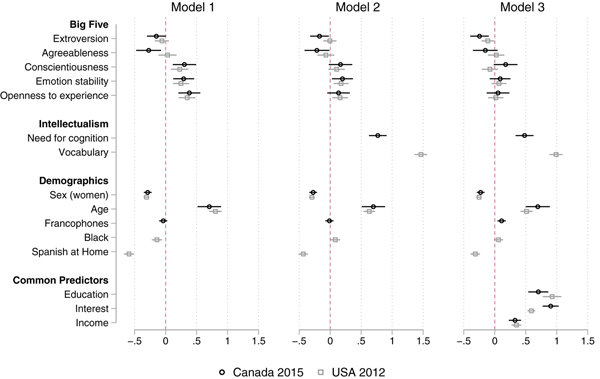
Figure 1 displays the results of the three linear regression models predicting political knowledge in the CES 2015 and the ANES 2012 data. In the CES 2015, knowledge was measured using four factual questions, while in the ANES 2012, it was assessed using six factual questions. To help compare the results, both variables were standardized to have a mean of 0 and a standard deviation (SD) of 1. The items used to measure political knowledge are available in Tables 1 and 2 of the online appendix. To compare coefficients more easily, all independent variables were recoded to range from 0 to 1. Hence, the coefficients represent the maximum effects of the variables on political knowledge.
Political Knowledge and Personality Traits in Canada and the US

In model 1, agreeableness had a significant and negative impact on political knowledge in the CES 2015 data, while it was not significant in the ANES 2012 data. The other four traits exhibit consistent effects across the two countries. Extroversion did not have a significant impact, while conscientiousness, emotional stability and openness to experience all demonstrated positive and significant impacts on political knowledge. In the CES 2015, respondents who scored the highest on the openness scale were 0.38 SD more knowledgeable than those who scored the lowest, and this represents approximately 0.5 additional correct responses. In the ANES 2012, highly open respondents were 0.34 SD more knowledgeable, or gave approximately 0.6 additional correct answers.
The intellectualism variables were included in model 2. In both studies, these variables exhibited positive and significant relationships with political knowledge. In the CES 2015, individuals who had a high need for cognition were 0.77 SD more knowledgeable; they were able to correctly answer approximately 1.0 more question. In the ANES 2012, respondents with high vocabulary skills answered 2.5 additional questions correctly, or were 1.46 SD more knowledgeable. Considering the Big Five variables, the coefficient for openness to experience became nonsignificant in the CES 2015, and it was much reduced in the ANES 2012, though it remained significant. Considering verbal skill, ANES 2012 respondents were able to correctly answer approximately 0.27 additional political knowledge questions, which represents movement of approximately 0.16 SD. This finding generally supports our hypothesis, especially because, in both studies, the intellectualism variables were the strongest predictors of political knowledge. In both surveys, emotional stability remained positively related to political knowledge, and the impact of conscientiousness was no longer significant. This finding may indicate that the intellectualism variable may be capturing some elements of the trait. Agreeableness remained negative in both studies, but again only yielded a significant coefficient in the CES 2015. Finally, while the impact of extroversion was negative in both countries, it exhibited a significant impact in the Canadian study but not in the U.S. study.
Finally, model 3 included education, political interest, and income to further test the robustness of the findings. The inclusion of these controls was especially important to assess the robustness of the vocabulary score variable in the ANES 2012. In the CES 2015, need for cognition remained positive and significant. Individuals who had a high need for cognition were approximately 0.50 SD more knowledgeable; they were able to correctly answer slightly more than 0.50 extra questions correctly. In the ANES 2012, the impact of vocabulary skills remained positive and significant. Americans with a high vocabulary score were approximately 1 SD more knowledgeable, which means that they were able to correctly answer approximately 1.7 additional questions. In both studies, the impact of openness to experience was nonsignificant. The impact of extroversion was negative and nonsignificant in both countries. In the CES 2015, extroverts were able to correctly answer approximately 0.33 fewer questions, while in the ANES 2012, extroverts answered approximately 0.20 fewer questions correctly. Finally, no other personality trait had a significant impact in model 3 with the inclusion of the common predictors of political knowledge. Moreover, in both studies, the intellectualism variables were among the strongest predictors of political knowledge. To further test the robustness of the patterns revealed, similar models were estimated without the four traits of the Big Five that were not the focus of the present study (see Table 4 of the online appendix). The results were very similar to those obtained when including all the traits.
The results of the present study indicate that openness to experience has a positive and significant impact on political knowledge but that this impact is greatly reduced or vanishes when a variable capturing intellectualism is included. This was true both in the ANES 2012 and the CES 2015, where different measures of intellectualism were used. These findings clearly support the general hypothesis that the aesthetic aspect of openness to experience does not have a meaningful impact on political sophistication. What really matters is the intellectual facet of openness, which is much better captured by need for cognition or vocabulary skills.
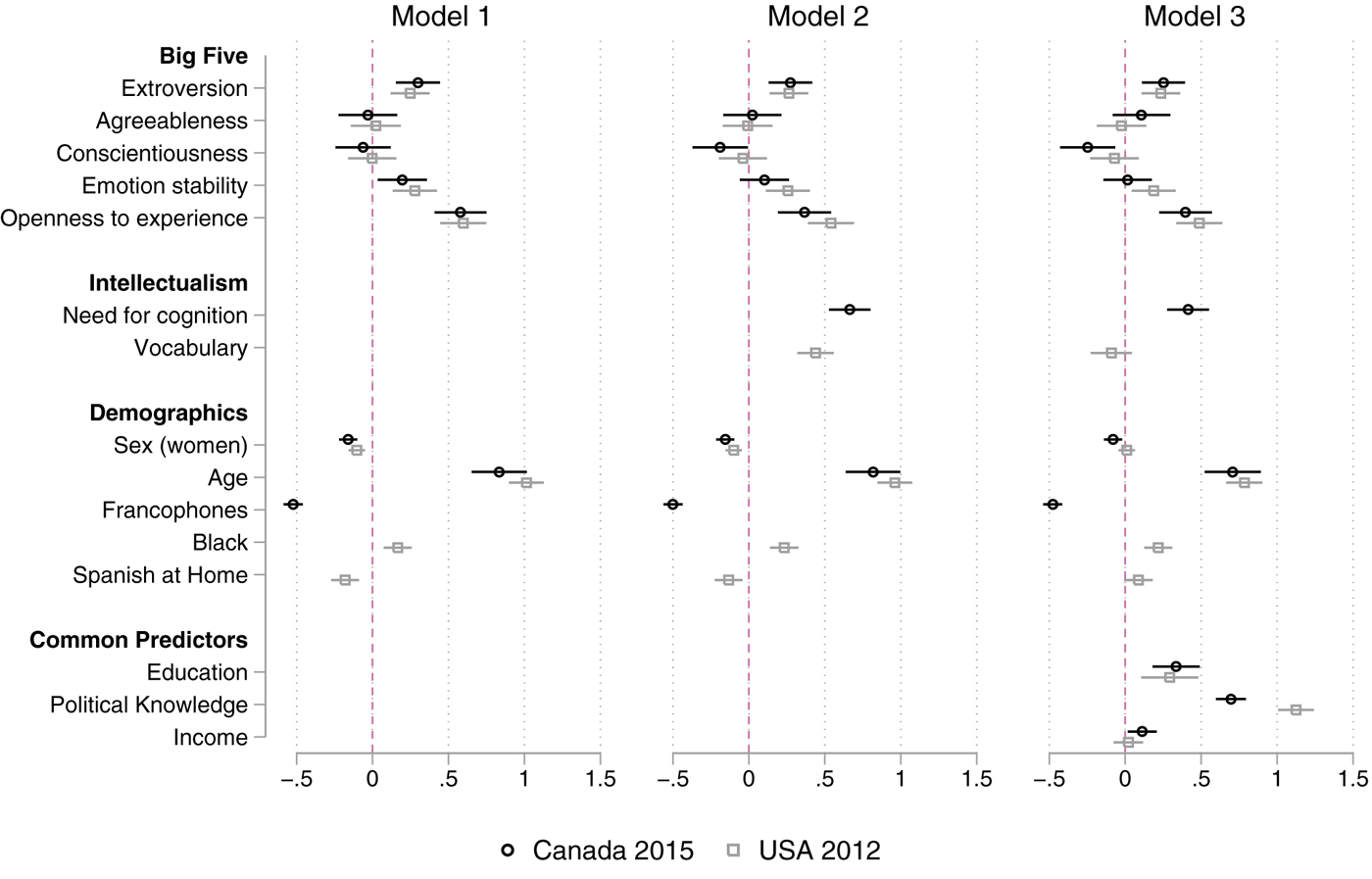
Past research has shown that openness is positively related to interest in politics (for example, Gerber et al. Reference Gerber, Huber, Doherty and Dowling2011a, Reference Gerber, Huber, Doherty and Dowling2011b; Mondak Reference Mondak2010; Mondak and Halperin, Reference Mondak and Halperin2008). Since interest is obviously related to political knowledge, I sought to determine whether the former relationship held when intellectualism was considered. Figure 2 reports the results of three regression models similar to the models specified previously. The succession of models followed the same logic: model 1 was a baseline model including the Big Five traits along with control variables at an equivalent place in the causal sequence, model 2 included the intellectualism variables, and to model 3, common predictors of political interest were added to test the robustness of the findings.
Political Interest and Personality Traits in Canada and the US

In model 1, openness showed a positive and significant impact on political interest both in the CES 2015 and the ANES 2012 cohorts. Highly open Canadians were 0.58 SD more interested in politics, while similar Americans were more interested in politics by 0.60 SD. The effects of the other four traits were also very similar for both studies. Extroversion and emotional stability yielded positive and significant impacts on political interest, while conscientiousness and agreeableness had no significant effects.
Intellectualism variables were included in model 2. The effect of openness remained largely unaffected; it remained positive and significant. The effects of openness were very similar in magnitude to the results of model 1. Moreover, Canadians who showed a high need for cognition were approximately 0.66 SD more interested in politics, whereas verbally skilled Americans were more interested in politics by approximately 0.44 SD.
Finally, model 3, which included the other standard predictors of political interest and the impacts of openness to experience, remained largely unaffected by the inclusion of these controls. Interestingly, while need for cognition remained positive and significant in the CES 2015 cohort (0.39 SD), vocabulary skills became nonsignificant in the ANES 2012 cohort. This points to a possible difference in the impact of intellectualism as a personality trait, that is most likely captured by need for cognition, intellectualism as pure cognitive skills, best captured by the vocabulary score in the US. Again, further tests showed that the general pattern was similar when the four other Big Five traits were excluded from the models (see Table 6 of the online appendix).
The intellectualism variables used thus far had similar effects on political knowledge, which had the advantage of not being a self-reported measure since it could be checked against reality. But the impact of these variables differed when political interest was considered. Need for cognition, which is closer to intellectualism as a personality trait, yielded a positive impact on political interest, even when further controls were included. In contrast, vocabulary skills, which were more likely linked to cognitive skills, did not. Additionally, model 2 in Figure 1 shows that openness became nonsignificant in the CES 2015 data as soon as need for cognition was included. Although the inclusion of vocabulary skills in the ANES 2012 data diminished the magnitude of the effect of openness by approximately 50%, it remained positive and significant. Since cognitive skills and intellectualism as a personality trait may be two different things, the next test was aimed at determining whether including a need-for-cognition variable in the ANES 2012 model that also included verbal skills would yield similar results as the CES 2015 model. Moreover, cognitive skills are expected to foster intellectualism as a personality trait, which leads to the question of their respective impacts when both are considered.
Intellectualism and Cognitive Skills
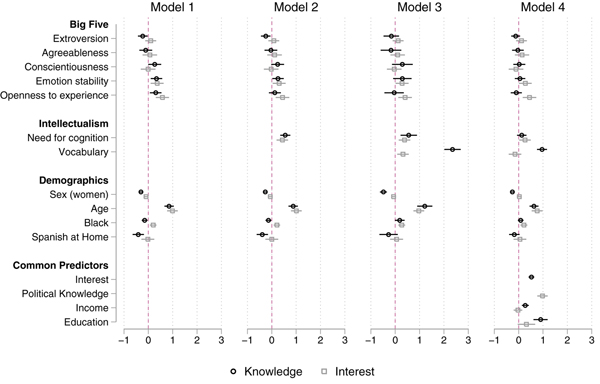
Thus far, this analysis has been limited to the CES and the ANES, which were conducted during their respective national elections in 2015 and 2012. Fortunately, in 2013, respondents from a subsample of the ANES 2012 were recontacted through the ANES 2013 recontact study, which included three items pertaining to need for cognition. First, the results for the need-for-cognition variable in the ANES 2012 study were compared to those obtained using the CES 2015 data. My hypotheses were that individuals scoring high on the need-for-cognition scale would also exhibit more political knowledge and interest and that the impact of openness to experience would become nonsignificant when need for cognition was included. I also wanted to know whether the expected impact of need for cognition would hold when considering verbal skills, which are very likely to capture cognitive skills. Hence, the goal was also to compare the respective impacts of intellectualism as a personality trait and as real intellectual skills. Figure 3 shows the results of four linear regression models predicting a respondent's political knowledge and interest in politics. Again, all predictors were recoded to range from 0 to 1, and both dependent variables were standardized.
Intellectualism and Verbal Skills' Impact on Political Knowledge and Interest -- ANES Recontact Study

In model 1, the first models from Figures 1 and 2 were replicated using only the respondents who were also in the ANES 2013 recontact study. The results were very similar, with small differences regarding the impact of conscientiousness and extroversion on political knowledge. Most importantly, using this smaller dataset, openness to experience still had a positive and significant impact on both political knowledge and interest.
In model 2, the need for cognition measurement available in the ANES 2013 recontact study was also included. Openness to experience exhibited a nonsignificant impact on political knowledge once that measure was included, whereas no other Big Five traits were affected. Open individuals still expressed significantly more interest in politics by approximately 0.4 SD. Hence, the results from model 2 replicated those from the CES 2015 data. Openness to experience had a positive and significant impact on political knowledge, but this effect vanished when need for cognition was included.
Verbal skills were included in model 3, and they yielded a positive impact on both political knowledge and interest. Highly skilled respondents were able to answer approximately 2.3 additional political knowledge questions (≈1.4 SD), and they reported more interest in politics by approximately 0.3 SD. However, the impact of need for cognition remained positive and significant. Respondents with a high need for cognition correctly answered approximately 0.56 additional political knowledge questions (0.32 SD), and they reported more interest in politics by approximately 0.38 SD.
The evidence is clear that intellectualism as a personality trait has an independent impact that remains meaningful even when a measure closely related to cognitive skills is included. To further test the robustness of these findings, common predictors of political knowledge and interest were included in model 4. The impact of vocabulary skills on political knowledge was slightly reduced, but it remained significant; those who scored high on that scale were able to correctly answer approximately 1.6 additional questions (~1 SD). The impact of verbal skills became nonsignificant for political interest, which was consistent the previous results of the full ANES 2012. The impact of openness remained largely unaffected, and the impact of need for cognition remained positive and significant for political interest. Respondents with a high need for cognition expressed more interest in politics by approximately 0.26 SD, but for political knowledge, the relationship became nonsignificant.
This last result could cast doubt on the real importance of intellectualism as a personality trait for political knowledge. However, personality traits are usually considered anterior to most of the common predictors of political knowledge that were included in model 4. This is especially true for education, which is much more likely to be explained by need for cognition than to explain it. To test this possibility, I replicated model 4 without education. (Results are available for model 5 in Table 8 of the online appendix). While the impacts of verbal skills and openness to experience were largely unaffected by this exclusion, need for cognition regained statistical significance at the 0.05 level. In that model, respondents with a high need for cognition were able to correctly answer approximately 0.35 extra political knowledge questions (0.21 SD). Interestingly, the impact of verbal skills on political interest remained nonsignificant in the model excluding the education control. Again, robustness checks were conducted in models excluding the four Big Five traits that were not under consideration, and the general patterns of the results were similar (see Tables 9 and 10 of the online appendix).
Overall, this analysis shows that although verbal skills are among the strongest predictors of political knowledge, they have a weaker impact on political interest. More importantly, intellectualism—as measured by need for cognition—has a positive impact on both political knowledge and interest that remains meaningful when a variable close to cognitive abilities is considered. Openness to experience is positively related to political interest, but highly open individuals are not more informed. While these individuals seem to think of themselves as being more interested in politics, there is no evidence that this higher interest translates into real political knowledge.
Political Discussion and Exposure to Conflict
Despite these findings, the aesthetic facet of openness to experience may be relevant to political knowledge in indirect ways. Research linking personality traits to social networks has shown that personality profiles do influence various aspects of an individual's interactions with others. Notably, personality traits have been shown to impact political discussion (for example, Gerber et al., Reference Gerber, Huber, Doherty and Dowling2012; Hibbing et al., Reference Hibbing, Ritchie and Anderson2011; Mondak and Halperin, Reference Mondak and Halperin2008; Mondak et al., Reference Mondak, Hibbing, Canache, Seligson and Anderson2010; Mondak Reference Mondak2010), and this is important because exposure to political discourse is expected to increase political awareness, especially when individuals are exposed to heterogeneous points of view (Huckfeldt et al., Reference Huckfeldt, Mendez and Osborn2004; Mutz Reference Mutz2002a, Reference Mutz2002b). While it is possible to discuss politics only with those with whom one agrees, political discussion can also lead to disagreement, and personality traits are linked to how individuals react to conflict. For instance, high levels of agreeableness are related to conflict avoidance (Jensen-Campbell and Graziano, Reference Jensen-Campbell and Graziano2000), and open individuals are likely to be more at ease with disagreement because of their appreciation for diversity and exploration. Interestingly, Gerber et al. (Reference Gerber, Huber, Doherty and Dowling2012) found that open individuals avoided discussing politics when there was disagreement, yet they expressed a preference for disagreement on sensitive topics and had a lower tendency to report avoiding such discussions. Additionally, Testa et al. (Reference Testa, Hibbing and Ritchie2014) showed that people with a positive orientation toward conflict benefit more, in terms of political knowledge and tolerance, from political disagreement than individuals with negative dispositions toward conflict. Hence, openness to experience may foster political knowledge through exposure to political discussions and disagreement in an individual's social network.
The CES 2015 data allowed me to test this possibility. Canadian respondents were asked how many days of the week they typically discuss politics and the news with family members, as well as their friends. These two items (Cronbach's alpha of 0.83) were combined in one indicator capturing respondents’ exposure to political discussion. Similarly, respondents were asked to indicate how many times in the past 12 months they had a discussion with someone who disagreed with their political views (that is, never, more than once, a few times, more than five times). Interacting these indicators with openness experience while controlling for need for cognition facilitated a test of the potential impact of openness on political knowledge once a more precise measure of intellectualism was also included. Additionally, since intellectualism can also be expected to interact with exposure to political discussion and disagreement, this possibility was also tested.
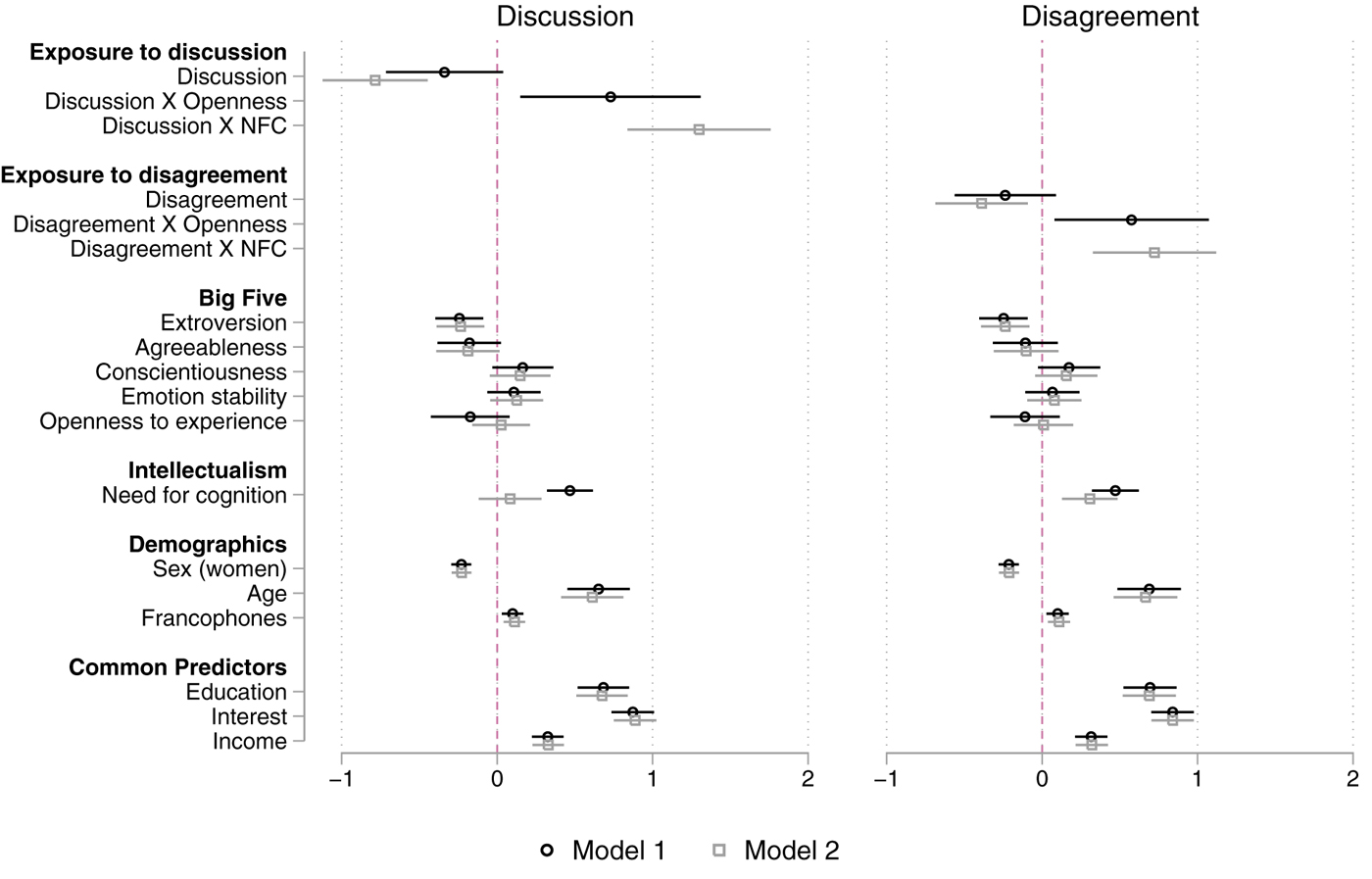
Figure 4 displays the results of four regression models predicting political knowledge in the CES 2015 data. The panel on the left shows the impact of exposure to political discussion, and the panel on the right shows the impact of disagreement. Apart from the inclusion of the two new variables and the interaction terms, all models are presented in a similar way as the fully controlled models presented earlier. In both panels, the first model examined the impact of openness to experience that also interacted with the relevant variable, and the second model did the same with need for cognition. In all cases, all interactive terms yielded positive and significant coefficients.
Political Knowledge and Exposure to Discussion and Disagreement in Canada

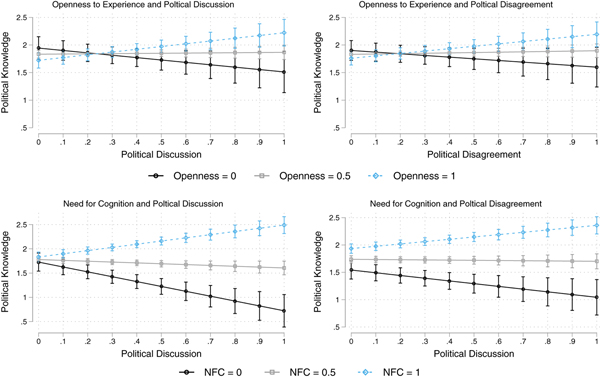
To better grasp the substantive impacts of these interactions, Figure 5 displays model-based predictions of the relevant interaction terms. Clearly, the more Canadians were open to experiences, the more they benefited from exposure to political discussion and disagreement. For instance, Canadians who scored the highest on openness correctly answered approximately 1.7 additional political knowledge questions than when they were not exposed to political discussion at all. Their performance increased to approximately 2.2 additional correct answers when they were highly exposed to political discussion. Among Canadians who scored low on openness, the average number of correct answers was approximately 1.9 higher when they were not exposed to discussion, and those who were highly exposed gave approximately 1.5 additional correct answers. Similarly, highly open Canadians who were not exposed to political disagreement were able to answer approximately 1.8 additional political knowledge questions correctly, and those who were highly exposed to disagreement exhibited a better performance, at approximately 2 additional correct answers.
The Effect of Openness to Experience and Need for Cognition on Political Knowledge as a Function of Exposure to Political Discussion and Disagreement

The pattern regarding need for cognition appears to be even stronger. Respondents with a high need for cognition correctly answered approximately 1.8 more political knowledge questions when they were not exposed at all to political discussion, and their performance increased to approximately 2.5 additional correct answers when they were highly exposed. On the contrary, respondents with low need for cognition gave approximately 1.7 more correct answers when they were not exposed at all to political discussion, and their performance significantly decreased to approximately 0.7 additional correct responses when they were highly exposed to discussion. The figures for exposition to disagreement are roughly similar. Canadian respondents with high need for cognition correctly answered approximately 1.9 more knowledge questions when they were not exposed to disagreement, and their performance increased to approximately 2.4 more correct answers when they were highly exposed. Respondents with low need for cognition who were not exposed to disagreement were able to answer an average of 1.5 additional knowledge questions, and their performance decreased to an average of 1 additional correct answer when they were highly exposed to disagreement. Hence, our results using the CES 2015 data set are in line with those of Testa et al. (Reference Testa, Hibbing and Ritchie2014).
In the ANES 2012, American respondents were asked how many days in the past week they had discussed politics, but they unfortunately were not asked any question capturing their exposure to political disagreement. Nonetheless, the available measure of exposure to political discussion was used and the models from the left panel of Figure 4 were replicated using the ANES 2012 data, adapting the controls. The results from the CES 2015 data could not be replicated for openness to experience or verbal skills (see models 1 and 2 of Table 12 of the online appendix). Using the ANES 2013 recontact study data and the available need for cognition measurement, the CES 2015 findings could not be replicated (see Models 3 Table 12 of the online appendix). In all cases, the ANES 2012 data produced nonsignificant interaction terms with political discussion. For that reason, I am reluctant to posit a firm conclusion regarding the interaction of political discussion and disagreement with openness and need for cognition. Nonetheless, these results from CES 2015 data suggest that openness to experience may have an indirect impact on political knowledge through Canadians behaviours toward political discussions and disagreement.
Discussion
Among the Big Five personality traits that have recently acquired popularity in political science, the trait labelled “openness to experience” should be more carefully analyzed. Psychologists do not agree on the meaning of the trait, which has always been characterized by a tension between its intellectual and aesthetic components. Past research has shown that openness to experience has a positive relation to political knowledge, and this should mostly be explained by the intellectual aspect of openness and not by its aesthetic facet.
Three different data sets were analyzed in the present study: the 2015 Canadian Election Study (CES 2015), the 2012 American National Election Study (ANES 2012), and the ANES 2013 Internet Recontact Study, which consists of a randomly selected subsample from the ANES 2012. The ANES 2012 and the CES 2015 both used the TIPI scale to measure the Big Five traits. The CES 2015 contains items tracking need for cognition, which was used as a measure of intellectualism, while the ANES 2012 used a measure of verbal skills that is more closely related to cognitive abilities. Moreover, the ANES 2013 Recontact Study included three need-for-cognition items, which allowed further investigation of the independent impacts of intellectualism as a personality trait and pure cognitive skills.
In the ANES 2012 and the CES 2015, openness to experience showed a positive effect on political knowledge that was greatly reduced (in the ANES 2012) or vanished (in the CES 2015) when variables capturing intellectualism, that is, verbal skills (in the ANES 2012) and need for cognition (in the CES 2015) were included. The ANES 2013 recontact study was used to replicate the findings regarding need for cognition, and to test the robustness of the effect when verbal skills, which were used as a proxy for cognitive skills, were also included. The results obtained in the CES 2015 data set were replicated in the ANES 2013 recontact study, where openness to experience had a positive and significant impact on political knowledge that vanished when need for cognition was considered. This finding reinforces confidence that the real mechanism by which openness has been found to positively affect political knowledge occurs through its relation to intellectualism.
Moreover, these results support the argument that intellectualism as a personality trait does play a significant role, even when controlling for cognitive skills. Since openness to experience and cognitive skills are known to be related (Ackerman and Heggestad, Reference Ackerman and Heggestad1997; Austin et al., Reference Austin, Deary, Whiteman, Fowkes, Pedersen, Rabbitt, Bent and McInnes2002; Brand, Reference Brand1994; Chamorro-Premuzic et al., Reference Chamorro-Premuzic, Moutafi and Furnham2005; Furnham et al., Reference Furnham, Moutafi and Chamorro-Premuzic2005; McCrae, Reference McCrae1994; Moutafi et al., Reference Moutafi, Furnham and Crump2003, Reference Moutafi, Furnham and Paltiel2005; Zeidner and Matthews, Reference Zeidner and Matthews2000;), we can obviously expect that it is the same for intellectualism and cognitive skills. Thus, this article also provides further reassurance that intellectualism matters.
Additionally, this analysis shows that although highly open individuals seem to express more interest in politics, they are not more informed as a result. Hence, the article supports the argument that intellectualism, and not openness to experience per se, is what really drives political knowledge from different data sets using different measures. These results regarding openness and political interest are also in line with the findings of Gerber et al. (Reference Gerber, Huber, Doherty and Dowling2011a) and Gerber et al. (Reference Gerber, Huber, Doherty and Dowling2011b). In both articles, the authors found positive relationships between openness and political interest. While verbal skills has a strong and robust impact on political knowledge, their effect on political interest was somewhat inconsistent when further controls are included. By contrast, intellectualism had a positive and robust impact on political interest. The latter is a personality trait that is likely to foster an individual's taste for various domains, while verbal skills provide the necessary abilities to become competent in an abstract domain such as politics. Political sophistication has typically been understood as the triangulation of means, motives and opportunities (Delli Carpini and Keeter, Reference Delli Carpini and Keeter1996; Luskin, Reference Luskin1987). Hence, while personality traits are likely to provide motives and therefore increase the occurrence of learning opportunities, cognitive skills are clearly related to the means since they provide the processing power to learn from these opportunities.
Therefore, the potential impacts of openness to experience and need for cognition on people's ability to learn from political discussion and disagreement were investigated further. Looking again at the CES data, openness to experience and need for cognition significantly interacted with an individual's reported frequency of political discussion and disagreement. Highly open individuals who discussed more about politics with their friends and family, and who reported having experienced more disagreement about political issues, were also more informed, as were Canadians with high levels of need for cognition. By contrast, Canadians scoring low on the two traits and having experienced greater political discussion and more disagreements tended to be less informed. Overall, these findings are in line with those of Testa et al. (Reference Testa, Hibbing and Ritchie2014), who showed that individuals who were positively disposed toward disagreement benefited from experiencing disagreement with others and became more informed and tolerant as a result.
Although the ANES 2012 data did not include a measure capturing respondents’ exposure to political disagreement, I tested whether the CES 2015 results regarding frequency of discussion also held in the ANES 2012 data. They did not. For that reason, I am reluctant to offer any firm conclusion on these interactive effects. However, the fact that these effects were systematic in the CES 2015 data, and the fact that openness to experience proved to have an interactive impact with the frequency of political discussion and exposure to disagreement, even when need for cognition was accounted for, clearly suggest that further research is warranted. Hence, these results open an avenue for future research about political sophistication and knowledge.
Supplementary material
To view supplementary material for this article, please visit https://doi.org/10.1017/S000842391800046X
Acknowledgments
I would like to thank Patrick Fournier, Romain Lachat, Richard Nadeau, Frédérick Bastien, Peter Loewen, Robert Luksin and the anonymous reviewers for their comments and suggestions. I would also like to thank the Fonds de recherche du Québec-Société et culture for their financial support.