INTRODUCTION
The leishmaniases are considered zoonoses where humans are accidental hosts. Natural vertebrate hosts include mammals of the Cingulata, Pilosa, Carnivora, Rodentia, Primate, Marsupialia and Perissodactyla orders. The primary hosts are wild mammals, such as rodents and canids (Ashford, Reference Ashford1996). Globally, more than 30 species of trypanosomes have been recorded in over a hundred of species of bats (Molyneux, Reference Molyneux, Kreier and Baker1991). In the Americas, families of the Phyllostomidae, Vespertilionidae and Molossidae are the most commonly infected bats (Brener and Andrade, Reference Brener and Andrade1979).
Despite its close relationship with trypanosomatids, the role of bats in the biological cycle of Leishmania has receiving increasing attention. However, some species of sand flies can live in the same locations inhabited by these mammals, such as caves, crevices, houses or abandoned buildings. In these environments, bats are a food source for insects (Lampo et al. Reference Lampo, Feliciangeli, Marquez, Bastidas and Lau2000) and vice versa. Some studies have reported direct (Mutinga, Reference Mutinga1975) and indirect evidence (Morsy et al. Reference Morsy, Salama and Abdel Hamid1987) that bats have been infected by Leishmania spp. The only report of parasites from the genus Leishmania isolated from bats was observed with the growth of Leishmania infantum (syn. L. chagasi) in a blood culture from the bat species Carollia perspicillata (De Lima et al. Reference De Lima, Rodriguez, Barrios, Avila, Canizales and Gutierrez2008). The presence of L. infantum, L. amazonensis and L. braziliensis DNA in bats was already demonstrated in studies conducted in Brazil (Savani et al. Reference Savani, de Almeida, de Oliveira Camargo, D'Auria, Silva, de Oliveira and Sacramento2010).
Diverse natural Leishmania infection in bats has been reported around the World (Mutinga, Reference Mutinga1975; Rajendran et al. Reference Rajendran, Chatterjee, Dhanda and Dhiman1985; Morsy et al. Reference Morsy, Salama and Abdel Hamid1987; Rotureau et al. Reference Rotureau, Catzeflis and Carme2006; De Lima et al. Reference De Lima, Rodriguez, Barrios, Avila, Canizales and Gutierrez2008; Savani et al. Reference Savani, de Almeida, de Oliveira Camargo, D'Auria, Silva, de Oliveira and Sacramento2010; Shapiro et al. Reference Shapiro, da Costa Lima Junior, Dorval, de Oliveira Franca, Cepa Matos Mde and Bordignon2013; Millan et al. Reference Millan, Ferroglio and Solano-Gallego2014a ; Berzunza-Cruz et al. Reference Berzunza-Cruz, Rodriguez-Moreno, Gutierrez-Granados, Gonzalez-Salazar, Stephens, Hidalgo-Mihart, Marina, Rebollar-Tellez, Bailon-Martinez, Balcells, Ibarra-Cerdena, Sanchez-Cordero and Becker2015). These findings suggest their possible epidemiological incrimination in the transmission cycle of Leishmania. The aim of this study was to investigate the presence of Leishmania DNA in blood samples of bats captured in a region considered non-endemic for Leishmaniasis in Brazil (Triângulo Mineiro and Alto Paranaiba regions of Minas Gerais).
METHODS
Study area and capture of bats
Bats were captured in a study conducted previously in different rural regions of the Triangulo Mineiro (Agua Comprida S21°54′0″, W45°40′0″; Conceição das Alagoas S19°54′51″, W48°23′11″; Conquista S19°56′20″, W47°32′38″; Uberaba S19°45′27, W47°55′36″; Uberlandia S18°54′41″, W48°15′44″) and Alto Paranaiba (Araxá S19°35′36″, W46°56′27″; Nova Ponte S19°9′46″, W47°40′42″ and Perdizes S19°21′19″, W47°16′58″) (Bento, Reference Bento2006; Bento, Reference Bento2013). These regions are areas of ‘cerrado’ (Brazilian savanna) (Ab'sáber, Reference Ab'sáber and Ferri1971; Alho, Reference Alho and Pinto1993; Rizzini, Reference Rizzini1997). Climate in most of the study area is classified as Aw (Tropical savannah climate, with summer rains) with two defined seasons (dry and rainy). The rains occur most often in the hottest season from October to March, when the average minimum temperature is higher than 18 °C. The dry season is between April and September. The annual precipitation varies between 1400 and 17 000 mm, and is concentrated between December and February (Motta, Reference Motta1993). These regions were classified as non-endemic areas by the time bat were captured. The captures occurred during the night, between approximately 18 and 24 h, using mist nets, dip nets or manually. The taxonomic classification of the captured bats was conducted using keys for the family (Gregorin, Reference Gregorin and Taddei2002), genus and species (Vizotto and Taddei , Reference Vizotto and Taddei1973; Reis et al. Reference Reis, Peracchi, Pedro and Lima2007).
Blood collection
From each of the 448 bats captured, 0·5–1·0 mL of blood was collected by cardiac puncture and blood samples were preserved in guanidine-EDTA solution V/V (6 m Guanidine–HCl and 0·2 m disodium EDTA, pH 8·0) and stored at 4 °C.
DNA extraction and polymerase chain reaction (PCR)
The DNA extraction from blood was performed using the phenol–chloroform method (Gomes et al. Reference Gomes, Macedo, Vago, Pena, Galvao and Chiari1998). In order to amplify Leishmania DNA, we employed primers Jw11 (5′-CCTATTTTACACCAACCCCCAGT-3′) and Jw12 (5′-GGGTAGGGGCGTTCTGCGAAA-3′) targeting the Leishmania kDNA region (Nicolas et al. Reference Nicolas, Prina, Lang and Milon2002). The electrophoresis was performed in agarose gel 1% stained with GelRed™ 1× (Biotium, USA) and visualized in UV transiluminator.
The positives sample for kDNA was performed PCR of the partial region of the cytochrome b gene (marker encoded on maxicircles), it was amplified in a total volume of 50 µL containing 1× of buffer, 100 mm of dNTPs, 50 pm of each primer, 1·25 U of GoTaq Polymerase (Promega) and 10 ng of DNA. The PCR products were precipitated with 70% and sequenced by the dideoxy-terminal method in an automated capillary sequencer (AB3730, Applied Biosystems) by both strands in ACTGene Analises Moleculares (Brazil). The sequences were submitted to BLASTn for similarity search with Leishmania sequences deposited on the databases. Since Cytb marker is not able to discriminate L. braziliensis from L. peruviana species, the positive samples were subsequently typed by the direct sequencing of HSP70 as recommended elsewhere (Hernandez et al. Reference Hernandez, Alvarez, Gonzalez, Ayala, Leon and Ramirez2014; Ramirez and Galetti, Reference Ramirez and Galetti2015).
Identification of Leishmania species
The resulting sequences were edited in MEGA 5·0 and aligned using ClustalW 1·8 with sequences from L. donovani donovani (AB095957), L. donovani infantum (AB095958), L. donovani chagasi (AB095959), L. tropica (AB095960), L. major (AB095961), L. aethiopica (AB095962), L. mexicana mexicana (AB095963), L. amazonensis (AB095964), L. garnhami (AB095965), L. braziliensis (AB095966), L. panamensis (AB095968), L. guyanensis (AB095969), L. equatoriensis (AB434687), L. pifanoi (EF579907), L. lainsoni (AB433280), L. colombiensis (KF302738) and L. peruviana (AB433282) retrieved from GeneBank as suggested by different studies (Luyo-Acero et al. Reference Luyo-Acero, Uezato, Oshiro, Takei, Kariya, Katakura, Gomez-Landires, Hashiguchi and Nonaka2004). A maximum composite likelihood (MCL) analysis using a Tamura-3 parameter was run in MEGA 7·0. To evaluate the robustness of the nodes in the resulting phylogenetic tree, 1000 bootstrap replicates were performed. All sequences obtained in this work were deposit in the Genbank (MF344824–MF344895).
Statistical analysis
The Chi-square (χ 2) test was used to determine possible associations between variables (feeding habits and county capture) and positive PCR results for Leishmania sp. using Statistica software 10·0 (Statsoft, Tulsa, OK, 2011), with a significance level of 5% (P < 0·05).
Ethical considerations
This study was approved by the Ethics Committee for Use of Animals (CEUA) of the Federal University of Triângulo Mineiro, protocol n. 51 and authorized by the Brazilian Environmental Institute (IBAMA) under licenses: 076/2003, 121/2004, 143/06-NUFAS/MG and 13206-1.
RESULTS
Leishmania infection
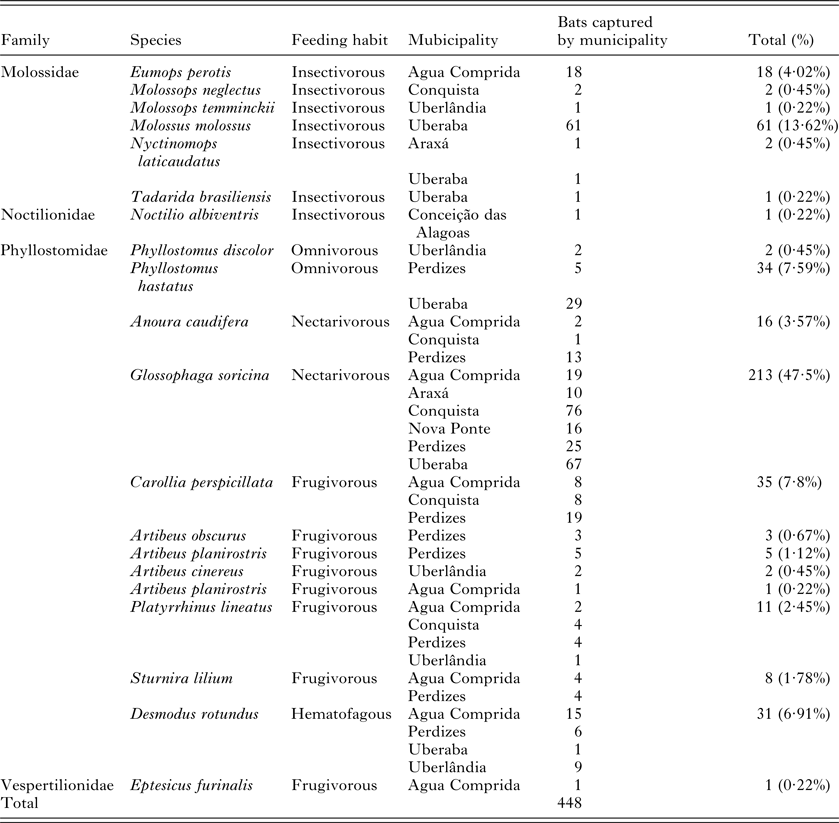
Blood samples of 448 bats representing 20 different species captured in eight districts of Triângulo Mineiro and Alto Paranaiba, MG, Brazil (Table 1) were analysed. In five out of the eight studied municipalities, 36 bats were positive for Leishmania spp. The highest frequency of bats infected with Leishmania was in Água Comprida (11·4%), followed by Conquista (9·9%), Uberaba (9·4%), Araxá (9·1%) and Perdizes (3·6%). Regarding the bat's alimentary habit, the highest percentage bats that tested positive of Leishmania spp. DNA were insectivores (12·6%), followed by omnivores (8·3%), nectarivores (7·5%), frugivorous (6·1%) and haematophagous (3·2%). However, there was no significant association between feeding habits and presence of Leishmania sp. (P = 0·416) or the municipality of origin (P = 0·431).
Bat species captured in Minas Gerais, Brazil by family, feeding habits and county origin

Identification of Leishmania species
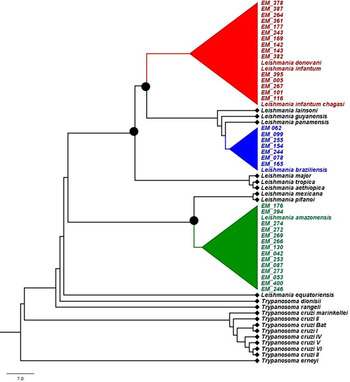
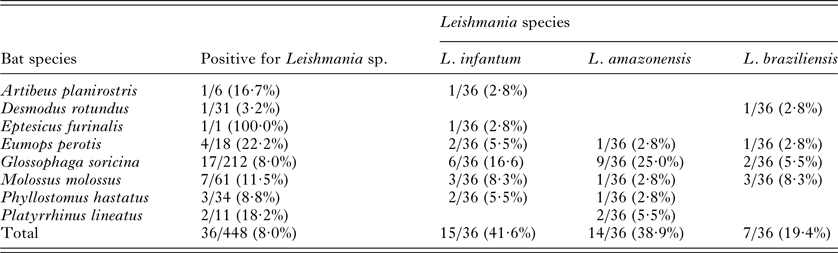
Eight out of the 20 species of bats captured were positive for Leishmania spp. (40·0%). The species with multiple representative samples that had the highest rate of Leishmaina presence was Eumops perotis (22·2%), followed by Platyrrhinus lineatus (18·2%), Artibeus planirostris (16·7%), Molossus molossus (11·5%), Phyllostomus hastatus (8·8%), Glossophagas soricina (8·0%) and Desmodus rotundus (3·2%) (Table 2). Additionally, only one species of Eptesicus furinalis was captured, and it was found to positive for Leishmania spp. (Table 2). Leishmania species identified in the infected bats were: L. infatum in 41·6%, L. amazonensis in 38·9% L. braziliensis in 19·4%, respectively (Table 2). These results were supported by the maximum-likelihood (ML) phylogenetic tree constructed based on Cytb marker (Fig. 1).
Molecular phylogenetic analysis by the maximum-likelihood (ML) method. The evolutionary history was inferred by using the ML method based on the Tamura–Nei model. The tree with the highest log likelihood (−2763,0697) is shown. Initial tree(s) for the heuristic search were obtained automatically by applying Neighbour-Join and BioNJ algorithms to a matrix of pairwise distances estimated using the maximum composite likelihood (MCL) approach, and then selecting the topology with superior log likelihood value. The analysis involved 61 nucleotide sequences. Codon positions included were 1st+2nd+3rd+Non-coding. All positions containing gaps and missing data were eliminated. There were a total of 405 positions in the final dataset. Black dots indicate bootstrap values over 80%.

Positivity for Leishmania species in bats captured in Minas Gerais, Brazil

DISCUSSION
Leishmaniases comprise a set of pathologies caused by different species of the genus Leishmania. This infection is considered an anthropozoonosis where more than 100 mammals have been naturally infected with these parasites. Among those mammal hosts, bats arise as some of the most important putative reservoirs of some Leishmania species. Herein, we investigated the presence of Leishmania DNA in bat's blood samples collected in areas of Triângulo Mineiro and Alto Paranaíba from Brazil that are considered non-endemic for leishmaniasis. We observed 8·0% of positive samples for Leishmania infection. Diverse studies have reported natural infection of Leishmania in bats suggesting a relevant epidemiological role in the transmission cycle of leishmaniasis (Rotureau et al. Reference Rotureau, Catzeflis and Carme2006; Savani et al. Reference Savani, de Almeida, de Oliveira Camargo, D'Auria, Silva, de Oliveira and Sacramento2010; Shapiro et al. Reference Shapiro, da Costa Lima Junior, Dorval, de Oliveira Franca, Cepa Matos Mde and Bordignon2013; Millan et al. Reference Millan, Lopez-Roig, Cabezon and Serra-Cobo2014b ; Berzunza-Cruz et al. Reference Berzunza-Cruz, Rodriguez-Moreno, Gutierrez-Granados, Gonzalez-Salazar, Stephens, Hidalgo-Mihart, Marina, Rebollar-Tellez, Bailon-Martinez, Balcells, Ibarra-Cerdena, Sanchez-Cordero and Becker2015; de Rezende et al. Reference de Rezende, Herrera, Carvalho, Carvalho Anjos, Ramos, de Araujo, Torres and de Oliveira2017). Also, the fact of finding Leishmania infection in a geographical region that is not considered endemic for leishmaniasis shows the relevant role that bats play for the dispersal of distinct pathogens as Leishmania. The ecology of these mammals highlights their putative importance as reservoirs of infectious diseases and zoonotic pathogens due to their high ability of mobility, broad distribution and social behaviour (communal roosting and fission–fusion social structure). Among these pathogens emerge rabies, severe acute respiratory syndrome (SARS), henipavirus, possibly Ebola and distinct Trypanosoma species (Halpin et al. Reference Halpin, Young, Field and Mackenzie2000; Guyatt et al. Reference Guyatt, Twin, Davis, Holmes, Smith, Smith, Mackenzie and Young2003; Li et al. Reference Li, Shi, Yu, Ren, Smith, Epstein, Wang, Crameri, Hu, Zhang, Zhang, McEachern, Field, Daszak, Eaton, Zhang and Wang2005; Hamilton et al. Reference Hamilton, Cruickshank, Stevens, Teixeira and Mathews2012a ,Reference Hamilton, Teixeira and Stevens b ).
Frugivores, insectivorous, omnivores and vampire bats were positive for the presence of Leishmania DNA, but no significant association was found between the bat-feeding preference and parasite infection rates (Brener and Andrade, Reference Brener and Andrade1979; Marinkellei, Reference Marinkellei1982) as observed in our study. The identification of Leishmania hosts is crucial to determine the natural transmission cycle of this parasite and to understand the epidemiology of the disease (Brandao-Filho et al. Reference Brandao-Filho, Brito, Carvalho, Ishikawa, Cupolillo, Floeter-Winter and Shaw2003). Some authors consider animals as potential reservoirs when the infection rate is above 20%, while lower percentages indicate that the animal is an accidental host (Berzunza-Cruz et al. Reference Berzunza-Cruz, Rodriguez-Moreno, Gutierrez-Granados, Gonzalez-Salazar, Stephens, Hidalgo-Mihart, Marina, Rebollar-Tellez, Bailon-Martinez, Balcells, Ibarra-Cerdena, Sanchez-Cordero and Becker2015). On the other hand, studies define a reservoir as one or more epidemiologically connected populations or environments in which the parasite can be permanently maintained and from which infection is transmitted to the defined target population (Haydon et al. Reference Haydon, Cleaveland, Taylor and Laurenson2002; Thompson and Etter, Reference Thompson and Etter2015). In this pragmatic scenario, bats from our study would not be considered strict reservoirs. This is clearly depicted to the fact that the area where bats were captured is not considered endemic for leishmaniasis. However, the presence of Leishmania DNA implies that the circulation of parasites could provoke future likely emergent outbreaks. In the light of our data, these findings represent relevant information in order to consider prevention and control strategies in the region.
The biggest limitation in the understanding of the ecology of leishmaniasis is the lack of sensitive markers for the identification and discrimination of Leishmania species. Traditionally, microscopic examination is considered the diagnostic routine method for identification of Leishmania. However, more sensitive methods such as the PCR have been developed as an alternative for the diagnosis and identification of Leishmania species. PCR platforms show sensitivity values between 92 and 100% and specificity of 100% (Shahbazi et al. Reference Shahbazi, Shahabi, Kazemi, Mohebali, Abadi and Zare2008; Mohammadiha et al. Reference Mohammadiha, Mohebali, Haghighi, Mahdian, Abadi, Zarei, Yeganeh, Kazemi, Taghipour and Akhoundi2013; Adams et al. Reference Adams, Gomez, Scheske, Rios, Marquez, Cossio, Albertini, Schallig and Saravia2014). For the amplification of DNA fragments of Leishmania species, the use of genetic targets such as kinetoplast DNA (kDNA), which has a sensitivity of 97% and a specificity of 87%, has been reported in several studies (Marques et al. Reference Marques, Volpini, Genaro, Mayrink and Romanha2001; Rodriguez et al. Reference Rodriguez, De Lima, Aguilar, Rodriguez, Barker and Convit2002). The internal heat shock protein 70 kDa (HSP70) also reflects a sensitivity of 95% and a specificity of 100% (Garcia et al. Reference Garcia, Parrado, De Doncker, Bermudez and Dujardin2007; Montalvo et al. Reference Montalvo, Fraga, El Safi, Gramiccia, Jaffe, Dujardin and Van der Auwera2014) and the transcribed internal spacer (ITS-1) with 40 and 96%, respectively (Marfurt et al. Reference Marfurt, Nasereddin, Niederwieser, Jaffe, Beck and Felger2003; Kumar et al. Reference Kumar, Bumb, Ansari, Mehta and Salotra2007; Ovalle Bracho et al. Reference Ovalle Bracho, Porras de Quintana, Muvdi Arenas and Rios Parra2007) and finally the small 18S ribosomal subunit with a similar behaviour as kDNA in terms of sensitivity and specificity (Adams et al. Reference Adams, Gomez, Scheske, Rios, Marquez, Cossio, Albertini, Schallig and Saravia2014). These are the most commonly used markers for the identification of Leishmania DNA by PCR and real-time PCR. Regarding the use of molecular markers used to discriminate in mammals, Cytb and 18S have been widely used in mammals (De Lima et al. Reference De Lima, Rodriguez, Barrios, Avila, Canizales and Gutierrez2008; Pinto et al. Reference Pinto, Ocana-Mayorga, Tapia, Lobos, Zurita, Aguirre-Villacis, MacDonald, Villacis, Lima, Teixeira, Grijalva and Perkins2015). Herein, we employed kDNA to detect Leishmania infection and subsequently amplified and sequenced Cytb. All samples positive by kDNA amplified by Cytb. kDNA represents around the 10% of Leishmania genome and Cytb marker is located in the maxicircle molecule with dozens of copies (Liu et al. Reference Liu, Liu, Motyka, Agbo and Englund2005). The number of copies suggests, Cytb is a very sensitive marker to conduct Leishmania species discrimination in mammals. This marker has been used in other trypanosomes with relevant results in terms of sensitivity (De Lima et al. Reference De Lima, Rodriguez, Barrios, Avila, Canizales and Gutierrez2008; Marcili et al. Reference Marcili, Speranca, da Costa, Madeira Mde, Soares, Sanches Cde, Acosta Ida, Girotto, Minervino, Horta, Shaw and Gennari2014; Ramirez and Llewellyn, Reference Ramirez and Llewellyn2014). Also, several authors have shown the high specificity of Cytb to discriminate Leishmania species (Foulet et al. Reference Foulet, Botterel, Buffet, Morizot, Rivollet, Deniau, Pratlong, Costa and Bretagne2007; Ramirez et al. Reference Ramirez, Hernandez, Leon, Ayala, Florez and Gonzalez2016) Therefore, future studies should consider Cytb as a suitable marker for Leishmania species discrimination in mammals.
A vast number of Leishmania species have been described in bats from Brazil such as L. infantum, L. amazonensis and L. braziliensis (De Lima et al. Reference De Lima, Rodriguez, Barrios, Avila, Canizales and Gutierrez2008; Savani et al. Reference Savani, de Almeida, de Oliveira Camargo, D'Auria, Silva, de Oliveira and Sacramento2010; de Rezende et al. Reference de Rezende, Herrera, Carvalho, Carvalho Anjos, Ramos, de Araujo, Torres and de Oliveira2017). Herein, we detected single infections of L. infantum, L. amazonensis and L. braziliensis, which highlights the epidemiological threat in the transmission to humans causing visceral, cutaneous and/or mucocutaneous leishmaniasis (Lemos and Lima Reference Lemos and Lima2005; Paula et al. Reference Paula, Souza, dos Reis, Limongi, Pajuaba Neto Ade and Rodrigues Ede2013). This work opens new perspectives to study the importance of bats in the epidemiology of leishmaniases, though the presence of amastigotes in the skin or blood of the animal has not been directly demonstrated, which would provide the greatest opportunity for phlebotomine infection.
In conclusion, our results showed that bats from the Triângulo Mineiro and Alto Paranaiba regions of Brazil are involved in the transmission cycles of L. infantum, L. amazonensis and L. braziliensis. The epidemiological importance of the role bats play in leishmaniasis has not yet been defined.
FINANCIAL SUPPORT
National Incentive Program for Research in Parasitology Basic/2010, Coordenação de Aperfeiçoamento de Pessoal de Nível Superior (CAPES). Process CNPq 307284/2014-0, productivity in research.
CONFLICT OF INTEREST
The authors declare that they have no conflicts of interest.