Introduction
Disasters caused by natural hazards are an important public health issue, as they increase morbidity and mortality rates.Reference Noji and Toole1 In the psychological literature, reviews of existing studies have evaluated whether disasters produced by natural or human-made hazards create the greatest psychological distress. Some analyses have found that disasters caused by natural events are considered to be out of one's personal control, and therefore, are more distressing than disasters for which one can attribute human responsibility.Reference Rubonis and Bickman2 Other reviews indicated that while disasters caused by natural hazards often result in feelings of helplessness, disasters produced by human factors cause the most distress due to the perception that the disaster was preventable. A strong drive to place blame may ensue, resulting in distressing anger and feelings of revenge directed at the perceived cause of the tragedy, (e.g., lax government regulations regarding safety measures, poor maintenance of equipment, the motives for causing the disaster).Reference Baum, Gatchel and Schaeffer3,Reference Halpern and Tramontin4 The intense negative emotional arousal adds to the distress of the disaster itself.
However, attributions of blame are but one psychosocial factor in the evolution of a disaster. The distinction between types of disasters becomes less clear in relation to its aftermath.Reference Leon5 For example, long-term human-made consequences following a hurricane or an earthquake, can include the deterioration of the community infrastructure, internal displacement and possible associated violence in refugee camps, and inadequate relief efforts. Therefore, overriding factors such as the number of physical injuries, fear of death, loss of property, and overall impact on the community have shown to be the strongest predictors of long-term psychological symptoms.Reference Halpern and Tramontin4,Reference Briere and Elliott6
Summaries of the literature have shown that female gender, minority status, and lower socioeconomic status are risk factors for the later development of psychological distress post-disaster.Reference Norris, Friedman and Watson7,Reference Shultz, Allen, Neria, Espinel and Bobrowsky8 In addition, pre-disaster psychopathology is a strong predictor of post-disaster symptoms and psychiatric diagnosis; chronic physical health problems also increase the risk for post-disaster psychological problems. Thirty months following a devastating fireworks explosion in the Netherlands, identified risk factors for post-disaster psychopathology were pre-disaster psychopathology and relocation.Reference Yzermans, Donker, Kerssens, Dirkzwager, Soeteman and ten Veen9
Populations impacted by fire disasters share a number of common health problems. For those in the area of the fires, immediate effects include burns, dehydration, and heat exhaustion; in addition, smoke inhalation can cause severe and permanent respiratory tract injuries.Reference Johnston10,Reference Stefanidou, Athanaselis and Spiliopoulou11 Studies of the aftermath of Australian bushfire disasters documented that the affected population is at increased risk for ongoing physical and psychological health problems over an extended period of time.Reference Johnston10 A one-year follow-up of survivors of the 1983 Ash Wednesday fires showed a higher prevalence of a number of health problems including hypertension, gastrointestinal disorders, and diabetes, compared to the general population.Reference Clayer, Bookless-Pratz and Harris12 Moreover, 42% met criteria for some type of psychiatric diagnosis, most commonly anxiety, depression, and/or post-traumatic stress disorder. A 20-month follow-up indicated continuing psychiatric morbidity in this population.Reference McFarlane, Clayer and Bookless13
The kinds of symptoms evident post-disaster may vary in relation to specific aspects of the fire aftermath. A 2–4 month follow up of the Baldwin Hills fire in California that caused widespread property damage indicated that being in the area during the fire was associated with future post-traumatic stress symptoms; the extent of loss was associated with depression symptoms.Reference Maida, Gordon, Steinberg and Gordon14 A 7–9-month follow-up of survivors of the Oakland/Berkeley California firestorm found that dissociative symptoms experienced in the immediate aftermath of the fire and future stressful life experiences predicted the later onset of post-traumatic stress symptoms.Reference Koopman, Classen and Spiegel15
The current study assessed the psychological status, subjective health evaluation, and personal attitudes and values of the population impacted by the 2007 wildfires on the Peloponnese Peninsula. The focus was on both the individual and the community effects of the fires. The strategy was to compare a randomized group that experienced the fire in the community with a demographically similar group from the same regions, but in areas not reached by the fires. The goal was to identify the psychosocial health needs of the fire victims, views on the major problems in their region, perceptions of trust in different institutions, and the measures through which government-level institutions could provide aid and support to these communities.
Overview of the Disaster
During the summer of 2007, a series of wildfires on the Peloponnese Peninsula of Greece destroyed a significant portion of the landmass, causing the loss of human lives, livestock, olive groves, private houses and public buildings, and a decline in tourism.16,17 The European Union classified this disaster as among the most lethal wildfire outbreaks since 1871 (European Parliament Resolution of 04 September 2007).
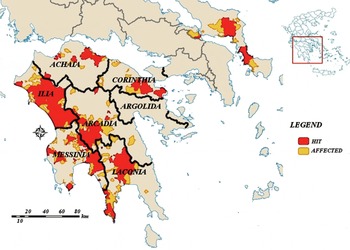
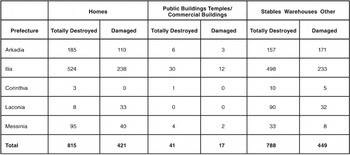
The disaster affected the areas of the Peninsula to a varying degree, according to which criterion is considered. Based on surface area, Ilia, Arkadia, and Laconia were the prefectures most affected (Figure 1); the greatest material damage occurred in Ilia and Arkadia. In terms of population distribution, Ilia and Messinia were the most affected (Table 1). The wildfires affecting these particular areas started near the end of August 2007 and remained uncontrolled for >4 days due to strong winds and the extreme drought that had struck the area during the preceding months. The Illia and Messinia region's micro-climate also was a contributing factor, as much of the affected area, in particular, the hardest hit region of Ilia, lies between a coastal zone and two mountain ranges. Villages in the lowlands and in semi-mountainous and mountainous regions within all four prefectures were affected. The wildfires caused the evacuation of 1,500 km2 (579 mi2) of forest areas, olive groves, cultivated areas, and villages (Table 1).16 The wildfires also threatened the archaeological grounds of Ancient Olympia in Ilia.
Map of the 2007 Greek wildfires.

Number of buildings damaged in the aff ected areas, by type and prefecture.

According to official data from the Agricultural University of Athens,17 a total of 502 municipal sections in the Peloponnese Peninsula were affected by the fires, constituting 35% of the total area covered by the seven prefectures of the Peninsula. The total area directly impacted by the wildfires was estimated at 1,772 km2 (684 mi2), 55% of which were forests and natural landscape, 41.1% agricultural, and the remainder were populated. The areas that were considered to be erosion hazards due to the effects of the fires totaled 2,230 km2 (861 mi2), while a total of 22.3% of the local nature preserves, as designated by Natura 2000, were destroyed. In terms of immediate losses, the initial data indicated that the areas most affected consisted primarily of forests, olive groves and, to a lesser extent, vineyards and other areas with fruit producing trees.17 There also was a substantial loss of livestock and beehives. In other areas with processing units (cheese factories, olive oil refineries, and wineries), the indirect loss due to the reduction of the production of raw materials was significant.
Major damage also was recorded in six rural tourism facilities.16 This damage was not limited to the physical damage to the facilities; the impact also was increased by the degradation of the surrounding environment, i.e., the public areas and the natural landscape, and the loss/evacuation of the human resources of the area. Furthermore, the wildfires directly affected the income and livelihoods of the local agricultural population. Significant after-effects included a decline in employment of the population living in the affected areas due to the general decrease in economic activity.17
The unique characteristics of the current research project lie in the fact that the disaster affected a Mediterranean country in an area that combines agricultural, processing, stock farming, and tourist activities. It also occurred at the peak of the summer season, during which a significant portion of urban inhabitants visit their ancestral lands. Their presence during the disaster likely contributed to the overall emotional impact of the event.
Methods
A survey was conducted using a comprehensive questionnaire individually administered to each of the participants. The population surveyed was drawn from the prefectures of Ilia, Messinia, Arkadia, Laconia, and Corinthia. Adult inhabitants 18–65 years of age who were living in villages declared struck by the wildfires were compared with a demographically similar group living in neighboring villages declared unaffected by the fires by a joint Ministerial Decree. The Fire Group consisted of 409 participants (215 males, 194 females); the Control Group, 391 participants (202 males, 189 females). The number of fire and control participants in each prefecture was proportional to the population distribution of the affected areas.
The questionnaire consisted of several sections: (1) demographic information; (2) views on general problems in the region and trust in institutions; (3) locus of control; (4) the SCL-90-R inventory; (5) self-perception of health; and (6) stressful life events. The SCL-90-R psychological inventory contains 90 items, nine primary symptom dimensions and three global indexes.Reference Derogatis18 It is designed to provide an overview of an individual's psychological symptoms and their intensity over a specific period, typically, the last seven days, the time period used in this study. Items are rated on a five-point scale ranging from “Not at all” to “Extremely”. The primary scales are as follows: Somatization, Obsessive-Compulsive, Interpersonal Sensitivity, Depression, Anxiety, Hostility, Phobic Anxiety, Paranoid Ideation, and Psychoticism. The Global Severity Index (GSI) is designed to measure overall psychological distress, and is a combination of number of reported symptoms and the rated intensity of perceived stress. The Positive Symptom Distress Index (PSDI) measures the ratings of the intensity of symptoms; the Positive Symptom Total (PST) measures the number of self-reported symptoms. The SCL-90-R has been translated into >24 languages, and >1,000 studies have been conducted demonstrating the reliability, validity, and usefulness of the instrument. A Greek version of the measure with psychometric properties similar to the English version was used in this study.Reference Donias, Karastergiou and Manos19
The questionnaire was administered via personal interviews conducted in the homes of the participants. The individual corresponding to the required gender and age as established by the sampling process was invited to participate. The respondents were briefed on the purpose of the study, the anonymity of their responses, and gave their consent before continuing. There were no financial incentives offered. In cases in which the educational level was low, the interviewer read the items out loud and recorded the answers, while in all cases, an auxiliary card containing the question at hand and the relevant answers was handed to the respondents to aid in the process. The study was conducted over a 14-day period, six months after the cessation of the fires.
Statistical Processing
Fifty-six questionnaires (16.3%) were rejected from the Fire Group as unreliable because the participant gave the same rating to all of the SCL-90-R items, or did not answer that section of the form; 129 questionnaires (49.2%) were rejected from the Control Group following the same criteria. The Control Group rejection proportion was significantly greater than in the Fire Group (p <0.001). The data analyses were conducted on 615 respondents with complete data: fire group n = 353; (182 males, 171 females); Control Group n = 262 (131 males, 131 females).
Analysis of variance of independent samples (ANOVA) was used to analyze the SCL 90-R data. Chi-square analyses were conducted to compare differences on the nominal data. The PASW statistics program by SPSS version 17.0.2 (SPSS, Inc., Chicago, IL) was used.
Results
Responder Demographic Characteristics
The demographic characteristics of both the Fire and the Control Group with valid and invalid data were compared. The invalid fire group responders compared to the fire group with valid data were statistically significantly younger (p <0.05), more educated (p <0.001), merchants (p <0.001), students (p <0.01), and less likely to be married (p <0.05). Similarly, the invalid Control Group responders compared to the Control Group with valid data were significantly younger (p <0.05), more educated (p <0.001), in white collar occupations (p <0.05), students (p <0.01), and less likely to be married (p <0.05).
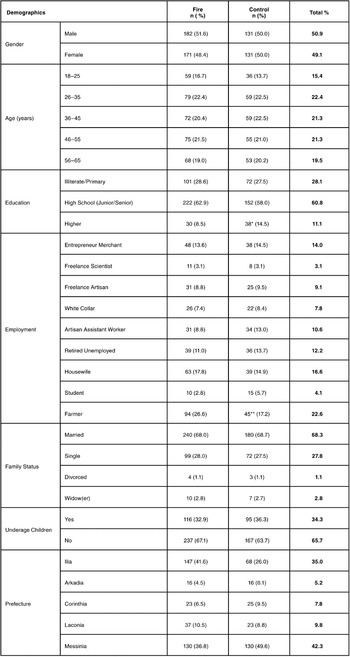
The demographics of the study sample with valid data that formed the sample for the subsequent statistical analyses are presented in Table 2, and indicated few statistically significant differences between the two groups. In both groups, the majority had completed high school, were married, and did not have underage children living at home. A significantly higher proportion of the Control Group had higher education (p <0.05); a significantly higher proportion of the Fire Group were farmers (p <0.01).
Demographic information on Fire and Control group participants with complete data (Fire Group: n = 353; Control Group: n = 262; *p <0.05; **p <0.01)

Psychological Distress
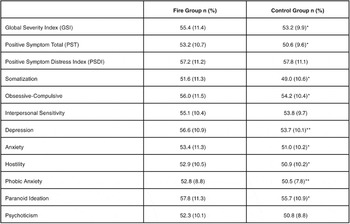
The SCL 90-R findings demonstrated statistically significant higher scores in the Fire Group on seven of the nine primary scales (Interpersonal Sensitivity and Psychoticism, not significant) and on the GSI and PST. For the Fire Group, the relatively highest t-scores were on the Paranoid Ideation (p <0.001), Depression (p <0.001), and Anxiety scales (p <0.05). The Paranoid Ideation scale results can be interpreted as reflecting suspiciousness about the motives of other people. Because of high correlations among the individual scales,Reference Donias, Karastergiou and Manos19 the global summary indexes are the most informative measures, indicating levels of overall psychological distress. On the GSI, the Fire Group t-score was 55.4 ±11.4 (1 standard deviation); Control Group, 53.16 ±9.9 (p <0.05). On the PST, the Fire Group t-score was 53.24 ±10.7; Control Group, 50.6 ±9.6) (p <0.05). The Positive Symptom Distress Index (PSDI) t-scores were as follows: Fire Group, 57.2 ±11.2; Control Group, 57.8 ±11.1 (not significant). While the statistically significant differences provide evidence of relatively greater distress in the Fire Group, it should be noted that the level of distress reported is only slightly above the standardized t-score mean.
The SCL 90-R primary scale and global index findings comparing the Fire and Control Groups are presented in Table 3.
Fire and control group t-score mean values on the SCL-90-R global indexes and primary scales. (Fire Group: n = 353; Control Group: n = 262; *p <0.05; **p <0.001)

Subjective Perception of Health Status
Subjects rated the following items on visual analog scales set from 0–100: “In general, how would you rate your health today?”, and “In general, how would you rate your health one year ago?”. There were no significant differences between the groups in current health ratings (Table 4). However, both the Fire and Control Groups rated their health one year ago as significantly better than at the present time; fire 78.4 vs. 74.0 (p <0.001); Control 75.8 vs. 74.3 (p <0.05).
Mean visual analog scale scores assessing subjective perception of health at the current time and in the previous year rated on a 100 point scale from 0 (Death) to 100 (Best level of health that you can imagine)

Fire Group: n = 353; Control Group n = 262
a Fire Group current vs. last year: p <0.001
b Control Group current vs. last year: p <0.05
c Fire Group current vs. Control Group current: not significant
d Fire Group last year vs. Control Group last year: not significant
Regional Problem Views
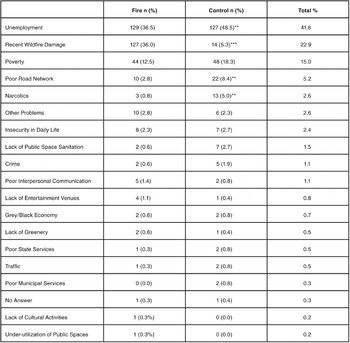
In response to the question “What is in your opinion the most important problem in the region where you live?”, Unemployment was designated by the largest proportion of participants in both groups, Fire Group = 36.5%; Control Group = 48.5%, and was significantly higher in the control group (p <0.01). Designation of Recent Wildfire Damage was as follows: Fire Group = 36.0%; Control Group = 5.3% (p <0.001); poverty: Fire Group = 12.5%; Control Group = 18.3% (not significant). Poor Road Network was chosen as: Fire Group = 2.8%; Control Group = 8.4% (p <0.01); Narcotics: Fire Group = 0.8%; Control Group = 5.0% (p <0.01). The proportion indicating the specific most important problem in their region is presented in Table 5.
Designation by the Fire and Control Groups of the most important problem in the region. (Fire Group: n = 353; Control Group: n = 262; **p <0.01; ***p <0.001)

Trust in Institutions
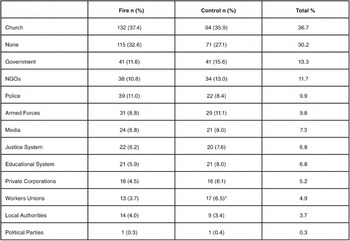
Findings in response to the item “Which two of the following institutions do you trust more today in Greece?” indicated that for both groups, the greatest trust was in the Church: Fire Group = 37.4; Control Group 35.9%; “None”: Fire Group 32.6%, Control Group = 27.1%. Trust in formal State or municipal institutions was relatively low; Government: Fire Group = 11.6%; Control Group = 15.6%; Police: Fire Group= 11.0%; Control Group = 8.4%; Local Authorities: Fire Group = 4.0%; Control Group = 3.4%. A significantly greater proportion of the Control Group indicated trust in Worker's Unions: Fire Group = 3.7%; Control Group = 6.5% (p <0.05). The complete findings are in Table 6.
Designation by the Fire and Control group of the two institutions most trusted in Greece. (Fire Group: n = 353;Control Group: n = 262; p <0.05)

Social Values
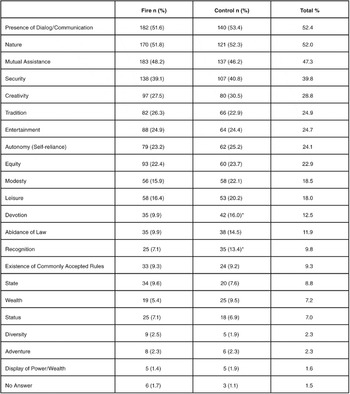
Participants were asked to choose up to five values in response to the item “Certain words correspond to various social values. Which of these values are the most important to you?” The proportion choosing particular values was quite consistent between the two groups; “Presence of a dialog-communication”: Fire Group = 51.6%, Control Group = 53.4%; “Nature”: Fire Group = 51.8%, Control Group = 52.3%; “Mutual Assistance”: Fire Group = 48.2%, Control Group = 46.2%; “Security”: Fire Group = 39.1%, Control Group = 40.8%. A significantly higher proportion of the Control Group indicated the following values: Devotion: Fire Group = 9.9%, Control Group = 16.0% (p <0.05); Recognition: Fire Group = 7.1%, Control Group = 13.4% (p <0.05). The complete findings are in Table 7.
Designation by the Fire and Control group of the (up to 5) most important personal social values. (Fire Group: n = 353; Control Group: n = 262; *p <0.05)

Discussion
The findings of this investigation conducted six months after the devastating 2007 Peloponnese Peninsula fires indicated greater psychological distress in the group that experienced the fires (Figure 1) compared to a demographically similar Control Group. Although the SCL-90-R scale and Global Summary scores were different between groups, it is important to note that the mean scores were within the normal range for both groups. Furthermore, although both groups perceived their health status one year previously as significantly better than at the current time, the subjective perception of current health status was high. These findings reflect considerable hardiness and resilience in the overall population, despite being impacted by a major disaster. In effect, these individuals have been able to cope with this disaster on a psychological level, even though the social and environmental effects were considerable.
This interpretation is consistent with the findings of a prior study comparing the fire and control groups' beliefs about locus of control, and also point to psychological strengths in the Fire Group.Reference Mellon, Papanikolau and Prodromitis20 A greater external locus of control was evident in the Fire Group, i.e., the belief that events that happen to the individual are outside of his/her personal control. These attributions can be considered psychologically adaptive because the fires and associated devastation were indeed out of their personal control.
Although the Control Group participants did not experience personal or property damage from the fires, they lived in the same regions as the Fire Group, and thus, were affected by similar factors, such as the closeness of the fires, concern that the fires might spread to their homes and farms, evacuation of people from neighboring areas, and media attention.Reference ten Veen, Morren and Yzermans21 Because the ongoing activities of the overall region were disrupted, including economic and work factors, greater access to community services as needed would have been helpful for the total group.Reference Green, Lindy, Grace, Gleser, Leonard, Korol and Winget22
The similarity of the total population surveyed also is reflected in the general lack of significant findings comparing the groups on their views of the most important problem in their region (other than the fires), trust in different institutions, and personal values. The wildfires, by significantly affecting the socioeconomic structure of the damaged areas, as well as the wider region over an extended period of time, amplified the existing and persistent economic problems of unemployment and poverty affecting the entire region, thus, adding to the distress caused by the disaster itself.Reference Quarantelli23 The needs of the overall community for improving the quality of their lives are demonstrated by the designation of the most important problems faced in their region: unemployment and poverty.
It is important to note that a considerable percentage of both groups did not consider any institution to be trustworthy; only 13.3% of the total sample indicated Government as one of the most trusted institutions (with no significant difference between the two groups). This fundamental image of a distant, unreliable, unilateral, and selective State is deeply rooted in the social culture of Greek rural populations, and may relate to policies of the State system, resulting in unequal development opportunities, distinctions between the center and the periphery, and different policies in different geographic regions.Reference Kataki24 A further source of friction with public authorities that results in additional stress is the cause and conditions of the fire, the degree to which it could have been avoided or contained, and the ensuing decisions regarding the reconstruction process.Reference Camilleri, Healy, McDonald, Nicholls, Sykes, Winkworh and Woodward25
On the other hand, it also is important to note that despite the presence of danger from disasters such as wildfires and the past experiences of such disasters, many people do not take preventive measures because they consider the government to be responsible for this task. According to Quarantelli,Reference Quarantelli23 this perceived obligation of the government is seen as more of an ethical than a legal obligation; therefore, after the disaster, the government is considered to be inadequate.
In contrast, local churches, the Archepiscopate, and foreign Orthodox organizations acted promptly to provide relief. In particular, the presence during the fire of local priests who distributed resources and provided psychological support, helped to establish the view of the church as the most reliable institution. The positive intervention of the church lies not only in its prompt presence within the area, but also in its familiarity with the local population, culture, and problems and needs.Reference Mileti26 Therefore, the pre-existing relationships among individuals were factors that, to a large extent, determined which institutions people trust after a disaster.Reference Glass27
The social values specified by the overall group reflect a strong community spirit (i.e., the importance of communication with others, mutual assistance), yet also security. PhuaReference Phua28 reported that the majority of people tend to behave in an altruistic fashion during or after a disaster; Camilleri et al noted the importance of communication and voluntary efforts and assistance from family members as well as friends, neighbors, and colleagues.Reference Camilleri, Healy, McDonald, Nicholls, Sykes, Winkworh and Woodward25 During a disaster, victims perceive the problem more directly in their immediate environment, mobilize to offer assistance to the injured, help to free trapped persons, ensure that family and friends are safe, clean up debris in their area, and, in general, exhibit organized and focused behavior on an individual and micro-social level.Reference Quarantelli23
Security also was considered an important personal social value by a substantial proportion of the sample. In this regard, it is probable that the wildfires instilled feelings of insecurity in the whole of Greece; for example, the media spent days transmitting harsh images of the fire-stricken areas. Furthermore, tradition also was found to be an important value by a substantial proportion of both groups. This value is deeply rooted in the rural population, because this group is not as exposed to the pressures of modern life as are those in urban settings, thus, tradition provides a set of moral and ethical guidelines by which people live and behave.Reference Kataki24 The threat faced by the archaeological grounds in Ancient Olympia also elicited an increased focus toward tradition by the general population as well as the victims; the ancient Greek civilization is inextricably linked to the concept of tradition held by modern Greece, irrespective of educational level or age. Oliver-SmithReference Oliver-Smith, Hoffman and Oliver-Smith29 suggested that after the occurrence of a disaster, faith in tradition is increased because victims mourn not only personal losses, but losses of public buildings, historical sites, and other important points of public reference. The strong evaluation of nature in this predominantly rural population also was highly evident, which is to be expected, given the importance of the natural environment as their primary source of income.
This investigation has several limitations due to the significant number of Control Group participants with invalid psychological data. Therefore, generalizations about the psychological status and attitudes of the total population of the Peloponnese Peninsula should be made with caution. However, because there were significantly fewer respondents with invalid psychological data in the Fire Group, the findings from this group may be considered with relatively greater confidence; moreover, the demographics of the valid Control Group were similar. It is of interest that it was the younger, more educated, higher occupational level respondents in both groups who did not complete the questionnaire data appropriately. This may reflect a purposeful lack of cooperation, possibly because of a distrust of government and other State institutions, and concerns about the use of the findings. However, without further direct information, this interpretation is speculative.
Conclusions
It is helpful to consider intervention strategies that could be useful to enhance the quality of life of the Peloponnese and other populations suffering from disasters. Based on a consensus of worldwide experts, five empirically supported interventional principles to guide psychosocial prevention and intervention efforts at the early and mid-stages of a disaster were identified: “promoting: (1) a sense of safety; (2) calming; (3) a sense of self-and community efficacy; (4) connectedness; and (5) hope.” (Hobfall et al, pp 285–286). The important role of State institutions in promoting these efforts is evident. In the current study, these institutions were perceived as untrustworthy by a majority of the population surveyed. In contrast, trust in the Church was relatively high, and was exemplified through actions by the clergy at local, regional, national, and international levels, to provide immediate material and psychosocial support.
From public health and quality of life standpoints, it seems evident that in the Peloponnese Peninsula, disaster preparedness and response must go hand-in-hand with an improvement in the overall economic situation. In addition, environmental and agricultural management polices are needed to allow burned areas to return to pre-disaster production levels, while at the same time re-establishing their unique biodiversity. Therefore, it is crucial not only to establish efficient preparedness plans, but to have long-term environmental and civic management policies in place.