Cardiovascular implantable electronic devices (CIEDs), including implantable loop recorders, pacemakers, implantable cardioverter–defibrillators, and cardiac resynchronization therapy (CRT) devices are increasing in prevalence nationwide, with an estimated 245,000 new device implantations in the United States during 2007.Reference Zhan, Baine, Sedrakyan and Steiner 1 With the aging of the population, and as indications for these devices have expanded, the number of potentially eligible patients for CIED implants and the number of patients receiving CIED implants continues to rise.Reference Bradshaw, Stobie, Knuiman, Briffa and Hobbs 2 – Reference Tracy, Epstein and Darbar 4 At the same time, the incidence of infections complicating cardiac device implantation is also growing,Reference Voigt, Shalaby and Saba 5 – Reference Voigt, Shalaby and Saba 7 underscoring the need for safe and effective interventions to reduce the number of these costly and highly morbid healthcare-associated infections.
Infections complicate approximately 1%–2% of CIED procedures and are estimated to cost $20,000–$50,000 per infection.Reference Greenspon, Patel and Lau 6 , Reference Sohail, Henrikson, Braid-Forbes, Forbes and Lerner 8 , Reference Margey, McCann and Blake 9 Deep CIED infections, defined as infections affecting the generator or device lead, are associated with all-cause mortality rates of up to 35%.Reference Sandoe, Barlow and Chambers 10 Guidelines recommend routine use of antibiotic prophylaxis prior to CIED implantation to prevent CIED associated infections, but there is no specific recommendation regarding postimplantation antimicrobial use and duration.Reference Epstein, DiMarco and Ellenbogen 3 , Reference Bratzler, Dellinger and Olsen 11 Data supporting the use of postprocedural antibiotics following CIED procedures are lacking, and literature examining antimicrobial use patterns is absent.
The objective of this study was to describe the frequency of prolonged postprocedural antimicrobial use lasting more than 24 hours after CIED procedures. A secondary goal was to determine the extent to which this practice varies across the VA healthcare system. To quantify use, we employed the VA Clinical Assessment Reporting and Tracking Program (CART), a national quality initiative for all VA cardiac catheterization laboratories and an emerging initiative for electrophysiology laboratories. In this paper, we first outline the types of antibiotics prescribed following CIED interventions and the duration of treatment. We then assess the degree to which prolonged postprocedural antimicrobial use varies across cardiac catheterization laboratories across the VA healthcare system. Finally, we describe factors associated with prolonged postprocedural antimicrobial use following CIED procedures. These findings lay the groundwork for future quality improvement projects to improve antimicrobial use in procedural and other outpatient clinical care areas.Reference Tsai, Box and Gethoffer 12 , Reference Maddox, Plomondon and Petrich 13
METHODS
Databases
The Veterans’ Affairs Clinical Assessment Reporting and Tracking Program (CART) is a national quality initiative for all VA cardiac catheterization laboratories.Reference Maddox, Plomondon and Petrich 13 The CART program is a clinical software application designed to collect standardized data on all coronary angiograms and percutaneous coronary interventions (PCIs). Entry into CART is required for all cardiac catheterization procedures performed within the VA healthcare system, but reporting via CART is optional for electrophysiology procedures, including device implantations and revisions.Reference Tsai, Box and Gethoffer 12 Electrophysiology data collected in the CART program include procedural type, date of procedure, patient demographics (age, sex), and comorbidities (diabetes, renal disease, heart disease history). The CART data are combined with other VA data sources, including VA pharmacy and administrative data (eg, race, ethnicity), to create a longitudinal data repository that supports the quality assessment, quality improvement, and clinical research missions of the CART Program.
VA pharmacy databases include data on drugs dispensed and duration of treatment. Importantly, pharmaceuticals prescribed in procedural areas, including the electrophysiology laboratory, may not be included in VA pharmacy databases due to the methods in which these drugs are ordered and administered. Not all drugs administered in procedural areas are collected in the pharmacy databases, although orders placed by providers prior to the time of procedure are captured. All other inpatient and outpatient pharmacy orders filled within the VA healthcare system are recorded in its pharmacy databases.
Patient Cohort
All patients undergoing a CIED procedure (including new device implantations, upgrades in patients with prior devices, pulse generator replacements, lead revisions, pocket revisions, etc.) in the VA system and entered into the VA CART software application during the period from October 1, 2007, to September 30, 2013, were included in the analysis. No patients were excluded. This study was approved by the Colorado Multiple Institutional Review Board.
Outcome Measures
Our primary outcome measure was incidence of prolonged postprocedural antimicrobial use. This outcome was defined as both inpatient and outpatient antibiotic prescriptions filled within 7 days following the CIED procedure and lasting more than 24 hours following the procedure, based upon the number of doses dispensed. Prescriptions filled within 7 days prior to the procedure and continued for 24 hours or longer following the procedure were also included. Duration was determined based on the start date of the earliest antimicrobial prescription and was calculated based on the number of doses dispensed. Secondary measures included type of antibiotic use and duration of use.
Analysis
Facility-level unadjusted rates of postprocedural antibiotic use were calculated and examined using descriptive statistics. Because 50% of the facilities had fewer than 20 device procedures recorded in CART during the time frame of this study, results were also stratified by quartile of device procedure volume.
Predictors of prolonged postprocedural antimicrobial use lasting more than 24 hours were evaluated using generalized estimating equations. Prolonged postprocedural antimicrobial use was evaluated as a binary outcome with an assumed binomial distribution, logistic link function, and an exchangeable structure, to allow for clustering by subject within a facility. The model was fit using the SAS generalized linear model (GENMOD) procedure.
The predictors evaluated in the model included age, sex, race (white, black, other), diabetes, history of tobacco use, chronic obstructive pulmonary disease (COPD), cerebrovascular disease (CVD), peripheral arterial disease (PAD), chronic kidney disease (CKD), glomerular filtration rate (GFR), β-lactam allergy, prior myocardial infarction, prior coronary artery bypass grafting surgery (CABG), type of device implanted (biventricular pacemaker (BiVPPM), biventricular pacemaker/implantable cardioverter–defibrillator (BiVPPM/ICD), permanent pacemaker, ICD), receipt of periprocedural antibiotics (given on the day of the procedure), and number of device implantation and revision procedures entered into the CART system for a single patient (range, 1–4).
All analyses were completed using SAS software version 9.4 (SAS Institute, Cary, NC).
RESULTS
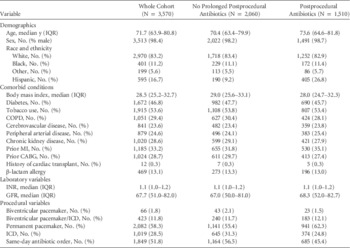
A total of 3,712 CIED procedures were performed among 3,570 unique patients at 34 VA Medical Centers from fiscal year 2009 to fiscal year 2013 and entered into the CART software. During the study period, these facilities performed 5,793 National Healthcare Safety Network PACE (pacemaker and ICD) procedures of the 18,526 procedures performed nationwide (31.2%). The median age was 71.1 years (interquartile range [IQR], 63.9–80.8) and 3,513 of 3,570 patients were male (98.2%) (Table 1). Medical records revealed that 1,849 patients (51.8%) were prescribed antibiotics on the same day as the procedure. In total, 1,211 of 3,712 procedures (32.6%) were performed on an entirely ambulatory basis with no inpatient component of care. Among these 3,712 procedures, 2,677 (72.1%) were classified as elective, 34 (0.9%) were classified as emergent, and 869 (23.4%) were classified as urgent. Data were missing for 132 procedures (3.6%).
Demographics of Cohort

NOTE. IQR, interquartile range; COPD, chronic obstructive pulmonary disease; MI, myocardial infarction; CABG, coronary artery bypass grafting surgery; INR, international normalized ratio; GFR, glomerular filtration rate; ICD, implantable cardioverter–defibrillator.
More than 24 hours of postprocedural antimicrobial prophylaxis was prescribed following 1,579 of 3,712 CIED procedures (42.5%). Among these, 41 of 1,579 prescriptions (2.61%) were filled during the 7-day window prior to the procedure. The remaining antimicrobial prescriptions (1,538 of 1,579; 97.4%) were initiated during the period immediately following the CIED procedure.
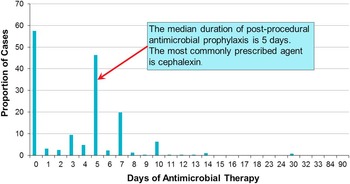
The median duration of postprocedural antimicrobial therapy was 5 days (IQR, 3–7 days) (Fig. 1). The most commonly prescribed antibiotic was cephalexin (1,1,52 of 1,579; 73%), followed by doxycycline (11 of 1,579; 7.5%) and ciprofloxacin (101 of 1,1579; 6.4%). Vancomycin was the most commonly used intravenous agent (73 of 1,579; 4.6%). Other antimicrobials, including trimethoprim-sulfamethoxazole, were prescribed infrequently.
Incidence and duration of postprocedural antimicrobial use in the cardiac electrophysiology laboratory.

Facility-Level Variation
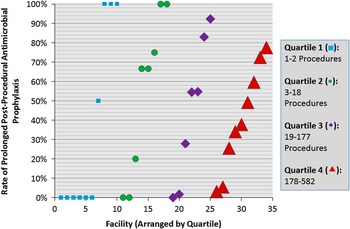
Clinical practice varied substantially by facility, with some facilities rarely prescribing prolonged postprocedural antimicrobial therapy and others prescribing antimicrobial therapy following the vast majority of CIED procedures. Among facilities with the highest volume of procedures entered into the CART program (fourth quartile, 178–582 procedures), incidence of prolonged postprocedural antibiotic use ranged from 3.2% to 77.6% of procedures. There appeared to be no relationship between the number of procedures performed in a facility and the incidence of postprocedural antibiotic use (Fig. 2).
Incidence of prolonged postprocedural antimicrobial use, by quartile of procedural volume. Rate of prolonged postprocedural antibiotic use lasting more than 24 hours, stratified by quartile of procedural volume entered into the CART software program. Each marker represents 1 facility. Prolonged postprocedural antimicrobial use varied considerably by facility, with some facilities prescribing prolonged therapy following the vast majority of procedures, and others never prescribing prolonged postprocedural antimicrobials following cardiac device implantation and revision procedures.

Predictors of Prolonged Postprocedural Antibiotic Use
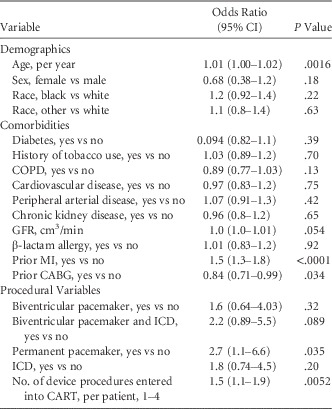
Age, prior myocardial infarction, placement of a permanent pacemaker (vs other types of device implantation), and increasing number of device implantation or revision procedures on a single patient increased the odds of receiving antibiotics after a procedure, whereas prior CABG decreased the odds (Table 2). No association between postprocedural antibiotic use and traditional predictors of postoperative infection (ie, diabetes, tobacco use, chronic kidney disease) was identified.
Predictors of Prolonged Postprocedural Antimicrobial Use

NOTE. COPD, chronic obstructive pulmonary disease; MI, myocardial infarction; CABG, coronary artery bypass grafting surgery; ICD, implantable cardioverter–defibrillator; CART, VA Clinical Assessment Reporting and Tracking software.
DISCUSSION
The objective of this study was to describe the frequency of prolonged postprocedural antimicrobial use following CIED implantation and the extent to which this practice varies across the VA healthcare system. We found that prolonged postprocedural antimicrobial prophylaxis following CIED procedures is common, occurring following 4 of 10 interventions, and that practice patterns vary significantly by facility. Regardless of how many CIED procedures are performed at a facility, some centers prescribe prolonged postprocedural antibiotics to almost all patients undergoing CIED procedures, and other facilities rarely prescribe prolonged antimicrobial therapy after interventions. These findings suggest that there may be opportunities to improve antimicrobial use following CIED procedures.
While preimplantation antimicrobial prophylaxis dramatically reduces the incidence of postprocedural device infections,Reference Darouiche, Mosier and Voigt 14 , Reference de Oliveira, Martinelli and Nishioka 15 routine prolonged postprocedural antibiotic use lasting more than 24 hours after CIED interventions has not been demonstrated to reduce infection rates and is specifically opposed by multi-society guidelines.Reference Bratzler, Dellinger and Olsen 11 The American Heart Association/American College of Cardiology does not specifically comment on duration of antimicrobial therapy following CIED procedures.Reference Epstein, DiMarco and Ellenbogen 3 The common practice of prolonged antimicrobial use may be harmful, leading to increased rates of adverse medication reactions, increasing antimicrobial resistance, and increased incidence of Clostridium difficile infections.Reference Carignan, Allard, Pepin, Cossette, Nault and Valiquette 16 , Reference Harbarth, Samore, Lichtenberg and Carmeli 17 Prolonged postprocedural antibiotic use has not been demonstrated to be an effective measure for reducing postoperative infections following traditional surgical procedures, including cardiac surgical procedures.Reference McDonald, Grabsch, Marshall and Forbes 18 In addition, the incidence of infection following CIED procedures performed in the EP laboratory is similar to the incidence of infection among CIED procedures in the operating room,Reference Remmelts, Meine and Loh 19 where cardiothoracic surgeons have been subject to Surgical Care Improvement Project (SCIP) measures that include early discontinuation of antibiotics. 20
Given the wide variation in use of prolonged postprocedural antimicrobial prophylaxis following CIED procedures, there may be opportunities for quality improvement and antimicrobial stewardship programs for procedures performed in cardiac catheterization laboratories to reduce the variation in use of antimicrobial prophylaxis. The critical first steps to improving postprocedural antimicrobial use will be to engage and educate the cardiac electrophysiology staff, to determine their reasons for prescribing antibiotics in this setting, and to identify ways to address their beliefs and institutional culture. Targeting inpatient postprocedural antimicrobial orders may be relatively straightforward with currently available antimicrobial stewardship resources; however, outpatient and oral antimicrobial use may present a larger barrier to quality improvement because data regarding effective interventions for outpatient antimicrobial stewardship are limited.Reference Drekonja, Filice and Greer 21 A 48-hour review of necessity of antimicrobial therapy is an intervention recommended by the Society for Healthcare Epidemiology of America, Infectious Diseases Society of America and Pediatric Infectious Diseases Society (SHEA/IDSA/PIDS) to reduce antimicrobial use in inpatients. However, this intervention is not feasible in the outpatient setting. 22 Perhaps the integration of clinical decision support technology into electronic prescribing could reduce unwarranted variation in antimicrobial prescribing following CIED interventions.Reference Darda, Khouri and Gorges 23
We found that traditional risk factors for postprocedural infections were generally not significant predictors of prolonged postprocedural antimicrobial use. The patient-level risk factors for CIED infections include diabetes, heart failure, renal dysfunction, and repeat procedure.Reference Baddour, Epstein and Erickson 24 Receipt of a permanent pacemaker, versus other types of devices, is associated with a lower risk of CIED infection. In contrast, the variables we found to be associated with prolonged postprocedural antibiotic use were age, placement of a permanent pacemaker, no history of CABG, history of myocardial infarction, and increasing number of device procedures in a single patient. The only variable that was associated with both cardiac device infection and postoperative antimicrobial use was device revision procedures, which may be associated with a higher incidence of infection when compared to initial device implantation.Reference Cengiz, Okutucu and Ascioglu 25 – Reference Nery, Fernandes and Nair 27 The lack of overlap between factors associated with CIED infection and with prolonged antimicrobial use following CIED implant and the wide variation in rates of antimicrobial use between facilities suggests that there are opportunities to improve antibiotic prescribing practices following CIED procedures.
We are aware of several limitations in our study. First, we did not include all CIED implants in the VA during the study period. We included all CIED implants that were entered in the CART software, which was not mandatory for CIED procedures. Our estimates may be biased by the facilities and providers that opted to participate. However, bias is less likely at sites with high reported procedural volume (ie, the fourth quartile of volume), where most or all procedures are likely to be captured. Second, we were unable to determine whether the majority of the postprocedural antibiotic use was driven by procedures for device revision, which have been demonstrated to have a higher risk of infectious complications than de novo implantations in some settings.Reference Lin, Hung and Chen 26 , Reference Sohail, Uslan and Khan 28 However, we did evaluate the 142 procedures known to be revisions within the CART program and found that 69 procedures (48.6%) received postprocedural antimicrobial therapy. This rate of antimicrobial use is similar between revision procedures and the overall cohort, suggesting that device revision procedures are not the primary driver of post-CIED procedure antimicrobial use. Third, our estimates of antibiotic use for postprocedural prevention of cardiac device infections may be overestimates of actual antibiotic use patterns; we were not able to exclude antibiotics that may have been initiated for other reasons, such as treatment of urinary tract infections. However, our analysis was limited to only prescriptions covering the immediate periprocedural period, thus limiting the probability that patients were being treated for other comorbid infections. Furthermore, we found that the vast majority of the antimicrobial prescriptions were for agents primarily active against Gram-positive organisms (cephalexin, vancomycin, doxycycline), which are the most common causes of surgical-site infections and CIED infections, and are drugs commonly prescribed to treat surgical-site infections and CIED infections.Reference Sohail, Uslan and Khan 28 , Reference Lewis, Hayes, Holmes, Vlietstra, Pluth and Osborn 29
To more fully evaluate the reason for antimicrobial use, we conducted a manual review of 50 cases conducted at a single VA Medical Center. We found that all antimicrobial prescriptions initiated during the 7-day window following a CIED procedure were given for prophylactic purposes. In addition, in our limited manual review, we found that practice patterns varied significantly by provider: One provider prescribed antimicrobials following almost all procedures; another provider prescribed antimicrobials following “complicated” and revision procedures; and another provider almost never prescribed postprocedural prophylactic antimicrobials. In addition, we found that only 41 of 1,579 antibiotic prescriptions were initiated prior to the procedure, suggesting that the vast majority of use was not driven by treatment of other infections. Fourth, it is also possible that there was some degree of underreporting; some patients may have filled their antimicrobial prescriptions outside of the VA healthcare system. However, this number is expected to be exceedingly small among patients who had their device procedure within the VA healthcare system because receiving the antibiotic outside of the VA healthcare system is typically more expensive for VA patients. Finally, it is possible that preprocedural antimicrobials may be undercounted, because drugs ordered and administered in procedural areas only—cases in which the physician did not order the antimicrobial before the time of the procedure—may not be included.
In conclusion, similar to antibiotic prescribing practices in other clinical care arenas, there is wide variation in the use of postprocedural antibiotics following device procedures in electrophysiology laboratories. Our results show that postprocedural antibiotic use is common. Given the current lack of evidence supporting routine prolonged antimicrobial use following CIED interventions, the electrophysiology laboratory may be a potential target for future antimicrobial stewardship and quality improvement programs designed to improve and reduce antimicrobial use in diverse clinical settings.
ACKNOWLEDGMENTS
Financial support: The research was supported by the Seattle-Denver Center of Innovation for Veteran-Centered and Value-Driven Care (Seattle, Washington and Denver, Colorado).
Potential conflicts of interest: All authors report no conflicts of interest relevant to this article.