Introduction
The hormones abscisic acid (ABA) and gibberellin (GA) play key roles in regulating plant development. Critical aspects of plant physiology such as protective responses to environmental stress and the control of seed germination depend on the interaction between these two hormones. In imbibing seeds, ABA stimulates the expression of genes required for protection against drought stress, while repressing the expression of genes required for growth-related processes such as germination and storage reserve breakdown. As many of these growth-related genes are induced by GA, the signalling pathways for ABA- and GA-regulated gene expression are intimately linked, with many genes regulated in opposite directions by the two hormones (Lovegrove and Hooley, Reference Lovegrove and Hooley2000; Johnson, Reference Johnson, Thomas, Murphy and Murray2003; Chen and An, Reference Chen and An2006).
ABA-mediated gene expression is regulated by a variety of transcription factors including MYB proteins (Zheng et al., Reference Zheng, Schumaker and Guo2012), the B3-domain containing VPI/ABI3 protein (Feng et al., Reference Feng, Chen, Wang, Hong, Wu and Chen2014), ABI4, an APETALA2-like protein, and many basic leucine zipper (bZip) proteins (Jakoby et al., Reference Jakoby, Weisshaar, Droge-Laser, Vicente-Carbajosa, Tiedemann, Kroj and Parcy2002). The group A bZip proteins, also known as ABF (ABRE binding factor) or AREBs (ABRE binding) (Fujita et al., Reference Fujita, Yoshida and Yamaguchi-Shinozaki2013) are particularly important in activating ABA-induced genes whose promoters contain an ABA-response element (ABRE) (Shen et al., Reference Shen, Zhang and Ho1996). The signal transduction pathway leading to ABA-regulated gene expression in cereal grains involves the wheat (Triticum aestivum) ABF protein TaABF1 (and its orthologs in other grain species). While the expression of TaABF1 itself is grain specific (Johnson et al., Reference Johnson, Wagner, Verhey and Walker-Simmons2002), other related wheat ABFs are expressed in roots and leaves (Li et al., Reference Li, Feng, Zhang, Tang, Zhang, Ma, Zhao and Gao2016; Ohnishi et al., Reference Ohnishi, Himi, Yamasaki and Noda2008). Proteins similar to TaABF1 (Johnson et al., Reference Johnson, Shin and Shen2008) are also present in barley (Hordeum vulgare) (HvABF1) (Schoonheim et al., Reference Schoonheim, Sinnige, Casaretto, Veiga, Bunney, Quatrano and de Boer2007), rice (OsABI5/OREB1) (Zou et al., Reference Zou, Guan, Ren, Zhang and Chen2008), and Arabidopsis (ABI5) (Lopez-Molina et al., Reference Lopez-Molina, Mongrand and Chua2001). In transient assays carried out in bombarded aleurone cells, over-expression of TaABF1 can substitute for exogenous ABA in stimulating the expression of ABA-induced genes or in inhibiting the expression of GA-induced genes (Johnson et al., Reference Johnson, Shin and Shen2008).
In contrast to the large number of ABF proteins that upregulate ABA-induced genes, only TaABF1, HvABF1 and HvABF2 have been found to function in downregulating GA-induced genes in response to ABA. These proteins are therefore of special interest as they play a critical role at the intersection of ABA and GA response pathways. While the transcriptional inhibitory activity of TaABF1 towards GA-induced genes such as Amy32b is well documented (Johnson et al., Reference Johnson, Shin and Shen2008), the mechanism for this suppression is unknown. Amy32b is directly upregulated by the transcription factor GAMyb (Gubler et al., Reference Gubler, Raventos, Keys, Watts, Mundy and Jacobsen1999), which binds to a consensus GA-response element present in the promoter of Amy32b and other GA-inducible genes. TaABF1 downregulates transcription of the GAMyb gene through an unknown mechanism, thus suppressing Amy32b expression. In addition to regulating post-germinative growth processes such as storage reserve mobilization, TaABF1 may also play an important role in regulating grain dormancy, as wheat cultivars with greater seed dormancy contain higher TaABF1 transcript levels (Rikiishi et al., Reference Rikiishi, Matsuura and Maekawa2010).
As ABFs act downstream of ABA to regulate gene expression, they must themselves be subject to ABA-induced activation in some manner. This regulation of ABFs can occur at a number of levels, from transcriptional activation to post-translational modification. The mRNA levels of several ABFs including AtABI5 and AtABF1 increase strongly in response to ABA (Lopez-Molina et al., Reference Lopez-Molina, Mongrand and Chua2001; Finkelstein et al., Reference Finkelstein, Gampala, Lynch, Thomas and Rock2005). In contrast, TaABF1 mRNA (Johnson et al., Reference Johnson, Shin and Shen2008) and protein (Harris et al., Reference Harris, Martinez, Keyser, Dyer and Johnson2013) levels do not respond to ABA, suggesting that regulation of TaABF1 may occur only at the post-translational level. Post-translational modification (especially phosphorylation) of transcription factors in response to ABA is a key aspect of ABA signalling, and its mechanisms have been well documented in Arabidopsis. ABA is perceived by receptors (Ma et al., Reference Ma, Szostkiewicz, Korte, Moes, Yang, Christmann and Grill2009; Park et al., Reference Park, Fung, Nishimura, Jensen, Fujii, Zhao, Lumba, Santiago, Rodrigues, Chow, Alfred, Bonetta, Finkelstein, Provart, Desveaux, Rodriguez, McCourt, Zhu, Schroeder, Volkman and Cutler2009) that, upon ABA binding, inhibit the activity of PP2C phosphatases. This permits the phosphorylation/activation of SnRK2 protein kinases, which in turn phosphorylate and activate transcription factors from the ABF family of bZip proteins (Fujii and Zhu, Reference Fujii and Zhu2009). Phosphorylation of ABF proteins, and its effects on their activity, has been studied in a number of cases including AtABI5 (Piskurewicz et al., Reference Piskurewicz, Jikumara, Kinoshita, Nambara, Kamiya and Lopez-Molina2008), OREB1/OsABI5 (Hong et al., Reference Hong, Chae, Lee, Nam, Kim and Byun2011) and TRAB1 (Kagaya et al., Reference Kagaya, Hobo, Murata, Ban and Hattori2002).
Our previous work suggests that TaABF1 may be regulated via phosphorylation as well. The ABA-inducible SnRK2 kinase PKABA1 can phosphorylate peptide sequences from TaABF1 in vitro (Johnson et al., Reference Johnson, Wagner, Verhey and Walker-Simmons2002) and TaABF1 isolated from wheat grains was found to be in a phosphorylated state (Harris et al., Reference Harris, Martinez, Keyser, Dyer and Johnson2013). However, the specific phosphorylation sites that are important in regulating TaABF1's transcriptional activity and their roles in different aspects of ABA and GA signalling are still unknown.
To further investigate the mechanism by which TaABF1 is regulated, we tested phosphomimetic mutations at multiple serine residues that are candidate phosphorylation sites. We report that phosphorylation of TaABF1 can either stimulate or inhibit the activity of TaABF1 in regulating downstream genes, depending on the site and pattern of phosphorylation. Our results also provide insights into the mechanisms through which TaABF1 acts to regulate downstream gene expression.
Materials and methods
Preparation of DNA constructs
The UBI::Luciferase internal control plasmid pAHC18 (Christensen and Quail, Reference Christensen and Quail1996), reporter constructs Amy32b::GUS (Lanahan et al., Reference Lanahan, Ho, Rogers and Rogers1992), HVA 1::GUS (Shen et al., Reference Shen, Uknes and Ho1993), and effector construct UBI::TaABF1 (Johnson et al., Reference Johnson, Shin and Shen2008) have been described previously. Mutant versions of the effector construct UBI::TaABF1 were generated by site-directed mutagenesis using the Stratagene Quickchange kit. Mutant plasmids were all confirmed by Sanger DNA sequencing.
Particle bombardment
De-embryonated grains of Himalaya barley (obtained from the Department of Crop and Soil Sciences at Washington State University) were imbibed for 2 days in Imbibing Solution (20 mM sodium succinate, 20 mM calcium chloride, pH 5.0), and the pericarp and testa were removed. After one more day of imbibition, the DNA mixture (in 1:1 ratio) of Amy32b::GUS (or HVA1::GUS) and UBI::Luciferase, with or without an effector construct, was bombarded into embryoless barley grains (at least six replicates per test construct), using a Bio-Rad PDS-1000/He system. After incubation for 24 h in Imbibing Solution with various treatments, GUS assays and luciferase assays were performed as previously described (Harris et al., Reference Harris, Martinez, Keyser, Dyer and Johnson2013; Uwase et al., Reference Uwase, Enrico, Chelimo, Keyser and Johnson2018).
Results
Phosphomimetic mutations activate TaABF1
Previous work indicates that peptide sequences from TaABF1 can be phosphorylated in vitro by the SnRK2 protein kinase PKABA1 (Johnson et al., Reference Johnson, Wagner, Verhey and Walker-Simmons2002) and that TaABF1 isolated from imbibing wheat grains is in a phosphorylated state (Harris et al., Reference Harris, Martinez, Keyser, Dyer and Johnson2013). Those findings suggest that phosphorylation of specific serine residues on TaABF1 might modulate the activity of TaABF1 as a transcription factor.
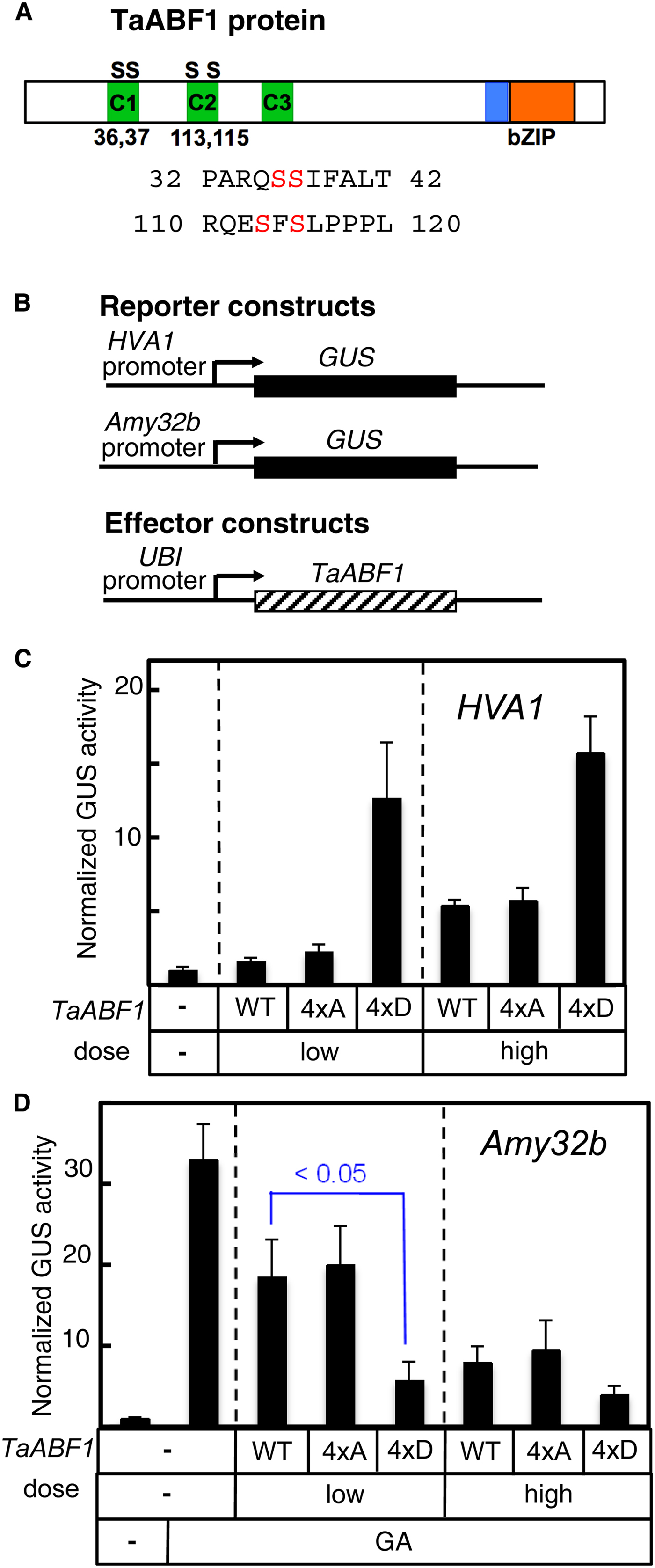
We therefore tested whether mutation of serine residues within the conserved regions of TaABF1 would affect its ability to regulate downstream gene expression. We first tested the simultaneous mutation of serines 36, 37, 113 and 115 (Fig. 1A), by preparing TaABF1 effector constructs with codons for those amino acids altered to encode either alanine (unable to be phosphorylated) or aspartate (phosphomimetic). The TaABF1 effector constructs were introduced into barley aleurone cells together with reporter genes for either HVA1 or Amy32b (Fig. 1B). For activation of the ABA-inducible HVA1 promoter, the quadruple alanine (4 × A) mutant was equivalent to the WT TaABF1 construct (Fig. 1C). However, the quadruple aspartate (4 × D) mutant was three to five times more potent than WT TaABF1 (Fig. 1D), indicating that phosphorylation at one or more of these sites (in the C1 and C2 regions) increases the ability of TaABF1 to upregulate HVA1. We also observed that the 4 × D TaABF1 effector had increased ability to downregulate Amy32b stimulation by GA (Fig. 1D).
Phosphomimetic mutations activate TaABF1. (A) Diagram of TaABF1 protein indicating the four serine residues targeted in this experiment. (B) Reporter and effector constructs used in the experiment. (C) The HVA1::GUS reporter and the internal control construct, UBI::luciferase, were co-bombarded into barley aleurone cells together with a TaABF1 effector construct. For the ‘low’ dose of TaABF1 an effector/reporter ratio (w/w) of 0.02 was used, while for the ‘high’ dose a ratio of 0.10 was used. TaABF1 constructs were wild-type (WT), or had codons 36, 37, 113 and 115 altered to encode alanine (4 × A) or aspartate (4 × D). Bars indicate GUS activities after 24 h of incubation. GUS activity was normalized in every independent transformation relative to the luciferase activity. Data are means ± SE. (D) The Amy32b::GUS reporter and the internal control construct, UBI::luciferase, were co-bombarded into barley aleurone cells together with a TaABF1 effector construct as indicated above. For the ‘low’ dose of TaABF1 an effector/reporter ratio of 0.01 was used, while for the ‘high’ dose a ratio of 0.05 was used. Bars indicate GUS activities after 24 h of incubation with or without 1 μM GA. GUS activity was normalized and reported as in panel C. Statistical p-values were calculated using Student's t-test (Student, 1908).

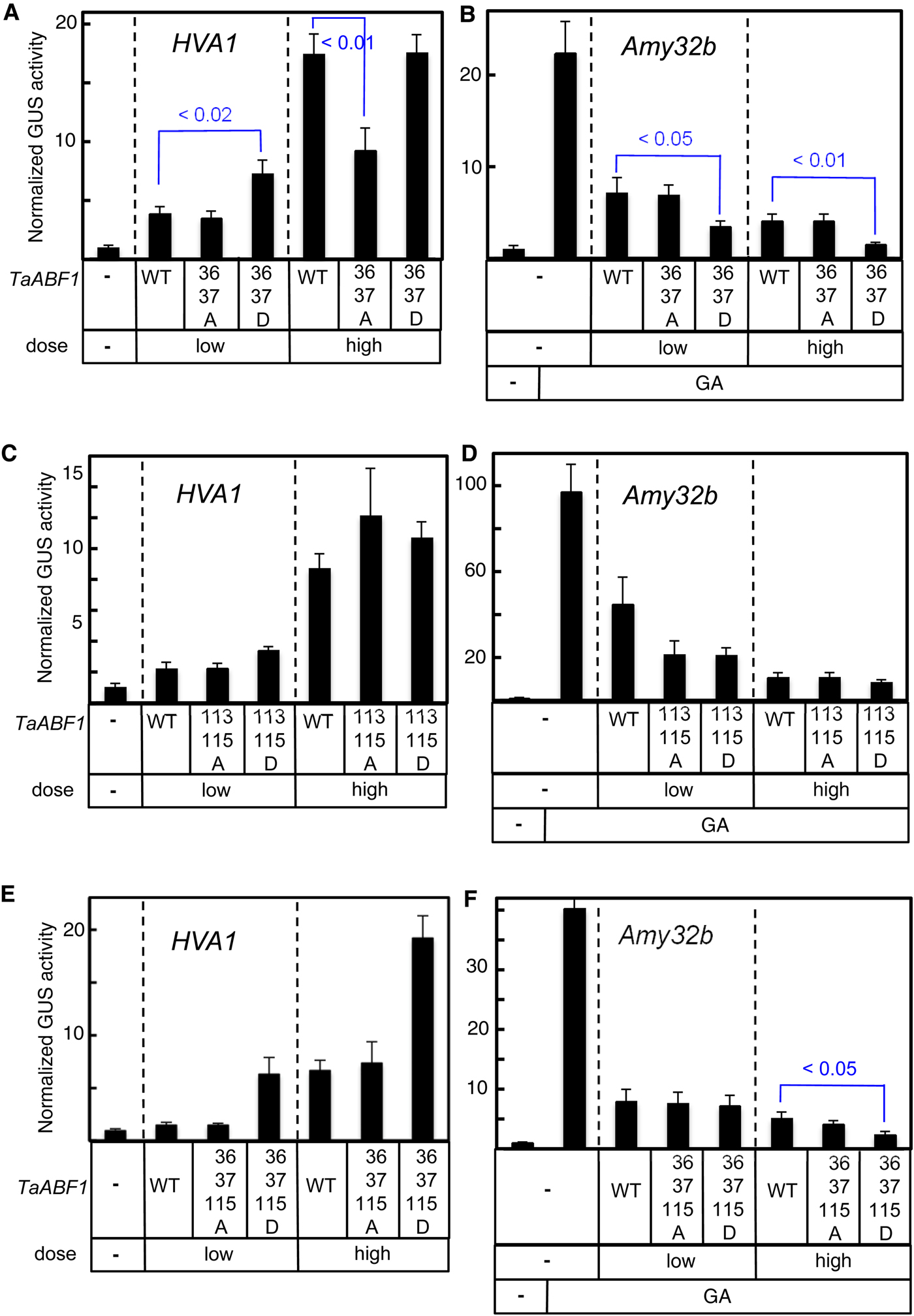
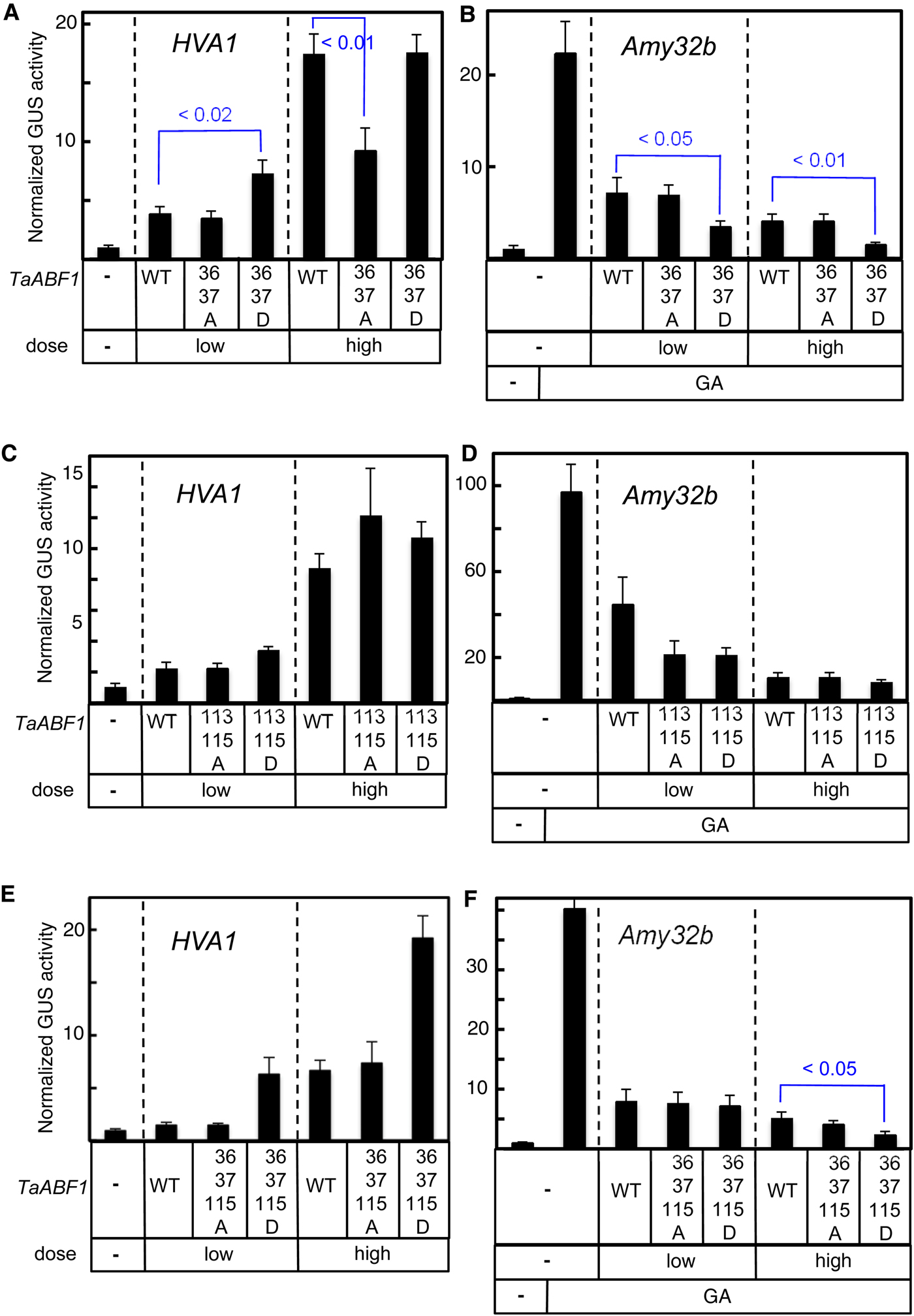
To more specifically address which of these serine residues in TaABF1 could serve as activation sites, we carried out a series of single, double and triple amino acid substitutions. Phosphomimetic mutations at serines 36 and 37 also resulted in stimulation of TaABF1 activity towards both HVA1 and Amy32b (Fig. 2A,B), although the upregulation of HVA1 was not as strong as that resulting from the quadruple substitution. Phosphomimetic mutation of S37 alone (supplementary Fig. S1) also resulted in a modest stimulation of TaABF1 activity towards both HVA1 and Amy32b. Little or no stimulation of TaABF1 activity towards either HVA1 or Amy32b was observed with phosphomimetic mutations to serines 113 and 115 (Fig. 2C,D). A triple phosphomimetic substitution at serines 36, 37 and 115 resulted in stimulation of TaABF1 activity towards HVA1 (Fig. 2E) comparable to that of the quadruple substitution (Fig. 1D). The triple phosphomimetic substitution also modestly reduced the ability of TaABF1 to inhibit Amy32b expression (Fig. 2F). In summary, these results indicate that phosphorylation of serine residues in the C1 region can activate TaABF1, and that additional phosphorylation in the C2 region can increase the level of activation. However, phosphorylation in the C2 region alone has very little stimulatory effect on TaABF1 activity.
Multiple phosphomimetic mutations are required for strong activation of TaABF1. (A) The HVA1::GUS reporter and the internal control construct, UBI::luciferase, were co-bombarded into barley aleurone cells together with a TaABF1 effector construct as in Fig. 1. TaABF1 constructs were wild-type (WT), or had codons 36 and 37 altered to encode alanine (‘A’) or aspartate (‘D’). Bars indicate GUS activities after 24 h of incubation. (B) The Amy32b::GUS reporter and the internal control construct, UBI::luciferase, were co-bombarded into barley aleurone cells together with a TaABF1 effector construct as indicated above. Bars indicate GUS activities after 24 h of incubation with or without 1 μM GA. (C) TaABF1 effector constructs with codons 113 and 115 altered to encode alanine (‘A’) or aspartate (‘D’) were analysed as in A. (D) TaABF1 effector constructs with codons 113 and 115 altered to encode alanine (A) or aspartate (D) were analysed as in B. (E) TaABF1 effector constructs with codons 36, 37 and 115 altered to encode alanine (‘A’) or aspartate (‘D’) were analysed as in A. (F) TaABF1 effector constructs with codons 36, 37 and 115 altered to encode alanine (‘A’) or aspartate (‘D’) were analysed as in B. GUS activity was normalized and reported as in Fig 1.
Phosphomimetic mutation at S113 deactivates TaABF1
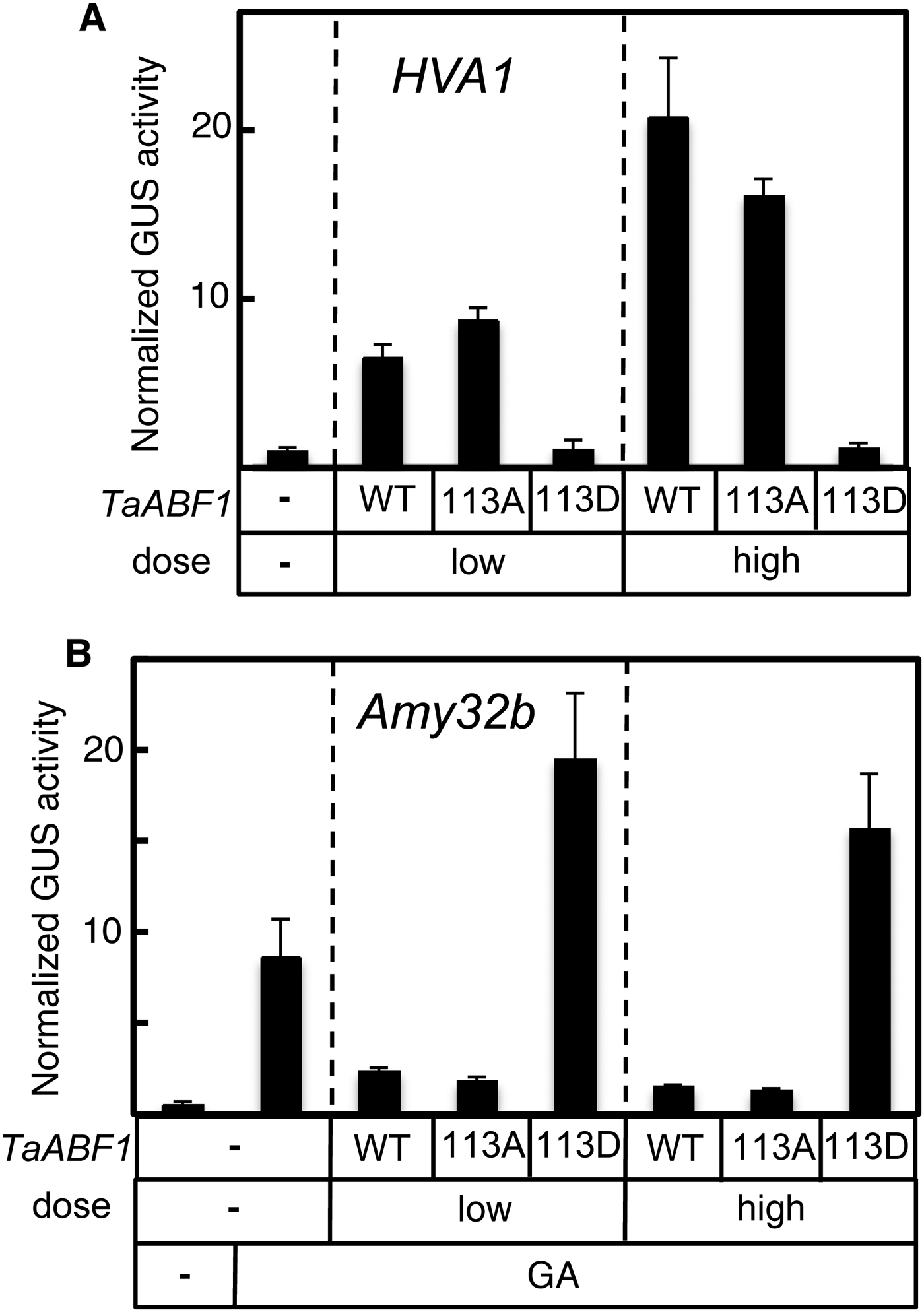
While the majority of phosphomimetic mutations that we tested had either a stimulatory effect on TaABF1 activity or had no significant effect, we found that a single S113D mutation completely eliminated the ability of TaABF1 to upregulate HVA1 or to downregulate Amy32b (Fig. 3). Taken together with the previous results, this indicates that phosphorylation of TaABF1 can either stimulate or inhibit the activity of TaABF1 in regulating downstream genes, depending on the site and pattern of phosphorylation. It also indicates that the effect of phosphorylation at individual sites is not necessarily additive. For example, the S36D, S37D, S115D phosphomimetic triple mutation (Fig. 2E,F) is not stronger that the quadruple mutation (Fig. 1C,D) despite the fact that it is missing the deactivating S113D mutation.
Phosphomimetic mutation at S113 inhibits TaABF1. (A) The HVA1::GUS reporter and the internal control construct, UBI::luciferase, were co-bombarded into barley aleurone cells together with a TaABF1 effector construct. TaABF1 constructs were wild-type (WT), or had codon 113 altered to encode alanine (‘A’) or aspartate (‘D’). Bars indicate GUS activities after 24 h of incubation. (B) The Amy32b::GUS reporter and the internal control construct, UBI::luciferase, were co-bombarded into barley aleurone cells together with a TaABF1 effector construct as indicated above. Bars indicate GUS activities after 24 h of incubation with or without 1 μM GA. GUS activity was normalized and reported as in Fig 1.

Mutation of the bZIP domain differentiates the two functions of TaABF1
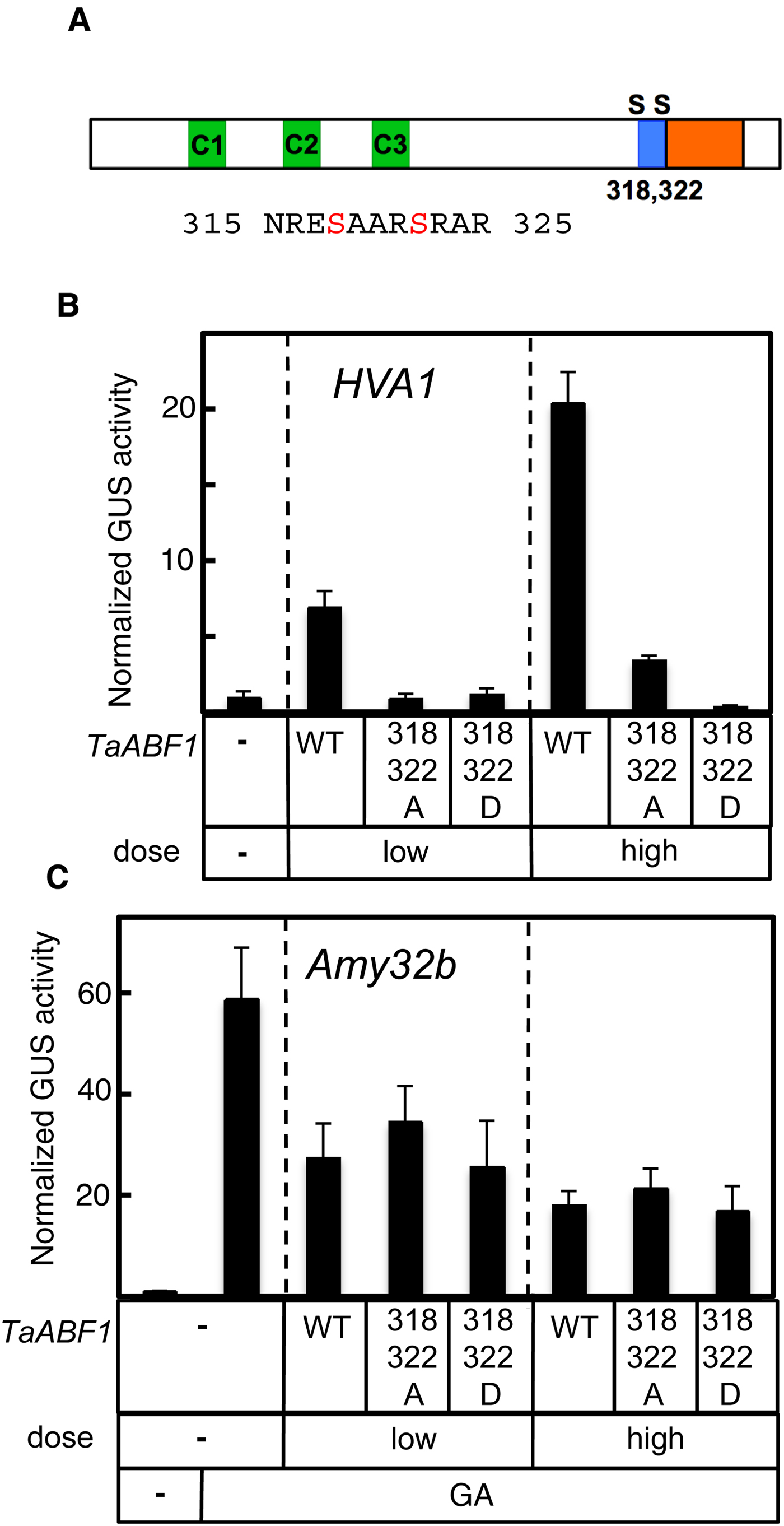
Each of the mutations that we tested in the C1 and C2 domains of TaABF1 had effects clearly consistent with the role of phosphorylation at those sites. For example, we did not observe that mutations to A and D at the same site both activated or both deactivated TaABF1. We did, however, observe such a pattern for alterations in the bZIP domain. Mutation of S318 and S322 (Fig. 4A) to either A or D eliminated the ability of TaABF1 to activate HVA1 (Fig. 4B), but had no effect on the ability of TaABF1 to downregulate GA-stimulated Amy32b, providing a clear demonstration that the two functions of TaABF1 are carried out via different mechanisms. The simplest interpretation of these data is that an intact unphosphorylated serine is required at position 318 and/or 322 for the functional integrity of TaABF1, and any alteration prevents binding of TaABF1 to ABRE sequences. These findings also suggest that while TaABF1 activates HVA1 (which contains an ABRE) (Shen et al., Reference Shen, Zhang and Ho1996) by direct binding to promoter DNA, its activity in downregulating Amy32b (which does not) does not require direct DNA binding.
Mutation of the DNA-binding domain prevents TaABF1-mediated activation of HVA1. (A) Diagram of TaABF1 protein indicating the two serine residues targeted in this experiment. (B) The HVA1::GUS reporter and the internal control construct, UBI::luciferase, were co-bombarded into barley aleurone cells together with a TaABF1 effector construct. TaABF1 constructs were wild-type (‘WT’), or had codons 318 and 322 altered to encode alanine (‘A’) or aspartate (‘D’). Bars indicate GUS activities after 24 h of incubation. (C) The Amy32b::GUS reporter and the internal control construct, UBI::luciferase, were co-bombarded into barley aleurone cells together with a TaABF1 effector construct as indicated above. Bars indicate GUS activities after 24 h of incubation with or without 1 μM GA. GUS activity was normalized and reported as in Fig 1.

HVA1 expression is not regulated by GA
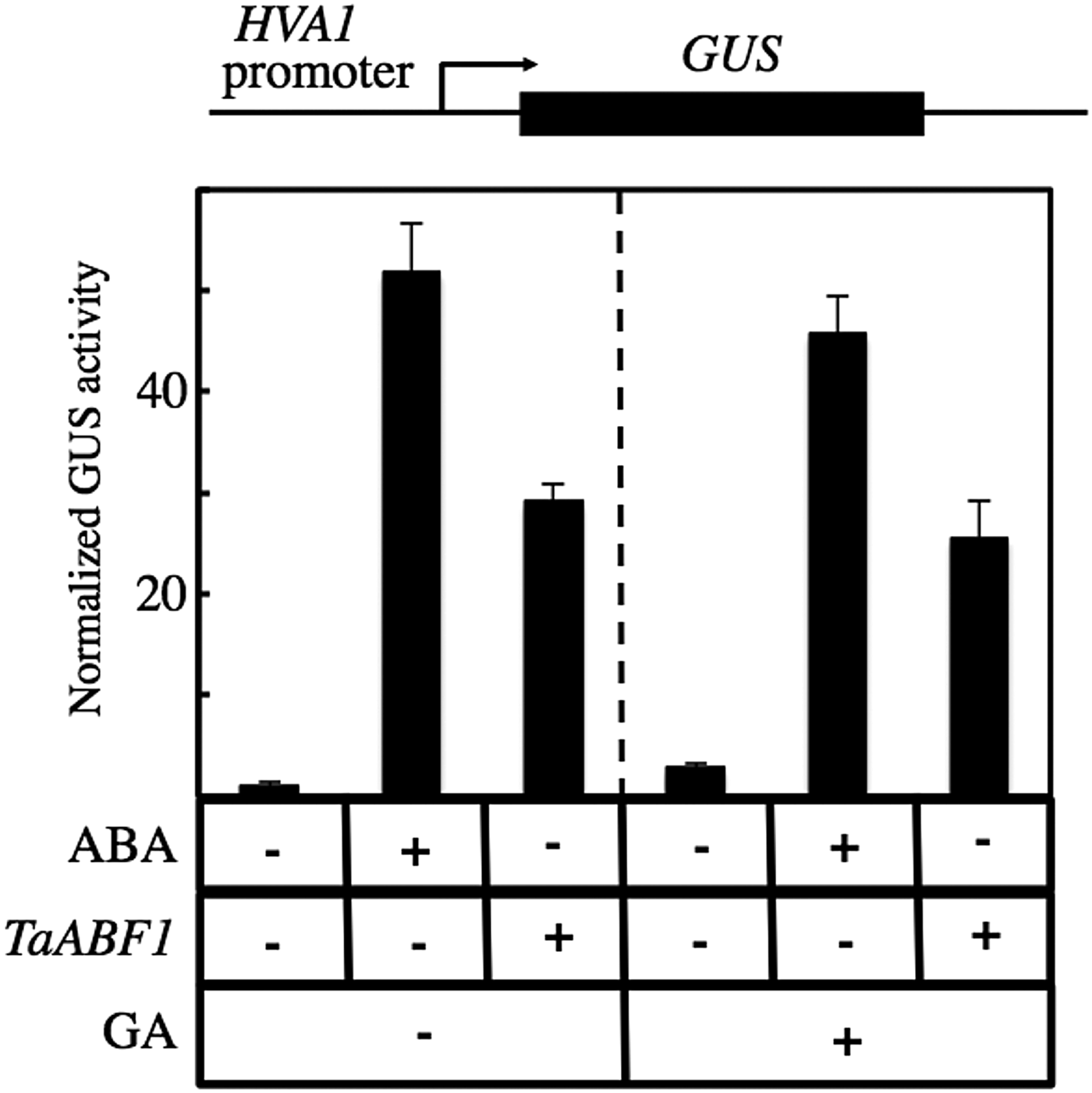
The results shown in Fig. 3 indicate that the ability of TaABF1 to activate HVA1 expression can be inactivated by phosphorylation. Previous work (Harris et al., Reference Harris, Martinez, Keyser, Dyer and Johnson2013) showing that the degree of TaABF1 phosphorylation in vivo is altered by GA, together with the fact that GA hastens the degradation of HVA1 mRNA during imbibition (Hong et al., Reference Hong, Barg and Ho1992), led us to wonder if the transcriptional activation of HVA1 might be downregulated by GA, as is the case for some other ABA-induced genes (e.g. PKABA1). As shown in Fig. 5, our HVA1 reporter construct was strongly activated by either ABA or by TaABF1. However, neither the ABA-induced HVA1 expression nor the TaABF1-induced HVA1 expression was inhibited by the presence of GA, indicating that HVA1 expression is not under regulation by GA. The relationship (if any) between GA-induced TaABF1 phosphorylation (Harris et al., Reference Harris, Martinez, Keyser, Dyer and Johnson2013) and the induction of HVA1 by TaABF1 remains uncertain at this point.
Activation of HVA1 by TaABF1 is not inhibited by GA. The HVA1::GUS reporter and the internal control construct, UBI::luciferase, were co-bombarded into barley aleurone cells together with a TaABF1 effector construct. Bars indicate GUS activities after 24 h of incubation with or without 1 μM GA. GUS activity was normalized and reported as in Fig 1.

Discussion
The transcription factor TaABF1 acts downstream of ABA to activate ABA-induced genes (e.g. HVA1) and to downregulate ABA-suppressed genes (e.g. Amy32b) (Harris et al., Reference Harris, Martinez, Keyser, Dyer and Johnson2013). In contrast to several other members of the ABF family of transcriptional regulators (Casaretto and Ho, Reference Casaretto and Ho2003; Zou et al., Reference Zou, Guan, Ren, Zhang and Chen2008), the TaABF1 protein is present constitutively in aleurone cells and its abundance is not altered by either ABA or GA (Harris et al., Reference Harris, Martinez, Keyser, Dyer and Johnson2013), suggesting that TaABF1 might be regulated exclusively at the post-translational level. As TaABF1 protein is phosphorylated in vivo and several other ABF proteins are regulated via phosphorylation (Piskurewicz et al., Reference Piskurewicz, Jikumara, Kinoshita, Nambara, Kamiya and Lopez-Molina2008; Hong et al., Reference Hong, Chae, Lee, Nam, Kim and Byun2011), we assessed the ability of phosphorylation to modulate the transcriptional regulatory activity of TaABF1. While there are many potential sites of phosphorylation on the TaABF1 polypeptide (Johnson et al., Reference Johnson, Wagner, Verhey and Walker-Simmons2002), we began by analysing a subset of these sites, chosen based on their location in highly conserved regions (Li et al., Reference Li, Feng, Zhang, Tang, Zhang, Ma, Zhao and Gao2016) and on their role in the regulation of other ABF proteins related to TaABF1 (Furihata et al., Reference Furihata, Maruyama, Umezawa, Yoshida, Shinozaki and Yamaguchi-Shinozaki2006; Hong et al., Reference Hong, Chae, Lee, Nam, Kim and Byun2011).
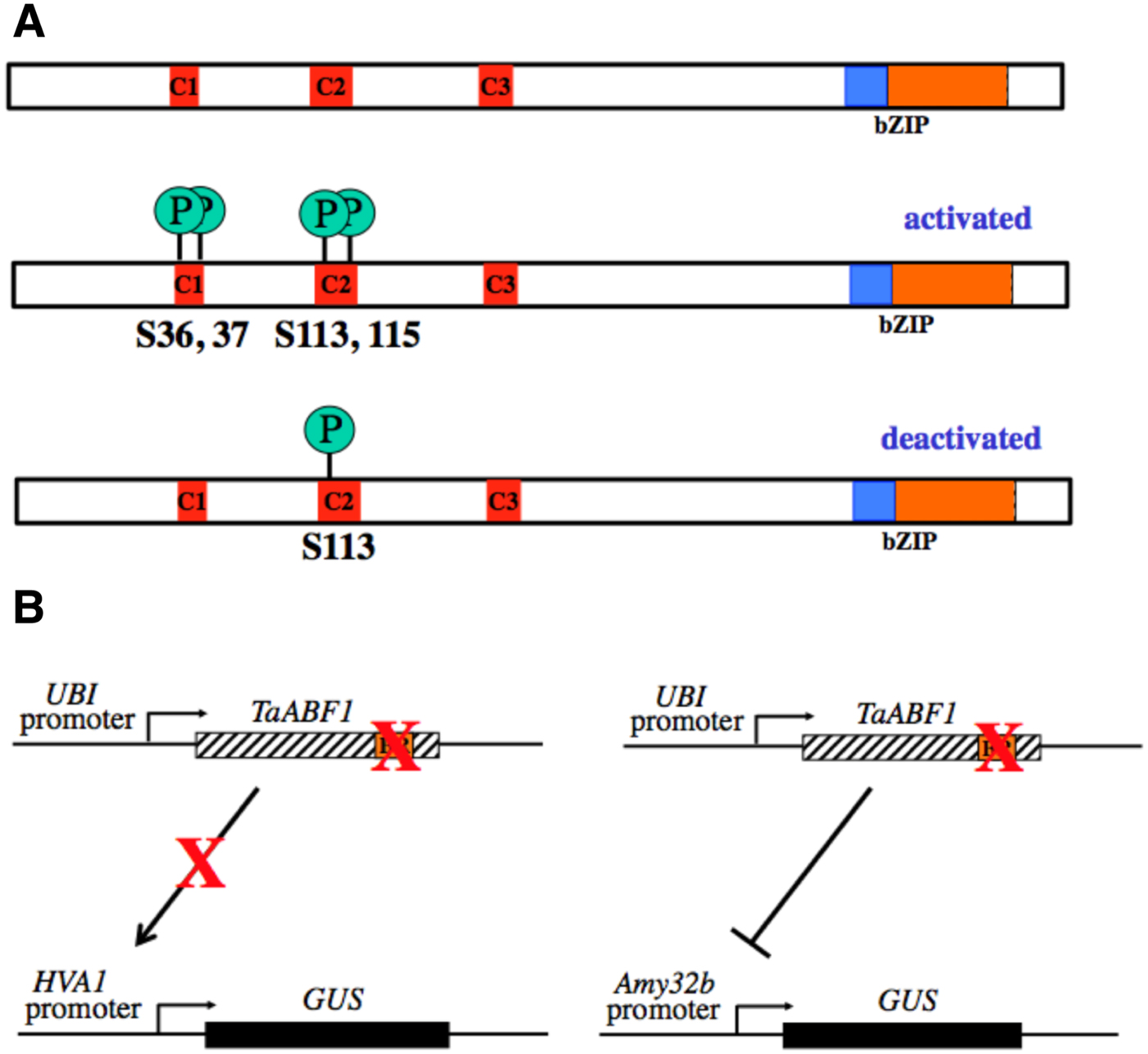
The simultaneous mutation of serines 36, 37, 113 and 115 to the phosphomimetic amino acid aspartate resulted in a robust activation of TaABF1, both in terms of its ability to stimulate HVA1 and its ability to repress GA-upregulation of Amy32b. This result strongly suggests that in vivo phosphorylation at those residues similarly activates TaABF1 (Fig. 6A). The fact that altering these four serine residues to alanine (preventing the possibility of phosphorylation) had no effect on TaABF1 activity suggests that under the conditions used for these experiments, the wild-type TaABF1 may not have been phosphorylated at those sites in the barley aleurone. Under such conditions, preventing its phosphorylation would have no effect. Phosphomimetic mutations restricted to the two serine residues in region C1 (36, 37) or in C2 (113,115) had more modest effects than those targeting all four serines. Targeting three of the serines (36, 37, 115) had effects virtually indistinguishable from targeting all four.
Proposed model for regulation of TaABF1. (A) TaABF1 that is not phosphorylated at S36, S37, S113 or S115 has an intermediate level of activity for stimulating ABA-induced genes (e.g. HVA1) and down-regulating ABA-repressed genes (e.g. Amy32b). Phosphorylation at all four of these residues increases the activity of TaABF1. Phosphorylation at only S113 results in deactivation of TaABF1. (B) Alteration of TaABF1's DNA binding domain prevents binding to the HVA1 promoter and the resulting transcriptional activation. TaABF1's DNA-binding domain is dispensable for repression of Amy32b expression.

Strikingly, a phosphomimetic mutation at just S113 resulted in deactivation of TaABF1 (Fig. 6A). As for the quadruple mutation discussed above, the S113A mutation did not affect TaABF1 activity, again suggesting that the wild-type TaABF1 may not have been phosphorylated at that site under our assay conditions. If the effect of phosphorylation at specific sites were simply additive, we would expect that the triple phosphomimetic mutation (36, 37, 115) would result in much stronger activation of TaABF1 than the quadruple alteration (36, 37, 113, 115) as it lacks the strongly deactivating S113D mutation. As this was not the case, we must conclude that while different patterns of TaAFB1 phosphorylation affect its activity in different ways, the effects of each individual phosphorylation event is not necessarily additive in creating the overall result.
The existence of both positive and negative regulation for a single ABF protein through phosphorylation has been previously observed for the rice ABF protein OREB1/OsABI5 (Hong et al., Reference Hong, Chae, Lee, Nam, Kim and Byun2011). For OREB1, phosphorylation at the C1 domain increased its activity while phosphorylation at the C2 domain decreased its activity. Within the C1 region of TaABF1, amino acids S36, S37 and A40 are equivalent to S43, S44 and S47 of OREB1. Hong et al. (2001) found that a triple phosphomimetic mutation (S43D, S44D, S47D) in OREB1 greatly suppressed its activity while the deletion of the C1 domain increased OREB1's activity. The difference between our findings with the C1 domain of TaABF1 and those observed with OREB1 may point to the importance of S47 phosphorylation in the inhibition of OREB1, as that residue is replaced by alanine in TaABF1. In the C2 region of TaABF1, amino acids S113 and S115 are equivalent to S118 and S120 of OREB1. Hong et al. (2001) found that a double phosphorylation-preventing mutation (S118A, S120A) in OREB1 suppressed its activity, suggesting that phosphorylation of OREB1's C2 has a positive regulatory function. As they did not test any single mutations at S118, it is not possible to make a direct comparison with our strongly inhibitory S113D mutation in TaABF1.
In contrast to the results with OREB1, phosphorylation at either the C1 region or the C2 region (or both) of the Arabidopsis protein AREB1/ABF2 appears to result in activation (Furihata et al., Reference Furihata, Maruyama, Umezawa, Yoshida, Shinozaki and Yamaguchi-Shinozaki2006). Specifically, mutation of either S26 (equivalent to S37 of TaABF1) or S86 (equivalent to S113 of TaABF1), substantially reduced the activity of AREB1.
The amino acids S37 (in the C1 domain of TaABF1) and S113 (in the C2 domain) are contained within the motif RXXS/T, which is a target sequence for calcium-regulated kinases and SnRK2 kinases (Hong et al., Reference Hong, Chae, Lee, Nam, Kim and Byun2011). A synthetic peptide containing amino acids 102–123 of TaABF1 was previously found to be phosphorylated by the ABA-induced SnRK2 kinase PKABA1 (Johnson et al., Reference Johnson, Wagner, Verhey and Walker-Simmons2002), although it could not be determined from that work which specific amino acid was phosphorylated.
TaABF1 contains a bZIP DNA-binding domain, which binds directly to ABRE sequences in ABA-induced wheat promoters (Guo et al., Reference Guo, Liu, Sun, Cao, Huo, Wuda, Xin, Hu, Du, Xia, Rossi, Peng, Ni, Sun and Yao2018). Because previous work has indicated that the DNA-binding domain of TaABF1 can be phosphorylated in vitro by PKABA1 (Johnson et al., Reference Johnson, Wagner, Verhey and Walker-Simmons2002), we investigated the effects of altering two serines within that region (318, 322). The results we obtained (Fig. 4) are not entirely straightforward to interpret in determining the role of S318 and S322 phosphorylation for regulating the activity of TaAFB1. They do, however, provide very interesting insights into the role of TaABF1's DNA-binding domain. TaABF1's bZIP domain binds to ABREs present in ABA-induced genes to activate their transcription (Guo et al., Reference Guo, Liu, Sun, Cao, Huo, Wuda, Xin, Hu, Du, Xia, Rossi, Peng, Ni, Sun and Yao2018). Our findings here suggest that an intact serine residue is required at position 318 and/or 322, and that any alteration prevents binding of TaABF1 to the ABRE in the HVA1 promoter (Fig. 6B). These data are at least consistent with the possibility that phosphorylation of S318 and S322 inhibit DNA-binding by TaABF1, as the phosphomimetic mutation had an inhibitory effect. The inhibitory effect of the S318A, S322A mutation could be explained if the unphosphorylated serines(s) are required and altering them to alanine interferes with DNA binding.
While it is known that TaABF1 inhibits Amy32b expression indirectly by downregulating expression of the transcription factor GAMyb (which activates Amy32b expression), the mechanism by which TaABF1 inhibits GAMyb transcription is unknown (Harris et al., Reference Harris, Martinez, Keyser, Dyer and Johnson2013). The very interesting finding that TaABF1 is still completely functional for downregulating Amy32b even after two serines in its DNA-binding domain are disrupted (Fig. 6B) suggests that it may associate with the GAMyb promoter indirectly, perhaps via a protein–protein interaction.
In summary, our mutational analysis of TaABF1 provides strong evidence for its regulation by phosphorylation. Phosphorylation of TaABF1 can apparently either be activating or inhibitory, depending on the location and pattern of phosphorylation. It will be very interesting to follow up on this work, and determine which of the serines we have identified as potentially regulatory are phosphorylated or dephosphorylated in response to ABA and GA signalling in vivo. We also present evidence that the action of TaABF1 in mediating ABA-induced downregulation of GA-induced genes (e.g. Amy32b) is not mediated through direct interaction with gene promoters, as it does not rely on the two serines in the bZip DNA-binding domain. In addition, we demonstrate that in contrast to many other ABA-induced genes, HVA1 is not downregulated by GA.
Supplementary material
The supplementary material for this article can be found at https://doi.org/10.1017/S0960258518000429.
Supplementary figure S1. Single phosphomimetic mutation of S37 modestly stimulates TaAF1.
Author ORCIDs
Russell R. Johnson, 0000-0002-5850-9059
Acknowledgements
The authors gratefully acknowledge Jessica Moore, Greyson Butler, Matthew Giron and Taylor Enrico for their help with particle bombardment and protein analysis.
Funding
This work was supported in part by a Colby College Natural Sciences Division Research Grant and by grants from the National Center for Research Resources (5P20RR016463-12) and the National Institute of General Medical Sciences (8 P20 GM103423-12) from the National Institutes of Health.