Prejudice against immigrants, or xenophobia, can be framed in the social ideology of exclusion, although it contains characteristics pertaining to rejection of foreigners, depending on the target group of prejudice and discrimination. In the Spanish case, negative attitudes towards certain groups of immigrants, such as Moroccans and Gypsies of Romanian origin, have been increasing in recent years to the extent that they are perceived as an obstacle to cultural, religious, and ethnic uniformity, a threat to the national identity, and often are regarded as dangerous delinquents and as competitors for economic resources limited by the current economic crisis (Bermejo, Reference Bermejo2004; Cea D'Ancona, Reference Cea D’Ancona2005, Reference Cea D’Ancona2007, Reference Cea D’Ancona2009; Cea D'Ancona & Valles Martinez, Reference Cea D’Ancona and Valles Martínez2009; Checa & Arjona, Reference Checa and Arjona2013; López, Reference López2012). These prejudiced attitudes translate into discriminatory practices that make these immigrant groups the ones who have the highest rates of unemployment, suffer greater discrimination in the job market, and have a greater number of police records and arrests, placing a strong social stigma on them (Camino et al., Reference Camino, Àlvaro, Torres, Garrido, Morais and Almeida2013; Cea D'Ancona, Valles, & Eseverri, Reference Cea D’Ancona, Valles and Eseverri2013; IIEAMM, 2010; López, Reference López2012).
According to Villanueva, Domínguez and Revilla (Reference Villanueva, Domínguez, Revilla, Sánchez and Ullán1995), prejudice against immigrants has three distinct moments in time. First would be the construction of the object (immigrants), as threatening and differing from the customs and norms of the ingroup; second, the possible disposition to act violently against these “strange and despicable” individuals, either on the part of ordinary civilians or the police; and third, subsequent justifications for the violent actions, which are repeated, at times, in the form of repressive speech, classifying immigrants, specifically Moroccans and Romanian Gypsies in Spain, as threatening and dangerous individuals who “bear” a distinct mark, indelible and clearly of the type of characteristic attributed to them, by the mere fact of being what they are.
An interesting aspect in the study of the psychosocial processes that give rise to the formation of prejudiced attitudes towards certain groups of immigrants is that of values. For Schwartz and Bilsky (Reference Schwartz and Bilsky1987), values are defined as “(a) concepts or beliefs, (b) about desirable end states or behaviors, (c) that transcend specific situations, (d) guide selection or evaluation of behavior and events, and (e) are ordered by relative importance” (p. 551). According to Schwartz (Reference Schwartz and Zanna1992, Reference Schwartz2006), what gives rise to and organizes values in different cultures is precisely the set of individual motivations, which, in turn, would be universal.
According to these same authors, human values can be grouped into distinct and recognized motivational types in various cultures. This cross-cultural characteristic of motivational types is probably due to the basic requirements to which all societies need to respond, which are: basic needs of biological organisms, interpersonal reasons to socialize through interaction, and finally, the institutional demands for the well-being and survival of the groups (Schwartz & Bardi, Reference Schwartz and Bardi2001; Schwartz & Bilsky, Reference Schwartz and Bilsky1987).
According to Schwartz (Reference Schwartz and Zanna1992, Reference Schwartz1994, Reference Schwartz2012), values can be classified into ten motivational types: self-direction, stimulation, hedonism, achievement, power, benevolence, conformity, tradition, security, and universalism. The theoretical model developed by that author outlines a dynamic framework among motivational types, i.e., individuals tend to give high priority to mutually compatible motivational types and low priority to motivational types that present conflicts among themselves.
The motivational types would be organized into two bipolar dimensions (Schwartz Reference Schwartz1994, Reference Schwartz2012; Schwartz, Caprara, & Vecchione, Reference Schwartz, Caprara and Vecchione2010), which are: openness to change versus conservation, and self-promotion versus self-transcendence. The first dimension includes the types that emphasize independence of judgment and action, and favor openness to change (self-direction and stimulation), unlike those that emphasize obedience to authority in the preservation of traditional practices and the protection of stability, i.e., conservation (security, conformity, and tradition). On the other hand, the second dimension is formed by self-transcendence (universalism and benevolence), which contrasts the motivational types that accept others as equals and emphasize concern for their well-being, with the motivational types of self-promotion (power and achievement) that highlight the pursuit of personal success and dominance over others.
Despite the limited number of studies analyzing the relationship between xenophobia and values, there is some empirical evidence demonstrating the importance of individual values in explaining the acceptance or rejection of immigrants in the receiving countries (Ramos, Reference Ramos2011). Regarding tolerance for contact with the outgroup, Sagiv and Schwartz (Reference Sagiv and Schwartz1995) developed a study with groups of Jews (majority groups) and Christian and Muslim Arabs (minority groups). The objective was to learn what sorts of values could be related to the disposition toward social contact with the respective outgroups. Overall, the results demonstrate that the values of universalism and self-direction were the ones that best promoted social contact with the minority groups, while those of tradition and security inhibited it. In other words, it was shown that individuals with a strong adherence to traditional values that emphasize the “security” of the dominant group are more apprehensive about making contact with the minority group, taking shape as a form of discrimination through outgroup disparagement of these social minorities.
Other empirical studies show that the values that emphasize personal success in terms of merit are associated with intolerance and discrimination against social minorities (Feather & McKee, Reference Feather and McKee2008; Katz & Hass, Reference Katz and Hass1988; Lima, Machado, Ávila, Lima, & Vala, Reference Lima, Machado, Ávila, Lima and Vala2006; Lima, & Vala, Reference Lima and Vala2002).
Alvaro and Monter (Reference Álvaro and Monter2010) recently demonstrated such an argument in a study with samples from 21 European countries. The results showed that in countries where values of equal commitment and social justice are prioritized, which in terms of individual values would be openness to change and self-transcendence, the attitudes towards immigrants are those of acceptance, whereas countries that favor hierarchical order, conservation, and self-promotion, exhibit attitudes of rejection toward immigrants. In countries where the maintenance of order and social power is the main emphasis, rejection and expulsion of immigrants was perceived as a way to maintain this order and the stability within the country, i.e., discrimination was expressed through the justification of maintaining order and power.
The present study
Overall, the studies discussed so far, which have investigated the relationships between values, prejudice, and discrimination, are correlational studies in which the associations between values and prejudice are analyzed. Thus, this study aims to contribute to understanding the relationship between values and xenophobia, investigating their moderating effect on the psychosocial processes involved in the acceptance and justification of discrimination against social minorities, in this case Moroccans and Romanian Gypsies.
Given the above, the general objective of this research was to investigate whether police violence is more tolerated when the victim is a member of a social minority (e.g., Moroccan immigrants and Romanian Gypsies in Spain) than when the victim is a member of a social majority (e.g., a Spanish citizen). The first hypothesis is that the tolerance of police violence against a member of a social minority (Moroccan or Romanian Gypsy) is greater than when the victim is presented as a member of a social majority (Spaniard). It is also expected that there is no significant difference in the tolerance averages for the two social minorities.
On the other hand, assuming that intergroup conflicts do not occur in a social vacuum (Tajfel, Reference Tajfel1981), the second objective was to examine the moderating role of values in the attitudes towards tolerance of police violence.
It is expected that a strong adherence to the conservation and self-promotion values subsystems enhances the effect of nationality or ethnic origin on the tolerance of police violence. In other words, the effect of nationality or ethnic origin described in the first hypothesis will be greater among participants with a higher adherence to these two values subsystems than among participants with a lower adherence to them.
Contrasting with previous hypotheses, the adherence to the openness to change and the self-transcendence values subsystems attenuates the effect of nationality or ethnic origin on the tolerance of police violence. That is, the effect of nationality or ethnic origin described in the first hypothesis will be lesser among participants with a higher adherence to these values subsystems than among participants with a lower adherence to them.
Several empirical studies carried out in different countries provide support for our hypotheses: in the US (Katz & Hass Reference Katz and Hass1988; Pantoja Reference Pantoja2006; Pettigrew Reference Pettigrew1959), in Israel (Sagiv & Schwartz Reference Sagiv and Schwartz1995), and in Belgium (Duriez, Luyten, Snauwaert, & Hutsebaut, Reference Duriez, Luyten, Snauwaert and Hutsebaut2002). Taken together, the results of all these studies have shown that individuals with a stronger adherence to traditional values that emphasize the maintenance of the status quo and meritocratic point of view are more apprehensive about making contact with the minority groups, such as homosexuals (Kuntz, Davidov, Schwartz, & Schmidt, Reference Kuntz, Davidov, Schwartz and Schmidt2015), women (Feather & McKee, 2012), and immigrants (Davidov, Meuleman, Billiet, & Schimidt, Reference Davidov, Meuleman, Billiet and Schmidt2008). Along the same line, Davidov and Meuleman (Reference Davidov and Meuleman2012) have shown that the effects of self-transcendence and conservation values were the strongest predictors of attitudes towards immigration. Thus, self-transcendent individuals displayed lower tendencies to reject immigration whereas conservative individuals rejected immigration more strongly.
Method
Participants
This was a simple random sample, whose inclusion criterion was to be a college student and accept taking part in the research. The participants were 207 college students from the sociology (n = 149) and social work (n = 58) programs of a public institution in Madrid, who were randomly assigned to the experimental conditions. The age of participants ranged from 17 to 31 years (M = 20.2, SD = 2.68). Most of the participants (67.1%) were female.
Procedures and instruments
This is a quasi-experimental study with a single data collection instrument. The questionnaire was answered individually and applied collectively with the permission of the professors from the randomly chosen disciplines. It began with the presentation of a supposed news item published in a national newspaper about the arrest, in the act, of an individual who was suspected of arms trafficking. It was said that the police used excessive force and injured the suspect. Later, the suspect, who was found guilty, requested compensation for the injuries caused by the police. Three situations were used: the suspect could be Spanish (member of the social majority), Moroccan or Romanian Gypsy (members of the social minority). Each participant responded to only one of the conditions.
From this scenario, the following variables were obtained:
Tolerance of police violence
(the dependent variable) was operationalized by asking participants, on a six-point Likert scale, whether they agreed with the action by the police. Also, in the case where they did not, the question was posed, likewise on a six-point Likert scale, whether the police should pay compensation for the injuries and, if so, asked about the amount of compensation, which could vary from one thousand to one hundred thousand Euros.
Schwartz values
We applied the Values scale developed by Schwartz (Reference Schwartz2003), containing 21 items in Likert format, ranging from 1 (It has nothing to do with me) to 6 (Just like me). With the objective of evaluating whether the participants' values scores fit the measures and dimensions of the Schwartz model, we used multidimensional scaling (MDS) in an ordinal model, established, a priori, with two dimensions.
To establish the configuration of distances between variables, we assessed the squared Euclidean distances (ALSCAL algorithm). The variables (effects) were transformed into Z scores before creating the matrix of distances between them, and the S-stress and R2 (Squared Multiple Correlation) indices were used to evaluate model fit. These indices co-vary inversely, i.e., the dimensionality of the space is assessed by a decrease in S-stress value and a corresponding increase in R2. Therefore, the S-stress closest to 0 (zero) and the R2 closest to one (1) indicate better model fit, allowing, respectively, values up to 0.15 and greater than or equal to 0.60 (Schiffman, Reynolds, & Young, Reference Schiffman, Reynolds and Young1981). The data obtained presented a solution with good adjustment indicators (S-stress = 0.15, R2 = 0.86).
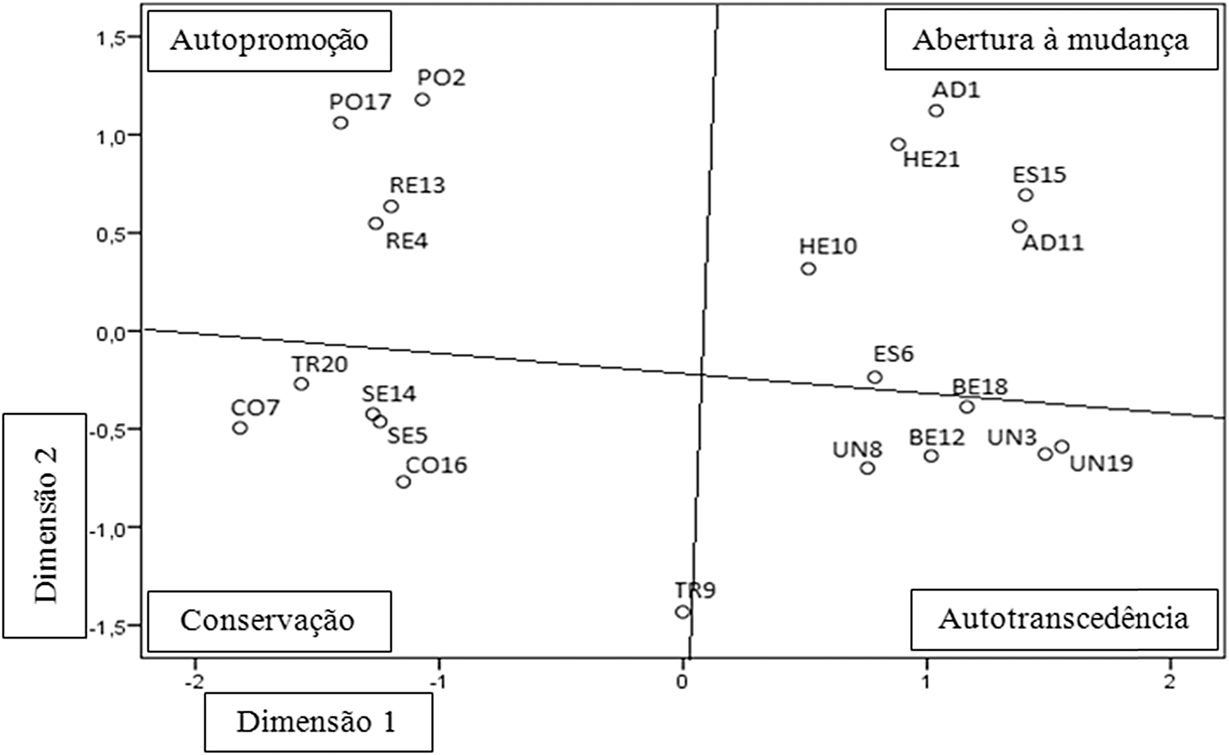
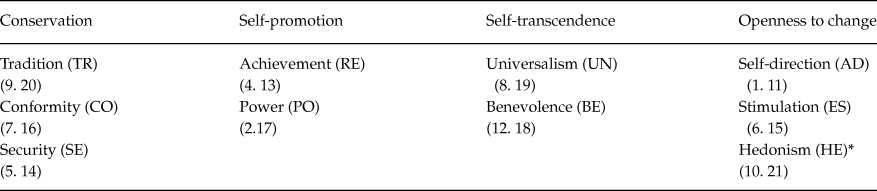
As can be seen in Figure 1, based on the values presented in Table 1 for understanding the acronyms associated with the values, the results show that the arrangement of the types of values is consistent with the Schwartz model of the motivational types, since the first dimension was formed by the openness to change and conservation poles, and the second was formed by the self-direction and self-transcendence poles. The scale items fit together perfectly within their respective dimensions, and can be seen from the lines marked out. The internal consistency analysis of the motivational types presented the following alphas: 0.70 for conservation (tradition, conformity, and security); 0.64 for self-transcendence (universalism and benevolence); 0.65 for self-promotion (achievement, power, and hedonism); 0.62 for openness to change (self-direction and self-stimulation).
Exploratory multidimensional scaling of the Schwartz model.
[Figure text: Dimensão1 = Dimension1; Dimensão2 = Dimension2; Autopromoção = Self-promotion (PO = power; RE = achievement); Abertura à mudança = Openness to change (BE = Benevolence; AD = self-direction; HE = hedonism ES = stimulation); Conservação = Conservation (TR = tradition CO = conformity SE = security); Autotranscendência = Self-transcendence (UN = universalism BE = benevolence]

Dimensions and their respective associated values according to the scale

* HE is related both to self-promotion and openness to change.
Testing the Hypotheses and analyses of moderations
To analyze the effect of the manipulation of the independent variable (scenario - national or ethnic origin) on the dependent variable (Tolerance of police violence) we used the ANOVA (analysis of variance) statistical technique with a post-hoc Tukey test, which allows for verifying whether there are simultaneous significant differences between the means of the three groups studied (Spanish x Moroccan x Romanian Gypsy). We chose this technique for robustness in the “between groups” condition and because it evaluates the probability of seeing differences between conditions due to sampling error. Additionally, we analyzed, also through an ANOVA, the results regarding the approval of compensation and the amount of compensatory damages.
Hypothesis
H1 - It is expected that the tolerance of police violence against a member of a social minority (Moroccan or Romanian Gypsy) is greater than when the victim is presented as a member of a social majority (Spaniard). It is also expected that there is no significant difference in the tolerance averages for the two social minorities.
Results
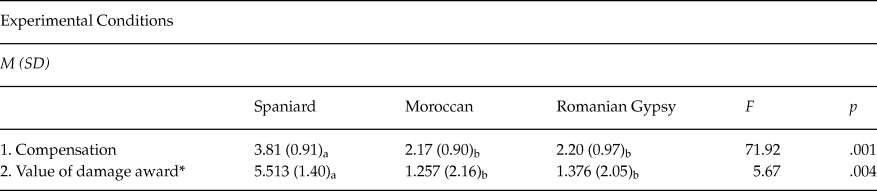
Participants tolerated police violence less when the character was Spanish (M = 2.34, SD = 0.98) than when the character was Moroccan (M = 4.19, SD = 0.95) or Romanian Gypsy (M = 3.99, SD = 0.96), F (2, 206) = 77.91, p = .001, ηp 2 = 0.433. Next, we assessed whether there was a significant difference in the approval of compensation (Table 2). Participants were more accepting of a possible damage award when the character was Spanish than when Moroccan or Romanian Gypsy. Finally, in the same table, it is seen that the participants gave a higher damage award value when the character belonged to a social majority. The Spaniard received greater compensation than the Moroccan and the Romanian Gypsy. Overall, these results show that the manipulation of the independent variable produced the expected effect, thus confirming H1, but also demonstrate a clear case of discrimination when the victim of police violence is a member of a social minority.
Comparison between the means of the levels of support for compensation and its value

* Only those who approved of compensation provided a damage award value.
Note: Averages that are on the same line and share the same subscript (a or b) are not significantly different from one another, at a p < .05, as revealed by the Tukey post-hoc test.
Having confirmed H1, it is expected that the Schwartz Values Subsystems play a moderating role in the relationship between police violence and tolerance of this violence. Thus:
-
• H1a - it is expected that adherence to the self-promotion values subsystem enhances the effect of nationality or ethnic origin on the tolerance of police violence.
-
• H1b - it is expected that adherence to the conservation values subsystems enhances the effect of nationality or ethnic origin on the tolerance of police violence.
In other words, the effect of nationality or ethnic origin described in H1 will be greater among participants with a higher adherence to these values subsystems than on participants with a lower adherence to them;
-
• H1c - it is expected that adherence to the openness to change values subsystem attenuates the effect of nationality or ethnic origin on the tolerance of police violence.
-
• H1d - it is expected that adherence to the self-transcendence values subsystem attenuates the effect of nationality or ethnic origin on the tolerance of police violence.
In other words, the effect of nationality or ethnic origin described in H1 will be lesser among participants with a higher adherence to these values subsystems than among participants with a lower adherence to them.
In order to test these hypotheses, we followed the procedures suggested by Aiken and West (Reference Aiken and West1991) to analyze moderating effect using ordinary least square multiple regression. First, we dummy coded the experimental conditions as follows: Scenario 1 (Sc1) = Moroccan; Scenario 2 (Sc2) = Spaniard. We used Scenario 3 (Romanian Gypsy) as a reference group against which the other scenarios were contrasted. Then, we centered each of the Schwartz value subsystems around their means and we computed the interaction terms by multiplying the Scenario 1 and Scenario 2 by each of these centered subsystems.
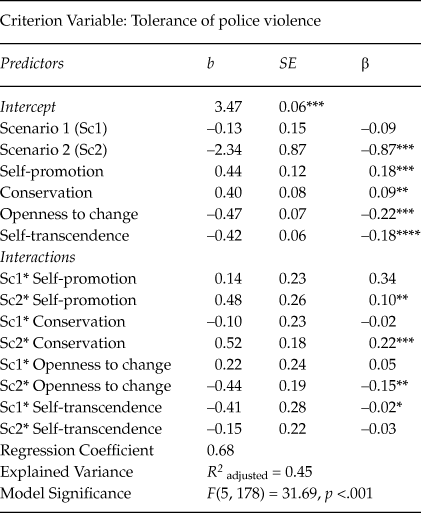
As can be seen in Table 3, the resulting multiple regression coefficient is strong and significantly different from zero. Analysis of the parameter estimates showed that the effect of the (Sc2) scenario manipulation is significant, meaning that tolerance of police violence was lesser in the Spaniard scenario than in the Romanian Gypsy one. Since (Sc1) is not significant, it can be said that there was no difference in the evaluation of the action of the police when the character was Moroccan, compared to the scenario in which the character was a Romanian Gypsy, as predicted in H1. A significant effect is noted for the self-promotion and conservation values subsystems, which indicates that the higher the adherence to these values subsystems, the greater the tolerance for police violence, confirming H1a and H1b. On the other hand, we note also a significant effect for the openness to change and self-transcendence values subsystems, which indicates that the higher the adherence to these values subsystems, the lesser the tolerance for police violence, confirming H1c and H1d.
Results of the multiple linear regression applied to analyze the predictive factors of tolerance of police violence

Note: Scenario 1 = Moroccan; Scenario 2 = Spaniard. Scenario 3 (Romanian Gypsy) is the reference group.
* p < .05
** p < .01
*** p < .001
The significant interactions between the manipulation of nationality or ethnic origin and the values subsystems are most important for testing the hypotheses. However, there was one unexpected effect, represented by the interaction between Sc1 and self-transcendence, demonstrating there was a significant difference between the two social minorities, i.e., there was greater tolerance for police violence when the character was a Moroccan than when a Romanian Gypsy, in participants with lower self-transcendence values. The interactions were interpreted based on the projection of the regression lines representing the effect of scenario manipulation for participants with low adherence (–1 SD below the mean) and high adherence (+1 SD above the mean).
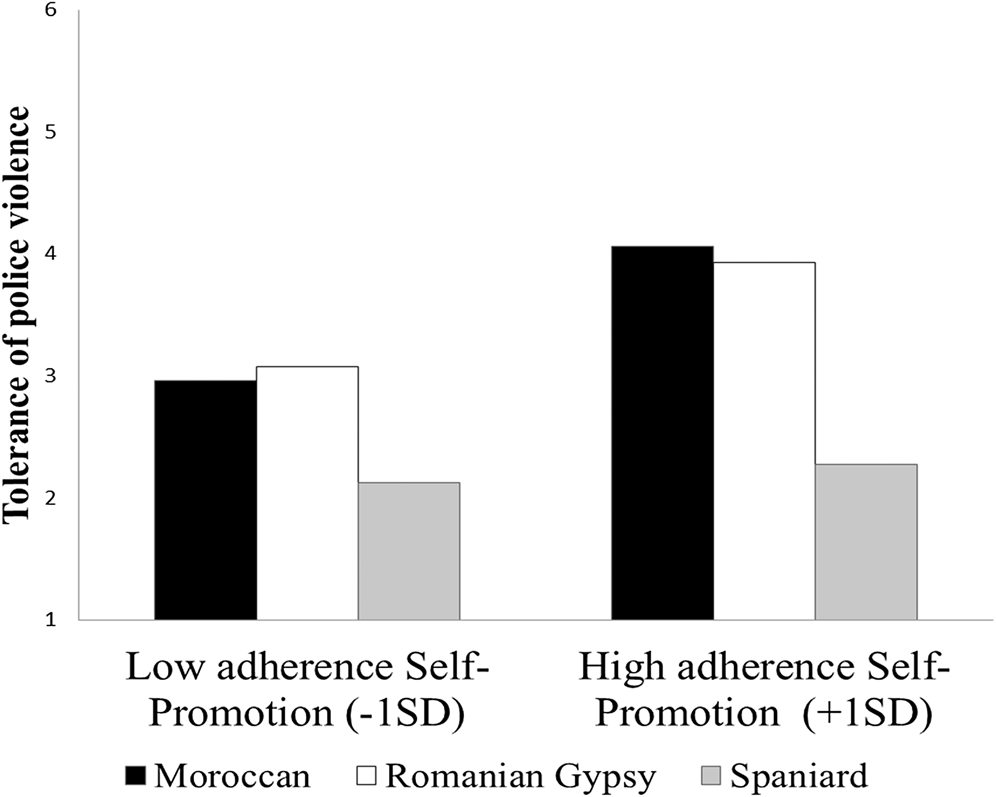
Regression lines representing the tolerance levels of police violence according to scenario type, moderated by the self-promotion values subsystem.

Figure 2 shows the effect of the manipulation of the scenario (nationality or ethnic origin) on the tolerance of police violence, moderated by the self-promotion values subsystem. Among the participants with higher adherence to the self-promotion values subsystem there was significant difference between Moroccan and Spaniard (b = –2.14, SE = 0.24, β = –0.80, p < .001), and between Romanian Gypsy and Spaniard (b = 1.66, SE = 0.23, β = 0.62, p < .001), but they did not differ between Moroccan and Romanian Gypsy (b = 0.04, SE = 0.26, β = 0.01, ns). Analyzing the estimated predicted values for tolerance of police violence (i.e., the Y’ values), participants tended to perceive the police violence as less appropriate when the target was Spanish (Y’ = 2.27) than when the target was Moroccan (Y’ = 4.06) or Romanian Gypsy (Y’ = 3.93), i.e., the scenario influenced tolerance for violence against social minorities in the participants with high adherence to the self-promotion values subsystem, and this is equally high in the Moroccan and Romanian Gypsy conditions, confirming H1a.
Regarding the participants with a lower adherence to the self-promotion values subsystem, there was likewise a significant difference between Moroccan and Spaniard (b = –1.64, SE = 0.24, β = –0.61, p < .001), as well as between Romanian Gypsy and Spaniard (b = –1.79, SE = 0.24, β = –0.67, p < .001), but they did not differ between Moroccan and Romanian Gypsy (b = 0.14, SE = 0.23, β = 0.05, ns). Participants perceived the police violence as less appropriate when the target was Spanish (Y’ = 2.12) than when the target was Moroccan (Y’ = 2.96) or Romanian Gypsy (Y’ = 3.07), i.e., in the situation of low adherence, the scenario also influenced the tolerance for violence against social minorities. However, the participants of this situation showed less tolerance of police violence against social minorities, although this, even so, was higher for the social minority conditions (Moroccan and Romanian Gypsy), than for the social majority condition (Spanish). Therefore, it can be said that the self-promotion values subsystem had a moderating effect because it exacerbated the effect of the scenario manipulation on the tolerance of police violence against social minorities, which was greater in participants with a high adherence to this values subsystem.
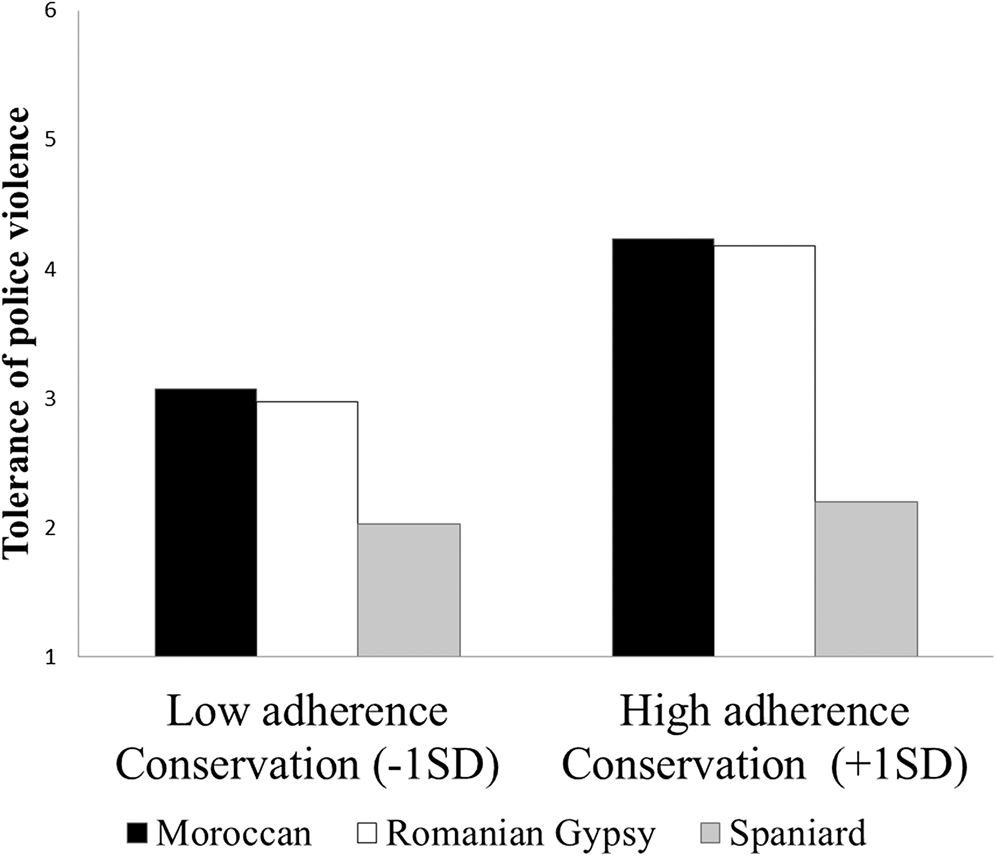
Regression lines representing the tolerance levels of police violence according to scenario type, moderated by the conservation values subsystem.

The results show that there was also a significant interaction between the scenario manipulation and the conservation values subsystem. Figure 3 shows the effect of the manipulation of the scenario (nationality or ethnic origin) on the tolerance of police violence, moderated by the conservation values subsystem. Among participants with a higher adherence to the conservation values subsystem, there was a significant difference between Moroccan and Spaniard (b = –1.87, SE = 0.24, β = –0.70, p < .001), and between Romanian Gypsy and Spaniard (b = 1.66, SE = 0.23, β = 0.62, p < .001), but they do not differentiate between Moroccan and Romanian Gypsy (b = 0.20, SE = 0.24, β = 0.07, ns). Participants perceived the police violence as less appropriate when the target was Spanish (Y’ = 2.20) than when the target was Moroccan (Y’ = 4.23) or Romanian Gypsy (Y’ 4.18), i.e., the scenario influenced the tolerance for violence against social minorities, confirming H1b.
Among participants with low adherence to the conservation values subsystem, there was also significant difference between Moroccan and Spaniard (b = –1.89, SE = 0.23, β = –0.70, p < .001), and likewise between Romanian Gypsy and Spaniard (b = 1.85, SE = 0.25, β = 0.69, p < .001), but they did not differ between Moroccan and Romanian Gypsy (b = 0.04, SE = 0.26, β = 0.01, n.s.). Thus, participants perceived the police violence as less appropriate when the target was Spanish (Y’ = 2.03) than when the target was Moroccan (Y’ = 3.07) or Romanian Gypsy (Y’ = 2.97). In fact, participants showed less tolerance of police violence in the low adherence situation, although this remained higher in the social minority conditions (Moroccan and Romanian Gypsy), than in the social majority condition (Spanish). Therefore, it can be said that the conservation values subsystem also had a moderating effect, since it potentiated the effect of the scenario manipulation on the tolerance of police violence, i.e., there was more discrimination against social minorities by the participants when they presented a high adherence to this values subsystem. In summary, it was confirmed that the moderating effect of the self-promotion and conservation values subsystems was indeed significant, confirming H1a and H1b.
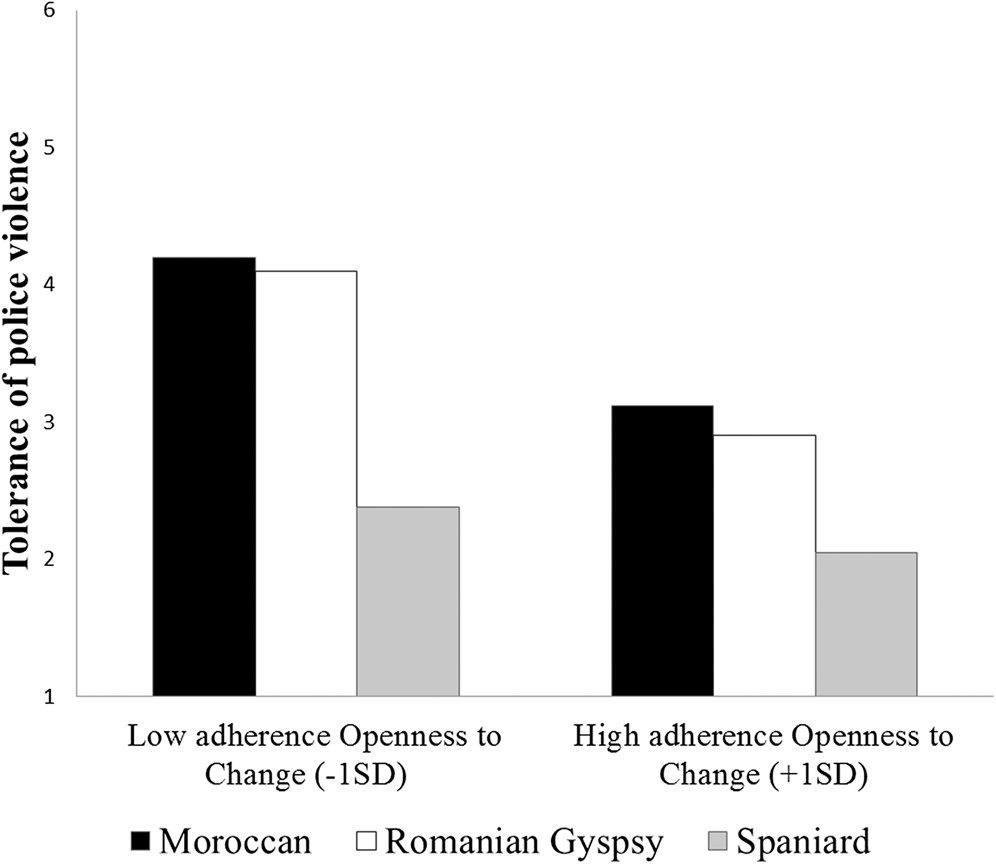
Regression lines representing the tolerance levels of police violence according to scenario type, moderated by the openness to change subsystem values.

Continuing through the results, a significant interaction between the manipulation of the scenario and the openness to change values subsystem was also observed. Figure 4 shows the effect of the scenario manipulation (ethnicity and nationality) on tolerance of police violence, moderated by the openness to change values subsystem. Participants with low adherence to openness to change tended to perceive the police violence as less appropriate when the target was Spanish, i.e., there was significant difference between Moroccan and Spaniard (b = –1.83, SE = 0.24, β = –0.68, p < .001), and between Romanian Gypsy and Spaniard (b = 1.52, SE = 0.22, β = 0.56, p < .001), but they did not differ between Moroccan and Romanian Gypsy (b = 0.31, SE = 0.24, β = –0.11, ns). Participants showed greater tolerance of police violence against social minorities by the fact that there is less tolerance for it against the Spaniard (Y’ = 2.38) compared with the Moroccan (Y’ = 4.20) and the Romanian Gypsy (Y’ = 4.10).
Among participants with a higher adherence to the openness to change values subsystem, there was a significant difference between Moroccan and Spaniard (b = –1.94, SE = 0.23, β = –0.72, p < .001), and also between Romanian Gypsy and Spaniard (b = 1.95, SE = 0.23, β = 0.73, p < .001), but they did not differ between Moroccan and Romanian Gypsy (b = 0.13, SE = 0.24, β = 0.01, n.s.). Confirming H1c, the tolerance for violence was less in the situation of greater adherence to openness to change, although, even so, the tolerance for violence remained higher for the social minorities, as participants tended to perceive the police violence as less adequate when the target was Spanish (Y’ = 2.05) than when the target was Moroccan (Y’ = 3.12) or Romanian Gypsy (Y’ = 2.90). Therefore, it can be said that the openness to change values subsystem presented a moderating effect, since it attenuated the effect of the scenario manipulation on the tolerance of police violence, which is lower in participants with high adherence to this values subsystem.
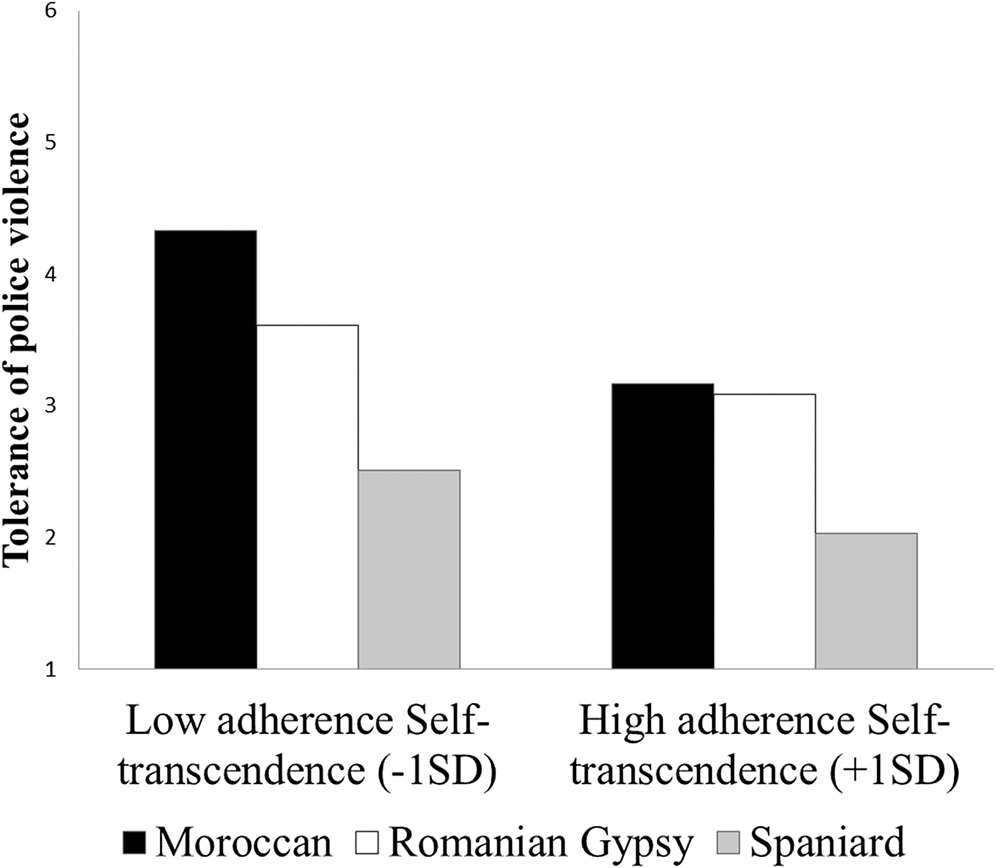
Regression lines representing the tolerance levels of police violence according to scenario type, moderated by the self-transcendence subsystem values.

To complete the set of results from the Schwartz Values Subsystems, we assessed whether the self-transcendence values subsystem would have a moderating effect. Figure 5 shows the effect of the scenario manipulation (ethnicity and nationality) on the tolerance of police violence, moderated by the self-transcendence values subsystem. Participants with low adherence tended to perceive the police violence as less appropriate when the target was Spanish. However, when the target was from a social minority, the participants felt that police violence was more appropriate for the Moroccan than for the Romanian Gypsy, i.e., there was a significant difference between Moroccan and Spaniard (b = –1.81, SE = 0.23, β = –0.67, p < .001), between Romanian Gypsy and Spaniard (b = 1.59, SE = 0.24, β = 0.59, p < .001), and between Moroccan and Romanian Gypsy (b = 0.48, SE = 0.24, β = 0.17, p = .05). Participants perceived the police violence as less appropriate when the target was Spanish (Y’ = 2.51) than when the target was Moroccan (Y’ = 4.33) or Romanian Gypsy (Y’ = 3.61). However, the unexpected effect demonstrates that the Moroccan suffered even more discrimination.
Among participants with a higher adherence to the self-transcendence values subsystem, there was a significant difference between Moroccan and Spaniard (b = –1.94, SE = 0.23, β = –0.72, p < .001), and also between Romanian Gypsy and Spaniard (b = –1.86, SE = 0.24, β = –0.69, p < .001), but they did not differ between Romanian Gypsy and Moroccan (b = 0.78, SE = 0.25, β = 0.02, ns). Although discrimination against social minorities was seen, it was lesser, and confirmed H1d since there was less tolerance in participants with higher adherence. Thus, the police violence was perceived as less appropriate when the target was Spanish (Y’ = 2.03) than when the target was Romanian Gypsy (Y’ = 3.09) or Moroccan (Y’ = 3.17). Although there was less discrimination against social minorities, they continued to suffer more discrimination than the social majority.
In summary, the openness to change values subsystem showed a significant moderating effect, as well as did the self-transcendence values subsystem, confirming H1c and H1d. However, in this latter values subsystem, an unexpected result was obtained, since the interaction between Sc1 and self-transcendence was significant, i.e., there was a difference in the evaluation of police violence between the Moroccan and Romanian Gypsy conditions. It was not predicted that in the condition of low adherence to the self-transcendence subsystem there would be a difference between these two minority groups, even though moderation occurred.
From a historical and empirical perspective, the Moroccans are even more discriminated against than the Romanian Gypsies in Spain, as shown in previous studies and social indicators on discrimination against this group in Spanish territory (Cea D'Ancona, Reference Cea D’Ancona2009; CIS, 2010; Sección Española de Amnistía Internacional, 2010). Perhaps this is the reason behind the differences found in the situation of low adherence in the self-transcendence values subsystem. As predicted, the lower the adherence to self-transcendence, the greater was the tolerance of violence against social minorities. This indeed occurred, although the Moroccan has suffered more discrimination than the Romanian Gypsy.
Discussion
First, it must be emphasized that the police violence described in this study was more accepted when the victim was a member of a minority (Moroccan or Romanian Gypsy); additionally, it was demonstrated that this leniency shows up both in the greater support for damage compensation when the victim is a member of the majority (Spanish), as well as in the amount of possible damages, which would be much higher than when the victim was a member of a social minority.
The fact that the participants in this study were college students should also be emphasized, first because it demonstrates the need to use more extensive and representative samples in future studies, but at the same time, warns us about the situation of certain immigrant minorities in Spain. This being the case, it is fitting to ask whether the results presented here would be found in the general population.
The observed results also showed that the different dimensions of the individual values, from S. Schwartz, have a moderator role at least with regard to the tolerance of police violence against social minorities such as the Moroccan and the Romanian Gypsy, in Spain. The proposed hypotheses were confirmed, i.e., the higher adherence to the conservation and self-promotion values subsystems, which are characterized by personal success and by the preservation of traditional practices, would act as a moderator of discrimination in the form of tolerance of police violence.
On the other hand, the openness to change and self-transcendence values subsystems imply benevolence and acceptance of others, i.e., it was hypothesized that individuals with higher adherence to these values would tend toward less tolerance of police violence against social minorities. Indeed, the results confirmed this hypothesis and confirmed that these Schwartz Values Subsystems act fundamentally as moderators in the rejection of discrimination.
Taken together, these results are highly socially relevant for two reasons. First, in general, more highly educated individuals have a lower tendency to reject immigration (e.g., Davidov & Meuleman, Reference Davidov and Meuleman2012), and social science students have an even lower level of rejection (e.g., Alvaro et al., Reference Álvaro, Silva, Lima, Torres, Camino and Garrido2012). However, this was not the case in this study. In a very reasonable and unfortunately frequent scenario of police violence, university students discriminate against social minority members in an unequivocal way. Second, while value adhesion is acquired during early life, universities have a crucial role in changing public opinion on controversial subjects such as immigration. Therefore, the results of the present study might be highly relevant for policies designed to change public opinion about immigration.
Obviously, the tolerance regarding discrimination against social minorities depends on many other factors, but, undoubtedly, the structure of the individual values has an important role in reducing or strengthening prejudiced attitudes and in the acceptance or rejection of practices and behaviors that encourage the exclusion of immigrant minorities.
From a theoretical point of view, the results of the studies discussed earlier, such as those by Álvaro and Monter (Reference Álvaro and Monter2010), Feather and McKee (Reference Feather and McKee2008), Katz and Hass (Reference Katz and Hass1988), and Sagiv and Schwartz (Reference Sagiv and Schwartz1995), among others, also empirically support the results obtained here. However, we must emphasize that, through the type of method used (quasi-experimental) and the type of analyses conducted (moderation), the present investigation goes beyond previously discussed studies, deepening the understanding of the role of values in such complex phenomena as studied here. This is an important theoretical and methodological contribution to this field.
Finally, another aspect of this work that we have to keep in mind is that we are studying the two immigrant communities that have the worst image among Spaniards. This study needs to be extended to other immigrant groups to investigate whether the processes of acceptance of discrimination observed here occur with the same intensity, and also to see whether the effects of moderation found here are replicated or not.
This research has been financially supported by Capes (Coordenação de aperfeiçoamento de pessoal de nivel superior 307/2015) and SGU (Ministerio de Educación, Cultura y Deporte -Secretaría General de Universidades- PHBP14/00055) which are gratefully acknowledged.