Introduction
Navua sedge [Cyperus aromaticus (Ridley) Mattf. & Kük.] is an invasive C4 perennial sedge species of the Cyperaceae family found predominantly in tropical environments. It is a native of tropical Africa but has now spread widely and become problematic in many southwest Pacific islands and in the tropical north of Queensland, Australia (Benson Reference Benson1992; Black Reference Black1984; Parsons and Cuthbertson Reference Parsons and Cuthbertson1992; Vitelli et al. Reference Vitelli, Madigan and van Haaren2010). Being unpalatable, C. aromaticus provides very low feed value to cattle, which facilitates its spread in pastures (Vitelli et al. Reference Vitelli, Madigan and van Haaren2010), where it can consequently establish a significant presence. Coupled with this invasion, the species can spread at an alarming rate across large areas within a short period of time. In Fiji, C. aromaticus is known to have reduced the carrying capacity of pastures by up to 40%, causing huge losses to the dairy and intensive livestock-grazing industries (Karan Reference Karan1975). In Australia, this weed species has a significant impact on livestock-grazing industries, sugarcane (Saccharum officinarum L.) and banana (Musa acuminata Colla) plantations, and various ecosystems in the tropical north of Queensland.
Cyperus aromaticus is a persistent sedge that strongly competes with more preferred species for sunlight, water, nutrients, and space, forming dense stands with thick clumps. A huge contributor to the spread of this species is its dual mode of reproduction (Black Reference Black1984). In this respect, its capacity for producing large numbers of seeds is known to enhance dispersal from the parent plant and initiate new infestations, while vegetative propagation allows the plant to spread over much shorter distances, maintaining its population persistence (Barrett Reference Barrett2015; Levine and Murrell Reference Levine and Murrell2003; Pfeiffer et al. Reference Pfeiffer, Günzel and Frey2008). Vegetatively, C. aromaticus spreads through the extension of its rhizome system and by dispersal of viable rhizome fragments, especially during cultivation. Each seed head produces approximately 250 seeds, and C. aromaticus is capable of producing 450 to 550 million seeds ha−1 (Karan Reference Karan1975). Studies conducted by Vitelli et al. (Reference Vitelli, Madigan and van Haaren2010) showed that soil seedbank densities of 44,400 to 56,700 viable seeds m−2 are present in areas of dense C. aromaticus infestation. Mature seeds are lightweight and are thus readily dispersed by wind over short distances. Other vectors of dispersal include floodwaters (hydrochory), the hooves and digestive tract of cattle (zoochory), humans, and harvesting machinery. Cyperus aromaticus forms a persistent seedbank in which 31% seed viability was observed after 5 yr in seedbank-depletion studies (Vitelli et al. Reference Vitelli, Madigan and van Haaren2010). Species like C. aromaticus form abundant and persistent seedbanks, and they are therefore able to germinate when conditions are favorable, reducing the possibility of local eradication and allowing them to maintain their population dominance (Pyšek and Richardson Reference Pyšek, Richardson and Nentwig2007).
Weed invasion occurs by a three-stage process: introduction, establishment, and spread (Aikio et al. Reference Aikio, Duncan and Hulme2010; Richardson et al. Reference Richardson, Pysek, Rejmanek, Barbour, Panetta and West2000; Theoharides and Dukes Reference Theoharides and Dukes2007). The period between establishment and spread is called the lag phase (Bryson and Carter Reference Bryson and Carter2004; Mack et al. Reference Mack, Simberloff, Mark Lonsdale, Evans, Clout and Bazzaz2000; Prentis et al. Reference Prentis, Wilson, Dormontt, Richardson and Lowe2008). In this lag phase, small populations of established invasive species adapt to their new environment and begin to expand into new regions, with their abundance increasing exponentially (Richardson et al. Reference Richardson, Pysek, Rejmanek, Barbour, Panetta and West2000; Sakai et al. Reference Sakai, Allendorf, Holt, Lodge, Molofsky, Kimberly, Baughman, Cabin, Cohen, Ellstrand, McCauley, O’Neil, Parker, Thompson and Weller2001; Theoharides and Dukes Reference Theoharides and Dukes2007). An extended length of time in the lag phase may be due to either a lack of genetic variation, which prevents rapid adaptation to novel conditions, or barriers for the population to reach a threshold size that facilitates spread (Aikio et al. Reference Aikio, Duncan and Hulme2010; Sakai et al. Reference Sakai, Allendorf, Holt, Lodge, Molofsky, Kimberly, Baughman, Cabin, Cohen, Ellstrand, McCauley, O’Neil, Parker, Thompson and Weller2001). In the third phase of invasion, the species increases in abundance in distal areas (Richardson et al. Reference Richardson, Pysek, Rejmanek, Barbour, Panetta and West2000), and it is at this time that asset-based management is required. Because asset-based management comes with high economic and labor costs, it is important to control unwanted weed species before they reach the invasion stage. Currently, C. aromaticus is thought to be in the lag phase in Australia, making it an opportune and cost-effective time to control this species. During the lag phase, the species is particularly susceptible to change, including changes related to human actions (e.g., land-use changes), biotic variations (e.g., availability of pollinators or dispersers), and/or abiotic factors (e.g., climatic variation). How plants cope with these changes determines the level of their invasion success (Lenda et al. Reference Lenda, Skórka, Knops, Moroń, Tworek and Woyciechowski2012; Spalazzi et al. Reference Spalazzi, Tecco and Funes2019). Understanding the effects of these factors on weed species is an important step in identifying specific invasion strategies and formulating a management strategy at a time when intervention is cost-effective, efficient, and environmentally sensitive.
During the early stages of a plant’s life cycle, the characteristics of the seed-bearing microsite play an important role in the germination, seedling establishment, and subsequent growth of the species, thus helping to regulate the spread and abundance of the species (Carrillo-Gavilán et al. Reference Carrillo-Gavilán, Espelta and Vilà2012; Fenner and Thompson Reference Fenner and Thompson2005; McAlpine and Jesson Reference McAlpine and Jesson2008). Abiotic factors such as temperature, light, moisture stress, salt concentration, radiant heat, and seed location in the soil seedbank influence germination through either initiation or inhibition (Baskin and Baskin Reference Baskin and Baskin1998; Cuneo et al. Reference Cuneo, Offord and Leishman2010). Among these factors, temperature and light are widely regarded as the most critical environmental factors to regulate seed germination (Batlla and Benech-Arnold Reference Batlla and Benech-Arnold2014; Presotto et al. Reference Presotto, Poverene and Cantamutto2014). A previous study reported that seeds of C. aromaticus can germinate at different temperatures ranging from 15 to 25 C; however, no germination was observed under completely dark conditions, and a maximum germination of 99% was observed when seeds were germinated under alternating temperatures of 15/25 C at 8-h dark/16-h light and 15/25 C at 16-h light/8-h dark conditions (Karan Reference Karan1975). Further, moisture stress imposed by salt levels and osmotic potential in the growth medium can delay, reduce, or prevent seed germination, as these conditions restrict water intake of the seed (Bittencourt et al. Reference Bittencourt, Bonome, Trezzi, Vidal and Lana2017; DiTommaso Reference DiTommaso2004). Soil pH also affects weed seed germination, although some weeds can tolerate a wide range of pH levels (Hao et al. Reference Hao, Lv, Bhattacharya and Fu2017; Nosratti et al. Reference Nosratti, Almaleki and Chauhan2019), which is a key trait of an invasive generalist species. Along with high variability in soil properties, salinity and alkalinity are often considered a major hindrance in Queensland agriculture (Dang et al. Reference Dang, Christopher and Dalal2016). However, knowledge gaps currently exist in the response of C. aromaticus to different levels of salt, pH, and osmotic stress. Location of seed in the soil seedbank, or its burial depth, is another determining factor in seed germination and seedling emergence, as burial limits light penetration and alters ambient germination temperatures (Baskin and Baskin Reference Baskin and Baskin1998).
The germination biology of various populations of weed species is known to vary under different environmental conditions (Chadha et al. Reference Chadha, Florentine, Chauhan, Long, Jayasundera, Javaid and Turville2019; Loura et al. Reference Loura, Sahil, Florentine and Chauhan2020). Within the infestation region in Queensland, Australia, variable environmental conditions occur for rainfall and temperatures, and therefore weed populations may differ in their responses to these different environments and may require different management practices (Cai et al. Reference Cai, Crimp, Jones, McInnes, Durack, Cechet, Bathols and Wilkinson2005; Iqbal et al. Reference Iqbal, Manalil, Chauhan and Adkins2019; Whitfield and Queensland Department of Environment and Resource Management 2010). Better knowledge and understanding of the factors that favor or prevent the spread and establishment of C. aromaticus under various environmental conditions are essential to develop effective local measures to prevent further spread (DiTomaso Reference DiTomaso2000; Loddo et al. Reference Loddo, Carlesi and Da Cunha2019). We present a comprehensive seed ecology study to facilitate an appropriate management plan addressing the complexity of C. aromaticus. We evaluate and compare the germination and emergence abilities of three populations of C. aromaticus seeds to various abiotic factors: (1) temperature, (2) photoperiod, (3) soil pH, (4) salinity, (5) osmotic stress, (6) heat stress, and (7) burial depth.
Materials and Methods
Seed Collection and Site Description
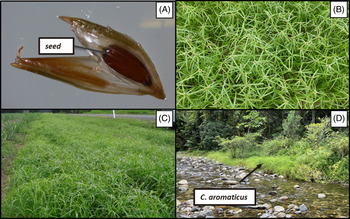
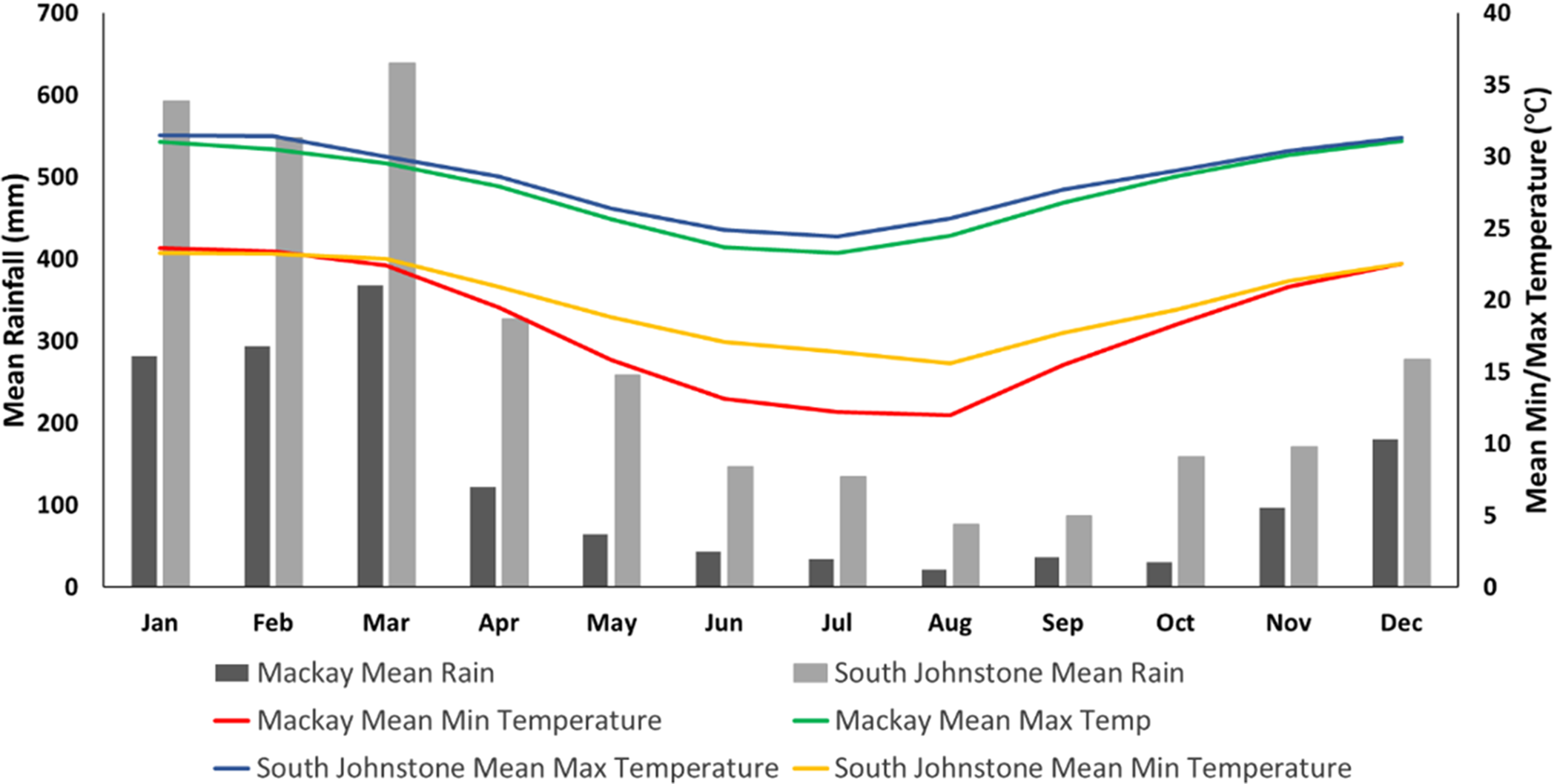
Mature C. aromaticus seeds (Figure 1A) were collected from more than 100 plants for each of the three populations in Queensland, Australia. Seeds were collected from McCutcheon Road, South Johnstone (SJ) (17.71528°S, 146.045°E) in June 2019 from a roadside that had a monoculture of C. aromaticus plants (Figure 1B). SJ receives its highest rainfall, more than 500 mm mo−1, in the months of January, February, and March, and the average temperature ranges from a maximum of 32 C in summer to a minimum of 14 C in winter (Figure 2). The second population was collected in March 2019 from outside a fenced paddock in Mackay (M) (21.116912°S, 148.752388°E) (Figure 1C). M receives its maximum rainfall of 368 mm in March and minimum rainfall of 21 mm in August (averaged from 2008 to 2018), and the average temperature ranges from a maximum of 31 C in summer to a minimum of 12 C in the winter (Figure 2). Seeds from the Nyleta Creek (NC) population were collected from the banks of Nyleta Creek, which is a rain forest creek, upstream from most agriculture and disturbance (17.79089°S, 145.9550°E), in December 2019 (Figure 1D). Along with C. aromaticus, there were other shrubs and sedges present along the creek. The climatic conditions at NC were similar to those of SJ (Figure 2). Seeds from each site were collected in a labeled paper bag and brought to Federation University Australia, where they were stored in the seed ecology laboratory at room temperature (19 C) until use.
Mature viable seed of Cyperus aromaticus (A), seed collection site at South Johnstone (B), Mackay (C), and Nyleta Creek (D) in Queensland, Australia.

The mean monthly rainfall and average monthly maximum and minimum temperatures collected from South Johnstone Experiment station (17.61°S, 146.00°E; located approximately 16 km from the South Johnstone site and 31 km from the Nyleta Creek site) and Mackay Aero station (21.17°S, 149.18°E; located approximately 43 km from the Mackay site). The temperature and rainfall data are presented as monthly averages from January 2008 to December 2018 (Bureau of Meteorology 2019).

General Seed Germination Protocol
Germination experiments were conducted under a completely randomized design during July 2019 to May 2020 at the seed ecology laboratory, Federation University Australia, Mount Helen, Australia (37.627663°S, 143.891103°E). Before germination trials, seeds were placed in a strainer and surface sterilized by rinsing in 1% sodium hypochlorite for 1 min, and washed thoroughly with sterilized, reverse-osmosis (RO) water. The surface-sterilized seeds were evenly placed in a 9-cm-diameter petri dish lined with Whatman® No. 10 filter paper (GE Healthcare UK Ltd., Amersham Place, Buckinghamshire, UK). Filter papers were moistened with 9 ml of either RO water or a treatment solution to provide adequate moisture for germination. Petri dishes were sealed with Parafilm® (Curwood Parafilm MTM Laboratory Wrapping Film, Fisher Scientific PTE LTD., Marsiling Industrial Estate Road 3, Singapore) to ensure moisture retention. To mimic the 24-h dark conditions, petri dishes were wrapped with a double layer of aluminum foil. Petri dishes were then incubated in seed germination cabinets (humidity cabinet, TRISLH-495-1SD, Vol.240, Thermoline Scientific, Wetherill Park, NSW, Australia) equipped with cool-white fluorescent lamps to provide a photosynthetic photon flux of 40 µmol m−2s−1. Observations were made daily for 35 d, with trials continuing 1 wk after the last germination. The seeds were regarded as germinated when the radicle was approximately 2-mm long and the plumule had emerged. On the 35th day, nongerminated seeds were tested for their viability using 2,3,5-triphenyltetrazolium chloride (Saatkamp et al. Reference Saatkamp, Affre, Dutoit and Poschlod2011; Van Waes and Debergh Reference Van Waes and Debergh1986).
Effects of Temperature and Photoperiod on Seed Germination
Cyperus aromaticus seeds were exposed to two photoperiod regimes, 12-h light/12-h dark and 24-h dark under four temperature regimes in incubators set at day/night temperatures of 17/7, 25/15, 30/20, and 35/25 C. As maximum germination was observed under 12-h light/12-h dark conditions at 25/15 C for the SJ and M populations and 12-h light/12-h dark conditions at 30/20 for the NC population, subsequent experiments were conducted using these temperatures and photoperiods for these populations.
Effects of pH
A range of buffer solutions (pH values 4 to 10) were prepared according to Chachalis and Reddy (Reference Chachalis and Reddy2000) and were used to examine the effect of pH on seed germination. For control comparisons, sterilized RO water with a pH value of 6.2 was used. Buffers were prepared using 2 mM solutions of potassium hydrogen phthalate (pH 4), MES (2-(N-morpholino) ethanesulfonic acid) (pH 5 and 6), HEPES (N-2-hydroxyethyl) piperazine-NO-(2-ethanesulfonic acid) (pH 8), and tricine (N-Tris(hydroxymethyl)methyl glycine) (pH 9 and 10). The specific pH values were obtained by adjusting with 1 M HCl or NaOH.
Effects of Salinity Stress
To evaluate the effects of salinity on seed germination of C. aromaticus, a range of sodium chloride (NaCl) concentrations (0, 25, 50, 75, 100, 150, 200, and 250 mM) were prepared by dissolving NaCl (Mallinckrodt Baker, Phillipsburg, NJ, USA) in sterile distilled water. For each of these trials, a treatment with sterile RO water was included as a control.
Effects of Osmotic Stress
Effects of osmotic stress on C. aromaticus seed germination were tested in aqueous polyethylene glycol (PEG) solutions with an average molecular weight of 8,000 (Sigma Aldrich, St Louis, MO, USA). PEG was dissolved in sterilized distilled water to obtain different concentrations of osmotic potential solutions (0, −0.1, −0.2, −0.4, −0.6, −0.8, and −1.0 MPa). For each of these trials, a treatment with sterile RO water was included as a control.
Effects of Radiant Heat Stress
To check the effects of radiant heat, six replicates of 20 seeds were exposed for three periods of time to varying radiant heat (180, 360, and 540 s each at 80, 100, and 120 C). The seeds were counted, put in glass petri dishes, and then exposed to radiant heat by placing them in an oven (type UFE500, Memmert GmbH + Co. KG, Äußere Rittersbacher Straße 38, Schwabach, Germany) maintained at the relevant temperature. Once removed from the oven, the seeds were placed in petri dishes lined with filter paper and moistened with sterile RO water. For each of these trials, a no-heat treatment was included as the control.
Effects of Seed Burial Depth
To assess the effects of seed burial depth, six replicates of 20 seeds were buried at different depths (0, 0.5, 1, 2, 3, and 4 cm). The seeds were placed on the soil surface in the punnets (10-cm length by 6-cm width by 6-cm height) and covered with sterilized soil (potting mix) to achieve the desired depths. A constant water supply was facilitated by placing the punnets in a large butcher’s tray filled with water, and then the trays were incubated in the germination cabinets. The seed/seedling was considered germinated/emerged when the plumule was visible.
Seed Germination Parameters
The formula given by Kader (Reference Kader2005) was used to calculate the germination rate index (GI) or the emergence rate index (EI) to measure the rate of germination or emergence of C. aromaticus seeds:
 $${\rm{GI}}\ {\rm{or}}\ {\rm{EI}} = {{G_1} \over 1} + {{G_2} \over 2} + \cdots \ldots + {{G_x} \over x}$$
where G 1, G 2, and G x are the germination percentages times 100 at 1, 2, and x days after sowing, respectively.
The mean germination or the emergence time (MGT/MET), which expresses the rate of seed germination or emergence, was calculated with the formula described by Kader (Reference Kader2005)
 $${\rm{MGT}}\ {\rm{or}}\ {\rm{MET}} = {{\sum Dn} \over {\sum n}}$$
where n represents number of seeds germinated on day D, and D is the number of days counted since the beginning of the experiment.
Following the calculation in Coolbear et al. (Reference Coolbear, Francis and Grierson1984), the time taken for 50% germination or emergence (T50 or E50) was calculated using the formula: :
 $${\rm{T_{50}}}\ {\rm{or}}\ {\rm{E_{50}}} = ti{{({N \over 2} - n_i)(t_j - t_i)} \over {(n_j - n_i)}}$$
where N represents the total number of seeds germinated or emerged and n i and n j the cumulative number of seeds germinated by adjacent counts at times t i (day) and t j (day), respectively. This implies that n i < N/2 < n j .
Statistical Analyses
In all experiments, three replicates of each population were arranged in a completely randomized design. The experiments were repeated within a week of completion of the first trial to produce six replicates for each treatment and to test the reliability of the results. In total, 5,640 seeds were used for each population in this study. For each of the 47 treatments conducted in this study, there were six replicates of 20 seeds each, so 120 seeds were used per treatment per population. All the data were analyzed using ANOVA, available in the IBM SPSS Statistics v. 26 (IBM, 1 New Orchard Road, Armonk, NY). The effect of temperature, pH, salinity stress, osmotic stress, radiant heat, and burial depth were evaluated with two-way ANOVA to determine the effect of population, treatment, and their interaction. The significant main effects were further explored with Tukey’s honesty difference (HSD) at P ≤ 0.05. Significant interactions were further explored with simple effects and Bonferroni adjustments.
Results and Discussion
Effects of Temperature and Photoperiod
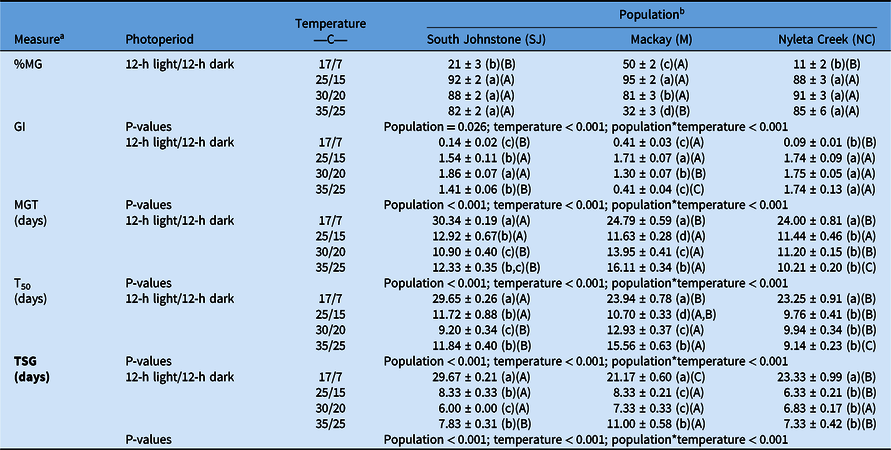
Seeds from all three populations subjected to continuous dark did not germinate, hence only the data for the light/dark regime were included in the analyses and are presented (Table 1). The highest germinations of 92% and 95% were observed in the 25/15 C alternating temperatures in the SJ and M populations, respectively. However, population NC recorded the maximum germination of 91% in the 30/20 C alternating temperature treatment (Table 1). An interaction effect of population with alternating temperatures was observed for the mean germination percentage (%MG). Seeds of the SJ and NC populations had similar %MG when germinated in alternating temperatures of 25/15, 30/20, and 35/25 C, significantly higher than the %MG at 17/7 C (Table 1). In contrast to the SJ and NC populations, the %MG for the M population was significantly different across all temperature regimes. At the lowest temperature regime (17/7 C), the %MG of the M population was greater than the %MG of the SJ and NC populations, and at the highest temperature regime (35/25 C), the %MG of the M population was less than the %MG of the SJ and NC populations. However, at alternating temperatures of 25/15 and 30/20 C, the %MG values were similar across all three populations (Table 1). The interaction effect of population with alternating temperatures was also observed for other germination parameters, including GI, MGT, T50, and time to start germination (TSG). GI was significantly higher at 17/7 C and lower at 35/25 C for the M population compared with the other two populations (Table 1). Across all populations, MGT, T50, and TSG were significantly greater in the lowest temperature regime (17/7 C) compared with the other three temperature regimes.
The effect of alternating temperature regimes on seed germination of Cyperus aromaticus from three populations collected in Queensland, Australia.

a %MG, mean germination percentage; GI, germination rate index; MGT, mean germination time; T50= time taken to reach 50% germination; TSG, time taken to start germination.
b Values within columns followed by the same lowercase letter (first set of parentheses) are not significantly different at P ≤ 0.05. Values within rows followed by the same capital letter (second set of parentheses), are not significantly different at P ≤ 0.05.
The highest germinations of the SJ and M populations were obtained at the 25/15 C alternating temperature treatment, whereas the highest germination of the NC population was at 30/20 C, although not significantly different from the 25/15 C and 35/25 C regimes (Table 1). Seeds from the M population had significantly higher germination in alternating temperatures of 17/7 C and significantly lower germination in 35/25 C compared with the SJ and NC populations, which may be attributable to localized plant adaptation. For all populations, maximum germination immediately after seed harvest ranged from 90% to 95%, indicating the absence of innate dormancy in this species. The germination parameters TSG, T50, and MGT increased significantly, while GI decreased significantly at the cooler temperatures of 17/7 C in each of the three populations (Table 1).
External temperature and available light affect germination by regulating the enzymes that are directly involved in germination (Baskin and Baskin Reference Baskin and Baskin1998). The results from this study show that seeds from the SJ and NC populations had optimal germination at alternating temperatures of 25/15, 30/20, and 35/25 C, whereas the M population had optimal germination at alternating temperatures of 25/15 C. Reduced germination in all three populations at alternating temperatures of 17/7 C suggest that this species germinates best under warmer conditions and may be less problematic in cooler seasons or at higher altitudes in tropical regions, as it is a tropical sedge, native to equatorial Africa. Our results are similar to those of Karan (Reference Karan1975), who observed 99% germination in alternating temperatures of 25/15 C in C. aromaticus seeds from Fiji. Other Cyperus species that exhibit higher germination at warmer temperatures include variable flatsedge (Cyperus difformis L.) (Chauhan and Johnson Reference Chauhan and Johnson2009; Pedroso et al. Reference Pedroso, Dourado Neto, Victoria Filho, Fischer and Al-Khatib2019), ricefield flatsedge (Cyperus iria L.) (Chauhan and Johnson Reference Chauhan and Johnson2009), fimbry [Fimbristylis miliacea auct non (L.) Vahl] (Chauhan and Johnson Reference Chauhan and Johnson2009), Cyperus microiria Steudel (Chozin and Nakagawa Reference Chozin and Nakagawa1988), crested greenhead sedge (Kyllinga squamulata Thonning ex Vahl) (Lowe et al. Reference Lowe, Whitwell, McCarty and Bridges1999), low spikesedge (Kyllinga pumila Michx.) (Lowe et al. Reference Lowe, Whitwell, McCarty and Bridges1999), Cyperus arenarius Retz (Gulzar et al. Reference Gulzar, Hameed, Alatar, Hegazy and Khan2013), Cyperus conglomeratus Rottb. (Keblawy et al. Reference Keblawy, Neyadi, Rao and Al-Marzouqi2011), and yellow nutsedge (Cyperus esculentus L.) (Thullen and Keeley Reference Thullen and Keeley1979). Requiring a relatively high temperature for germination is typical for most sedges (Schütz Reference Schütz2000).
No germination was recorded under dark conditions in all temperature regimes tested, demonstrating the absolute requirement for light to stimulate germination in C. aromaticus. This result is consistent with the light requirement for germination of C. aromaticus seeds from Fiji (Karan Reference Karan1975). Light requirement for the germination of C. aromaticus seeds suggests that its germination and subsequent emergence will be favored by the presence of seeds on or near the soil surface. Other Cyperus species known to be positively photoblastic are Vahil’s fimbry [Fimbristylis vahlii (Lam.) Link] (Baskin et al. Reference Baskin, Baskin and Chester1993), bearded flatsedge (Cyperus squarrosus L.) (Baskin et al. Reference Baskin, Baskin and Chester2004), Cyperus inflexus (Baskin and Baskin Reference Baskin and Baskin1976), C. iria, F. miliacea, C. difformis (Chauhan and Johnson Reference Chauhan and Johnson2009; Derakhshan and Gherekhloo Reference Derakhshan and Gherekhloo2013), C. microiria (Chozin and Nakagawa Reference Chozin and Nakagawa1988), shortleaf spikesedge (Kyllinga brevifolia Rottb.), K. squamulata, and K. pumila (Lowe et al. Reference Lowe, Whitwell, McCarty and Bridges1999). Baskin and Baskin (Reference Baskin and Baskin1998) reported that members of the Cyperaceae family had higher germination under light conditions compared with the dark condition, and 18 out of 43 species required light for germination. Inhibition of dark-induced germination could be a strategy to avoid deeply buried seeds from germinating, as they would not have enough resources to emerge (Gulzar et al. Reference Gulzar, Hameed, Alatar, Hegazy and Khan2013).
Effect of pH
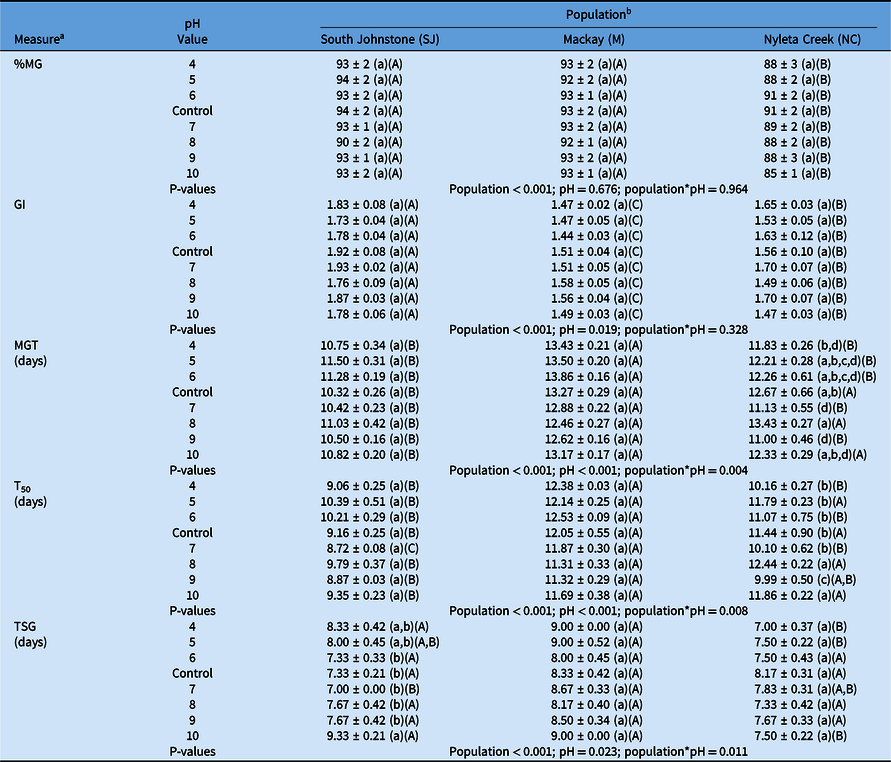
Overall, pH did not have any significant main effect or interaction with population on %MG, indicating that soil pH is not a limiting factor for seed germination. Within each population, %MG was similar across all pH levels tested. For GI, both populations and pH levels had a significant effect, but there was no interaction effect of population with pH levels observed. GI values for all three populations, irrespective of pH level, were significantly different (P ≤ 0.05) (Table 2). For MGT, T50, and TSG, there were significant effects of population and pH levels and also an interaction effect of population with pH levels (Table 2). There was no difference in the MGT and T50 across all pH levels within populations in both the SJ and M populations, whereas the NC population had significant difference between the pH levels (P ≤ 0.05) (Table 2). In the NC population, seeds at pH 9 had the shortest MGT of 11 d and T50 of 9.99 d compared with seeds at pH 8, which had the longest MGT of 13.43 d and T50 of 12.44 d (Table 2). TSG was similar within populations at all pH levels for the M and NC populations, whereas it was significantly different between pH levels for the SJ population (P ≤0.05), with seeds at pH 10 taking the longest time (9.33 d) to start to germinate, compared with seeds at pH 7, which took the shortest time to germinate (7 d) (Table 2).
The effect of pH on seed germination of Cyperus aromaticus from three populations collected in Queensland, Australia.

a %MG, mean germination percentage; GI, germination rate index; MGT, mean germination time; T50= time taken to reach 50% germination; TSG, time taken to start germination.
b Values within columns followed by the same lowercase letter (first set of parentheses) are not significantly different at P ≤ 0.05. Values within rows followed by the same capital letter (second set of parentheses), are not significantly different at P ≤ 0.05.
In all three populations, germination was above 85% regardless of the pH level (Table 2). This ability of C. aromaticus to germinate in a wide range of soil pH conditions presents a significant advantage. From these data, we can conclude that C. aromaticus germination occurs over an extensive pH range that covers most soils in Australia (de Caritat et al. Reference de Caritat, Cooper and Wilford2011). This trait of C. aromaticus, common to many invasive weed species such as K. brevifolia, allows it to exploit a wide range of environments, including disturbed and degraded regions (Molin et al. Reference Molin, Khan, Barinbaum and Kopec1997). There are no such previous studies conducted on C. aromaticus with which to compare our findings, but literature on another Cyperus weed, C. difformis, is available. The findings of Derakhshan and Gherekhloo (Reference Derakhshan and Gherekhloo2013) have shown that we have contrasting observations for C. difformis, for which germination declined rapidly with increasing alkalinity, from 89% germination at pH 6 to 12% germination at pH 9. Overall, the comprehensive adaptability of all three populations of C. aromaticus to germinate in a wide range of pH levels strongly suggests that soil pH is not a restrictive factor and the species can establish in a wide range of soil pH conditions.
Effect of Salinity
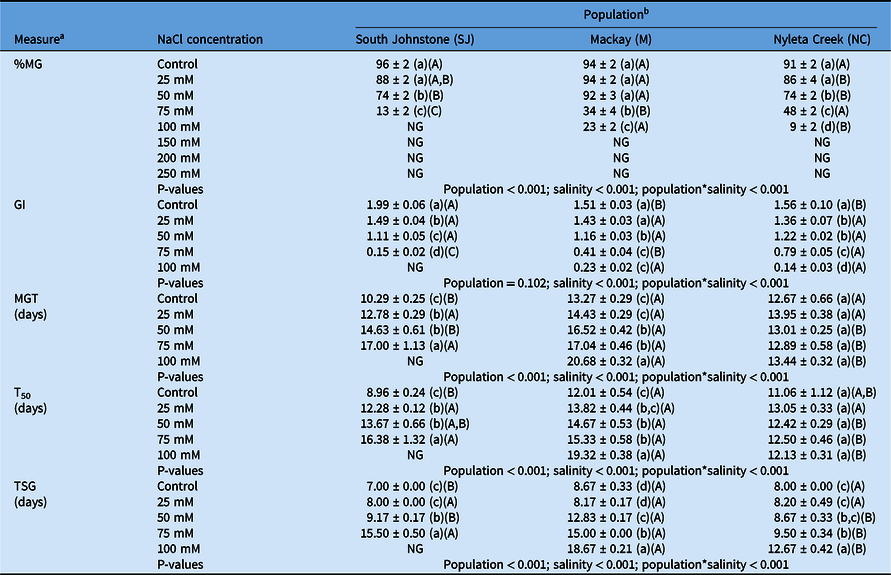
An interaction effect of population with salinity treatment was observed for all germination parameters, including %MG, GI, MGT, T50, and TSG (Table 3). No germination was observed in the SJ population at 100 mM NaCl concentration, whereas the M and NC populations had 23% and 9% germination, respectively. No germination was observed from any population at or above 150 mM NaCl concentration. There was a significant difference observed in the %MG between all three populations at 75 mM NaCl concentration: the NC population had the highest germination, followed by the M population, and the SJ population had the lowest germination (Table 3). At 100 mM NaCl concentration, the M population recorded greater germination than the NC population, and the SJ population did not have any germination (Table 3). Within populations, %MG was similar to the control only at 25 mM salinity for the SJ and NC populations, whereas %MG was similar to the control at 25 mM and 50 mM for the M population. The SJ population was affected to a greater extent by increasing salinity compared with the other populations, as was evident from its reduced %MG at 75 mM NaCl concentration and no germination beyond that (Table 3). The %MG of all three populations declined as the salinity increased; however, %MG declined more sharply for the SJ population compared with the M population, for which %MG started to decrease only at NaCl concentrations greater than 50 mM. NaCl concentration required for 50% inhibition of maximum germination was 60.62, 72.22, and 75.68 mM for the SJ, M, and NC populations, respectively. GI, MGT, T50, and TSG at 25 mM salinity were similar across all populations. The TSG increased at 75 mM NaCl concentration for the SJ and M populations, whereas it increased at 100 mM NaCl or more for the NC population (Table 3).
The effect of salinity on seed germination of Cyperus aromaticus from three populations collected in Queensland, Australia.

a %MG, mean germination percentage; GI, germination rate index; MGT, mean germination time; T50= time taken to reach 50% germination; TSG, time taken to start germination; NG, no germination.
b Values within columns followed by the same lowercase letter (first set of parentheses) are not significantly different at P ≤ 0.05. Values within rows followed by the same capital letter (second set of parentheses), are not significantly different at P ≤ 0.05.
Seed germination was inversely proportional to salinity for all three C. aromaticus populations. GI decreased, while the TSG, MGT, and T50 increased with increasing salinity in all populations demonstrating the effect of unfavorable conditions for seed germination at higher salt concentrations. Similar to our M and NC populations, seeds of C. difformis and C. iria did not germinate at NaCl concentrations at or above 150 mM (Chauhan and Johnson Reference Chauhan and Johnson2009). Local adaptation to salinity was found in C. difformis from the Philippines (Chauhan and Johnson Reference Chauhan and Johnson2009) and Iran (Derakhshan and Gherekhloo Reference Derakhshan and Gherekhloo2013), with the Iranian population being more tolerant to salinity.
Salinity influences seed germination in several ways, including though ion toxicity and by imposing osmotic stress (Bliss et al. Reference Bliss, Platt-Aloia and Thomson1986; Farooq et al. Reference Farooq, Hussain, Wakeel and Siddique2015). Accumulation of toxic ions within the cells disrupts the metabolic activity and negatively affects hormonal and enzymatic activity required for germination (DiTommaso Reference DiTommaso2004; Rivero et al. Reference Rivero, Mestre, Mittler, Rubio, Garcia-Sanchez and Martinez2014). Osmotic stress limits water uptake by the seeds, resulting in insufficient moisture to start the internal biochemical processes (Woodstock Reference Woodstock1988). In addition to negatively impacting physiological processes in the seeds, sodium modifies soil structure and impacts fertility by replacing calcium and magnesium in the anion exchange process, leading to water and nutrient stress, poor aeration, and erosion (DiTommaso Reference DiTommaso2004). Seeds of C. aromaticus are likely to germinate in slightly saline conditions; however, regions with highly saline soils fed by brackish/saline water in coastal areas are unlikely to support populations of this weed. Rainfall, changes to water distribution networks, or irrigation waters with very low salinity could promote establishment of this species, as the low range of NaCl concentrations permitted high germination rates.
Effect of Osmotic Potential
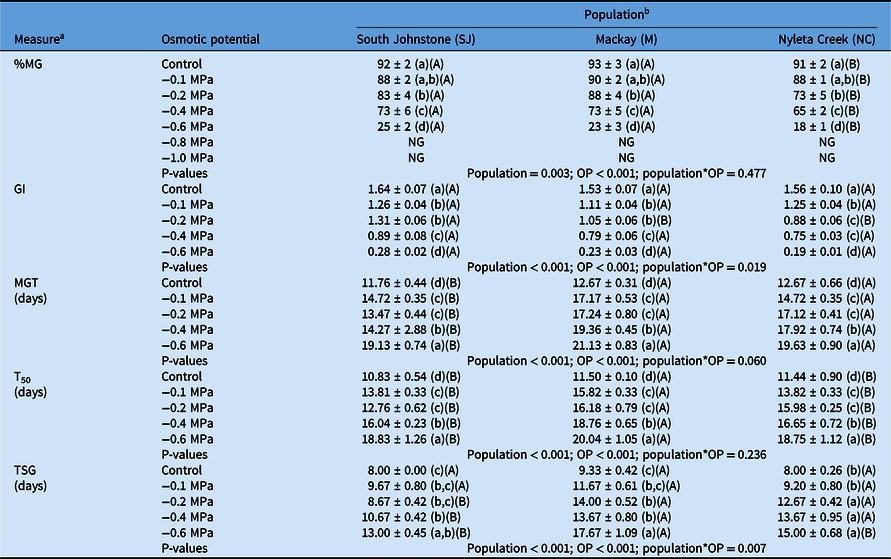
Maximum germination was recorded in the control for all populations. There was a gradual decrease in germination until −0.4 MPa, but germination decreased sharply as the osmotic potential decreased beyond −0.4 MPa, with no germination recorded at osmotic potentials of −0.8 MPa and lower (Table 4). Osmotic potentials −0.52 MPa, −0.51 MPa, and −0.49 MPa were required to decrease germination by 50% of maximum in the SJ, M, and NC populations, respectively. Significant effect of population and osmotic potential on %MG was observed individually; however, no interaction effect was observed. The %MG was significantly lower for the NC population than for both the SJ and M populations (Table 4). In all three populations, %MG for −0.1 MPa was similar to that for −0.2 MPa (Table 4). However, with the increase in osmotic stress of −0.4 MPa and beyond, %MG decreased significantly (P ≤ 0.05). An interaction effect between population and osmotic potential was seen for GI and TSG. Significant effect individually of population and osmotic potential was seen for MGT and T50; however, no interaction effect was found (Table 4).
The effect of osmotic potential on seed germination of Cyperus aromaticus from three populations collected in Queensland, Australia.

a %MG, mean germination percentage; GI, germination rate index; MGT, mean germination time; T50= time taken to reach 50% germination; TSG, time taken to start germination; NG, no germination; OP, osmotic potential.
b Values within columns followed by the same lowercase letter (first set of parentheses) are not significantly different at P ≤ 0.05. Values within rows followed by the same capital number (second set of parentheses), are not significantly different at P ≤ 0.05.
Increase in PEG concentrations had a negative impact on C. aromaticus seed germination, as PEG acts to limit available water and thus imposes osmotic stress on the seed’s biological system. Under osmotically stressful conditions, seeds are unable to prepare for germination, as they cannot reach the critical moisture threshold required for imbibition. Germination parameters overall demonstrated the negative effects of moisture stress in this study by displaying a decrease in GI and increase in MGT, T50, and TSG with the increase in osmotic stress (Table 4), indicating that water availability is a limiting factor for seed germination. Results indicate that a moist environment favors the germination of C. aromaticus, supported by the occurrence of this weed in areas of mid- to high rainfall and the observed flushes of C. aromaticus plants in the fields during January to March in Queensland, which coincide with the high rainfall season (Figure 2). As germination and establishment of C. aromaticus is favored by conditions of adequate soil moisture or rainfall, C. aromaticus spread may be restricted to well-drained, moist soil due to its inability to germinate under low soil moisture conditions.
Germination of other Cyperus weed species including C. difformis (Philippine population), C. difformis (Iranian population), C. iria, K. brevifolia, and F. miliacea follow a trend of decreasing germination with increasing osmotic stress (Chauhan and Johnson Reference Chauhan and Johnson2009; Derakhshan and Gherekhloo Reference Derakhshan and Gherekhloo2013; Molin et al. Reference Molin, Khan, Barinbaum and Kopec1997). Kyllinga brevifolia and C. difformis (Philippine population) did not germinate at osmotic potential at or below −0.6 MPa (Chauhan and Johnson Reference Chauhan and Johnson2009; Molin et al. Reference Molin, Khan, Barinbaum and Kopec1997). Cyperus iria, C. difformis (Iranian population), C. difformis (Philippine population), and F. miliacea required osmotic potentials of −0.46 MPa, −0.47 MPa, −0.12 MPa, and −0.69 MPa, respectively, for 50% inhibition of maximum germination (Chauhan and Johnson Reference Chauhan and Johnson2009; Derakhshan and Gherekhloo Reference Derakhshan and Gherekhloo2013). Sufficient moisture levels are required for imbibition and activation of metabolic reactions that result in embryo development and seedling growth (Bittencourt et al. Reference Bittencourt, Bonome, Trezzi, Vidal and Lana2017; Fenner and Thompson Reference Fenner and Thompson2005). The present study considered the effect of salinity and osmotic stress individually on seed germination; however, these two factors combined may have a heightened effect on the seed germination of C. aromaticus (Chauhan et al. Reference Chauhan, Gill and Preston2006). Further research is needed to understand the combined effects of these two factors on seed germination and resulting seedling establishment of C. aromaticus.
Effect of Radiant Heat
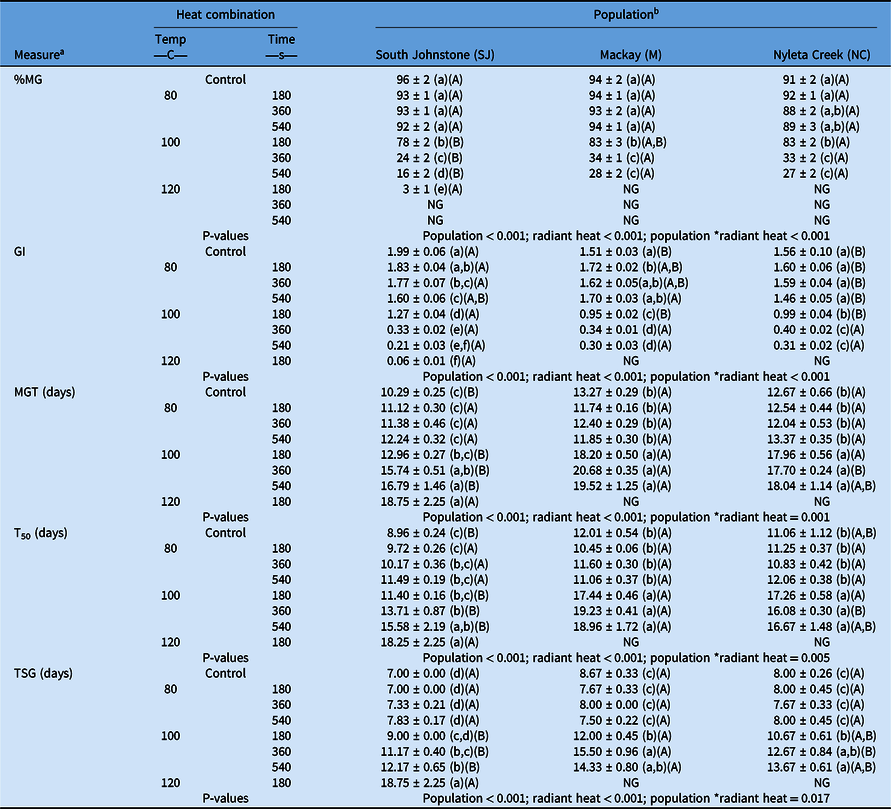
A significant interaction was found between population and radiant heat treatment for %MG (Table 5). In all three populations tested, there was no significant difference in the %MG in the seeds exposed to 80 C for 180, 360, and 540 s, both within each population and between populations (Table 5). At radiant heat of 100 C, %MG declined for each population as the time of exposure increased. At radiant heat of 120 C, with a 180-s exposure, %MG was reduced to 3% in the SJ population, and no germination occurred with longer exposure durations. No germination occurred in the other C. aromaticus populations exposed to 120 C regardless of exposure duration. GI, MGT, T50, and TSG had significant interaction between population and radiant heat treatment (Table 5). For the germination parameters of MGT, T50, and TSG, there was no significant difference within populations and among populations when seeds were exposed to radiant heat of 80 C for 180, 360, and 540 s (Table 5).
The effect of heat stress on seed germination of Cyperus aromaticus from three populations collected in Queensland, Australia.

a %MG, mean germination percentage; GI, germination rate index; MGT, mean germination time; T50= time taken to reach 50% germination; TSG, time taken to start germination; NG, no germination.
b Values within columns followed by the same small letter (first set of parentheses) are not significantly different at P ≤ 0.05. Values within rows followed by the same capital letter (second set of parentheses), are not significantly different at P ≤ 0.05.
The effect of heat exposure on ungerminated seeds for temperatures up to 100 C indicates that C. aromaticus may have some tolerance to low heat for short time periods. Hence, short-term low-temperature burning may not be successful in suppressing germination of C. aromaticus seeds. Inhibition of seed germination recorded by exposing the seeds to 120 C for varying time durations before germination indicates that higher-temperature burns maybe a useful tool for managing C. aromaticus infestations by reducing the germination potential of seeds present on the soil surface, and probably those that are shallowly buried (Willis et al. Reference Willis, McKay, Vranjic, Kilby and Groves2003). Exposure to heat shock from fires can negatively affect seed germination by desiccating the seed coat and/or by causing deterioration of and damaging the embryo (Baskin and Baskin Reference Baskin and Baskin2014; Jeffery et al. Reference Jeffery, Holmes and Rebelo1988; van de Venter and Esterhuizen Reference van de Venter and Esterhuizen1988). We have shown that germination of C. aromaticus is not stimulated by heat, as the germination percentages were not significantly higher in heat-treated seeds compared with control (Jaureguiberry and Díaz Reference Jaureguiberry and Díaz2015).
Effect of Burial Depth
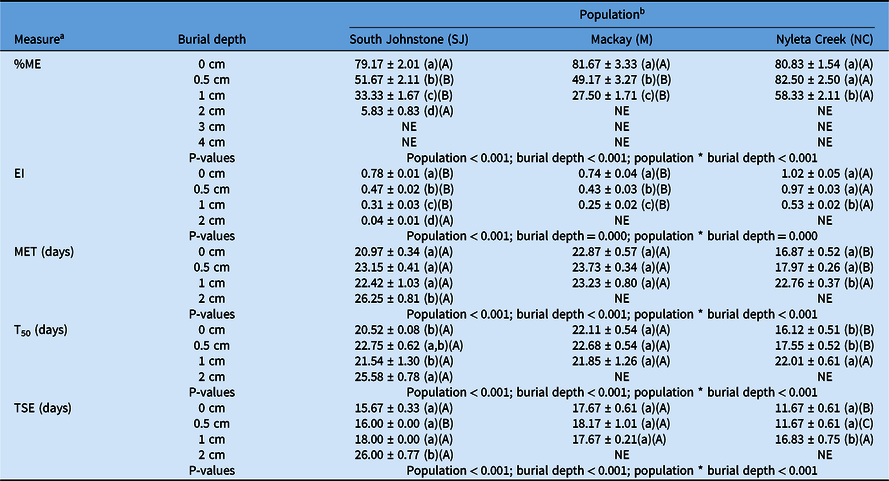
Seed burial depth influenced seedling emergence in all three populations of C. aromaticus, with emergence inhibition increasing with seed burial depth, although populations responded differently to burial depth, as supported by the interaction between these parameters (Table 6). Emergence was greatest when seeds were placed on the soil surface for both the SJ and M populations, and emergence decreased remarkedly for these two populations when seeds were buried 0.5 cm or more. For the NC population, there was no difference in emergence for seeds sown on the soil surface compared with burial at 0.5 cm, but emergence was reduced with burial at 1 cm (Table 6).
The effect of seed burial depth on emergence of Cyperus aromaticus from three populations collected in Queensland, Australia.

a %ME, final emergence percentage; EI, emergence rate index; MET, mean emergence time; T50, time taken to reach 50% emergence; TSE, time taken to start emergence; NE, no emergence.
b Values within columns followed by the same small letter (first set of parentheses) are not significantly different at P ≤ 0.05. Values within rows followed by the same capital letter (second set of parentheses), are not significantly different at P ≤ 0.05.
An interaction between population and burial depth was also observed for EI, MET, T50, and TSE (Table 6). Emergence of C. aromaticus was greatest for the SJ and M populations when seeds were sown on the soil surface, but for the NC population, emergence of seeds buried at 0.5 cm was similar to that of seeds sown on the soil surface. Emergence declined progressively as burial depth increased for all populations (Table 6). Seeds from the M and NC populations did not germinate at burial depths of 2 cm or more, and only 6% emergence occurred when seeds from the SJ population were buried at 2 cm, while no emergence occurred at depths greater than 2 cm (Table 6). Emergence of surface-sown seeds from all populations was similar; however, at 0.5- and 1-cm burial depths, emergence was similar for the SJ and M populations, but emergence for the NC population was greater compared with the other two populations (Table 6). The depth required for 50% inhibition of the maximum seedling emergence was 0.36 and 0.35 cm for the SJ and M populations, respectively, whereas a burial depth of 1.02 cm was required for 50% inhibition of maximum emergence in the NC population.
The negative correlation between burial depth and emergence is consistent with positively photoblastic seeds such as C. aromaticus, as light is unable to reach the deeper layers of soil, and there is limited soil–gas exchange (Benvenuti Reference Benvenuti2003). It has been reported by Woolley and Stoller (Reference Woolley and Stoller1978) that less than 1% of the incident light is transmitted to soil at depths of 0.2 cm and greater. In addition, small seed size is another factor, and the very small seeds of C. aromaticus are typical for the genera Cyperus (Baskin and Baskin Reference Baskin and Baskin1998; Leck and Schütz Reference Leck and Schütz2005). Larger seeds have more carbohydrate reserves that help them emerge from greater burial depths compared with small-seeded species, whose carbohydrate reserves may not be able to support emergence from greater depths (Benvenuti et al. Reference Benvenuti, Macchia and Miele2001; Chauhan and Johnson Reference Chauhan and Johnson2008). These factors could also explain similar emergence response from all populations of buried seeds of C. aromaticus. In the burial depth experiment, seedling emergence on the soil surface (Table 6) was lower than germination observed in petri dishes in the 12-h light/12-h dark conditions (Table 1). This difference could be due to lower soil to seed contact and water availability on the soil surface than on the filter papers (Ghorbani et al. Reference Ghorbani, Seel and Leiferr1999).
Other Cyperaceae weed species, including K. brevifolia, K. squamulata, C. difformis, C. Iria, F. miliacea, and C. microiria, had maximum emergence from seeds sown on the soil surface, with decreased emergence when burial depth increased (Chauhan and Johnson Reference Chauhan and Johnson2009; Chozin and Nakagawa Reference Chozin and Nakagawa1988; Derakhshan and Gherekhloo Reference Derakhshan and Gherekhloo2013; Hoyle et al. Reference Hoyle, McElroy and Guertal2013; Mahfuza et al. Reference Mahfuza, Juraimi, Rajan, Bin Man, Rastans and Omar2006; Molin et al. Reference Molin, Khan, Barinbaum and Kopec1997). Cyperus capitatus Vand., a non-weedy Cyperus species, also showed reduction in emergence with increase in burial depth (Redondo-Gómez et al. Reference Redondo-Gómez, Andrades-Moreno, Parra, Mateos-Naranjo and Sánchez-Lafuente2011). Similar to C. aromaticus, K. brevifolia experienced an increase in the time to start of emergence as the burial depth increased (Molin et al. Reference Molin, Khan, Barinbaum and Kopec1997), and the calculated depth for 50% inhibition of the maximum emergence in K. squamulata was 0.8 cm (Hoyle et al. Reference Hoyle, McElroy and Guertal2013). The time to start emergence varies by species and is also dependent on the soil composition and properties (Benvenuti Reference Benvenuti2003; Hoyle et al. Reference Hoyle, McElroy and Guertal2013).
The results obtained in this study suggest that shallow tillage could bury seeds below the depth of emergence; however, it is important to consider other parameters when planning to use tillage as a management tool. Tillage operations can bring buried seeds back to the soil surface and potentially increase germination rates. Tillage operations may also cause fragmentation of the rhizomes, which can break apical dormancy and induce more shoot production from the rhizomes.
In conclusion, germination of C. aromaticus seeds is completely inhibited in dark conditions. The highest germination levels occurred in the SJ and NC populations of C. aromaticus at alternating day/night temperature regimes of 25/15, 30/20, and 35/25 C and at 25/15 and 30/20 C in the M population, with germination greatly inhibited at the temperature regime of 17/7 C. Our results also showed that C. aromaticus can germinate over a wide pH range, suggesting that soil pH is not a limiting factor for recruitment of this species. Salinity and osmotic potential were inversely related to germination in all three populations of C. aromaticus, indicating conditions of low salinity and adequate soil moisture or rainfall favor the germination of this species. Inhibition of germination recorded by exposing the seeds to 120 C for varying time durations before germination indicates that higher-temperature burns may be a useful tool for managing C. aromaticus infestations by reducing the germination of seeds present on the soil surface. Therefore, we recommend fire as a possible tool to be further investigated for use in control of this weed. Greater emergence from seeds at the soil surface suggests that no-till farming practices would favor emergence of C. aromaticus. As this species could not emerge from depths beyond 2 cm, the option of shallow tillage to bury the seeds below this depth requires investigation, with the caveat that already buried seeds may be mobilized to the surface and tillage may fragment the rhizome, aiding further spread of the species. It is important to consider both aspects of reproduction of this weed species, that is, both seeds and rhizomes, when planning any management strategy for its control. However, as germination is inhibited in dark conditions, mulch can be used to prevent light from reaching the seeds, and this may prove to be a management strategy. Management of this weed requires approaches that minimize soil seedbank input and/or prevent germination of soil seedbanks. When C. aromaticus plants develop a rhizome, they become difficult to effectively control using current weed management practices due to the reproductive ability of rhizomes, which have a larger nutrient store. Therefore, appropriate measures should be taken in advance to manage this weed species before it reaches this critical rhizome level and to prevent the addition of more seeds to the soil seedbank.
Acknowledgments
The Ph.D scholarship for AC was funded by Federation University Australia, and the funding for the project was provided by the Department of Agriculture and Fisheries, Biosecurity Queensland, Australia. No conflicts of interest have been declared. The authors would like to thank Boyang Shi, Melissa Setter, Stephen Setter, and Lalith Gunasekera from the Department of Agriculture and Fisheries, Biosecurity Queensland, for providing the seeds for this study.