1. Introduction
The term ‘Payments for Environmental Services’ (PES) defines a wide range of incentive mechanisms to address the underlying causes of environmental degradation by inducing behavioural changes among local actors (Bulte et al., Reference Bulte, Lipper, Stringer and Zilberman2008). There are numerous examples of how payments from beneficiaries within a locality, river-basin, region or even globally have been implemented in attempts to overcome environmental externalities of one kind or another. There are global and multilateral mechanisms such as the Clean Development Mechanism of the Kyoto Protocol and the Global Environment Facility, as well as more localised PES schemes such as the Primampiro municipal watershed-protection scheme in Ecuador (Wunder and Albán, Reference Wunder and Albán2008). In addition to varying in their geographical scope, PES schemes also vary in the nature of the incentive provided and hence in their effectiveness in any given circumstance. The purpose of this paper is to shed further light on the relative cost-effectiveness of PES with respect to other, more indirect policy instruments, also commonly used to supply environmental services around the world.
In PES schemes, such as the Costa Rican pagos por servicios ambientales (PSA) scheme and the Sloping Lands Conversion Programme in China, compensation is offered to farmers directly for each unit of land reforested or conserved (e.g., Xu and Cao, Reference Xu and Cao2002; Pagiola, Reference Pagiola2008). More indirect policy approaches can be conceptualised to provide incentives via some associated input to production. These so-called ‘joint-production’ activities include selective logging, eco-certification and eco-tourism (see Kotchen, Reference Kotchen2005; Donovan et al., Reference Donovan, Stoian, Macqueen and Grouwels2006; Macqueen et al., Reference Macqueen, Dufey, Gomes, Hidalgo, Nouer, Pasos, Suárez, Subendranathan, Trujillo, Vermeulen, Voivodic and Wilson2008).Footnote 1 Recent theoretical and empirical work has naturally shaped the views of the institutions involved in implementing policy to supply environmental services, as well as the design of schemes on the ground. For obvious reasons, perhaps the most influential contributions in this respect have been those which address the question of the relative cost-effectiveness of different policy approaches to supply environmental services.Footnote 2
One virtually unequivocal answer to this question can be found in an oft-cited and influential paper by Ferraro and Simpson, who, using a broad definition of PES to include both PES as defined in this paper (‘direct payments’) and indirect policy approaches (‘indirect payments’), conclude, ‘Conservation practitioners should be wary of adopting indirect payments’ (Ferraro and Simpson, Reference Ferraro and Simpson2002: 345, henceforth F&S). F&S reach this conclusion by employing duality theory to analyse the mechanics of different policy approaches to an ‘ecological entrepreneur’, for whom conserved land is an input to an eco-friendly production process, e.g., ecotourism. Although their approach presupposes perfectly elastic supply in input and output markets and profit-maximising behaviour by a price-taking entrepreneur, their conclusion appears to be remarkably robust, even when some of these assumptions are relaxed.Footnote 3 One corollary of this result is that, in the absence of side payments, the preferences of the NGO or donor and eco-entrepreneur are generally opposed. The donor will prefer the cost-effective PES, while the eco-entrepreneur will prefer the more indirect approach, since it profits from the additional payments required. An alternative interpretation of this result is that, in a developing country context there is tension between environmental and poverty alleviation objectives.
It is well documented, however, that among the many market imperfections found in developing countries, quantity constraints and non-price rationing are among the most common, particularly in the agricultural sector (see e.g., Azam et al., Reference Azam, Biais, Dia and Maurel2001; Colman et al., Reference Colman, Solomon and Gill2005; Petrick, Reference Petrick2005). Input and output quotas are obvious examples and, at the extreme, markets may be missing completely. Beyond this, perhaps the most frequent example of non-price rationing in developing countries is credit rationing (e.g., Hoff and Stiglitz, Reference Hoff, Stiglitz, Hoff, Braverman and Stiglitz1993). While there are several definitions of credit rationing, it is usually thought of as a situation in which the borrower's private demand is higher at the current rate of interest than the loan offered by the lender (Petrick, Reference Petrick2005).Footnote 4 This description of developing countries has led to frequent calls in development policy circles for the relaxation of constraints, particularly in relation to credit (e.g., Azam et al., Reference Azam, Biais, Dia and Maurel2001; Vakis et al., Reference Vakis, Sadoulet, de Janvry and Cafiero2004). While such issues are frequently discussed in the context of agricultural production, similar problems undoubtedly beset the ‘eco-entrepreneurs’ that are the focus of policy implementation, and were the subject of analysis by F&S. For example, there are often missing markets for the necessary inputs, such as the skills required to develop business plans, viable market contacts and quality products (RCW, 2007). Credit rationing is also likely due to the risks inherent in joint production, insecure tenure and asymmetric information between lenders and borrowers (Ascher, Reference Ascher1994; RCW, 2007).Footnote 5
In the context of joint-production enterprises, the implications for policy are obvious: Indirect approaches which relax quantity constraints offer an important opportunity to expand ecological entrepreneurship and generate environmental services. Indeed, there are already numerous examples of this kind of intervention in which NGOs or governments provide assistance to relax certain constraints, rather than direct incentive payments. One example, in the context of credit, is the Brazilian government's programme, FNO-Especial, which provides credit to small forest enterprises based in the Amazon that have environmental and social goals (Campos et al., Reference Campos, Francis and Merry2005).Footnote 6 In other cases contributions come in the form of complementary inputs, such as tourism infrastructure, product marketing and processing facilities (see e.g., Wunder, Reference Wunder2000; MacQueen et al., Reference Macqueen, Dufey, Gomes, Hidalgo, Nouer, Pasos, Suárez, Subendranathan, Trujillo, Vermeulen, Voivodic and Wilson2008), all of which give rise to another important question: In the presence of quantity constraints, which policy is more cost effective, PES or more indirect approaches that relax constraints? This paper goes part way to answering this question.
In order to make direct comparisons with F&S we return to the parsimony of their benchmark model of a donor and an eco-entrepreneur each with perfect information. Our sole addition to the model is a quantity constraint on an input to the production process, the relaxation of which is the objective of the donor's indirect scheme. This quantity constraint is open to a rather general interpretation: a credit constraint, an input quota and analogous arguments can be made for constraints on output.Footnote 7 We apply the work of Fulginiti and Perrin (Reference Fulginiti and Perrin1993) who extended duality theory to the constrained profit function. For relative cost-effectiveness, we compare the cost to the donor of subsidising inputs directly versus the indirect policy of relaxing capital constraints, which can be thought of as the purchase of inputs or provision of capital by the donor. Thus, the deadweight welfare losses of each approach are compared alongside the creation of positive quota rents from the implementation of an indirect policy. The results of the analysis are revealing and run counter to F&S in two senses. Firstly, PES are shown to have no systematic cost advantage over a more indirect approach which relaxes constraints. Secondly, there are instances when both the donor and the eco-entrepreneur prefer the indirect approach. In these instances, it is possible that indirect schemes are more likely to achieve dual environment and poverty objectives. Within the confines of the model these outcomes are more likely when constraints are, or rationing is, severe.
The paper is organised as follows. Section 2 describes the model, while section 3 analyses the overall cost-effectiveness of each intervention. Sections 4 and 5 analyse the preferences of the donor and eco-entrepreneur respectively. Section 6 offers a discussion of the results, while 7 concludes.
2. Policies to supply environmental services: a model with constraints
In order to assess the relative cost-effectiveness of PES and a policy to relax constraints, we follow closely the model of F&S. We have a profit-maximising eco-entrepreneur (henceforth, firm) that operates an ‘ecologically benign’ production process with two variable inputs to production, forest and capital. ‘Forest’, F, represents any ecological attribute useful in the generation of an eco-friendly output. ‘Capital’, K, represents some arbitrary input. Thus, a quantity, Q, of an eco-friendly product is produced using a production technology, f(K, F). This technology represents an economic activity such as eco-tourism that allows environmental services, for instance, biodiversity, to flow from the forest used in eco-production activities. The market prices of output, capital and forest are P Q, PK, and PF, respectively, where PF is the opportunity cost of using forest in eco-production and could represent the returns to converting the forest to agricultural production. Following F&S, we assume that K is a technical complement to forest in eco-production, i.e.,  .Footnote 8 Moreover, as in F&S, we also assume that a unit of forest in eco-production provides the same quantity and quality of environmental services as a unit of conserved forest. In the absence of outside intervention, the firm uses and thus conserves forest for eco-production. The decision of the firm, therefore, concerns the quantity of forest to allocate to eco-production given that its cost as an input to production is PF.
We depart from the benchmark of F&S by assuming that capital, K, is subject to non-price rationing and limited to K. As well as reflecting credit-rationing or input quotas, this constraint could also approximate missing markets (K = 0). This approach is perhaps closest to the analysis of non-separability by Muller and Albers (Reference Muller and Albers2004) in which market constraints are addressed in the context of a utility-maximising household. However, while Muller and Albers focused on the response of constrained households to conventional PES schemes and ‘agricultural development programmes’, our focus is on the cost-effectiveness of relaxing quantity constraints.Footnote 9 Henceforth, we refer to the latter policy as an ‘indirect approach’, since it is an alternative means of supplying environmental services.
The return to the model of F&S, and the focus on profit rather than utility maximisation, allows us to obtain general results concerning the cost-effectiveness of these interventions in a reasonably tractable manner. For simplicity, we assess cost-effectiveness in the context of a constraint on inputs, although parallel arguments apply to output constraints. Fortunately, the theory of firm behaviour under quantity constraints is already well developed and we apply the work of Fulginiti and Perrin (Reference Fulginiti and Perrin1993) to analyse constrained profit functions.
Define the constrained profit function as

where z represents other fixed factors. This can be contrasted to the unconstrained profit function ΠU(PQ, PF, PK; z), which describes the solution to the unconstrained problem. It is straightforward to show that the constrained profit function is related to the unconstrained profit function in the following way (see Appendix A for details):

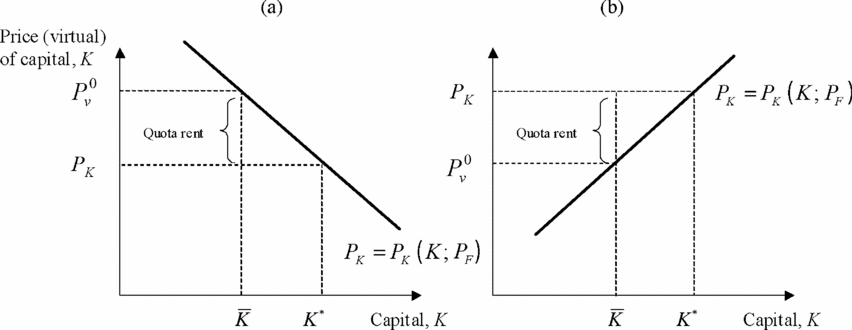
where Pv is the ‘virtual’ or shadow price of capital, i.e., the price which would induce an unrestricted firm to choose the quantity K. Each value of K has a unique virtual price. Figure 1 shows the virtual prices for input and output quotas respectively. Also shown in figure 1 is the quantity (Pv − PK), which is often called the ‘quota rent’. This is an important determinant of the results that follow.
Virtual prices and quota rent for (a) rationed input and (b) rationed output

Following F&S we assume that a donor wants to induce greater forest conservation than the firm would find privately beneficial under prevailing market conditions. In F&S, the donor has two options for inducing greater conservation: subsidies to ‘Forest’ or ‘Capital’ inputs. That is, PES or the indirect approach, respectively. In the case presented here, the donor also has two options: (1) payments in the form of a subsidy to forest land, or (2) indirect provision of forest land via relaxation of the constraint on capital, K. The latter could involve the provision of inputs as opposed to cash subsidies to capital (or output).
We follow F&S and compare the relative cost-effectiveness of policies in achieving a unit change on forest land. Hotelling's Lemma applied to the constrained profit function, together with the derivative of the constrained profit function with respect to the constrained input, K, yield respectively (see Appendix A)


Choosing dPF and dK so as to induce a unit change in forested land, F, gives the following relationship:Footnote 10

Following Fulginiti and Perrin (Reference Fulginiti and Perrin1993), who describe the Hessian of the constrained profit function in terms of the derivatives of the unconstrained function, the impact of the indirect policy can be expressed as

where the subscript v refers to the derivative with respect to the ‘virtual’ price of capital, Pv.
The construct of virtual prices and the representation in equation (4) are convenient since they allow the analysis to be undertaken using the unconstrained profit function, making the results more directly comparable to F&S. Equations (3) and (4) exploit the duality between the derivative of the constrained profit function with respect to K and the unconstrained profit function with respect to Pv. To be clear, the derivative of the constrained profit function with respect to the virtual Pv yields the unconstrained demand for capital K, while the derivative of the constrained profit function with respect to K yields the virtual/shadow price.
We now proceed by determining the cost-effective intervention, and then analyse the donor's and firm's preferred interventions.
3. Cost-effective policy to supply environmental services
For PES, the cost to the donor and the impact on firm profits can be described in a manner similar to that of F&S. The indirect policy of relaxing capital constraints requires the purchase of inputs by the donor. We undertake the analysis assuming that the unit resource cost of capital is the underlying market price PK. Questions remain concerning the share of the costs and benefits of this policy between the firm and the donor, but this only becomes important when discussing the intervention preferred by each party. It is also likely that the cost of transacting in each market differs. For ease of presentation, we assume for the moment that transactions costs, be they fixed or variable, are the same for each intervention.Footnote 11
Using the relations between the constrained and unconstrained profit functions allows the cost-effective analysis to be undertaken in virtual price-space. Appendix B shows that the incremental cost (dC) of using an indirect approach rather than PES is given byFootnote 12

This expression has clear parallels with F&S.Footnote 13 Whereas F&S compare the cost-effectiveness of each policy approach by comparing the quantities of capital needed in each case, here the comparison is made in terms of changes in virtual prices. The term dPIv is the change in the virtual price as a consequence of relaxing the constraint on capital, K. The term dPDv is the change in the virtual price of capital as a consequence of the direct subsidy to forest land. Given the assumptions, the former is negative and the latter is positive.
As shown in Appendix B, the first term in equation (5) is positive, since it has the same sign as the determinant of the Hessian of the constrained profit function. The second term is the quota rent associated with the intervention and is positive as explained above.Footnote 14 Hence, the sign of dC is indeterminate. If equation (5) is positive, then PES outperform the indirect approach in terms of cost-effectiveness. Further manipulations yield the following approximation for the marginal cost:

This leads to proposition 1:
Proposition 1. When the unit resource cost of capital is P, the relaxation of input constraints will be more cost-effective than PES to forest land when P is less than the average of the terminal virtual price under PES and an indirect approach, P 1Dv and P 1Iv, respectively. That is

Proof. This follows from equation (6).
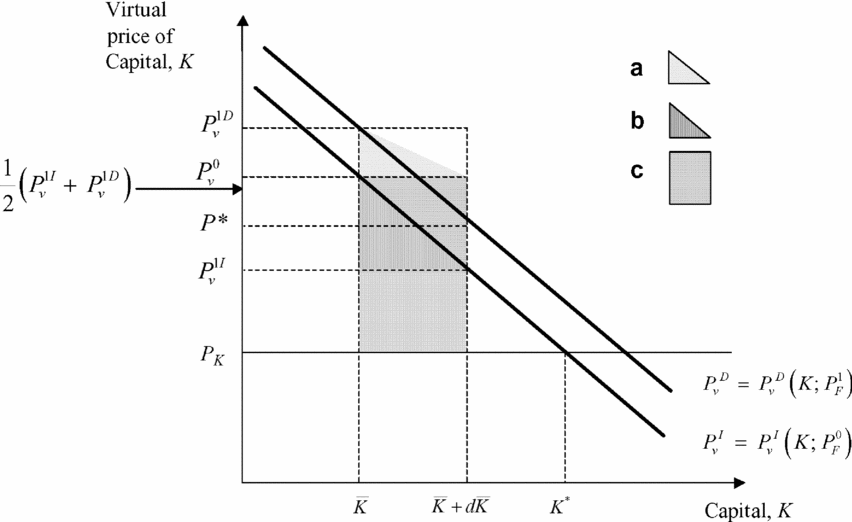
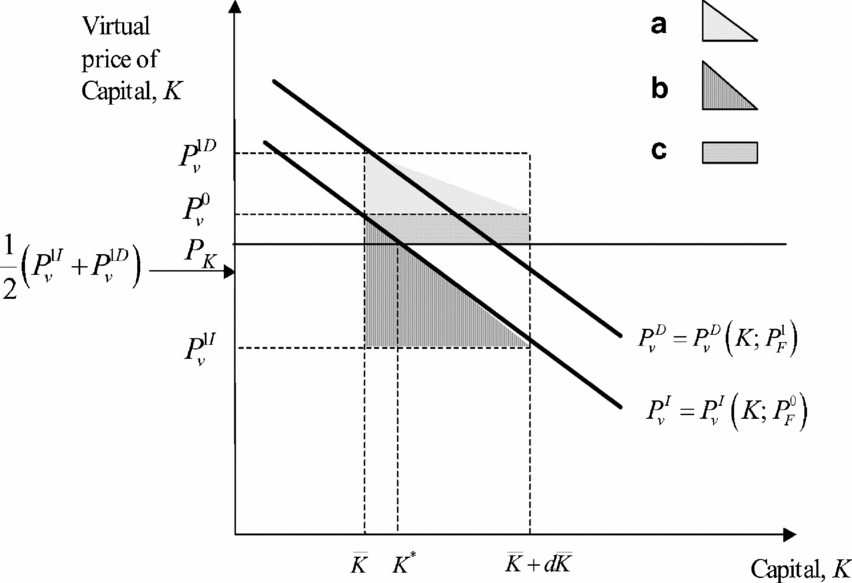
Figures 2 and 3 provide a graphical comparison of policy interventions under the assumption that the donor can choose either one or the other. Figure 2 illustrates the analysis for the case of a severe input constraint. In this case PK ≪ P 1Dv, P 1Iv, and it is obvious that the indirect approach would be preferred to PES.Footnote 15 Graphically, the second term on the right-hand side of equation (5), the total quota rent, is given by c in figure 2.Footnote 16 The term  is given by (negative) area b and
 is given by (negative) area a. Relative cost-effectiveness is given by a comparison of areas a and (b + c). In this case, the area (b + c) represents the additional profits to the firm and is clearly large and positive.
PES vs the indirect approach (for Capital, K) – a severe constraint

PES vs the indirect approach (for Capital, K) – a minor constraint

Figure 3 shows a case at the other extreme in which the donor would effectively ‘over-egg the pudding’ in order to achieve its environmental services target. Although the quota rent exists, area c, it is much smaller than the large and negative deadweight loss, area b. This loss outweighs the deadweight loss under PES, given by area a. In addition to this, capital is increased beyond what would be efficient in the absence of constraints (K*), thereby causing a social loss. Here, PES are more cost-effective.
F&S compared the deadweight loss associated with different policy approaches when markets function perfectly. Loosely speaking, in the context of figures 2 and 3, F&S compared areas a and b and showed that the former is almost always smaller than the latter. Where markets are constrained, however, the total quota rent, area c, must also be considered.
What proposition 1 and figures 2 and 3 show is that when constraints are severe, other things being equal, the relaxation of constraints can be more cost-effective than PES. This finding differs from F&S and illustrates an important example in which PES are not preferred to more indirect alternatives to supply environmental services. Effectively, the quota rent represents a reduction in the funds required to achieve the targeted change in forest land under an indirect approach, compared to PES, where no such rents are released.
The preceding analysis also presents the possibility that a fully informed donor could obtain a kind of optimum optimorum by employing a combined policy strategy. That is, by first removing the constraint via the provision of capital at the world price in the quantities desired by the firm, and then subsidising forest land directly. The theory as it stands suggests that the firm would purchase K* of capital, at which point it would be cost-effective to subsidise forest land directly à la F&S. Once again, the cost-effective-combined strategy will depend on the severity of the constraint.
Of course, there are many possible behavioural and informational assumptions that could be explored. The presence of rents suggests the possibility of arbitrage between each party and that the analysis of bargaining power could be apposite. The presence of credit rationing points to an analysis of informational asymmetries, and a discussion of the ability of the donor to overcome these asymmetries and relax the constraint. We return to this in section 6, but for now we remain with the simple framework and analyse the conditions under which the donor and firm prefer PES or the indirect approach.
4. The donor's preferred policy
The donor must pay either −dPFF with PES, or PKdK under the policy of relaxing the constraint. The donor will prefer PES if

Appendix C shows that this condition becomes

where ηCij is the constrained elasticity of demand for input i with respect to price of input j, and ηUij is the unconstrained equivalent.Footnote 17 This is a convenient form for the result since it reveals the dependence on the virtual price elasticity of demand for capital: ηUKK, and the quota rent associated with the constraint (Pv − PK). The result is analogous to that of F&S, but introduces some important differences. F&S show that in the case of perfect markets, the donor will prefer PES (‘direct payments’) if the following inequality holds:

which F&S show is always the case for homothetic technologies and some non-homothetic ones. This leads to proposition 2:
Proposition 2. If the eco-entrepreneur is a profit maximiser and subject to a quantity constraint in an input market, a policy that relaxes the constraint in the input market will be the donor's preferred policy to increase forest cover if
1. the quota rent associated with the constraint is large: (P 0v − PK);
2. the resource cost of the constrained input is low: PK is low;
3. the demand for capital is highly inelastic with respect to its own (virtual) price: ηUKK is small.
Proof. This follows from the inspection of equation (8), noting that  and (P 0v − PK) > 0 for an input constraint. (See also Appendix C).
In a world of perfect markets, the donor will almost always prefer PES to the indirect approach, as shown by F&S. When constraints exist in input markets, this conclusion is no longer robust. When a severe constraint exists and the quota rent is large, the donor will prefer to relax input constraints rather than subsidise forest. This preference is also enhanced by the fact that the constrained own-price elasticity of demand for forest land is smaller than the unconstrained: ηCFF < ηUFF. This means that a larger subsidy is required for a given response. Both of these features can conspire to make the indirect approach more preferable.
5. The eco-entrepreneur's preferred policy
When the firm is constrained in an input market, for small changes in PF or K, the firm's profits will change respectively as follows:


where the latter comes from equation (18) in Appendix A, and assumes that the firm receives the additional inputs for free (does not pay PK). Hence the firm prefers PES if

This leads to proposition 3:
Proposition 3. Three outcomes are possible for an input constraint: (i) the donor prefers PES and the firm prefers the indirect approach; (ii) vice versa and (iii) both donor and firm prefer the indirect approach.
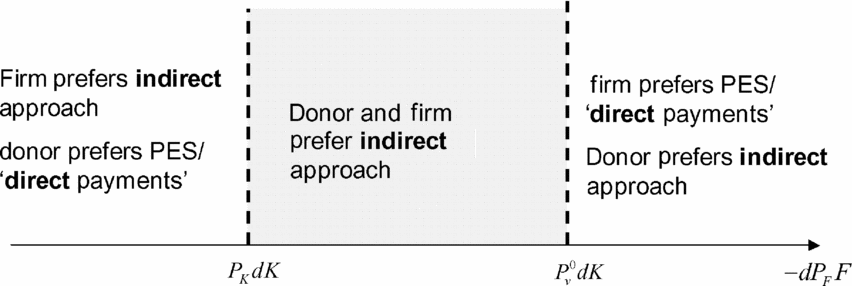
Proof. Inspection of equations (10) and (7), noting P 0v > PK reveals that (i) if −dPFF < PKdK, the donor prefers PES and the firm prefers the indirect approach; (ii) the reverse is true if −dPFF > P 0vdK and (iii) if P 0vdK > −dPFF > PKdK, then both the donor and the firm prefer the indirect approach.
Figure 4 elaborates on proposition 3 and shows the intermediate values of the cost of PES (−dPFF) at which the donor and firm will both desire the indirect approach. The area of agreement is large when the quota rent is large, i.e., when the input constraint is severe. One interpretation of this result is that environmental and poverty alleviation objectives need not be in tension. Where constraints are severe, the indirect policy approach not only provides cost-effective provision of forest land in this case but also provides the largest transfer to eco-entrepreneurs. We now discuss these implications in further detail.Footnote 18
Donor vs eco-entrepreneur's preferences over PES and indirect approaches

6. Discussion
In this paper, we compared the cost-effectiveness of payments for environmental services with an indirect approach that relaxes market constraints, where constraints can be understood to represent any type of non-price rationing of inputs and outputs. With this minor adaptation, which better reflects the situation in many developing countries, cost-effectiveness is investigated following Ferraro and Simpson (Reference Ferraro and Simpson2002) using the duality between the constrained and unconstrained profit function shown by Fulginiti and Perrin (Reference Fulginiti and Perrin1993).
The underlying premise of F&S is that donor funds are directed towards the eco-output price or to facilitate the acquisition of complementary inputs such as tourism infrastructure, product marketing and processing facilities. Local agents such as communities faced with cheaper inputs or higher output prices will therefore increase production, hence increasing the demand for intact ecosystems as an input to production. The key assumption is that, prior to the intervention, agents face perfectly elastic supply or demand and can buy profit-maximising quantities of the inputs they need at prevailing market prices. The addition of a quantity constraint is a simple way to analyse the cost-effectiveness of differing policy approaches in the presence of market constraints.
The theoretical results differ from F&S on two counts. First, PES are not systematically more cost-effective than an indirect approach which relaxes the market constraint. Second, there are instances when both donor and recipient prefer the indirect approach. Within the limited context of our model, both outcomes are more likely when market constraints are severe. In order for these results to be useful to the practitioner, it is important to give them a practical interpretation.Footnote 19
Quantity restrictions and other forms of non-price rationing appear to be very common among small-scale entrepreneurs in developing countries, with perhaps credit rationing as the most obvious example. While credit rationing may be as pertinent an issue in eco-production as in agriculture, where constraints on credit for eco-entrepreneurs are relaxed, there may still be problems in accessing other inputs necessary for production. In fact attracting credit may be contingent on having access to other inputs in the first place (RCW, 2007). This suggests that modelling behaviour under quantity constraints of one sort or another is extremely apposite. Indeed, there are numerous empirical examples of interventions that have attempted to boost eco-production activities and increase the area of forest being preserved via policy to relax underlying constraints.
So, what types of inputs are likely to be constrained? The answer to this may depend on the eco-production process under consideration, although some generalisations can be made. In Suriname, for example, a bio-prospecting agreement between local tribes and the International Cooperative Biodiversity Group (ICBG), a US government-funded programme, led to the provision of inputs to local communities in the form of training, information and technology transfer (Guérin-McManus et al., Reference Guérin-McManus, Famolare, Bowles, Malone, Mittermeier and Rosenfeld1996). These inputs were an integral part of the drug development process, for example, in the extraction of plant chemicals from organic matter. In this and other cases, such as those involving selective logging, there exists a need to support first-stage processing on a small scale, for example, by facilitating the acquisition of simple grading, processing or packaging techniques.
As a result of small-scale production of natural products, and regional and seasonal variability in supply quality and quantity, it is often difficult to reach a scale of production that is of commercial interest to buyers in domestic or international markets. Here coordination problems among entrepreneurs, for example, can exacerbate capital constraints and limit the scale of production. One way of dealing with and overcoming both the quality and scale problem has been for firms to group together as cooperatives or associations. These are often initiated or at least enabled by third parties, such as donors and NGOs, who effectively resolve this constraint (MacQueen et al., Reference Macqueen, Dufey, Gomes, Hidalgo, Nouer, Pasos, Suárez, Subendranathan, Trujillo, Vermeulen, Voivodic and Wilson2008). Moreover, eco-products generally cater to niche markets and despite rapid growth in recent years are still typically found in developed rather than developing or emerging markets. This suggests that at least some inputs to joint production may not be easily available via the market, particularly more intangible ones such as skills development and technology transfer, and may partially explain why they tend to be supplied by third parties. The same could be said of interventions to relax constraints on output.
In addition, the United Nations Conference on Trade and Development's (UNCTAD) BioTrade InitiativeFootnote 20 recorded that eco-entrepreneurs often lack clear business plans with well-elaborated product and market-chain analyses. They also lack links with existing enterprises that create backward linkages and involve business managers in programme design and training. Obtaining market information, establishing transport links and promoting trade effectively is often difficult and costly. For example, in the Cuyabeno Wildlife Reserve in Ecuador, the Cofans of Zabalo independently operate all eco-tourism services, with complementary marketing and transport logistic inputs from a larger tourism services firm (Wunder, Reference Wunder2000). In Indonesian Borneo, marketing and transport networks were established by the local NGO, SHK-Kaltim, so that high-quality, sustainably-produced rattan could be transported and sold in national and international markets as a certified eco-product. A number of rattan-producing villages share the same networks.Footnote 21 All these are effective examples of input constraints, which can be understood in light of the model presented above. Naturally, the exact nature of these constraints is likely to vary from case to case and hence, requires more refined analysis than is presented here.
This is certainly true in relation to credit rationing. Nevertheless, one interpretation of the above results is that donors or NGOs should involve themselves in providing more credit to eco-entrepreneurs. Indeed, historically this has been a common policy prescription in development circles and there are numerous examples of subsidised credit schemes, even in the realm of PES (e.g., Campos et al., Reference Campos, Francis and Merry2005; Petrick, Reference Petrick2005). However, by and large, the history of such schemes is littered with defaults, losses and eventual failure (Petrick, Reference Petrick2005). In part, this is a consequence of failure to understand the complex causes of credit rationing and the fact that credit rationing often represents a constrained Pareto optimum. For instance, Ghosh et al. (Reference Ghosh, Mookherjee, Ray, Mookherjee and Ray2000) show that where moral hazard is the cause, additional credit need not lead to Pareto improvements and suggest that such strategies may be resisted by existing lenders. Rather, interventions should target the root cause of market constraints by reducing asset inequality, increasing bargaining power for borrowers and improving credit information networks. While these are not simple recommendations to act upon, successful micro-finance projects do exist.
There are a host of issues that we have not yet considered that may be important for forest protection interventions in developing countries. Similar to those highlighted by F&S, there are issues relating to, for example, transaction costs, designing and targeting effective contracts and property rights enforcement. For the most part, these issues are relevant for the cost-effectiveness of any policy approach despite not being explicit features of our modelling framework. A critical assumption of our model is the supply of environmental services in an eco-production process that utilises a unit of forest being identical to those from a unit of directly conserved forest. In the real world, eco-production processes vary widely in terms of the process under consideration in addition to the context in which they are being implemented. It is likely, however, that the environmental services provided from eco-production will be inferior to those from pure conserved forest in many cases. In such cases, the relaxation of this assumption weakens our result. Nevertheless, much still depends on the characteristics of the constraint, e.g., its severity, the eco-production process as well as the context under study.
It is also important to point out that, despite being couched in terms of activities such as eco-tourism and eco-certification, our results have wider applicability. Firstly, the model is relevant for the provision of environmental services via certain agricultural activities, which can be seen as joint production processes, such as the planting of hedgerows by farmers. But the idea of relaxing constraints is more general still. For instance, in the case of the Sloping Lands Conversion Programme, a large reforestation PES scheme in China, ex post analysis of farmers' responses to direct payments to retire cultivated land revealed the role of relaxing market constraints in achieving dual environmental and poverty objectives. Crucially, it was found that indirect strategies, targeting important binding constraints such as weak land tenure or local public goods, might be more cost-effective means to reduce cultivation at the extensive margin, and increase incomes, than direct payments (Gauvin et al., Reference Gauvin, Uchida, Rozelle, Xu and Zhan2009; Groom et al., Reference Groom, Grosjean, Kontoleon, Swanson and Zhang2009).Footnote 22
This, in turn, highlights the potential for indirect policy approaches both to maximise cost-effectiveness and alleviate poverty at the same time. In reality, many policy programmes in developing countries have been designed with dual goals. Conceptually and empirically, the performance of policy to achieve dual policy goals has been studied, for example, by Feng (Reference Feng2007) and Gauvin et al. (Reference Gauvin, Uchida, Rozelle, Xu and Zhan2009). They show that while trade-offs exist, better targeting of environmental providers could improve performance. This, of course, requires information that may be privately held, thus raising the problem of strategic behaviour. For cost-effectiveness in our case, we would need information on constraints that may also be very costly to obtain. Further complicating the issue is the fact that finding information on the severity of constraints may be a matter of trial and error given that providers might not hold this information either.
7. Conclusion
In conclusion, our model results show that, in contrast to F&S, payments for environmental services are not always more cost-effective than an indirect approach that relaxes market constraints. Moreover, there are instances when both parties prefer the indirect approach. Both outcomes are more likely when rationing is severe. But how relevant is this stylised model with respect to eco-production processes in the real world? First, model results hinge on the assumption of equality in supply of environmental services from eco-production and pure conservation, which may not hold for many eco-production processes. Moreover, from the discussion of some empirical examples in the previous section, we observe that many donors and NGOs transfer capital and other inputs rather than cash for the purchase of inputs. It is clear that in the absence of heavy outside support many of these eco-production processes would not be economically viable. Our model shows that such interventions can be cost-effective where constraints are severe. Nevertheless, careful empirical research is needed to compare these outcomes to various counter-factuals.
A final question relates to asking how far such constraints can be used to explain the supposed dearth of successful eco-entrepreneurs in Africa, Asia and Latin America in a rapidly expanding global market for eco-products (as indicated by, for example, the RCW, 2007). In this paper we have focused only on the possible role of market constraints. Nevertheless, there may be numerous reasons for the failure for eco-production processes in the developing world. Therefore, donors would be well advised to identify the cause of limited eco-production before intervening. In a world of more-or-less perfect markets, this points to PES for land as suggested by F&S. Where they can be identified and measured, relaxing constraints could well be cost-effective in a constrained world.
Appendix A: Constrained and unconstrained profit function
Fulginiti and Perrin (Reference Fulginiti and Perrin1993) analyse the profit function when one of the inputs is constrained. Their analysis completely characterises the Hessian of the constrained profit function in terms of derivatives of the unconstrained profit function with respect to prices of unconstrained inputs and ‘virtual’ prices of constrained inputs.
We explore their approach using our simple model.

This defines the unconstrained profit functions in which the firm is free to choose the variable inputs, F and K, subject to the fixed inputs, z. Now, suppose that one of the inputs, K, is constrained such that K = K, the constrained profit function can be written as

where ΠP(.) is the partial profit function. To define the relationship between constrained and unconstrained profit functions it is useful to define ‘virtual’ price, Pv, of K as the price that would induce the firm to choose K:

This yields

which gives a formal definition of Pv: ΠvU = −K.Footnote 23 This gives the following relationship between ΠU and ΠC at Pv:

and from equations (12) and (14) we get

Using this relation it is possible to derive the following relationships, which are used in the derivations in the text (Fulginiti and Perrin, Reference Fulginiti and Perrin1993: 99):


More importantly, the Hessian of the constrained profit function can be defined in terms of the second own- and cross-price derivatives of the unconstrained profit function. The results for inputs F and K are


Were we to present the results for the output Q, the signs in equation (20) and the second term on the right-hand side of equation (21) would change.
Appendix B: Cost-effectiveness of policy approaches to supply environmental services – proof of proposition 1
Following F&S we can make a second-order approximation for the change in profits when additional forest is provided via PES. Dropping z for brevity we get

The total cost of the intervention can be calculated by subtracting from this expression the overall cost of the PES intervention to the donor. The cost of PES is given by the right-hand side of the following expression, where F 0 is the initial level of forest cover, and the right-hand side is the deadweight loss:Footnote 24

Following the same procedure yields an expression for the change in profits following the relaxation of capital constraints:

Subtracting the resource cost of the policy, which in section 3 is assumed to be PKdK, yields the net profits:Footnote 25

where P 0v is the initial virtual price of capital at K = K. The right-hand side of equation (22) is a welfare triangle. The right-hand side of equation (23) contains the welfare triangle and an expression representing the quota rent, (P 0v − PK), the latter being the marginal value of relaxing the constraint. These terms are explained graphically in figures 2 and 3 in the text.
The proof of equation (5) is as follows. Taking the right-hand side of equation (23) from the right-hand side of equation (22) gives the following expression:

Note that the change in the virtual price of capital as a result of the indirect approach, dPIv, is given by

Similarly, the change in the virtual price as a result of PES is given byFootnote 26

Using relation (3) the first term in square brackets of equation (24) reduces to dPF. It is then easy to see via substitution of equations (25) and (26) that equation (24) becomes

which is one step from equation (5).
The proof of equation (6) comes from noting that dPIv = P 1Iv − P 0v and dPDv = P 1Dv − P 0v.
Appendix C: The donor's preferences – proof of proposition 2
The donor prefers PES if −dPFF < PKdK. Noting from equations (3) and (4) that  and
 , this becomes

Taking the reciprocal and multiplying both sides by PF gives

Given the symmetry of the unconstrained profit function we have ∂FU/∂Pv = ∂KU/∂PF. Inserting this, multiplying top and bottom by K and rearranging yields in equation (8)Footnote 27

 and
 .

 . Note that ηCFF, ηUKK and ηUKF > 0.
 .
 in the case of a constrained input (Fulginiti and Perrin,
 , which noting equation (
 . Given equation (
 . Details can be found in Fulginiti and Perrin (
 , which would be the point elasticity at Pv but for the fact that it is evaluated at PK. Noting that PK = (Pv + PK − Pv), the numerator becomes