Introduction
The prevalence of paediatric overweight and obesity has tripled since 1975. Consequently, in 2016, over 340 million children and adolescents aged between 5 and 19 are diagnosed with overweight or obesity (Nishtar, Gluckman, & Armstrong, Reference Nishtar, Gluckman and Armstrong2016). Moreover, paediatric overweight and obesity are known to carry over into adulthood, and to be comorbid with substantial medical and psychosocial diseases, which have high societal costs (Apovian, Reference Apovian2013; Dixon, Reference Dixon2010; Alemzadeh, Lifshitz, & Rising, Reference Alemzadeh, Rising and Lifshitz2007; Reilly & Kelly, Reference Reilly and Kelly2011; Wyatt, Winters, & Dubbert, Reference Wyatt, Winters and Dubbert2006). The high prevalence, emerging comorbidities, and poor prognosis are alarming and represent a significant public health challenge. Therefore, prevention is necessary, and both policymakers and the research community have important responsibilities.
To develop evidence-based prevention programs for childhood overweight and obesity, we must first unravel the underlying mechanisms and causal factors. Current research focuses on emotional eating, as it is highly prevalent and is assumed to be an essential mechanism in the development and maintenance of paediatric overweight and obesity (Braet & Van Strien, Reference Braet and Van Strien1997; Debeuf et al., Reference Debeuf, Verbeken, Boelens, Volkaert, Van Malderen, Michels and Braet2020; O'Connor, Jones, Conner, McMillan, & Ferguson, Reference O'Connor, Jones, Conner, McMillan and Ferguson2008; Reichenberger et al., Reference Reichenberger, Kuppens, Liedlgruber, Wilhelm, Tiefengrabner, Ginzinger and Blechert2018). A prospective study in adults showed that weight gain was driven by emotional eating, rather than by lifestyle aspects such as nutrition and sports (Koenders & van Strien, Reference Koenders and van Strien2011). Emotional eating, studied both as a trait and a state variable, is defined as eating in the presence of negative emotions (van Strien & Oosterveld, Reference van Strien and Oosterveld2008) and is observed in adults (O'Connor et al., Reference O'Connor, Jones, Conner, McMillan and Ferguson2008; Zellner et al., Reference Zellner, Loaiza, Gonzalez, Pita, Morales, Pecora and Wolf2006) as well as in children and adolescents (Braet & Van Strien, Reference Braet and Van Strien1997; Debeuf, Verbeken, Van Beveren, Michels, & Braet, Reference Debeuf, Verbeken, Van Beveren, Michels and Braet2018; Nguyen-Rodriguez, Unger, & Spruijt-Metz, Reference Nguyen-Rodriguez, Unger and Spruijt-Metz2009; Vandewalle, Mabbe, Debeuf, Braet, & Moens, Reference Vandewalle, Mabbe, Debeuf, Braet and Moens2017). In one study, 40% of the children (5–12 years) reported elevated emotional eating scores (Michels et al., Reference Michels, Sioen, Braet, Eiben, Hebestreit, Huybrechts and De Henauw2012). Moreover, emotional eating also occurs when experiencing positive emotions (Macht, Reference Macht2008) and stress (Chao et al., Reference Chao, Grey, Whittemore, Reuning-Scherer, Grilo and Sinha2016; Meule, Reichenberger, & Blechert, Reference Meule, Reichenberger and Blechert2018). Although older studies reported that stress leads to reduced food consumption, it is now generally acknowledged that especially mild stress leads to overeating (Hill, Moss, Sykes-Muskett, Conner, & O'Connor, Reference Hill, Moss, Sykes-Muskett, Conner and O'Connor2018; O'Connor et al., Reference O'Connor, Jones, Conner, McMillan and Ferguson2008).
Stress is experienced when a person believes that he or she is unable to cope with a situation that is significant for his or her well-being (Lazarus & Folkman, Reference Lazarus and Folkman1986). Different studies demonstrate a high prevalence of stress among children and adolescents. In Belgium, 29.6% of young people (15–24 years) report stress (Gisle, Drieskens, Demarest, & Van der Heyden, Reference Gisle, Drieskens, Demarest and Van der Heyden2018). On a European level, 45.7% of children (4–11 years) experience stress at least once a week (Vanaelst et al., Reference Vanaelst, Huybrechts, Bammann, Michels, de Vriendt, Vyncke and Henauw2012). Stressful experiences are characterized by negative affect states but also by physiological symptoms associated with arousal, such as enhanced tension (Lazarus, Reference Lazarus1993; Winsky-Sommerer, Boutrel, & de Lecea, Reference Winsky-Sommerer, Boutrel and de Lecea2005).
Adolescents experiencing stress are at a high risk to gain weight and eventually become overweight or obese (Aparicio, Canals, Arija, De Henauw, & Michels, Reference Aparicio, Canals, Arija, De Henauw and Michels2016; De Vriendt, Moreno, & De Henauw, Reference De Vriendt, Moreno and De Henauw2009). This can be explained by different mechanisms. High levels of stress are associated with increased cortisol, which physiologically is known to cause abdominal fat accumulation and weight gain (Peckett, Wright, & Riddell, Reference Peckett, Wright and Riddell2011; Tomiyama, Reference Tomiyama2019). Different studies have also found that elevated cortisol levels are associated with a higher consumption of high-fat and energy-dense food (Epel, Lapidus, McEwen, & Brownell, Reference Epel, Lapidus, McEwen and Brownell2001; Tomiyama & Fiske, Reference Tomiyama2019; Torres & Nowson, Reference Torres and Nowson2007). These changes in eating behaviour can be described as emotional or stress-induced eating. In stressful situations, adults, adolescents, and children tend to consume less healthy snacks and more unhealthy foods, such as high-sugar and high-fat food (Chao et al., Reference Chao, Grey, Whittemore, Reuning-Scherer, Grilo and Sinha2016; Habhab, Sheldon, & Loeb, Reference Habhab, Sheldon and Loeb2009; Nguyen-Rodriguez et al., Reference Nguyen-Rodriguez, Unger and Spruijt-Metz2009; O'Connor et al., Reference O'Connor, Jones, Conner, McMillan and Ferguson2008; Zellner et al., Reference Zellner, Loaiza, Gonzalez, Pita, Morales, Pecora and Wolf2006). Psychological mechanisms are also thought to play a role: the rewarding effect of food results in reduced tension, decreased negative emotions, and increased positive emotions, which can lead to learning effects culminating in the development of emotional eating as a coping strategy (Macht, Reference Macht2008). It is considered maladaptive to use emotional eating as a means to reduce stress, as eating food does not solve the cause of stress, and it can cause secondary negative affect states, such as guilt or shame (Macht, Reference Macht2008). Consequently, it is acknowledged that the chronic experience of emotional problems without adequate emotion regulation (ER) can induce chronic stress-induced eating, leading to enhanced caloric intake and increased weight (Braet & Van Strien, Reference Braet and Van Strien1997; Brown, Schiraldi, & Wrobleski, Reference Brown, Schiraldi and Wrobleski2009; Michels et al., Reference Michels, Sioen, Braet, Eiben, Hebestreit, Huybrechts and De Henauw2012; Nguyen-Rodriguez et al., Reference Nguyen-Rodriguez, Unger and Spruijt-Metz2009).
Laboratory studies confirm that emotional eating is used as a strategy to cope with stress and negative emotions (Aldao & Nolen-Hoeksema, Reference Aldao and Nolen-Hoeksema2010; Evers, Stok, & de Ridder, Reference Evers, Stok and de Ridder2010). However, it is unknown whether suboptimal ER strategies cause emotional eating. So far, the ER literature has primarily investigated whether self-reported trait-like use of specific ER strategies explain correlational, observed differences in subsequent eating (Aldao & Nolen-Hoeksema, Reference Aldao and Nolen-Hoeksema2010). Yet, this approach does not allow for causal inferences, and it does not explain whether adequate ER could lead to reduced emotional eating and a return to a more healthy weight. In the current study, we, therefore, aim to test the role of ER in emotional eating by manipulating the utilised ER strategy. ER is defined as the exertion of effort to influence one's emotions — more specifically, which emotions are felt, when and how emotions are experienced, and how emotions are expressed (Gross, Reference Gross1998). Adequate ER relies on adaptive ER strategies such as ER reappraisal and ER self-compassion, which reduce negative affect and protect individuals against the development of psychopathology. In comparison, less adequate ER relies on maladaptive ER strategies, such as ER rumination, which are less effective in reducing negative affect and are associated with more psychological problems in the long term. Several recent studies have shown these effects on various parameters, although not yet regarding emotional eating (Aldao & Nolen-Hoeksema, Reference Aldao and Nolen-Hoeksema2010; Cracco, van Durme, & Braet, Reference Cracco, van Durme and Braet2015; Ehret, Joormann, & Berking, Reference Ehret, Joormann and Berking2018; Wante, Van Beveren, Theuwis, & Braet, Reference Wante, Van Beveren, Theuwis and Braet2018). ER strategies are often acquired through observation in a family context, and they are malleable, which makes them important targets of prevention programs (Morris, Silk, Steinberg, Myers, & Robinson, Reference Morris, Silk, Steinberg, Myers and Robinson2007).
In the current study, two manipulations will be conducted in order to examine the differential effects of ER rumination and ER self-compassion. ER rumination is a well-researched maladaptive ER strategy, which is described as a steadfast and passive cognitive focus on negative emotions, with repeated worrying about this negative affect and its causes and consequences (Hilt & Pollak, Reference Hilt and Pollak2013; McLaughlin & Nolen-Hoeksema, Reference McLaughlin and Nolen-Hoeksema2012). ER rumination is linked to persistence and even amplification of negative affect (Rood, Roelofs, Bögels, Nolen-Hoeksema, & Schouten, Reference Rood, Roelofs, Bögels, Nolen-Hoeksema and Schouten2009; Treynor, Gonzalez, & Nolen-Hoeksema, Reference Treynor, Gonzalez and Nolen-Hoeksema2003; Wante et al., Reference Wante, Van Beveren, Theuwis and Braet2018) and is positively correlated with anxiety, depressive symptoms, eating disorders, and substance use (Aldao & Nolen-Hoeksema, Reference Aldao and Nolen-Hoeksema2010; Bartoskova et al., Reference Bartoskova, Sevcikova, Durisko, Maslej, Barbic, Preiss and Andrews2018). In contrast, ER self-compassion is a well-researched, adaptive ER strategy, which involves recognising, tolerating, and understanding one's own emotional state, as well as feeling compassion for oneself and motivating oneself to alleviate one's suffering (Berking & Whitley, Reference Berking and Whitley2014; Ehret et al., Reference Ehret, Joormann and Berking2018; Strauss et al., Reference Strauss, Taylor, Gu, Kuyken, Baer, Jones and Cavanagh2016). ER self-compassion is found to boost resilience against psychopathology and is negatively related to eating disorders, severe binge eating, weight concerns, and food consumption (Steindl, Buchanan, Goss, & Allan, Reference Steindl, Buchanan, Goss and Allan2017; Trompetter, de Kleine, & Bohlmeijer, Reference Trompetter, de Kleine and Bohlmeijer2017).
Current Study and Hypotheses
The experiment consisted of four phases: Baseline Stress phase (phase I), Stress Induction (phase II), Guided Emotion Regulation Manipulation (application of the adopted ER strategy; phase III), and the Food-Taste Buffet (phase IV). We tested three hypotheses. Hypothesis 1: The used ER strategy affects the magnitude of experienced stress and negative affect after exposure to a social exclusion stressor (defined as the ‘Differential ER’ hypothesis). More specifically, (1a) ER rumination does not reduce stress and negative affect, while (1b) ER self-compassion reduces stress and negative affect. Hypothesis 2: Following stress exposure, ER strategy affects levels of stress and negative affect, thus indirectly affecting Food Intake (defined as the ‘Stress-Increased Eating’ hypothesis). Specifically, insufficient ER induces the use of increased food consumption as an ER strategy. (2a) We expect that adolescents, using the ER rumination, are not able to regulate their stress and negative affect during phase III and, therefore, will regulate by subsequent eating, operationalized in a higher intake of high-fat and sugary food items. (2b) Adolescents undergoing an ER self-compassion are expected to show a more effective regulation of their stress and negative affect, and consequentially, lower Food Intake will be observed. Hypothesis 3: Food Intake decreases stress and negative affect (defined as the ‘Eating-Reduced Stress’ hypothesis). We expect different effects in the ER rumination and ER self-compassion group. (3a) ER rumination does not change stress and negative affect (during phase III), and, thus, participants instead regulate their stress and negative affect through their eating behaviour; that is, the Food Intake during the Food-Taste Buffet (phase IV) decreases their stress and negative affect and increases their positive affect. (3b) In contrast, as ER self-compassion has a regulating effect (phase III) on stress, participants experience no further changes in stress and negative affect during the Food-Taste Buffet. This analysis is needed to test whether eating is a ‘successful’ ER strategy.
Method
Participants
Fifty-three Dutch-speaking adolescents between 11 and 18 years old were recruited during data collection in 2017 of two longitudinal studies on emotional well-being in 246 adolescents, 6 months preceding the current study: Generation 2020 study (Van Beveren, Mezulis, Wante, & Braet, Reference Van Beveren, Mezulis, Wante and Braet2019) and the Reward-study (De Decker, Verbeken, Sioen, Moens, et al., Reference De Decker, Verbeken, Sioen, Moens, Braet and De Henauw2017, De Decker, Verbeken, Sioen, Van Lippevelde, et al., Reference De Decker, Verbeken, Sioen, Van Lippevelde, Braet, Eiben and De Henauw2017). The present study aimed to research specifically adolescents experiencing stress; therefore, besides age constraints, an inclusion criterion for this study was a score of >12 on their stress report (measured with the Perceived Stress Scale, PSS) (Cohen, Kamarck, & Mermelstein, Reference Cohen, Kamarck and Mermelstein1994). Of all 118 eligible adolescents, scoring >12 on the PSS, 45% agreed to participate in the current study with 19 boys (35.8%) and 34 girls (64.2%). The sample incorporates a broad range of adjusted BMI (BMI defined as the percentage of the normal BMI according to age and gender; range = 83.2–200.8%) (Table 1). Studying ER processes specifically in adolescents experiencing stress is a first step in understanding the important stress-eating relationship.
Descriptive Statistics in ER Rumination and ER Self-Compassion Group and Group Comparisons

Note: PSS = perceived stress scale; DEBQ = Dutch Eating Behavior Questionnaire; Adjusted BMI = BMI defined as percentage of the normal BMI according to age and gender; Mann–Whitney U-test when data were not normally distributed.
* p < 0.05.
** p < 0.01.
Study Design and Procedure
The current study used a mixed between- and within-subjects design, in which participants were randomly allocated to one of the two ER conditions (ER rumination or ER self-compassion), and participated in a four-phase experiment (Baseline Stress phase, Stress Induction, Guided Emotion Regulation Manipulation, and Food-Taste Buffet).
This study was approved by the Ethical Committee of Ghent University. Participants were selected and contacted based on their PSS score. The PSS (Cohen et al., Reference Cohen, Kamarck and Mermelstein1994) was filled out during the data collection of two longitudinal studies in 2017, 6 months preceding the current study. After both the parents and the adolescents signed the informed consent, participants completed an online baseline questionnaire at home before visiting the laboratory.
Adolescents were invited to the laboratory when they were off from school: Wednesday afternoon, weekend days, and holidays. To create uniformity, all appointments were scheduled at 10 AM, 1 PM, or 4 PM. Prior to recruitment, each research appointment on a specific time point (10 AM, 1 PM, and 4 PM) on every research day was randomly allocated to one of the two ER manipulations (rumination or self-compassion group). By scheduling the appointment with the adolescents, participants were randomized to one of the two groups: the ER rumination (n = 29) or the ER self-compassion (n = 24). The difference in the number of participants across both groups can be explained by the availability of participants. The participants were asked to abstain from eating at least 2 h before their schedule at the laboratory.
At baseline, no significant differences were found between both groups in age [t(51) = −1.11; p = 0.273], gender [χ2(1) = 0.65; p = 0.422], adjusted BMI [t(51) = −1.25; p = 0.218], perceived stress [t(51) = 1.09; p = 0.282], and trait emotional eating [t(51) = 1.35; p = 0.184] (Table 1).
The study consisted of four phases (Figure 1), which every participant underwent individually.
Visual analogue scales in a laboratory design.

Phase I (Baseline Stress phase): At arrival in the laboratory, the participant was explained the rationale, the procedure, and the monitoring during the study. Thereafter, the participant rated his or her hunger (Time 0 = T0), was served some sandwiches, and was instructed to eat until satisfaction. The participant watched a 10 min neutral movie clip, and both hunger and Stress-related Affect States (Stress AS) were rated at the end of this phase (Time 1 = T1).
Phase II (Stress Induction phase): The Cyberball game, a well-validated stress paradigm and acknowledged for inducing Frustration, was adopted based on previous studies with adolescents (Hartgerink, Van Beest, Wicherts, & Williams, Reference Hartgerink, Van Beest, Wicherts and Williams2015). The participant played the virtual computer game in which he or she is socially excluded (Williams & Jarvis, Reference Williams and Jarvis2006). Stress AS were rated also at the end of this phase (Time 2 = T2).
Phase III (Guided Emotion Regulation Manipulation phase): First, the participant was asked to remember and focus on the feeling he or she had during the Cyberball game. Further, the researcher instructed the participant to try to change this feeling, by using one of the two ER strategies (ER rumination or ER self-compassion), supported by cue-cards, during maximum 15 min. Hunger and Stress AS were rated again at the end of this phase (Time 3 = T3).
Phase IV (Food-Taste Buffet): Finally, the participant was offered a Food-Taste Buffet and received instructions to score taste, while eating as much as the participant wanted. Afterwards, Stress AS was rated a fourth time (Time 4 = T4), followed by a debriefing on both the Stress Induction and Food-Taste Buffet.
Emotion regulation strategies
Participants, asked to use ER rumination in phase III, were guided through the strategy with the support of one visualised cue-card presenting following questions: ‘What feeling do you have? How strong is the feeling you have? How long will the feeling last?’
Participants, asked to use ER self-compassion in phase III, were guided through the strategy with the support of one visualised cue-card whereby they had to (1) relax through abdominal breathing, (2) support themselves, and (3) had to feel compassion for themselves by saying ‘I can tolerate this feeling, I am here for myself’ (Berking & Whitley, Reference Berking and Whitley2014; Ehret et al., Reference Ehret, Joormann and Berking2018; Strauss et al., Reference Strauss, Taylor, Gu, Kuyken, Baer, Jones and Cavanagh2016).
Main Outcome Measures
Trait measures
Perceived Stress Scale
The Perceived Stress Scale (PSS) (Cohen et al., Reference Cohen, Kamarck and Mermelstein1994) is a self-report measure on the perception of experiencing stress in the previous month. The PSS contains 10 items, which need to be rated on a five-point Likert scale from 0 = never to 4 = very often. An item example is ‘In the last month, how often have you felt nervous and “stressed”?’ Good psychometric qualities are reported, such as a good internal consistency and external validity (Lee, Reference Lee2012). In the current study, an acceptable reliability for the PSS was found (α = .69). The test–retest reliability of the PSS was satisfactory between 2 days and 4 weeks (r > 0.70). However, longitudinal studies on the changes in PSS scores are necessary (Lee, Reference Lee2012).
Dutch Eating Behavior Questionnaire
The Dutch Eating Behavior Questionnaire (DEBQ) (Braet et al., Reference Braet, Claus, Goossens, Moens, Van Vlierberghe and Soetens2008; Braet & Van Strien, Reference Braet and Van Strien1997; van Strien, Frijters, Bergers, & Defares, Reference van Strien, Frijters, Bergers and Defares1986) assessed by self-report three eating styles: restrained eating, external eating, and emotional eating. In this study, only the subscale ‘emotional eating’ was taken into account for descriptive purposes, measured by 13 of total 33 items. The items need to be rated on a five-point Likert scale from 1 = never to 5 = very often. An item example is ‘When feeling angry, do you feel like you want to eat something?’ The DEBQ has a good reliability and external validity, and can be used in children and adolescents between 7 and 17 years old (Braet et al., Reference Braet, Claus, Goossens, Moens, Van Vlierberghe and Soetens2008; Braet & Van Strien, Reference Braet and Van Strien1997; Ricciardelli & McCabe, Reference Ricciardelli and McCabe2001). More specific, the emotional eating subscale has a good internal validity in overweight and normal-weight adolescents (respectively, α = .91 and α = .93) (Braet et al., Reference Braet, Claus, Goossens, Moens, Van Vlierberghe and Soetens2008). In the current study, a good reliability for emotional eating was found (α = .94).
Descriptive variables
The age, gender, height, and weight of the participant were measured. The adjusted BMI was calculated according to normative Flemish data, expressed as the percentage above the mean, according to their age and gender (Roelants, Hauspie, & Hoppenbrouwers, Reference Roelants, Hauspie and Hoppenbrouwers2009).
State measures during the laboratory setting
Stress and Related Affect States (Stress AS)
During the laboratory task, stress was operationalized by seven Visual Analogue Scales (VAS) on which participants rated their stress on six Stress and related Affect States (Stress AS) at four different time-points (Figure 1) on a 100 mm line (0–100). Based on the literature on differential effects of different affect states, the following affect states were selected: ‘bored,’ ‘anxious,’ ‘frustrated,’ ‘sad,’ ‘stressed,’ and ‘angry.’ The social exclusion paradigm is well known for inducing Frustration. Moreover, also one positive affect state was measured: ‘happy’ (Chao et al., Reference Chao, Grey, Whittemore, Reuning-Scherer, Grilo and Sinha2016; Debeuf et al., Reference Debeuf, Verbeken, Van Beveren, Michels and Braet2018; Macht, Reference Macht2008; Meule et al., Reference Meule, Reichenberger and Blechert2018; van Strien & Oosterveld, Reference van Strien and Oosterveld2008).
Temporal change scores between the VAS on different time-points were calculated, indicating the changes in Stress AS parameters: (1) VAS Stress AS 2 − VAS Stress AS 1 (defined as Stress AS reactivity) showed the assumed effect of the Cyberball game, comparing T1 with T2 assessments; (2) VAS Stress AS 3 − VAS Stress AS 2 reflected the assumed effect of applying ER rumination or ER self-compassion on Stress AS (defined as Stress AS regulation), comparing T2 with T3 assessments; and (3) VAS Stress AS 4 − VAS Stress AS 3 showed the assumed effect of the Food-Taste Buffet, and, thus, the effect of eating behaviour on Stress AS (defined as emotional eating), comparing T3 with T4 assessments.
Hunger
A VAS, ranging from ‘not at all’ until ‘extremely’ (100 mm line), questioned the hunger state of the participants on three crucial time-points during the study: at baseline (T0), after eating the sandwiches (T1), and after applying an ER strategy before the start of the Food-Taste Buffet (T3).
State emotional eating
During the laboratory task, the Food Intake assessment was operationalized through a Food-Taste Buffet in phase IV, more specifically by (1) the amount of eaten grams in total and (2) the amount of eaten grams in four food categories: [High Fat (HF) Savoury, (2) Low Fat (LF) Savoury, (3) HF Sweet, and (4) LF Sweet]. Based on the recommendations of Robinson et al. (Reference Robinson, Haynes, Hardman, Kemps, Higgs and Jones2017), a Food Buffet with both sweet and savoury food was offered. To conceal the real research question on how much participants would eat, they were told that the Food Buffet was a taste test. Instructions were given as followed: ‘Now you can do a taste test. Twelve food items are offered, you can taste them all and then answer three questions per food item.’ The questions were (1) ‘Do you like this food item in general? Yes or no?’; (2) ‘In general, how much do you like this food item?’; and (3) ‘How much do you want to eat this food item right now (= craving)?’ Questions 2 and 3 needed to be answered on a VAS, ranging from ‘not at all (=0)’ until ‘very much (=100)’. During the Food-Taste Buffet, participants were left alone in the room during 20 min. They were told that, in the meantime, the researcher would check the collected data. Moreover, participants were told that they could eat as much as they wanted.
The Food-Taste Buffet contained 12 food items, which were offered in small bites of 50 g. Before and after the Food-Taste Buffet, the amount of the food items was weighed, in order to determine the exact amount that has been eaten by the participant. The food items were chosen based on an image database ‘Food-Pics’ for experimental research on eating (Blechert, Lender, Polk, Busch, & Ohla, Reference Blechert, Lender, Polk, Busch and Ohla2019) and can be divided into four categories: (1) HF Savoury, (2) LF Savoury, (3) HF Sweet, and (4) LF Sweet. Examples of the food items in each category are salted chips, pretzels, chocolate cookies, and grapes, respectively.
Data Analytical Plan
Analyses started with a manipulation check (phase II). To test the effect of the Stress Induction on all potential Stress AS (Boredom, Anxiety, Frustration, Sadness, Stress, Anger, and Happiness), Repeated-Measures ANOVAs (RM-ANOVA) were conducted with Stress AS (VAS Stress AS 1 and VAS Stress AS 2) as outcomes, time as a within-subject factor, and group (ER rumination or ER self-compassion) as a between-subject factor. A significant time effect was expected; time * ER group interaction effects were explored, although not expected here. Only the Stress AS that showed a significant time effect (i.e. successful Stress Induction) was further used in the next hypotheses.
For hypothesis 1, the Differential ER hypothesis, testing the effect of the Guided ER Manipulation, RM-ANOVAs were used with Stress AS (VAS Stress AS 2 and VAS Stress AS 3) as outcomes, time as a within-subject factor, and group (ER rumination or ER self-compassion) as a between-subject factor (time * ER group interaction).
For hypothesis 2, the Stress-Increased Eating hypothesis, we analysed whether a Change in Stress AS (VAS Stress AS 3 − VAS Stress AS 2) during phase III resulted in subsequent increased Food Intake. Therefore, a linear regression analysis was done with a Change in Stress AS (VAS Stress AS 3 − VAS Stress AS 2), ER group, and a Change in the Stress AS * ER group interaction as independent variables; and Food Intake as a dependent variable. Moreover, for the models with significant interaction effects, simple slope analyses were conducted.
For hypothesis 3, the Eating-Reduced Stress hypothesis, we analysed the effect of the Food-Taste Buffet (phase IV) on changes in Stress AS (VAS Stress AS 3 − VAS Stress AS 4) after the Food Intake in both ER groups. Therefore, a linear regression analysis was done with Food Intake, ER group, and Food Intake * ER group interaction as independent variables; and Change in Stress AS (VAS Stress AS 3 − VAS Stress AS 4) as a dependent variable, thereby controlling for hunger.
Results
Descriptive Analyses
No significant differences in Stress AS at T1 and hunger at T0, T1, and T3 were observed between both groups. Regarding Food Intake, significant higher levels of HF Sweet and LF Savoury food items were consumed by participants in the ER rumination condition in comparison with participants in the ER self-compassion condition (Table 1). No significant correlations were found between trait emotional eating and Food Intake (neither with Total eaten grams, nor eaten grams in the four food categories). Concerning the appliance of one of both ER strategies in the Guided ER Manipulation phase, participants reported an ER adoption between 4 and 10 min.
Manipulation Check
The RM-ANOVAs on Stress AS of phases I and II revealed, as expected, no significant interaction effect but only significant time-effects (changes in Stress AS from T1 to T2) for Boredom [interaction effect: F(1,47) = 1.01, p = 0.320; time effect: F(1,47) = 10.52, p = 0.002], Frustration [interaction effect: F(1,51) = 1.04, p = 0.314; time effect: F(1,51) = 24.25, p = 0.000], and Happiness [interaction effect: F(1,51) = 0.32, p = 0.576; time effect: F(1,51) = 24.20, p = 0.000]. More specifically, Boredom (M VAS T1 = 15.25; M VAS T2 = 30.49) and Frustration (M VAS T1 = 4.17; M VAS T2 = 19.72) significantly increased after playing the Cyberball game, while Happiness significantly decreased (M VAS T1 = 67.41; M VAS T2 = 55.84). No interaction effects, but neither significant time-effects, were found for the Stress AS Anxious [F(1,51) = 1.94, p = 0.170], Sadness [F(1,51) = 0.28, p = 0.597], and Stressed [F(1,51) = 0.26, p = 0.610]. Because the manipulation did not affect these Stress AS, they were not taken into account in the subsequent analyses. Unexpectedly, Anger showed a significant time effect [F(1,51) = 5.42, p = 0.024] and a significant time * ER group interaction effect [F(1,51) = 4.86, p < 0.05]: a significant increase in Anger was found in the ER rumination group, but not in the ER self-compassion group. As this can hinder group comparisons, we decided to exclude Anger from our analyses.
Hypothesis 1: Differential ER Hypothesis
The RM-ANOVAs on Stress AS of phases II and III revealed no significant interaction effects (time × ER group), suggesting that the hypothesis was not confirmed. However, significant time-effects occurred for Boredom [interaction effect: F(1,47) = 2.36, p = 0.131; time effect: F(1,47) = 6.94, p = 0.011] and Frustration [interaction effect: F(1,51) = 0.06, p = 0.786; time effect: F(1,51) = 6.72, p = 0.012]. Although no a priori hypotheses were made regarding Happiness, no significant interaction nor time-effects were observed [respectively, F(1,51) = 1.08, p = 0.303, and F(1,51) = 2.05, p = 0.158].
Hypothesis 2: the Stress-Increased Eating Hypothesis
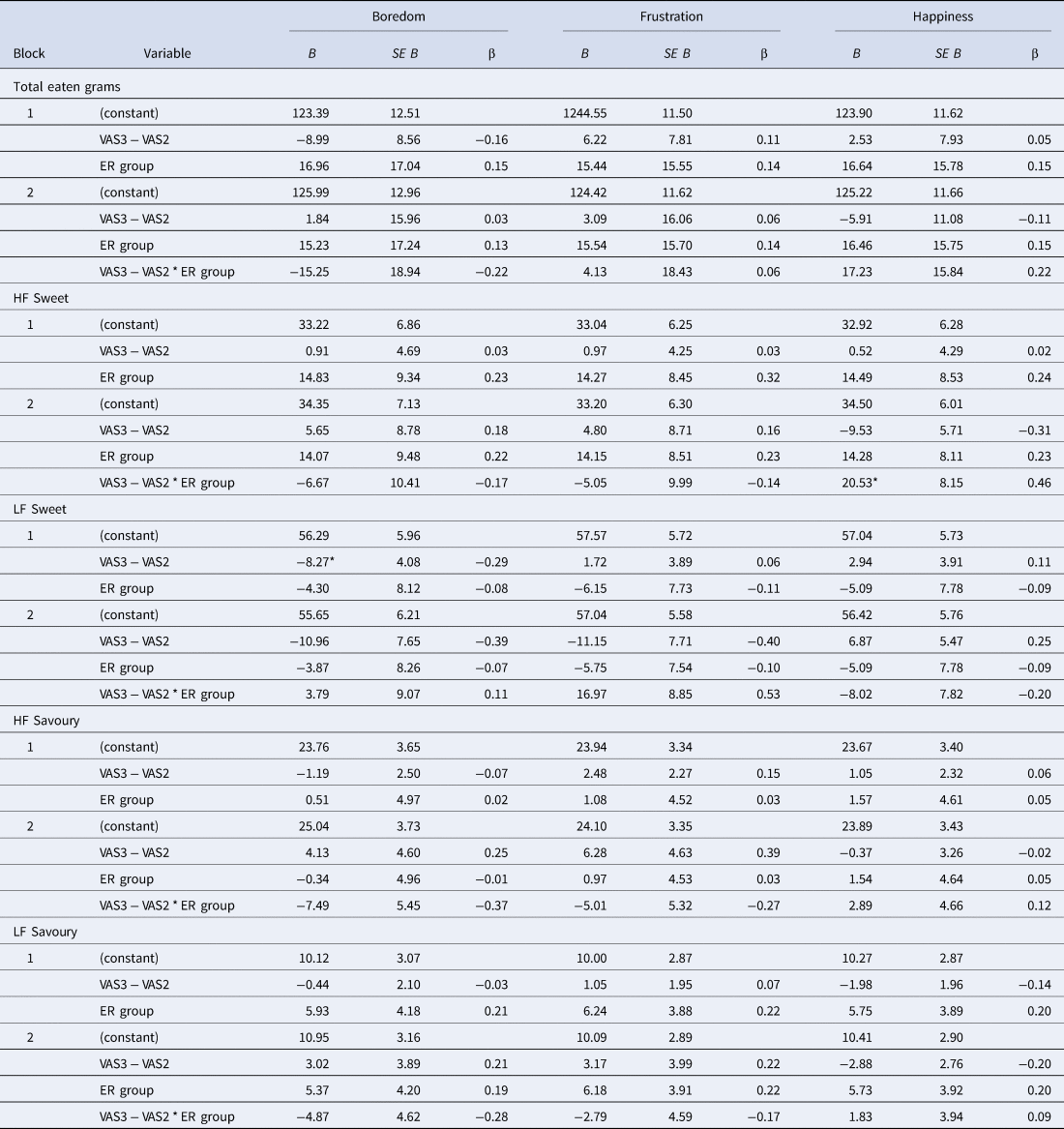
All statistics on the linear regressions are presented in Table 2 for five dependent food variables. The table presents two models for every dependent food variable: model 1 contains the effects of the independent variables Change in Stress AS and ER group, while model 2 is extended with the interaction term Change in Stress AS * ER group. For happiness, model 2 with a Change in Stress AS (VAS Happiness 3 − VAS Happiness 2), ER group, and the interaction term between those independent variables (Change in Stress AS * ER group) on Intake of HF Sweet Food was significant [F(3,49) = 3.18; p = 0.032; R 2 = .16]. Looking into the coefficients, Change in Stress AS (VAS Happiness 3 − VAS Happiness 2) and ER group did not significantly predict the HF Sweet Food Intake (p = 0.101 and p = 0.085, respectively), while the interaction term significantly predicted the HF Sweet Food Intake (p = 0.015). No other significant models were found for Boredom and Frustration predicting one of the five food outcome measures.
Hypothesis 2: Hierarchical Linear Regression Predicting Food Intake

Note: *p < 0.05.
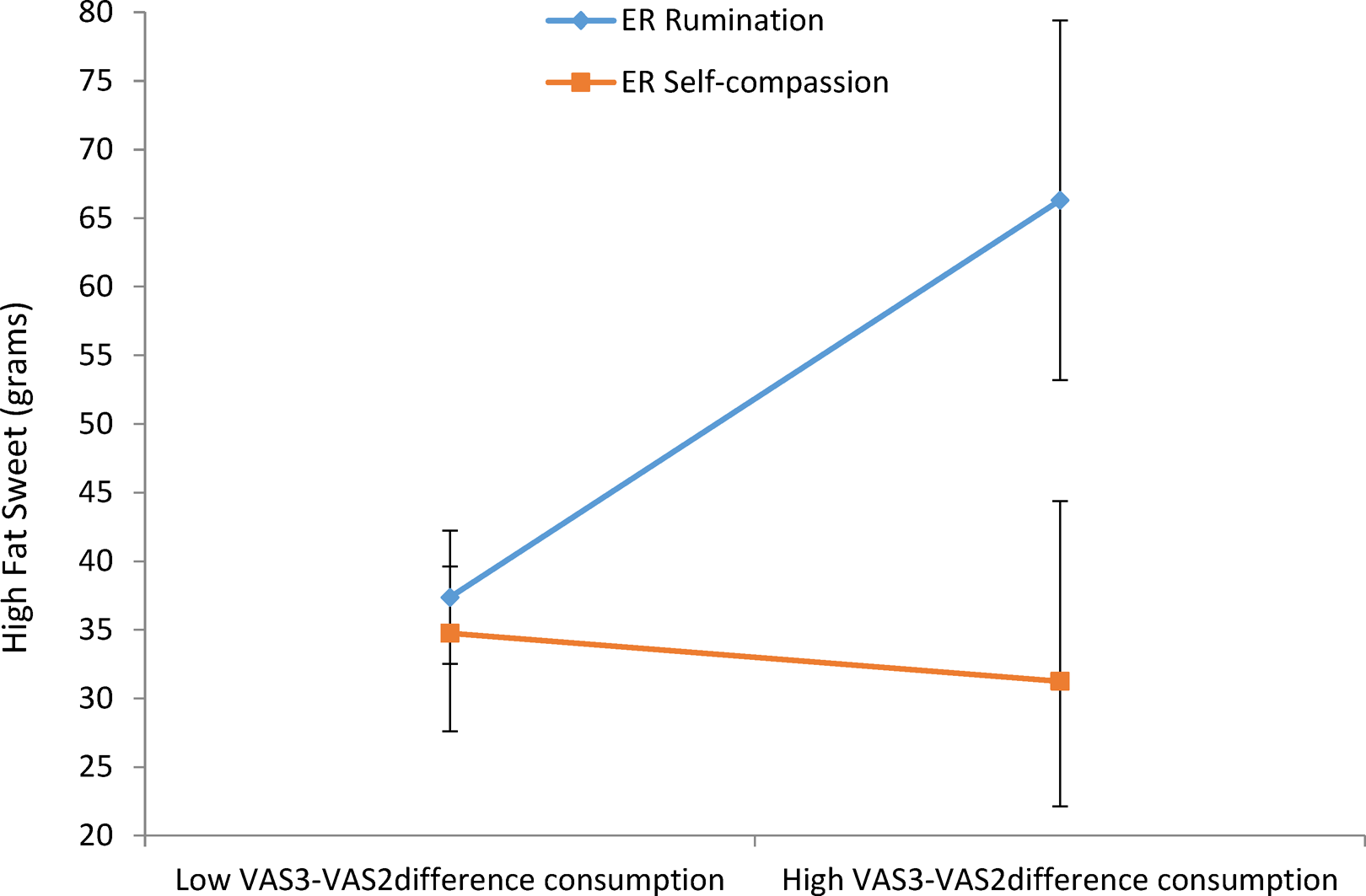
As depicted in Figure 2, for the (Happiness) Change in Stress AS * ER group interaction, it can be concluded that the more Happiness increased after applying ER self-compassion, and the less HF Sweet Food Intake was observed (VAS Happiness 3 − VAS Happiness 2). Otherwise, in the ER rumination group, nearly no change in Happiness was expected during phase III. Nevertheless, a remarkable relation was found: when ER rumination installed higher feelings of Happiness, a higher intake of HF Sweet food was observed during the Food-Taste Buffet (Figure 2). Furthermore, simple slope analyses were conducted for both adolescents with high changes in Happiness from phase II to III and adolescents with low changes in Happiness from phase II to III. For both, the main effect of ER group on HF Sweet food became significant: t(49) = 2.64, p = 0.011 (β = 4.93) and t(49) = −2.39, p = 0.021 (β = −4.46), respectively.
Interaction effect between VAS3 − VAS2 and ER group on HF Sweet food intake: slopes. Note: VAS=visual analogue scale.

Hypothesis 3: Eating-Reduced Stress Hypothesis
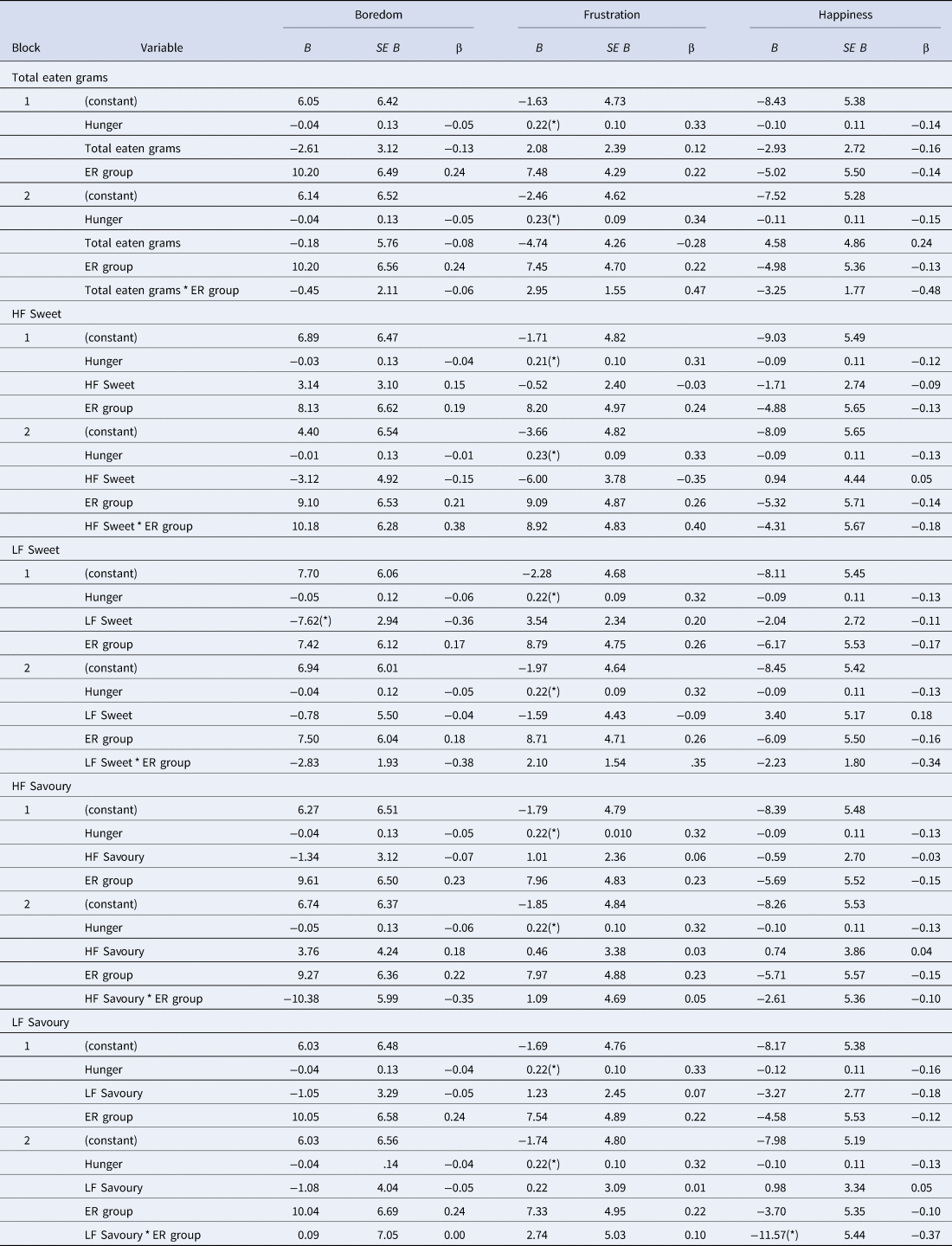
All statistics on the linear regressions are presented in Table 3 for three dependent Changes in Stress AS variables. The table presents two models for every dependent Change in Stress AS: model 1 contains an independent variable as one of the five food variables (Total eaten grams, HF Sweet, LF Sweet, HF Savoury, or LF Savory) and ER group (with VAS hunger at T3 added as a controlling variable), while model 2 is extended with the interaction term Food variable * ER group.
Hypotheses 3: Hierarchical Linear Regression Predicting Change in Stress AS

Note: *p < 0.05.
First, for the dependent variable Change in Stress AS Boredom, model 2 with LF Sweet food, VAS hunger 3, ER group and the interaction term between LF Sweet food and ER group (LF Sweet * ER group) predicted significantly the Change in Boredom (VAS Boredom 3 − VAS Boredom 4): F(4,42) = 3.02; p = 0.028; R 2 = .22. However, looking into the coefficients, nor the main effects, nor the interaction effects, were significant. Therefore, model 1 was explored with only the main effects, revealing a significant effect [F(3,43) = 3.23; p = 0.031; R 2 = .18] with a significant main effect of LF Sweet food [t(43) = −2.59; p = 0.013].
Second, also for the dependent variable Change in Stress AS Frustration, model 2 with LF Sweet food, VAS hunger 3, ER group and the interaction term between LF Sweet food and ER group (LF Sweet * ER group) significantly predicted the change in Frustration (VAS Frustration 3 − VAS Frustration 4): F(4,46) = 2.66; p = 0.044; R 2 = .19. Specifically, a significant main effect of hunger was found (p = 0.023), while the effect of the ER group was trend level (p = 0.071). Moreover, the Change in Frustration was significantly predicted by model 2 containing Total eaten grams, VAS hunger 3, ER group, and the interaction term Total eaten grams * ER group: [F(4,46) = 2.74; p = 0.040; R 2 = .19]. Looking into the coefficients, a significant effect was found of hunger (p = 0.019) and a trend-level effect of the interaction between Total eaten grams and the ER group (p = 0.063). Both ER group and Total eaten grams did not significantly predict the Change in Frustration, respectively, p = 0.120 and p = 0.272. In addition, the change in Frustration was trend level predicted by model 2 with HF Sweet food, VAS hunger 3, ER group, and the interaction term HF Sweet food * ER group [F(4,46) = 2.46; p = 0.058; R 2 = .18]. While hunger was a significant coefficient (p = 0.020), both the ER group and the interaction between HF Sweet food and ER group were trend-level predictors (p = 0.068 and p = 0.071, respectively).
Third, for Change in Stress AS Happiness, no significant models were found.
Additional Exploratory Analyses
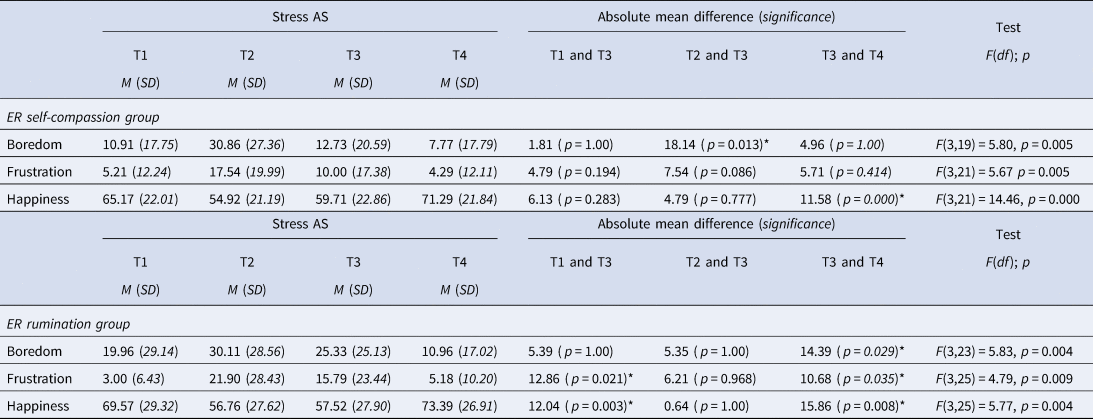
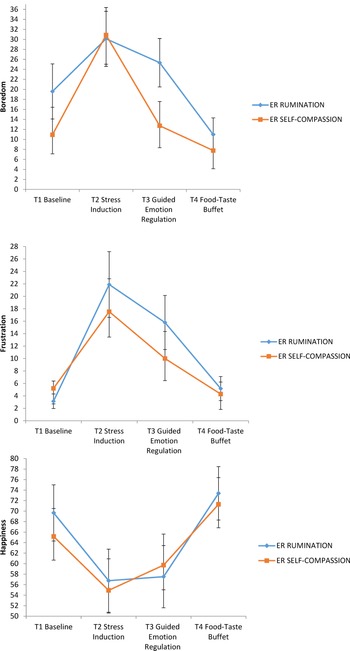
Additional exploratory analyses were conducted to look into the time-effects within the different manipulated ER groups to gain insights into the differential success of each ER strategy separately. This is helpful to generate clinical implications on the impact of ER on Stress AS reductions. Therefore, RM-ANOVAs across the four phases in each ER group separately were conducted and presented in Table 4. All repeated measures (Boredom, Frustration, and Happiness) in each ER group separately were significant.
Repeated Measures and Pairwise Comparisons of the Stress AS in ER Rumination and ER Self-Compassion Group

Note: *p < 0.05.
Comparing phase I with III (Guided ER manipulation phase), RM-ANOVA post-hoc comparisons within the ER self-compassion group on the Stress AS parameters revealed that Boredom, Frustration, and Happiness returned to baseline at T3 (VAS Stress AS 1 − VAS Stress AS 3). In the ER rumination condition, only Boredom returned to baseline after adopting ER rumination. In contrast, for Frustration, the levels of Stress AS at T3 were still significantly increased, while for Happiness, the levels of Stress AS at T3 were still significantly decreased (Table 4).
Comparing phase III with IV (Food-Taste Buffet), after adopting ER self-compassion, Boredom and Frustration did not change (Table 4), while in the ER rumination group, both Boredom and Frustration decreased significantly. Happiness increased significantly in both the ER self-compassion and ER rumination group (Table 4).
Comparing phase I with IV, in the ER self-compassion group, no significant differences were found, suggesting that the conservation of the returned Baseline Stress AS levels reached after phase III (see above) [VAS Happiness 1 − VAS Happiness 4 = 6.13 (p = 0.283), VAS Boredom 1 − VAS Boredom 4 = 3.14 (p = 1.00), VAS Frustration 1 − VAS Frustration 4 = 0.92 (p = 1.00)]. The ER rumination group returned to the baseline after phase IV, the Food-Taste Buffet, suggesting the restoration of baseline levels [VAS Happiness 1 − VAS Happiness 4 = 3.82 (p = 1.00), VAS Boredom 1 − VAS Boredom 4 = 9.00 (p = 0.420); VAS Frustration 1 − VAS Frustration 4 = 2.18 (p = 1.00)].
Discussion
Partial Evidence for the Hypotheses
Emotional eating is often regarded to be a learned strategy to cope with stress (Macht, Reference Macht2008). Also described as ‘eating your troubles away,’ it remains the predominant lay explanation for why individuals experience overweight and obesity, although it relies on different assumptions on the role of inadequate ER that still needs to be tested. In the present study, we induced stress, we manipulated which ER strategy participants used to regulate their stress, and we examined how this affected food consumption. The use of a laboratory task with a baseline (phase I), a Stress Induction (phase II), a Guided ER Manipulation (phase III), and a Food-Taste Buffet (phase IV) allowed us to investigate how different ER strategies influenced stress and affect (‘Differential ER’, hypothesis 1), and eating (‘Stress-Increased Eating’, hypothesis 2), and how eating influences subsequent stress and affect (‘Eating-Reduced Stress’, hypothesis 3). Our hypotheses were only partially confirmed.
We investigated two groups of stressed adolescents who were comparable on important descriptive variables (age, gender, adjusted BMI, stress, and emotional eating on a trait level). Manipulation checks showed that stress was successfully installed. After playing the Cyberball game, participants experienced an increased feeling of Boredom and Frustration, and a decreased feeling of Happiness, as was found by Hartgerink et al. (Reference Hartgerink, Van Beest, Wicherts and Williams2015) and Williams and Jarvis (Reference Williams and Jarvis2006).
The ‘Differential ER’ hypothesis was not supported, as ER rumination and ER self-compassion did not differentially influence stress and affect.
The ‘Stress-Increased Eating’ hypothesis was partially confirmed, as we found that participants who experienced an increase in Happiness after practicing ER self-compassion consumed less High-Fat Sweet food (in accordance with Aldao and Nolen-Hoeksema (Reference Aldao and Nolen-Hoeksema2010) and Evers et al. (Reference Evers, Stok and de Ridder2010)). In contrast, we found that most participants did not experience an increase in Happiness after ruminating. The participants that did report an increase in Happiness after ruminating consumed more High-Fat Sweet food. While unintuitive, this increase in Happiness may be understood as a short-term positive effect of applying a maladaptive ER strategy (Aldao & Nolen-Hoeksema, Reference Aldao and Nolen-Hoeksema2010; Cracco et al., Reference Cracco, van Durme and Braet2015); in contrast, maladaptive ER strategies are associated with negative consequences in the long run (Aldao & Nolen-Hoeksema, Reference Aldao and Nolen-Hoeksema2010; Bartoskova et al., Reference Bartoskova, Sevcikova, Durisko, Maslej, Barbic, Preiss and Andrews2018), such as higher levels of High-Fat Sweet food intake. This latter finding could be interpreted as an indicator of emotional eating (Macht, Reference Macht2008), as eating behaviour was altered in the presence of positive emotions. However, further research is needed to determine why only the change in positive feelings is related to food consumption.
We did not find that Boredom or Frustration interacted with the ER strategy to affect food consumption. First, the study might have been underpowered to detect small mixed interaction effects, as the two experimental groups consisted of 24 and 29 participants (Christley, Reference Christley2010). The nature of ER self-compassion may also offer a plausible explanation (Berking & Whitley, Reference Berking and Whitley2014; Ehret et al., Reference Ehret, Joormann and Berking2018; Strauss et al., Reference Strauss, Taylor, Gu, Kuyken, Baer, Jones and Cavanagh2016). Wante et al. (Reference Wante, Van Beveren, Theuwis and Braet2018) also found no significant differences between the effects of ER acceptance and ER rumination on stress-related affect. As an ER strategy, acceptance requires the individual to embrace and tolerate their stress, negative emotions, and suffering (Strauss et al., Reference Strauss, Taylor, Gu, Kuyken, Baer, Jones and Cavanagh2016; Wante et al., Reference Wante, Van Beveren, Theuwis and Braet2018). Consequently, although a positive effect on Happiness was detected, these adaptive and more response-focused ER strategies may show only small or no short-term effects on stress-related negative affect, resulting in less power to detect a difference with maladaptive ER strategies. Future research should include other and more antecedent-focused ER strategies like ER cognitive reappraisal (Gross, Reference Gross1998; Wante et al., Reference Wante, Van Beveren, Theuwis and Braet2018).
The ‘Eating-Reduced Stress’ hypothesis was partially confirmed, as we found that decreases in Frustration following food consumption were predicted by (1) hunger and (2) grams of Low-Fat sweet, High-Fat sweet, and Total consumed food. This result is in accordance with the hypothesis on the potential short-term success of emotional eating, more specifically, the rewarding/neutralizing effect of food (Macht, Reference Macht2008; Torres & Nowson, Reference Torres and Nowson2007). This prominent effect of Frustration could be related to the use of the Cyberball game, which is a well-validated paradigm, known to induce frustration (Hartgerink et al., Reference Hartgerink, Van Beest, Wicherts and Williams2015). However, the Cyberball game also affected feelings of boredom and happiness. Happiness was not subsequently affected by food consumption, suggesting that emotional eating does not enhance positive emotions. Boredom, however, showed smaller decreases when participants ate more Low-Fat Sweet food, suggesting that Low-Fat Sweet food may sustain boredom. This explanation is supported by a previous finding that a low-fat diet results in fewer changes in negative affect than other diets (McClernon, Yancy, Eberstein, Atkins, & Westman, Reference McClernon, Yancy, Eberstein, Atkins and Westman2007).
Furthermore, additional post-hoc exploratory analyses were conducted, which were interesting from a clinical perspective. Therefore, we further explored the differential effects of both ER groups. First, we found that ER rumination led to the sustained presence of negative affect (increased Frustration and decreased Happiness) following Stress Induction (Rood et al., Reference Rood, Roelofs, Bögels, Nolen-Hoeksema and Schouten2009; Treynor et al., Reference Treynor, Gonzalez and Nolen-Hoeksema2003; Wante et al., Reference Wante, Van Beveren, Theuwis and Braet2018). In addition, subsequent food consumption during the Food-Taste Buffet led to decreased Boredom and Frustration as well as increased Happiness, thereby returning all stress-related affect states to the baseline level (Figure 3). These results, although exploratory, are in line with our ‘Differential ER’ hypothesis that ER rumination does not help to regulate stress-related affect; and with our ‘Eating-Reduced Stress’ hypothesis that food consumption (i.e. emotional eating) will restore baseline affect in stressed individuals, for example, those who use maladaptive ER strategies. Second, in contrast, ER self-compassion restored stress-related affect (Boredom, Frustration, and Happiness) to the baseline after it was disturbed by induced stress; and food consumption did not further change the levels of Boredom and Frustration. These results are, although exploratory, in line with our ‘Differential ER’ hypothesis that ER self-compassion is an adaptive ER strategy, helping to reduce stress and negative affect; and with Ehret et al. (Reference Ehret, Joormann and Berking2018). Interestingly, the ER self-compassion group also experienced further increases in Happiness during the Food-Taste Buffet. This result is in accordance with the finding that food has a fundamental impact on positive feelings. More specifically, our eating behaviour and food consumption have a direct effect on our levels of Happiness (Blades, Reference Blades2009).
RM-ANOVA over all four phases.

Strengths and Limitations
The present study was conducted in a controlled laboratory setting, with a well-thought standardized design, and used a validated Stress Induction method. Moreover, the study experimentally manipulated ER, resulting in the possibility of investigating causal inferences. Because of the state measures at many time-points, we were able to conduct stringent analyses on the adoption of both ER rumination and ER self-compassion on both changes in stress and affect, and food consumption. Moreover, the measurement of different affect states is a strength, as they have differential effects on cognition, behaviour, and physiology, shown in a different degree of arousal (Lench, Flores, & Bench, Reference Lench, Flores and Bench2011; Schwartz, Fair, Salt, Mandel, & Klerman, Reference Schwartz, Fair, Salt, Mandel and Klerman1976). Therefore, the ER effects were researched separately for different stress and affect variables, which is in line with previous laboratory studies (Rood et al., Reference Rood, Roelofs, Bögels, Nolen-Hoeksema and Schouten2009; Wante et al., Reference Wante, Van Beveren, Theuwis and Braet2018). Another strength is the fact that the present study featured several food classes with different caloric contents (Blechert et al., Reference Blechert, Lender, Polk, Busch and Ohla2019).
Despite the study's strengths, some important limitations also warrant discussion. First, the findings may have been affected by reliance on self-reports, as these are susceptible to social desirability and motivational state. However, self-reporting is often the only way to measure subjective experiences such as hunger and affect (Paulhus & Vazire, Reference Paulhus and Vazire2007). Second, a priori power analyses revealed that 60 participants would be needed to detect a statistically significant effect. However, given that ER self-compassion reduced stress-related affect during the adoption of the ER instructions, we could only examine the role of emotional eating in half of the sample, which reduced the power to detect an effect and increased the risk of detecting false effects. In addition, many statistical tests were conducted, while not correcting for multiple testing. Consequently, the family-wise error rate of this study is high, which is a weakness of using multiple kinds of food in the present study and measuring many affect states. Another limitation is that we did not ask the participants if and what ER strategy they used during the Cyberball game and ER adaptation. Parsafar, Fontanilla, and Davis (Reference Parsafar, Fontanilla and Davis2019) found that fewer than 60% of adolescents used the ER strategy that they were instructed to use.
Conclusion
In sum, we found only partial evidence for the hypothesis that failed ER leads to overeating as a compensatory ER strategy. The findings show small indications of emotional eating of high-fat and high-sugar food when looking to the differential effects on positive feelings after adopting a specific ER strategy. We could confirm that eating-reduced negative feelings, but not that it enhanced positive affect. Finally, exploratory analyses revealed that adopting a specific ER strategy can increase or decrease one's stress level, and that ER rumination increases subsequent food consumption. Although not expected, several null-findings occurred: (i) non-regulated stress states did not affect eating, (ii) eating during stress did not enhance positive emotions, and (iii) not all foods improved affect following stress. Therefore, we recommend exploring the role of ER processes further to enhance our understanding of the relationship between stress and eating.
Acknowledgements
Proofreading by the Faculty of Arts and Philosophy, Ghent University, is acknowledged; and special thanks to Sercan Kahveci who did a final language check.
Author Contributions
All authors have substantially contributed to, seen, and approved the final version of the manuscript and qualify for authorship.
Funding
This work was supported by BOF (Bijzonder Onderzoeksfonds; grant no. BOF.24J.2016.0007.02).