INTRODUCTION
Word production involves retrieving a semantic representation of a word, linking that representation to its corresponding word form, and retrieving the phonemes that ultimately specify the articulation of the word. Anomia, or difficulty in retrieving words, is a prominent symptom of neurologically based language impairment, including stroke-related aphasia (Goodglass & Wingfield, 1997), progressive fluent or nonfluent aphasia (Grossman & Ash, 2004), progressive pure anomia (Graham et al., 1995) and progressive semantic dementia (Patterson & Hodges, 1995). In this study, we focus on treatment of word retrieval deficits associated with stroke-related aphasia.
Two important considerations for development of appropriate treatments for anomia are (1) the source of a naming impairment and (2) the effect of a treatment task on access to and activation levels of these representations. Here, we evaluate the effects of a treatment task, contextual repetition priming, on one source of word retrieval impairment in aphasia, impaired connections between lexical and semantic representations that affect access to and from semantics. Contextual repetition priming is a procedure in which a small number of pictureable words that are related semantically, phonologically, or not at all are trained as a set. In training, after the therapist says the name of the picture, the participant identifies it from an array of pictures undergoing training, and then repeats the name of the picture. This procedure is carried out several times for each picture in the set. This priming of related words is assumed to raise the activation levels of their semantic, lexical, and phonological representations through spreading activation thus making them temporarily more accessible when attempting to retrieve the word in a picture naming test following treatment. This procedure has resulted in short-term facilitation effects regardless of whether naming is affected by impaired connections between semantic and lexical representations or between lexical and phonological representations. When applied as a training technique in long-term treatment studies, the contextual repetition priming thus far has proved successful only when input lexical-semantic processing is intact (e.g., Martin et al., 2004b). The study presented here confirms this suggestion.
The Nature of Word Retrieval Impairments in Aphasia
Word processing impairments in stroke-related aphasia are attributed to impaired access to semantic, lexical and/or phonological representations (Raymer & Rothi, 2002), and maintaining that activation sufficiently to support comprehension and production of words (Martin & Gupta, 2004). This position is supported by evidence of preserved knowledge of words and their meanings despite failure to demonstrate this knowledge consistently in language tasks (e.g., Howard, 2000). Despite the consensus that aphasic impairment does not involve loss of knowledge, there is still disagreement about the locus of impairment. Whereas some models attribute it to a disturbance of semantic or phonological representations (Lambon Ralph et al., 2000), others attribute it to the “connections” between representations, impaired activation processes that lead to imprecise, and inconsistent activation of a word's representations (Dell et al., 1997). This latter model has served as the framework for the contextual priming studies described in this study and others (e.g., Martin et al., 2004b). This model makes two assumptions relevant to this study: (1) input and output connections between lexical and semantic representations are shared (Fig. 1) and (2) severity of impairment to these connections determines whether both input and output processing between lexical and semantics are impaired (more severe deficits) or just output processing (see Martin & Saffran, 2002 for detailed discussion). When input processing between words and their meanings is affected, repetition priming has only a short-term benefit to naming that is likely due to temporary increased activation levels of the lexical-phonological representations of the words being repeated.

A word processing model with separate but interacting input and output phonological lexicons.
Evidence that input and output connections between lexical and semantic representations are shared comes from associations between performances on input and output tasks. For example, Martin et al. (2005) reported correlations of input semantic processing tasks with accuracy and rates of semantic errors in picture naming. Although this model predicts that anomia arising from a breakdown in the semantic → lexical connection (as in a naming impairment) would always be accompanied by a disruption of input lexical → semantic processing, the latter would not always be apparent in language testing. Severity of impairment and task considerations can account for profiles of apparently intact input processes accompanied by impaired output. Pure anomia, for example, characterized by good performance on input semantic and phonological tasks, good repetition, and impaired naming is seemingly consistent with models that separate input and output lexical stores and their connections with semantics (e.g., Monsell, 1985; Raymer & Gonzales Rothi, 2002). However, most tasks that measure lexical-semantic input processing are easier than those used to measure output. To retrieve a name of a picture, for example, a semantic representation must be mapped onto a single word representation selected from a host of lexical “neighbors” competing for retrieval. In contrast, a typical measure of word comprehension requires mapping a spoken word to one of four pictures. Martin & Saffran (2002) argued that the inequities in difficulty of input and output tasks can yield an apparent profile of intact input lexical → semantic processing coupled with impaired output semantic → lexical processing in cases of milder impairment.
Contextual Repetition Priming
Repetition priming is used to facilitate word retrieval in the short term and is incorporated into many treatment approaches (e.g., Best et al., 2002; Patterson et al., 1983, Raymer et al., 1993). The participant hears a spoken name of a picture he is unable to name and repeats the word immediately. Within a short period of time, the picture-to-be-named is presented and the participant produces the name without assistance. This effect has been attributed to temporary residual activation of the word's semantic and phonological representations following repetition, which for a short time increases the accessibility of that word in other tasks such as naming (e.g., Weigl, 1961).
We have used massed repetition priming (multiple repetition primes) in naming facilitation and treatment studies, combining it with another variable that influences naming, the context in which a picture is named (e.g., Laine & Martin, 1996; Martin et al., 2004a; Martin et al., 2004b; Martin & Laine, 2000 Renvall et al., 2003; Renvall et al., 2005). By context, we mean the nature of the relationship among items that are being trained within a particular treatment session (semantically, phonologically related, or unrelated). When activated by repetition priming, semantically related or phonologically related representations spread to other representations that share these characteristics. Massed repetition priming of words that are related semantically or phonologically elevates the activation levels of all the words being trained. Martin et al. (2004) have shown that initially this increased activation causes facilitation (more correct responses compared to the pre-test) coupled with interference in naming (more errors on within-training probes). After a 5-minute interval following the end of training, however, the interference is gone and facilitation remains (improved performance on post-treatment naming compared to pre-treatment naming). The interactive activation model accounts for this short-term facilitation effect with the assumption that during the five-minute interval following training, activation of the cohort of representations of the trained words recedes, but not completely. For a short period of time the words are more accessible because of a residual increase in their activation level. However, that activation is not elevated enough to cause interference.
The Effect of Lexical-Semantic Impairment on the Effectiveness of Contextual Priming
Our studies have revealed an important variable that affects the success of contextual repetition priming: the source of the naming impairment. Contextual repetition priming seems to have only short-lived effects when connections between semantic and lexical representations (affecting both input and output) are impaired. In contrast, if input lexical-semantic processing is intact because of a milder impairment to these connections (affecting output only) or because naming is due to impaired connections between lexical and phonological representations, both short and long-term effects of contextual priming are observed.
We have used contextual repetition priming in two paradigms, single session facilitation studies and long-term treatment studies. In the facilitation studies, the procedure is run for each context type within a single session and in the treatment studies, it is carried out over multiple sessions until a specified criterion of accuracy is met. We have observed a fairly consistent pattern of short-term naming improvement in the facilitation studies for most, but not all, subjects (Martin et al., 2004b). Many show effects regardless of whether the training context is semantically, phonologically or unrelated, but some show specific sensitivities to semantic or phonological context compared to an unrelated context (Laine & Martin, 1996; Martin & Laine, 2000). In three long-term treatment studies, however, we have found consistently that long-term improvements in naming are observed only when input lexical-semantic abilities are preserved (Martin et al., 2004a; Renvall et al., 2003; Renvall et al., 2005). Cases with impaired lexical-semantic abilities demonstrated relatively preserved input phonological-lexical, output lexical-phonological and input–output phonological connections. For these latter cases, the short-term benefit of contextual repetition priming is attributed to a temporary increase in activation levels of the output lexical-phonological representations caused by the repetition priming. The lack of long-term benefit is attributed to impaired spread of activation to semantic levels of representation and no change in the strengths of these connections on input or output.
Here, we report two case studies of individuals who show impaired performance on tests of naming and input lexical-semantic processing and relatively good performance on measures of phonological processing. We tested the hypothesis that contextual repetition priming would have only short-term effects on naming because of the impaired access to semantics. Confirming evidence from these two cases is important because it specifies clearly the conditions under which a commonly used training procedure (repetition priming) is or is not effective. Additionally, this evidence would corroborate findings from other studies of learning in aphasia that indicate the importance of the integrity of semantic access to learning new words (Gupta et al., in press) and novel utterances with known words (Martin & Saffran, 1999). Finally, this information should be a useful guide in determining other approaches that will be effective when access to semantics is impaired.
METHODS
Participants
There were two participants, BM, a 73-year-old, left-handed woman, and BQ, a 29-year-old, right-handed man. Demographic information and Aphasia Quotients from the Western Aphasia Battery (Kertesz, 1982) are provided in Table 1. Participants were native English speakers and passed a hearing screening. Neither BM nor BQ was involved in any other treatment program while enrolled in this study or between the end of treatment and follow-up measures.
Participant demographics

All data collected from the participants reported in this study were obtained in compliance with regulations of Temple University's Institutional Review Board and the human research was completed in accordance with the guidelines of the Helsinki Declaration.
Design
A single subject multiple baseline design (McReynolds & Kearns, 1983) was used. Before treatment began, BM and BQ were administered a 652-item naming test with pictures from 15 categories drawn from 3 context conditions: semantic, (S) for example clothing, fruits; phonological, (P) words beginning with /s/, /d/, etc., and unrelated, (U). From the 15 categories in this naming test, training items were chosen from 9 categories in which 20 items were not named correctly within 20 seconds. These items were used to create three 60-item baseline naming tests, one for each of three Treatment Modules. Stimuli for each Treatment Module and its corresponding baseline naming test included items from one category within each relatedness context (e.g., Module 1 might include clothes, K-Words, unrelated words). In each treatment Module, the baseline measurement containing all 60 items was administered prior to the training of the first context until a stable baseline was achieved. Then training on the first context began. The baseline test was then administered at the start of each training session. These data served as measurements of the effects of training for the context being trained and served as an extended baseline for the other two contexts, until their training was initiated. In order to control for any potential training order effects, the order of context training was altered in each module (SPU, PUS, UPS).
Training and Control Items
From the set of 20 items in each context of the baseline naming test, 5 items that were most difficult to name over repeated presentations were designated for training and 5 items matched in frequency, length and difficulty served as control items. Most difficult to name items were those that had the highest error rate across the repeated baseline measures.
Procedure
There were three treatment sessions per week. Each session included a 60-item baseline test, with 20 words from each of three context conditions; a 10-item pretest with words from the context undergoing training (5 trained and 5 untrained); 3 multiple priming trials, each followed by naming probes; and a 10-item post-test.
The contextual priming procedure combines massed repetition priming with systematic manipulation of relationships (semantic, phonologic, and unrelated) among pictures in a treatment set. Priming trials included 3 steps: (1) spoken word-to-picture matching, (2) repetition of the picture's name and, (3) independent naming of the picture (see Appendix A for details). The 10 item pre-and post-tests were administered before and after each training session to monitor any evidence of short-term facilitation of trained and control items within a session.
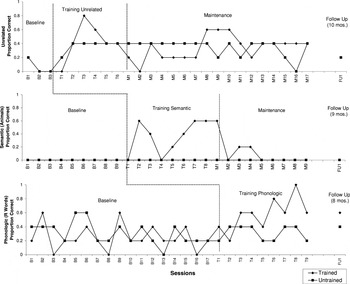
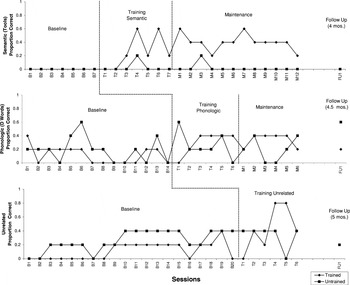
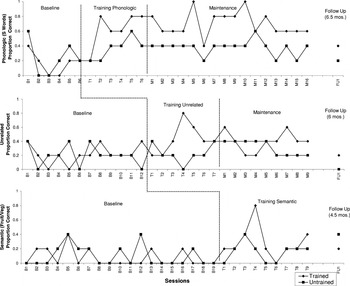
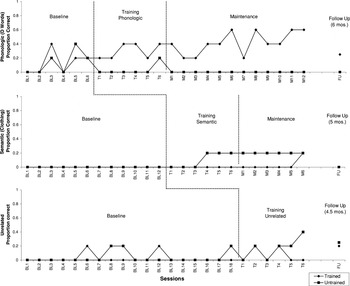
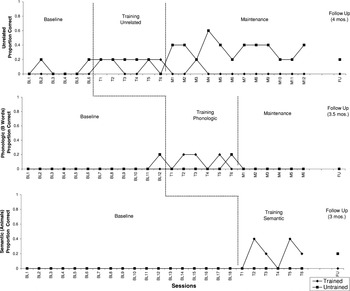
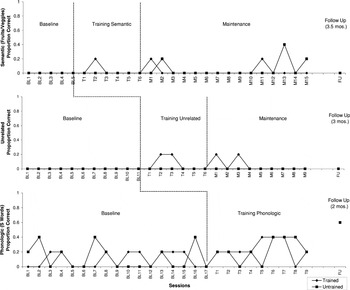
The criterion for completing a training set (semantic, phonological, or unrelated context set within a Training Module) and moving onto another relatedness context training set was either 80% correct on two consecutive sessions or a maximum of 9 treatment sessions. Short-term maintenance and generalization of treatment effects were evaluated with the 60-item baseline/generalization probe administered at the beginning of each session. Figures 2, 3, 4, 5, 6, and 7 show data from the 5 trained and 5 control items in each category extracted from the 60-item probe measure obtained at the beginning of each session. Therefore, although 60 items were presented at each probe point (the beginning of each session), the graphs represent proportion correct of the trained and control items within each category. Each of the three graphs follows performance on each condition with these probes throughout its baseline (or extended baseline for the two contexts that are not trained first), training phase and maintenance phase (for the two contexts that go through a maintenance phase). When training was completed for all three contexts, we replicated the treatment two additional times (Treatment Modules 2 and 3) using different categories within each context and counterbalancing the order of the three contexts, as noted earlier. At the conclusion of all three treatment modules, participants were administered each 60-item baseline test sequentially to assess long-term maintenance. Additionally, they were re-administered the 652 item naming test at the conclusion of all three Treatment Modules. This enabled us to compare performance on trained and untrained items before and after therapy in a larger set of words.

BM Treatment Module 1: Animals, R Words, UR 1. When a single point is present at follow-up, this indicates equivalent performance on trained and untrained items.

BM Treatment Module 2: Tools, D Words, UR 5. When a single point is present at follow-up, this indicates equivalent performance on trained and untrained items.

BM Treatment Module 3: Fruits & Vegetables, S Words, UR 4. When a single point is present at follow-up, this indicates equivalent performance on trained and untrained items.

BQ Treatment Module 1: Clothing, D Words, UR 1. When a single point is present at follow-up, this indicates equivalent performance on trained and untrained items.

BQ Treatment Module 2: Animals, B Words, UR 3. When a single point is present at follow-up, this indicates equivalent performance on trained and untrained items.

BQ Treatment Module 3: Fruits & Vegetables, S Words, UR 5. When a single point is present at follow-up, this indicates equivalent performance on trained and untrained items.
Scoring
Participants had 20 seconds to produce a name. The final attempt to name a picture was scored. To be scored as correct, a response had to be phonologically accurate and be either the target name or an acceptable alternative (based on the responses of five normal control subjects). Minor articulatory distortions that were consistently produced by a participant were counted as correct.
Data Analyses
McNemar tests of change were used to examine improvement of naming the items on the 652 item naming test. Acquisition, maintenance, and generalization were tracked by graphing correct responses on the baseline tests administered at the beginning of each training session.
Background Testing
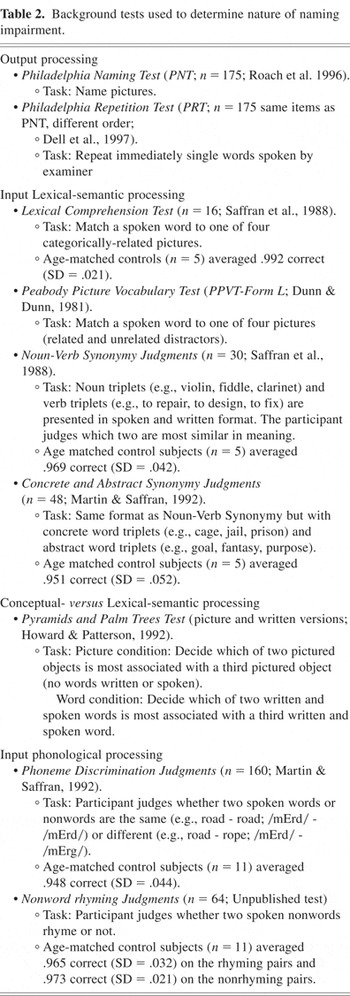
Table 2 provides short descriptions of the measures used to assess the semantic, lexical, and phonological abilities of each participant. Details of the administration of these tasks can be found in the references cited. Detailed data relating to test development and performance by nonaphasic controls for the Philadelphia Naming Test and Philadelphia Repetition Test can be found in the references noted. Data from age-matched controls without aphasia or brain damage are noted for the four laboratory-developed tests (two synonymy judgment tests, phoneme discrimination, and rhyming judgments).
Background tests used to determine nature of naming impairment.

These tests were administered to each participant. Results of these tests are discussed later and shown in Tables 3, 4, 5, and 6.
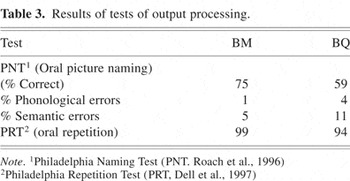
Results of tests of output processing.

Results of tests of input semantic processing

Results of tests of conceptual- and lexical semantic processing

Results of tests of input phonological processing.

RESULTS
Background Testing
Naming
BM demonstrated a moderated impairment of picture naming ability (Table 3), scoring 75% correct on the 175-item Philadelphia Naming Test (Roach et al., 1996). BQ demonstrated a more severe naming deficit (59% correct on the PNT). Both participants produced more semantic errors than phonological errors in naming.
Repetition
BM and BQ's performances on the Philadelphia Repetition Test (Dell et al., 1997) indicated relatively intact repetition abilities (Table 3).
Together, the results of the PNT and the PRT indicated that both BM and BQ had difficulty accessing lexical-phonology from semantics but were able to access output phonology via input phonology (good repetition).
Input Lexical-Semantic Processing
Both BM and BQ showed moderate deficits in lexical-semantic processing (see Table 4). Although they performed well on the lexical comprehension test, their performance declined on the more difficult PPVT (numbers in Table 4 are Standard Scores), which uses the same word-to-picture matching format. Also, they performed relatively poorly on the Synonymy judgment tasks, which require the ability to access word meaning representations from word form representations and maintain activation of those representations while making a judgment about their similarity.
Conceptual- versus Lexical-Semantic Processing
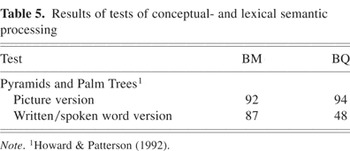
It is important to determine whether the semantic deficits present in the tests described earlier were caused by difficulty in accessing semantics from words or from a central, conceptual level of semantic representation. The Pyramid and Palm Trees Test (Howard & Patterson, 1992) with picture and word versions was administered for this purpose. Good performance on the picture version coupled with poorer performance on the word version indicates intact conceptual level semantics, but difficulty mapping words onto semantic representations. As Table 5 indicates, this pattern was demonstrated by each of the participants. The disparity between performances on picture and word versions of this test is particularly striking in the case of BQ.
Input Phonological Processing
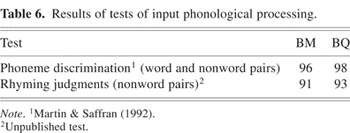
As Table 6 indicates, both BM and BQ demonstrated good performance on the two input phonological processing tasks.
The performance on input lexical-semantic processing tasks together with performance on the output tasks (naming and repetition) indicated that BM and BQ had impaired connections between lexical and semantic representations that affected access of semantics from lexical-phonological representations and access to lexical-phonological representations from semantics.
Results of Training
Baseline, acquisition and maintenance
Data from baseline, acquisition and maintenance phases of treatment are shown in Figs. 2, 3, and 4 for BM and Figs. 5, 6, and 7 for BQ. These data are the percent correct of the 5 trained and 5 control items from each context on the 60-item probe test presented at the start of each session. As can be seen, BM demonstrated variable improvement across conditions during the acquisition phase. These gains were only partially maintained during treatment in other contexts and in the follow-up testing at 4–10 months post-training. BQ did not respond well to this treatment. He made little improvement in any condition during acquisition and maintenance phases. Follow-up testing at 3–5 months post treatment revealed loss of even minor gains.
Pre- and post-testing performance
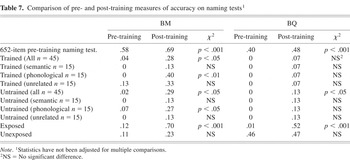
McNemar tests of change were used to evaluate pre- and post-performance on the 652-item naming test (see Table 7). From these, we were also able to determine pre- and post-performance on all trained pictures, all untrained pictures, and trained and untrained within each condition. Additionally, we looked at performance on pictures that were exposed during repeated baseline testing but never trained, as well as pictures that were never exposed during training (but were part of the 652- item pre- and post-treatment naming test).
Comparison of pre- and post-training measures of accuracy on naming tests1

BM showed some improvement in response to training only in the phonological condition (χ2(1) = 8.00, p < .05). BQ showed no positive effect of training in any training condition. Both BQ and BM demonstrated significant improvement on the 652-item naming test (BQ: chi square (1) = 19.18 p < .001; BM: χ2(1) = 27.22, p < .001). These gains can be attributed mostly to improvement on items that were repeatedly named on the baseline probes but were never trained (and see discussion later).
Generalization to untrained items was evident in BM's performance in the phonological context condition (χ2 = 5.83, p < .05). Additionally, BM and BQ show some evidence of generalization as significant improvement on the untrained items was observed when the three conditions were collapsed. In BM's case, the overall improvement seems due mostly to the gains made in the phonological context condition, but could also be due in part to repeated attempts to name.
Recent studies have shown that repeated opportunities to name pictures without direct training leads to some improvement in retrieving the names of those pictures (e.g., Nickels 2002). To examine this possibility, we compared performance on pictures that were exposed during baseline, acquisition, and maintenance 60-item naming probe tests and those pictures that were never exposed except in the 652-item pre- and post-treatment test (Table 7). For those pictures that were exposed in training, BQ's naming performance rose from .01 correct on the pre-test to .52 correct on the post-test. This difference was highly significant (χ2(1) = 44.10, p < .001). For those pictures that were unexposed during training, he named .46 correct on the pre-test and .47 correct on the post-test. BM showed a similar effect of exposure. On exposed items, her performance improved from .12 correct on the pre-test to .70 on the post-test (χ2(1) = 52.02, p < .001). The gains on unexposed items (.11 pre-test and .23 post-test) were not significant. These data provide further evidence for Nickels (2002) claim that repeated attempts to name pictures can facilitate word retrieval and suggest a need for further studies of this phenomenon.
GENERAL DISCUSSION
These two case studies support our hypothesis that individuals with impairment to connections between lexical and semantic representations make limited or no short-term gains following the contextual repetition priming treatment. Although the two participants differed with respect to certain characteristics (age, etiology, months post onset, classical aphasia category assignment), their performance profiles on measures of semantic and phonological processing were similar in pattern, showing (1) good performance on input and output phonological tasks; (2) relatively poor performance on measures of input lexical-semantic processing, especially those that require maintaining activation of semantic representations in working memory (e.g., the synonymy judgment tasks); (3) adequate conceptual-semantic processing; and (4) impaired picture naming with more semantic than phonological errors. This overall profile is consistent with a deficit in mapping between lexical and semantic representations that affects both input and output processing. As has been observed in our other treatment studies and learning experiments (Martin & Saffran, 1999), semantic or phonological relationships among pictures being trained did not boost performance relative to the unrelated condition. Apart from the contextual effects, the repetition priming itself had only a short-lived effect. An account of this pattern is discussed later.
Renvall et al. (2005) noted that if the lexical-semantic deficit involves impaired ability to activate item-specific semantic representations, then the boost in spreading activation provided by the context component of CP might actually spread too diffusely throughout the semantic neighborhood, resulting in less activation to the target relative to other competing representations. The effect of this would be to promote stronger competition among related items which in turn would reduce the strength or accuracy of item-specific semantic-phonological activation needed to successfully retrieve the name of a picture. In a more general sense, the poor response of the BM and BQ to repetition priming treatment is consistent with the claim that naming requires activation of semantic representations and repetition does not (e.g., Martin & Ayala, 2004). If input connections between lexical and semantic representations are intact, semantics should be activated in word repetition, and repetition priming should impact semantic activation of words for naming. However, when input to semantics is disrupted, repetition priming may have no short- or long-term effect on activation of the semantic representations and therefore, no impact on the top-down semantic activation of words needed to improve word retrieval in production. Any short term facilitating effects could be attributed to temporary increase in the activation of a word form in the lexicon and its corresponding phonemes, making it more accessible to impaired semantic activation as it spreads top-down through the lexicon.
This conclusion is consistent with models of word processing (comprehension and production) that postulate semantic and phonological representations whether there is interactivity between levels of representation or not. The interactive activation model (Dell et al., 1997; Schwartz et al., 2006), which does presume interaction between semantic and phonological levels of representation, predicts that adding context to a repetition priming task should increase activation of the target and related competitors. In two versions of the IA model, Dell and colleagues have explored two accounts of the processing impairment underlying word retrieval impairments. In one version (Dell et al., 1997), lesions involved impairing the activation spread and endurance of activation globally, within the lexical network (Dell et al., 1997). The second model accounted for aphasic impairment via selective lesions of the strength of activation spread from semantics to the lexical network and/or from lexical representations to the phonological network. In the latter model, they found that reducing connection weights between semantics and the lexical network resulted in many whole word intrusions that were semantically, phonologically, or unrelated to the target word, and reducing the connection weights between the lexical network and the phonological network resulted in more nonword errors and fewer whole word errors. The relevance of this model to the present study is that a lesion affecting connections between semantics and the lexical network is similar to the impairment of the two participants in this study and other reported cases with aphasic related semantic impairment. Although semantic knowledge is relatively intact, the spread of activation between the lexical network and semantics is reduced in strength and affects input and output processing.
Implications for Treatment of Word Finding Deficits Arising from Impaired Lexical-Semantic Connections
How do we treat word retrieval impairments resulting from impaired connections between the semantic system and the lexical-phonological system? Some treatment protocols aim to improve fundamental semantic abilities. For example, semantic feature analysis (Boyle & Coehlo, 1995) focuses on teaching the participant to explore the semantic features of objects to be named. This is done via questions and answers, which are expected to activate these features and strengthen the semantic “signal” that will access the target word form. Another approach is to use personalized or semantic self-cueing strategies to facilitate retrieval (Freed & Marshall, 1995). Contextual repetition priming is a much more “online” direct facilitation approach to facilitating retrieval. However, as we have noted, repetition itself does not necessarily stimulate impaired connections between lexical and semantic representations. Moreover, as we have observed in these two case studies, increasing semantic context does not promote much improvement under these circumstances.
We are currently exploring two approaches to this problem. In one approach, we are testing a new version of contextual priming that primes directly the connections between semantics and lexical forms in production. We have adapted the massed repetition priming portion of the task to become what we term “contextual production priming,” which combines massed production priming with three relatedness contexts (semantic, phonological, and unrelated). Production priming of a single word is accomplished by naming several different depictions of a word (e.g., five different exemplars of a chair). We will combine this with a cueing hierarchy to facilitate access to the word form and strengthen the output pathway using semantic and phonological cues. Thus far, our preliminary results suggest that in the case of impaired connections between semantics and the lexicon, this approach is most successful when the context is unrelated or phonologically related. The semantic context appears to promote too much interference. Although these observations are very preliminary, they are consistent with what we might expect with this kind of impairment. In production priming, the semantic context promotes activation of more competitors, stimulating interference. The unrelated context promotes increased activation of semantic, lexical and phonological representations without stimulating semantically related competitors. In the phonological condition, the effect would be the same as in the unrelated condition with an additional boost to the phonology of the words, making them more accessible to activation spread from semantics.
In a second approach to treatment of this kind of naming impairment, Renvall et al. (2005; in press) have tested the effects of supplementing the contextual repetition priming with additional semantic or phonological tasks to stimulate further the activation spread between semantic and lexical representations. In the case of one participant in this study with a moderate central semantic impairment, the semantic context condition with additional tasks (particularly with a semantic task) resulted in long-term improvements of naming. This result is promising and suggests that a need to investigate the effects of direct priming and less direct stimulation in combination and individually.
Although more research is needed in this area, converging evidence from these studies and others (e.g., Le Dorze et al., 1994; Raymer & Gonzales Rothi, 2002) suggests that a combination of approaches to stimulating the semantic ← → lexical pathway will fare better than a single approach. Direct priming of input and output pathways between semantics and the lexicon has some short-term effect, but might be more effective when combined with techniques such as stimulation of long-term semantic knowledge or techniques that increase activation of the phonological form, making it more accessible. These possibilities need to be explored in future treatment studies.
ACKNOWLEDGMENTS
This study was supported by a grant from the National Institutes of Health DC 01924-11 (PI: N. Martin) to Temple University. M. Laine was supported by grants from the Academy of Finland. The authors thank three anonymous reviewers for their helpful comments on earlier versions of this paper. Special thanks go to Kelly Bowes for her help with testing and data analysis. Additionally, the authors thank the two participants in this study for their patience and enthusiasm for this project. The information in this manuscript and the manuscript itself is new and original and that it is not currently under review by any other publication, and that it has never been published either electronically or in print. There are no financial or other relationships concerning this manuscript that would be considered a conflict of interest.
APPENDIX A
Training procedure: Priming trials and test probes (From Martin et al., 2004).
Following the 10-item pretest, the five pictures designated for training are displayed in front of the participant. A priming trial consisted of three steps: spoken word-to-picture matching; repetition and naming, as follows:
- Spoken word-to-picture matching: The examiner names a picture and asks the participant to point to the picture in the array of pictures. (“show me ____”)
- Repetition of the name: The examiner says the name of the picture and asks the participant to repeat it (“Say ___”).
- Independent naming (delayed repetition): The examiner asks the participant to name the picture (“What is this?).
- Steps 1–3 are carried out for each of the 5 pictures, presented in a random order, by the examiner.
- Steps 1–4 are repeated 4 times.
- Within-training Test probe: Following the above described training cycle, the participant is asked to name each of the five pictures undergoing training. These are presented in a random order.
- This entire training procedure for the context being trained (steps 1–6, the training and within-training probes) is repeated 2 more times within each session.
Post-test. Following a five-minute break the 10-item pretest (5 trained items and 5 control items) is re-administered.