1. Introduction
The neural reuse framework developed primarily by Michael Anderson offers a valuable and potentially revolutionary way to understand the neural underpinnings of cognitive functioning (Anderson Reference Anderson2007, Reference Anderson2010, Reference Anderson2015, Reference Anderson2016; Anderson, Kinnison, and Pessoa Reference Anderson, Kinnison and Pessoa2013; Anderson and Penner-Wilger Reference Anderson and Penner-Wilger2013). Neural reuse maintains that brain regions are involved in multiple and diverse cognitive tasks and that brain regions flexibly and dynamically interact in different combinations to achieve a variety of cognitive functions (Anderson Reference Anderson2010, Reference Anderson2015). Accordingly, most cognitive functions are possible only because different brain regions are dynamically and functionally assembled, disassembled, and then redeployed in different combinations.
A research program operating under the principles of neural reuse departs from the aims of more traditional neuropsychology and cognitive neuroscience research. Much of the research from these disciplines has progressed by characterizing the functions of specific, localized brain regions using psychological manipulations. Anderson (Reference Anderson2015) refers to this as the “what” strategy. For example, using functional magnetic resonance imaging (fMRI), a researcher might design a study in which participants engage in one task, A, that involves certain cognitive processes, X1 … Xn. Participants would then engage in another task, B, that is assumed to involve all the processes engaged in A plus another process of interest, Y. By subtracting the brain activity during A from B, the resultant neural activation is thought to be subserving process Y. This strategy—often referred to as the “subtraction method”—allows researchers to find either single or double dissociations in order to identify particular localized brain regions thought to subserve specific cognitive functions (Klein Reference Klein2010, Reference Klein2012; Bergeron Reference Bergeron2016). Functional neuroimaging research employing these methods in healthy individuals is purportedly complemented by single and double dissociations identified in lesion studies; selective cognitive impairments have been documented in patients with fairly localized brain lesions (Bergeron Reference Bergeron2007, Reference Bergeron2016). Cognitive functions are ascribed to localized neural structures on the basis of the behavioral deficits accompanying such lesions.
Proponents of neural reuse instead argue that the brain typically achieves such diverse and varied cognitive functions by redeploying the same regions in a variety of circumstances, and the ways in which different regions functionally cooperate, or interact, bring about different cognitive functions (Anderson Reference Anderson2015). Each brain region operates as a member of many different interacting coalitions at multiple spatial scales for different purposes. Anderson (Reference Anderson2010, Reference Anderson2015) seems to suggest that, when multiple brain regions are involved in carrying out a function in service of some task, relatively stable structure-function mappings can be obtained but that mapping includes the specification of functional interactions between brain regions. That is, whenever participant A engages in task X, the same set of functionally cooperating brain regions should subserve the task. However, those regions are likely redeployed to subserve other functions during other tasks in different combinations.
Neural reuse is an attractive general framework for understanding how the brain supports diverse cognitive functioning. But despite its promise, Anderson’s evidence in support of the central tenets of neural reuse is, at best, incomplete. Moreover, the meta-analytic methods used by Anderson and colleagues to purportedly provide support for neural reuse do not allow researchers to engage in the research program moving forward, and to date no comprehensive set of methods has been offered to engage in new empirical research operating under the assumptions of neural reuse. We argue that by conceptualizing the brain as a large-scale, complex network and by drawing on recent advances in multivariate complex network analyses of task-evoked functional brain data, we can provide strong support for the fundamental principles of neural reuse. We can also offer a means to fully engage in empirical research operating under the assumptions of neural reuse to make new discoveries about the neural underpinnings of cognitive functioning. More specifically, we argue that conceptualizations of modularity in network science (modularitynet) along with recently developed data-driven modularitynet algorithms provide the conceptual and methodological means to support the fundamental principles of neural reuse and to engage in a research program operating under these principles. Furthermore, modularitynet offers a unique way to understand and investigate the neural underpinnings of cognitive functioning that is completely distinct from the varieties of modularity that Anderson (Reference Anderson2015) criticizes.
To these ends, in section 2, we identify two fundamental guiding principles of neural reuse. In section 3, we provide a brief primer on complex brain networks, focusing primarily on how they are constructed from the underlying brain data. Then, in section 4, we show that the underlying assumptions made when employing modularitynet algorithms in network neuroscience are consistent with the fundamental guiding principles of neural reuse. We also show that existing empirical research employing modularitynet has provided support for the fundamental principles of neural reuse and that modularitynet and related algorithms offer tools for further testing their validity. In section 5, we argue that the extant evidence allegedly supporting neural reuse only partially informs the fundamental principles of the framework and that the meta-analytic methods typically employed to provide support for neural reuse do not allow researchers to fully engage in the research program. We further argue that existing research using modularitynet provides better evidence for the two fundamental principles of neural reuse and that using modularitynet allows researchers to more fully develop the research program moving forward. Modularitynet and complementary algorithms allow researchers to investigate how and to what extent functionally cooperating sets of brain regions assemble and disassemble across specific tasks and conditions and in different populations. Finally, in section 6, we conclude by briefly outlining how progress can be made by cognitive neuroscientists operating within the neural reuse research program.
2. Neural Reuse
In this section, we briefly contrast the underlying assumptions of neural reuse with those of other research programs in the cognitive neurosciences, and we identify the two fundamental guiding principles of neural reuse. Research in the cognitive neurosciences has traditionally operated under the assumption that cognitive functions can be straightforwardly mapped onto specialized, localized brain regions (Anderson Reference Anderson2015; Burnston Reference Burnston2016). For example, some have argued that a specific, localized neural structure on the ventral surface of the temporal lobe—the fusiform face area—is responsible for carrying out face perception (Kanwisher et al. Reference Kanwisher, McDermott and Chun1997). By localizing functions to specific brain regions, researchers would, in theory, be able to decompose the entire system (i.e., the brain) into parts, characterize those parts in functional terms, and then explain the behavior of the system by appealing to the functions of the parts (Burnston Reference Burnston2016). Traditionally, the statistical methods used to arrive at these interpretations preclude researchers from making any claims whatsoever about functional interactions between brain regions. Instead, these methods are designed only to identify transient increases and decreases in activity within specific, circumscribed, localized regions.
More recently, however, Anderson (Reference Anderson2015) and others have argued that specific neural structures are very rarely specialized to achieve specific cognitive functions. For example, Anderson (Reference Anderson2015) argues that while Broca’s area has traditionally been associated with language production, it is also involved in movement preparation, action sequencing, action recognition, imitation, and other functions. Similarly, insula activation has been associated with diverse functions, including gustation, empathy, disgust, pain, and attention (Menon and Uddin Reference Menon and Uddin2010; McCaffrey Reference McCaffrey2015).
As we discuss at length in what follows (esp. sec. 5), the evidence provided by Anderson and colleagues purportedly showing that brain structures are rarely specialized for specific functions mostly comes from large-scale meta-analyses of existing univariate activation results from hundreds of studies across diverse task domains (e.g., vision, attention, inhibition; Anderson and Pessoa Reference Anderson and Pessoa2011; Anderson et al. Reference Anderson, Kinnison and Pessoa2013). Generally speaking, univariate activation analyses are implemented to isolate the function(s) of individual brain regions, but they provide no information indicating whether or to what extent those regions are functionally connected with other brain regions. In addition to these activation-based meta-analyses, Anderson and Penner-Wilger (Reference Anderson and Penner-Wilger2013) performed a meta-analysis of functional connections between brain regions on the basis of results from hundreds of different studies broadly falling into 10 different task domains (e.g., attention, emotion, memory). This analysis allowed them to identify which brain regions were most often functionally connected within each task domain. Their results suggest that brain regions rarely share the same direct functional partners across these different task domains. Ultimately, Anderson (Reference Anderson2015) suggests that the vast majority of brain regions are involved in many diverse cognitive functions and that the different interactions between rapidly and transiently assembled, functionally cooperating subsets of brain regions are actually responsible for carrying out cognitive functions. So, the functional interactions between brain regions are what really differentiate the ways in which cognitive functions are neurally instantiated.
Anderson (Reference Anderson2015) offers two fundamental principles of neural reuse. The first fundamental principle of neural reuse (Principle 1, or the Multifunction Principle) is that brain regions are used and reused for diverse purposes in various task domains (Anderson Reference Anderson2015). Especially for higher-order cognitive functions, there is no one-to-one mapping of neural structure to cognitive function. The second fundamental principle (Principle 2, or the Interaction Principle) is that functional differences between task domains are critically reflected in the different patterns of interactions between many of the same elements forming the right neural team for a job (Anderson Reference Anderson2015). Sets of functionally cooperating brain regions are responsible for carrying out cognitive functions. These sets of functionally cooperating brain regions are thought to be consistently employed when a given person engages in the same task at different times. These two principles are not necessarily at work for the neural instantiation of every possible cognitive function; however, functional localization to specific, circumscribed brain regions is thought to be the exception rather than the rule (Anderson Reference Anderson2016). In sum, a given brain region will be involved in many different cognitive functions, and it will be involved in carrying out each function by uniquely interacting with certain other brain regions. These two principles form the foundation of neural reuse.
3. A Brief Primer on Complex Brain Networks
This section provides a brief overview of the concepts and methods for complex brain network analyses in contemporary cognitive neuroscience research. Modularitynet, like other graph metrics, describes the topological properties of networks using the formalisms of graph theory (Newman Reference Newman2006). Graph-theoretic representations are used to model and characterize real-world networks (Rathkopf Reference Rathkopf2018). All graphs that model real-world networks are composed of differentiable elements of the system (nodes) and pairwise relationships between those elements (edges). In the context of human functional brain networks, each node represents a discrete parcellation (i.e., circumscribed, defined piece) of brain tissue, and edges represent measured functional interactions (connections) between pairs of nodes (for reviews, see Bullmore and Sporns Reference Bullmore and Sporns2009; Rubinov and Sporns Reference Rubinov and Sporns2010; Pessoa Reference Pessoa2014).Footnote 1 More specifically, functional connections have traditionally been defined as temporal correlations, or statistical dependencies, between spatially remote neurophysiological events (Friston Reference Friston2011). If there is a functional connection between two nodes, then those nodes are thought to be communicating or sharing information with each other in order to carry out some function. As a point of contrast, in human structural brain networks, nodes also represent discrete parcellations of brain tissue, but edges represent the number of white matter tracts, the average fractional anisotropy of tracts connecting nodes, or similarities in other structural neural properties (Bullmore and Sporns Reference Bullmore and Sporns2009; Sporns Reference Sporns2011; Hermundstad et al. Reference Hermundstad, Bassett, Brown, Aminoff, Clewett, Freeman, Frithsen, Johnson, Tipper, Miller, Grafton and Carlson2013).
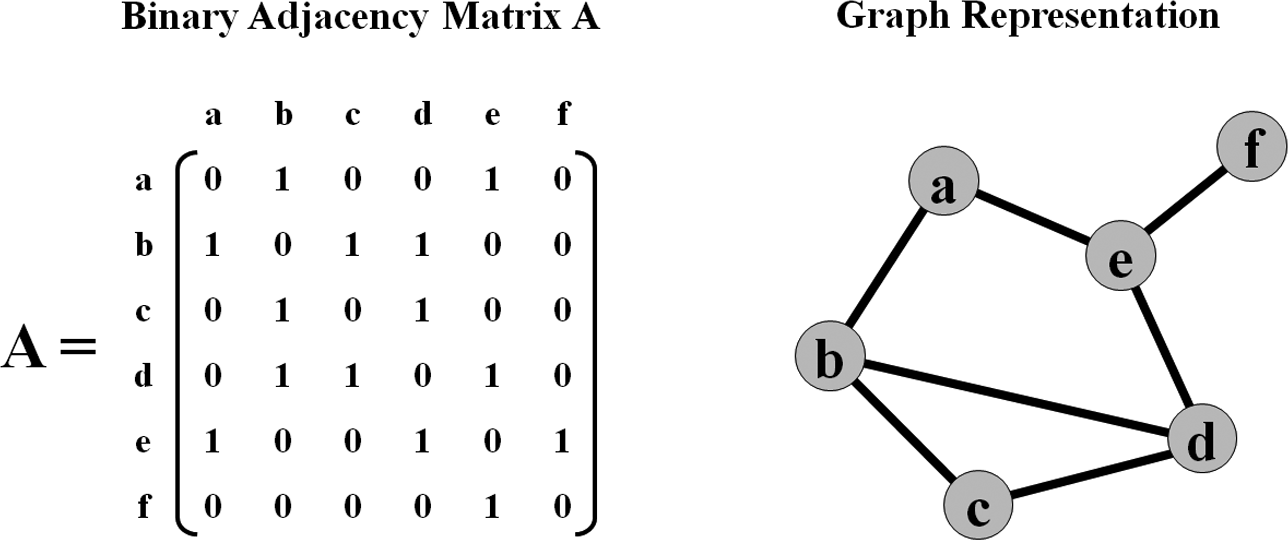
Adjacency matrices, or matrices in which both rows and columns are labeled by an ordered list of elements (nodes), represent the full set of nodes and connections for functional or structural networks (Pessoa Reference Pessoa2014). If a connection, however it is defined in application, exists between two nodes, their intersection in the matrix receives a value corresponding to whether there is a connection between the nodes (for a binary, unweighted network), the extent to which the nodes are connected (for a weighted network), or causal directionality between the nodes (for a directed network; Bullmore and Sporns Reference Bullmore and Sporns2009; Friston Reference Friston2011). Figure 1 depicts an example of a binary adjacency matrix and the corresponding graph representation (adapted from Rathkopf Reference Rathkopf2018). The adjacency matrix A has six nodes (a–f); an edge (connection) exists between nodes if the intersection in the matrix is a 1, and an edge does not exist between nodes if the intersection in the matrix is a 0.
Figure 1.

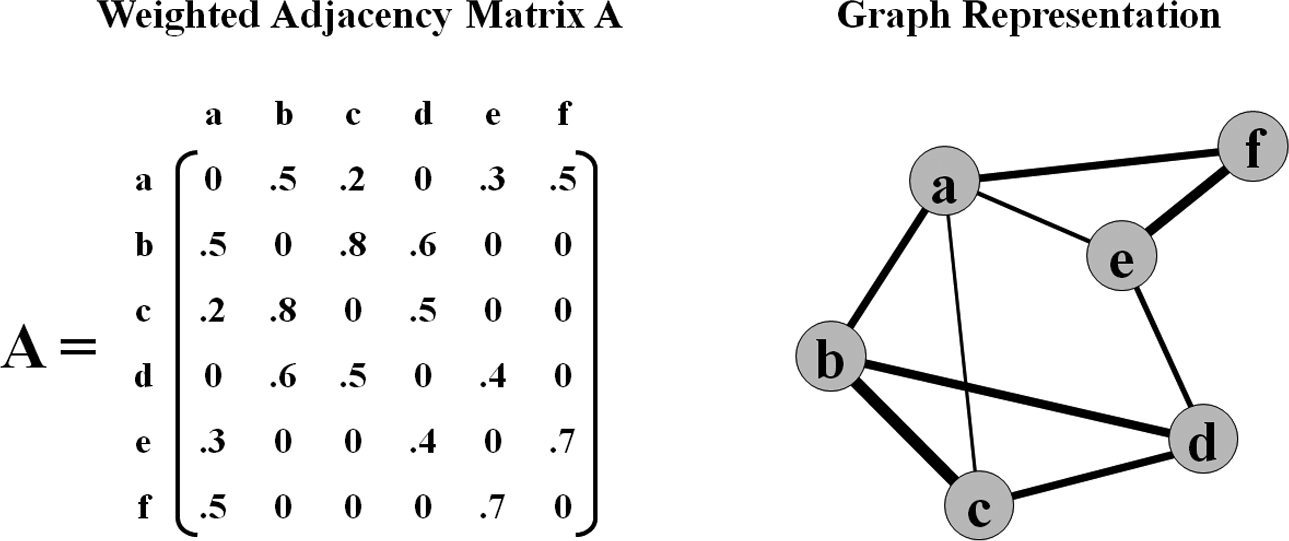
Figure 2 depicts an example of a weighted adjacency matrix and the corresponding graph representation. In figure 2, the adjacency matrix A also has six nodes (a–f); however, the strength of the connections between nodes, computed using a Pearson’s correlation, can take different values between 0 and 1, with 0 indicating no relationship and 1 indicating the strongest possible relationship. The width of the edges in the graph represents the strength of the connections. To assess how modularnet architectures change between cognitive tasks or conditions, modularitynet algorithms have been implemented on both binary and weighted functional brain networks. (See Bullmore and Sporns [Reference Bullmore and Sporns2009] for a detailed depiction of the steps implemented to create and analyze brain networks in practice.)
Figure 2.

Graph theory provides a rigorous set of tools to quantitatively describe topological properties of complex systems such as the brain (Rubinov and Sporns Reference Rubinov and Sporns2010; Rathkopf Reference Rathkopf2018). The same graph metrics can be computed on any kind of network no matter how nodes and edges are defined in practice, and networks composed of entirely different kinds of nodes and edges can possess the same topological properties. We see this with functional brain networks, as they have been constructed using diverse methods and technologies, such as fMRI (e.g., Eguíluz et al. Reference Eguíluz, Chialvo, Cecchi, Baliki and Apkarian2005; Achard and Bullmore Reference Achard and Bullmore2007; Heitger et al. Reference Heitger, Ronsse, Dhollander, Dupont, Caeyenberghs and Swinnen2012), electroencephalography (EEG; e.g., Boersma et al. Reference Boersma, Smit, de Bie, Van Baal, Boomsma, de Geus, Delemarre-van de Waal and Stam2011), and magnetoencephalography (MEG) data (e.g., Stam et al. Reference Stam, Haan, Daffertshofer, Jones, Manshanden, van Cappellen van Walsum, Montez, Verbunt, de Munck, van Dijk, Berendse and Scheltens2009). Additionally, structural brain networks have been constructed from both diffusion tensor imaging (DTI; e.g., Hagmann et al. Reference Hagmann, Cammoun, Gigandet, Meuli, Honey, Wedeen and Sporns2008; Gong et al. Reference Gong, Yong, Concha, Lebel, Gross, Evans and Beaulieu2009) and conventional MRI data (e.g., He, Chen, and Evans Reference He, Chen and Evans2007).
Comparing different kinds of functional brain networks constructed using different technologies (e.g., fMRI, MEG, or EEG) at different spatial and temporal scales may allow for a more comprehensive analytic strategy for investigating the neural substrates of cognition (Sporns Reference Sporns2011). Once a brain network has been constructed from the underlying data—regardless of how nodes and edges were explicitly defined or the technology used to collect the data (e.g., fMRI, EEG, DTI)—the same set of graph metrics can be used to elucidate many different topological properties, both local and global, of the interactions between brain areas.
This allows researchers to compare topological properties of different networks that have been constructed using different technologies. For example, brain networks derived from fMRI, DTI, and MEG data all tend to possess a small subset of network hubs (van den Heuvel and Sporns Reference van den Heuvel and Sporns2013; Maldjian, Davenport, and Whitlow Reference Maldjian, Davenport and Whitlow2014). These hubs tend to have many widespread connections in the brain, and they are critical for efficient neuronal signaling and communication across a broad range of cognitive tasks (Cole et al. Reference Cole, Reynolds, Power, Repovs, Anticevic and Braver2013). Assuming adequate computational power, graph metrics like modularitynet can be computed on networks at any spatial or temporal scale, and different kinds of information can be extracted from the topology observed at different scales.
4. Modularitynet and the Fundamental Principles of Neural Reuse
In this section, we show that the conceptual underpinnings of modularitynet in network neuroscience are consistent with the fundamental principles of neural reuse. We also show that existing empirical research employing modularitynet has provided support for them and that modularitynet and related algorithms offer tools for further testing their validity (Stanley and De Brigard Reference Stanley and Brigard2016).
Modularitynet is perfectly compatible with both fundamental principles of neural reuse. Several different modularitynet algorithms have been developed, but all modularitynet algorithms are used to identify subsets of network nodes that are more densely interconnected among themselves than they are with other nodes in the network (Newman Reference Newman2006; Sporns and Betzel Reference Sporns and Betzel2016). For instance, using the modularitynet algorithm developed by Blondel and colleagues (Reference Blondel, Guillaume, Lambiotte and Lefebvre2008) for binary, unweighted networks, the extent to which a functional brain network can be partially decomposed into nonoverlapping modulesnet is quantified by the modularitynet Q statistic. Mathematically, the value of Q assigned to a given network is ascertained as follows:

where eij is a measure of within-modulenet connections for modulenet i, ai is the total number of connections in modulenet i, and M is the total number of connections in the entire network. Modularity algorithms are designed to maximize the value of Q (Blondel et al. Reference Blondel, Guillaume, Lambiotte and Lefebvre2008). Typically, the modularitynet algorithm is run many times on a given network, and the run that produces the largest Q value is taken as the best partition. For the partition that produces the highest Q value, each node is assigned to a given modulenet in the network, and those assignments can be used to ascertain which nodes (if any) change modulenet allegiance (i.e., the module to which the node is assigned) during some new task or condition. Even though each node is assigned to a particular modulenet, all information can still be shared between modulesnet via intermodulenet connections (Telesford et al. Reference Telesford, Simpson, Burdette, Hayasaka and Laurienti2011; Sporns and Betzel Reference Sporns and Betzel2016).
Densely interconnected subsets of interacting brain regions (i.e., modulesnet) that can be detected using modularitynet algorithms are thought to be functionally cooperating to carry out certain cognitive functions (Sporns and Betzel Reference Sporns and Betzel2016; Stanley and De Brigard Reference Stanley and Brigard2016). Accordingly, modulesnet just are functionally cooperating groups of brain regions that dynamically assemble to carry out a cognitive function. The most commonly used modularitynet algorithms in functional brain network analyses provide useful information about (1) the extent to which the entire system organizes itself into specific modulesnet, (2) the spatial locations of nodes in each modulenet, (3) the extent to which the nodes within each modulenet preferentially cooperate with nodes within their own modulenet versus nodes in other modulesnet in the system, and (4) the different functional roles of specific nodes within each modulenet in the system (Valencia et al. Reference Valencia, Pastor, Fernández-Seara, Artieda, Martinerie and Chavez2009; Telesford et al. Reference Telesford, Simpson, Burdette, Hayasaka and Laurienti2011; Stanley et al. Reference Stanley, Dagenbach, Lyday, Burdette and Laurienti2014; Sporns and Betzel Reference Sporns and Betzel2016).
Modulesnet are not functionally autonomous, and individual nodes need not operate as singularly dedicated neural structures that must remain in only one modulenet across tasks (Telesford et al. Reference Telesford, Lynall, Vettel, Miller, Grafton and Bassett2016). Furthermore, given that brain networks are massively nonlinear systems, modulesnet are not separately modifiable. In functional whole-brain networks, all nodes in the network usually remain interconnected, albeit indirectly, via intermodulenet connections (Telesford et al. Reference Telesford, Simpson, Burdette, Hayasaka and Laurienti2011; Sporns and Betzel Reference Sporns and Betzel2016). Removing or adding connections in the network will likely change the entire modularnet architecture of the system. While modulesnet are not separately modifiable, autonomous, encapsulated processing units, they do still perform particular, specialized functions during certain tasks via the interactions between brain regions within each modulenet itself. As such, specific modulesnet are thought to perform specific functions, even though each modulenet remains interconnected with all other modulesnet in the system through intermodulenet connections. For example, relative to the modulesnet identified during resting state, a modulenet identified in visual cortex had a more consistent and densely interconnected structure across participants when those participants were engaged in a visual task (i.e., watching a movie clip; Moussa et al. Reference Moussa, Vechlekar, Burdette, Steen, Hugenschmidt and Laurienti2011). This modulenet, consistently identified across participants in visual cortex, was composed of many different functionally cooperating brain regions working together to allow participants to perceive incoming visual information from the environment. Similarly, in another study conducted by Stanley and colleagues (Reference Stanley, Dagenbach, Lyday, Burdette and Laurienti2014), as a working memory task became more demanding, a consistent and densely interconnected functional modulenet assembled, which included posterior parietal and lateral prefrontal regions. Presumably, the spatially distributed brain regions functionally cooperating in the assembled modulenet during the more demanding working memory task facilitate performance on the task. Thus, modulesnet can capture principle 2 of neural reuse, namely, that interactions between particular subsets of brain regions are responsible for carrying out different cognitive functions.
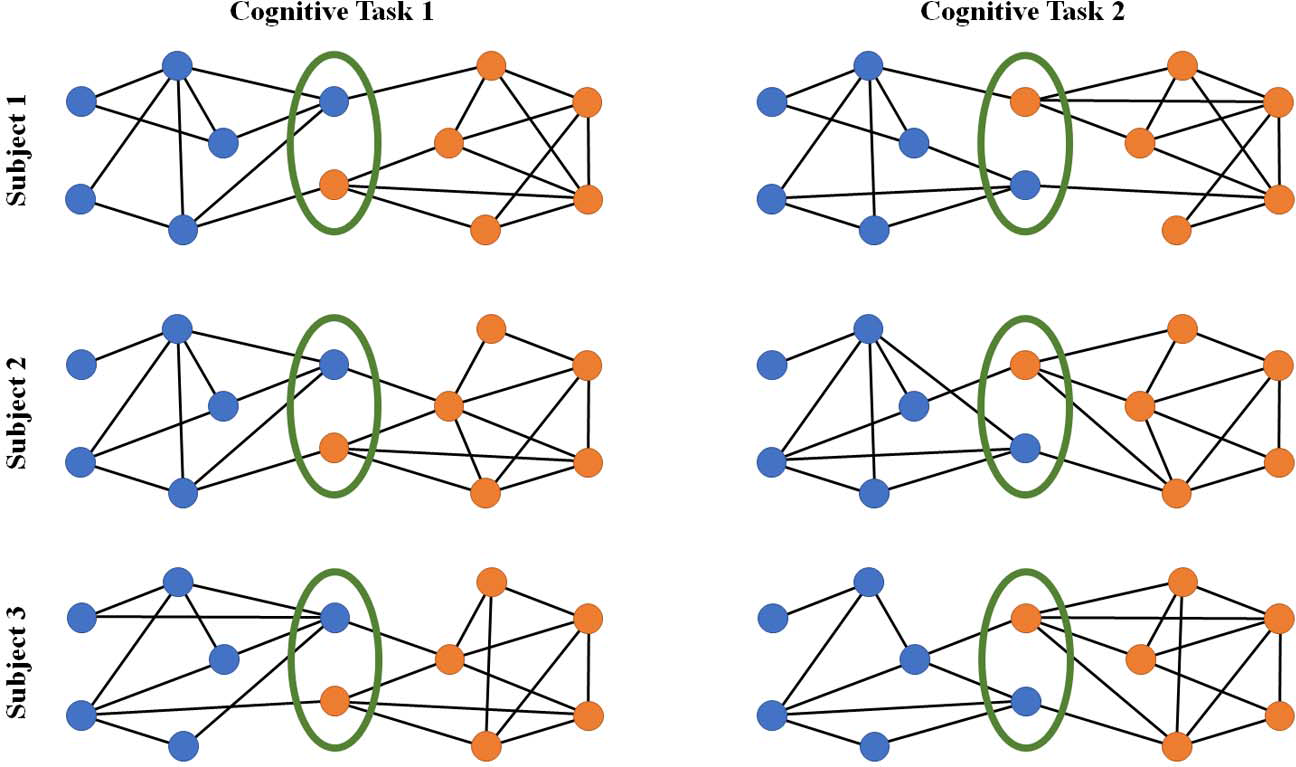
In using modularitynet algorithms to investigate neural reuse, nodes can change in modulenet allegiance between any set of tasks, if there are real differences in the neural teams that must be dynamically assembled to carry out those different tasks. If in fact nodes change their functional interactions to carry out new tasks by assembling new interconnected, functionally cooperating groups (modulesnet), it is possible to identify which nodes shifted modularnet allegiance and how they shifted. As such, one can empirically determine the extent of overlap (if any) in brain regions comprising different functionally cooperating teams carrying out two or more cognitive tasks. Figure 3 provides a conceptual example of how nodes might shift modularnet allegiance between two cognitive tasks. Graphical depictions of functional brain networks are presented for three participants in a study. While in the fMRI scanner, each participant engages in cognitive task 1 and cognitive task 2. Separate functional brain networks are constructed for when participants engage in the respective cognitive tasks. After running the modularitynet algorithm on these data, it was determined that each participant had two different modulesnet during cognitive task 1 and cognitive task 2, respectively. Node color corresponds to modulenet assignment, which is determined by running the modularitynet algorithm. Nodes (i.e., brain regions) circled in green change modularnet allegiance between the two cognitive tasks consistently across the three participants.
Figure 3.

Empirical research has shown that human functional brain networks exhibit a modularnet architecture, but that architecture is neither temporally static nor anatomically fixed. Instead, nodes do indeed alter their interactions with other nodes in the network to form new modulesnet depending on the cognitive demands on the system (Moussa et al. Reference Moussa, Vechlekar, Burdette, Steen, Hugenschmidt and Laurienti2011, Reference Moussa, Wesley, Porrino, Hayasaka, Bechara, Burdette and Laurienti2014; Cao et al. Reference Cao, Plichta, Schäfer, Haddad, Grimm, Schneider, Esslinger, Kirsch, Meyer-Lindenberg and Tost2014; Meunier et al. Reference Meunier, Fonlupt, Saive, Plailly, Ravel and Royet2014; Stanley et al. Reference Stanley, Dagenbach, Lyday, Burdette and Laurienti2014; Telesford et al. Reference Telesford, Lynall, Vettel, Miller, Grafton and Bassett2016). Thus, network nodes can and do change modularnet allegiance, or reorganize themselves to form new functionally interacting groups of brain regions, between different cognitive tasks to carry out new functions. This satisfies both fundamental principles of neural reuse: the same brain regions (i.e., nodes) can be used and reused to achieve diverse cognitive functions, and the dynamically assembled, functionally cooperating groups of nodes are responsible for carrying out the cognitive function.
For more complex cognitive tasks, it is even possible that multiple different modulesnet will themselves need to interact more extensively to carry out the cognitive function. For example, during a motor skill learning task, occipital regions might consistently form one functional modulenet while sensorimotor regions form another modulenet (Bassett et al. Reference Bassett, Muzhi, Wymbs and Grafton2015). Although nodes within these respective modulesnet may not change modularnet allegiance over time, the number and strength of connections between these two modulesnet may increase or decrease over time as a function of learning (Bassett et al. Reference Bassett, Muzhi, Wymbs and Grafton2015). Similarly, premotor regions may remain in one modulenet with other sensorimotor regions across different cognitive conditions, but these premotor regions may still interact more extensively with medial temporal lobe regions like the hippocampus, which belongs to a separate modulenet, in order for individuals to make motor responses after correctly retrieving certain items from memory (Geib et al. Reference Geib, Stanley, Dennis, Woldorff and Cabeza2017). So, even if a node does not change modularnet allegiance between two or more tasks, entire modulesnet might become more strongly connected to each other in order to carry out the cognitive function. Just as it is possible for neural teams to functionally organize into one modulenet to carry out simple tasks, multiple modulesnet carrying out different subfunctions may need to more extensively interact to carry out more complex, cognitively demanding tasks. Accordingly, modularitynet can be used to investigate the extent to which node assignment to modulesnet changes to subserve different cognitive functions. But modularitynet can also be used to investigate the extent to which the strength or number of connections within or between modulesnet changes, even when node assignments to modulesnet remain the same. In other words, modularitynet can characterize just how radical functional reorganization is across different tasks or conditions.
Because modularitynet algorithms are data driven, the quantity of nodes forming any given modulenet, the spatial locations of nodes within any given modulenet, the consistency of modularnet organization across a set of persons, and the extent of interconnectedness of nodes comprising each modulenet are determined by the nature of the functional brain network and not the experimenter (Newman Reference Newman2006). Furthermore, modularitynet algorithms are designed to admit the possibility that there are no clear, distinct modulesnet in the network. Consequently, modularitynet serves both as a validation of neural reuse between different tasks and as a way to identify those functionally cooperating subsets of brain regions carrying out any task of interest. Modularitynet makes no a priori assumptions about the selectivity of local neural structures for specific tasks. Instead, modularitynet algorithms are entirely data driven. If local neural structures are not selective and typically contribute to many diverse tasks, then modularitynet will show how neural structures (nodes) change modularnet allegiances by reorganizing their connections for any set of tasks. If local neural structures are highly selective for certain functions, however, then modularitynet algorithms will reveal that neural structures rarely change modularnet allegiance by reorganizing their connections across different tasks. As more empirical research is published using modularitynet and related algorithms, we will get a fuller picture of how and the extent to which each brain region alters its functional connections to achieve different cognitive functions.
There are at least two available quantitative methods for identifying the extent to which brain regions change modularnet allegiance across different task conditions. These methods allow researchers to both test the validity of the fundamental principles of neural reuse and engage in a research program operating under the principles of neural reuse. That is, these methods allow researchers to investigate how functionally cooperating sets of brain regions assemble and disassemble across specific tasks and conditions and in different populations. One is the measure of scaled inclusivity (SI; Steen et al. Reference Steen, Hayasaka, Joyce and Laurienti2011), which quantifies the extent to which particular nodes and modulesnet vary across different networks (within or between subjects) using set theory. SI is capable of computing how consistently each individual network node is classified in the same modulenet across networks of interest. SI is calculated by identifying the overlap of modulesnet across multiple networks in a standardized space while penalizing for the disjunction of modules. For instance, suppose node V is part of modulenet A in participant i and modulenet B in participant j. Then, SI for node V is calculated as

where S A and S B denote sets of nodes in modulesnet A and B, and |·| denotes the cardinality of the set. SI images represent the similarity in location and size of functional network modulesnet across a set of participant networks (Steen et al. Reference Steen, Hayasaka, Joyce and Laurienti2011; Moussa et al. Reference Moussa, Steen, Laurienti and Hayasaka2012; Stanley et al. Reference Stanley, Dagenbach, Lyday, Burdette and Laurienti2014). Higher values of SI for a given network node indicate that the node is more frequently located within the same modulenet across participants, while lower values of SI indicate that the node is more frequently located within different modules.
Using SI, Stanley et al. (Reference Stanley, Dagenbach, Lyday, Burdette and Laurienti2014) showed that the nodes within the modulenet composed primarily of default-mode brain regions maintained a highly consistent, densely interconnected, functionally cooperating modulenet during a minimally demanding working memory task (i.e., the 1-back task). Because the 1-back task is so minimally demanding, participants can still perform the task while letting their minds wander to other matters. Therefore, it is not surprising that Stanley et al. (Reference Stanley, Dagenbach, Lyday, Burdette and Laurienti2014) identified a highly consistent modulenet encompassing default-mode regions during the 1-back task, just as they likely would during resting state. However, when more attentional and working memory resources were required to perform the task (i.e., when the participants changed tasks to engage in the 2-back task), the previously observed default-mode modulenet disassembled. During this different, more difficult working memory task, a different set of brain regions that included lateral prefrontal and parietal regions became densely interconnected, forming a new, consistent modulenet across persons. While Stanley et al. (Reference Stanley, Dagenbach, Lyday, Burdette and Laurienti2014) used SI to compute the consistency of modularnet organization across participants for these two different working memory tasks (i.e., a 1-back task and a 2-back task), SI can also be computed on a nodal level to quantify the extent to which each network node changes modularnet allegiance across diverse cognitive tasks for an individual person or a group of people.
The second, compatible approach for identifying the extent to which brain regions change modularnet allegiance across different task conditions comes from recent developments in multilayer networks (Muldoon and Bassett Reference Muldoon and Bassett2016). Mucha and colleagues (Reference Mucha, Richardson, Macon, Porter and Onnela2010) originally developed a unique variant of the modularitynet algorithm that identifies how likely a given node is to remain within a modulenet over time or across multiple realizations of the network. In this way, each layer in a multilayer network constitutes a different unique network; a given layer might be constructed, for example, of a different subject, patient group, experimental condition, cognitive task, or time point (Muldoon and Bassett Reference Muldoon and Bassett2016). A node can exist in all layers or in a subset of layers and is linked throughout the layers by an edge representing the node’s identity. Using multilayer networks, Bassett et al. (Reference Bassett, Muzhi, Wymbs and Grafton2015) examined changes in the modularnet architecture of functional brain networks during several stages of learning in a simple sequence-production task. Their results show that two distinct motor and visual modulesnet were consistently identified across naive, early, middle, and late learning. However, the nodes comprising these two respective modulesnet became more preferentially interconnected with nodes in their own modulesnet (and therefore less connected with nodes in the other modulenet) with task practice. These results suggest that the motor and visual modulesnet become more autonomous as the behavior becomes more automatic. Relatedly, Braun et al. (Reference Braun, Schafer, Walter, Erk, Romanczuk-Seiferth, Haddad, Schweiger, Grimm, Heinz, Tost, Meyer-Lindenberg and Bassett2015) showed that nodes in the modulenet comprising prefrontal brain regions changed modulenet allegiance as cognitive load increased on a standard working memory task. However, nodes in modulesnet comprising occipital and somatomotor regions did not change modulenet allegiance in the same way.
For the purposes of investigating neural reuse, a given layer might represent the network for a single cognitive task for a single person or a group of subjects. A probability matrix would then be constructed wherein each element in the matrix quantitatively represents the probability that those two nodes are assigned to the same network modulenet across the set of networks. Although Bassett et al. (Reference Bassett, Muzhi, Wymbs and Grafton2015) and Braun et al. (Reference Braun, Schafer, Walter, Erk, Romanczuk-Seiferth, Haddad, Schweiger, Grimm, Heinz, Tost, Meyer-Lindenberg and Bassett2015) originally characterized modularnet allegiances as a function of a change in behavior within a particular cognitive domain (i.e., learning and working memory, respectively), more recent work has used multilayer networks to investigate how nodes alter their modularnet allegiances across different cognitive tasks (Telesford et al. Reference Telesford, Lynall, Vettel, Miller, Grafton and Bassett2016). Specifically, Telesford et al. (Reference Telesford, Lynall, Vettel, Miller, Grafton and Bassett2016) showed that across three distinct cognitive tasks, the pericalcarine cortex, lingual gyrus, and lateral occipital cortex did not change modularnet allegiance, while the pallidum and parahippocampal gyrus did. This approach allows for the identification of the particular neural teams engaged for each cognitive task in each domain and for the characterization of how those neural teams reorganize across different tasks within and between domains. In the future, this technique may also help to understand how modularnet allegiances change as a function of development as well as healthy and pathological aging (Sporns Reference Sporns2011; De Brigard Reference De Brigard2017).
In sum, modulesnet in network neuroscience are conceptualized as subsets of brain regions that tend to be more functionally interconnected among themselves than with other brain regions. Modularitynet algorithms can be used to identify which brain regions tend to interact among each other so that we can engage in a given cognitive task, and several methods have recently been developed to characterize the ways in which nodes (i.e., brain regions) change modularnet allegiance between different kinds of cognitive tasks. Thus, it is possible to use these algorithms to rigorously characterize the extent to which different brain regions are used and reused for diverse purposes in various task domains and ways in which functional differences between task domains are reflected in the different patterns of interactions between many of the same elements forming the right neural team to carry out some cognitive task. In this way, modularitynet is perfectly compatible with the fundamental principles of neural reuse.
5. Evidential Concerns with Neural Reuse and Resolutions with Network Modularity
We have argued that modularitynet is consistent with the two fundamental principles of neural reuse, and that modularitynet (along with SI or multilayer network methods) can be used to support and to investigate neural reuse. In this section, we argue that much of the empirical evidence Anderson (Reference Anderson2015) offers to support neural reuse only minimally informs the fundamental principles of the framework, and the meta-analytic methods he employs do not allow researchers to fully engage in the research program. We suggest that existing research using modularitynet provides better evidence for the two fundamental principles of neural reuse and that using modularitynet allows researchers to more fully develop the research program moving forward.
Neural reuse holds that when one is considering the neural underpinnings of cognition, greater weight is placed on the functional relations and interactions between neural structures than on the actions of individual regions (Anderson Reference Anderson2015, Reference Anderson2016). As Anderson (Reference Anderson2015, 40) puts it, “in the brain, function depends much more on interactions between parts than on the actions of parts.” The prominence of interactions in the neural reuse framework is readily apparent in the Interaction Principle (principle 2), according to which functional differences between task domains are critically reflected in the different patterns of interactions between many of the same elements forming the right neural team for a job. Patterns of interactions between particular brain regions are responsible for cognitive functioning.
Most of the evidence that Anderson and colleagues have put forth for neural reuse, however, is derived from large sets of existing work employing univariate activation analyses. These kinds of analyses are meant to isolate the function(s) of individual brain regions by statistically assessing whether there is a change in blood-oxygen-level-dependent signals (activity) between cognitive tasks or conditions of interest (Hardcastle and Stewart Reference Hardcastle and Stewart2002). Importantly, univariate activation analyses do not provide explicit information about functional interactions between brain regions during a particular cognitive task. A brain region need not exhibit a difference in gross activation between conditions of interest in order for that region to play a pivotal role in the functional brain network to carry out the cognitive function (Geib et al. Reference Geib, Stanley, Wing, Laurienti and Cabeza2015, Reference Geib, Stanley, Dennis, Woldorff and Cabeza2017). For example, Geib et al. (Reference Geib, Stanley, Wing, Laurienti and Cabeza2015) showed that to facilitate the retrieval of vivid visual images from memory, the hippocampus drastically reorganized its set of functional connections to bring about greater communication efficiency with the network and to become a more convergent structure for information. This was the case even though there was no difference in univariate activation for the hippocampus between the conditions of interest. Similarly, Geib et al. (Reference Geib, Stanley, Dennis, Woldorff and Cabeza2017) showed that successfully remembering compared to forgetting concrete words was associated with significant changes in the connectivity profile of the hippocampus and in its set of intermodulenet connections. As in Geib et al. (Reference Geib, Stanley, Wing, Laurienti and Cabeza2015), this was the case even though there was no difference in univariate activation for the hippocampus between the conditions of interest. In these two examples, although no change was detected in gross hippocampal activation between conditions, the functional connections between the hippocampus and many other brain regions changed dramatically to facilitate remembering. Thus, univariate activation analyses can at most lend support to the Multifunction Principle (principle 1) but not the Interaction Principle (principle 2).
Turning to the meta-analyses, Anderson and Pessoa (Reference Anderson and Pessoa2011) examined the selectivity of 78 standard anatomical regions of the brain by determining whether and how often each was active across 1,138 experimental tasks in 11 different categories, including action execution, action observation, action inhibition, attention, audition, vision, emotion, language semantics, reason, semantic memory, and working memory. They computed how often neural activations fell into each of the task categories using a formula called diversity variability (DV). DV is based on a modified standard deviation:

where Cati refers to the proportion of activations, “mean” is the average proportion of activations, and k is the total number of categories (i.e., 11 in this case). They found that the regions examined were active in an average of 95 tasks spread across nine different cognitive domains, suggesting that the same regions are active across many diverse tasks and cognitive domains. Similarly, using functional fingerprinting, Anderson et al. (Reference Anderson, Kinnison and Pessoa2013) quantified the diversity of tasks under which different brain regions show activations by determining how often each region was active in about 2,000 different experimental tasks. They also found that the same brain regions were active across diverse tasks and cognitive domains, which corroborated earlier work.
The problem with approaches using DV and functional fingerprinting is that the meta-analytic conclusions put forth by Anderson and colleagues are based on prior univariate activation analyses; thus, they can only provide information about which localized, discrete brain regions tend to differ in gross activation between different task conditions. That is, they do not explicitly provide information about how different brain regions interact or cooperate to carry out these different tasks. For it is possible that two or more brain regions are more active in general during task X compared with task Y while not actually being functionally connected during task X or task Y. The interactions, or connections, between regions are the key to neural reuse, but research with more traditional univariate methods is ill suited to provide direct support for the existence or properties of these patterns of interactions. Furthermore, if one were to design a new study assuming that the fundamental principles of neural reuse are true, then these meta-analytic methods would provide no information about how certain brain regions functionally cooperate during that specific task of interest to carry out the cognitive function. Consequently, the meta-analytic methods employed by Anderson and colleagues to support neural reuse provide little to no information about the way in which specific regions change and functionally reorganize across a set of specific tasks.
In contrast, modularitynet is computed by detecting certain patterns in the interactions between all brain regions comprising the network. That is, modularitynet takes into account all interactions between each and every brain region and subsequently identifies the subsets of brain regions that tend to be more densely interconnected (i.e., interacting more strongly) among themselves than the rest of the network. The functional groupings of highly interconnected brain regions observed during task A that appear consistently across subjects are thought to actually carry out the cognitive function associated with task A. While meta-analytic activation methods advocated by Anderson and colleagues do not provide explicit information about patterns of interactions between brain regions, modularitynet is capable of identifying interacting brain regions that functionally cooperate to carry out a cognitive task. Modularitynet can be computed on the brain networks of individual persons performing a single cognitive task or brain networks averaged across a set of participants performing a single cognitive task. Thus, modularitynet allows researchers to investigate functional cooperation during a cognitive task in a single subject or a cognitive task across a group of subjects.
Although most of Anderson’s evidence for neural reuse comes from meta-analyses of localized, isolated activations, Anderson and Penner-Wilger (Reference Anderson and Penner-Wilger2013) did perform a meta-analysis of functional connectivity data based on results from 1,127 experimental tasks falling into 10 different task domains. This analysis allowed them to identify which regions were most often functionally connected within each task domain. Their results do suggest that brain regions rarely share the same functional partners across different task domains. That is, functional connections do change between different task domains. While this approach is certainly a step in the right direction, it still suffers from several serious limitations.
First, the fact that anatomical networks are relatively sparse—and therefore limit the possible direct functional interactions in a brain network—underscores the importance of indirect connections in functional brain networks. In their functional connectivity meta-analysis, Anderson and Penner-Wilger (Reference Anderson and Penner-Wilger2013) only characterize the presence of bivariate, direct functional connections emanating from a brain region of interest. While direct connections indicate the immediate functional partners of brain regions, two brain regions might only be indirectly connected through a third brain region (Paolini et al. Reference Paolini, Laurienti, Norris and Rajeski2014). It is not possible for just any brain region to directly, functionally interact with any other brain region. There are physical limits on the possible set of direct functional connections that could exist in the network. In a seminal study, Felleman and Van Essen (Reference Felleman and Van Essen1991) compiled an anatomical connectivity matrix from the prior tract-tracing literature that summarized 305 axonal connections between 32 areas of the visual cortex in the macaque monkey (Felleman and Van Essen Reference Felleman and Van Essen1991). Most connections were shown to be reciprocal, and the overall connection density was sparse. Using noninvasive imaging technologies, recent research has shown that whole-brain white-matter networks in humans are similarly sparse (Sporns Reference Sporns2011; Bullmore and Sporns Reference Bullmore and Sporns2012; Wang et al. Reference Wang, Dai, Gong, Zhou and He2014). Brains are efficient, economical structures organized to minimize wiring costs while supporting high dynamic complexity (Bassett and Bullmore Reference Bassett and Bullmore2006; Sporns Reference Sporns2011). Diverse, spatially disparate brain regions may functionally cooperate to carry out some task, but that cooperation may depend on indirect connections through other nodes in the network. Functionally cooperating brain regions carrying out some function may require information to be transferred from brain region A to brain region C but only after that information is partially processed or transformed at brain region B (Sporns Reference Sporns2011; Stanley et al. Reference Stanley, Moussa, Paolini, Lyday, Burdette and Laurienti2013).
For example, consider an episodic encoding task for complex visual stimuli. As an individual views a scene, information travels from (1) the retina to (2) the lateral geniculate nucleus of the thalamus to (3) early striate cortex to (4) higher-order visual regions, and eventually to (5) the medial temporal lobe structures like the hippocampus. In this example, early striate cortex and the hippocampus might end up in the same modulenet, even though they are not directly connected to one another via an individual anatomical pathway. Spatially disparate brain regions like early striate cortex and the hippocampus can functionally cooperate to carry out the episodic encoding task even though they are not directly anatomically connected. To account for this, it is necessary to consider indirect connections that go through higher-order visual-processing regions in occipital, temporal, and parietal cortices. Regardless of whether the possible set of functional connections in a network is constrained by the underlying anatomical structure, modularitynet algorithms do not require that all nodes comprising a single modulenet are directly functionally connected. Modularitynet only requires that the set of nodes in each modulenet are generally more functionally interconnected among themselves than they are with nodes in other modulesnet in the network. Thus, modularitynet can readily account for indirect connections in establishing functionally cooperating groups carrying out different cognitive tasks.
Additionally, brain network analyses permit researchers to constrain the set of possible functional connections by the underlying anatomy for an individual person (Honey et al. Reference Honey, Kötter, Breakspear and Sporns2007; Honey, Thivierge, and Sporns Reference Honey, Thivierge and Sporns2010). A researcher might stipulate that a functional connection can only exist between any two brain regions if, say, at least one white matter tract connects those two regions. Modularitynet can then be computed on the anatomically constrained functional networks to investigate the neural substrates of cognitive functions (Honey et al. Reference Honey, Thivierge and Sporns2010). This approach should allow for a more biologically accurate characterization of modularnet architectures in functional brain networks. This approach also allows researchers to constrain the set of possible functional connections within individual subjects, further allowing the researcher to take into account the interindividual variability in the set of white matter connections in the brain. Notably, the functional connectivity meta-analyses performed by Anderson and colleagues do not account for whether there are underlying structural connections between regions. As such, it is possible that some of the direct functional connections identified by Anderson and colleagues are spurious, if there is no underlying structural connection between the regions. At best, those regions not connected by underlying structure might be indirectly connected in the larger network. Given current meta-analytic methods using prior functional connectivity analyses, such as those implemented by Anderson and Penner-Wilger (Reference Anderson and Penner-Wilger2013), it is not possible to constrain the identified functional connections by the underlying structure for individual persons to ensure that identified functional connections are not spurious.
The second limitation to the meta-analytic approach taken by Anderson and Penner-Wilger (Reference Anderson and Penner-Wilger2013) is that it is not possible to directly investigate whether individual differences in functional connectivity patterns are associated with behavioral performance on a given task. Anderson’s meta-analyses are conducted by collapsing across large sets of localized activations or coactivations from many different studies to identify consistencies in activation or coactivation within and between task domains. Recent research has indicated that individual differences in functional connectivity patterns and in modularitynet are closely related to behavioral performance on a variety of different tasks. For example, the presence of certain modularnet architectures during tasks are related to differences in working memory performance (Stanley et al. Reference Stanley, Dagenbach, Lyday, Burdette and Laurienti2014; Braun et al. Reference Braun, Schafer, Walter, Erk, Romanczuk-Seiferth, Haddad, Schweiger, Grimm, Heinz, Tost, Meyer-Lindenberg and Bassett2015), episodic memory retrieval performance (Meunier et al. Reference Meunier, Fonlupt, Saive, Plailly, Ravel and Royet2014; Geib et al. Reference Geib, Stanley, Dennis, Woldorff and Cabeza2017), and successful decision making (Moussa et al. Reference Moussa, Wesley, Porrino, Hayasaka, Bechara, Burdette and Laurienti2014). These studies have provided valuable information about the extent to which certain modularnet properties allow individuals to better perform these different cognitive tasks.
The third limitation is that these meta-analytic approaches cannot elucidate how functionally cooperating brain regions dynamically assemble and disassemble as individuals are repeatedly exposed to the same kinds of information or gradually learn complex behaviors. Our cognitive capacities and abilities change constantly over time. With repeated exposure or practice, we acquire the requisite expertise such that we do not need to engage in extensive searches or complex, elaborate analyses. Certainly, there are differences in the underlying functional brain activations and connections between novices and experts on diverse tasks (Patel, Spreng, and Turner Reference Patel, Spreng and Turner2013). Complex network analyses of neuroimaging data have provided new insights into adaptive neural processes, the attainment of knowledge, and the acquisition of new skills (Bassett and Mattar Reference Bassett and Mattar2017). For example, Bassett et al. (Reference Bassett, Wymbs, Porter, Mucha, Carlson and Grafton2011) investigated dynamic changes in modularitynet during a motor skill learning task. Their results indicate that as individuals learn the motor skill, changes in the allegiances of nodes to modulesnet predict the relative amount of learning in a later session. Diverse brain regions perform different roles within modulesnet during the course of motor skill acquisition, with some brain regions maintaining the same modularnet allegiance throughout the experiment and others exhibiting shifts in modularnet allegiance (Basset et al. Reference Bassett, Wymbs, Porter, Mucha, Carlson and Grafton2011, Reference Bassett, Muzhi, Wymbs and Grafton2015).
A fourth problem is that proponents of neural reuse argue that functional interactions between brain regions are responsible for carrying out cognitive functions instead of more segregated, specialized neural structures (Anderson Reference Anderson2015). Anderson and colleagues are right to place renewed emphasis on the importance of dynamic functional interactions in carrying out cognitive functions. Network neuroscience welcomes this renewed emphasis on the importance of functional interactions while still preserving a biologically realistic conception of functional specialization (or segregated functioning). Operating within network neuroscience, it is not necessary to build a general framework for the neural underpinnings of cognitive functioning by emphasizing the predominance of integration at the expense of segregation or vice versa. By conceptualizing the brain as a complex network and using graph metrics like modularitynet, researchers can investigate the roles of both segregated and integrative functioning within the system to carry out cognitive functions. Certain subsets of brain regions might functionally cooperate to carry out some more segregated, specialized function (i.e., modulenet 1), and other brains might functionally cooperate to carry out some other segregated, specialized function (i.e., modulenet 2). Through intermodulenet interactions, it is possible to examine more global integrative properties in the network—or the ways in which brain regions carrying out more specialized functions work together—for carrying out the task. Researchers can then empirically characterize the respective roles of segregated and integrative processes, both of which are likely important (at least to some extent) for carrying out most cognitive functions (Bullmore and Sporns Reference Bullmore and Sporns2009; Sporns Reference Sporns2011). Specific modulesnet are thought to perform specific functions, even though each modulenet remains integrated with all other modulesnet in the system via a complex set of intermodulenet connections. Segregated, specialized processing is achieved through strong interconnections within modulesnet for some purpose. If one grants that achieving a task is really about putting together the right “neural team” (i.e., modulenet), then that modulenet is engaged in specialized processing for that specific task. With modularitynet, it is possible to retain a conception of functional specialization without assuming that it is instantiated in localized, encapsulated neural structures that carry out specific cognitive tasks. Thus understood, modularitynet safeguards a conception of specialized, segregated functioning that has been useful and informative in cognitive neuroscience research.
In sum, we have argued that the meta-analytic methods employed by Anderson and colleagues as their primary source of evidence for neural reuse can at most support the Multifunction Principle (principle 1) but not the Interaction Principle (principle 2). Furthermore, these meta-analytic methods cannot help researchers investigate how certain brain regions change their functionally cooperating groups to carry out different cognitive functions or to facilitate improvement on one particular cognitive task. Modularitynet can, however, provide validation and support for both principles of neural reuse, and its implementation will allow researchers to more fully engage in the neural reuse research program going forward.
6. Conclusion
Neural reuse holds tremendous promise as a framework with which to understand and investigate the neural bases of cognitive processes. We have argued that recent developments in network neuroscience offer a unique conceptualization of modularity—modularitynet—that is consistent with the fundamental principles of neural reuse. While we believe that the extant evidence offered in support of neural reuse does not support its fundamental principles, empirical research using modularitynet clearly does. In addition, we have argued that these modularitynet algorithms and related metrics provide the requisite tools for engaging in the research program, especially for researchers reluctant to relinquish the idea that the brain does exhibit specialized functioning to carry out cognitive functions. Specific subsets of brain regions functionally cooperate in reliable and consistent ways (i.e., form a modulenet or multiple modulesnet) during a particular task in order to help carry it out. In this way, there is still a relatively stable neural basis for specific cognitive functions that are identified with modularitynet algorithms.
Modularitynet and related algorithms have the potential to revolutionize the way we think about the neural underpinnings of cognitive functions. These methods allow researchers to engage in a new research program that offers clear advantages over more traditional methods focused on localizing cognitive functions to specific neural structures. Meaningful progress will be made as researchers continue (1) to characterize how modularnet architecture changes across a larger set of cognitive tasks and (2) to identify the unique properties of nodes and edges that influence the likelihood of a node changing modularnet allegiance. Technological improvements in brain imaging and recording continue to provide new and more precise methods for measuring the brain’s anatomical (structural) and dynamic (functional) connections (Sporns Reference Sporns2011; Wang et al. Reference Wang, Dai, Gong, Zhou and He2014). These improvements will help researchers to constrain functional connectivity by the underlying neuroanatomy, thereby providing a more biologically realistic picture of how modulesnet assemble and disassemble across different tasks and conditions. They will also help researchers to understand how the process of assembling and dissembling modulesnet occurs across finer temporal resolutions.
Increasingly complex data in the social, technological, and biological sciences continue to engender the development of new tools and methods for representing and analyzing networks. With this rapid growth across different fields, new methods and tools will become available to provide researchers with new insights into how neural reuse works across diverse cognitive tasks. This will, in turn, enable researchers to build new models and theories about the neural substrates of cognitive functioning. These models and theories will be consistent with the fundamental principles of neural reuse, and they will be much more likely to reflect how the brain actually subserves diverse cognitive functions.