Implications
Daidzein is a major isoflavonic phytoestrogen that has a variety of biological functions (Cassidy, Reference Cassidy2003; Hwang et al., Reference Hwang, Kwak, Lim, Lee, Kang, Choe, Hur and Han2006). Our previous study showed that broiler breeders receiving 10 p.p.m. daidzein in diets significantly improved the water-holding capacity of breast muscle at market weight in offspring broilers (Ni et al., Reference Ni, Hong, Ren, Hu, Dai, Rao, Chen and Zhao2007). It is well known that daidzein can be biologically transformed to equol (Eq) by bacteria in the intestine and that this possesses more biological activities (Minamida et al., Reference Minamida, Tanaka, Abe, Sone, Tomita, Hara and Asano2006; Matthies et al., Reference Matthies, Clavel, Gütschow, Engst, Haller, Blaut and Braune2008). Eq exists in hens’ blood and accumulates dominantly in egg yolk (Saitoh et al., Reference Saitoh, Sato, Harada and Takita2001). Therefore, the aim of this study was to investigate whether the metabolite of daidzein, Eq directly injected in ovo, would be beneficial for improving the meat quality of broilers.
Introduction
Daidzein is one of the phytoestrogens existing widely in natural plants, particularly in soybeans and other legumes (Price and Fenwick, Reference Price and Fenwick1985). The molecular structure of daidzein is similar to endogenous estrogen, and the bioactivity is about 10−3 to 10−5 times as much as that of 17 β-estradiol (Holm et al., Reference Holm, Blomqvist, Brandt, Brunström, Ridderstråle and Berg2006). On the basis of the structural similarity to endogenous estrogens, isoflavones may bind to estrogen receptors and display agonistic or antagonistic effects (Cassidy, Reference Cassidy2003; Holm et al., Reference Holm, Blomqvist, Brandt, Brunström, Ridderstråle and Berg2006; Hwang et al., Reference Hwang, Kwak, Lim, Lee, Kang, Choe, Hur and Han2006). Besides hormone-dependent effects, isoflavones also show hormone-independent activities, such as antioxidative properties (Cos et al., Reference Cos, De Bruyne, Apers, Vanden Berghe, Pieters and Vlietinck2003; Jackman et al., Reference Jackman, Woodman, Chrissobolis and Sobey2007a). Improved antioxidative status in the living animal is considered to be beneficial for the consumers and the processing industry. Soybean isoflavones are potential additives that improve meat quality due to the antioxidant activity (Jiang et al., Reference Jiang, Jiang, Lin, Xi, Yu and Wu2007). Previous studies have shown that, as one of the two major isoflavones, daidzein supplemented into a basal diet has effects on animal growth, body composition and meat quality (Payne et al., Reference Payne, Bidner, Southern and Geaghan2001a and Reference Payne, Bidner, Southern and Mcmillin2001b).
With respect to the long-term effects of daidzein, there are few results of the positive effects on fetal and postnatal growth and development after pure daidzein supplementation in sows (Ren et al., Reference Ren, Kuhn, Wegner, Nürnberg, Chen and Ender2001). In birds, our previous study showed that during the post-peak but not the pre-peak laying stage, the supplementation of the broiler breeder diet with 10 mg/kg pure daidzein did not affect the market weight of the offspring on day 63 of age, while the meat quality was significantly improved by daidzein treatment (Ni et al., Reference Ni, Hong, Ren, Hu, Dai, Rao, Chen and Zhao2007). The above results indicate the positive maternal effect of daidzein on meat quality of the offspring. Nevertheless, the mediated signal underlying the long-term effect of daidzein on meat quality has not been elucidated.
Isoflavones ingested as feeds are believed to be biologically transformed to their metabolites and sometimes accumulated in animals. Biotransformation is an important factor in regulating the biological activity of dietary isoflavones (Matthies et al., Reference Matthies, Clavel, Gütschow, Engst, Haller, Blaut and Braune2008). Indeed, it is well documented that daidzein can be converted to equol (Eq) or o-desmethylangolensin (O-DMA) by enzymes of bacteria in the intestine (Minamida et al., Reference Minamida, Tanaka, Abe, Sone, Tomita, Hara and Asano2006). Eq was first isolated from pregnant mares’ urine in 1932 and was subsequently identified in human urine and in the plasma of sheep derived from daidzein (Marrian and Haslewood, Reference Marrian and Haslewood1932; Axelson et al., Reference Axelson, Kirk, Farrant, Cooley, Lawson and Setchell1982). As a metabolite of daidzein, Eq was found to exist in hens’ blood and to accumulate dominantly in egg yolk (Saitoh et al., Reference Saitoh, Sato, Harada and Takita2001). In vitro studies suggest that Eq and O-DMA are more biologically active than their precursor, daidzein (e.g. they bind to estrogen receptors with greater affinity; Atkinson et al., Reference Atkinson, Frankenfeld and Lampe2005). These observations let us speculate that dietary daidzein may improve meat quality through the metabolite product, Eq. Therefore, this study was aimed at investigating whether Eq directly injected into fertile eggs affects the growth and meat quality of broilers. The antioxidative or oxidative status was detected to reveal the relationship between the changes of meat quality and antioxidative capacity of Eq, using the common indices of the activities of superoxide dismutase (SOD), glutathione peroxidase (GSHPx) and the content of malondialdehyde (MDA) in plasma and muscle.
Material and methods
Animals
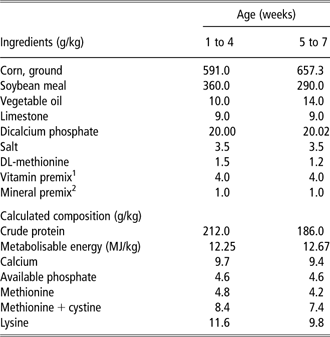
Four hundred and thirty-eight broiler fertile eggs (Sanhuang D, a local crossbred broiler breed) were obtained from a commercial hatchery and incubated following the standard procedure. At 7 days of embryonic age, the small tips of the eggs were disinfected and drilled by frog pins, and randomly allotted to three groups (146 fertile eggs per group): 20 μg (low dose, L) and 100 μg (high dose, H) Eq dissolved in a 100 μl mixture of white mineral oil and ethanol, and 100 μl mixture of white mineral oil and ethanol without Eq (control, Con), respectively, were injected into the albumen of fertile eggs. After hatching, broilers were raised under the same standard conditions with free access to water and fed till 49 days of age (diet nutrition is shown in Table 1). Prophylactic vaccination was carried out routinely and body weight (BW) was recorded weekly. At 49 days of age, birds were deprived of feed for 12 h and weighed just before slaughter, 20 broilers were taken randomly from each group and slaughtered by cervical dislocation for carcass and meat analysis. Plasma, liver, breast muscle and gastrocnemius muscle were collected and snap-frozen in liquid nitrogen. Frozen tissues were stored at −70°C before analysis.
Nutritional composition of the basal diet
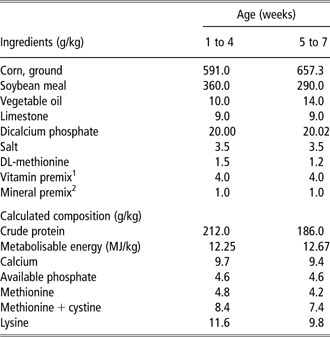
1Vitamin premix for broilers provided per kilogram of diet: Vitamin A, 8000 IU; Vitamin D3, 1500 ICU; Vitamin E, 11 mg, Vitamin K3, 1.5 mg; thiamin, 1.1 mg; riboflavin, 6.6 mg; niacin, 66 mg; pantothenic acid, 16.5 mg; folic acid, 1.1 mg; Vitamin B12, 13.2 g; ethoxyquin, 125 mg.
2Mineral premix for broiler provided per kg of diet: manganese sulfate, 68 mg; zinc oxide, 55 mg; iron sulfate, 26 mg; copper sulfate, 4.4 mg; iodine, 1.0 mg and selenium, 0.1 mg.
The whole pectoralis major (PM) muscle was outlined on a paper sheet then measured for area (breast muscle area (BMA)) using a scanner and image analysis software (Image-Pro Plus 4.5, Maryland, USA). Breadth of abdomen fat (BAF) was measured by a vernier caliper.
The experiment was undertaken following the guidelines of the Animal Ethics Committee of Nanjing Agricultural University.
Materials
Eq (purity ⩾ 99%, catalog no. E-5880) was bought from Shanghai EQUL Co. (Shanghai, China) and synthesized by LC Laboratories (Woburn, MA, USA). The antioxidative assays were conducted using the assay kits purchased from the Nanjing Jiancheng Institute of Bioengineering (Nanjing, Jiangsu, China).
Analysis of meat quality
Color measurement
Meat color was measured 45 min post mortem with a chromameter (Konica Minolta Sensing, Japan, Model CR400, no. A8203170) setting on the L*, a* and b* systems using D65 lighting and a 11-mm aperture in the measuring head CIE LAB values (L* measures relative lightness, a* relative redness and b* relative yellowness). A mean value was made from three readings on the surface of each sample, representing the whole breast muscle.
pH measurement
The pH value was measured 45 min post mortem in the right PM with a portable needle-tipped combination electrode Hanna HI9025 (Hanna Instruments Co., Portugal) and a portable needle-tipped thermometer Hanna HI145 (Hanna Instruments Co.) pH meter. The pH meter was calibrated in buffers at pH 4.01 and 7.007 at ambient temperature. For each measurement, the pH probe and the thermometer were inserted into carcasses with a similar depth (2 cm).
Measurement of shear force
The breast muscles were refrigerated overnight at 4°C and then brought to room temperature before cooking. The breast muscle from each bird was cooked till an internal temperature of 70°C in a digital water bath kettle (HH-6, Guohua instrument, Jiangsu, China) was reached. End point internal temperature was monitored with a thermometer. Cooked muscle was cooled at room temperature. Slices of 4 cm × 1 cm × 1 cm were cut parallel to the fiber orientation through the thickest portion of the cooked muscle and cut perpendicular to the fiber orientation of the muscle. Warner–Bratzler shear force was determined by using a digital meat tenderness apparatus (model C-LM3B, Northeast Agricultural University, Haerbin, China). A Warner–Bratzler apparatus was attached to a 25-kg load cell, and the highest test speeds were performed at 5 mm/s. The unit of the results was made by N.
Cooking loss measurement
The breast muscles were weighed and put into plastic bags to refrigerate overnight at 4°C, and then brought to room temperature before cooking. The breast muscle from each bird was cooked to an internal temperature of 70°C in a digital water bath kettle. End point internal temperature was monitored with a thermometer. Cooked muscle was cooled to room temperature. Then the cooked breast muscles were dried and weighed. The differences in breast muscle weight before and after cooking determined the cooking loss.
Drip loss measurement
Two 10 g pieces of the breast muscle of every bird were obtained and suspended on clips which lined up with the thread in the paper cups that was enveloped by the sealing plastic bags. They were then put into a refrigerator at 4°C for 24 h and 48 h. At 24 h and 48 h, the two pieces of the breast muscle of every bird were brought to room temperature, then taken down and wiped dry by the papers. The weights of the two muscles of every bird were recorded at 24 h and 48 h. The difference in the piece of muscle weight before and after suspension was the drip loss, and the results took the means of the two pieces of muscles.
Histochemical analysis
The method of Myosin ATPase staining was used to identify myofiber type and to measure myofiber size. Muscle blocks were taken perpendicularly to the direction of the myofibers. Fresh muscle blocks were mounted on corks coated with gum tragacanth, rapidly frozen in liquid nitrogen and then stored at −80°C. Serial tissue sections with a thickness of 10 μm were prepared with a cryostat at −20°C. Sections were pre-incubated at pH 4.35 (0.1 M Na acetate, adjusted with 0.1 M acetic acid, pH 4.35) at room temperature for 15 min. Then the sections were washed in water for 5 min and in distilled water for 1 min. Afterward, sections were incubated by ATPase incubation (45 mg ATP, 30 ml Tris-Ca2+ buffer for pH 9.5) at 37°C for 45 min. Subsequently, sections were washed in 1% CaCl2 wash solution for 3 min and then rinsed in 2% Co(NO3)2 for 3 min at room temperature. Then the sections were washed in water for 5 min and twice in distilled water for 30 s. Later, they were stained in a solution of 1% ammonium polysulfide for 5 min, and the stained sections were finally rinsed continuously under tap water for 5 min and washed in distilled water for 30 s. Then they were dehydrated in ascending series of ethanol concentrations, delipidated in a 1 : 1 (v : v) solution of xylene: absolute ethanol and coverslipped. Six fascicles were randomly selected from five serial sections of each sample using light microscopy (Olympus BH-2, Tokyo, Japan) with a camera (JVC, Japan) at magnification ×100, and the mean percentages of type I and type II myofibers were calculated using image processing software (Image-Pro Plus 4.5). Type I fibers are stained dark blank, whereas type II fibers are non-stained. Muscle fiber density is defined as myofiber number in a given cross-sectional area of the muscle, which was calculated with image processing software (Image-Pro Plus 4.5).
Biochemical analysis
One hundred milligrams of frozen tissue in 1 ml of homogenization buffer (0.86% cool physiological saline) was homogenized on ice with a Polytron-aggregate homogenizer (POLYTRON PT-1200E, Lucerne, Switzerland) for 10 s at 25 000 r.p.m. The homogenate was centrifuged at 2500 r.p.m. for 10 min at 4°C, and the resultant supernatant was 10% concentration; then 0.86% cool physiological saline was used to dilute the supernatant to 1%, 5% concentration, and stored at −20°C until analysis. The protein content of supernatants was determined using the Coomassie Brilliant Blue G250 (Amresco, Solon, USA) assay. The activities of total SOD (T-SOD) and GSHPx and the contents of MDA were assayed using colorimetric methods with a Microplate Reader (Synergy, BioTek, Winooski, USA). The assays were conducted using the assay kits purchased from the Nanjing Jiancheng Institute of Bioengineering and the procedures accordingly. The activities of T-SOD and GSHPx enzymes and the contents of MDA in breast muscle also were determined in a Microplate Reader using the assay kits from the Nanjing Jiancheng Institute of Bioengineering. To give activities of the enzymes in the linear range of standard curves constructed with pure enzymes, all samples were measured twice at appropriate dilutions.
Statistical analysis
All statistical analyses were performed with SPSS 11.0 for Windows (SPSS Inc., Chicago, IL, USA). All data were expressed as mean ± s.e.m. Comparison between groups was performed using t-test for independent samples. The level of significance was set at P < 0.05 in all analyses. Numbers used for statistics are noted in the tables.
Results
Posthatch growth performance
As shown in Table 2, hatching weight of broilers in the L group (20 μg Eq) was significantly lower than that in the control group by 4.26% (P < 0.01), while there was no significant difference among the three groups from 1 to 49 days old (P > 0.05).
Effect of Eq on posthatch growth performance of broilers (g)

Eq = equol; Con = control; L = low dosage of the Eq group; H = high dosage of the Eq group.
Values are means ± s.e.m. Mean values without common superscript (A, B) differ significantly among the Con, L and H groups (P < 0.01, n = 40).
Carcass performance
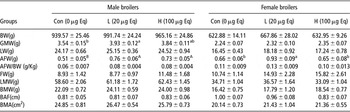
The results of the carcass performance of broilers are presented in Table 3. The BMA, the leg muscle weight and the BAF were not changed in male or female chickens. In the L group, gastrocnemius muscle weight gain was increased by 11.02% in male broilers (P < 0.05), compared to Con birds. Abdominal fat weight (AFW) of male broilers was significantly increased by low or high dosage of Eq injection (P < 0.01), and AFW of female broilers was significantly increased by low dosage (P < 0.05). However, the total body fat or the ratio of the weight of abdomen fat to BW was not altered by Eq administration.
Effect of Eq on carcass performance of male and female broilers at 49 days of age

Eq = equol; Con = control; L = low dosage of the Eq group; H = high dosage of the Eq group; GMW = gastrocnemius muscle weight; LW = liver weight; AFW = abdomen fat weight; AFW/BW = the relative weight of abdomen fat to BW; FW = fat weight; LMW = leg muscle weight; BMW = breast muscle weight; BAF = breadth of abdomen fat; BMA = breast muscle area.
Values are means ± s.e.m. Mean values without common superscript (A, B and a, b) differ significantly among the Con, L and H groups (P < 0.01 and P < 0.05, respectively. n = 20).
Meat quality
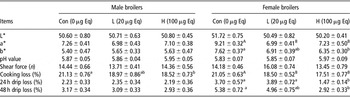
As shown in Table 4, redness (a*) of meat color in the L and H groups of female broilers was significantly decreased by 24.10% and 21.50% (P < 0.01), respectively. The yellowness (b*) of meat color in the H group was decreased by 16.67% more than that in the control group of female broilers (P < 0.05). Cooking loss in the L and H groups of female broilers were significantly decreased by 12.11% and 16.82% (P < 0.01), respectively. Compared with the control group, the drip loss at 24 h and 48 h of female broilers in the H group was decreased by 60.27% and 45.72% (P < 0.05), respectively. However, for male broilers, only cooking loss in the H group was significantly decreased by 12.35% (P < 0.05), showing the great gender difference. The pH value of breast muscle was not affected by Eq treatment (P > 0.05). A tendency to increase in the shear force of breast muscle was observed in the L group of female broilers, which showed an increase of 13.40% (P = 0.058).
Effect of Eq on meat quality of male and female broilers at 49 days of age

Eq = equol; Con = control; L = low dosage of the Eq group; H = high dosage of the Eq group; L* = lightness; a* = redness; b* = yellowness.
Values are means ± s.e.m. Mean values without common superscript (A, B and a, b) differ significantly among the Con, L and H groups (P < 0.01 and P < 0.05, respectively. n = 20).
Muscle fiber type and area
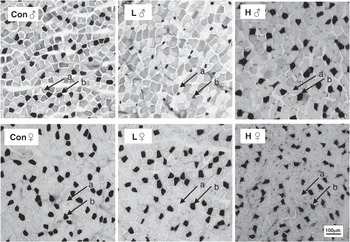
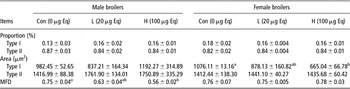
As shown in Figure 1 and Table 5, in neither male nor female broilers was the proportion of type I and II fibers of gastrocnemius muscle changed by Eq treatment (P > 0.05). About the area of type I and type II fibers of gastrocnemius muscle, it was only in female broilers treated with a high dosage of Eq that the type I fiber area was significantly decreased (P < 0.05). In addition, Eq obviously affected the density of the gastrocnemius muscle fiber of males, showing a dose-dependent decrease, and reached a statistic valuable in the high dosage group (P < 0.05). However, for female broilers, Eq injection in ovo did not change the density of the gastrocnemius muscle fiber at all (P > 0.05).
Morphology of the gastrocnemius of broilers at 49 days of age (Con = control group; L = low dosage of the Eq group; H = high dosage of the Eq group; a = fast white myofiber (type II fiber); b = slow myofiber ( type I fiber); ♀ = female; ♂ = male; bar = 100 μm).

Effect of Eq on muscle fiber type and area in gastrocnemius muscle of male and female broilers

Eq = equol; Con = control; L = low dosage of the Eq group; H = high dosage of the Eq group; MFD = muscle fiber density.
Values are means ± s.e.m. Mean values without common superscript (a, b) differ significantly among the Con, L and H groups (P < 0.05, n = 3).
Biochemical analysis
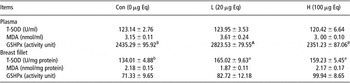
Table 6 shows the biochemical indices in the plasma and breast muscle of female broilers. In plasma, GSHPx activities in the L group of female broilers was significantly increased by 15.94% (P < 0.01), while the content of MDA and the activity of T-SOD was unaffected by Eq injection. In breast muscle, T-SOD activity was significantly increased by 23.14% and 18.82%, by 20 μg and 100 μg Eq treatment (P < 0.05), respectively. The activity of GSHPx was increased by high dosage of Eq injection but did not reach the significant statistic level (P = 0.06). The content of MDA was not changed by Eq treatment (P > 0.05).
Effect of Eq on antioxidative indexes in plasma and breast muscle of female broilers at 49 days of age

Eq = equol; Con = control; L = low dosage of the Eq group; H = high dosage of the Eq group; GSHPx = glutathione peroxidase; MDA = malondialdehyde; T-SOD = total superoxide dismutase activity.
Values are means ± s.e.m. Mean values without common superscript (A, B and a, b) differ significantly among the Con, L and H groups (P < 0.01 and P < 0.05, respectively; n = 20).
Discussion
On farm animals, the maternal effects of isoflavones on growth and body composition were not always consistent. Rehfeldt et al. (Reference Rehfeldt, Adamovic and Kuhn2007) reported that supplementation of 1 mg daidzein per kg BW daily in maternal diet from 85 days of gestation to parturition marginally affected meat quality and skeletal muscle cellularity of the progeny (Rehfeldt et al., Reference Rehfeldt, Adamovic and Kuhn2007). This is in agreement with our previous study on chicks. Our results showed that broiler breeders that received a basal diet supplemented with 10 mg daidzein per kg feed did not affect the growth performance of the offspring (Ni et al., Reference Ni, Hong, Ren, Hu, Dai, Rao, Chen and Zhao2007). However, there are few results on the maternal influences on improvement of fetal and postnatal growth and development when a low dose of daidzein (5 to 8 mg/kg feed) was supplemented to sows during late gestation (Liu et al., Reference Liu, Zheng, Chen, Chen and Han1999; Ren et al., Reference Ren, Kuhn, Wegner, Nürnberg, Chen and Ender2001). These variable effects of maternal supplement of isoflavones on the growth of the offspring seem to be contradictory and/or dependent on the animal model, applied dosage and time.
Biotransformation is an important process to regulate the biological activity of dietary isoflavones. Eq, as one of the two metabolic products of daidzein, has diverse biological activities, such as estrogenicity, antioxidant and antiandrogenic properties, which are much higher and stronger than daidzein (Muthyala et al., Reference Muthyala, Ju, Sheng, Williams, Doerge, Katzenellenbogen, Helferich and Katzenellenbogen2004). To our knowledge, no research has been conducted in poultry to test the effect of Eq on growth or meat quality. In this study, Eq injected in ovo at 7 days of embryonic stage did not affect the growth of offspring, although the hatching weight was significantly decreased with low dosage of Eq treatment. It was consistent with previous studies on the maternal effects of daidzein and glycitein in birds (Jiang et al., Reference Jiang, Jiang, Lin, Xi, Yu and Wu2007; Ni et al., Reference Ni, Hong, Ren, Hu, Dai, Rao, Chen and Zhao2007). Isoflavones may also be used as a feed supplement to decrease fat deposition in animals because of their estrogen-like function (for a review, see Bhathena and Velasquez (Reference Bhathena and Velasquez2002)). However, in this study, the total body fat and the relative weight of abdomen fat content to the BW remained unaffected by Eq treatment in male and female chickens.
With respect to meat quality, there are some effects on the offspring at market weight after maternal isoflavone supplementation. Studies on pigs showed that dietary soy isoflavone supplement did not affect carcass traits; however, a* and b* color scores and muscle drip loss were decreased as isoflavone levels increased (Payne et al., Reference Payne, Bidner, Southern and Mcmillin2001). This is in agreement with our results. In this study, Eq injection in ovo significantly decreased the a* and b* color scores in the breast muscle of female broilers, but without influence on male broilers, showing the gender difference. Up until now, the mechanism explaining the effects of isoflavones on meat color is still unknown. The value of muscle shear force ranged from 13.45 to 16.08 but there was no difference among groups. In addition, no significant differences were found on the muscle pH recorded at 45 min post mortem. Histochemical analysis showed that the area of type I fiber of female broilers and the density of gastrocnemius muscle fiber of male broilers were significantly decreased by the high dosage of Eq treatment; however, these changes did not affect the muscle content and tenderness. It is impossible to explain this result as an exclusive effect, as no literature was available about the effect of Eq or daidzein on muscle fiber development.
In pigs, dietary supplement of sows with daidzein did not influence meat quality measured on the longissimus muscle of the progeny, while there was a tendency for decreased drip loss in large litters (P = 0.15). It has also been found that sex was a crucial factor for the regulatory effect of maternal supplement of daidzein on the meat quality of the progeny (Rehfeldt et al., Reference Rehfeldt, Adamovic and Kuhn2007). Our results showed that cooking loss and drip loss of breast muscle were greatly decreased by Eq injection, especially in female broilers. These results are consistent with our previous study on the maternal effect of daidzein on meat quality of the offspring, which showed that, in the breast muscle and leg muscle of the offspring broilers, the rate of cooking loss and drip loss were significantly decreased by maternal pure daidzein supplementation (Ni et al., Reference Ni, Hong, Ren, Hu, Dai, Rao, Chen and Zhao2007). It is well known that drip loss and cooking loss are of high importance due to their large financial impact on the meat industry. Generally, muscle with low drip loss has an attractive appearance and also increases meat tenderness and juiciness. A decrease in cooking loss resulted in the improvement of nutritional quality in the muscle by preventing the loss of several essential minerals and vitamins (Yu et al., Reference Yu, Lee, Jeong, Paik, Choi and Kim2005). Therefore, this study gives evidence that Eq and its precursor daidzein are potential additives to improve muscle juiciness and nutrients. In addition, the consistency between Eq and daidzein on the water-holding capacity of the muscle suggests that the maternal effects of daidzein on the meat quality of the offspring may be mediated by Eq and needs further study.
The water-holding capacity of the muscle is related to the integrity of the muscle cell membrane. A well-protected cell membrane is favored for improving the water-holding capacity, which is dependent on better antioxidative status. It is well known that isoflavones have antioxidative capacity (Mitchell et al., Reference Mitchell, Gardner, McPhail, Morrice, Collins and Duthie1998; Liu et al, Reference Liu, Chang and Wiesenborn2005; Dwiecki et al., Reference Dwiecki, Neunert, Polewski and Polewski2009). Eq was found to have antioxidant activity in vivo and in vitro (Jackman et al., Reference Jackman, Woodman, Chrissobolis and Sobey2007a and Reference Jackman, Woodman and Sobeyb; Chung et al., Reference Chung, Kim, Jo, Hwang, Chae, Kwon, Lew, Lim, Kim, Kim, Kim and Kim2008). Few studies have been conducted to evaluate the effect of isoflavone on antioxidative status in broilers. Jiang et al. (Reference Jiang, Jiang, Lin, Xi, Yu and Wu2007) found that the T-SOD activity in breast muscles was significantly increased and the content of MDA was greatly reduced by adding 40 or 80 mg of isoflavones per kg feed of male broilers, which contributes to the improvement of meat quality (Jiang et al., Reference Jiang, Jiang, Lin, Xi, Yu and Wu2007). The results from an in vitro study showed that the SOD activity was increased significantly in ovarian germ cells of embryonic chickens in the presence of daidzein (Liu et al, Reference Liu, Zhang and Zeng2006). Similarly, we found that Eq injection in ovo at the early embryonic stage of broilers significantly increased the activity of GSHPx in plasma, GSHPx and T-SOD in breast muscle.
In conclusion, Eq injected in ovo at 7 days of embryonic age has little effect on the growth performance of broilers, but significantly improves the water-holding capacity of the muscle, which is associated with the significant increase in antioxidative status by upregulating GSHPx activities in plasma and T-SOD activities in muscle. However, the exact mechanisms of the long-term effects of Eq on the activities of antioxidative enzymes is worth further study.
Acknowledgment
This study was supported by the National Basic Research Program of China (2004CB117505) and the China–Nanjing Agriculture University Union foundation (NC2007004).