INTRODUCTION
Due to a dramatic increase in the proportion of birds being grown and in further processing (Ewart Reference Ewart1993), the success of poultry meat production has been related strongly to improvements in growth and carcass yield, mainly by increasing breast proportion and reducing carcass fat (Zerehdaran et al. Reference Zerehdaran, Vereijken, Van Arendonk and Van Der Waiij2005). It is possible to make large changes in the protein and lipid contents of broiler chicken carcasses by dietary manipulation (Fraps Reference Fraps1943; Donaldson et al. Reference Donaldson, Coombs and Romoser1956; Edwards et al. Reference Edwards, Denman, Abou-Ashour and Nugara1973). Increasing dietary protein concentration increases the proportion of lean meat, while increasing dietary energy concentration increases the proportion of carcass lipid (Pesti & Bakalli Reference Pesti and Bakalli1997). The cost of broiler diets is influenced greatly by energy sources and their dietary levels. In general, about 0·7 of the rearing cost in poultry production is related to caloric needs (Skinner et al. Reference Skinner, Waldroup and Waldroup1992). In addition to its measurement in the laboratory using wet chemistry, carcass composition of broiler chickens has been predicted by means of allometric equations, real-time ultrasonography, radioactive isotopes and specific gravity studies (Pesti & Bakalli Reference Pesti and Bakalli1997; Toledo et al. Reference Toledo, López and Costa2004; Rosa et al. Reference Rosa, Faria Filho, Dahlke, Vieira, Macari and Furlan2007; Makkar Reference Makkar2008). Conventional laboratory techniques for determining carcass composition are expensive, cumbersome and time consuming. Therefore, it would be advantageous if a simple means of estimating carcass composition could be developed. In this respect, the potential advantages from modelling growth are considerable. Neural networks (NNs) are applied in many fields to model and predict the behaviour of unknown systems or systems with complexity (or both) based on given input–output data. Using NNs does not require a priori equation or model. This characteristic is potentially advantageous in modelling biological processes (Dayhof & DeLeo Reference Dayhoff and De Leo2001). One self-organizing sub-model of artificial NN is the group method of data handling-type NN (GMDH-type NN), which has recently gained popularity as a powerful tool to express complex input–output dependencies. The GMDH-type NN provide an automated selection of essential input variables and build hierarchical polynomial regressions of necessary complexity (Farrow Reference Farrow and Farrow1984). The unique feature of the self-organizing modelling approach of GMDH-type NN is that it facilitates, systematically and autonomously, developing optimal complex models by performing both variable and structure identification. Evolutionary methods such as genetic algorithms (GA) have been widely used in different aspects of design of NN because of their unique capability of finding a global optimum in highly multi-modal or non-differentiable search space (Astrom & Eykhoff Reference Astrom and Eykhoff1971; Yao Reference Yao1999). The GA have been used in feed-forward GMDH-type NN for each neuron searching its optimal set of connections with the preceding layer (Vasechkina & Yarin Reference Vasechkina and Yarin2001; Nariman-Zadeh et al. Reference Nariman-Zadeh, Darvizeh and Ahmad-Zadeh2003). The aim of the current study was to demonstrate the ability of GMDH-type NN approach in modelling the effects of dietary ME (MJ/kg), CP (g/kg of diet), fat (g/kg of diet), crude fibre (CF, g/kg of diet), methionine (Met, g/kg of diet), lysine (Lys, g/kg of diet) and body weight (BW, kg) on carcass energy (C En, MJ/g) content and relative growth (g/g of BW) of carcass components in broiler chickens.
MATERIALS AND METHODS
Data source
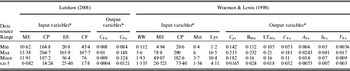
The necessary information used in the present study was taken from results published by Latshaw (Reference Latshaw2008) and Wiseman & Lewis (Reference Wiseman and Lewis1998). Ranges for the data used to develop and test the GMDH-type NNs models are presented in Table 1.
Ranges for the data used to develop the group method of data handling-type neural networks model for carcass energy and components in broilers

* ME, metabolizable energy (MJ/kg of diet); CP, crude protein (g/kg of diet); EE, ether extract (g/kg of diet); CF, crude fibre (g/kg of diet); C En, carcass energy (MJ/g); C Fa, carcass fat [g/g of body weight (BW)]; Met, methionine (g/kg of diet); Lys, Lysine (g/kg of diet); C pr, carcass protein (g/g of BW); B Mu, breast muscle (g/g of BW); LTMu, leg and thigh muscle (g/g of BW); A Fa, abdominal fat (g/g of BW); S Fa, skin fat (g/g of BW); V Fa, visceral fat (g/g of BW).
† s.d.=standard deviation.
Model development and statistical procedure
The idea of GMDH-type NN is to employ estimates of the output variable obtained from simple primeval regression equations that include small subsets of input variables (Farrow Reference Farrow and Farrow1984). By means of the GMDH-type NN algorithm, a model can be represented as a set of neurons in which different pairs in each layer are connected through a quadratic polynomial and thus produce new neurons in the next layer, and therefore can be used to map inputs to outputs. Such an NN identification process needs some optimization method to find the best network architecture. For this purpose, in the current study, GA were deployed to design the whole architecture of the GMDH-type NN, i.e. the number of neurons in each hidden layer and their configuration of connectivities to find the optimal set of appropriate coefficients of quadratic expressions. In order to demonstrate the predictive ability of the evolved GMDH-type NNs, a separate analysis was conducted on each input–output data set divided into two different subsets: namely training and testing sets (Tables 1 and 2). Quantitative examination of the predictive ability of models was made by common error measurement indices, including mean square error (MSE), R 2 and bias.
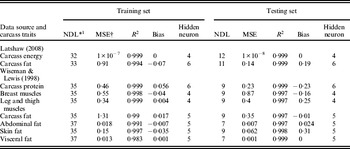
Model statistics and information for carcass energy and components in broilers
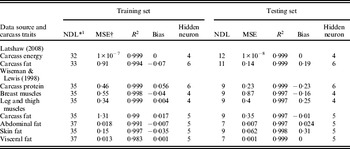
* NDL=number of data lines used for each trait to train or test the GMDH-type NNs.
† MSE=mean square error.
RESULTS
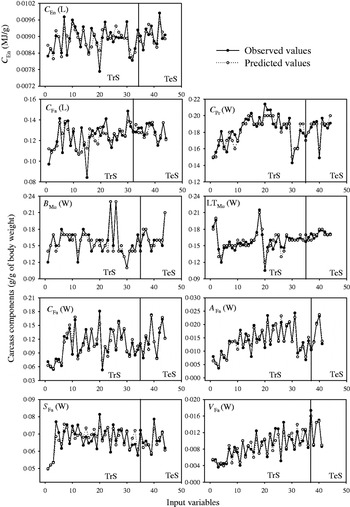
In order to demonstrate the predictive ability of the evolved GMDH-type NN, input–output data (originated from two different studies with broilers) were divided into two different sets, namely training and testing sets (Table 1). Data sets were imported into the GEvoM software for GMDH-type NN training (GEvoM 2009). For all carcass traits investigated (with a population size of 50 individuals), the best structures were reached by two hidden layers with 500 generations, cross-over probability of 0·95 and mutation probability of 0·01. It appeared that no further improvement could be achieved for such a population size. Training and testing sets for investigated carcass components are shown in Fig. 1. It is clearly evident from Fig. 1 that the evolved GMDH-type NN in terms of simple polynomial equations could successfully model and predict the output of testing data that have not been used during the training process. Limitations on space prevent the presentation of polynomial equations for all investigated carcass components. The complete list of generated polynomials may be provided upon the reader's request. As an example, polynomial Eqns (1)–(5) and (6)–(12) show the partial descriptions of GMDH-type NNs for C En and carcass protein (C Pr) content, respectively.
Comparison between actual and model-predicted values of carcass traits in broilers. The letters C En, C Fa, C Pr, B Mu, LTMu, A Fa, S Fa and V Fa indicate fit of models to data from carcass energy and carcass fat of Latshaw (Reference Latshaw2008) (L), and carcass protein, breast muscle, leg and thigh muscle, abdominal fat, skin fat and visceral fat of Wiseman & Lewis (Reference Wiseman and Lewis1998) (W), respectively. TrS and TeS stand for training and testing sets, respectively, used to evaluate the predictive ability of the evolved GMDH-type NNs.

For C En:
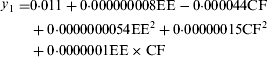




For C Pr:







Quantitative examination of the goodness of fit for the predictive models proposed by the GMDH-type NN revealed close agreement between observed and predicted values of C En and carcass components (Table 2).
DISCUSSION
Artificial NNs are a promising new generation of information-processing systems that demonstrate the ability to learn, recall and generalize from training data (Horng Reference Horng2002). NNs can improve performance by training and can define complex relationships among input data that may not be apparent using other approaches. System identification techniques are applied in many fields in order to model and predict the behaviour of unknown or very complex systems based on given input–output data (Astrom & Eykhoff Reference Astrom and Eykhoff1971). However, very little research has been conducted on modelling animal growth using artificial NN (Roush et al. Reference Roush, Dozirier Iii and Branton2006). Ahmadi et al. (Reference Ahmadi, Mottaghitalab and Nariman-Zadeh2007, Reference Ahmadi, Mottaghitalab, Nariman-Zadeh and Golian2008) and Mottaghitalab et al. (Reference Mottaghitalab, Faridi, Darmani-Kuhi, France and Ahmadi2010) introduced GMDH-type NN, a sub-model of NN, as an effective tool for predicting performance of broiler chickens and turkeys based on dietary nutrients. In the current study, the aim was to assess the ability of this self-organizing approach to model the effects of dietary ME (MJ/kg), CP (g/kg of diet), fat (g/kg of diet), CF (g/kg of diet), Met (g/kg of diet), Lys (g/kg of diet) and BW (kg) on C En (MJ/g) and relative growth (g/g of BW) of carcass components in broiler chickens. To find the best network architecture, the GA were deployed to design the whole architecture of the GMDH-type NN. Quantified values of bias (Table 2) show very little under- and over-estimation by the models proposed by the GMDH-type NN, which revealed close agreement between observed and predicted values of C En and carcass components. The value of R 2, a measure of the relation between the actual and predicted values, was high for both studies (Table 2) indicating a strong effect of all selected input variables on output prediction. This is in agreement with previous studies aimed at investigating the effects of different dietary nutrients on body composition in broilers (Fraps Reference Fraps1943; Donaldson et al. Reference Donaldson, Coombs and Romoser1956; Kubena et al. Reference Kubena, Lott, Deaton, Reece and May1972; Edwards et al. Reference Edwards, Denman, Abou-Ashour and Nugara1973). Data mining, the extraction of hidden predictive information from large volume of data, is a powerful methodology with great potential in several aspects of daily lives. In some situations, a purely generic input–output network model might be the only sensible way forward in practice. Self-organizing modelling, especially the GMDH approach, is also suitable and valuable as a part of the whole simulation process (Watton & Xue Reference Watton and Xue1997). In a practical situation, the polynomial equations generated by GMDH-type NN may be used for further prediction on any investigated carcass components given BW, dietary contents of ME, CP, Met and Lys. However, as the other data-based model, the applicability of GMDH-type NN is dramatically dependent on the data ranges that are used to train the model. Obviously, additional research with a larger experimental data (data that produce a larger ranges) may lead to obtain a more appropriate and applicable model. In conclusion, the results of the current study show that a GMDH-type NN modelling approach can be a simple but very effective method for predicting carcass composition in broiler chickens based on dietary input variables.