Introduction
Māori student achievement is vital to Māori futures socially, politically and economically (Durie, Reference Durie2003). Presently, over 90 per cent of Māori students attend English-medium schools in Aotearoa New Zealand, four per cent attend Māori-medium immersion schooling; with another six per cent attending other forms of alternative education (AE) – such as, Te Aho o te Kura Pounamu (largest Māori correspondence school in the country) or various special needs education based programmes (Ministry of Education, 2010). With over 90 per cent of the total population of Māori living in the North Island, national reports and studies concerning the educational wellbeing of whanau Māori and their children living in the South Island appears under-represented (Education Review Office, 2015). Unfortunately, a paucity of the literature exist as to what whānau Māori living in the lower half of the South Island say benefit their children's schooling and education in state funded primary (i.e., 5 years to 10 years) schools.
By both schools convening school hui throughout 2014–2015 provided whānau Māori and their children with a voice and to be heard. Through this process, whānau Māori and their children were able to identify and agree upon the following list of values and virtues as being the most important for their children to learn and develop, including: courage, respect, responsibility, honesty, punctuality, aroha (love), self-discipline, trust, thankfulness and courtesy. In addition, whānau Māori believed that the inclusion of Māori language, culture and ways of knowing and doing enhanced the learning relationship in the classroom, and in doing so, also strengthened the overall wellbeing of the child (Ministry of Education, 2011, 2013). Although schools and teachers openly acknowledged they could do more to engage with whānau Māori and their children, as mana whenua (i.e., reference to the local Indigenous peoples who have ‘demonstrated authority’ over land or territory in a particular area, and derived through genealogical links to that area and/or as mana tangata (i.e., power and status accrued through one's leadership talents, human rights, respect and love of people) (Mead, Reference Mead1984, Reference Mead2003; Shirres, Reference Shirres2000), many remained unsure about how to connect to local tribal Māori Elders in the right way, and without whānau Māori input and support.
Essentially, the study aimed to explore the connection between the virtues–values–strengths (Popov, Reference Popov2000) each schools includes and promotes, and the relationship of each to the wellbeing of whānau Māori, and their children attending these two schools. Listening to the voices of whānau Māori, and their children were fundamental to helping to identify the social and academic needs of our most vulnerable, and at-risk learners (Bishop, Reference Bishop1997; Whitinui, Reference Whitinui2008). The findings to emerge helped to envisage a culturally inclusive framework entitled: Ngā Niho Taniwha – Nurturing the Learning Spirit of the Māori Learner. The framework conceived was inclusive of three papatipu rūnanga (governing body of various Ngāi Tahu sub-tribes in the South Island) including Puketeraki, Ōtākou and Moeraki, as well as, one urban-based marae, Araiteuru which provides a culturally appropriate community space for all Māori living in the city of Dunedin to gather.
Importantly, the opportunity to work with both schools – one comprising of 24 per cent Māori students, and the other 19 per cent was intentional and culturally specific to the nature and scope of the study. In addition, both schools and teachers acknowledged that working alongside whānau Māori and their children was a good way of helping to build positive relationships for learning (Durie, Reference Durie2004). Working together to include Treaty based practices, principles and practices that reflect Māori ways of knowing and doing really helped to transform the negative experiences associated with intergenerational failure, and/or on-going Māori student underachievement (Bishop, Reference Bishop1997; Whitinui, Reference Whitinui2011).
Background
Māori Enjoying and Achieving Education Success as Māori
Over the past 20 years, improving educational outcomes for Māori students in Aotearoa New Zealand has focused primarily on changing the way teachers teach and engage with Māori children in the classroom (Macfarlane, Glynn, Cavanagh, & Bateman, Reference Macfarlane, Glynn, Cavanagh and Bateman2007; Whitinui, Reference Whitinui2004, Reference Whitinui2008, Reference Whitinui2011). Educators, policy-makers, practitioners and researchers have argued for many years that, improving educational outcomes or success for Māori children is just as much about developing ‘agentic teachers’ (Berryman, SooHoo, & Nevin, Reference Berryman, SooHoo and Nevin2013; Bishop, Reference Bishop, Denzin, Lincoln and Smith2008; Bishop & Berryman, Reference Bishop and Berryman2006) as it is, about connecting with the ‘whole’ person – culturally, spiritually and academically (Hutchings et al., Reference Hutchings, Barnes, Taupo, Bright, Pihama and Lee2012). In 2008, the Ministry of Education launched, Ka Hikitia: Managing for Success: Māori Education Strategy as a strategy for creating positive learning outcomes for Māori children. Three key principles underpin its intent, and include: (1) All Māori children have unlimited potential; (2) all Māori children have a cultural advantage by virtue of who they are – being Māori is considered an asset; not a problem or deficit, and; (3) all Māori children are inherently capable of achieving success (Ministry of Education, 2008). Akin to these principles, is that, schools and teachers are required to create learning opportunities that unleash the learning potential Māori children possess as well as, collaborate and construct learning environments that enhance Māori children to succeed across the curriculum (Ministry of Education, 2008, p. 19). Finding culturally uplifting ways for Māori children to succeed in conventional school settings as Māori, also requires schools and teachers to create a ‘culture of care’ where Māori children feel safe and respected (Macfarlane, Glynn, Cavanagh, & Bateman, Reference Macfarlane, Glynn, Cavanagh and Bateman2007).
Creating a Culture of Care in Schools
Research conducted by Bishop (Reference Bishop1997) and Macfarlane (Reference Macfarlane2004) contend that improving learning outcomes for Māori children is more likely to occur when schools and teachers develop positive relationships for learning. Moreover, understanding what constitutes a ‘culture of care’ requires schools and teachers coming to know what it means to ‘live as Māori – socially and culturally’ and ‘as citizens of the world – economically and politically’ today, and into the near future (Durie, Reference Durie2004; Macfarlane, Reference Macfarlane2004). Noted is the contestation of what schools and teachers prioritize as ‘educational success’, and that preoccupation with literacy and numeracy does not always mirror the educational aspirations whānau Māori and their children want, or indeed perceive as benefiting their educational futures. Similarly, whānau Māori perceptions, beliefs and attitudes about educational success do vary from school to school, teacher to teacher, community to community, as well as, region to region (Education Review Office, 2015). The New Zealand Curriculum (cited in Education Review Office, 2015, p. 5) states that:
Every school has a set of values. They are expressed in its philosophy, in the way it is organised, and in interpersonal relationships at every level. . . Schools need to consider how they can make the values an integral part of their curriculum and how they will monitor the effectiveness of the approach taken. (p. 38)
Macfarlane, Glynn, Cavanagh, & Bateman (Reference Macfarlane, Glynn, Cavanagh and Bateman2007) contend that developing culturally safe schools is really about schools creating the spaces for Māori language, culture and histories to co-exist. Although, as Professor Marie Battiste – a First Nation's Mi'kmaq scholar based at the University of Saskatchewan argued, the inclusion of culture on its own may not be enough to guarantee Indigenous children's success in their education (Battiste, Reference Battiste2013). The key nurturing the learning spirit of an Indigenous learner requires educators to promote a Sui Generis (a thing of its own kind) Education that seeks greater dialogue, participation, healing, restoration, self-determination, self-representation and investment in the holistic and sustainability of ways of thinking, communicating and acting together as Indigenous peoples (Battiste, Reference Battiste2013). Similarly, Professor Graham Hingangaroa Smith (Reference Smith2014), a prominent Māori educationalist and philosopher has consistently argued that, as Māori, we need to continue to figure out what in education we want to build on, improve and/or change and get on with it. From this position, transforming education is based on a mind-set of not waiting for education and/or schooling to be changed for us, but rather deciding what we want to change, and making the conscious decision to get up, and do it for ourselves (Smith, Reference Smith2014). Today, whānau Māori and their children are not only achieving educational and schooling success, but a more recent study entitled: Te Puawaitanga o ngā Whānau: Six Markers of Flourishing Whānau identified the six key markers of flourishing whānau, which included, whānau heritage, whānau wealth, whānau capacities, whānau cohesion, whānau connectedness and whānau resilience (Kingi et al., Reference Kingi, Meihana, Mason, Cunningham, Borman and Ellison-Loschmann2014). All six markers resonate well with whānau Māori in this study, but the reality with/in community, and the provisions available for many whānau Māori to flourish, let alone survive the day-to-day grind, is much a different story.
Improving Educational Outcomes for Māori Children
Over the past decade, four nationally funded flag-ship educational initiatives: Te Kauhua (2001–2008), Starpath (2001– present), Te Kotahitanga (2001–2013) and Te Kākano (2008–present) demonstrated that through purposeful, incremental and on-going professional development with schools and teachers can improve educational outcomes for Māori children (please refer to specific reports on-line at http://nzcurriculum.tki.org.nz/). At the end of 2013, a new Ministry of Education initiative called, Building on Success, was created to ‘build on’ the educational benefits acknowledged under the four previous initiatives. National data related to Māori student achievement is important, but according to the Ministry of Education's website, there has not been an annual report on how the government is achieving its key priorities related to the educational success of Māori learners since 2010.
Whānau Māori Voices in Education
In 2012, the New Zealand Council of Educational Research (NZCER) Te Wāhanga Māori unit released, Kia Puāwaitia Ngā Tūmanako: Critical Issues for Whānau in Māori Education. The report included responses from both English and Māori-medium settings, and took into account the most relevant literature alongside the feedback from whānau Māori attending two wānanga held in Te Whanganui-a-Tara (inclusive of Pōneke – Wellington City, Heretaunga – Hutt Valley, Porirua and Poneke). The findings concluded that whānau Māori need to be at the forefront of mainstream schooling/kōhanga/kura and teachers/kaiako minds when working with their children (Hutchings et al., Reference Hutchings, Barnes, Taupo, Bright, Pihama and Lee2012). The importance of whānau Māori engagement was critical to supporting the whakataukī ‘He Whānau Mātau, He Whānau Ora – A Knowing Whānau, is a Healthy Whānau’. The challenge, according to Liz Gordon's (2015) research on Tomorrow Schools (New Zealand Council for Educational Research, 1989) 25 years on – where 90 per cent of Māori and Pasifika students now attend decile 1–4 schools, is more to do with a lack of consistent support and inclusion of whānau Māori, than a lack of willingness from schools and teachers to make positive change. Decile ranked schools are a measure of the socio-economic position of a school's student community relative to other schools throughout the country, and are ranked between 1–10 (i.e., 1 being the lowest, and 10 the highest). Perhaps more concerning, is when schools and teachers over-ride the social wellbeing of Māori children for the academic wellbeing of all students, and use single measures, such as low social-economic status, to validate why Māori children are not fully engaging at schools, and/or underachieving their potential. Of course, many Māori children often have additional barriers to overcome due to a lack of access to a range of resources, funding, and services many of their wealthier peers may well take for granted. For example, colonisation during the 1800’s stripped many Māori of their economic assets by displacing and dismantling their communal and kinship lifestyle (Walker, Reference Walker1990). These sorts of intergenerational issues resulting in marginalisation and displacement of Māori children in their education.
Methodology
Aspirational Approach
Elizabeth Minnich (Reference Minnich1990) argued that ‘education can either maintain domination, or it can liberate. It can sustain colonization in neo-colonial ways, or it can decolonize’ (pp. 180–181). Every school is either a site of reproduction, or a site of change. The need to deconstruct as well as reconstruct the purpose of schooling, and indeed knowledge, to enable Indigenous children to unleash their educational potential (Minnich, Reference Minnich1990). Globally, Indigenous peoples are seeking alternatives to what schools currently provide, and that they want their voices heard, and their culture included and their aspirations respected, protected and fulfilled (Barnhardt, Reference Barnhardt2005; Battiste, Reference Battiste2000; Cajete, Reference Cajete2014; Macfarlane, Reference Macfarlane2000a, Reference Macfarlane2000b; Rangihau, Reference Rangihau1977; Whitinui et al., Reference Whitinui, McIvor, Robertson, Morcom, Cashman and Arbon2015). Katona (Reference Katona1975, p. 154) summarised that aspirational-based research can bring together more people for a common purpose, in that:
1. Aspirations are not static; they are not established once for all time;
2. Aspirations tend to grow with achievement and decline with failure;
3. Aspirations are influenced by the performance of other members of the group to which a person belongs and by that of reference groups;
4. Aspirations are reality orientated; most commonly they are slightly higher or slightly lower than the level of accomplishment rather than greatly different from it.
The premise of aspirational discourse is therefore founded on notions of community, and built on the collective accomplishment of all participating members of the group; relative to their hopes, dreams and goals for success in life. Based on the literature review above, as well as, the unique opportunity to work closely with both schools, two key research questions emerged as important to helping to guide the study, and included:
1. What can schools and teahcers do to create culturally safe environments that are likely to improve levels of participation (i.e., interest, attendance, success, voice, association and engagement) working with Māori children in English-medium primary schools in the Otago/Southland region, and;
2. How can we remove the risks and/or barriers associated with ‘Māori children enjoying and achieving educational success as Māori’ in English-medium primary schools in the Otago/Southland region?
Community-based Participatory (CBPR) Approach
The historical roots of CBPR can be traced back to the development of participatory action research by Kurt Lewin and Orlando Fals Borda, and the popular education movement in Latin America associated with Paulo Freire (Minkler & Wallerstein, Reference Minkler and Wallerstein2003). Whereby, community is often characterized as a group of people in a common geographical locality with common interests and common aspirations (Katona, Reference Katona1975; Minker, Blackwell, Thompson, & Tamir, Reference Minker, Blackwell, Thompson and Tamir2003; Minkler & Wallerstein, Reference Minkler and Wallerstein2003). The key purpose of CBPR therefore, is to increase the knowledge and understanding of a given phenomenon, as well as, to integrate the knowledge gained with appropriate interventions, and policy development for social change (Stoecker, Reference Stoecker2005). Employing a strength-based community approach aligns well with Tiriti o Waitangi (The Treaty of Waitangi) and Kaupapa Māori theory, and provides a culturally reasoned way of considering of doing the study in a ‘good way’ (Macfarlane, Blampied, & Macfarlane, Reference Macfarlane, Blampied and Macfarlane2011).
Te Tiriti o Waitangi (The Treaty of Waitangi) Relational Approach
The Treaty of Waitangi signed on February 6, 1840 between the Crown and Māori is New Zealand's founding document. It is also reflected in the New Zealand Curriculum Framework which states that ‘The New Zealand Curriculum . . . will help give effect to the partnership that is at the core of our nation's founding document, Te Tiriti o Waitangi/The Treaty of Waitangi’ (Ministry of Education, 2007, p. 6). The New Zealand Curriculum Update (2012) and its obligation to the Te Tiriti o Waitangi (The Treaty of Waitangi) in education includes three broad principles (Bishop & Glynn, Reference Bishop and Glynn1999; Ministry of Education, 2012b):
1. Partnership: to engage and collaborate with whānau Māori. Partnerships need to be developed between schools, parents, and the Māori community including whānau, hapū and iwi (e.g., whānaungatanga – building relationships).
2. Protection: to protect and enhance the wellbeing, identity and self-concept of the tamaiti (child) (i.e., guarantees to Māori their decision-making authority to define and protect their treasures as tangata whenua – people of the land).
3. Participation: to enhance the classroom curriculum to support presence, participation and learning for the tamaiti (child) (i.e., guarantees to Māori equality of opportunities and outcomes).
These principles, although intended to create a more inclusive space for how schooling and education proceeds to benefit Māori, do not always reaffirm the level of autonomy and/or decision-making whānau Māori expect, or indeed, actively seek. The convergence of the Māori version of the Treaty, and in particular, each Article(s) require an ‘active’, and not ‘passive’ level of engagement, for example:
1. Kāwanatanga (Article 1) seeks to protect the rights of Māori to govern over their own health and wellbeing through the adequate provision of resources, funding and services.
2. Tino Rangatiratanga (Article 2) confers and affirms to Māori absolute sovereignty over their taonga (i.e., treasures or what is deemed previous) – including their health, wellbeing, language, education, fora, flora, forests, rivers, streams, mountains, etc.
3. Oritetanga (Article 3) refers to equal citizenship and in particular, affirms one's human right to education. Indeed, education – is everyone's right, and an important step in moving Aotearoa New Zealand towards a fair and just society (Came, McCreanor, Doole, & Simpson, Reference Came, McCreanor, Doole and Simpson2017).
The Articles and principles included within the Treaty provide a rights-based approach to address issues concerning social injustice and equity, as well as building positive partnerships for learning. Situating the Treaty alongside Kaupapa Māori provides a cultural safety net in how we conduct research that will ultimately benefit Māori, and their communities.
Kaupapa Māori Theoretical Approach
Kaupapa Māori theory is embedded in the renaissance of the 1980’s. The development of Te Kōhanga Reo (i.e., early childhood language immersion nests for students before the age of 5 years), Kura Kaupapa Māori (i.e., total immersion for students 5–12 years), Te Whare Kura (i.e., total immersion for students 13–18 years) and more recently Wānanga (i.e., publicly owned tertiary institution that provides education in a Māori cultural context) transformed education in Aotearoa New Zealand. Kaupapa Māori as a culturally relevant approach to doing research, seeks to reinforce the validity and legitimacy of Māori knowledge and culture, ways of knowing. It also ensure our rights as Māori to meaningfully participate in determining our own destiny in all areas of society (Bishop, Reference Bishop1997; Bishop & Glynn, Reference Bishop and Glynn1998; Pihama et al., Reference Pihama, Cram, Walker, Pihema, Cram and Walker2002; Smith, Reference Smith1997, Reference Smith1999). Moreover, Kaupapa Māori provides a culturally ethical intervention that is self-determining, and includes culturally preferred ways of mediating social-economic impediments for the benefit of the collective (Smith, Reference Smith1997, Reference Smith, Denzin and Lincoln2005). Alternatively, Berryman, SooHoo, & Nevin (Reference Berryman, SooHoo and Nevin2013) suggest that coming to the ‘middle ground’ is more likely to foster a culturally safe space between the researcher and the participant(s); and to achieve a mutually respectful way of negotiating how best to create knowledge, and for whose benefit (p. 21). From within this space new knowledge can emerge, where both parties act as co-researchers, in the co-creation of new knowledge (Berryman, SooHoo, & Nevin, Reference Berryman, SooHoo and Nevin2013).
Methods
Data Collection
Multiple data gathering methods using an inductive process (i.e., a process of gathering data to establish patterns and meanings) were included in the study (Gray, Reference Gray2004). Data collection elicited five key strategies, and included:
1. Kanohi-ki-te kanohi (face-to-face) in-depth semi-structured interviews – culturally relevant and principled way to conduct research with Indigenous peoples (Bishop & Glynn, Reference Bishop1999; Macfarlane, Reference Macfarlane2000a).
2. Whānau Māori on-line questioning – provided opportunities for whānau Māori who couldn't make the scheduled hui to participate on-line (Tibble & Ussher, Reference Tibble and Ussher2012).
3. School whānau Māori hui – as working groups in the community helped to determine the most relevant values, virtues and strengths (Mane, Reference Mane2009).
4. Individual and focus-group interviews – provided rich, thick and descriptive experiences (Krueger, Reference Krueger2015; Kvale, Reference Kvale1996; Patton, Reference Patton1987, Reference Patton1990).
5. Re-reading observation notes taken during the school whānau Māori hui and interview process.
By carefully reading through the transcripts as well as my own field notes, I was able to identify a number of consistent themes that not only helped to address the key research questions aforementioned, but also provided the evidence to help support schools and teachers to evaluate their own practices working with whānau Māori and their children in these settings (Creswell, Reference Creswell2003).
Findings
The feedback from whānau Māori and their children, principals, Board of Trustees and teachers suggested six culturally responsive themes, and included:
1. How Māori achieve and enjoy education success as Māori is fundamental to measuring the quality and effectiveness of the schooling experience for whānau Māori and their children;
2. Reducing risks and overcoming barriers to enable Māori children to achieve and enjoy education success as Māori requires greater compliance, and consistent monitoring and reporting on how these challenges have been addressed;
3. Including Māori language, culture and ways of knowing, doing and being, although acknowledged as important to the success of Māori children in these schools, requires time for teachers to plan how to include te reo Māori me ngā tikanga (i.e., Maori language and culture) appropriately in the classroom;
4. Being open and willing to find ways for whānau Māori and their children to fully participate and flourish in their schooling was considered an important priority for both schools and teachers;
5. Distinguishing between values, virtues and strengths emerged as new knowledge for both schools and teachers;
6. Establishing culturally safe schools requires more evidence and/or wise practices (as opposed to good practices) as to what is working well, and what is not.
Enacting Māori Achieving and Enjoying Education Success as Māori
Both schools acknowledge that supporting ‘Māori children to enjoy and achieve education success as Māori’ requires building positive relationships for learning every day. One school, for example, made the collective decision to appoint a lead teacher of Māori and Pasifika curriculum development. Their role is to spend one day a week role-modelling to teachers how to teach different aspects of te reo me ngā tikanga (i.e., Māori language and cultural ways of knowing and doing) in the classroom to all students. The following comments highlight how teachers are responding to the initiative:
First of all, I sort of thought, well, you know, “achieving”, you know having the same expectations; but also recognizing that they are Māori, and that they do have things to bring to us. . .ummm, I haven't been good at doing the language and stuff, but that is important for them. . .I found out yesterday at the interviews, that one little boy likes to go the marae with his Dad – which I never knew before, so that was really good to find out. . . School A (Teacher 1)
Umm. . .I think we've sort of talked about it, but I think it's something we've got to talk about more, you know? School A (Teacher 2)
[We] just want children to realise their own distinctive culture, and to be happy with that, and to be aware what it means to them. . . School A (Teacher 3):
[We] want them [Māori children] to feel nurtured, and feel comfortable at school, and feel as if they are really valued. . . School B (Teacher 1)
Ummm. . .to my understanding. . .it's so they have their identity, language and culture valued, and included in teaching and learning. . .responding to the whole child, and their cultural needs. School B (Teacher 2)
To recognize their unique identity, and their language and culture. . .so it will support them to achieve the skills, knowledge, and qualifications they need to achieve success. . .in New Zealand and in the wider world. . .and their own community. School B (Teacher 3)
We want it to be “normal” (i.e., being bicultural) and our way of being a school. . . School B (Teacher 4):
It's actually cool to be Māori. . .and it’ really a positive thing. . .so we should embrace it. School B (Teacher 5):
Whānau Māori reported that building respectful communication outside of the classroom was just as important as what happens inside the school gates, and in the classroom. Going the ‘extra mile’ was something whānau Māori valued about the school and the teachers. Other strategies whānau Māori valued about the school included teachers planning and conducting a mihi whakatau – formal cultural welcome to all students and their families, at the start of every new school year, as well as a poroporoaki – formal farewell at the end of every school year for all students and their families. Principals from both schools supported the idea of inclusiveness, and that providing opportunities for all students to feel part of the life of the school was very important to establishing a positive and safe schooling culture. For example, both principals said:
Um, I think it's really coming down to giving the opportunities to learn and know about their culture, um, through, through the curriculum really, through everyday school. Um, and I know that, if they've got a better sense of their culture and belonging and um, identity and where they fit then, they're going to do better academically and socially, and, in all areas of life so, it's just giving them, giving, giving them the opportunities. . . School 1 (Principal A)
[W]e work with Ka Hikitia, and there's the five principles within that, as, it includes having knowledge of the Treaty, and um, the last five weeks we've been working around, um, around, when Waitangi day is, where there is always a unit around the Treaty and the children make their own treaties within the school, so we try and make it, so that it is meaningful for them as well. So, and then we've got our marae visits next week which, the year 5 and 6s and the year 4s, 3 and 4s have been working on their mihi and finding out about themselves. . . And I think that is the main thing. . .Is making sure that our Māori students um, feel good about being Māori, and reaching their potential. . . School 2 (Principal B):
The Boards of Trustees claimed that they received reports school wide achievement levels on a regular basis. In many cases, however, there was a lack of specific reporting on Māori children's achievement levels, which made it difficult for them to comment on how they were doing in comparisons to their peers. The lack of reporting on the social and academic successes of Māori children in these settings made it very difficult to identify the key areas for improvement. Conversely, whānau Māori were much more vocal about what their children enjoyed doing at school. Activities such as kapa haka (i.e., Māori performing dance group), school sports days, class field-trips, marae sleep overs and being part of the annual celebrations, such as Matariki (i.e., Māori New Year), Treaty of Waitangi Day (i.e., national holiday), ANZAC day (i.e. Remembrance Day) emerged as the main highlights. At home, whānau Māori enjoyed helping their children with their homework, reading the school newsletters, attending school-whānau Māori hui, and being able to attend school wide events that show cased their children. Some whānau Māori, however, felt there should be a lot more Māori art or music included in class, and around the school, and that schools could do a better job of including Māori language as one of its three official languages, alongside English and sign language. This whānau Māori suggested, helped their children to feel much more included and happier about attending school.
Reducing Risks and Overcoming Barriers to Support Māori Children to Achieve and Enjoy Education Success as Māori
Reducing the risks and/or overcoming barriers to support ‘Māori children to achieve and enjoy education success as Māori’ presented a number of challenges for both schools and teachers. First, whānau Māori and their children felt there was often a lack of communication from teachers about their children's learning strengths, weaknesses and/or talents. Whānau Māori also commented that the messages (i.e., school reports) they receive from the teachers were overly descriptive, and focussed moreso on whether or not Māori children were meeting national standards for numeracy and/or literacy. Despite these concerns, whānau Māori really valued the relationship with the teachers and principals because it helped them to feel connected and as a valued member of the schooling community. Other whānau Māori felt, however, that they really lacked the confidence and/or self-efficacy to collaborate with teachers in the best interest of their child(ren) because they felt they lacked the educational literacy to know what to ask. Breaking down these sorts of barriers are still a major challenge for many whānau Māori, who themselves, remember their own school experiences as rather negative. Indeed, a lack of whānau Māori support in the home emerged as one the most significant risk factors contributing to Māori children not achieving their full potential at school in the early years.
On the home-front, whānau Māori acknowledged that work commitments were often a challenge to being able to fully engage and support their children's schooling and learning. In some homes, both parents were not only working full time, but were also struggling financially to provide the wider learning opportunities and/or experiences outside of the classroom they knew other children were receiving. Similarly, teachers, principals and Board of Trustees also expressed that the lack of access to wider learning experiences outside of school and/or of the immediate community appeared to affect the confidence levels of some Māori children in the classroom, in that, they came across as often shy, afraid of making mistakes, and at times, withdrew their interest to learn.
Including Māori Language, Culture and Practices
The failure to include Māori language, culture, and practices in schools is often a reflection of underperforming school leadership, and lack of cultural safety in schools (Education, Reference Education2013; Ministry of Education, 2008). The Board of Trustees in each school disclosed that they were unsure as to how much Māori language and culture were being included in the classrooms, and/or within the school overall. Indeed, both principals agreed they could do more, but were often perplexed about where the funding or indeed, expertise to include Māori language, culture and practices would come from. Over 90 per cent of the teachers in this study really wanted more professional development on how to include te reo Māori me ngā tikanga (i.e., Māori language, culture and practices) into the classroom, but often found they had little or no time to do the training during the school day. School B, however took an innovative approach, and prioritised some of their annual funding to support one staff member to work with all teachers on ways to implement te reo Māori me ngā tikanga, and to role model how to include culturally responsive learning activities into the classroom (Macfarlane, Reference Macfarlane2004; Macfarlane, Glynn, Cavanagh, & Bateman, Reference Macfarlane, Glynn, Cavanagh and Bateman2007; Macfarlane, Webber, Cookson-Cox, & McRae, Reference Macfarlane, Webber, Cookson-Cox and McRae2014). Both school leaders acknowledged, that despite the positive gains made working with Māori children in the classroom, some teachers felt limited by how much language and culture they knew to include in the classroom, suggesting, that ‘you do your best, but often you don't know what you don't know’.
Supporting Whānau Māori and their Children to Fully Participate in School
Whānau Māori and their children expressed that they felt more comfortable about coming into the school when teachers were positive, encouraging and offered constructive feedback about how their child(ren) are doing. Similarly, teachers who were identified as good communicators, adopted positive teaching cues and were able to understand the day-to-day social-cultural landscape of Māori children and their home-life were able to provide a much more effective learning relationship with Māori children. Finally, teachers who embraced cultural activities that involved field trips, or other culturally relevant experiences (i.e., marae visits, Māori kapa haka performances, and/or school wide musical productions) really helped Māori children to feel valued and accepted (Whitinui, Reference Whitinui2004, Reference Whitinui2008). It was also noted that improving the attendance for Māori children was also relative to when finances to buy food in the home was not a barrier, and that Māori children were coming to school no hungry and with their own lunch.
Analysis
Establishing Culturally Safe and ‘with-it’ Schools
Macfarlane, Glynn, Cavanagh, & Bateman (Reference Macfarlane, Glynn, Cavanagh and Bateman2007) contend that developing a ‘culture of care’ in schools is fundamental to building positive learning relationships in the classroom. In this context, restoring and/or enhancing the mana (essence) of the child is essential to the wellbeing of the child and their social and academic development (Macfarlane, Glynn, Cavanagh, & Bateman, Reference Macfarlane, Glynn, Cavanagh and Bateman2007). Similarly, developing a culturally intuitive way of knowing is deeply rooted in the connection between our past, present and future (Bernal, Reference Bernal1998). Cultural intuition, therefore, is not only relational it is also a ‘complex process that is experiential, historical, personal, collective and dynamic’ (Bernal, Reference Bernal1998, p. 568). It also provides the space to create answers to problems schools, teachers, whānau Māori and their children have been mulling over for some time, using where appropriate, culturally with-it approaches (Halas, McRae, & Carpenter, Reference Halas, McRae, Carpenter, Forsyth and Giles2012) that reflect our own unique lived realities and prior learning experiences. In this regard, the collective experiences shared in this study enabled schools and teachers to collaborate on their practices working with whānau Māori and their children as a ‘full circle of work’ (Dillard, Reference Dillard, Denzin, Lincoln and Smith2008).
Positive Education in Aotearoa New Zealand
The New Zealand Ministry of Education's Positive Behaviour 4 Learning programme (developed in 2009) attracted 81.7 million dollars of government funding in 2015 (Education Review, 2013). Both primary schools were actively engaged in developing their own positive education to fairly represent the needs of their schooling community. School A conducted a school wide survey alongside a whānau Māori school meeting to consider the top four values and virtues they felt would best support the vision of school and its commitment to integrating a culture of positive education. School A chose to adopt the Virtues Project (52 virtues) founded in Canada in 1991 by Linda Kavelin-Popov, Dr. Dan Popov and John Kavelin while School B spent a year consulting and adopting the Values in Action (24) programme (Peterson & Seligman, Reference Peterson and Seligman2004). Both schools are extremely committed to integrating the values, virtues and strengths from both initiatives by promoting value or virtue focused weeks, and by acknowledging acts of mindfulness, kindness, and respect for each other. By everyone working together to empower students to make positive social and behavioural choices at school really helped to improve students’ overall wellbeing (Education Review Office, 2015).
A recent report on the Wellbeing for Children's Success at Primary School (2015) aimed at meeting the needs of young people at-risk of developing, mild to moderate mental health issues requires greater attention in our schools (Education Review Office, 2015). In 2011, over 3,500 at-risk children accessed AE with the majority (70%) identifying as Māori or Pasifika ethnicities. Two-thirds of AE students in 2010 were male. (Ministry of Education, 2012a). Another initiative called, Positive behaviour for learning (PB4L) strategy developed and funded by the Ministry of Education in 2009, aimed to encourage positive behaviours at school, reduce bullying and violence in schools, as well as, increase student engagement, and improve positive learning experiences and outcomes, especially for at-risk and special needs students. Changing the culture of school to be more inclusive of Māori ways of knowing, doing and being requires school leaders and teachers to be willing to acknowledge what they don't know about Māori ways of life; second, to be open and willing to confronting their own personal biases – stereotypes, beliefs and attitudes teaching Māori children, and; thirdly, for schools leaders and teachers to continue to grow their professional identities that are inclusive and welcoming of culturally relevant and diverse Māori teaching and learning practices.
Continuing to build positive student-teacher relationships was key for one child who stated: ‘I need to know my teachers, and relationships with grown-ups in my life are really important to me, as well as my friends, and I need to feel comfortable with people who spend a lot of time with me’. This was also reiterated by whānau Māori who felt it was important to be able to trust how a teacher(s) relate to their children – socially and academically. Positive and engaging relationships whānau Māori also suggested, ‘provided a safety net for our children to feel safe and want to learn’.
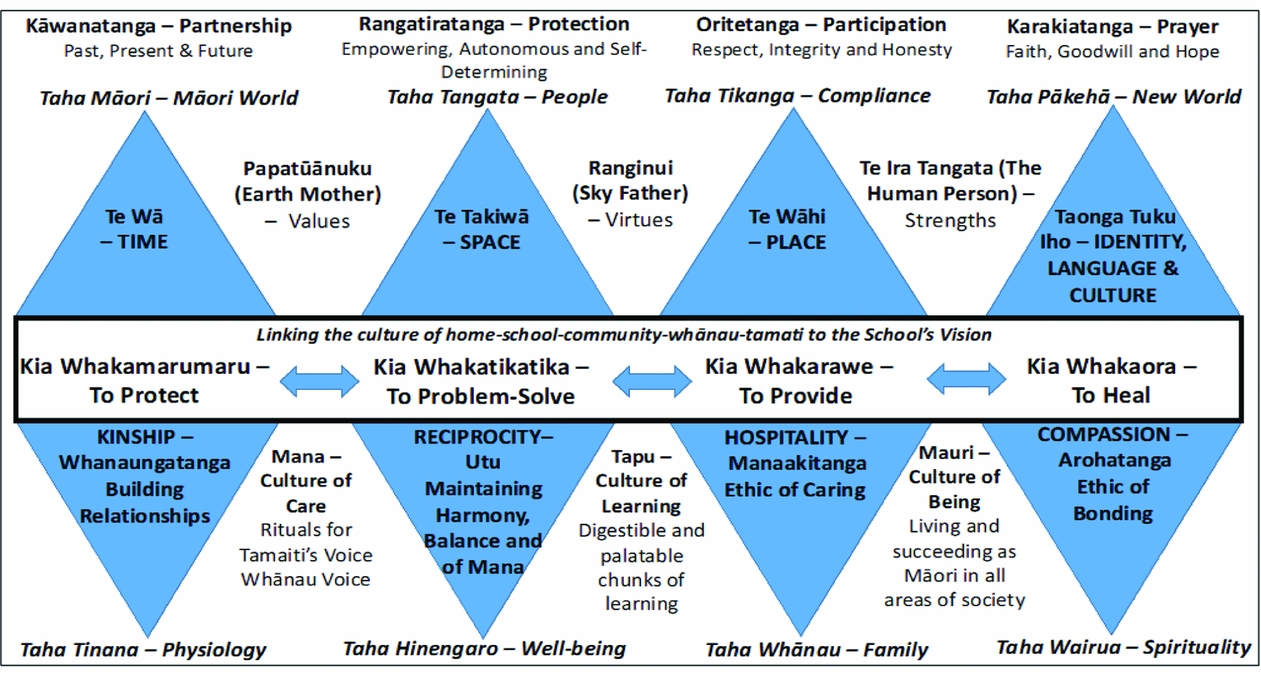
The Ngā Niho Taniwha (i.e., saw-edged patterns symbolizing family houses within a tribe and/or chiefly lineage) – Nurturing the Learning Spirit of the Māori Learner (i.e., Figure 1) conceptual framework emerged from the many conversations I had with whānau Māori and their children, principals, teachers and Board of Trustees over a period of 12 months. The culturally responsive framework not only mirrors the snow-covered mountain peaks of Aoraki in the South Island, and its link to the people of Ngāi Tahu, it also provides a way for schools and teachers to acknowledge the Indigenous peoples whose sacred lands they have the unique privilege to work on each day.
Ngā Niho Taniwha – nurturing the learning spirit of the Māori learner.

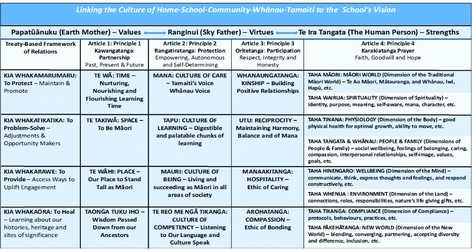
The inclusion of the Treaty of Waitangi is underpinned by four quite distinct cultural principles – kawangatanga, rangatiratanga, oritetanga and karakiatanga, and as a schooling commitment to upholding taha Māori (i.e., Māori worldviews) as a culturally inclusive practice (Smith, Reference Smith2000, Reference Smith2003). In this regard, the framework aims to protect and nurture the identity of a Māori child at school, as well as to support the inclusion of on-going dialogue with whānau Māori in the best interest of the child. Both schools agreed, that using culturally inclusive teaching approaches in English-medium schooling contexts in Aotearoa New Zealand, should be the norm, not the exception. Figure 2, suggests an innovative and culturally relevant framework of linking a school's vision with the learning needs of whānau Māori, and their children – more so as culturally connected learners (Meyer, Reference Meyer2005).
Linking the culture of home-school-community-Whānau Māori – Tamaiti to the school's vision.

I hasten to add, that this way of thinking is not new within a Māori world (Patterson, Reference Patterson1992; Royal, Reference Royal1998; Shirres, Reference Shirres2000) or indeed, in how Māori connect what and how they learn – philosophically and/or metaphorically (Durie, Reference Durie2004; Macfarlane, Reference Macfarlane2004; Royal, Reference Royal1998; Shires, Reference Shirres2000, Whitinui, Reference Whitinui2011). One school principal suggested that research of a holistic, reciprocal, is desperately necessary more than anything else, because it helps us to reflect not only what we are doing to benefit Māori children, and their learning, but it also enables us to reflect on what it means to be bicultural, and to create a kind of relational convergence that addresses educational inequities and inequalities for all students to learn – socially and academically.
Implications
The aim of developing schools as ‘cultural brokers’ to benefit whānau Māori and their children requires greater resourcing and professional development for existing teachers. Understanding the markers of whānau Māori flourishing (Kingi et al., Reference Kingi, Meihana, Mason, Cunningham, Borman and Ellison-Loschmann2014) and linking the culture of home-school-community-whānau Māori to the school's vision (i.e., Figure 2) is the first step for honouring the educational aspirations of whānau Māori, and their children. Therefore, it is vitally important for schools and teachers to not only talk with whānau Māori (as a collective) about the educational aspirations they have for their children's social and academic wellbeing, but to also be willing to translate back to whānau Māori amd their children how this will be achieved. For example, teachers who role-modelled te reo Māori me ngā tikanga in their classrooms were more likely to strengthen the identity of Māori children, as well as, promote healthy relationships for learning. Similarly, building a strong sense of belonging for Māori children was achieved when the school and teachers included appropriate Māori stories, field trips, cultural theme weeks, marae visits and/or kapa haka. Of interest were the following relationally and inclusive questions whānau Māori felt more confident to ask the school leaders and teachers:
1. How engaged was my child in class today?
2. Does my child consistently complete his or her work in class?
3. Is my child generally well-liked by his peers and the teachers?
4. What can my child improve on, and how?
Whānau Māori also reported that they valued the school organizing regular hui or meetings. It not only kept whānau Māori up-to-date with the how their children were doing, but it also provided a form of relational accountability through mutual trust, respect and empathy. The following questions respond to how schools and teachers can improve participation levels of Māori children in these settings. Exploring ways for schools and teachers to reduce the risks and/or overcome the barriers associated with Māori children not achieving their social and academic potential in these settings was a key consideration.
1. What can schools and teachers do to improve Māori children's level of interest in these two schools?
Ensuring that Māori children have a culturally safe environment where they can build positive, encouraging and just relationships with their teachers and their peers is essential to building a positive identity, and sense of self. Second, and as aforementioned, organizing activities that validate a child's cultural identity for example, introducing school-wide kapa haka learning sessions, promoting te reo Māori throughout the year, providing culturally relevant field trips to local sites of significance (Manning, Reference Manning2009, Reference Manning2017; Penetito, Reference Penetito2010), as well as including overnight marae visits provided a space(s) for language and culture to seen, heard and respected (Whitinui, Reference Whitinui2004, Reference Whitinui2008, Reference Whitinui2011). Maintaining an open door policy where teachers were actively engaged in supporting Māori children in a range of activities outside of normal school hours really helped to build better relationships for learning in the classroom.
2. What improves attendance of Māori children, and why?
A number of anecdotes emerged from both schools, and teachers that when food (i.e., morning breakfast, and/or lunches) was made available at school, and where finances to attend and participate in various scheduled school activities was not a barrier for Māori children, confidence and capability levels to learn increased significantly. Positive, open and honest relationships between staff and whānau Māori about their children's learning also instilled greater levels of trust and motivation to learn (Ministry of Education, 2011). In regards to attendance, schools and teachers, acknowledged that more can be done in this area, and were open to engaging with whānau Māori and their children about how to address such issues collaboratively (Ministry of Education, 2000). Schools and teachers also acknowledged that singling out individual children about their attendance was not constructive, and in some ways created barriers to learning and/or staying on task.
3. What constitutes positive associations for Māori children at school, and in the classroom?
One child best encapsulates the views of the majority of children when he/she said, ‘they need to know their teachers. . . relationships with the grown-ups in their lives are important to me, as well as my peers, as I want to feel comfortable with the people I spend most of my time with’. This was also reiterated by whānau Māori, who felt it was important for them to have faith and trust in the person who their child was spending six hours a day with. Indeed, creating a cultural safety net at school for Māori children, was not only about teachers creating positive relationships for learning in the classroom with students, it was also about creating a caring classroom environment or ethos where Māori children were acknowledged, and included as more likely to succeed as any other child in the classroom (Macfarlane, Reference Macfarlane2004).
4. What constitutes levels of success for Māori children at school, and in the classroom?
The feedback about success from both schools, and their teachers were at odds with what whānau Māori and their children reported. The schools and teachers focused more on Māori children's academic success, in terms of having children meet the national standards in literacy and numeracy, where whānau Māori and their children focused more on factors attributed to their social success (inclusive of culture) – such as feeling happy, engaging in daily physical activity and developing positive relationships with their teachers and peers. They also spoke about how important it was to have their language and culture validated by the school and their teachers, and that having work pitched at the age appropriate level was really important in building daily levels of success in the classroom, and having adults available to help with their learning both in the classroom, and at home (Macfarlane et al., Reference Macfarlane, Webber, Cookson-Cox and McRae2014; Mead, Reference Mead2003; Whitinui, Reference Whitinui2011).
5. What improves Māori children engagement at school and in the classroom?
Relationships and genuine respect were shared as two key factors of helping Māori children to better engage in the classroom. As mentioned above, creating a recognition space for open, honest and two-way conversations with whānau Māori and their children about their children's learning and/or behaviour really helped to clarify what is working well, and what can be further improved on. The example of involving kapa haka (Whitinui, Reference Whitinui2004, Reference Whitinui2008, Reference Whitinui2011) as a culturally integrated whole-school activity was shared by a number of participants in this study as critical to helping to develop a positive learning and behavioural outcomes for Māori children in these two schools.
Conclusion
The responses in the study clearly highlight the importance of continuing to strive to uphold, improve, and build on the national strategic intent of ‘Māori enjoying and achieving education success as Māori’ (Ministry of Education, 2008). Second, it is equally important for English-medium schools and teachers to engage with whānau Māori and their children in regular dialogue about ways to improve the schooling experience, and as the key cultural stakeholders and end-users of education. In addition, developing and building effective whānau-school-community wide partnerships for learning were considered necessary in how schools and teachers improving what they teach, and how. The Treaty of Waitangi, as our nation's founding document, and included within the New Zealand Curriculum Framework requires greater visibility, relevancy, and inclusion as to how it makes a difference for Māori children, and their learning in these settings. The Ngā Niho Taniwha – Nurturing the Learning Spirit of the Māori Learner highlighted above has far reaching implications and benefits for how schools and teachers can meet the social and academic needs of whānau Māori – as mana whenua, mana tangata and/or mana kaiwhakahaere (i.e., organisers, managers, advisors or advocates whose job it is to help lift the hopes, dreams and aspirations of people). The comment by whānau Māori related to, ‘What happens outside the school gates; is just as important as what happens inside the school gates’, is an open invitation for schools and teachers to be more culturally aware and socially engaged with/in the community, and outside the four walls of a classroom (Manning, Reference Manning2009, Reference Manning2017; Penetito, Reference Penetito2010). Manning (Reference Manning2009, Reference Manning2017) and Penetito (Reference Penetito2010) have both written extensively on the importance of place based pedagogy in New Zealand schools from an iwi/hapū Māori perspective, and the importance of (re)connecting Māori children to the land, language and their lives (socially and culturally) as Māori. Engaging iwi/hapū (i.e., within a wider Māori community), alongside the development and integration of school wide values, virtues and strengths from a Treaty-based standpoint, aims to build better relationships for learning that are educationally aspirational, as well as, socially and culturally informed. As a follow-up to this study, being able to predict and/or measure whether or not Māori children are either flourishing or languishing was a key consideration participants were very interested in knowing more about (Kingi et al., Reference Kingi, Meihana, Mason, Cunningham, Borman and Ellison-Loschmann2014; Morgan, Reference Morgan2006). By conducting such a study, schools, teachers, whānau Māori and their children felt they would be in a much stronger position to identify and anticipate the key risks and/or barriers associated with children's learning. Working together to eliminate inequalities for whānau Māori and their children perhaps remains as, Walker (Reference Walker1990) described, ‘a struggle without an end’. Conducting this study, however, did affirm that both schools are committed to honouring the educational aspirations whānau Māori and their children seek, and that including a Treaty relational based framework provides the ethical and inclusive blueprint for how to move forward together.
About the Author
Paul Whitinui (Ngāpuhi, Te Aupōuri, Ngāti Kurī, and Pākehā) is an Assistant Professor in the School of Exercise Science, Physical and Health Education (EPHE), based in the Faculty of Education at the University of Victoria. He was born and raised in Whakatāne, Bay of Plenty, New Zealand and has been a grateful visitor here on the sacred lands of the Coast and Strait Salish for the past year. Paul completed his doctorate in 2007 at the University of Auckland, New Zealand. His dissertation explored the educational benefits associated with Indigenous Māori students participating in Māori performing arts (i.e., kapa haka). His current research interests include exploring the effectiveness of Indigenous cultural safety training practices in higher education and community, successful learning pathways for Indigenous learners in higher education and community, as well as, investigating Indigenous children's wellbeing in public schools.