1. INTRODUCTION
Nonlinear propagation of intense laser pulses in plasma is one of the important recent interests with many applications including charged particles acceleration in plasma wakefield (Tajima et al., Reference Tajima and Dawson1979), laser fusion (Tabak et al., Reference Tabak, Hammer, Glinsky, Kruer, Wilks, Woodworth, Campbell, Perry and Mason1994; Deutsch et al., Reference Deutsch, Furukawa, Mima, Murakami and Nishihara1996), higher harmonics generation (Sprangle et al., Reference Sprangle, Esarey and Ting1990; Milchberg et al., Reference Milchberg, Durfee Iii and Macilrath1995; Zhou et al., Reference Zhou, Peatross, Murnane, Kapteyn and Christov1996), magnetic field generation (Shukla, Reference Shukla1999), X-ray lasers (Lemoff et al., Reference Lemoff, Yin, Gordan Iii, Barty and Harris1995), etc. In addition, propagating intense laser pulses in plasma can lead to the numerous instabilities (Max et al., Reference Max, Arons and Langdon1974; Esarey et al., Reference Esarey, Sprangle, Krall and Ting1996; Mori, Reference Mori1997) such as the parametric Raman and Brillouin instabilities, modulational and filamentational instabilities.
Self-focusing is a nonlinear optical phenomenon that appears via the change of the medium refractive index exposed to the intense electromagnetic radiation (Akhmanov et al., Reference Akhmanov, Sukhurov and Khokhlov1968; Cumberbatch, Reference Cumberbatch1970; Mourou et al., Reference Mourou, Tajima and Bulanov2006). When the refractive index of the medium increases with the electric field intensity, it can act as a positive focusing lens for an electromagnetic wave characterized by an initial transverse intensity profile, as in a laser beam. This phenomenon often occurs when an intense electromagnetic radiation generated by femtosecond lasers propagates through many solids, liquids, and gases. Related to the structure of medium and the laser intensity, several mechanisms may produce variations of the refractive index which leads to the self-focusing.
Recently, the development of laser technology has made possible the observation of self-focusing in the interaction of intense laser pulses with plasmas (Wagner et al., Reference Wagner, Chen, Maksimonchuk and Unstadter1997; Krushelnick et al., Reference Krushelnick, Ting, Moore, Burris, Esarey, Sprangle and Baine1997). In plasma, the thermal, relativistic, and ponderomotive effects can lead to the appearance of the self-focusing. Thermal self-focusing is the result of collisional heating of plasma due to the propagation of electromagnetic wave in plasma. Increase in the temperature leads to the hydrodynamic expansion which causes an increase in the refraction index and further heating (Perkins et al., Reference Perkins and Valeo1974). Relativistic self-focusing is the result of the relativistic mass increase of the plasma electrons, which modifies the refractive index. Ponderomotive self-focusing is induced by the ponderomotive force, which accelerates electrons in the radial direction of the beam and produces a lower density in the central regions. As a result, an increase in the refraction index causes the self-focusing of the propagating electromagnetic wave.
When an intense short laser pulse propagates through plasma, electron-positron (e-p) pair's production can lead to the creation of three component electron-positron-ion (e-p-i) plasma (Berezhiani et al., Reference Berezhiani, Tskhakaya and Shukla1992). Also e-p-i plasma can be observed in the experimental investigations, where positrons are used to study the transport in the tokomaks (Surko et al., Reference Surko, Levethal, Crane, Passne and Wysocki1986). Furthermore, such three component plasma appeared in the early universe (Rees, Reference Rees, Gibbons, Hawking and Siklos1983) and can exist in the pulsars magnetosphere (Michel, Reference Michel1982).
Recently, the problem of the laser self-focusing in magnetized cold electron-ion (e-i) plasma has been studied theoretically (Jha et al., Reference Jha, Mishra, Upadhyaya and Raj2006; Reference Jha, Mishra, Upadhyay and Raj2007; Varshney et al., Reference Varshney, Sen, Rathore and Varshney2011). The effect of polarization on the laser beam self-focusing in hot e-i magneto-active plasma has already been studied by Sepehri Javan and Nasirzadeh (Reference Sepehri Javan and Nasirzadeh2012). In the present work, we theoretically consider self-focusing of a circularly polarized intense laser beam in magnetized hot e-p-i plasma. We pay special attention to the effect of polarization, temperature, and fraction of e-p pairs on self-focusing. Our results can be useful in the experimental researches where positrons are employed as probes and also when the scattering of electromagnetic waves is used in the diagnostics of e-p-i plasmas.
The organization of this paper is as follows. In Section 2, the basic assumptions are presented and the nonlinear wave equation is derived. An analytic expression for the evolution of laser spot size is obtained in Section 3. In Section 4, a numerical study of the self-focusing of circularly-polarized laser beam in magnetized e-p-i plasma is presented. Concluding remarks are made in Section 5.
2. DERIVING NONLINEAR WAVE EQUATION
We consider the propagation of a circularly-polarized electromagnetic wave in hot magnetized three-component e-p-i plasma. We assume that the plasma medium is a mixture of background e-i plasma and excess e-p plasma. Each type of plasma particles, including two different groups of electrons belong to two different sources, positrons, and ions, may have different temperatures. To determine the quantities related to the electrons of background e-i plasma, ions, electrons of e-p pair plasma, and positrons, we use indices e2, i, e1, and p, respectively. We take the external magnetic field parallel to the z axis, i.e.,  ${\bf B}_{\bf 0}=B_0 {\hat {\bf e}}_{\bf z}$. To describe the nonlinear dynamics of the interaction of electromagnetic wave with plasma, we define the electric and the magnetic fields E and B through the vector and scalar potentials A, φ as
 $${\bf E}=- \displaystyle{1 \over c}\displaystyle{{\partial {\bf A}} \over {\partial t}} - \nabla {\rm \varphi}\comma \; \quad {\bf B}=\nabla \times {\bf A}\comma$$
where c is the speed of light.
Using Eq. (1) in the Maxwell equations, one can obtain
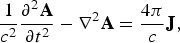 $$\displaystyle{1 \over {c^2 }}\displaystyle{{\partial ^2 {\bf A}} \over {\partial t^2 }} - \nabla ^2 {\bf A}=\displaystyle{{4{\rm \pi} } \over c}{\bf J} \comma$$
here, 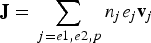 ${\bf J}=\sum_{\,j=e1\comma e2\comma p}{n_j e_j {\bf v}_j }$ is the current density of the electrons and positrons of plasma, e j, vj, n j are the density, velocity, and charge of type j, respectively. We ignored the translational velocity of the heavy ions.
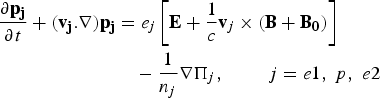
Now, we can write the relativistic fluid momentum equation for each type of plasma particles as
 $$\eqalign{\displaystyle{{\partial {\bf p}_{\bf j} } \over {\partial t}}+\lpar {\bf v}_{\bf j} .\nabla \rpar {\bf p}_{\bf j} &=e_j \left[{{\bf E}+\displaystyle{1 \over c}{\bf v}_j \times \lpar {\bf B}+{\bf B}_{\bf 0} \rpar } \right]\cr & \quad - \displaystyle{1 \over {n_j }}\nabla \Pi _j\comma \; \qquad j=e1\comma \; p\comma \; e2}$$
here, pj, Πj, e j are the momentum, pressure and charge of j type, respectively. Substituting Eq. (1) into Eq. (3) leads to
 $$\eqalign{& \displaystyle {{\partial {\bf p}_{\bf j} } \over {\partial t}}+\displaystyle{1 \over {{\rm \gamma} _j m_0 }}\lpar {\bf p}_{\bf j} .\nabla \rpar {\bf p}_{\bf j} =- \displaystyle{{e_j } \over c}\displaystyle{{\partial {\bf A}} \over {\partial t}} - e_j \nabla {\rm \varphi}+\displaystyle{{e_j } \over {{\rm \gamma} _j m_0 c}}{\bf p}_{\bf j} \cr & \quad \times \lpar \nabla \times {\bf A}\rpar \pm \displaystyle{{{\rm \omega} _c } \over {{\rm \gamma} _j }}{\bf p}_{\bf j} \times {\hat {\bf e}}_{\bf z} - k_B T_j \nabla \ln \lpar n_j \rpar \comma \; }$$
here, T j is the temperature, m 0 is the electron rest mass, 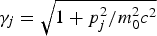 ${\rm \gamma} _j=\sqrt {1+p_j^2 /m_0 ^2 c^2 } $ is the relativistic Lorentz factor, ωc = e B 0/m 0c is the electron cyclotron frequency, and k B is the Boltzmann constant. Also, it should be clarified that in Eq. (4) the sign of ωc for positron (electron) is positive (negative).
We consider the propagation of circularly polarized wave along the external magnetic field and write the vector potential of this wave as
 $${\bf A}=\displaystyle{1 \over 2}\tilde A\lpar {\hat {\bf e}}_{\bf x}+i{\rm \sigma} {\hat {\bf e}}_y \rpar \exp \lpar - i{\rm \omega} _0 t+ik_0 z\rpar +c.c.\comma$$
where, ω0, k 0 are the frequency and wave number, respectively, σ = +1, − 1 denotes the right- and left-hand circularly polarized wave, respectively, and also  $\tilde A\lpar z\comma \; t\rpar $ is the slowly varying amplitude that satisfies the following condition:
 $$\left\vert {\displaystyle{1 \over {{\rm \omega} _0 }}\displaystyle{{\partial \tilde A} \over {\partial t}}} \right\vert \lt \lt \left\vert {\tilde A} \right\vert .$$
Inserting Eq. (5) into Eq. (4) we can find that Eq. (4) is satisfied by (Rao et al.-, Reference Rao, Shukla and Yu1984; Shukla et al., Reference Shukla, Rao, Yu and Tsintsadze1986; Sepehri, Reference Sepehri Javan and Adli2013; Sepehri et al., Reference Sepehri Javan2013)
 $${\bar {\bf p}}_j=\displaystyle{{{\bar {\bf A}}} \over {1 - {\rm \sigma} {\rm \alpha} /{\rm \gamma} _j }}\comma \; \quad \, \hbox{for} \quad j=e1\comma \; e2\comma \; \quad {\bar {\bf p}}_p=\displaystyle{{ - {\bar {\bf A}}} \over {1+{\rm \sigma} {\rm \alpha} /{\rm \gamma} _p }}$$
and together with
 $$\eqalign{n_j & =n_{0j} \exp \left[{\displaystyle{{e{\rm \varphi} } \over {k_B T_j }} - {\rm \beta} _j \left({{\rm \gamma} _j - 1 - \displaystyle{{{\rm \sigma} {\rm \alpha} } \over {2{\rm \gamma} _j^2 }}\vert \bar p_j \vert ^2 } \right)} \right]\comma \; \quad \, \hbox{for} \quad j=e1\comma \; e2 }$$
and
 $$n_p=n_{0p} \exp \left[{ - \displaystyle{{e{\rm \phi} } \over {k_B T_p }} - {\rm \beta} _p \left({{\rm \gamma} _p - 1+\displaystyle{{{\rm \sigma} {\rm \alpha} } \over {2{\rm \gamma} _p^2 }}\vert \bar p_p \vert ^2 } \right)} \right]\comma$$
where, n 0j is the unperturbed density,  ${\bar {\bf p}}_j={\bf p}_j /m_0 c$ is the normalized electron momentum,
 ${\bar {\bf A}}=e{\bf A}/m_0 c^2 $ is the normalized vector potential, α = ωc/ω0, βj = c 2/v Tj2, v Tj2 = k BT e/m 0 is the thermal velocity. For weakly relativistic laser intensity, when
 $\vert {\bar {\bf A}}\vert ^2\comma \; \vert {\bar {\bf P}}_j \vert ^2 \lt \!\!\lt 1$ and
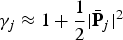 ${\rm \gamma} _j \approx 1+\displaystyle{1 \over 2}\vert {\bar {\bf P}}_j \vert ^2 $, we can simplify densities of plasma particles as following
 $$n_j=n_{0j} \exp \left[{\displaystyle{{e{\rm \varphi} } \over {k_B T_j }} - \displaystyle{{{\rm \beta} _j } \over 2}\displaystyle{{\left\vert {{\bar {\bf A}}} \right\vert ^2 } \over {\lpar 1 - {\rm \sigma} {\rm \alpha} \rpar }}} \right]\comma \; \qquad j=e1\comma \; e2$$
and
 $$n_p=n_{0p} \exp \left[{ - \displaystyle{{e{\rm \varphi} } \over {k_B T_p }} - \displaystyle{{{\rm \beta} _p } \over 2}\displaystyle{{\left\vert {{\bar {\bf A}}} \right\vert ^2 } \over {\lpar 1+{\rm \sigma} {\rm \alpha} \rpar }}} \right].$$
We suppose that the ion slow motion is non-relativistic. When the phase velocity of the ion fluctuations is much smaller than the thermal velocity, the quasi-static ion number density follows from a balance of the ion thermal pressure and the slow field. Since the quasi-static interaction arises on very slow time scale (typically larger than the ion plasma period)  ${\rm \omega} _{\,pi} ^{ - 1}=\lpar 4{\rm \pi} n_{0i} e^2 /m_{0i} \rpar ^{ - {1/ 2}} $, where n 0i and m 0i are unperturbed density of ion and rest mass of ion, respectively), one may assume an isothermal equation of state for ions, and obtain the ion number density expression (Jha et al., Reference Jha, Mishra, Upadhyaya and Raj2006):
 $$n_i=n_{0i} \exp \left(- \displaystyle{{e{\rm \varphi} } \over {k_B T_i }}\right)\comma$$
where T i is the ions temperature.
Expanding Eqs. (10)–(12) and using them in the quasi-neutral condition n e1 + n e2 − n p − n i = 0, yields the following result
 $${\rm \varphi}=\displaystyle{{\matrix{n_{0e1} {\rm \beta} _{e1} \left(\displaystyle{1 \over 2}\displaystyle{{\vert \bar A\vert ^2 } \over {1 - {\rm \sigma} {\rm \alpha} }}\right)+n_{0e2} {\rm \beta} _{e2} \left(\displaystyle{1 \over 2}\displaystyle{{\vert \bar A\vert ^2 } \over {1 - {\rm \sigma} {\rm \alpha} }}\right)\cr- n_{0p} {\rm \beta} _p \left(\displaystyle{1 \over 2}\displaystyle{{\vert \bar A\vert ^2 } \over {1+{\rm \sigma} {\rm \alpha} }}\right)}} \over {\displaystyle{e \over {k_B }}\left(\displaystyle{{n_{0e1} } \over {T_{e1} }}+\displaystyle{{n_{0e2} } \over {T_{e2} }}+\displaystyle{{n_{0p} } \over {T_p }}+\displaystyle{{n_{0i} } \over {T_i }}\right)}}.$$
Introduction Eq. (13) into Eqs. (10) and (11) results in the following for the densities of plasma particles
 $$n_j=n_{0j} \exp \left(- \displaystyle{1 \over 2}\vert \bar A\vert ^2 Q_j \right)\comma \; \qquad j=e1\comma \; e2\comma \; p\comma \; i\comma$$
where
 $$Q_{e1}=\displaystyle{{\displaystyle{{ - {\rm \zeta} _2 {\rm \beta} _{e2} } \over {1 - {\rm \sigma} {\rm \alpha} }}+\displaystyle{{{\rm \zeta} _p {\rm \beta} _p } \over {1+{\rm \sigma} {\rm \alpha} }}+\displaystyle{{{\rm \beta} _{e1} } \over {1 - {\rm \sigma} {\rm \alpha} }}\left(\displaystyle{{{\rm \zeta} _2 } \over {{\rm \delta} _2 }}+\displaystyle{{{\rm \zeta} _i } \over {{\rm \delta} _i }}+\displaystyle{{{\rm \zeta} _p } \over {{\rm \delta} _p }}\right)} \over {1+\displaystyle{{{\rm \zeta} _p } \over {{\rm \delta} _p }}+\displaystyle{{{\rm \zeta} _2 } \over {{\rm \delta} _2 }}+\displaystyle{{{\rm \zeta} _i } \over {{\rm \delta} _i }}}}\comma$$
 $$Q_{e2}=\displaystyle{{ - \displaystyle{{{\rm \beta} _{e1} } \over {1 - {\rm \sigma} {\rm \alpha} }}+\displaystyle{{{\rm \zeta} _p {\rm \beta} _p } \over {1+{\rm \sigma} {\rm \alpha} }}+\displaystyle{{{\rm \beta} _{e2} } \over {1 - {\rm \sigma} {\rm \alpha} }}\left({\rm \delta} _2+{\rm \zeta} _p \displaystyle{{{\rm \delta} _2 } \over {{\rm \delta} _p }}+{\rm \zeta} _i \displaystyle{{{\rm \delta} _2 } \over {{\rm \delta} _i }}\right)} \over {{\rm \zeta} _2+{\rm \zeta} _i \displaystyle{{{\rm \delta} _2 } \over {{\rm \delta} _i }}+{\rm \zeta} _p \displaystyle{{{\rm \delta} _2 } \over {{\rm \delta} _p }}+{\rm \delta} _2 }}\comma$$
 $$Q_p=\displaystyle{{\displaystyle{{{\rm \beta} _{e1} } \over {1 - {\rm \sigma} {\rm \alpha} }}+\displaystyle{{{\rm \zeta} _2 {\rm \beta} _{e2} } \over {1 - {\rm \sigma} {\rm \alpha} }}+\displaystyle{{{\rm \beta} _p } \over {1+{\rm \sigma} {\rm \alpha} }}\left({\rm \zeta} _i \displaystyle{{{\rm \delta} _p } \over {{\rm \delta} _i }}+{\rm \zeta} _2 \displaystyle{{{\rm \delta} _p } \over {{\rm \delta} _2 }}+{\rm \delta} _p \right)} \over {\left({\rm \zeta} _p+{\rm \delta} _p+{\rm \zeta} _i \displaystyle{{{\rm \delta} _p } \over {{\rm \delta} _i }}+{\rm \zeta} _2 \displaystyle{{{\rm \delta} _p } \over {{\rm \delta} _2 }}\right)}}\comma$$
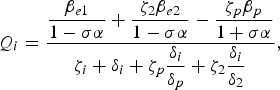 $$Q_i=\displaystyle{{\displaystyle{{{\rm \beta} _{e1} } \over {1 - {\rm \sigma} {\rm \alpha} }}+\displaystyle{{{\rm \zeta} _2 {\rm \beta} _{e2} } \over {1 - {\rm \sigma} {\rm \alpha} }} - \displaystyle{{{\rm \zeta} _p {\rm \beta} _p } \over {1+{\rm \sigma} {\rm \alpha} }}} \over {{\rm \zeta} _i+{\rm \delta} _i+{\rm \zeta} _p \displaystyle{{{\rm \delta} _i } \over {{\rm \delta} _p }}+{\rm \zeta} _2 \displaystyle{{{\rm \delta} _i } \over {{\rm \delta} _2 }}}}\comma$$
 $$\displaystyle{{n_{0e2} } \over {n_{0e1} }}={\rm \zeta} _2 \comma \; \qquad \displaystyle{{n_{0p} } \over {n_{0e1} }}={\rm \zeta} _p \comma \; \qquad \displaystyle{{n_{0i} } \over {n_{0e1} }}={\rm \zeta} _i \comma$$
 $$\displaystyle{{T_p } \over {T_{e1} }}={\rm \delta} _p \comma \; \qquad \displaystyle{{T_i } \over {T_{e1} }}={\rm \delta} _i \comma \; \qquad \displaystyle{{T_{e2} } \over {T_{e1} }}={\rm \delta} _2 .$$
In the physical units, we obtain from Eqs. (7)
 $$\eqalign{{\bf v}_{e1} & =\displaystyle{e \over {m_0 c}}\displaystyle{{\bf A} \over {{\rm \gamma} _{e1} - {\rm \sigma} {\rm \alpha} }}\comma \; {\bf v}_{e2}=\displaystyle{e \over {m_0 c}}\displaystyle{{\bf A} \over {{\rm \gamma} _{e2} - {\rm \sigma} {\rm \alpha} }}\comma \; {\bf v}_p=\displaystyle{{ - e} \over {m_0 c}}\displaystyle{{\bf A} \over {{\rm \gamma} _p+{\rm \sigma} {\rm \alpha} }}.}$$
Also, for the electrons and positrons Lorentz factors one can write approximately
 $${\rm \gamma} _{e1\comma e2} \approx \sqrt {1+\displaystyle{{\vert {\bar {\bf A}}\vert ^2 } \over {\lpar 1 - {\rm \sigma} {\rm \alpha} \rpar ^2 }}} \comma \; \qquad {\rm \gamma} _p \approx \sqrt {1+\displaystyle{{\vert {\bar {\bf A}}\vert ^2 } \over {\lpar 1+{\rm \sigma} {\rm \alpha} \rpar ^2 }}} .$$
Now, taking Eqs. (14) and (21) into consideration, we can derive the nonlinear current density
 $$\eqalign{{\bf J} & =- \displaystyle{{\bf A} \over 4{\rm \pi} c}\left\{\displaystyle{{\rm \omega}_{\,pe1}^2 \over {\rm \gamma} _{e1} - {\rm \sigma} {\rm \alpha}}\exp \left(- \displaystyle{Q_{e1} \over 2}\vert \bar A\vert^2 \right)+\displaystyle{{\rm \omega}_{\,pe2}^2 \over {\rm \gamma}_{e2} - {\rm \sigma} {\rm \alpha}} \right. \cr & \left. \quad \times \exp \left(- \displaystyle{Q_{e2} \over 2}\vert \bar{A}\vert^2 \right)+\displaystyle{{\rm \omega}_{\,pp}^2 \over {\rm \gamma}_p + {\rm \sigma} {\rm \alpha}}\exp \left(- \displaystyle{Q_p \over 2}\vert \bar{A}\vert^2 \right)\right\}}$$
where 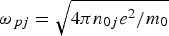 ${\rm \omega} _{\,pj}=\sqrt {4{\rm \pi} n_{0j} e^2 /m_0 } $ is the Langmuir frequency of j type particle.
In the weakly relativistic regime of laser intensity, we can expand the nonlinear current density of Eq. (23) with respect to the normalized vector potential amplitude and save only the second orders of amplitude. In this case, substituting simplified current density, together with the vector potential in the form of Eq. (5) into Eq. (2) leads to the following equation for the electromagnetic wave envelope
 $$\eqalign{& \left(\nabla ^2 - \displaystyle{1 \over {c^2 }} \displaystyle{\partial ^2 \over \partial t^2 } \right)ae^{i\lpar k_0 z - {\rm \omega} _0 t\rpar } =k_p^2 \left[\displaystyle{{\rm \omega} _{\,pe1}^2+{\rm \omega} _{\,pe2}^2 \over {{\rm \omega} _p^2 }}\left(\displaystyle{1 \over {1 - {\rm \sigma} {\rm \alpha} }} \right)\right. \cr & \left. \quad +\displaystyle{{\rm \omega} _{\,pp}^2 \over {{\rm \omega} _p^2 }}\left(\displaystyle{1 \over {1+{\rm \sigma} {\rm \alpha} }} \right)- \vert a\vert ^2 N \right]ae^{i\lpar k_0 z - {\rm \omega} _0 t\rpar } \comma \; }$$
where the nonlinear term is described by
 $$\eqalign{ N & =\displaystyle{{{\rm \omega} _{\,pe1}^2 } \over {{\rm \omega} _p^2 }}\left({\displaystyle{1 \over {2\lpar 1 - {\rm \sigma} {\rm \alpha} \rpar ^4 }}+\displaystyle{{Q_{e1} } \over {2\lpar 1 - {\rm \sigma} {\rm \alpha} \rpar }}} \right)+\displaystyle{{{\rm \omega} _{\,pe2}^2 } \over {{\rm \omega} _p^2 }}\left({\displaystyle{1 \over {2\lpar 1 - {\rm \sigma} {\rm \alpha} \rpar ^4 }}+\displaystyle{{Q_{e2} } \over {2\lpar 1 - {\rm \sigma} {\rm \alpha} \rpar }}} \right)\cr & \quad +\displaystyle{{{\rm \omega} _{\,pp}^2 } \over {{\rm \omega} _p^2 }}\left({\displaystyle{1 \over {2\lpar 1+{\rm \sigma} {\rm \alpha} \rpar ^4 }}+\displaystyle{{Q_p } \over {2\lpar 1+{\rm \sigma} {\rm \alpha} \rpar }}} \right) \comma }$$
and  ${\rm \omega} _p=\sqrt {{\rm \omega} _{\,pe1}^2+{\rm \omega} _{\,pe2}^2+{\rm \omega} _{\,pp}^2 } \comma \; a=e\tilde A/m_{0e} c^2 \comma \; k_p={\rm \omega} _p /c$ are the total Langmuir frequency, normalized amplitude of vector potential, and wave number of the total plasma wave, respectively.
For pure e-i plasma when ωpe1 = ωpp = 0, the nonlinear term reduces to
 $$N=\displaystyle{{{\rm \omega} _0^4 } \over {2\lpar {\rm \omega} _0 - {\rm \sigma} {\rm \omega} _c \rpar ^4 }}+\displaystyle{{{\rm \omega} _0^2 } \over {2\lpar {\rm \omega} _0 - {\rm \sigma} {\rm \omega} _c \rpar ^2 }}\displaystyle{{{\rm \beta} _{e2} } \over {1+T_i /T_{e2} }}\comma$$
that agrees with the results of Sepehri Javan and Nasirzadeh (Reference Sepehri Javan and Nasirzadeh2012). In the case of pure pair plasma (when ωpe2 = 0 and ωpe1 = ωpp) we can obtain
 $$N=\displaystyle{{1+{\rm \alpha} ^4+6{\rm \alpha} ^2 } \over {\lpar 1 - {\rm \alpha} ^2 \rpar ^4 }}+\displaystyle{{\rm \beta} \over {\lpar 1 - {\rm \alpha} ^2 \rpar ^2 }}\comma$$
where 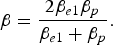 ${\rm \beta}=\displaystyle{{2{\rm \beta} _{e1} {\rm \beta} _p } \over {{\rm \beta} _{e1}+{\rm \beta} _p }}.$
3. ENVELOPE EVOLUTION
Eq. (24) describes the nonlinear dynamics of a circularly polarized electromagnetic wave envelope in magnetized hot e-p-i plasma in the quasi-neutral approximation. This approximation cannot be more realistic in the case of cold plasma and large-amplitude fields (Shukla et al., Reference Shukla, Marklund and Eliasson2004). To study the problem of self-focusing of electromagnetic wave, we use the well-known source dependent expansion method (Esarey et al., Reference Esarey, Sprangle, Krall and Ting1997). In this method, we expand the laser amplitude as a series of Laguerre-Gaussian source-dependent modes as the following
 $${a\lpar r\comma \; z\rpar =\sum\limits_m {\hat a_m } L_m \lpar {\rm \chi} \rpar \exp \lsqb\! - \lpar 1 - i{\rm \alpha} _s \rpar {\rm \chi} /2\rsqb \comma \; \quad m=0\comma \; 1\comma \; 2\comma \; 3\comma \; \ldots \comma}$$
where,  $\hat a_m \lpar z\rpar $ is the complex amplitude, χ = 2r 2 /r s2, r s (z) is the spot size, αs (z) = k 0r s2/2R c is related to the curvature R c associated with the wave-front and L m (χ) is a Laguerre polynomial of order m. We consider only the lowest order Gaussian mode (m = 0) in Eq. (28) and assume the amplitude of this mode as
 $\hat a_0=a_s \exp \lpar i{\rm \theta} _s \rpar $, where a s is the real amplitude and θs is the phase. By substituting Eq. (28) in the wave equation (24), we can obtain the following differential equation for the evolution of laser spot size
 $$\displaystyle{{\partial ^2 r_s } \over {\partial z^2 }}=\displaystyle{4 \over {k_0 ^2 r_s ^3 }}\left({1 - \displaystyle{{k_p ^2 a_0 ^2 r_0 ^2 } \over 8}N} \right)\comma$$
where r s (z = 0) = r 0. The first term on the right-hand side of Eq. (29) gives the vacuum diffraction and the second term related to the nonlinear effects of density perturbation, relativistic mass variation, temperature correction, polarization, and external magnetic field on the laser spot size evolution. The parameter P/P c = k p2a 02r 02N/8 is the normalized power. When P > P c the nonlinear term is dominant and the self-focusing occurs. The term p c = 2π2c 5m 02/k p2 λ2e 2N (where λ is the wave-length of laser) presents the critical power for nonlinear self-focusing of electromagnetic waves in the magnetized hot e-p-i plasma.
Solution of Eq. (29) yields the following
 $$\displaystyle{{r_s ^2 } \over {r_0 ^2 }}=1+\left({1 - \displaystyle{P \over {P_c }}} \right)\displaystyle{{z^2 } \over {Z_R ^2 }}\comma$$
where Z R = k 0r 02/2 is the Rayleigh length.
4. NUMERICAL DISCUSSIONS
Now, we numerically study the evolution of laser spot size as a function of physical parameters. Initially, it should be better to mention that the order of parameters has been selected in accordance with the usual ranges of parameters used in the laser-plasma interaction experiments (for example, see Jha et al. (Reference Jha, Kumar, Raj and Upadhyaya2005)). In all investigated cases, we have supposed a Nd:YaG laser with frequency ω0 = 1.88 × 10¹⁵s −1 (that corresponds to the laser wave length λ ≈ 1 μm), a 0 = 0.1 (laser intensity I ≈ 1.4 × 10¹⁶W/cm 2) and beam waist r 0 = 15 µm.
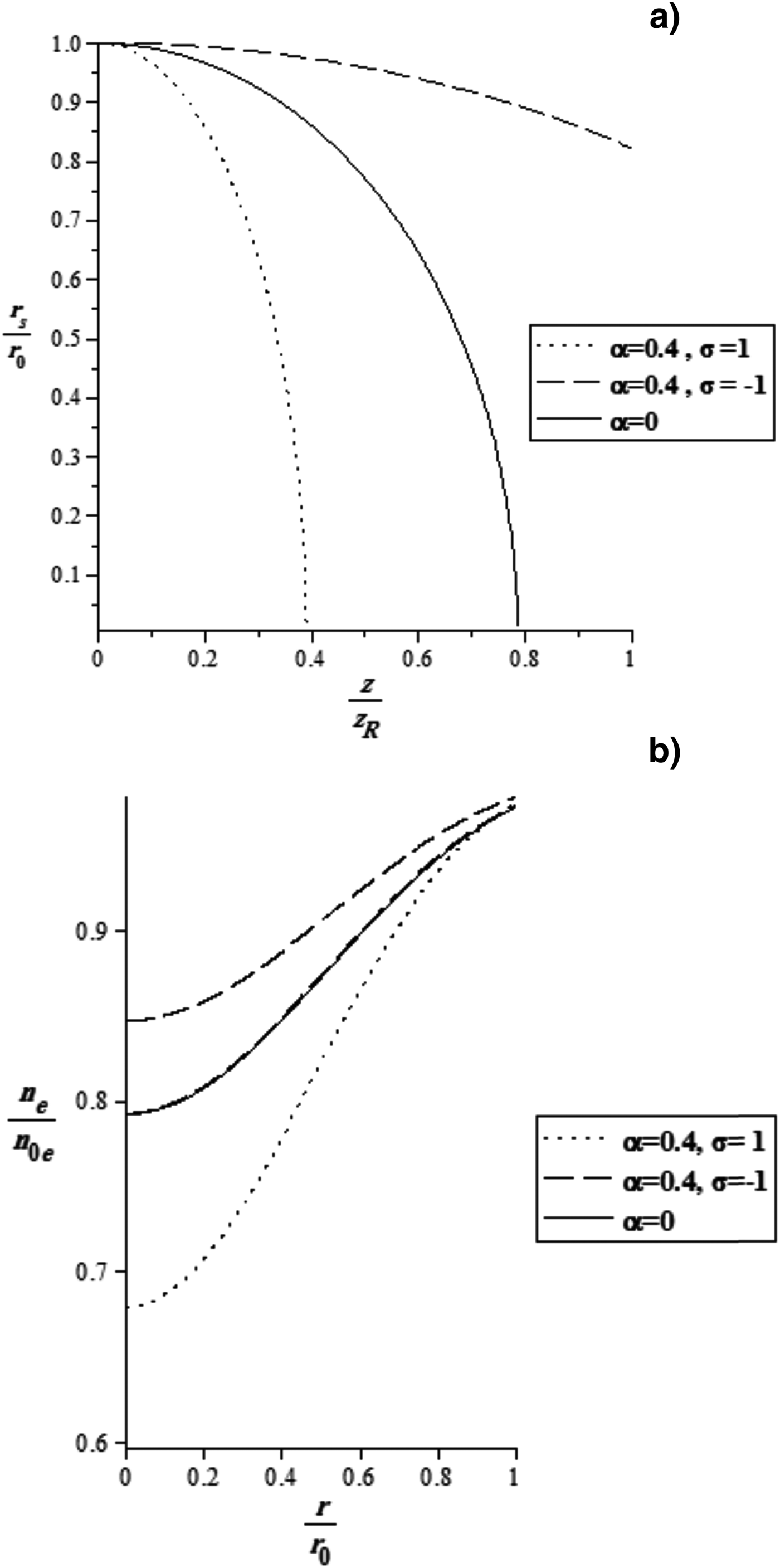
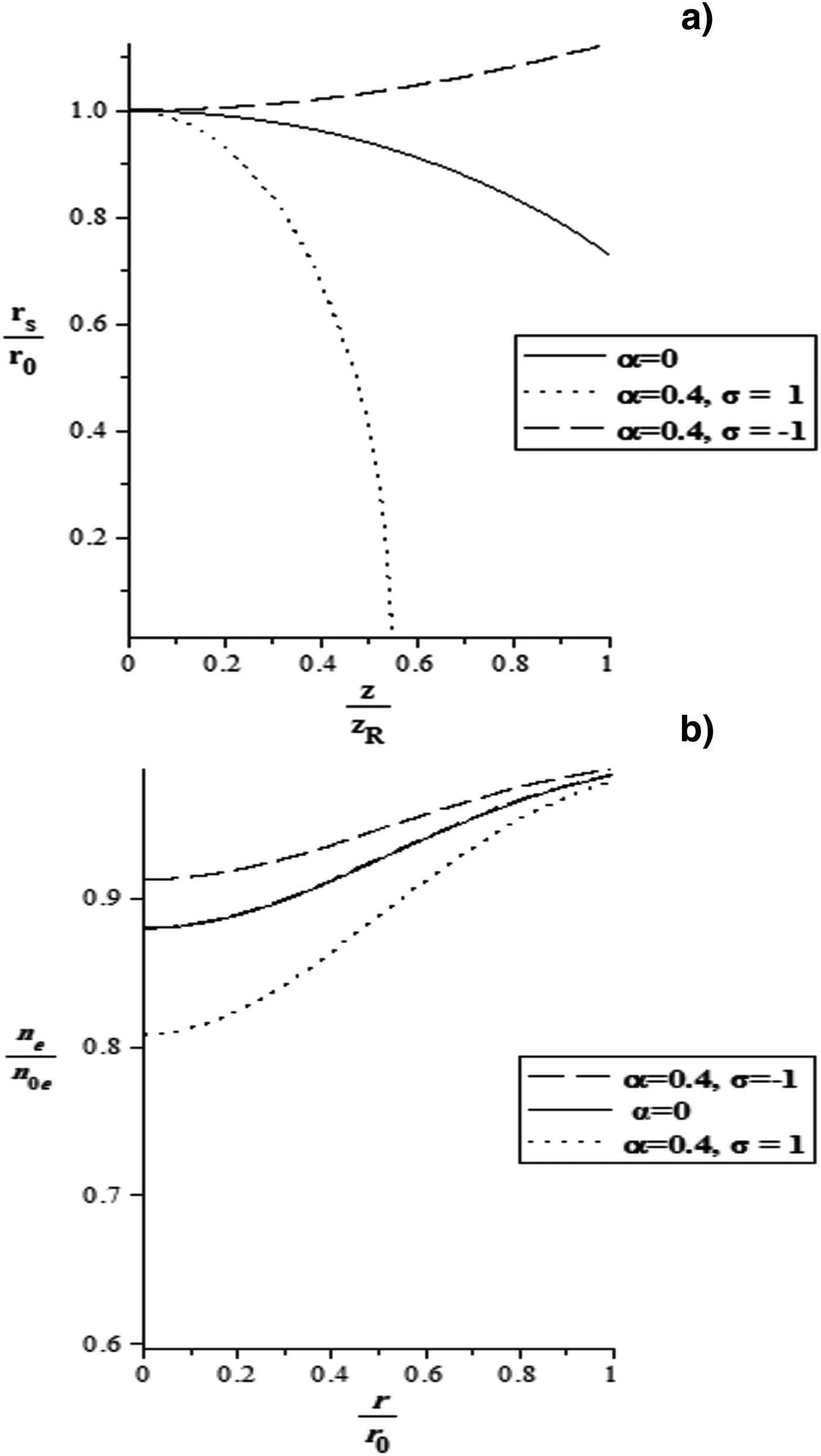
Figure 1a shows the variation of normalized laser spot size r s/r 0 with respect to normalized propagation distance z/Z R. In Figure 1b, we considered the variation of normalized electron density n e/n 0e (and or ions density) with respect to normalized radial distance r/r 0 at a fixed z/Z R = 0.3. In both cases, solid lines are used for unmagnetized plasma, dotted lines for right-hand polarized wave with α = 0.4 (or equivalently B 0 = 4.28 kT), and dashed lines for left-hand polarized wave with α = 0.4. Here we assumed e-i plasma with ωpe1 = ωpp = 0, ωpe2 = 0.1ω0 (n 0e2 ≈ 1019cm −3), T e2 = 10 keV, and T i = 1 keV. We can see that the spot size decreases with increasing external magnetic field for right-hand laser polarization. Inversely, laser spot size increases with increasing magnetic field for left-hand polarization. Therefore, the application of external magnetic field enhances the quality of self-focusing for right-hand polarization and reduces it for left-hand polarization. Physically, the right-hand wave drives electrons in the direction of their cyclotron motion. In this polarization, the increase in magnetic field causes the increase in transverse velocity of electrons and it leads to the increase in the relativistic mass of electrons. The rotation sense of the left-hand polarization is opposite to electrons cyclotron motion and the velocity of electrons (and/or consequently, the nonlinearity of plasma medium) decreases with increase in external magnetic field. In Figure 1b, the effect of magnetic field on the laser beam self-focusing is evident. We can see that the application of magnetic field increases the slope of the density profile for right-hand polarization and decreases it for left-hand polarization. In Figure 2, we increased ions temperature to T i = 10 keV. Increase in the ions temperature leads to the decrease in the self-focusing property for all cases. Since the density of plasma particles is Maxwellian-like, because of the increase in the temperature, the variation of particles distribution in space is more slowly than the previous lower temperature case. In other words, increase in the temperature quenches the ponderomotive force which leads to a decrease in the slope of the density profile for all cases (compare Figs. 1b and 2b).
(a) Variation of normalized laser spot size r s/r 0 with respect to normalized propagation distance z/Z R (b) variation of normalized electron density n e/n 0e with respect to normalized radial distance r/r 0 in a fixed z/Z R = 0.3. Solid lines for unmagnetized plasma, dotted lines for right-hand polarized wave with α = 0.4, and dashed line for left-hand polarized wave with α = 0.4. ωpe1 = ωpp = 0, ωpe2 = 0.1 ω0, T e2 = 10 keV, and T i = 1 keV.

(a) Variation of normalized laser spot size r s/r 0 with respect to normalized propagation distance z/Z R (b) variation of normalized electron density n e/n 0e with respect to normalized redial distance r/r 0 in a fixed z/Z R = 0.3. Solid lines for unmagnetized plasma, dotted lines for right-hand polarized wave with α = 0.4, and dashed line for left-hand polarized wave with α = 0.4. ωpe1 = ωpp = 0, ωpe2 = 0.1 ω 0, and T e2 = T i = 10 keV.
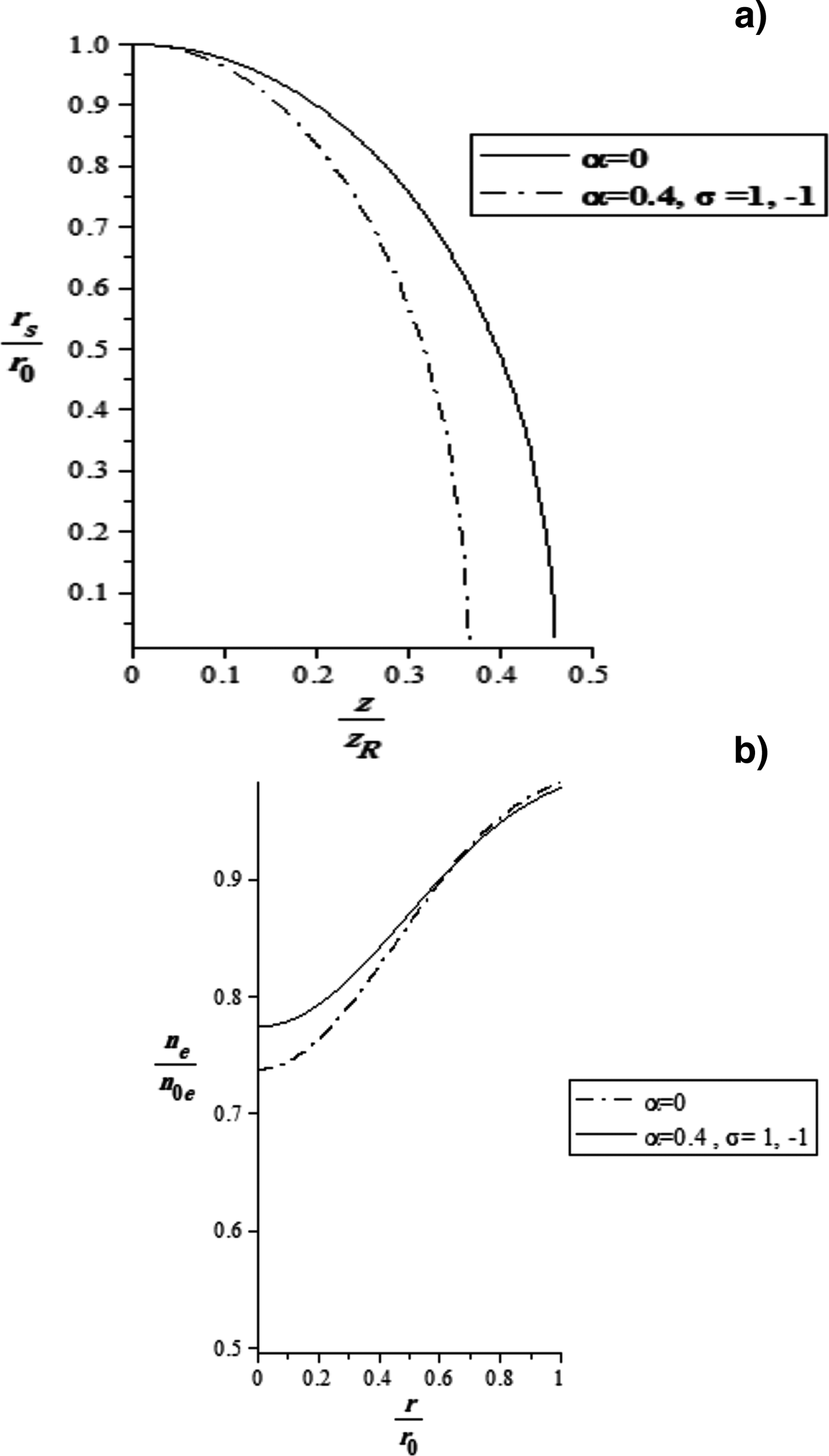
In Figure 3a, normalized laser spot size r s/r 0 is plotted versus normalized propagation distance z/Z R. In Figure 3b, variation of normalized electron density n e/n 0e with respect to normalized radial distance r/r 0 is demonstrated at a fixed z/Z R = 0.3. In both cases, solid lines are used for unmagnetized plasma, and dash-dotted lines for left- and right-hand polarized waves with α = 0.4. Here we considered pure e-p pair plasma with ωpe1 = ωpp = 0.1ω0, ωpe2 = ωpi = 0, and T e1 = T p = 10 keV. Kind of polarization does not have an effect on the behavior of the system, because the mass and charge magnitude of the electrons and positrons are equal. Comparing Figures 2 and 3 reveals that in a similar situation, the quality of self-focusing in the pair plasma is much better than the e-i plasma. In the pair plasma besides the electrons, the positrons contribute in the nonlinear current density and it improves the nonlinearity of pair plasma.
(a) Variation of normalized laser spot size r s/r 0 with respect to normalized propagation distance z/Z R (b) variation of normalized electron density n e/n 0e with respect to normalized redial distance r/r 0 in a fixed z/Z R = 0.3. Solid lines for unmagnetized plasma, and dash-dotted lines for left- and right-hand polarized waves with α = 0.4. ωpe1 = ωpp = 0.1ω0, ωpe2 = ωpi = 0, and T e1 = T p = 10 keV.
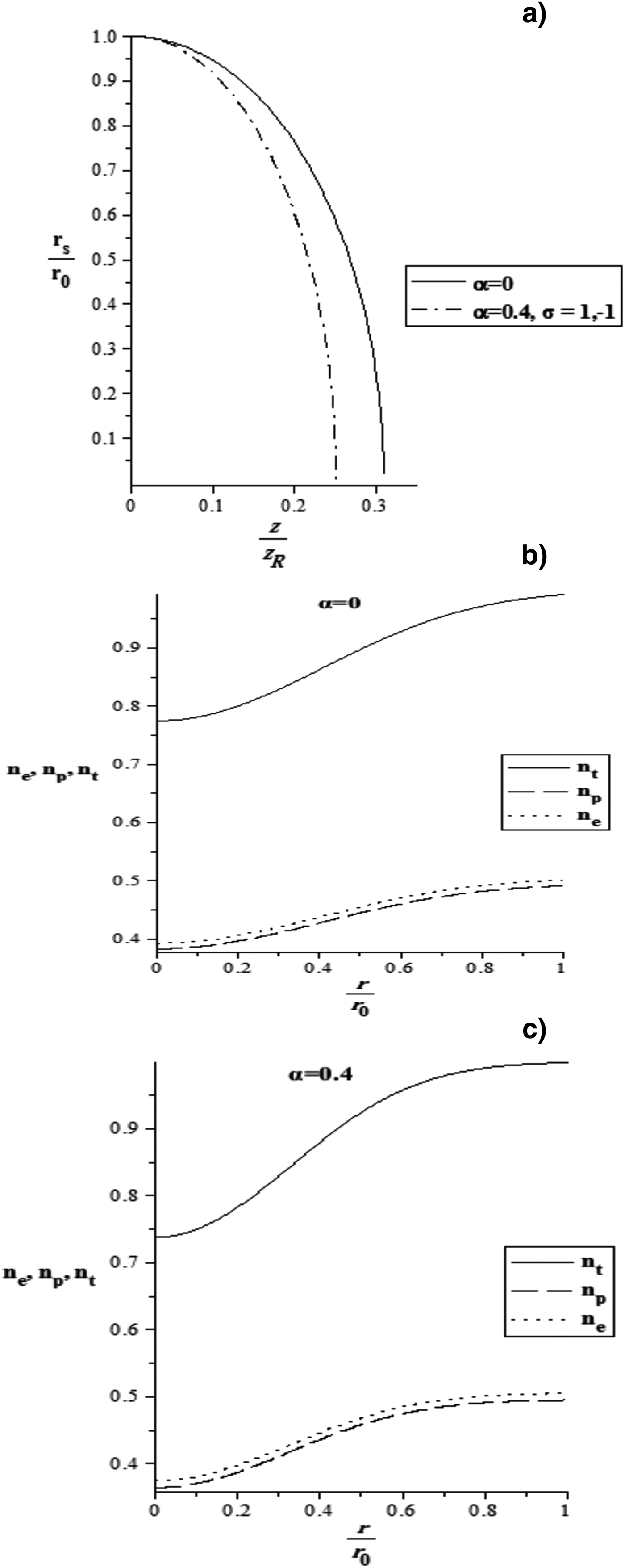
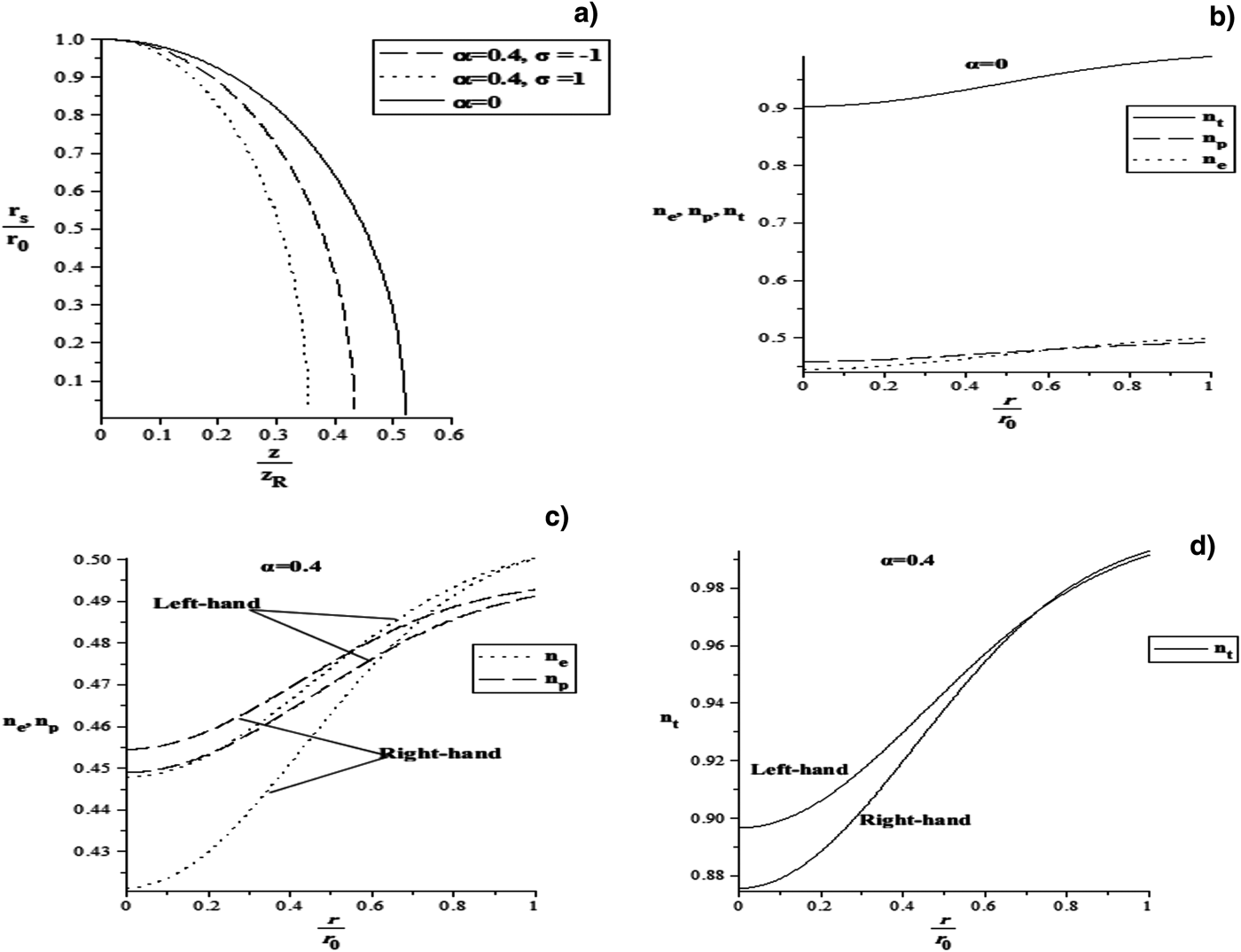
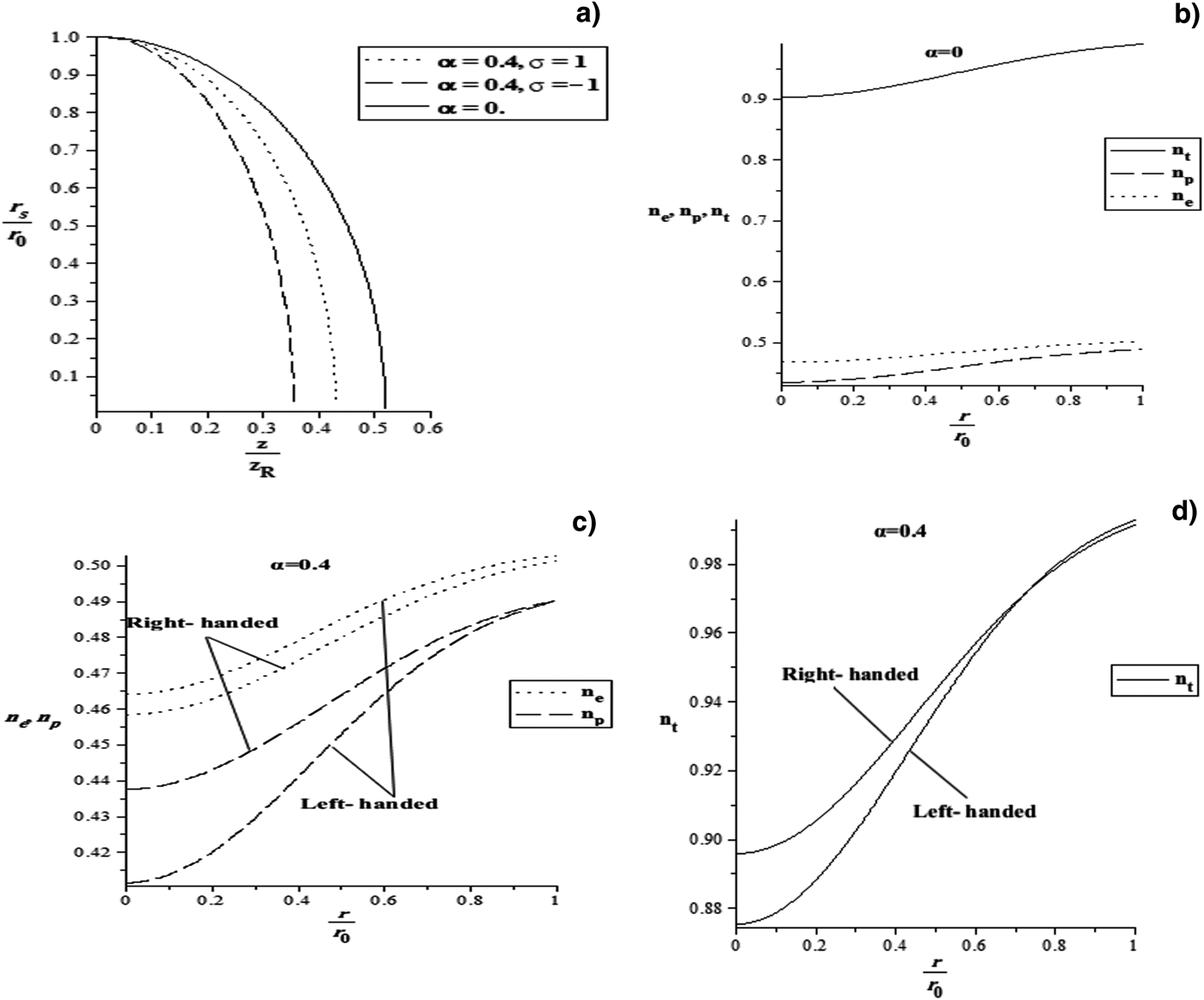
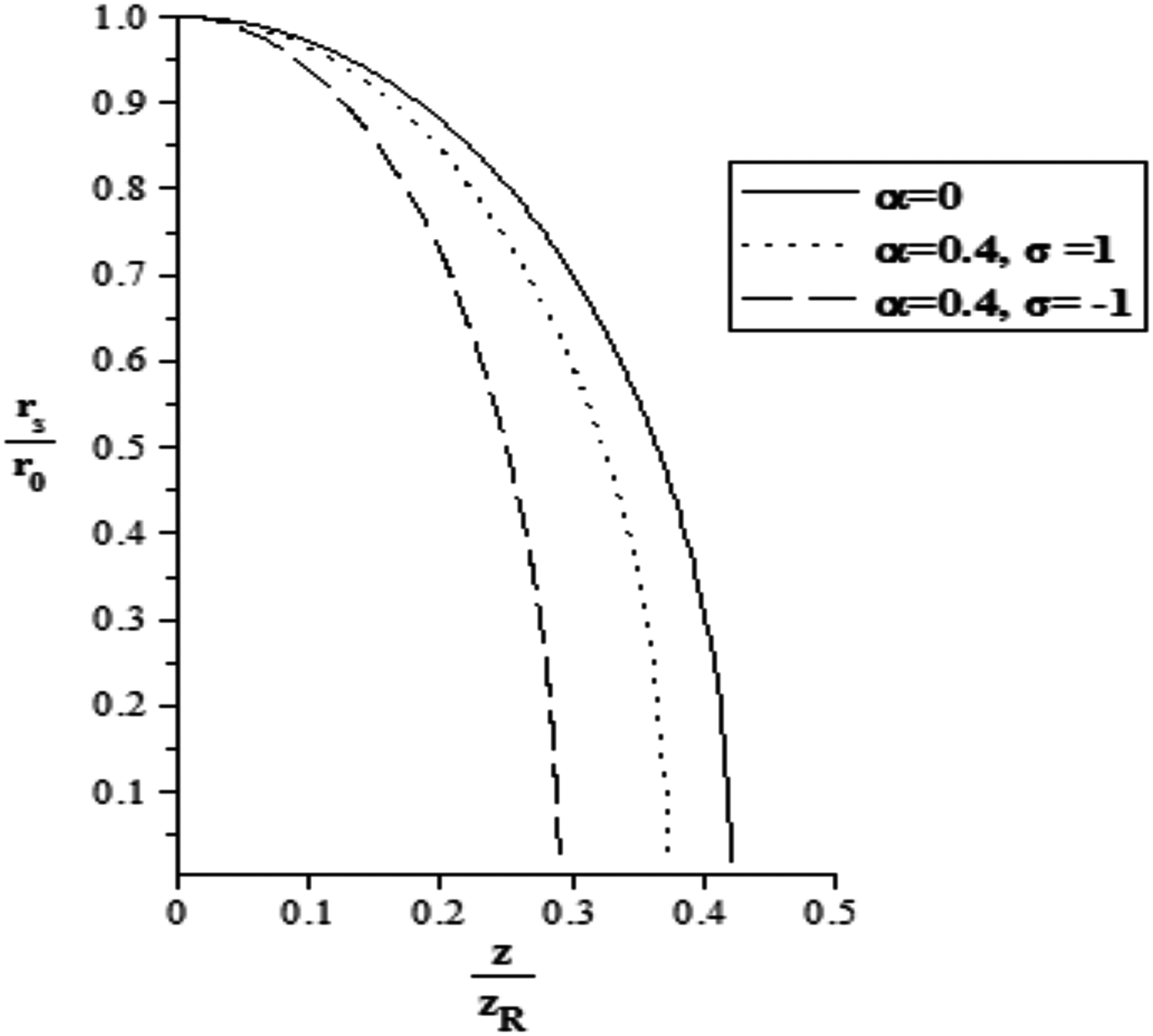
In Figure 4, we choose ωpe1 = ωpe2 = 0.1ω0, ωpp = 0.1 4ω0, and T e1 = T e2 = T p = T i = 10 keV, so the density of electrons is slightly larger than that of the positrons. From Figure 4a we can see that the application of external magnetic field improves the quality of self-focusing but practically there is no difference in the behavior of right- and left-hand polarizations. Figures 4b and 4c shows the radial variations of densities. All densities are normalized by n 0e1 + n 0e2 + n 0p. We can see that the slope of density profile for magnetized plasma is larger than the unmagnetized case. In Figure 5, we increased temperature of positrons to T p = 50 keV and the other parameters were not changed with respect to the previous case. Figure 5a shows that in this case increase in the positrons temperature leads to the decrease in the self-focusing. However, for magnetized plasma, right-hand polarization acts better than left-hand. Comparing Figures 4b and 5b we can find that slope of positron density profile becomes smoother with increasing temperature of positrons in unmagnetized plasma and consequently total density (n e1 + ne2 + n p) profile becomes smoother. Figure 5c represents the electron and positron density profiles for magnetized plasma. Magnetization of plasma leads to the increase of density profile slope for all cases but electron density becomes sharper for right-hand polarization and inversely positron density is sharper for left-hand polarization. Total density profiles are plotted in Figure 5d for right- and left-hand polarizations. In the total density profile, right-hand polarization case is sharper and beam becomes more focused for this case. In Figure 6, we have done an interchange between temperatures of electrons and ions and we have chosen T p = 10 keV, and T e1 = T e2 = 50 keV. Figure 6a shows a behavior change in the self-focusing of magnetized plasma for right- and left-hand polarizations. In this case, left-hand polarization becomes more focused by exerting external magnetic field. Figure 6b shows the density profiles for unmagnetized plasma. In this figure because of low-temperature positrons, the slope of positron density is sharper than that of electron but total density profile practically remains unchanged with respect to the previous case. Figure 6c demonstrates the variation of electron and positron densities versus radial distance for right- and left-hand polarizations. Temperature of positrons is lower and slope of positron density profiles are sharper. Density profiles become sharper by exerting external magnetic field for both polarizations. However, slope of electron density for the right-hand polarization is larger than that of the left-hand and inversely slope of positron density for the left-hand polarization is larger than that of the right-hand. Summation of these densities for right- and left-hand polarizations is shown in Figure 6d. We can see that for total densities slope of left-hand polarization is larger and consequently the quality of self-focusing for this polarization is better. In Figure 7, we have reduced temperature of positrons to T p = 1 keV. In this case, laser beam focuses more than in previous case. Furthermore, difference between the right- and the left-hand polarizations self-focusing quality is more considerable.
(a) Variation of normalized laser spot size r s/r 0 with respect to normalized propagation distance z/Z R, solid line for unmagnetized plasma, and dash-dotted line for magnetized plasma with α = 0.4. (b) variation of density (normalized by n 0e1 + n 0e2 + n 0p) with respect to normalized radial distance at z/Z R = 0.3 in unmagnetized plasma, dashed line for positron, dotted line for electron, and solid line for total density. c) variation of normalized density with respect to normalized radial distance at z/Z R = 0.3 in magnetized plasma with α = 0.4, dashed line for positron, dotted line for electrons, and solid line for total density. In all cases ωpe1 = ωpe2 = 0.1ω0, ωpp = 0.1 4ω0, and T e1 = T e2 = T p = T i = 10 keV.
(a) Variation of normalized laser spot size r s/r 0 with respect to normalized propagation distance z/Z R Solid line for unmagnetized plasma, dotted line for right-hand polarized wave with α = 0.4, and dashed line for left-hand polarized wave with α = 0.4. (b) variation of density (normalized by n 0e1 + n 0e2 + n 0p) with respect to normalized radial distance at z/Z R = 0.3 in unmagnetized plasma, dashed line for positron, dotted line for electron, and solid line for total density. (c) variation of normalized density with respect to normalized radial distance at z/Z R = 0.3 in magnetized plasma with α = 0.4, dashed line for positron, dotted line for electrons. d) variation of normalized total density with respect to normalized radial distance at z/Z R = 0.3 in magnetized plasma with α = 0.4. In all cases ωpe1 = ωpe2 = 0.1ω0, ωpp = 0.14ω0, T p = 50 keV, T e1 = T e2 = 10 keV, and T i = 0.5 keV.
(a) Variation of normalized laser spot size r s/r 0 with respect to normalized propagation distance z/Z R Solid line for unmagnetized plasma, dotted line for right-hand polarized wave with α = 0.4, and dashed line for left-hand polarized wave with α = 0.4. (b) variation of density (normalized by n 0e1 + n 0e2 + n 0p) with respect to normalized radial distance at z/Z R = 0.3 in unmagnetized plasma, dashed line for positron, dotted line for electron, and solid line for total density. (c) variation of normalized density with respect to normalized radial distance at z/Z R = 0.3 in magnetized plasma with α = 0.4, dashed line for positron, dotted line for electrons. (d) variation of normalized total density with respect to normalized radial distance at z/Z R = 0.3 in magnetized plasma with α = 0.4. In all cases ωpe1 = ωpe2 = 0.1ω0, ωpp = 0.14ω0, T p = 10 keV, T e1 = T e2 = 50 keV, and T i = 0.5 keV.
Variation of normalized laser spot size r s/r 0 with respect to normalized propagation distance z/Z R for ωpe1 = ωpe2 = 0.1ω0, ωpp = 0.1 4ω0, T p = 1 keV, T e1 = T e2 = 50 keV, and T i = 0.5 keV. Solid line for unmagnetized plasma, dotted line for right-hand polarized wave with α = 0.4, and dashed line for left-hand polarized wave with α = 0.4.
5. CONCLUSIONS
In this paper, we investigated self-focusing of a weakly relativistic laser pulse propagating along an external magnetic field in a hot e-p-i plasma. Spot size evolution of circularly polarized laser beam in magnetized hot e-p-i plasma is studied. It is found that for e-i plasma, application of external magnetic field enhances self-focusing of the right-hand polarization but for the left-hand polarization reduces it. For pure e-p pair plasma, application of magnetic field improves self-focusing, also. In a similar situation, pure pair plasma acts better than e-i plasma. Furthermore, effect of temperature on the self-focusing property is investigated. It is observed that for both polarizations increase in temperature of each sort of plasma particles leads to the defocusing of laser beam. For the case near to pure pair plasma but with slightly excess electrons, temperature plays an essential role in the behavior of magnetized plasma. In this case when electrons have higher temperature, the left-hand polarization acts better than the right-hand and for high-temperature positrons, plasma changes behavior and the right-hand polarization laser beam focuses better than the left-hand.