Introduction
In contrast to the prominence of their predecessors as the dominant urban elite under the Gupta regime in the fifth and sixth centuries, the activities of merchant groups in early medieval Bengal are shrouded in obscurity.Footnote 1 Known references are limited to some short donative inscriptions on a stone pillar and images. On the other hand, the B haddharmapurāṇa, a text dating from the thirteenth century,Footnote 2 mentions several mercantile communities as a part of contemporary social groups deemed to be mixed jātis (varṇasaṃkaras) (Shastri Reference Shastri1974: 3.13.35, 41, 3.14.63, 68). By that time, merchant groups seem to have attained a level of organization at which they could be perceived as jātis by the brāhmaṇas who composed the text. The paucity of information, however, has not allowed us to reconstruct their organizational process.
This situation has to some extent been changed by the recent discovery of two inscriptions. One is the Indian Museum copper plate inscription of Dharmapāla, which sheds light on the choice of a career as sāmanta made by members of a merchant family in the eighth century (Furui Reference Furui2011a). More important is an inscription dating from the reign of Mahīpāla I, engraved on a stone slab found at Rajbhita in Hatpada mauza of Jabarhat union, Pirganj upazila, Thakurgaon district in the Rangpur subdivision of Bangladesh (Hok and Kuddus Reference Hok and Kuddus2005: 8). It gives us a glimpse into the collective activity of merchant groups in eleventh-century North Bengal through an association called vaṇiggrāma, which is not mentioned in any known earlier or contemporary sources from Bengal.
The inscription is currently kept in Varendra Research Museum, Rajashahi, accession number 2002.23 (8640). It was first edited by M. Monirul Hok and M. Abdul Kuddus of the museum (Hok and Kuddus Reference Hok and Kuddus2005).Footnote 3 It was read by Gouriswar Bhattacharya who presented its contents in a lecture (G. Bhattacharya Reference Bhattacharya2007a).Footnote 4 His transcription of the inscription was published by Krishnendu Ray (Reference Ray2009) without permission, with discussions on its contents. Ray also published an article with overlapping contents (Ray Reference Ray2008).
While appreciative of the efforts of Hok and Kuddus in reading and editing the inscription, with difficulty in terms of both research materials and infrastructure, I still have to point out their mistakes both in reading and interpretation. Ray's recognition of the importance and implications of the inscription for the activities of merchant groups in early medieval Bengal should be acknowledged. However, he made serious errors in interpreting the contents of the inscription, partly due to misreadings by previous editors but principally because he misunderstood the contents and made some far-fetched speculation. Given its importance, the inscription deserves better treatment.
Fortunately, I was able to prepare a better reading from photographs of the original inscription taken personally at Varendra Research Museum on 22 July 2009. This has resulted in a better interpretation which helps improve our understanding of aspects of the early medieval history of Bengal. In the present article, I will provide in part 1 an improved edition of the inscription with a translation and discussion of its contents. In part 2 I attempt to delineate the history of mercantile groups of early medieval Bengal with additional information from new inscriptions.
Part I: Rajbhita stone inscription of the time of Mahīpāla I, year 33
Physical features
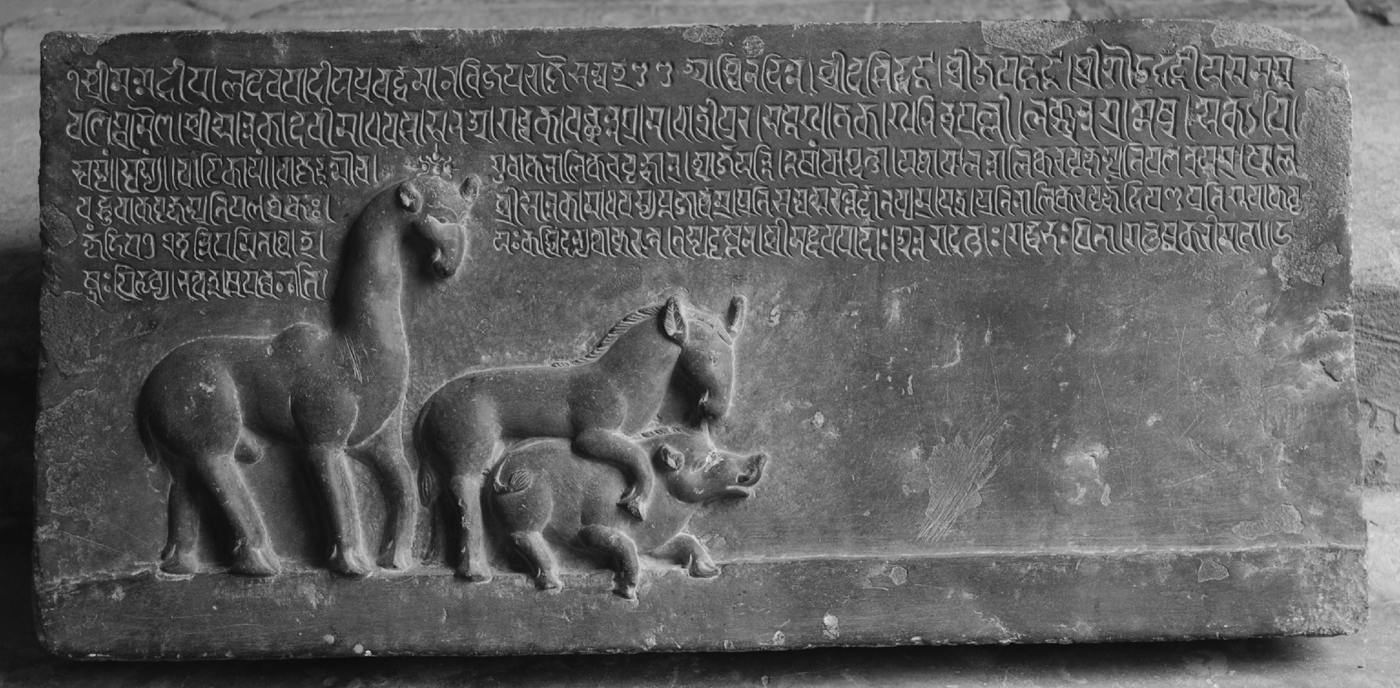
The inscription, of six lines, is engraved lengthways on a slab of grey schist, sized 66 cm in length, 31 cm in breadth and 7 cm in thickness and weighing 30 kg (Hok and Kuddus Reference Hok and Kuddus2005: 9). The most peculiar feature of the slab is a high relief in its lower part, which depicts three animals facing to the right, namely a donkey copulating with a sow and a camel behind them. A fleuron (flower motif) and the head of the last animal divide the third, fourth and fifth lines of the inscription in the middle (Figure 1).
The Rajbhita stone inscription of the time of Mahīpāla I, Year 33. Photograph by the author. Courtesy of Varendra Research Museum.

The inscription, in Sanskrit prose, is engraved in characters generally called proto-Bengali or Gauḍīya. Both the engraving and the preservation of letters are excellent so that they are all clear and legible. The palaeography supports the identification of Mahīpāla, whose reign is mentioned in the inscription, with Mahīpāla I, the son of Vigrahapāla II and the father of Nayapāla. According to the Sarnath stone pedestal inscription referring to his reign (Maitreya Reference Maitreya1912: 104–09), the year 1083 Vikrama Samvat (1026 ad) falls within his reign which lasted forty-eight years to our knowledge (Chowdhury Reference Chowdhury1967: 85–7). The reference to the thirty-third year of his reign in the present inscription may locate it to the first half of the eleventh century.Footnote 5
Orthographically, the reduplication of consonants after r, a feature generally found in early medieval inscriptions of Bengal, is observed in this inscription. As for characters, the consonants p and y are so similar that they are indistinguishable in some places. The consonant v also has a peculiar shape, which looks like a character denoting p with a narrow neck.
Numerals indicating 3 and 1 appear in this inscription. Despite their recognition of the former at the date in the first line, the previous editors missed it in the fourth. They also failed to recognize the latter numeral in the fifth line.
TextFootnote 6
(1) [Siddham] śrīman-Mahīpāladeva-pādīya-pravarddhamāna-vijaya-rājye samvat 33 Āśvina-dine | śrī-Deśihaṭṭa | śrī-Jayahaṭṭa | śrī-Gauḍahaṭṭīya-samasta-
(2) vaṇig-grāmeṇa | śrī-Sonnakādevīmādhava-śāsana āgaccak-āvacchunna-grāma | Dhātrīpura | Saptakhātaka | Khanitrapallī | Lakkhunnagrāmeṣu | se ke'pi |
(3) svasyāṃ svasyāṃ | vāṭikāyāṃ | vājya-bhūmau ca | [fleuron] guvāka-nālikera-v
 kṣān | ārjayanti | teṣāṃ vāg = dattā | yathā-phalan = nālikera-vkṣam = prati paṇa trayam | phala-
(4) vad-guvāka-v
kṣam = prati paṇa ekaḥ | [image] śrī-Sonnakāmādhavasya pūj-ārtham | prati-samvatsaran = tair = ddātavyam | yatra | prati nālikera-vkṣaṃ hi pa 3 prati guvāka-v-(5) kṣaṃ hi pa 1 etan = niyamitā = thāt | [image] yaḥ kaś = cid = anyathā kurute | tasya d
ṣṭena | śrīmad-deva-pādāḥ | antar-ādattāḥ | garddabhaḥ pitā | gartta-ṣūkarī mātā | u-(6) ṣṭraḥ pit
vyo bhavet | ṣapatha iti |
Notes to the text
[H&K = Hok and Kuddus Reference Hok and Kuddus2005: 11–12; R = Ray Reference Ray2009: 275]
1. [siddham]: expressed by a symbol, a loop open to the left. ˚rājye: rājñe H&K; rāje R. ˚haṭṭīya˚: thus R.; haṭṭa yai˚ H&K. ˚samasta˚: thus R.; ˚samasū˚ H&K.
2. ˚grāmeṇa: ˚grāmena H&K; ˚dhāmeṇa R. ˚āvacchunna˚: emend ˚āvacchinna˚ cf. thus H&K; ˚āvacchanna˚ R. se ke'pi: emend ye ke'pi cf. thus R; sekyepi H&K.
3. vājya-bhūmau: vājña-sumau H&K; yājña [bhī]mau R. ārjayanti: emend arjayanti cf. thus H&K; ājayanti R. ˚phalan: thus R; ˚phālan H&K. paṇa: yaṇa H&K; pana˚ R. 3-4. phalavad˚: phālavad˚ H&K; [phī]lavad R.
4. paṇa: yaṇa H&K; Pana R. ˚Sonnakā˚: ˚sonnakā H&K; ˚sannakā˚ R. ˚samvatsaran = tair = ddātavyam: ˚samvase rantairddātapyam H&K; ˚saṃvatsaran tair dolata vyaṃ R. pa 3: failing to recognize the second sign as a numeral, H&K read yaṇṭa; pa[na], R. prati-guvāka˚: prati guvāka H&K; priti guvāka˚ R.
5. hi pa 1: H&K read di pata, failing to recognize the numeral; hi yatra R. etan = niyamitā = thāt: emend etan = niyamitā = rthāt cf. etamniyamitāthāt H&K; etan niyamita | – [t] R. tasya: thus R; taṣya H&K. antar-ādattāḥ: thus H&K; antarā dattā R. gartta˚: thus R; gastta H&K. 5–6. uṣṭraḥ: thus H&K; ustraḥ R.
6. pit
vyo: thus R; pitvye H&K. bhavet: thus R; bhavetrū H&K. ṣapatha: emend śapatha.
Translation
Success! On the day of Āśvina [i.e. the day of Autumnal Equinox] in the year 33 of the prosperous and victorious reign of his majesty the illustrious Mahīpāla (I), the (following) word was given [i.e. an agreement was made] by the association of all the merchants (samastavaṇiggrāma) belonging to the illustrious Deśihaṭṭa, the illustrious Jayahaṭṭa and the illustrious Gauḍahaṭṭa, about all those who cause to grow areca nut and coconut trees at each small garden and vājyabhūmi Footnote 7 of their own in Dhātrīpura, Saptakhātaka, Khanitrapallī and Lakkhunnagrāma, which are the villages coming to [i.e. belonging to] and demarcated in the donated tract (śāsana) of illustrious Sonnakādevīmādhava (ll. 1–3): “three paṇas per coconut tree according to the (growth of) fruit (and) one paṇa per fruit-bearing areca nut tree should be given by them every year for the worship of illustrious Sonnakāmādhava (ll. 3–4). In this regard, it is thus determined according to the cause: for each coconut tree hi(raṇya) pa(ṇa) 3, for each areca nut tree hi(raṇya) pa(ṇa) 1 (ll. 4–5). In full view of the one who does anything otherwise, his majesty the illustrious deity [i.e. Sonnakāmādhava] will be withdrawn; his father will be a donkey, his mother a sow of the ditchFootnote 8 and his paternal uncle a camel. (This is) the curse.” (ll. 5–6)
Contents
The inscription records an agreement made by the association of all the merchants belonging to the three markets, in relation to those members who grow areca nut and coconut trees in their own small gardens and vājyabhūmis in the four villages belonging to the donated tract of a deity called Sonnnakādevīmādhava. It is agreed that they would annually pay in cash (hiraṇya) three paṇas per coconut tree and one paṇa per areca nut tree for worship of the deity.Footnote 9 This transaction implies that some merchants of the association leased plots in the revenue-free tracts of the deity and cultivated fruit-bearing trees on them. The recorded agreement set the terms of the lease at the annual payment of a fixed amount in cash for worship of the deity, presumably through the association. It presupposes the sale of fruits by the merchants, and any money remaining after payment of prescribed dues seems to have belonged to them.
In spite of its brevity, this inscription has a bearing on several important aspects of the early medieval history of Bengal. The first of these is the activity of an organization called vaṇiggrāma.Footnote 10 This organization showed its presence in western India as an association of merchants. The earliest reference goes back to the second century bc, as attested in an inscription on a pillar in a cave at Karle (Kosambi Reference Kosambi1955: 66).Footnote 11 The activity and character of this organization in the sixth century ad is clearer, thanks to two copper plate inscriptions. The Sanjeli plate of the time of Toramāṇa, year 3, datable to the beginning of the sixth century, records the agreement by foreign merchants and resident traders to offer particular merchandise at fixed rates to the deity Jayasvāmin in Vadrapālī (Ramesh Reference Ramesh1986: 175–81). Those merchants, who belonged to a vaṇiggrāma, are warned against breaking the agreement (ibid.: 181, ll. 9–10). This case attests to the collective activity of vaṇiggrāma and its character as an association of merchants both belonging to the locality and hailing from distant areas (Chakravarti Reference Chakravarti and Raven2008: 397–8). The copper plate inscription of Viṣṇuṣeṇa dated year 649 Vikrama Samvat, corresponding to 592 ad, gives us more insights (Sircar Reference Sircar1953–54). It is a charter of conduct and custom (ācārasthitipātra) issued by Viṣṇuṣeṇa, a local king, on application by the vaṇiggrāma of Lohāṭā. It approves and enumerates the customary rules for member merchants of the association about their prestige and autonomy against the interference of royal agents, about fines for offences, and about cesses and duties levied on different kinds of merchandise (Kosambi Reference Kosambi1959: 285–9). The vaṇiggrāma in this case is an association of various kinds of merchants which imposes customary rules on its members and enjoys some degree of autonomy from political powers.
In the present case, the reference to vaṇiggrāma is important in itself, as this is the only one yet found in Bengal. The character and constituents of the organization are discernible in its description in the inscription. The vaṇiggrāma is constituted by all the merchants belonging to three markets (haṭṭa). As will be discussed below, a haṭṭa appears in the contemporary inscriptions as a rural market. The aforementioned expression suggests that those merchants belonged to particular markets and that such an affiliation was an important element of their identity. The names of haṭṭa suggest differences in their character and constituents. Deśihaṭṭa seems to denote a market for local merchants, while Gauḍahaṭṭa may be for merchants of the neighbouring sub-region of Gauḍa (corresponding to present-day Murshidabad district and the southern part of the Malda district of West Bengal). Jayahaṭṭa may be named after an individual and have constituents different from the others. All of them can be separately located in some proximity to the four villages mentioned in the inscription, though their identification with present settlements based solely on the similarity of names, attempted by Ray (Reference Ray2009: 273), is not convincing and needs further verification in terms of philological interpretations. It is remarkable that the merchants organized themselves as a collective in spite of their affiliations to different markets and probable differences in specialization.
The position of the vaṇiggrāma as representing the collective interest of the merchants is implied in the agreement made in its name. Its intervention in the relationship between members who leased land plots and the deity, an institutional landholder, suggests that the association negotiated on their behalf. This form of collective representation may have strengthened their bargaining power vis-à-vis the temple authority. On the other hand, it entails the imposition of inner regulation: members had to accept the terms set by the association while leasing, as individuals, land plots from the deity. For collective interest to be represented and pursued, cohesion of the association had to be maintained through the regulation of its members.
These features of the vaṇiggrāma, i.e. the membership including various merchants and the representation of collective interest with inner regulation, show some commonality with vaṇiggrāmas in western India mentioned above. What is different is the involvement of members in horticulture, for which they surely needed the service of a local agrarian group. No arrangement on this matter is mentioned in the present inscription, so it is unclear whether the association also regulated the relationship between the former and the latter.
The deity Sonnakādevīmādhava seems to be a form of Viṣṇu named after a woman called Sonnakā. A number of Viṣṇu images found in north Bengal, datable to the eleventh or twelfth centuries, are inscribed with the names of the deity ending with his epithets like Mādhava and Nārāyaṇa. The epithets are prefixed with male or female personal names, as attested by the specimens kept in several museums.Footnote 12 While one image inscription points to a donor installing the deity prefixed with somebody else's name,Footnote 13 others seem to indicate that they were named after donors. The installation of deities named after themselves is the practice often followed by the kings of South and South-East Asia in the early medieval period (Sanderson Reference Sanderson2004: 415–6; Reference Sanderson and Einoo2009: 60, 274). A textual prescription for this practice is found in the Kriyākāṇḍakramāvalī of Somaśambhu (Sanderson Reference Sanderson and Einoo2009: 85–6, n. 150). The kings of Bengal were no exception as is corroborated by the Mainamati plates of Laḍahacandra, which record the donations to the deity named Laḍahamādhava installed by the king (Sircar Reference Sircar1973: 74, l. 53, 76, l. 20). This practice is not limited to the royal patrons: a verse in the Silimpur stone inscription says that a brāhmaṇa named Sāhila established a temple of Sāhilāditya, Viṣṇu named after himself, for his late father (Basak Reference Basak1915–16: 291, ll. 9–10).Footnote 14 In view of all this, Sonnakā in the present inscription also seems to be a donor who installed the Viṣṇu named after herself. Though her position is unclear, the honorific devī suffixed to her name in the second line and the fact that she could mobilize enough wealth to establish a deity which would hold at least four villages as donated tracts point to her high position. She could be a member of a royal family like Māhaṭā, the queen mother of Śūrapāla, who established Māhaṭeśvara in Vārāṇasī (Sircar Reference Sircar1986: 14–5, ll. 57–8), or a consort of a subordinate ruler like Saṇhāyikā, the wife of mahāsāmanta Bhadraṇāga who constructed a small vihāra (vihārikā) within Somapura mahāvihāra (Furui Reference Furui2011a: 154, ll. 63–4).
Finally, the most remarkable feature of this inscription, that is the curse mentioning donkey, sow and camel and its graphic representation, should be considered. There are contemporary or later stone objects on which images of a donkey copulating with a sow are engraved. This is an expression of a curse on a transgressor by which his parents would be reborn as these animals, as corroborated in some cases by corresponding inscriptions. In eastern India, three eleventh-century stone boundary posts from Budhpur, Purulia district of West Bengal, two twelfth-century or later stone inscribed stelae from Ratnagiri, Jajpur district of Orissa, and two thirteenth-century stone inscriptions from the area around Bodhgaya have such images engraved on them (Walsh Reference Walsh1937: 442–3; Gupta Reference Gupta1965: 92, no. 12; Mitra Reference Mitra1983: 214–5, plates CLXIII–CLXIV; Majumdar Reference Majumdar1919: 47, note 33; Vidyavinoda Reference Vidyavinoda1913–14: plate facing p. 29). The inscriptions from Ratnagiri include an imprecatory verse corresponding to the image (Mitra Reference Mitra1983: 214, verse 3, ll. 5–6, 215, verse 4, ll. 7–8). This is the same as for the inscription discovered from Janibigha near Bodhgaya (Majumdar Reference Majumdar1919: 47, verse 4, ll. 10–13). The description of the curse in both engraved image and sentence is also found in the two stone inscriptions of Kuruspal in the Bastar district of Chattisgarh, datable to the third quarter of the eleventh century (Lal Reference Lal1909–10: 32, l. 25; 34, ll. 14–6). On the other hand, a variant form which depicts a donkey copulating with a woman with textual reference to a transgressor's father becoming the former appears in the inscriptions of the mid-thirteenth century from Jhansi and Vidisha, central India (Prasad Reference Prasad1973: 89–90, ll. 16–8, plate facing p. 88; Trivedi Reference Trivedi1978: 207, ll. 7–10). The same motif with a different textual explanation, identifying the woman with a transgressor's mother, is found in some Śilāhāra inscriptions of twelfth- and thirteenth-century North Konkan (Mirashi Reference Mirashi1977: 146–8, 148–50, 153–6, 156–8, 161–3, 280–2; cf. Griffiths Reference Griffiths, Mevissen and Banerjee2009: 471–2).
The cases mentioned above show that the depiction of the curse as an image of donkey and sow was prevalent in eastern India, while the variant form with donkey and woman spread in central and western India. The present case can be included in the former category. However, its depiction of animals in a refined high relief is remarkable, compared with the rather crude engraving in other cases. Furthermore, the appearance of a camel as a possible fate of the paternal uncle clearly distinguishes it from others. Camels were not unknown to the people of early medieval Bengal, as an official in charge of troops of elephants, horses, camels and boats is listed in the address section of all the Pāla grants.Footnote 15 Still its appearance in the present inscription is noteworthy. Though not necessarily realistic, the characteristics of a camel – hump, long neck and height – are captured well in this image. It is probable that the merchants who ordered this inscription with relief had some acquaintance with this animal through their mercantile activity.
With the information provided by the present inscription and its clarification made above, I would like to proceed to a discussion and delineation of the history of mercantile groups in Bengal.
Part II: Merchant groups in Bengal
From dominance as urban elites to obscurity
The presence and activity of mercantile groups in Bengal becomes visible in historical records from the mid-fifth century onwards, thanks to the so-called land sale grants issued under the Gupta provincial administration of Puṇḍravardhana-bhukti in North Bengal. These copper plate inscriptions record the sales of waste/fallow land plots to individuals against monetary payment in gold and silver currencies, sanctioned by an organization called the adhikaraṇa, consisting of influential local people, and the donations of these plots to some religious agents (Yamazaki Reference Yamazaki1982). Merchants appear in these documents mostly as members of the adhiṣṭhānādhikaraṇa, i.e. the city office.
Four of the five Damodarpur copper plate inscriptions record cases of land sales approved by the adhiṣṭhānādhikaraṇa of Koṭivarṣa-viṣaya, the supra-village administrative unit roughly corresponding to the present districts of Bogra and Dinajpur in Bangladesh and South Dinajpur in West Bengal. The adhikaraṇa seemed to be organized at the city of Koṭivarṣa, identifiable with the present site of Bangarh in South Dinajpur district (Goswami Reference Goswami1948: 1–2). For the period of at least 100 years covered by those inscriptions, i.e. from 124 to 224 Gupta Era (444–543 ad), the same group of leading urban figures had constituted this organization. Mercantile members designated as nagaraśreṣṭhin and sārthavāha were among them, together with chief artisans (prathamakulika) and chief scribes (prathamakāyastha) (Sircar Reference Sircar1965: 291, ll. 4–6; 293, ll. 4–5; 337, ll. 3–4; 347–8, ll. 4–5). According to the Paharpur plate dated year 159 Gupta Era (479 ad), plural nagaraśreṣṭhins were also constituents of the adhiṣṭhānādhikaraṇa of the city of Puṇḍravardhana, identifiable with the present site of Mahasthangarh (Sircar Reference Sircar1965: 359, l. 1). Nagaraśreṣṭhins seem to have been chief merchants engaged in trade and money lending, while sārthavāhas were traders whose engagement in long-distance trade with caravan organizations is depicted in contemporary literary sources (Maity Reference Maity1970: 159–61). The context of their activity was the thriving trade between Bengal and other regions, attested in the return journey of the Chinese monk Fa-hien from Tāmralipti to Siṅhala on a merchant vessel (Nagasawa Reference Kazutoshi1996: 319; cf. Li Reference Li2002: 203).
Contemporary clay sealings discovered at Basarh in northern Bihar, the site representing the ancient city of Vaiśālī, attest to the fact that śreṣṭhins, sārthavāhas and kulikas were running a guild-like organization called nigama on their own or with other groups.Footnote 16 In view of the term “chief” (prathama) prefixed to the title of some of them, it is plausible that the same groups in Koṭivarṣa also maintained such organizations and constituted the adhikaraṇa as representatives of each organization, though the clay sealings discovered so far through the limited excavations of the site of Bangarh do not include the same kind (Goswami Reference Goswami1948: 12–3).
What is notable is that the jurisdiction of the adhiṣṭhānādhikaraṇa was not limited to the city itself but covered rural settlements in its proximity. This is clear from the venues of land sales recorded in the four Damodarpur plates and the Paharpur grant: they respectively include villages within Koṭivarṣa-viṣaya and Dakṣiṇāṃśaka-vīthī of Puṇḍravardhana-bhukti (Sircar Reference Sircar1965: 292, l. 11; 293, l. 9; 337, l. 6; 349, ll. 15–7; 359–60, ll. 1–3). By involvement with this organization as its members, those merchant groups could create and extend their vested interests in the rural area. This is evident in the case of nagaraśreṣṭhin Ribhupāla recorded in the Damodarpur plate of the time of Budhagupta, without date, assignable to the last quarter of the fifth century (ibid.: 336–9).
Ribhupāla was a member of the adhiṣṭhānādhikaraṇa (ibid.: 337, ll. 3–4). He petitioned for the sale and donation of land plots to construct two temples and two small storehouses for the deities Kokāmukhasvāmin and Śvetavarāhasvāmin in the vicinity of land plots which he had previously donated to them in Doṅgāgrāma. According to Sircar, Kokāmukha was a pilgrimage place (tīrtha) located in the eastern part of present-day Nepal, and Ribhupāla may have been there on pilgrimage and, after his return, donated a large area of land in his native district to those deities (Sircar Reference Sircar1971: 275–81). Then he constructed temples and storehouses for the same deities near to the donated tract, due to the difficulty in sending income from the land to the tīrtha in Nepal (ibid.: 281). On both occasions, Ribhupāla seemed to be involved in the management of temple land and in forwarding its income. Through these acts, he was able to establish a strong presence and influence in the village while furthering his interests in the city as a merchant: he established in the village two temples and their landed property, in whose management he may have held a vested interest. At least one of those temples, that of Śvetavarāhasvāmin, survived to be the donee of the case recorded in the Damodarpur plate of year 224 Gupta Era (Sircar Reference Sircar1965: 346–50). This fact attests to the success of Ribhupāla's attempt.
Compared with their prominence in the earlier period, merchant groups were relatively insignificant after the mid-sixth century. The continuance of their trade activity in the late seventh century is confirmed by the account of the Chinese monk I-ching, which describes hundreds of merchants travelling from Tāmralipti to the Magadha area forming a caravan (Adachi Reference Adachi1942: 139; cf. I-Ching Reference Lahiri1986: 79). The same text attests to the seaborne trade network connecting Tāmralipti and Harikela in Bengal with South India, Siṅhala and South-East Asia in the seventh century (Adachi Reference Adachi1942: 78, 93, 174; cf. I-Ching 1986: 41–2, 61, 94–5). It is plausible that merchants in Bengal were also involved in this network. However, unlike their counterparts in the previous period, merchant groups are totally absent from the land sale grants of the period between the mid-sixth and early seventh centuries, in spite of the continuance of the practice of land sales and accompanying monetary transactions in both Vaṅga and Rāḍha, respectively sub-regions of central and western Bengal (Sircar Reference Sircar1965: 363–7; 367–9; 372–7; 370–2; Bhattasali Reference Bhattasali1925–26; Furui Reference Furui2011b). This phenomenon can be partly explained as being the result of the shifting focus of activity of land sales from the relatively developed area around urban centres of North Bengal to less developed tracts. On the other hand, the sources of the later period indicate a change in the form of presence of those merchant groups, which must have germinated in this period.
Two forms of ruralization: landed magnates and rural merchants
After two-and-a-half centuries of absence, merchant groups reappear in the inscriptions of Bengal and the adjoining areas from the early ninth century onwards. References in the inscriptions indicate a change in their presence that may be described as two forms of ruralization: their acquisition of a new status, either as landed magnates or as rural merchants.
The first form is discernible in a copper plate inscription of Dharmapāla dated year 26, assignable to the beginning of the ninth century (Furui Reference Furui2011a). It records a royal donation of land plots petitioned by mahāsāmanta Bhadraṇāga, a subordinate ruler. It includes the eulogy of four generations of his lineage in five verses (ibid.: 153, ll. 46–55). What is remarkable is that his great-grandfather Balanāga is mentioned as sārthavāha, a trader (ibid.: ll. 47–8). It suggests the continuing presence of merchant groups in North Bengal in the early eighth century, the period to which Balanāga could belong, in spite of the silence of contemporary sources.
At the same time, the eulogy indicates a choice made by the merchant family: their shift of status to a lineage of subordinate rulers. This shift occurred in the time of Uccaganāga, the grandson of Balanāga, who is called mahāsāmanta (ibid.: l. 49). One element which facilitated this change was the military activity rather clearly described in the eulogy of the former's son, Bhadraṇāga (ibid.: ll. 51–5, vv. 17–8). What prompted this shift is unclear due to the corrosion of the relevant portion of the inscription (ibid.: ll. 48–9, v. 15). It can only be guessed that the status of subordinate ruler could bring better fortune to the family, in view of the prominence of this group under early Pāla rule (Furui Reference Furui2007: 188–96). It should be noted, however, that a power base in rural society was indispensable for this shift, in addition to the military capability mentioned above. The stronger section of merchant groups seems to have had the potential for the transformation, with landholdings and vested interests in the rural settlements, as attested in the case of Ribhupāla discussed in the previous section.
While the case of Balanāga's family shows a choice made by a prominent section of merchant groups, some short inscriptions on images and a stone pillar datable to the period between the ninth and twelfth centuries indicate the presence of merchant groups in eastern Bihar and Samataṭa, a sub-region of eastern Bengal, though less significant than their counterparts in fifth- and sixth-century North Bengal. In the first area, the Rajauna image inscription of the time of Śūrapāla, year 5, records the installation of an image of twelve Ādityas by Ranoka, the son of vaṇik Śrīdhara residing in the town of K milā in the latter half of the ninth century (Banerjee Reference Banerjee1975: 107). One of the bronze images discovered from Kurkihar, which seems to be contemporary, is engraved with the name of the donor, vaṇika Māṇeka, the son of Jānū (Gupta Reference Gupta1965: 142, no. 89). Similarly, the Nalanda pillar inscription of the time of Rājyapāla mentions the erection of a pillar by Vaidanāthadeva, the son of Manoratha, belonging to a vaṇika family in the mid-tenth century (Sircar Reference Sircar1949: 8). The Chandimau image inscription of the time of Rāmapāla, year 42, which mentions as the donor vaṇika sādhu Saharaṇa, the son of sādhu Bhādulva originating from Rājagha and residing in Etrahāgrāma, indicates the continuance of such cases as late as the first half of the twelfth century (Banerji Reference Banerji1915: 93–4).
In Samataṭa, the Mandhuk image inscription of the time of Gopāla II, year 1, mentions senior trader (vddhasārtha) Jambhalamitra as the donor (Sircar Reference Sircar1952: 57, ll. 2–3).Footnote 17 In the Baghaura image inscription of the time of Mahīpāla I, year 3, the donor is vaṇika Alokadatta, the son of Vasudatta belonging to Vilakīndaka in Samataṭa (Bhattasali Reference Bhattasali1923–24: 355, ll. 2–4). Similarly, vaṇika Buddhamitra, the son of vaṇika Jambhalamitra residing in Vilikandhaka of Samataṭa, is mentioned as the donor in the Narayanpur image inscription dated year 4 of the same king (Sircar Reference Sircar1943: 125, ll. 2–4). The first inscription belongs to the second half of the ninth century, while the last two can be assigned to the end of the tenth century.Footnote 18 Vilakīndaka and Vilikandhaka, settlements mentioned as the residences of donors in the last two inscriptions, are probably identical (ibid.: 123), in view of the poor execution of both inscriptions and possible mistakes on the part of engravers.
These cases show that some sectors of merchant groups continued their mercantile activity as a hereditary occupation in the mostly rural landscape. The hereditary character is clear from the expression “merchant family” (vaṇikakula) in the Nalanda pillar inscription and the title vaṇika prefixed to both father and son in the Narayanpur inscription (Sircar Reference Sircar1949: 8, l. 3; 1943: 125, ll. 3–4). Though it is not mentioned explicitly, other cases referring to either the donor or his father with the same title seem to presuppose heredity (Banerjee Reference Banerjee1975: 107, pt. 2; Gupta Reference Gupta1965: 142, no. 89; Banerji Reference Banerji1915: 94, l. 1; Bhattasali 1923–24: 355, l. 3). The rural background of their presence is also discernible, except in the case of the Rajauna image inscription in which the donor was a resident of Kmilā (Banerjee Reference Banerjee1975: 107, pt. 2), an urban settlement suffixed with the word “city” (adhiṣṭhāna) in the Valugdar image inscription of the time of Dharmapāla (Sircar Reference Sircar1949–50: 144, l. 1). The residence of the donor is mentioned as a grāma in the Chandimau image inscription (Banerji Reference Banerji1915: 93, l. 1) and Vilakīndaka/Vilikandhaka in the Baghaura and Narayanpur inscriptions may also be a rural settlement (Bhattasali 1923–24: 355, ll. 2–3; Sircar Reference Sircar1943: 125, ll. 2–3). The diminished presence of those merchant groups is suggested by the fact that their donative activities were limited to the installation of images or the erection of a pillar. There is no evidence indicating their involvement in donations and other transactions related to landed properties as in the case of their counterparts in fifth- and sixth-century North Bengal.
The presence and activity of those merchant groups in rural society were enabled by the spread of rural markets and commercial activities around them.Footnote 19 The earliest reference in Bengal to a rural market called haṭṭa is found in the Damodarpur plate of the time of Kumāragupta I, year 128 Gupta Era (447 ad). It is mentioned as an accompaniment to the donated land plot in the village of Airāvatagorājya (Sircar Reference Sircar1965: 194, l. 10). This fact seems to indicate that a brāhmaṇa donee was given the right to income from a market. References to haṭṭa became more frequent from the ninth century onwards. A small market (haṭṭikā) accompanies the four donated villages in the Khalimpur plate of Dharmapāla (Sircar Reference Sircar1983: 68, ll. 51–2). Dhtipurahaṭṭikā is mentioned as a part of donated tracts in the Mainamati plate of Laḍahacandra, year 6 (no. 1) (Sircar Reference Sircar1973: 74, l. 45). In some other land and village grants, the right over haṭṭa, namely the right to the cess on income from sales at the market, is listed as one of the privileges conferred on donees.Footnote 20Haṭṭa also appears as a part of a place name in some inscriptions.Footnote 21 One stone inscription, probably from Bihar, currently kept in the British Museum, mentions a market named Ajāhaṭṭa accompanied by fishers (kaivarta) and vintners (śauṇḍa), (where one cowrie-shell (varāṭikā) each should be charged at fish shops (G. Bhattacharya Reference Bhattacharya2007b: 72, ll. 5–6). These cases suggest that markets with vigorous mercantile activities spread so well in rural settlements that the right over them could constitute a privilege for a donee of land and village grants.
The last case shows the character of the haṭṭa as a local market where foodstuffs and other commodities for daily use are exchanged. The merchandise may also include agrarian products with commercial value. Mango and mahua trees, or mango, jackfruit, areca nut and coconut trees, often accompany land and village grants by the Pāla and Candra kings as privileges conferred on the donee from the mid-ninth century onwards.Footnote 22 The products from these trees could mostly be consumed by the donees themselves, for domestic use in the case of brāhmaṇas or for ritual services in the case of religious institutions. However, the sale of at least coconuts and areca nuts at rural markets is implied in the Rajbhita inscription discussed above (Part 1). It indicates the trade of agrarian products, at least their surplus, in the rural area by mediation of merchants. It even implies their involvement in commercial cropping for which they especially leased land plots with fruit-bearing trees from the religious institution.
The trade in rural areas may not be limited to the exchange of local products at rural markets. There are references to “income at the gate” (dvārikādāna) in relation to the donated villages in the Jajilpara plate of Gopāla III (Misra and Majumdar Reference Misra and Majumdar1951: 142, l. 23) and income from boat landing (ghaṭṭa) as one of the donee's privileges in several copper plate inscriptions.Footnote 23 Both seem to be cesses charged on commercial goods passing through those nodes of transportation. They attest to the inter-local trade through which commodities were transported both by river and by land. Those commodities may also have been exchanged at haṭṭas with the involvement of rural merchants.
It should also be noted that cowrie-shells, which were the medium of exchange in the Pāla territory according to the account of an Arab merchant (Ahmad Reference Ahmad1989: 44), had to be imported from foreign countries like the Maldives as mentioned by Ibn Battuta in a later period (Husain Reference Husain1953: 201). Their circulation in the rural area is confirmed by the stone inscription kept in the British Museum mentioned above and a hoard found at the site of Paharpur (G. Bhattacharya Reference Bhattacharya2007b; Dikshit Reference Dikshit1938: 33). The flow of cowrie shells into the rural settlements may have been facilitated by merchant groups who kept connection with the outer world while establishing themselves in the rural markets.
The case of the Rajbhita inscription reiterates the second form of ruralization of merchant groups, namely their mercantile activity in the rural landscape, and its precondition, vigorous trade around rural markets. The agreement recorded in the inscription presupposes the sales of agrarian products at rural markets by merchants. Its reference to the vaṇiggrāma, however, reveals another aspect. As discussed above (Part 1), it was an association of all the merchants belonging to several markets (haṭṭa). Its absence in other contemporary sources could be due to their character, recording small-scale pious deeds by individual merchants with reference at most to their family. It is noteworthy that a transaction which involved properties of a deity and entailed negotiation with its temple authority could only be enacted through the association of merchants. It forms a stark contrast with the case of Ribhupāla in fifth-century North Bengal, who could singlehandedly mobilize enough resources to establish two temples with related facilities and landed properties, with the tacit agreement of the adhikaraṇa members including himself and other urban elites (Sircar Reference Sircar1965: 336–9). This fact confirms the diminished presence of merchant groups in this period, which can be inferred from the other inscriptions. At the same time, it suggests the significance of association for merchant groups in enhancing their position in the rural area. The organization of vaṇiggrāma was a new phenomenon, which can be differentiated from the organization of urban elites of fifth- and sixth-century North Bengal centred on a certain urban settlement. It was a viable option for merchant groups in the context of their diminished presence in the face of the rising class of subordinate rulers, which integrated some of their stronger sections like the family of sārthavāha Balanāga (Furui Reference Furui2011a: 150). A similar process of organization into occupational groups by literates and artisans can be observed in the contemporary inscriptions (Furui Reference Furui2007: 208–23). One result of such a process is discernible in the social outlook of brāhmaṇas codified in the following period.
Organization towards specialized groups
Merchant groups cease to appear in the inscriptions of Bengal and Bihar from the mid-twelfth century onwards, while the association of artisans called śilpigoṣṭhī in Varendra, North Bengal, is mentioned in the Deopara stone inscription of Vijayasena (Majumdar Reference Majumdar1929: 49, l. 32). Rural markets appear only once as a place name,Footnote 24 while the Vangiya Sahitya Parishad plate of Viśvarūpasena, belonging to the first quarter of the thirteenth century, contains some references alluding to them. This inscription records the bestowal of revenue-free śāsana status to plots of land accumulated by a brāhmaṇa through donations and purchases. The land plots include seven betel vine plantations (varaja) and one areca nut plantation (kalana) (Majumdar Reference Majumdar1929: 146, ll. 45–6, 50–1; Sircar Reference Sircar1954: 204–5). For the last plantation, the price (mūlya) of three thousand areca nuts to be produced annually is also specified (Majumdar Reference Majumdar1929: 146, ll. 50–1). These references indicate the cultivation of crops with commercial value, which is confirmed for areca nuts. The sales of betel leaves can also be inferred from the description of “income from betel vine plantation” (varajāya) as an additional component of the income from the donated tract, together with the price of areca nuts.Footnote 25 The sale of those products indicates the continuance of commercial activity in rural areas, which gave an incentive for the cultivation of commercial crops. Rural markets may have been the venue, even though they are not mentioned as frequently as before.
In contrast to the silence of the inscriptions, the Bhaddharmapurāṇa, a local Purāṇa of Bengal composed in the latter half of the thirteenth century (Hazra Reference Hazra1963: 448–61), gives us a glimpse into the possible process of change experienced by merchant groups.Footnote 26 In the thirteenth and fourteenth chapters of its Uttarakhaṇḍa, the text narrates origins of social groups in Bengal, including several merchant groups, as a result of a mixture of varṇas (varṇasaṃkara) enforced by the evil king Veṇa and explains their hierarchical order and occupations fixed by the righteous king Pthu, Veṇa's son, in consultation with qualified brāhmaṇas present at the “gathering of dharma” (dharmasaṃgraha) convened by him.Footnote 27 As I have discussed elsewhere, the composition of this narrative can be interpreted as an attempt by brāhmaṇas to comprehend and explain the social reality with their own framework and to impose their idealized social order on the other groups at the same time (Furui Reference Furui, Ghosh, Bandyopadhyaya, Majumdar and Pal2013 forthcoming). The analysis of the descriptions of merchant groups in this narrative thus informs us of their perception by brāhmaṇa textual composers and, furthermore, of their relative position and power relation vis-à-vis brāhmaṇas and other social groups.
Among the social groups described in relevant parts of the text, those clearly recognizable as merchants are gandhika vaṇik (condiment merchant)/vaṇik and svarṇavaṇik/kānaka vaṇik (gold merchant), while tāmbūlin and taulika can also be included for their occupations, defined as sales of betel leaves and areca nuts respectively.Footnote 28 All of them belong to the category of saṃkara/saṃkarajāti claimed to be the progeny of the intermarriage of different varṇas and their descendants.Footnote 29Saṃkaras, also called thirty-six jātis, are deemed to be śūdras (Shastri Reference Shastri1974: 3.14.28) and divided into the three hierarchical ranks of uttama (best), madhyama (middle) and adhama/antyaja (lowest) according to the combination of their parents (Furui Reference Furui, Ghosh, Bandyopadhyaya, Majumdar and Pal2013 forthcoming). The gandhika vaṇik, claimed to descend from a brāhmaṇa father and a vaiśya mother, belongs to the first (Shastri Reference Shastri1974: 3.13.35), while the svarṇavaṇik is assigned to the second madhyama rank as an offspring of an ambaṣṭha (physician) father and a vaiśya mother (ibid.: 3.13.41). Tāmbūlin and taulika, both deemed to be the progeny of a vaiśya father and a brāhmaṇa mother, also belong to the uttama rank (ibid.: 3.13.39). This is a ritual hierarchy in which the first is said to deserve ritual service by qualified śrotriya brāhmaṇas, while the second and the last are to be served by fallen brāhmaṇas with the same status as themselves (ibid.: 3.14.73–5). The last rank is also claimed to be outside varṇāśramadharma (ibid.: 3.13.48cd).
The descriptions of merchant groups in the text suggest that they were perceived by brāhmaṇa composers as endogamous occupational groups like other saṃkaras. The term “thirty-six natural occupations” (ṣaṭtriṃśajjātakarma) used in the text to denote saṃkaras indicates this perception (ibid.: 3.13.49ab). It can also be seen in the statement that brāhmaṇas recommended that Pthu prohibit the further mixture of saṃkaras and fix their occupations, as a solution to the disorder brought by varṇasaṃkara (ibid.: 3.14.11–3). The merchants had already shown their character as a hereditary occupational group in the previous period, while relationships between its members, such as marriage alliances, were not clear from the short inscriptions they left (see above). Their recognition as endogamous groups suggests that the process of their organization through networking among themselves, of which the formation of vaṇiggrāma shows one aspect, had reached a certain level at which they could be perceived as jātis. It was, however, not a straightforward process and a very detailed analysis of the text would lead us to detect a certain complexity surrounding it.
The social order described in the text does not include the comprehensive category of vaiśya or vaṇik as a separate varṇa. The word vaṇik is used rather as a synonym of gandhika vaṇik (Shastri Reference Shastri1974: 3.14.63b) and all the merchants including them constitute a part of saṃkaras with specialization in particular types of merchandise. It contrasts with descriptions of merchants simply as a vaṇik or sārtha in the inscriptions of the previous period (see above). It could be interpreted as a reflection of social change which occurred by the thirteenth century, namely, the progress of specialization among merchant groups. It should be noted, however, that this perceived change contradicts the organizational principle of vaṇiggrāma deducible from the Rajbhita inscription. The organization consisted of all of the merchants belonging to several markets, with a single category of vaṇik. Though some of them were to engage in sales of areca nuts, they were not differentiated as taulika. The absence of a comprehensive category of vaiśya/vaṇik and the emergence of identities of specialized merchant groups suggest that the organization of vaṇiggrāma could not lead to the establishment of a merchant group as a bloc sufficiently powerful to be perceived as such, unlike their counterparts in western India who held a strong position with their corporations (Jain Reference Jain1990: 227–32).
The social order described in the text, which also lacks kṣatriya varṇa, consists of bipolarity of brāhmaṇas and śūdras without intermediate varṇas. It must be borne in mind, however, that this is not just a reflection of the contemporary social situation, which witnessed neither the rise of political powers claiming authentic kṣatriya status nor the dominance of merchant groups, but also a Brahmanical claim of hegemony over any other groups deemed to be śūdras (Furui Reference Furui, Ghosh, Bandyopadhyaya, Majumdar and Pal2013 forthcoming). The fact that brāhmaṇas could make such a claim indicates that neither military nor merchant groups could become an alternative power challenging the former. It endorses the possible “failure” of merchant organization discussed just above. Brāhmaṇas attained some level of hegemony with which they could attempt to impose their idealized social order (Furui Reference Furui2007: 244–59). The imposition, however, entailed tension and negotiation between brāhmaṇas and other social groups including merchants, as the text tells us.
At the dharmasaṃgraha described in the fourteenth chapter, the king subjugates dissenting saṃkaras and fixes their occupations according to the advice of brāhmaṇas. The groups whose occupations are fixed on this occasion are limited to most of the uttamajātis, svarṇakāras and svarṇavaṇiks among madhyamas, and finally the gaṇakas. These are social groups of some importance whose compliance was sought by brāhmaṇas to wield hegemony in rural society (Furui Reference Furui, Ghosh, Bandyopadhyaya, Majumdar and Pal2013 forthcoming). Most important among them are the non-brāhmaṇa literate groups of karaṇa (scribe), ambaṣṭha (physician), māgadha (panegyrist) and gaṇaka (astrologer), to whom special plots consisting of eight to thirteen verses each or one full verse are devoted (Shastri Reference Shastri1974: 3.14.30–40 [karaṇa], 41–53 [ambaṣṭha], 55–62 [māgadha], 71 [gaṇaka]). Their minute analysis reveals the effort of brāhmaṇas to secure the co-operation of these literate groups by admitting their prominent position among saṃkaras and possession of particular branches of specialized knowledge on the one hand, and by claiming their dependence on brāhmaṇas for their position and knowledge on the other (Furui Reference Furui, Ghosh, Bandyopadhyaya, Majumdar and Pal2013 forthcoming). They are perceived as groups with the potential to challenge Brahmanical authority through their alternative knowledge.
In comparison merchant groups seem not to matter much to brāhmaṇas. Only half or a quarter of a verse each is devoted to the description of their occupations.Footnote 30 This treatment is the same as that of artisans such as weavers (tantravāya) and blacksmiths (karmakāra) or service groups like barbers (nāpita) (Shastri Reference Shastri1974: 3.14.63a, 64ab, 63c). Thus brāhmaṇas make no special efforts in the text to entice merchant groups. Though their importance in rural society is recognized by the former, they do not hold a distinctive position in relation to other groups. This tallies well with their diminished position observed in the previous period (see above).
However, careful reading of the relevant portion still reveals some caution exercised by brāhmaṇas against merchant groups. The equation of vaṇik with gandhika vaṇik can be interpreted as their denial of the presence of wholesale merchants and intention to restrict occupations of merchant groups. The caution of brāhmaṇas is clearer in the ambiguity concerning the position of svarṇavaṇik, together with svarṇakāra. In spite of their madhyama status, their occupation is explained together with those of the uttamajātis. On the other hand, what is designated as their occupation is not the trade in gold inferable from their name, but the inspection of the genuineness (tattvaparīkṣā) of gold and silver ornaments (Shastri Reference Shastri1974: 3.14.68ab).Footnote 31 These facts belie the arbitrariness of their definition. We may detect here an attempt by the brāhmaṇas to contain these particular groups by assigning them to a lower ritual rank and by limiting their occupations, while they could not help but treat them as being on a par with uttamajātis. Such an effort may be induced by the caution of brāhmaṇas against these groups with potential wealth.
Thus the analysis of the Bhaddharmapurāṇa shows the progress in organization of merchant groups resulting in the formation of specialized groups comparable to jātis and its failure to produce an influential bloc of mercantile communities. On the other hand, the text also alludes to the potential of merchant groups which provoked the caution of Brahmanical composers. The later period would see the continuance of this tension in a different historical context.
Concluding remarks
The history of merchant groups in early medieval Bengal delineated above can be summarized as a process of the ruralization of urban elites in its early phase, and that of the organization of merchants located in rural space towards specialized groups comparable to jātis in its later phase. The new inscriptions enable us to fill gaps with new information, and also give us perspectives from which we can go beyond unilineal simplicity. The genealogy of the family of Balanāga in the Indian Museum plate shows an alternative available for an eminent merchant family, namely the shift of status to a lineage of local rulers. The activity of the vaṇiggrāma recorded in the Rajbhita stone inscription suggests not only a possible form of organization but also its impasse detectable in the contradiction between its organizational principle incorporating diverse merchants and the division of merchants into specialized groups described in the later Bhaddharmapurāṇa. The careful reading of the last text, on the other hand, reveals tension between merchant groups and brāhmaṇas who tried to restrain the former by imposition of inferior ritual ranks and specialized occupations.
The process discussed in the present article proceeded, needless to say, in the overall context of the early medieval history of Bengal in which the interaction of elements such as agrarian expansion, the stratification of landed relation and the establishment of regional kingdoms brought about historical change. The history of merchant groups can be understood only in this context. At the same time, it was an important constituent of this historical change, together with the interconnected phenomena of spread of markets and monetary transactions to rural societies, of which only the former is discussed in the present article. These elements and phenomena should be studied intensively in their totality. I hope that the present study contributes something to the study of the historical process of early medieval Bengal by providing a better understanding of this partial but important constituent.