“Let the jury consider their verdict,” the King said, for about the twentieth time that day.
“No, no!” said the Queen. “Sentence first––verdict afterwards.”
“Stuff and nonsense!” said Alice loudly. “The idea of having the sentence first!”
“Hold your tongue!” said the Queen, turning purple.
“I won’t!” said Alice.
“Off with her head!” the Queen shouted at the top of her voice. Nobody moved.
Lewis Carroll, Alice’s Adventures in Wonderland
In 1249, four-year-old Katherine Passcavant faced execution for homicide in England. She had thrown open a door, accidentally knocking another child into a vat of boiling water. The law of homicide made no exception for age or accident, and a jury sentenced Katherine to death. The only option that remained was the royal pardon. On her family’s entreaty, King Edward II showed mercy to the girl by pardoning her [Duker Reference Duker1977: 479]. 768 years later, Barack Obama, President of the United States, had by the end of his second term approved 1,927 pardons and commutations, the second highest total for a U.S. President since the 19th century [Department of Justice Office of the Pardon Attorney 2017].
In 1450, the English Parliament passed a bill of attainder against “the notorious rebel Jack Cade” who led an armed revolt against Henry VI. The bill that they passed legislatively asserted Cade’s guilt and punished him in the manner typical of attainders, through the forfeit of his possessions and property and by purporting to make “his Blood corrupt and disabled forever,” a punishment that reached not only for the body of the attainted but also for the prospects of his descendants. Cade would have been put to death as a result of this legislative act asserting his guilt had he not already escaped this odd-by-modern-lights exercise of justice by dying during the attempt to apprehend him [Lehmberg Reference Lehmberg1975: 675].
In contrast to pardons, however, there are no modern examples of attainder to pair with the legislative bill that condemned Cade as a criminal. For unlike pardons, which remain a ubiquitous part of governance under the rule of law, attainder and related forms of “legislative justice” [Pound Reference Pound1914] have become obsolete. The U.S. Constitution, which in Article I, Sections 9 and 10 forbids Congress and the states the power of attainder and in Article II, Section 2 invests the pardon power in the President, reflects this consensus: today the rule of law is everywhere characterized by the two contradictory institutional facts that pardons are lawful and attainders are not.
The divergent fates of these institutions is surprising when set against the fact that both pose a challenge to the fundamental rule of law principle that criminal classification is achieved through rule-based judicial processes and not by arbitrary, unilateral, bespoke executive or legislative fiat. Montesquieu expresses this central tenet of the rule of law when he writes that “there is no liberty […] if the power of judging is not separate from legislative power and from executive power. If it were joined to legislative power, the power over the life and liberty of the citizens would be arbitrary […] If it were joined to executive power, the judge could have the force of an oppressor” [Montesquieu Reference Montesquieu1989:157]. This tenet describes the case against both executive mercy and legislative punishment, for both purport to exercise powers of legal classification that are reserved for the judiciary under the rule of law. In addition to both usurping judicial powers, these practices also share other characteristics: both create individual exceptions in opposition to the rule of law ideal that the law defines the crime rather than the criminal; both can be and have been exercised in capricious, self-serving, corrupt, or otherwise venal ways; both substitute for the due process of law alternative, special, and potentially inferior processes; both tend to operate in a post facto manner rather than relying on legal standards in place at the time of an offense; both pose the threat of arbitrary power; and both also have similar potential advantages in providing a mechanism that can be more flexible and attuned to the nuances of specific cases than generally written laws, as well as providing political leaders with tools for managing crises and opportunistically pursuing the public good.
These structural similarities between institutions of lawful, extrajudicial punishment and clemency, paired with their starkly different trajectories, pose the central empirical puzzle of this article. Why have pardons, and related forms of extrajudicial but lawful clemency, become ubiquitous in rule of law jurisdictions while attainders, and related forms of extrajudicial but lawful punishment, have become extinct?
The argument of this article is that, contrary to the relativist presumptions of most sociology of morality, a central explanation for this moral-institutional divergence is the fact that attainders are more dangerous to the rule of law than pardons.
This latter argument provides the article with its theoretical motivation: to better understand the processes linking moral meanings, facts, and institutional forms [Hitlin and Vaisey Reference Hitlin and Vaisey2013: 57]. Most sociologists of morality operate within what Abend identifies as the Weberian, descriptive-relativist framework, holding that the sociology of morality should assume that moral truth is not relevant to the sociological explanation of different moral judgments and values [Abend Reference Abend2008: 107-12]. While descriptive relativist assumptions require that truth be “bracketed” [Tavory Reference Tavory2011: 275] when explaining moral action, there is no such requirement for facts. Indeed, many sociologists of morality have worked to understand how, for example, material facts [Barnard Reference Barnard2016; Klett Reference Klett2014], social facts [Quinn Reference Quinn2008; Sayer Reference Sayer2005], and facts of history and experience [Strand Reference Strand2015] influence moral judgments, actions, and systems.
These sorts of facts are more easily distinguishable from morals, however, than the purported fact that attainders are more dangerous to the rule of law than pardons. Indeed, this “fact,” that I propose will help unravel the institutional divergence of pardons and attainders despite their formal similarities, has many of the hallmarks of a moral truth claim, which a descriptive relativist sociology cannot credit with causal force [Abend Reference Abend2008: 91]. But rather than reflecting a subjective moral judgment, I argue that asymmetries of pardon and attainder with respect to the rule of law reflect a class of facts that are of value for the sociology of morality. Here, I will call these relational facts. Relational facts are not moral truths or subjective moral judgments, but facts about relationships between moral constructs.
Investigating this class of facts, in addition to helping resolve the pardon/attainder conundrum, contributes to the effort to develop a better understanding of the fact-value relationship [Putnam Reference Putnam2002]. It describes an important way in which facts as facts—information about the world, the truth value of which is independent of subjective, interpretive circumstances—can influence moral judgments and institutional arrangements, but also contends that they do so through ultimately subjective interpretive processes. The significance of this argument for moral institutions, the ultimate explanatory focus of this article, is the suggestion that we should not take moral institutions to be a sort of limpid reflection of culture nor, for that matter, of social forces beyond it; we may do better by thinking of them as turbid mixtures of culture with facts, history, and interpretations [Wilson Reference Wilson2011]. The concept of relational facts suggests that these elements themselves often occur in alloys and admixtures that are not yet well understood by sociologists of morality or culture and merit further investigation.
To examine how one such mixture of relational facts and moral interpretations contributes to explaining the divergence of pardons and attainders, the article focuses on the institutionalization of the absolute exclusion of attainders and the affirmation of a powerful pardon institution in and by the U.S. Constitution. After discussing the concept of relational facts and providing a general description of pardons and attainders, the article shows how the moral interpretation of relational facts led to institutional arrangements that bore the imprint of both. In particular, the framers of the U.S. Constitution and their successors interpreted the factual symmetries and asymmetries that relate pardons and attainders to other constructs through an interpretive matrix that gave each practice an opposite meaning, associating attainder with tyranny, one of their greatest fears, and pardon with the pragmatic pursuit of liberty, their greatest hope. This interpretive divergence led directly to the institutional divergence that saw the enshrinement of pardon and the abolition of attainder in the Constitution, an institutional arrangement that reflected both interpretations embedded in the moral culture of the framers and the ascertainable, mind-independent, relational fact that attainder poses a greater threat to the rule of law than pardon.
Relational facts
The obvious starting point for thinking about the relationship between facts and moral institutions is the fact-value relationship [Abend Reference Abend2008; Putnam Reference Putnam2002; see also Geertz Reference Geertz and Geertz1983]. Hume’s conceptualization of the fact-value relationship as a dichotomy set thinking on this topic down a stultifying path that has taken time to return from. Simply put, in the dichotomous view, on one side are matters of objective fact and on the other are matters of subjective value. This dichotomous treatment aligns in seductive affinity with the standard descriptive relativist sociological conception of morality, placing morality wholly in the domain of subjective valuations and distinguishing it from facts. This dichotomous view has come under significant direct scrutiny, however, first by moral philosophers [Putnam Reference Putnam2002] and more recently by sociologists of morality [Abend Reference Abend2008]. Sociologists have also contributed to this reconsideration of the fact-value relationship through empirical studies that focus on causal relationships crossing over the purported fact-value divide. They have observed both ways in which “the world impinges on people’s beliefs about it” [Abend Reference Abend, Hitlin and Vaisey2010: 574] and ways in which moral values can through social action become factual circumstances of the social world [Norton Reference Norton2014; Steensland Reference Steensland2006].
The relationship of this body of work to the broader reconsideration of the fact-value dichotomy is important in that it crafts an empirical lens for magnifying the border between facts and values, resolving a picture not of a rigid dichotomy but of “the entanglement of facts and values” [Putnam Reference Putnam2002: 34]. The sociological contribution to rethinking the relationship between facts and values, however, is largely limited to the supposed border between the two where facts and values “impinge” on one another. There are reasons to think, though, that the sociology of morality is well positioned to offer theoretical and empirical insight into the entanglement of facts and values deeper into the hinterland of the supposed dichotomy through observations of the force of facts operating inside what would normally be considered the terrain of values.
The idea of “thick moral concepts” [Abend Reference Abend, Hitlin and Vaisey2010: 578-579, 2011; Putnam Reference Putnam2002: 34-43] offers the best way of conceptualizing this argument. Corresponding with Geertz’s concept of “thick description,” an analytical strategy that aims to account for social phenomena by placing them in the cultural and social “universe” [Geertz Reference Geertz and Geertz1977:13] that renders them meaningful for participants, thick moral concepts like cruelty [Putnam Reference Putnam2002] “presuppose certain social, economic, institutional, and cultural facts” [Abend Reference Abend, Hitlin and Vaisey2010:579]. It is the social universe in which they are situated that renders them intelligible. What this means is that with thick moral concepts, or “constructs” to give the sense of a somewhat larger class of phenomena, “the description has the evaluation built into it” [Abend Reference Abend, Hitlin and Vaisey2010:579]. If we attempt to extract these thick moral constructs from their social and cultural conditions of intelligibility, to vivisect them into their fact-components and value-components, the very thing we are trying to analyze disappears. We can also make the same point in reverse: thick moral constructs, as Geertz writing about the fact-law distinction puts it, create “a distinctive manner of imagining the real” [1983:173]. Which is to say, thick moral constructs render facts intelligible in culturally specific ways.
Thick moral constructs also render facts intelligible as part of larger moral systems that are structured by the relationships between multiple moral constructs. Strand [Reference Strand2015] has pursued this very idea in the context of Bourdieusian field theory, arguing that changes in the character of morality can be attributed to the experience of moral fields that are structured by, among other things, moral concepts. By focusing on Geertz rather than Bourdieu I hope to foreground interpretive dynamics rather than the more tightly specified “social mechanics” [Geertz Reference Geertz and Geertz1983: 182] of Bourdieusian field theory, but the idea is roughly the same: that a moral system is structured both by the substantive content of its thick moral constructs and by the relationships among the multiple moral constructs that it contains.
Relational facts of this sort are not unassailable truths. Nor are they unconnected to meaning and subjectivity. But they are distinct from other aspects of moral systems in that they are not primarily dependent for their force on subjective mind-states or interpretive processes. The non-subjective facticity of relational facts of this sort means that they have a tendency to become manifest in ways that reflect the force of the fact and not just that of the interpretive webs thrown around it. The observation of relational facts, in a sense, is the relative autonomy of culture [Alexander and Smith 2003] cutting the opposite way, the relative autonomy of facts from the grasp of cultural and moral systems. Furthermore, it may be noted that relational facts of this sort are facts about relationships between thick moral constructs, and that if those constructs change so will the facts. But this is no different than any other sort of fact that we may wish to suggest sails under the flag of non-subjective forces. They are relational facts, but this hardly makes them different than other facts with a more naturalistic sheen. The grass is green only in relation to a complex visual and cognitive system, and 80 m.p.h. is relative to the motion of the earth not to mention the social facts of “miles” and “hours.”
In order to analyze relational facts of this kind we need to examine two parts of a moral system: its thick constructs and the relationships between them. To pursue this objective in the case of pardons and attainders I adopt two distinct but related analytical strategies. The strategy of “cultural hermeneutics,”—a “semantics of action”—[Geertz 1983: 182] aims for the reconstruction of the subjective moral meanings associated with thick moral constructs (including rule of law, liberty, tyranny, pardon, and attainder) that contextualized founding era moral judgments and institution-building. The second strategy, a sort of cultural “poetics” [Geertz Reference Geertz1981: 123]—a syntax of relationships—focuses on non-interpretive facts about the relationships between the thick moral constructs in the founder’s moral universe. Relational facts of this sort are best understood not by examining actors’ interpretations, but by examining the historical manifestations of relationships between thick moral constructs as well as through theory. Historical manifestations of relational facts are of course interpreted by actors and drawn into the hermeneutic dimensions of the moral system, as I describe below, but at least in principle the analytic strategies appropriate to each can be distinguished.
Pardons and attainders
The power of the sovereign to absolve the condemned, to show mercy, and to reduce punishments in cases where the law is too harsh is an ancient one. Indeed, following Schmitt’s famous dictum—“sovereign is he who decides on the exception” [1985: 5]—the pardon is one of the most unfettered expressions of sovereignty that persists in modern rule of law regimes, a view congruent with its origins as an act of personal grace by the sovereign. It is unsurprising, then, that this quintessential expression of sovereign power has apparently been coextensive with political power itself [Sebba Reference Sebba, Landau and Sebba1977a], and has existed in rule of law regimes since their earliest formations. While over this long sweep of history it took on specific forms and limits, the central feature of the pardon remained intact: a sweeping power to make exceptions to judicial classifications.
More specifically, the term “pardon” is often used in a casual sense to describe a bundle of related powers of clemency. These sometimes-overlapping powers include pardons, which undo some or all of the consequences of a conviction; commutations, which reduce the punishment inflicted on an individual; reprieves, which delay punishment; and amnesties (or general pardons), which release entire categories of offenders from punishment. These powers themselves have occurred in many varieties, creating a large palette of historical possibilities. In the United States pardons can be full, for all crimes committed by an individual, or partial, only for some of their crimes. They can also be conditional subject to “virtually any terms” [Kobil Reference Kobil1990: 595], and the executive can use the power of commutation to substitute almost any punishment for another as long as the recipient agrees and the conditions do not “unreasonably infringe on the individual commutee’s constitutional freedoms.”Footnote 1 While pardons are often thought of as a response to a legal judgment and punishment, they can also be exercised prior to sentencing, prior to conviction, or prior to a trial as was the case in Gerald Ford’s pardon of Richard Nixon. Pardons are entirely immune from legislative or judicial oversightFootnote 2 and they are applicable to almost any crime. They are limited, however, in cases of impeachment and where the pardon power intersects with other basic rights and principles of law. For instance, the pardon power cannot reach outside of the jurisdiction of the person who exercises it; nor can it interfere with the property rights of others, or force the government to make payments [Crouch Reference Crouch2009: 35], and judges have argued that clemency powers should comply with at least “some minimal procedural safeguards.”Footnote 3 Of course, these details vary across jurisdictions. Some jurisdictions have lodged the pardon power in a legislature, or split it between an executive and a specially appointed body such as a board of pardons; others impose different limits on it. But, typically, powers of clemency are noteworthy for the extent to which they are unbounded. They are also striking in their effects. At its most potent a pardon purports to effect a total reversal of the fact of conviction and punishment (though not of the crime itself—clemency typically reaches status but does not attempt to reach facts). At the extreme, the U.S. Supreme Court has held, a pardon “releases the punishment and blots out of existence the guilt, so that, in the eye of the law, the offender is as innocent as if he had never committed the offence […] it makes him, as it were, a new man.”Footnote 4
The concept of attainder, in contrast to pardons and clemency, is less well known, much more specific in its emergence, and lasted for a shorter time as a legal practice. But attainder, and the related, less drastic form of the bill of pains and penalties, are legal manifestations of what is also an ancient expression of sovereign power: the power to punish. The specificity of attainder is that it affords extrajudicial punishment within the rule of law. A bill of attainder “is a legislative act which inflicts punishment without a judicial trial […] In these cases, the legislative body, in addition to its legitimate functions, exercises the powers and office of judge […] it pronounces upon the guilt of the party without any of the forms or safeguards of trial.”Footnote 5 Unlike pardons, attainders were limited to the English legal tradition, and took on a recognizable form around the 15th century, becoming the “characteristic instrument of Tudor policy” [Pollard cited in Lehmberg Reference Lehmberg1975: 675] by the 16th century, and then waxing and waning in use until sputtering out of existence around the turn of the 19th century. Attainder usually condemned the attainted to a grisly death, for instance by burning or some combination of hanging, drawing, and quartering, as well as the loss of property and titles, and the corruption of the blood of the attainted, a measure that disinherited the children from the estate of the attainted or any estate that would pass to them through the attainted. It is this last part of the institution that gave attainder its name, as it purported to forever taint the bloodline of the condemned in addition to the more direct corporeal punishments that it inflicted. Bills of pains and penalties were similarly passed by the legislature to apply punishments to named individuals. However, they could be used to inflict punishments short of the horrors of attainder and could thus be used in a wider range of cases, as in the last English usage of this legal form in George IV’s attempt to secure a divorce from his estranged wife, Queen Caroline, in 1820 [Pound Reference Pound1914: 2].
The use of attainder and bills of pains and penalties traveled with the spread of English legal culture through the empire, taking root in places including its American and Caribbean colonies, New Zealand, Australia, and Canada. In the American colonies these institutions were rarely used until the Revolution when they were frequently used as a method for controlling and punishing loyalists at a time when law enforcement and legal capacity were at a low ebb [Berger Reference Berger1978: 376-379; Ostler Reference Ostler2014: 79]. In all of the countries that have practiced attainder and bills of pains and penalties, however, the practice has either been abolished or simply petered out [Ostler Reference Ostler2014].
The history of attainder outside of the common law and its legal diaspora is shorter to relate. As Snee and Pye write, the civil law “knows nothing of the bill of attainder or bills of pains and penalties. All criminal process is judicial process” [1960: 478]. Globally and historically, lawful extrajudicial punishment has been a rare innovation and is today apparently extinct in rule of law systems.
The symmetry of pardons and attainders
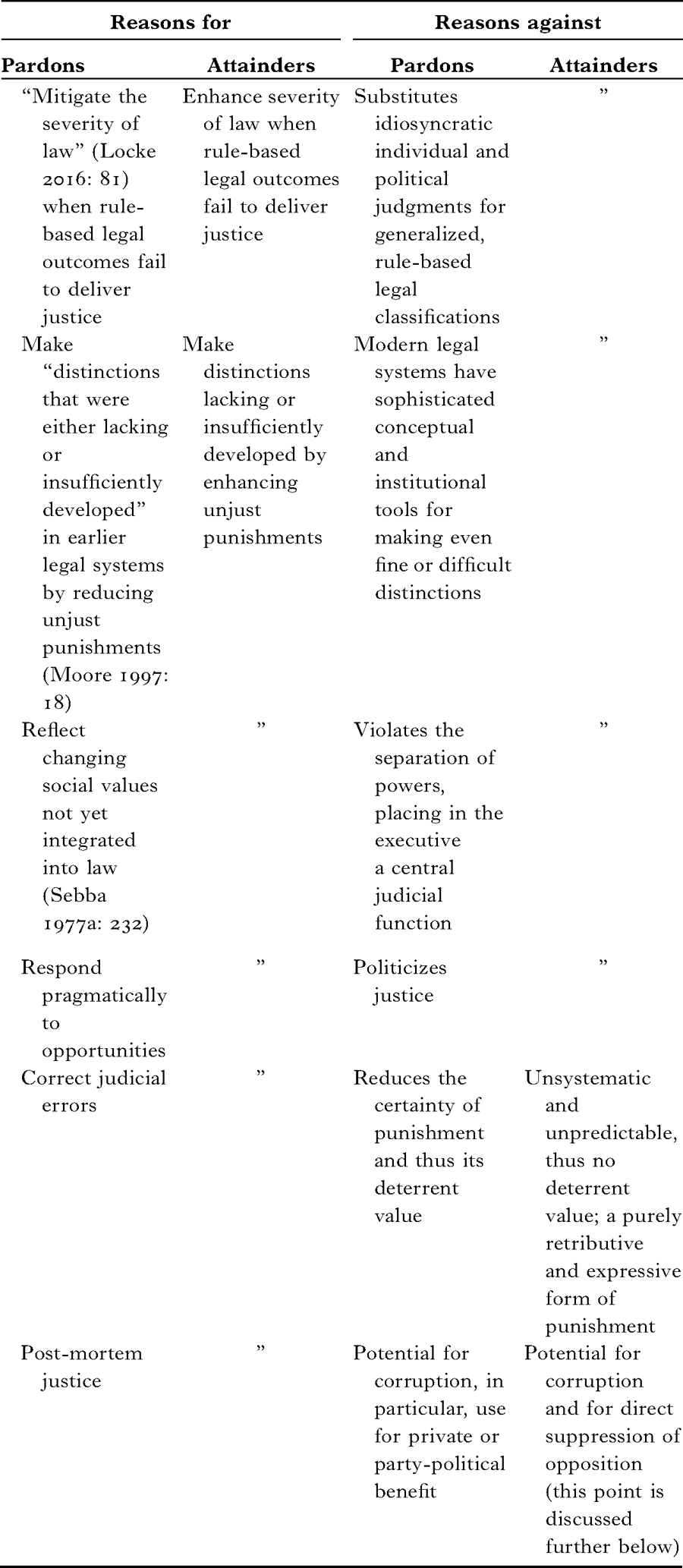
Pardons and attainders are mirror-images of each other, different in their effects but remarkably similar in their structural relationship to the central rule of law premise that the “power of judging” [Montesquieu Reference Montesquieu1989: 157] ought to be left to the judiciary. Their symmetry is manifest in many of the arguments for and against each practice. Table 1 provides an overview of these arguments. In a general sense, the arguments for both attainder and pardons, as well as the arguments against each institution, turn on the relative merits of flexible and rule-based decision-making. Both attainders and pardons provide significantly more flexibility in the use of legal classifications, and this flexibility makes both practices rapidly adaptable and capable of dealing with the confounding particulars of specific cases and social and historical circumstances. On the other hand, this very flexibility threatens the foundational rule of law idea that the law should be in the business of applying generally applicable rules in interpreting particular cases. Its flexibility also has another downside in its potential for the abuse of these powerful levers of law and state.
Main reasons for and against pardons and attainders

Read against their deep symmetries, the fact that the trajectories of these two institutional forms are exactly opposite is striking. Powers of clemency exist in every single rule of law country [Sebba Reference Sebba1977b], and have throughout the history of this form of government with very few exceptions, and those short-lived. On the other hand, attainder and bills of pains and penalties were only ever used in England and in the countries of its legal diaspora [Ostler Reference Ostler2014; Snee and Pye Reference Snee and Pye1960], and were fully extinct by the early 19th century, with the last attainder trial in England held in 1798 and the last use of the bill of pains and penalties procedure in 1820 [Chafee Reference Chafee1956: 136-197].
How are we to explain this divergence given the structural similarities of the institutions just described? Reasons based on legal principle are not particularly helpful for the reasons just explained. When Sebba writes about pardons, “what place is there for an institution rooted in the concept of an omnipotent sovereign tempering justice with mercy as he is swayed in the mood of the moment in a twentieth centur constitutional democracy?” [Sebba Reference Sebba, Landau and Sebba1977a: 221], she also provides a perfectly apt summary of the case against attainders. And when Justice Powell writes in an attainder case that by “impermissibly [assuming] a function that the Constitution entrusted to another branch,” the House’s vote to force the deportation of a specific individual “raises the very danger the Framers sought to avoid—the exercise of unchecked power […] Congress is not subject to any internal constraints […] [it] is not bound by established substantive rules. Nor is it subject to the procedural safeguards, such as the right to counsel and a hearing before an impartial tribunal, that are present when a court or an agency adjudicates individual rights […] When it decides rights of specific persons, those rights are subject to ‘the tyranny of a shifting majority,’” he could as well be making a principled argument against pardons (INS v. Chadha, 462 U.S. 966 [1983]).
The explanation that I develop here focuses on the relationship between two variables. The first is the fact that, for all of their structural similarities from the perspective of rule of law principle, pardons and attainders have an important asymmetry in their potential for abuse. This asymmetry, I contend, is a relational fact, not itself a moral interpretation or directly dependent on interpretive mechanisms. The second is the process of moral interpretation and the specific semiotic matrix that defined the moral-interpretive work of the framers of the Constitution and their successors. It was in the context of the cultural system of founding era legal morality that the factual asymmetry between pardons and attainders became profoundly, indeed, decisively significant in a way that sacralized the former and polluted the latter, leading to the enshrinement of the one and the abolition of the other.
The fact of asymmetry
What this asymmetry boils down to is that a lawful, extrajudicial power to punish poses a greater symbolic and substantive danger to the rule of law than does the lawful, extrajudicial power to extend clemency––despite the many similarities of the two institutions. To be clear, I am arguing that this claim is rooted in empirically ascertainable differences in the structural position of these powers in relation to the other thick moral constructs that defined the moral culture of the framers and their successors. These relational facts are manifest in ascertainable differences in how these powers work in the social world that are likewise not dependent on the views or beliefs of participants in those moral systems. The moral meaning of those facts, however, was conditional on the cultural system that the framers and their successors used to interpretively grasp those facts, and to transform them into intelligible parts of their moral universe.
The most salient differences between pardon and attainder can be summarized in five categories of asymmetrical facts.
• The populations targeted by extrajudicial clemency and punishment have different features that give powers of punishment greater scope and greater impact. The universe of viable objects of extrajudicial powers of punishment is far larger than that for powers of mercy. This is because, while clemency can only extend to someone who has been or could be judicially targeted, there is no such limit on the population that can be targeted by a power to punish.
• Extrajudicial punishment can operate in total freedom from the judiciary while clemency remains tied to it. Because powers of clemency can only extend to those who are or could be targeted by the judicial branch, the power remains in contact with the operation of the judiciary. A power to punish, though, could be used to initiate and pursue action entirely independently of the judiciary, and thus has the potential to usurp judicial powers and become an alternative to judicial justice in a way that clemency does not.
• Extrajudicial punishment creates its own leverage; clemency does not. The power of punishment creates the circumstances that give it leverage [De Geest and Dari-Mattiacci Reference De Geest and Dari-Mattiacci2013:364]. Clemency, on the other hand, relieves actual circumstances: a criminal conviction or a credible threat of a criminal conviction through the usual judicial process. While clemency can easily be molded to the classic form of quid pro quo corruption—you do this, I’ll give you that—it cannot be fitted to the more flexible and more threatening form of quid pro nihilo demands—do this or else. Powers of punishment can.
• Punishment and clemency have inherently asymmetrical limits in their individual consequences. At its limit, clemency purports to make the convicted “a new man.” And what else could it do? But punishment taken to its individual limit is the end of all other incentives, the quiet of the grave. Clemency is ultimately a power over legal classification; punishment has the potential to be, and in historical cases of attainder often was, a power over life itself.
• The time horizons of leverage differ between mercy and punishment. Punishment can exert a more durable leverage than clemency. Once a pardon is given, it cannot be repeated because the individual pardoned will no longer be within the population on whom pardon can operate. But threats of punishment work differently. It is when it is not delivered that the threat can work again, and it can thus serve as a more durable form of leverage [De Geest and Dari-Mattiacci Reference De Geest and Dari-Mattiacci2013: 361, 371].
To summarize: even though both pardon and attainder symmetrically violate core rule of law principles, they differ fundamentally on the pragmatic question of what can be done with them. The lawful extrajudicial power to reclassify the condemned as the free is of far more limited practical political use than a power to unilaterally reclassify the free as condemned. This fact is not lost on either would-be dictators or would-be republicans, though it is construed differently by each. That construal, I suggest, should be modeled as a process of moral interpretation.
A model of the moral interpretation of relational facts
In asserting the above facts as facts I do not claim that they are unassailable, but rather that their truth or falsity is an objective, empirical question about relationships between moral constructs—as true in Jersey as in Java—and not a moral or interpretive one. The significance of these asymmetries, however, is a fundamentally interpretive matter. How, then, should we conceptualize the moral interpretation of empirical facts?
Figure 1 represents a simple conceptual schema that links empirical facts to moral institutions through the mechanism of moral interpretation. Its depiction of a sequential process with discrete stages is an analytical conceit aimed at capturing the core elements of a process that is in reality more rambunctious, involving large numbers of people, occurring in a multi-threaded manner across multiple situations linked in varying ways to the institutionalization process, and exhibiting recursive loops between different stages and processes rather than a steady sequential progress.
Stages and processes linking facts to institutions through the mechanism of moral interpretation. The dashed lines of the “empirical fact” stage indicates that it is an analytical construct, subject to empirical scrutiny but ultimately immanent in historical circumstance. Non-interpretive influences on institutions are beyond the scope of this analysis but noted for context

It begins with an analytical assertion of an empirically supportable relational fact. Such facts are of course derived from historical social circumstances. In empirical contexts, relational facts are manifest in specific conjunctures alongside other facts and historical forces, and cannot therefore be assumed to have, on the spot, the clarity afforded to them in the form of an analytical expression. As manifest in conjunctural historical circumstances, relational facts can influence moral institutions through at least two pathways. One is through direct effects on the circumstances of institutionalization (by shaping preceding institutions or socio-economic structures for example). This pathway is less relevant in the present case. The other pathway to institutionalization flows through the mechanism of moral interpretation, the domain of Geertz’ cultural hermeneutics. This pathway includes the epistemic process through which the historical manifestations of a given empirical fact becomes known to actors. In the moral interpretation stage, actors grasp the meaning of historical cases and patterns in light of the codified concerns, principles, hierarchies, and other patterns of signification that comprise their cultural-moral system.Footnote 6 It is in this interpreted form that relational facts can enter into the making of moral institutions, and do so as both relational facts and interpretations: as morally interpreted relational facts.
Relational facts and divergent institutions in the U.S. case
The U.S. Constitution provides a strikingly clear and self-contained instance of the divergent trajectories of pardons and attainders. The subsequent jurisprudence and institutional practice with regard to each practice has proceeded in the same mold. Pardon has been confirmed by the courts as a almost unlimited prerogative power of the President, and is now bureaucratized in the Office of the Pardon Attorney of the Justice Department. The constitutional prohibition on attainders brought to an end the use of this legal form in the U.S. It has subsequently been used by the courts to limit legislative punishments of individuals and identified groups more broadly. But how did the factual symmetries and asymmetries of the two practices influence this institutional form?
In terms of the stages and processes described above, the factual similarities and differences between pardon and attainder were prominently manifest in the political and legal history of the English state. Pardons were used for purposes ranging from venal self-enrichment to genuine mercy. The pardon power expanded with the Empire, enshrined in the charters of the colonies and incorporated into their legal practice as a prerogative of colonial governors, as well as in other forms. Attainder, on the other hand, saw little usage in the American colonies until the Revolutionary era. It was nonetheless well-known because of that later usage as well as through its history of high-profile uses against enemies of the crown and other elite factions in English political and legal history. As participants in trans-Atlantic legal culture [Bilder Reference Bilder2008] the participants in the 1787 U.S. Constitutional Convention in Philadelphia as well as their successors knew this history well. As Edmund Burke noted in 1775, “they have sold nearly as many of Blackstone’s Commentaries in America as in England,” [cited in Nolan Reference Nolan1976].
To summarize, the empirical asymmetries between attainder and pardon had manifested themselves in a lengthy historical record, and both specific elements and the general themes of that record were well and widely known among legal and political elites of the U.S. founding generation. They brought this knowledge to bear in crafting the Constitution and, in particular, in creating the institutional reality that, despite their structural similarities and mutual violation of fundamental tenets of the rule of law, pardons were necessary and attainders forbidden. As I will show below, the reasons that they gave for these arrangements closely conform to factual differences in the relationship between pardons, attainders, and the rule of law.
Nonetheless, there is no necessary moral reason to prefer pardons to attainders. That meaning is not inherent in history or in historical knowledge, even if the asymmetries between pardon and attainder manifest themselves historically. Rather, it is contingent on the signification of that knowledge and history in the context of a moral universe that guided the framers and their successors in their highly-institutionally-leveraged grasp of meaning from history.
The moral interpretation of pardons and attainders in the U.S. case
To capture the key features of that universe I adopt the “formalist” [Tavory Reference Tavory2011: 276] structural-semiotic analytical approach advocated by Alexander and Smith [Reference Alexander and Smith1993, 2003] for the cultural explanation of sociological phenomena. By adopting this approach I do not intend to subscribe to the notion that this cultural system was universal or consensually shared. It was embedded in and the product of intense social struggles and contestation [Klarman Reference Klarman2016], but can nonetheless be discerned as a powerful organizing force within that tumultuous social reality that faces all cultural systems.
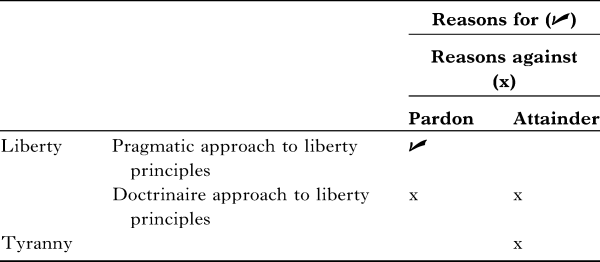
The central interpretive structure that was most influential in determining the collective meanings the framers and their successors gave to pardon and attainder was perhaps the most significant cultural structure of all in U.S. constitutional history: the binary opposition between liberty and tyranny. Furthermore, the interpretive matrix through which the framers and their successors grasped the meanings of pardon and attainder for the institutions they were building had nested within the liberty/tyranny opposition a subordinate distinction: a hierarchy of worth [Lamont Reference Lamont1994; Steensland Reference Steensland2006] that placed the pragmatic pursuit of the principles associated with liberty—such as the rule of law—over a rigidly doctrinaire adherence to the principles as principles. Table 2 provides a representation of this interpretive matrix. Following it, we can make sense of the interpretation of the relational facts distinguishing pardon and attainder in the following way. There was a strong argument, described above, against both pardon and attainder since they violate the core rule of law doctrine separating judging from other branches of government. In the case of pardon, however, this was coupled with a strong pragmatic argument about the power of pardons to ensure liberty if the law was too severe. The strongest arguments against pardon—the risk of corruption for example—fell outside of the heightened salience of the liberty/tyranny binary construction and were therefore discounted. In the case of pardons, this interpretive matrix produced a strong argument for pardons as a tool for the pragmatic pursuit of liberty despite its violation of rule of law principles––an interpretation based on a history of pardon that accurately conveyed its pragmatic value in ensuring liberty and its low risk of supporting tyranny.
Pardon and attainder interpreted in light of the liberty/tyranny binary opposition and the pragmatic/doctrinaire hierarchy of worth

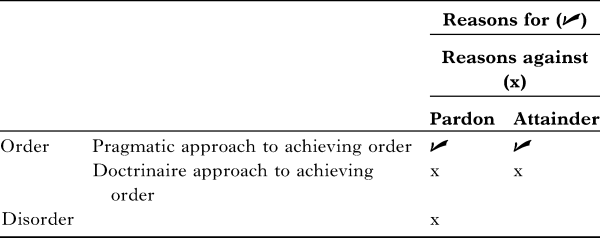
For attainders, on the other hand, the strong doctrinaire argument against it found no pragmatic counterbalance. Indeed, the founders saw in the history of attainder a significant weapon against liberty in the hands of a would-be tyrant. The historical manifestation of lawful, extrajudicial punishment in the form of attainder again accurately conveyed its low pragmatic value in ensuring liberty and its high risk for tyrannical abuse. On the other hand, the pragmatic arguments in favor of attainder described above fall outside of the liberty/tyranny binary, and are thus less salient in a moral-interpretive context centered on liberty/tyranny. Those arguments suggest the value of attainder in sharpening punishment in situations where it is judged necessary, an advantage not aligned with liberty and indeed redolent of the potential for tyrannical abuse of lawful, extrajudicial powers of punishment. If those arguments and the whole question of pardons and attainders were to be considered hypothetically in the context of an order/disorder binary (Table 3), however, the interpretive matrix would look very different and the case for attainder would be much stronger.
Hypothesized interpretive matrix organized around a central order/disorder binary form

The sense and force of the (liberty(pragmatic/doctrinaire)/tyranny) formulation recurs throughout the primary source material on pardons and attainders in the U.S., from the founding on, as well as in the secondary literature. To illustrate its utility for understanding this interpretive nexus I will briefly apply it to the two most important interpretive claims from Table 2—the interpretation of pardon as consistent with a pragmatic pursuit of liberty and the interpretation of attainder as a tyrannical power. For each case I touch on founding-era interpretations of the meanings of these institutions and then on the reflection of this original interpretive formation in more modern manifestations of their significance.
For a first instance of the power of the (liberty(pragmatic)) interpretation of pardon we can look to the debate over the pardon clause during the Constitutional Convention. The inclusion of the pardon power in the prerogatives of the President was proposed early in the convention and received little resistance. For instance, the suggestion that the President should only be able to issue pardons with the consent of the Senate received almost no support because those present deemed it unworkable.Footnote 7 Another effort to limit the pardon to post-conviction relief did not even receive a vote, as James Wilson’s pragmatic objection that, “pardon before conviction might be necessary in order to obtain the testimony of accomplices”Footnote 8 caused the motion to be withdrawn. The sense that both of these moments reflect the interpretation of the pardon power in light of a pragmatic orientation to securing the principle of liberty receives a direct statement in Alexander Hamilton’s comments on pardon in Federalist 74. He writes: “in seasons of insurrection or rebellion, there are often critical moments, when a well timed offer of pardon to the insurgents or rebels may restore the tranquillity of the commonwealth; and which, if suffered to pass unimproved, it may never be possible afterwards to recall. The dilatory process of convening the legislature, or one of its branches, for the purpose of obtaining its sanction to the measure, would frequently be the occasion of letting slip the golden opportunity. The loss of a week, a day, an hour, may sometimes be fatal.”Footnote 9 Hamilton’s pragmatism with regard to pardon can be found both in the text of this quotation, particularly in its concern with the construction of a pardon power as flexible and rapid as possible, as well as in its uneasy juxtaposition with his commitment elsewhere to the importance of the principle of the separation of powers.Footnote 10 In the case of pardon, in any case, its pragmatic value to liberty trumped its violation of an otherwise sacred doctrine. That hierarchy receives an even balder, if fine, statement by Madison who favorably contrasts the pragmatism of the Constitution that had been drafted against the imagined “artificial structure and regular symmetry which an abstract view of the subject might lead an ingenious theorist to bestow on a Constitution planned in his closet or in his imagination”.Footnote 11 That this pragmatism around pardon is ultimately ensconced in the semiotics of liberty we can see in Hamilton’s explanation for having a pardon power at all. He justifies pardon in the name of “humanity and good policy” as a necessary check on the terrible power of government, writing that, “the criminal code of every country partakes so much of necessary severity, that without an easy access to exceptions in favor of unfortunate guilt, justice would wear a countenance too sanguinary and cruel,”Footnote 12 emphasizing both the importance of the pardon as a way to limit the power of the state and the fact that, despite its power as a checkrein, pardon is nonetheless benign with respect to the threat of tyranny.
This founding interpretive formulation set a mold that future institutionalizing moral interpretations have hewed to with great fidelity. Consider the following interpretive configuration. Barack Obama commuted more sentences than any President in U.S. history. A letter from the President to one of those commutees begins by noting that, “the power to grant pardons and clemency is one of the most profound authorities granted to the President of the United States.”Footnote 13 The way that the Obama administration conceptualized that power conforms closely to the (liberty(pragmatic)) section of the interpretive matrix described above. Neil Eggleston, Counsel to the President, notes that the White House set out to “reinvigorate clemency” by focusing on “federal inmates serving sentences imposed under outdated laws.”Footnote 14 Eggleston further notes that, “while the mercy the President has shown […] is remarkable, we must remember that clemency is an extraordinary remedy […] Only Congress can achieve the broader reforms needed to ensure over the long run that our criminal justice system operates more fairly and effectively in the service of public safety.”Footnote 15 The central value of these acts of Presidential clemency, as Deputy Attorney General Cole of the Department of Justice put it, was that it represented a practical tool for the furtherance of the deepest principle of liberty: “For our criminal justice system to be effective, it needs to not only be fair; but it also must be perceived as being fair.” Cole notes, “older, stringent punishments that are out of line with sentences imposed under today’s laws erode people’s confidence in our criminal justice system, and I am confident that this initiative will go far to promote the most fundamental of American ideals—equal justice under law.”Footnote 16 In this formulation, clemency is represented both as a pragmatic fix to a systemic failure and as a tool in service to the highest ideals of law and liberty.
The principle interpretation of attainder, on the other hand, equated the practice with the great nemesis of the founders: tyranny. As Madison writes in Federalist 44, “Bills of attainder […] are contrary to the first principles of the social compact, and to every principle of sound legislation […] expressly prohibited by the declarations prefixed to some of the State constitutions […] [o]ur own experience has taught us, nevertheless, that additional fences against these dangers ought not to be omitted. Very properly, therefore, have the convention added this constitutional bulwark in favor of personal security and private rights.”Footnote 17 That attainder represented a risk of tyranny was likewise made explicit during the debates at the Constitutional Convention. After proposing the prohibition on attainders, Elbridge Gerry of Massachusetts notes that the motivation for the prohibition is the fear of what a legislature would do with that power. Madison’s notes on the convention convey the strength of the consensus on the risk of attainders by their very brevity: the delegates adopted the prohibition on attainder without objection.Footnote 18 This easy consensus is in part explicable because of the association of attainder with tyrannical governmental over-reach in cases that were, for the delegates, well-known and recent. In the Revolutionary era attainder became a common legislative tool used to control and punish loyalists [Palfreyman Reference Palfreyman2015: 453]. In particular, two notorious uses were well-known and loomed large in the interpretation of attainder. The first was the attainder of Josiah Philips in Virginia in 1778. Philips was a loyalist raising armed havoc in Virginia who had eluded capture. Under the urging of Thomas Jefferson, the Virginia House of Delegates passed a bill of attainder condemning Philips and his associates unless they turned themselves in to undergo normal judicial trial [Lynch Reference Lynch2002]. Though initially justified as a wartime expediency, a decade later the trial had come to represent the dangers of attainder even in the hands of well-meaning legislators, and was disavowed even by those who had participated in it [Steilen 2015]. The second was the “Act to Preserve the Freedom and Independence of This State” passed by New York in 1784 that banished listed loyalists from the state and empowered the government to seize and sell their forfeited property. One of the most prominent moments in Alexander Hamilton’s post-Revolutionary legal career came with his defense of loyalists against these forfeitures, a position that many had come to see, by the time of the drafting of the Constitution, as the assertion of the rule of law over an arbitrary and vengeful abuse of state power. These Revolutionary-era attainders introduced a dangerous new twist on the power by putting it in the hands of publically elected legislatures that were willing to use it for populist ends, raising real Madisonian fears of the tyranny of the majority [Palfreyman Reference Palfreyman2015]. The meaning of attainder, based on both historical knowledge and experience, was so clear to the framers in its association with tyranny that it was one of the few individual rights expounded in the original text of the Constitution, and one of its few direct limitations of state sovereignty. It is today an obscure legalism, but the founders interpreted it as a matter of paramount concern for protecting liberty from the power of the state, even––indeed especially––if that state was ultimately controlled by the people.
The association of attainder with the risk of tyranny continues as a powerful interpretive stream to the present day. It flows clearly, for example, through the concurring opinion of Justice Powell in INS v. Chadha (1983), a case involving unicameral Congressional veto power over immigration decisions by the Attorney General. Powell argues that this scheme amounted to a constitutionally prohibited attainder, a legislative trial by one chamber of Congress that had the effect of singling out an individual for punishment. In his opinion Powell cites Madison in Federalist 47, writing that, “the Framers perceived that ‘[t]he accumulation of all powers legislative, executive and judiciary in the same hands, whether of one, a few or many, and whether hereditary, self-appointed, or elective, may justly be pronounced the very definition of tyranny,’”Footnote 19 in order to support his invalidation of the Congressional veto of immigration decisions at stake in the Chadha case, further citing the fear of “the tyranny of shifting majorities” that the Framer’s had taken as a central lesson of the Acts of Confederacy experiment, an experiment as many saw it in exactly the sort of legislative tyranny that the prohibition on attainders sought to avoid. 196 years later, the interpretation of attainder as a primary tool of tyranny remained a dominant one.
Discussion and Conclusion
If liberty/tyranny was indeed the central organizing cultural structure guiding the framers’ interpretations of pardons and attainders, then the institutions that they created reflect accurately a factual relationship between the thick moral constructs of liberty, tyranny, pardon, and attainder: attainders threaten liberty in ways that pardons do not. By the same token, if pragmatism in pursuit of liberty is valued over doctrine, then a factual case can again be made for the value of pardon in relation to a pragmatic understanding of the rule of law as a valuable tool for checking overly harsh criminal punishments. The symmetrical pragmatist case for a lawful, extrajudicial power of punishment is no longer symmetrical when considered in the context of the master liberty/tyranny binary, for the pragmatic value of attainder, which is real, is not a pragmatic contribution to liberty so much as it is one to order. They are not symmetrical with respect to the relational facts that the framers saw as most significant.
One question raised by the argument presented so far is whether the moral interpretation of empirical facts is any different than moral interpretations of other sorts of social and environmental information. What is the force of facticity in this analysis? Relational moral facts differ from purely subjective moral judgments like “killing animals is evil” in that their facticity shapes their entry into moral interpretation. In particular, facticity that is separate from interpretation manifests itself historically in ways that are not dominated or even necessarily well-aligned with interpretations, and will continue to do so contingent on other parts of its historical context. It was not an accident, in this view, that the framers had abundant evidence for the position that pardons are benign and attainders are dangerous relative to the rule of law, but the manifestation of a factual asymmetry in the relationships between these thick moral constructs.
An emphasis on facts and facticity does not, however, move the sociology of morality in the direction of moral realism. Facts, passing through an interpretive process become something other than facts: moral meanings, combined with others in forms that make mostly cultural and never strictly factual or relational sense. It does argue, however, for the relevance of whether some dimension of moral interpretation reflects a relational fact about the moral system within which it operates, because such facts may shape moral interpretation in different ways than strictly interpretive realities. Consider, for example, the scheme proposed here in light of the physical fact of anthropogenic climate change. That fact, like the relational facts that I have been discussing, is amenable to myriad moral interpretations. However, notwithstanding its interpretive malleability, the underlying facts, and the force of facticity that manifests itself historically in ways beyond the reach of the most fervent interpretants is a fundamentally important part of the moral dynamics surrounding climate change. We can interpret to our heart’s content, but the sea will rise.
Pound writes of the demise of attainder that, “the provisions of modern constitutions in this respect represent more than the influence of eighteenth-century theory. They represent a universal experience of the ills involved in legislative justice” [Pound Reference Pound1914: 12] and, we can add, that universal experience was the opposite with respect to clemency. Pound’s explanation is helpful in its focus on experience [Strand Reference Strand2015], a turn to the world, and to facts about the world as one of the key drivers of the divergent trajectories of these institutions. The all but universal rule-of-law judgment on pardons and attainders reflects a more general form: an interpretive nexus formed on one side by the structured specificity of culture and on the other by the experience of a social world containing facts that neither fully escape the grasp of culture nor are fully determined by it––a tangle of facts and meanings.