INTRODUCTION
Amorphophallus paeoniifolius, popularly known as elephant foot yam, is an important tropical tuber crop in India. It is grown in Andhra Pradesh, Bihar, Chattishgarh, Gujarat, Karnataka, Kerala, Maharastra, Orissa, Uttar Pradesh, Tamil Nadu, West Bengal and the northeastern states (Nedunchezhiyan and Byju, Reference Nedunchezhiyan and Byju2005). Elephant foot yam grows well in fertile soil and is grown in alluvial soils in Andhra Pradesh, Bihar, West Bengal and Uttar Pradesh, and vertisols in Chattishgarh, Gujarat, Karnataka, Maharastra and Tamil Nadu. It is also grown in alfisols in Kerala, Orissa and the northeastern states. It is a long-duration crop (eight months) and requires well-distributed rainfall of 1000 mm. In India, the estimated production area is 37 000 ha with a total output of 670 000 tonnes and average corm yield of 21 t ha−1 (CTCRI, 2010).
The elephant foot yam plant looks like an unfolded umbrella. The above-ground part is a solitary leaf. The petiole, which is 150–200 cm in height looks like a stem (7–10 cm diameter), hence it is called a pseudostem. The petiole divides into three rachises at the top, which spread 200–250 cm in width. Depending on the plant size, the three rachises together have 150–200 leaflets. A corm, a modified stem, is below the petiole (pseudostem) and is the storage organ. It has a depressed-globose shape. Sometimes corms produce cormels, which are miniatures of corms that develop from lateral buds occurring at each corm node. The shape of the cormel is globose and the number depends on the variety or land race. Both corm and cormels are used as planting materials.
Elephant foot yam corms are consumed as a vegetable after boiling, baking or frying. A pickle (regarded as a delicacy) is also made from the corms (Nedunchezhiyan and Misra, Reference Nedunchezhiyan and Misra2008). Corms are rich in minerals and vitamins (Nedunchezhiyan et al., Reference Nedunchezhiyan, Byju and Naskar2008) and are used to prepare many indigenous medicines for piles, asthma, dysentery and other abdominal disorders. The corm is a ‘food medicine’.
The variety ‘Gajendra’, which is very popular in India, has a low calcium oxalate content (Nedunchezhiyan and Misra, Reference Nedunchezhiyan and Misra2008) and commonly does not produce cormels. However, in the Gajendra variety one or two small cormels per plant are reported to occur when it is grown in clay-rich heavy soils (Sankaran et al., Reference Sankaran, Singh, Nedunchezhiyan, Santhosh and Chander Datt2008). After harvest of the corm, farmers keep corms of 400–500 g weight for use as seed for a subsequent planting season.
Of late, mealybug (Rhizoecus amorphophalli) is threatening Amorphophallus cultivation in India. Williams (Reference Williams1985) reported the presence of this mealybug in some root crops in India. It is a noxious insect whose soft body is easily identified by a coating of a distinct white waxy substance. It infests the corms both in the field and in storage (Misra et al., Reference Misra, Nedunchezhiyan and Suja2005). Mealybugs are seen in clusters on the stem, petiole and leaf, particularly on the lower side. Infestation is high during warm and dry periods. Usually the Amorphophallus seed corms are harvested during the dry season after the crop is fully matured. During this period, mealybugs enter soil cracks and holes formed after pseudostem drying and infest the corms. Infestation becomes severe when the corms are left for longer periods in the soil during the dry season. Mealybug is a pest that thrives in hot and humid conditions. When the temperature is more than 30 °C its infestation is severe, and increases with rising temperature and humidity. During storage, when temperature and humidity are high, it can infest an entire batch of corms. The crawler (early stage of the first instar nymph prior to settling) and adults suck and de-sap the cell content of corms (Palaniswami, Reference Palaniswami, Upadhyay, Mukherjee and Dubey1999). Severely infested corms shrivel which adversely affects their quality and marketability. Infestation also affects the corms’ ability to sprout which then affects subsequent production and productivity.
Several methods have been tried for controlling mealybug. Rubbing of infested corms with a dry cloth, and forcefully washing the corms with water are the some of the management practices which are recommended (Misra et al., Reference Misra, Sriram, Nedunchezhiyan and Mohandas2003). However, reinfestation after some time is common when using these techniques. Although insecticides provide effective control (Misra et al., Reference Misra, Nedunchezhiyan, Shivalingaswamy and Edison2002) their use with vegetables is not advisable for several reasons including health and environmental hazards (WMO, 1995), the risk of insect resistance (Fishwick, Reference Fishwick1988) and their high cost.
In view of these problems, together with the WTO regulations, there is a need to restrict insecticide use globally and implement safe alternatives to protect stored food grains and vegetables (Subramanyam and Hagstrum, Reference Subramanyam and Hagstrum1995; Yusof and Ho, Reference Yusof and Ho1992). In this context, there is potential to promote low risk, cheap techniques for mealybug control. Indian farmers traditionally use cow dung, red earth, copper sulphate and salt to treat both true seeds and tubers either to prevent pests and diseases or to improve germination/sprouting. Cow dung slurry is used for tuber treatment when cut tubers of yam (Dioscorea spp.) and elephant foot yam are used as seed material because it arrests evaporation and pest attack and prevents diseases (Misra et al., Reference Misra, Sriram, Nedunchezhiyan and Mohandas2003; Nedunchezhiyan, Reference Nedunchezhiyan2008). Pigeonpea seeds are also treated with red earth, clay and fly ash to prevent storage pests (Singal and Chauhan, Reference Singal and Chauhan1997).
The Indian Council of Agricultural Research has granted a mega seed project (MSP) for production of good quality planting material of tuber crops (elephant foot yam, yams, taro, etc.) to the Regional Centre of Central Tuber Crops Research Institute, Bhubaneswar, during 2006. Under this project the Institute is producing and selling 5–7 tonnes of planting material of elephant foot yam corms every year to farmers, developmental agencies, research organisations, etc. As the mealybug problem has reached alarming levels in various parts of India, the present investigation was carried out under MSP to develop an eco-friendly and sustainable technology for managing mealybug.
MATERIALS AND METHODS
The well-established fact that the damaging effects of mealybugs on corms in storage carry through to field performance guided design of this study. A set of mealybug control measures were applied to corms prior to storage and the incidence and severity of the pest were then monitored during storage through determining levels of infestation and assessing corm quality (Experiment 1). The subsequent establishment and growth of these corms in the field under conditions normally used for the crop's production were assessed (Experiment 2). The study was conducted in 2009 and was repeated in 2010 at the Regional Centre of Central Tuber Crops Research Institute (20°14′50″N; 85°47′06″E), Dumuduma, Bhubaneswar, India using seed corms, which the MSP had produced.
Experiment 1
The storage study was conducted in a randomized block design with three replications. There were seven corm treatments per replicate: control (no treatment), hot water treatment (50 °C), copper sulphate solution (1000 ppm), common salt (NaCl) solution (1000 ppm), cow urine, cow dung slurry (2:1, 2 kg of cow dung in 1 litre of water) and clay slurry (1:1, 1 kg of clay in 1 litre of water). These treatments are referred to as: hot water (HW), copper sulphate (CS), salt (Sa), urine (Ur), dung (Du) and clay (Cy).
Elephant foot yam corms var. Gajendra were used. In each year of the study, each treatment of each replicate comprised 24 corms of relatively uniform size and 450–550 g fresh weight, each visibly infested with mealybug. The treatments were made on 25 February 2009 and 22 February 2010. The corms were soaked or coated in the appropriate solution/slurry for 10 minutes. The treated corms were shade-dried for 2 days and then taken into the storage shed. This was a well-ventilated structure that reduced light to about 70% of daylight and reduced temperature, relative to that outside, by about 4–5 °C. Each batch of corms was spread in a single layer in a 25-mm-thick plywood container measuring 1 m × 1 m × 60 cm high. Containers were kept 5 m away from each other in the storage shed. The number of mealybugs present in a 25 cm2 area of a sample corm (one corm per treatment per replication selected randomly) was recorded at intervals of 10 days up to 60 days after treatment (DAT). The fresh weight of each batch of corms was recorded at 0, 30 and 60 DAT and used to calculate the percentage weight loss of the corms at 30 and 60 DAT.
At 0 and 60 DAT, one mealybug infested corm in each batch of corms was randomly selected for analysis of starch (Moorthy and Padmaja, Reference Moorthy and Padmaja2002) and total sugars (CTCRI, 2005) which were calculated as percentage concentrations expressed on fresh corm weight basis.
Experiment 2
Field establishment and plant growth were assessed using the corms of Experiment 1 in an randomized block design with three replications. The field was prepared by one pass of a disc plough and three passes of a cultivator. Farmyard manure (10 t ha−1) and single super phosphate fertilizer (P2O5 60 kg ha−1) were broadcast before one pass of the cultivator. A plot size of 4.5 m × 3.2 m was made and a spacing of 90 cm row to row and 90 cm plant to plant was adopted for planting. Twenty corms were planted in each treatment per replicate. Each corm was placed 5–7 cm deep in a pit which was covered with soil to make a 15 cm high mound above the corm. All mounds were mulched with paddy straw (5 t ha−1). Urea (80 kg N ha−1) and muriate of potash (80 kg K2O ha−1) were applied around the mounds in two equal splits at 30 and 60 days after planting (DAP). Weeding and earthing-up were carried out prior to fertilizer application. The emergence percentage, plant height (up to the division of pseudostem into rachises) and collar diameter of the pseudostem (just above the ground surface) were measured at 30 and 60 DAP. Collar diameter was measured using Vernier calipers.
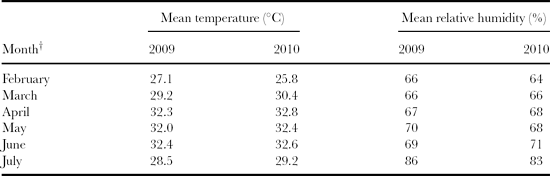
Temperature and relative humidity (Table 1) were recorded from a field weather station situated 250 m from the storage shed. The mean temperature increased from February to April and remained more or less constant until June, before decreasing in July. Relative humidity increased slowly from February to June (to about 70%) and then increased markedly (to >80%) in July.
Weather conditions during storage and field study period.

†February to June covers the dry season.
The data for quality characteristics and field performance were analysed statistically using the ‘Genstat’ programme (Discovery Edition 3, 2010, VSN International, UK). The significant differences between treatments were determined using the least significant difference (LSD) test at 5%.
RESULTS
Storage experiment
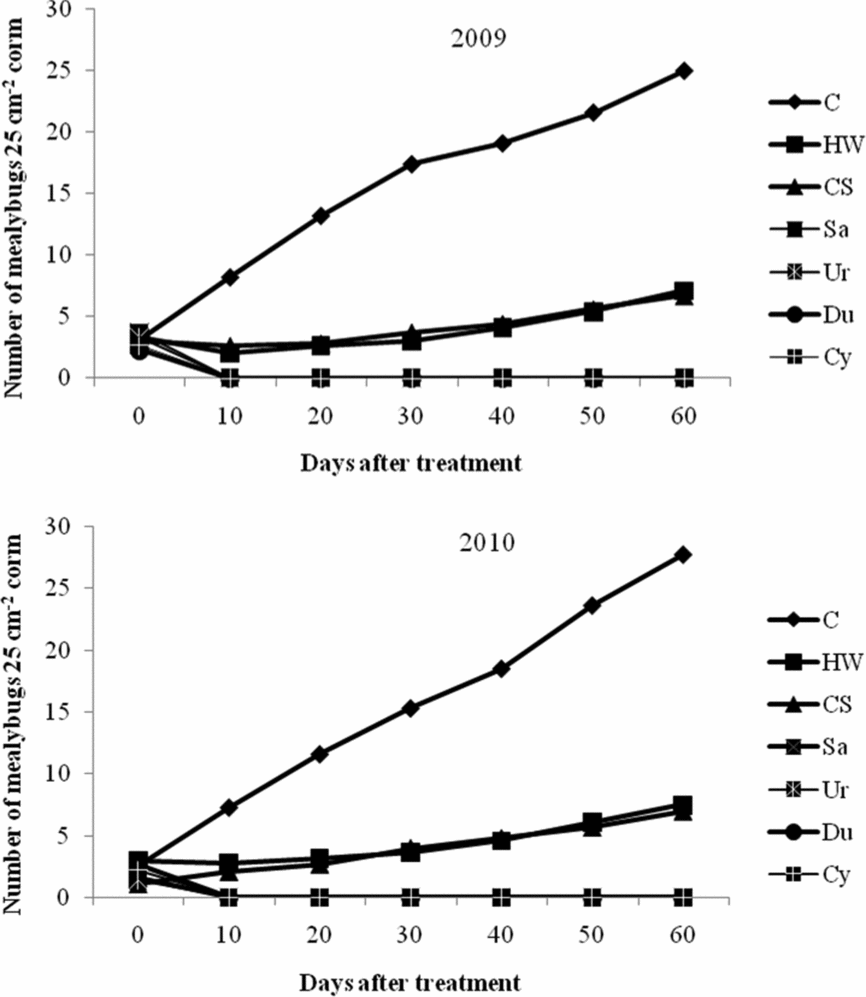
The results for mealybug numbers were similar in both years (Figure 1). Large and consistent differences developed during the storage period between the control, the HW and CS treatments, and the other four treatments (Sa, Ur, Du, Cy). When storage commenced, the mean overall level of infestation was 3.1 ± 0.17 mealybugs per cm2 in 2009 and 2.1 ±0.27 mealybugs per cm2 in 2010. In the control, numbers steadily increased as the storage period progressed reaching 4–5 times greater by 60 days after the experiment commenced. In contrast, no mealybugs were found in the Sa, Ur, Du and Cy treatments by 10 DAT nor in the subsequent storage period to 60 DAT. The HW and CS treatments appeared initially to restrain mealybug increase, but from 20 DAT onwards the numbers slowly increased up to 60 DAT to an infestation level about 27% in 2009 and 28% in 2010 of the control.
Number of mealybug during storage in various treatments. The treatments Sa, Ur, Du and Cy all had the same value (0) for mealybug counts and therefore the data points are not distinguisable in the figure. Treatments: C: control; HW: hot water; CS: copper sulphate; S: salt; Ur: urine; Du: dung; C: clay.

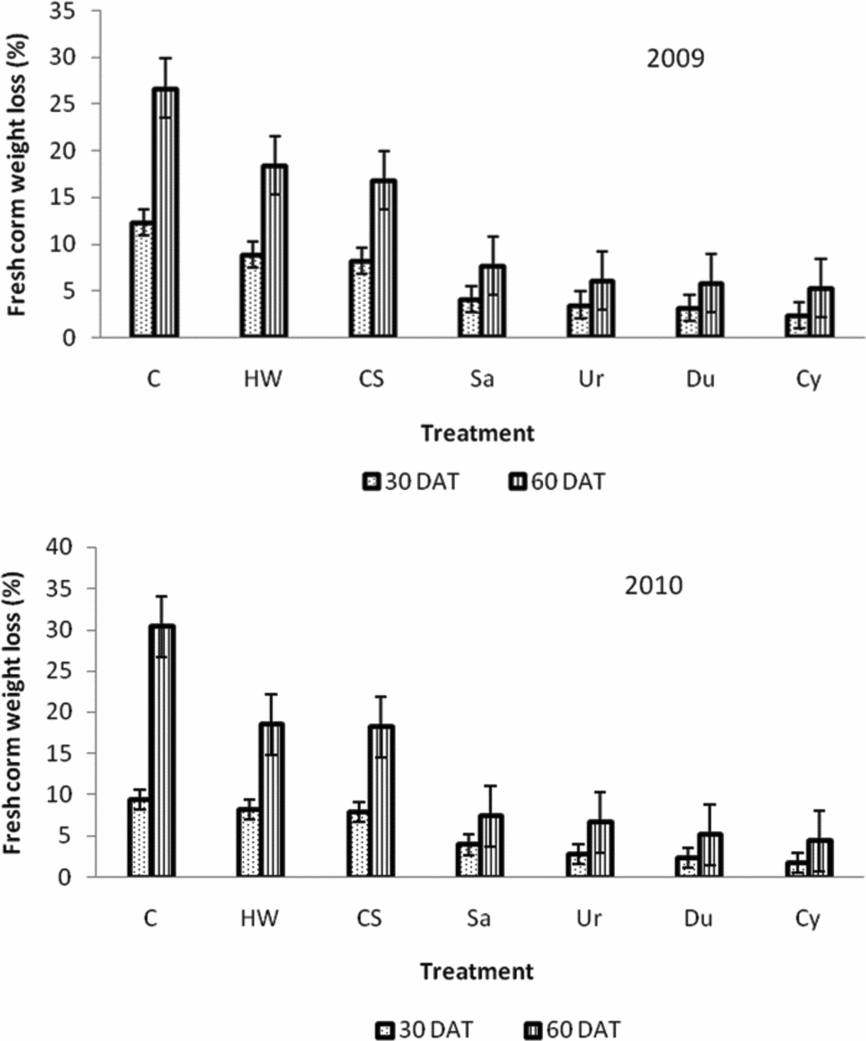
Weight loss is a common phenomenon in elephant foot yam during storage (Nedunchezhiyan, Reference Nedunchezhiyan2008; Nedunchezhiyan et al., Reference Nedunchezhiyan, Saurabh and Ranasingh2006). The longer the storage period the greater the weight loss. This arises from tissue dehydration and metabolic processes (e.g. respiration) as well as processes of deterioration associated with pests and other agents that cause tissue decay. Among all the treatments, by 60 DAT, the largest weight loss (27%, 2009 and 30%, 2010) was observed in the control (Figure 2). The weight losses in the HW and CS treatments were similar and less than the control (mean across treatments and years of 18% at 60 DAT) while those for treatments Sa, Ur, Du and Cy were similar and relatively small (mean across treatments and years of 6% at 60 DAT).
Fresh corm weight loss during storage. Bars indicate standard error of mean. DAT: days after treatment. Treatments: C: control; HW: hot water; CS: copper sulphate; S: salt; Ur: urine; Du: dung; C: clay.

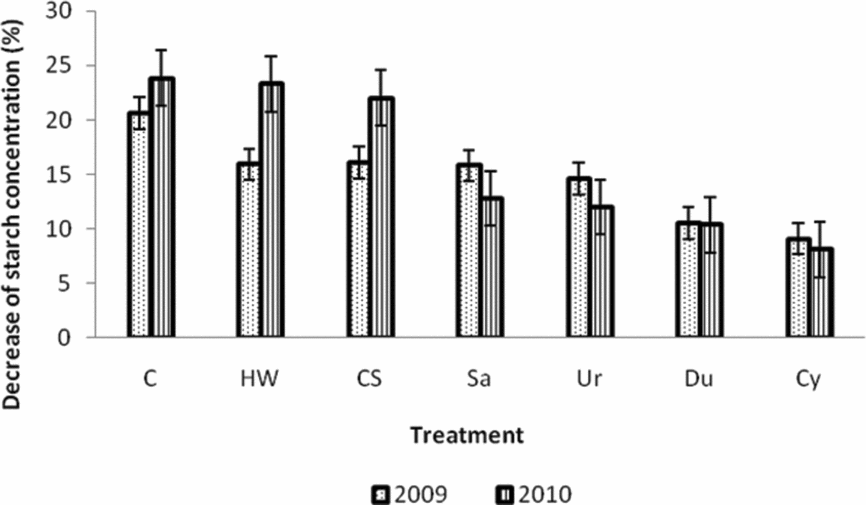
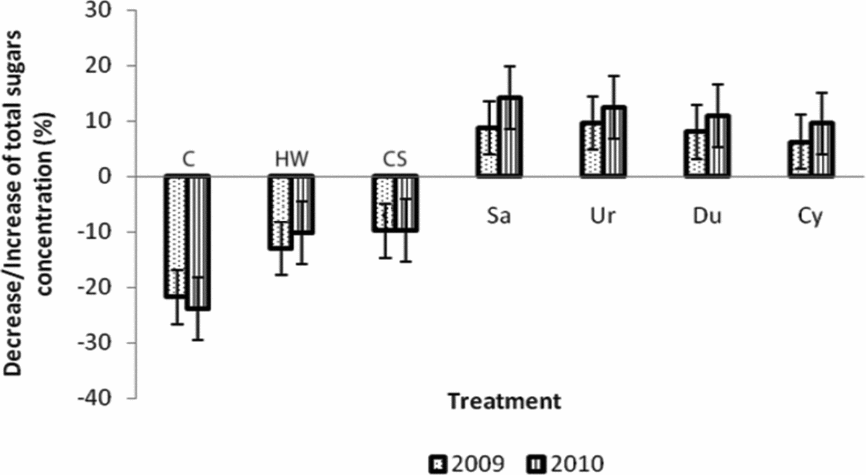
The changes in starch and total sugars are shown in Figures 3 and 4 respectively and indicate how the treatments for mealybug modified corm metabolism. Although some small differences were observed between years the main effects of four of the treatments (Sa, Ur, Du and Cy) were to significantly reduce starch decline and significantly increase total sugars as compared with the control. In the control, in both years, starch and total sugars each decreased by about 22% and 23% respectively during the storage period. In contrast, over the same period in both years, mean starch levels decreased by only 14% in Sa and Ur, and 10% in Du and Cy, and mean total sugars increased by 10%. In the HW and CS treatments, changes in starch were similar (2010) or slightly less (only 16%, 2009) than in the control and the observed decrease in total sugars (mean of 11%) was also less than the control.
Percentage reduction of starch concentration during storage of corms. Bars indicate standard error of mean. Treatments: C: control; HW: hot water; CS: copper sulphate; S: salt; Ur: urine; Du: dung; C: clay.

Percentage decrease/increase of total sugars concentration during storage of corms. Bars indicate standard error of mean. Treatments: C: control; HW: hot water; CS: copper sulphate; S: salt; Ur: urine; Du: dung; C: clay.

Field establishment
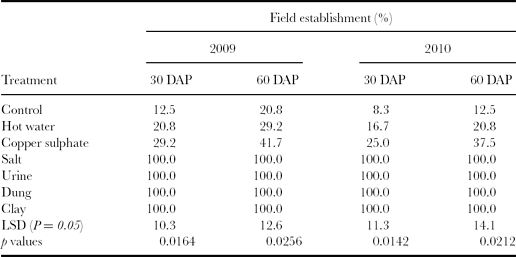
There was a highly significant effect of treatment on the corms in respect of both the speed and success of field emergence (Table 2). At 30 DAP, all the corms of treatments Sa, Ur, Du and Cy had achieved emergence but in the remaining treatments (control, HW and CS) there was significantly less emergence (ranked control (least), HW (mid-) and CS greatest at 25–29%). By 60 DAP, these three treatments achieved slightly more emergence rising, at best, to about 40% (CS treatment).
Effect of corm treatment in storage on field establishment of elephant foot yam.

DAP: Days after planting; LSD: least significant difference.
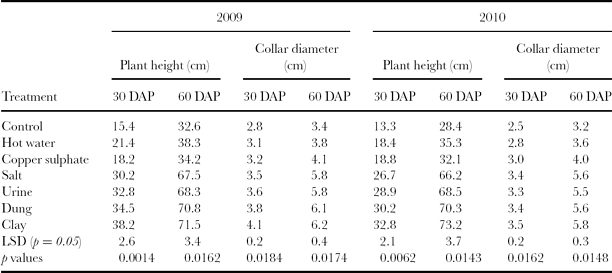
In those corms that achieved emergence, there were also highly significant differences in plant height and collar diameter at 30 and 60 DAP in both years (Table 3). By 60 DAP, treatments Sa, Ur, Du and Cy achieved at least double the height and 75% greater collar diameter than the control. The plants of treatments HW and CS were less vigorous achieving heights and collar diameters only slightly greater than the control.
Effect of corm treatment on plant growth and collar diameter of elephant foot yam†.

†A sub-sample of three plants was measured and averaged in each treatment in each replication.
DAP: Days after planting; LSD: least significant difference.
DISCUSSION
The observed increases in mealybug numbers in the control treatment during the storage period of each year of the study indicate that weather conditions (Table 1) and starch concentration of the corms (Figure 3) supported mealybug multiplication. Irrespective of these favourable conditions for the pest, all the treatments for mealybug control reduced (HW and CS) or completely prevented (Sa, Ur, Du and Cy) mealybug multiplication in treated corms stored for up to 60 days.
In this study, in broad terms, the treatments that were selected to control mealybugs either were rinses (HW, CS, Sa and Ur) or coatings (Du and Cy) with chemical residues adding to their effects in the case of the CS, Sa, Ur and Du treatments. There is already some information on why such treatments are effective. Salt crystals obstruct crawlers and prevent egg-laying (Misra, Reference Misra2000). Khan (Reference Khan2003) reported that a mixture of table salt and lower rates of insecticide was effective against sucking pests. Chaudhari and Chaudhari (Reference Chaudhari and Chaudhari1993) reported that salt solution dehydrates soft body insects and worms by osmosis. Cow urine is reported to have many pesticidal properties (Dhama et al., Reference Dhama, Rajesh, Chauhan and Simmi2005). Cow dung and clay coating each act as a physical barrier, comparable with the use of red soil mixed with pulse seeds. Studies of this practice found that mud soil acts as a physical barrier and blocks respiration of storage pests (Prasad and Ramprasad, Reference Prasad and Ramprasad2006; Shaheen and Khaliq, Reference Shaheen and Khaliq2005) and inhibits oviposition (Singal and Chauhan, Reference Singal and Chauhan1997). Cow dung also has germicidal properties (Swain et al., Reference Swain, Ray and Nautiyal2008; Swain and Ray, Reference Swain and Ray2009).
Although the HW and CS treatments initially restricted mealybug multiplication, they became less effective as storage progressed indicating that these treatments are not effective for long-term storage. However, they might be effective when mealybug numbers either are low or treated corms can be planted within 20 days.
Among all the treatments, salt is both cheap and available everywhere. Urine was equally effective but widespread availability is a concern. Both these materials were easy to use in treating the corms. Similarly the dung and clay coatings were highly effective but may have limited availability and also require more labour than other treatments. In particular, a thorough mixing of cow dung or clay in water is required before treating the corms.
The loss of weight of corms of elephant foot yam during storage usually coincides with the dry season (Table 1) when high temperatures accelerate moisture loss. Apart from evaporation, mealybugs de-sap by sucking the tissues of corms (Misra et al., Reference Misra, Sriram, Nedunchezhiyan and Mohandas2003). At a later stage, dry rot fungi such as Botryodiplodia theobrome, Rhizopus spp. attack the corm tissues, which turn into a black mass (Misra et al., Reference Misra, Sriram, Nedunchezhiyan and Mohandas2003). Then the corm loses its shape and finally collapses. In this study, such changes were observed in the untreated (control) corms and to a lesser extent in the least effective measures for mealybug control (HW and CS). The efficacy of four of the treatments (Sa, Ur, Du and Cy) in limiting weight loss was marked (in the range of 5–8% by 60 DAT compared with 27–30% in untreated corms; Figure 2). Although the effect did not attain significance, the mean weight loss data for cow dung and clay slurry respectively (Figure 2) suggest that these physical coatings were the most effective measures for limiting evaporative losses.
The quality of elephant foot yam corms has been found to be affected by de-sapping or sucking of tissues by mealybugs (Palaniswami, Reference Palaniswami, Upadhyay, Mukherjee and Dubey1999) and by growth of Botryodiplodia theobromae and Rhizopus spp. at a later stage (Misra et al., Reference Misra, Sriram, Nedunchezhiyan and Mohandas2003). In this study, the corms of the control treatment were infested with the largest number of mealybugs and had the largest reductions in the quality indicators (starch and total sugars, Figures 3 and 4). Once again, although the effect did not attain significance, the smallest mean reductions in starch and increase in total sugars occurred in corms coated either with cow dung or clay slurry. This may indicate that a physical coating impedes invasion, and the associated deleterious effects, of storage pests and diseases.
The key observations of the field experiment were the successful (100%) field emergence of the corms of the Sa, Ur, Du and Cy treatments and their subsequent vigorous growth relative to those of the control and the HW and CS treatments (Table 2). This distinct contrast can be explained by the effectiveness, during the whole period of corm storage, of a relatively weak common salt solution, neat cow urine and slurries of cow dung and clay in preventing mealybug multiplication. Linked with this, it was observed (data not shown) that the corms remained free from other known sources of storage damage. Hence, these corms were able to produce healthy sprouts, which in turn produced healthy plants, as shown by the plant heights and collar diameters recorded for these treatments (Table 3). In contrast, the untreated corms of the control, infested with large numbers of mealybugs, either did not sprout or produced only weak sprouts with subsequent poor growth. Relative to the control, the limited development of mealybug infestation observed in CS and HW treated corms resulted in more corm emergence and better plant growth.
CONCLUSIONS
An aqueous salt solution was found to be very effective in controlling the mealybug and retaining the quality of the corms, with subsequent benefits to corm sprouting and vigour of the following crop. Only a weak dilution (1000 ppm, about 1 teaspoon of salt in 10 litres of water) is required and treating the corms is easy. Common salt is both cheap and widely available compared with the other materials that were tested (cow urine, cow dung slurry and clay slurry) although these were equally effective in controlling mealybug. Under the MSP, this salt solution is used to treat the elephant foot yam seed corms which are sold to farmers. The Regional Centre of Central Tuber Crops Research Institute, Bhubaneswar is also creating awareness about the common salt solution treatment for managing mealybug in elephant foot yam corms through print media and training farmers.