Introduction
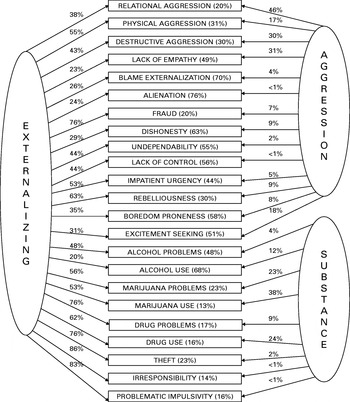
This paper is a component of the proposed meta-structure for DSM-V and ICD-11. The evidence presented here corresponds to the possible validators, as suggested by the DSM-V Task Force Study Group, for clusters of psychiatric illness (Hyman et al., personal communication, 3 December 2007; see also Andrews et al. Reference Andrews, Goldberg, Krueger, Carpenter, Hyman, Sachdev and Pine2009). In this paper we consider the evidence for an Externalizing cluster of disorders. From the perspective of the current DSM, our focus is primarily on substance dependence, antisocial personality disorder and conduct disorder because these disorders have received the most research attention in studies focused on evaluating aspects of an externalizing spectrum conceptualization. Specific features of other disorders may also be understood as elements within an externalizing spectrum; for example, hyperactive/impulsive aspects of attention deficit hyperactivity disorder (ADHD) may be more relevant than inattention; and the impulsivity aspects of borderline personality disorder (BPD) may be more relevant than instability in self-image (see Fig. 1). Although these other DSM disorders per se are not the direct focus of the current review, the perspective described in this paper points toward the need to parse these disorders into their constituent features to better understand how they relate to underlying psychopathology spectrum concepts. Consider, for example, BPD. James & Taylor (Reference James and Taylor2008) modeled BPD co-morbidity in the context of other internalizing (emotional) and externalizing disorders, and found it to load simultaneously on both the emotional and externalizing spectrum factors. Thus, BPD is significantly heterogeneous, containing features that tap into both the emotional and the externalizing disorder spectrums.
General Externalizing factor loadings are given as percentages (loadings squared) connecting the Externalizing factor (symbolized by the oval on the left side of the figure) to the manifest variables (symbolized by the rectangles in the middle of the figure). The two subordinate factor loadings, for Aggression and Substance factors, are given as percentages on the right side of the figure, connecting the Aggression and Substance factors to the manifest variables. Residual variances are the percentages given within each rectangle and represent the variance unique to each manifest variable. These data were previously reported in a loading metric in Table V of Krueger et al. (Reference Krueger, Markon, Patrick, Benning and Kramer2007). They are reprinted here with permission of the American Psychological Association.

Other disorders that may be ‘putatively externalizing’ based on their symptoms are subject to similar limitations in interpretation based on current definitions of mental disorders. Consider, for example, intermittent explosive disorder (IED). This disorder was studied in the National Comorbidity Survey Replication (NCS-R) and 81.8% of cases identified by broad criteria met criteria for at least one other lifetime mental disorder (Kessler et al. Reference Kessler, Coccaro, Fava, Jaeger, Jin and Walters2006). Moreover, the odds of having other disorders, given an IED diagnosis, were elevated for all disorders considered. Structural modeling of currently defined disorders provides a good starting point for making sense of this kind of ‘polymorphous co-morbidity’, but it is also clear that disorders showing these patterns need to be parsed into their constituent features to obtain a better understanding of the underlying bases for co-morbidity.
Along these lines, the temperamental antecedent of disinhibition provides the principal feature of the externalizing disorders and, from our perspective, the relevance of a specific current DSM construct to the externalizing spectrum stems from the extent to which variation in risk for the disorder can be traced to disinhibition (see Fig. 1). This perspective requires some reversal of figure and ground in thinking about classification, but will probably prove ultimately clarifying. That is, currently defined disorders are often heterogeneous and polymorphously co-morbid because they are defined from the top down by expert consensus, rather than being built from the bottom up in terms of core psychopathological features that define psychologically coherent spectrums of variation (cf. Fig. 1).
Shared genetic and specific environmental risk factors
Genetics
Genetic research on the externalizing spectrum builds on evidence for the spectrum's phenotypic coherence. The relevant genetic database involves replicated findings from biometrical modeling studies of twin data and also recent promising molecular leads inspired by biometrical models. Building on work documenting genetic contributions to antisocial and substance-use behaviors (e.g. Lyons et al. Reference Lyons, True, Eisen, Goldberg, Meyer, Faraone, Eaves and Tsuang1995; Tsuang et al. Reference Tsuang, Lyons, Meyer, Doyle, Eisen, Goldberg, True, Lin, Toomey and Eaves1998; Jacobson et al. Reference Jacobson, Prescott and Kendler2002; Kendler et al. Reference Kendler, Aggen, Tambs and Reichborn-Kjennerud2006; Torgersen et al. Reference Torgersen, Czajkowski, Jacobson, Reichborn-Kjennerud, Roysamb, Neale and Kendler2008), at least three separate research groups have reported evidence for a hierarchal account of the genetics of the externalizing spectrum. In this model, much of the genetic effect on substance dependence (alcohol and illicit substances) and antisocial (conduct disorder and antisocial personality) DSM disorders is in common, yet there are also smaller (but not trivial) residual genetic effects on substance dependence (Young et al. Reference Young, Stallings, Corley, Krauter and Hewitt2000; Krueger et al. Reference Krueger, Hicks, Patrick, Carlson, Iacono and McGue2002; Kendler et al. Reference Kendler, Prescott, Myers and Neale2003). Also important is the high magnitude of the genetic effect on the general latent externalizing propensity in these studies (the heritability), which has been reported as being in the range of 80% (albeit a portion of this high heritability may be traced to the factor being latent and therefore free of stochastic measurement error). This genetic research clearly dovetails well with the phenotypic model in Fig. 1, where a distinction is seen between the general externalizing propensity linking antisocial behavior and substances and an independent propensity for substance involvement specifically. A more detailed description of Fig. 1 is provided in the section on a quantitative model of the phenotypic externalizing spectrum.
Inspired by these biometrical findings, the Collaborative Genetics of Alcoholism (COGA) Project has recently focused on the externalizing spectrum as a target phenotype. Dick et al. (Reference Dick, Aliev, Wang, Grucza, Schuckit, Kuperman, Kramer, Hinrichs, Bertelsen, Budde, Hesselbrock, Porjesz, Edenberg, Bierut and Goate2008) present both linkage and association results comparing and contrasting alcohol dependence, antisocial personality disorder, conduct disorder, drug dependence, novelty seeking, sensation seeking, and a general externalizing component derived as the variance in common among these phenotypes. Logarithm (base 10) of odds (LOD) scores (indexing the strength of linkage) were stronger for the externalizing component than for the other individual phenotypes, and pointed to a region on chromosome 7 as conferring general risk for externalizing outcomes. Association analyses focused on single nucleotide polymorphisms (SNPs) in the CHRM2 gene, which had been identified as a candidate in previous research (e.g. CHRM2 was associated initially with risk for alcohol dependence and then found to be associated specifically with risk for co-morbid alcohol and drug dependence). Externalizing showed more associations with SNPs in CHRM2 than any of the other specific phenotypes. The conclusion is that the search for genes conferring risk for externalizing phenotypes is enhanced by focusing on the broad spectrum (the externalizing factor on the left side of Fig. 1), as opposed to focusing on specific manifestations (rectangles in Fig. 1; cf. Corley et al. Reference Corley, Zeiger, Crowley, Ehringer, Hewitt, Hopfer, Lessem, McQueen, Rhee, Smolen, Stallings, Young and Krauter2008).
Environmental factors
In general, identifiable influences external to the person that enhance the risk of psychopathology (e.g. maltreatment, family violence) tend to be non-specific, impacting disorders in a coherent way, as opposed to impacting specific syndromes in a highly specific manner (Zucker, Reference Zucker, Cicchetti and Cohen2006). This phenomenon can be framed in terms of the cumulative risk hypothesis, the idea being that cumulative exposure over multiple developmental periods in multiple domains enhances the likelihood of psychopathology in an additive fashion. In support of this hypothesis with specific regard to the externalizing spectrum, exposure to a single adverse risk factor shows far less association to externalizing behavior than cumulative exposure to multiple risk factors (Rutter, Reference Rutter, Kent and Rolf1979; Deater-Deckard et al. Reference Deater-Deckard, Dodge, Bates and Pettit1998; Legrand et al. Reference Legrand, McGue and Iacono1999; Sameroff, Reference Sameroff, Sameroff, Lewis and Miller2000; Appleyard et al. Reference Appleyard, Egeland, van Dulmen and Sroufe2005; Miller-Lewis et al. Reference Miller-Lewis, Baghurst, Sawyer, Prior, Clark, Arney and Carbone2006; Keyes et al. Reference Keyes, Iacono and McGue2007; Reif et al. Reference Reif, Rosler, Freitag, Schneider, Eujen, Kissling, Wenzler, Jacob, Retz-Junginger, Thome, Lesch and Retz2007), and individual risk factors can be combined into a single composite indicator, providing a summary of cumulative exposure. Importantly, this cumulative risk index combines both genetic and environmental variance, reflecting not only environments ‘imposed’ on people (environmental main effects statistically independent of genetic main effects) but also the way people react to, select and interpret their experiences (gene–environment correlation, which would be reflected as genetic contributions to putatively ‘environmental’ measures, such as perceptions of family life). For example, in twin research from Minnesota, a composite factor indexing various problem behaviors (contact with police, early sexual activity, illegal substance use) was moderately heritable (implying gene–environment correlation) but also substantially influenced by main shared environmental effects (40%), and this cumulative index of both genetic and environmental risk predicted a range of externalizing disorders (McGue & Iacono, Reference McGue and Iacono2005; McGue et al. Reference McGue, Iacono and Krueger2006).
Factors external to the person may also act as moderators, changing the way genetic and environmental risks are channeled and manifested. For example, heritability of the broad externalizing spectrum has been shown to be higher for families in urban settings than for those in rural settings, and this moderating effect transcended specific forms of externalizing disorder (Legrand et al. Reference Legrand, Keyes, McGue and Iacono2008). Other environments, particularly ones that have the effect of limiting choice of behavior, also act to reduce the genetic influences on substance use and symptoms of externalizing disorders; this effect has been found for rural settings (Rose et al. Reference Rose, Dick, Viken and Kaprio2001), religious upbringing (Koopmans et al. Reference Koopmans, Slutske, van Baal and Boomsma1999) and parental monitoring (Dick et al. Reference Dick, Viken, Purcell, Kaprio, Pulkkinen and Rose2007).
Shared neural substrates, biomarkers, and cognitive and emotional processing abnormalities
The role of the brain in the etiology and development of psychopathology is clear. Yet there are few well-validated biomarkers linked to mental disorders, thus limiting the ability to incorporate neuroscience directly into psychiatric diagnosis (Hyman, Reference Hyman2007). Nevertheless, classificatory rubrics should help to guide neuroscientific inquiry, and findings from neuroscience should ‘feed back’ to refine classification. The externalizing spectrum, that is the covariation among antisocial and substance-related disorders, provides a rubric that has proven useful in pursing this strategy.
Research is converging to suggest that the prefrontal cortex (PFC) plays a key role in the etiology of behavioral disinhibition, the personality trait at the core of the externalizing spectrum (cf. Fig. 1; Patrick & Bernat, Reference Patrick, Bernat, Krueger and Tackett2006; Iacono et al. Reference Iacono, Malone and McGue2008). The PFC is thought to play a part in processes related to monitoring one's actions, weighting alternatives, and inhibiting inappropriate responses or impulses. Pertinent to the externalizing spectrum is the PFC's role in the inhibition of previously rewarded but task- or goal-inappropriate responses, an idea known as cognitive control (Miller & Cohen, Reference Miller and Cohen2001). Consistent with this perspective on the role of the PFC, matching current stimuli with earlier stimuli in an ongoing stream (the ‘n-back task’) activates the dorsolateral PFC, and the degree of activation increases as the demands of the task increase (Cohen et al. Reference Cohen, Forman, Braver, Casey, Servan-Schreiber and Noll1994, Reference Cohen, Perlstein, Braver, Nystrom, Noll, Jonides and Smith1997). Anatomically distinguishable parts of the PFC are found to have dissociable functions in experimental contexts (e.g. the inferior frontal cortex in the right hemisphere is involved in stopping a prepotent response; Aron, Reference Aron2007). Nevertheless, the entire PFC also seems to function as a network of discrete but interconnected regions (Aron, Reference Aron2008), and in everyday life, it is the general coherence and functioning of the system that may map most directly onto the concept of an externalizing spectrum of individual differences.
In this connection, other substructures of the broader PFC are also relevant to externalizing tendencies. For example, damage to the orbitomedial PFC is associated with impulsive, aggressive behavior (Damasio et al. Reference Damasio, Grabowski, Frank, Galaburda and Damasio1994), as demonstrated dramatically in the textbook case of Phineas Gage. Orbitomedial PFC is found to be particularly relevant to cognitive control over emotional activation (Davidson et al. Reference Davidson, Putnam and Larson2000), consistent with the extensive connections between orbitomedial PFC and limbic structures. PFC also connects to other structures in broader networks, most notably the anterior cingulate cortex (ACC), which functions in tandem with the PFC. The error-related negativity, a brain potential response that follows errors in a speeded reaction time task, is thought to tap ACC activation, and is predicted by the broad externalizing tendency portrayed in Fig. 1 (Hall et al. Reference Hall, Bernat and Patrick2007).
Other electrophysiological abnormalities identified in people at risk for various forms of externalizing psychopathology may also reflect these disinhibitory processes. These abnormalities have been characterized as representing a deficit of ‘central nervous system (CNS) inhibition’ (Begleiter & Porjesz, Reference Begleiter and Porjesz1999; Polich, Reference Polich2007). A commonly used index is the P300 evoked potential (P3), a scalp electrical response occurring around 300 ms after the onset of a stimulus. Reduced amplitude in the P3 (P3AR) has been found in persons with myriad externalizing disorders (Iacono et al. Reference Iacono, Carlson, Malone and McGue2002) and in persons with higher levels of substance use and misuse (Yoon et al. Reference Yoon, Iacono, Malone and McGue2006). P3 amplitude reduction early in life predicts development of substance use disorders (SUDs) (Carlson et al. Reference Carlson, McLarnon and Iacono2007). Research also shows links between P3AR and the general externalizing spectrum, that is the covariance in common among externalizing syndromes, as opposed to the residual variance in any specific syndrome (Patrick et al. Reference Patrick, Bernat, Malone, Iacono, Krueger and McGue2006). The P3AR-externalizing link can be explained by genetic influences common to both (Hicks et al. Reference Hicks, Bernat, Malone, Iacono, Patrick, Krueger and McGue2007a). P3AR therefore represents a compelling endophenotypic indicator of overall externalizing risk (Iacono et al. Reference Iacono, Malone and McGue2008).
Shared temperamental antecedents
The terms ‘externalizing’ and ‘disinhibition’
Drawing from data on associations between personality and psychopathology constructs (e.g. Clark, Reference Clark2005; Krueger, Reference Krueger2005), the core psychological feature of diverse common forms of psychopathology is distress or negative emotionality, and the core feature of externalizing forms of psychopathology is disinhibited distress. The term ‘externalizing’ is frequently encountered in the literature, and the use of the term recognizes the seminal work of Achenbach (Reference Achenbach1966) on the empirical structure of psychopathology. Use of the term ‘externalizing’ also explicitly links the child and adult literatures, which both reveal the existence of a coherent group of disinhibitory disorders that lead to externalized forms of distress. Some may prefer to describe ‘externalizing disorders’ simply as ‘disinhibitory disorders’, and such a rubric is also apt, and may be preferable for use in official nosologies. We use the term ‘externalizing’ because the relevant literature is generally framed by this term. Yet it is also worth considering how the two terms ‘externalizing’ and ‘disinhibition’ are linked.
Psychologically speaking, in a distressed individual, disinhibitory processes lead to psychopathological signs and symptoms with impacts external to the person, such as adverse consequences for society. With this in mind, the mental disorders described in the DSM-IV most directly pertinent to an underlying externalizing spectrum are those with significant antisocial or disinhibitory component (e.g. conduct disorder, antisocial personality disorder, illicit substance dependence). All of these syndromes involve distress with destructive implications for societal structures external to the individual, and in this sense, disinhibitory processes result in externalized expressions of distress.
Personality, temperament and externalizing psychopathology
An extensive body of research links temperament and personality constructs with externalizing disorders described in DSM-III and -IV (see reviews by Sher & Trull, Reference Sher and Trull1994; Clark, Reference Clark2005; Krueger et al. Reference Krueger, Markon, Patrick and Iacono2005). Two broad domains within the empirical structure of personality are especially relevant to externalizing syndromes: negative emotionality/neuroticism (N/NE) and disinhibition (DIS, which reverses and combines the domains of agreeableness and conscientiousness from the well-known Five-Factor Model of personality: Costa & Widiger, Reference Costa and Widiger2002; Markon et al. Reference Markon, Krueger and Watson2005). Substance dependence syndromes, conduct disorder and antisocial personality disorder are all linked with traits from both the N/NE and DIS domains (Krueger et al. Reference Krueger, Caspi, Moffitt, Silva and McGee1996). Although childhood ADHD is not the focus of this review, it is also worth noting that the N/NE and DIS domains are also the key domains predicting ADHD symptoms in adults (Nigg et al. Reference Nigg, John, Blaskey, Huang-Pollock, Willcutt, Hinshaw and Pennington2002).
Additional understanding of the personality dynamics of externalizing syndromes can be gleaned by examining correlates at a more fine-grained level. At this level, traits such as alienation and suspiciousness (a sense that one is consistently mistreated in interpersonal circumstances, and the resulting view of life as harsh, necessitating a self-centered approach) are potent predictors of violence in particular (Arseneault et al. Reference Arseneault, Moffitt, Caspi, Taylor and Silva2000). This is consistent with the location of these traits being intermediate in factor space, between N/NE and DIS (Markon et al. Reference Markon, Krueger and Watson2005) ; these fine-grained traits combine features of both the N/NE and DIS domains. This intermediate location is also occupied by other indicators of interpersonal antagonism and hostility (e.g. oppositionality and callousness).
Evidence for personality-externalizing links also extends beyond cross-sectional data. Controlling for contemporary levels of externalizing symptomatology at age 18 in a birth cohort, N/NE and DIS predicted externalizing symptomatology at age 21 (Krueger, Reference Krueger1999). Moreover, personality-externalizing links are not limited to shorter-term predictive validity in adulthood. Temperamental features emerging as early as age 3 predict the development of externalizing disorders in adulthood (Caspi et al. Reference Caspi, Moffitt, Newman and Silva1996).
High rates of co-morbidity among disorders as currently defined and symptom similarity
Co-morbidity patterns for DSM disorders
The term ‘co-morbidity’, though still frequently seen in the psychopathology literature, is problematic because it can legitimately refer to encountering patients where two disorders occurred together simply by chance (co-occurrence), or to the completely different situation in which two disorders are correlated in the population at large (correlation). For example, a near-sighted person with depression could be said to be a ‘co-morbid case’, even if near-sightedness and depression are generally uncorrelated at the population level. Hence, by co-morbidity, we mean that putatively distinct categorical disorders are correlated (co-occur at greater than chance rates). The statistical concept of a correlation can also be expressed as the odds ratio, which quantifies the observation that the probability of having one disorder is significantly enhanced in the presence of another disorder.
Understood as correlation, co-morbidity patterns for DSM mental disorders studied in large-scale epidemiological studies clearly reveal the signature of an underlying externalizing spectrum. This literature was recently meta-analyzed by Krueger & Markon (Reference Krueger and Markon2006), who combined data from five studies representing 23 557 research participants assessed for mental disorders that have been the most frequent targets of epidemiological inquiry (unipolar mood, anxiety, SUDs and antisocial disorders). The best-fitting model grouped DSM-defined conduct disorder, antisocial personality and SUDs together as indicators of an externalizing spectrum, whereas unipolar mood and anxiety were indicators of a separate emotional or ‘internalizing’ spectrum (as described in Goldberg et al. Reference Goldberg, Krueger, Andrews and Hobbs2009).
A quantitative model of the phenotypic externalizing spectrum
Krueger et al. (Reference Krueger, Markon, Patrick, Benning and Kramer2007) sought to construct a novel quantitative model of the externalizing spectrum, setting aside existing conventions such as the chapter headings and rationally based disorder categories of the DSM-IV. In this work, the model was built from the ground up without any initial or a priori distinction between the putatively separate domains of substance involvement, antisocial behavior and personality. The empirically derived structural model that emerged from the work did not support segregation of manifest facet-level constructs into rational rubrics that frame chapters of DSM-IV, such as ‘SUDs’ versus ‘personality disorders’. Instead, the organization of diverse manifest externalizing facets was linked to their psychological meaning, as opposed to superficial symptom similarity.
Three broad latent factors emerged; the loadings of these three factors on the 23 manifest facet level constructs studied are shown in Fig. 1 (the model was fit to data from 1787 diverse male and female research participants; Krueger et al. Reference Krueger, Markon, Patrick, Benning and Kramer2007). One factor (loadings expressed as percentage of variance accounted for, extending from the ‘Externalizing’ factor on the left side of the figure to the manifest variables in the middle) saturated all facets in the domain and can be understood as the broad externalizing propensity. Further information about the psychological nature of externalizing, however, can be gleaned by examining the facets with the highest loadings. In particular, irresponsibility and problematic impulsivity had the highest loadings, suggesting that the core deficit leading to diverse externalizing problems relates to an inability to approach life planfully. The second factor (Aggression) represents callousness and aggressive behavior, and the third factor (Substance) represents a propensity for involvement with substances. The percentages inside each rectangle in the middle represent residual variance unique to each manifest outcome variable, not shared with any other variable (technically, these values confound unique reliable variance with idiosyncratic unreliable variance, but the generally high reliabilities of these variables means that much of the residual is likely to represent unique aspects of each manifest outcome, as opposed to ‘psychometric error’). These are standardized values, so the loadings plus the residual variance add up to roughly 100%, with tolerance for rounding; that is, 100% of the total variance in the specific manifest variable. For example, for problematic impulsivity, 83% of the variance is associated with general externalizing, <1% of the variance is associated with substance involvement, and 16% of the variance is unique to problematic impulsivity.
An interesting feature of the model that emerged from this work relates to the independence of the factors in Fig. 1. The model portrayed in Fig. 1 is known as a ‘hierarchical model’, in which a general factor loads on all the manifest variables in the model, but other factors only load on specific subsets of variables, and the factors are mutually uncorrelated and independent. The implication of the independence of the factors is that multiple underlying pathways can lead to the same specific clinical outcomes. Consider and contrast, for example, the manifest alcohol use and drug problem variables. The extent of involvement with alcohol is multiply determined and can be traced to at least three sources delineated in Fig. 1: general externalizing, a separate and independent propensity to use substances generally, and a propensity to use alcohol specifically (indeed, the last of these seems to be the most important source of variation in alcohol use; that is, the value in the rectangle is larger than the loadings from the latent factors). Thus, alcohol use is not a highly reliable indicator of the general externalizing propensity because it is too multiply determined.
By contrast, the majority of the variance in problems with illicit substances (76%) is attributable to the general externalizing propensity. This is the sense in which the factors that emerged in this work (the loadings on the figure) are more ‘psychological’ than ‘rational’. Although alcohol use and drug problems are superficially similar in that they both involve substances (and are therefore grouped together in DSM-IV), the psychological meaning of the two behaviors is distinct. Grouping alcohol use with drug dependence disguises the way in which illicit substance problems reliably indicate an underlying externalizing propensity, whereas using alcohol is notably less relevant to delineating the nature of externalization. Indeed, Krueger et al. (Reference Krueger, Markon, Patrick, Benning and Kramer2007) present a cluster analytic account of the data portrayed factor analytically in Fig. 1, showing that drug problems are part of a cluster of behaviors also involving socio-legal criminality (theft, fraud) and personality per se (irresponsibility and problematic impulsivity, representing the core of the general externalizing propensity, cf. Fig. 1), whereas alcohol use and problems form a more isolated cluster of behaviors. Moreover, specific manifest outcomes in Fig. 1 may be linked to more than one psychopathology spectrum; for example, marijuana use and problems may show additional connections with the internalizing spectrum (Wittchen et al. Reference Wittchen, Fröhlich, Behrendt, Günther, Rehm, Zimmermann, Lieb and Perkonig2007) and different elements of impulsivity may be associated with specific risky behaviors (Smith et al. Reference Smith, Fischer, Cyders, Annus, Spillane and McCarthy2007).
A key implication of this work is that research on underlying deficits (the broad latent factors, shown as ovals on Fig. 1) is likely to be more profitable than research on manifestations (the rectangles in Fig. 1), which are multiply determined and therefore less likely to be related to underlying etiologies in a straightforward manner. A related implication is that the underlying externalizing deficit could serve as a useful classificatory rubric in DSM-V (Krueger et al. Reference Krueger, Markon, Patrick and Iacono2005). The utility of this perspective is becoming clear in research on the genetics and biological correlates of externalizing syndromes, as described above.
Course of illness
Externalizing behaviors typically follow a pattern of increasing throughout adolescence, with the highest prevalence rates found in early adulthood, followed by a steady decline, although impulse disorders tend to have an earlier age of onset than substance use disorders (Jackson et al. Reference Jackson, Sher and Wood2000; Moffitt et al. Reference Moffitt, Caspi, Rutter and Silva2001; Chassin et al. Reference Chassin, Flora and King2004; Kessler et al. Reference Kessler, Berglund, Demler, Jin, Merikangas and Walters2005). Hicks et al. (Reference Hicks, Blonigen, Kramer, Krueger, Patrick, Iacono and McGue2007b) extended this literature by examining externalizing disorder development (alcohol dependence, adult antisocial behavior, nicotine dependence, drug dependence) from age 17 to 24 using latent variable modeling approaches. They found that the effects of age and gender on the specific disorders were mediated by the general externalizing factor. The externalizing factor mean increased with age, suggesting that the change in prevalence of specific externalizing disorders from adolescence to young adulthood can best be understood as a reflection of change in the underlying disinhibitory process. Men and women did not differ in the structure of the externalizing factor, but men did have a significantly greater number of externalizing problems, and this gender difference was well accounted for by the mean level of the externalizing factor, as opposed to specific gender differences in specific disorders. Although the modeling approach used by Hicks et al. (Reference Hicks, Blonigen, Kramer, Krueger, Patrick, Iacono and McGue2007b) needs to be extended to other parts of the life course, their findings suggest that the course of externalizing development is best understood from a spectrum perspective. Rather than each individual aspect of externalizing following an idiosyncratic trajectory, individual differences in the spectrum develop and change in concert.
Treatment response
Treatment of externalizing psychopathology is not typically conceptualized in terms of the general spectrum, and this makes good clinical sense when the presentation is consistent with the later stages of an externalizing process. For example, if an adult patient presents with substance dependence as the primary concern, the acute clinical considerations pertain to safe and appropriate detoxification, not to the underlying disinhibitory processes that eventuated in substance dependence.
From a primary prevention perspective, however, underlying personality processes are crucial initial targets. The extensive evidence supporting the externalizing spectrum conceptualization suggests that many adult externalizing outcomes with high costs to society are the end results of numerous individual choices, biased in an externalizing direction by general disinhibitory processes. The implication for public health is that either (a) primary prevention should focus on helping persons with disinhibitory tendencies to make less harmful choices or (b) direct reduction of disinhibitory tendencies should be a focus of primary prevention. To our knowledge, the latter strategy (direct reduction) is not currently realistic, although this may change as our understanding of the genetics and neurobiology of disinhibition improves, and more targeted pharmacologic agents are developed. The former strategy may be more realistic for the time being. For example, Palmgreen et al. (Reference Palmgreen, Lorch, Donohew, Harrington, Dsilva and Helm1995) conducted a media campaign targeting persons with high levels of sensation seeking, encouraging them to contact a hotline where they could receive information about exciting activities that did not involve drug use. To the extent that this kind of approach dismantles the connection between disinhibition and its high social costs (e.g. drug problems), it is likely to have a broad impact in reducing the prevalence and costs of externalizing tendencies.
Conclusions
The construct of a coherent spectrum of externalizing disorders is supported by many of the salient criteria proposed by the Study Group of the DSM-V Task Force. The construct has demonstrated its utility in framing diverse research, including recent research in genetics and neurobiology. Importantly, the idea is not that every syndrome in the spectrum is the same; rather, the elements differ quantitatively in the extent to which they are more central versus peripheral to the spectrum (see Fig. 1). The empirical coherence of the externalizing spectrum supports its inclusion as a classificatory rubric in DSM-V and ICD-11 (Krueger et al. Reference Krueger, Markon, Patrick and Iacono2005). Future research could parse additional DSM-IV disorders into their constituent features (e.g. examining the emotional dysregulation and impulsivity features of BPD separately), and seek to understand how those features relate to constructs such as an externalizing spectrum. The goal ultimately is to redefine heterogeneous and polymorphously co-morbid current disorder concepts in terms of the core features of coherent underlying spectrums of human variation.
Declaration of Interest
None.