BACKGROUND
Since its inception in the 1960s, the specialty of infection prevention and control has grown considerably. The field took shape in the 1970s following the landmark Study on the Efficacy of Nosocomial Infection Control (SENIC) project and grew in importance with the emergence of employee safety and multidrug-resistant organisms in the 1980s.Reference Haley, Quade, Freeman and Bennett 1 , Reference Hughes 2 In the 1990s and into the 2000s, the focus on hospital-acquired infection (HAI) prevention grew, so the field played a larger role in regulatory, patient safety, and quality improvement issues. In the present day, infection control data are frequently available to the public and impact hospital finances and healthcare insurance reimbursements.
BASIC CONSIDERATIONS
A key leader in any infection prevention/healthcare epidemiology program is the healthcare epidemiologist (HE). The role of the HE has also emerged and grown considerably over the past several years. The HE historically often had little formal epidemiologic training and was frequently not paid for his or her efforts. Today, the field has become a critical component of the routine function of healthcare institutions, and the HE has multiple diverse responsibilities that include regulatory review, patient safety, quality improvement, clinical practice and education, administration and public reporting of infection, and infection process data. To effectively serve in these various roles, the HE requires formal support to protect time and effort and to support training activities and professional development. The skills and competencies needed to be an effective HE are considerable. This guidance document highlights the roles, necessary skills, and training opportunities for a HE and is 1 of 3 articles focusing on core aspects of any infection prevention/healthcare epidemiology program. The other 2 partner articles focus on (Reference Haley, Quade, Freeman and Bennett1) infrastructure requirements for infection prevention/healthcare epidemiology programs and (Reference Hughes2) the core competencies necessary for directing a hospital antimicrobial stewardship program.
The HE is strongly preferred to be a physician, as a physician’s insight into the clinical practice of medicine and the nuances of patient care are critical with regard to development and implementation of infection prevention processes in the clinical hospital setting. This clinical perspective gives the HE credibility with key influential clinical and administrative stakeholders and will facilitate implementation of changes in healthcare worker process and behavior.
PURPOSE
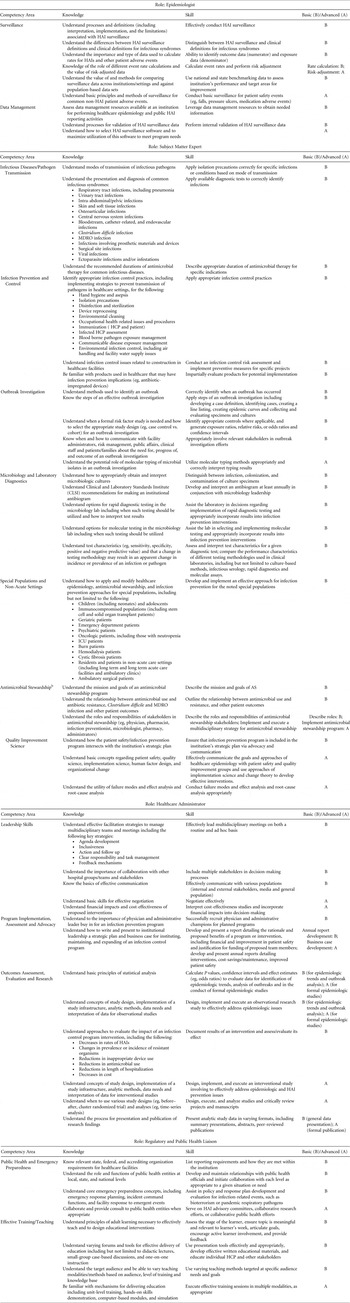
Although there is a formal certification program for infection preventionists with demonstrated benefits,Reference Pogorzelska, Stone and Larson 3 formal accreditation for HE does not currently exist. In fact there is no clear and comprehensive formal description available detailing the various skills necessary for the current-day HE to be successful, nor is there a list of the training resources that are currently available. With this article, we aim (Reference Haley, Quade, Freeman and Bennett1) to describe the various roles and skill sets required for an HE in the United States to be successful; (Reference Hughes2) to describe the formal and informal training resources available to learn about these roles and obtain the necessary skills; and (Reference Pogorzelska, Stone and Larson3) to identify gaps in training opportunities and opportunities to improve the availability of training opportunities and skills acquisition. This article details the following HE roles: epidemiologist, subject-matter expert, quality and performance improvement leader, regulatory/public health liaison, healthcare administrator, clinician educator, and outcomes assessment evaluator and researcher. Each section of the document outlines an essential role that the HE at times assumes and also details the pertinent skills and competencies required to effectively perform that role. A comprehensive list of HE skills and competencies are listed in Table 1; they are categorized into those that apply to HEs practicing in any healthcare setting (basic) and those that apply to HEs in specialized settings such as academic centers or who have a specific career focus such as antimicrobial stewardship or quality (advanced).
CORE Competencies for the Healthcare Epidemiologist (HE).Footnote a

NOTE. HAI, healthcare-associated infection; MDRO, multidrug-resistant organism; HCP, healthcare personnel; ICU, intensive care unit.
a This table articulates critical knowledge and skills for professionals engaged in healthcare epidemiology. Each category provides detail based on type of activities. This information is useful in developing educational needs assessments, informing curriculum development, delineating training requirements and identifying possible testing/certification parameters. These skills and competencies are categorized into those that apply to HE practicing in any healthcare setting (basic) and those that apply to HE in specialized settings such as academic centers or who have a specific career focus such as antimicrobial stewardship or quality (advanced).
b Refer to antimicrobial stewardship document for broader description of core competencies.6
HEALTHCARE EPIDEMIOLOGIST ROLES
Epidemiologist
One of the most important skills of the HE is the ability to apply the science of epidemiology to the healthcare setting. As part of his or her role, the HE must discover and understand causes and patterns of disease and adverse outcomes and apply that knowledge to improve the health and safety of patients. To adequately perform these activities, the HE should have a working knowledge of disease exposure and transmission, an understanding of measures of incidence and prevalence (and the distinction between the two), and a basic knowledge of microbiology, bacteriology, virology, and mycology.
Given the increasing shift of healthcare to the outpatient setting, the term “hospital” epidemiologist is dated and is no longer completely accurate, as the epidemiologist must monitor disease outcomes and trends among both hospitalized patients and patients in outpatient settings. A more accurate term is “healthcare epidemiologist.”
Simply put, the epidemiologist should be able to gather data, interpret data properly, and determine an appropriate course of action. Modern healthcare data, however, have become increasingly complex and are obtained from a myriad of diverse sources. To facilitate organization and interpretation of these data, the epidemiologist must also be familiar with basic biostatistics, including data analysis and interpretation; mathematics; and pattern recognition. For example, one of the most common types of data is HAI surveillance data. Calculation and interpretation of even simple types of surveillance data involves the appropriate gathering of outcomes data (ie, a numerator), exposure data (ie, a denominator), and, ideally, patient- or procedure-specific data that can be used for risk-adjustment. Another example of complex evaluation and analysis is comparing incidence rates to comparator rates, or benchmarking. Benchmarking involves comparing surveillance data from 1 location (eg, an intensive care unit) to a suitable benchmark or goal (such as published National Healthcare Safety Network rates). Benchmarked comparisons allow for critical and comparative interpretation of performance of a hospital, unit or surgeon, to help in the allocation of resources by the HE and the infection prevention/healthcare epidemiology program in general to optimize performance. However, sufficient knowledge of infection risks and patient characteristics that may affect outcomes is needed to ensure that appropriate comparisons and benchmarking is occurring.
Collectively, the principles of epidemiology and biostatistics allow the epidemiologist to focus on and recognize changes at the “population level” instead of the level of the individual patient. The epidemiologist is often called upon to interpret and explain complex population data in a concise, clear, and actionable manner.
Subject Matter Expert
An HE must serve as a subject-matter expert in many areas, including but not limited to infectious diseases, principles of infection prevention and control, antimicrobial stewardship, occupational health related to infectious diseases, quality improvement processes related to HAIs, and regulatory requirements (Table 1).
Infectious diseases and principles of infection prevention and control
Knowledge of infectious diseases includes pathogenesis, clinical presentation, modes of transmission, diagnostic tests, treatment, and prevention. Activities of the HE in these areas include pattern recognition, investigation, and control of an outbreak; collaboration with the Director of the Clinical Microbiology Laboratory regarding development and implementation of diagnostic and surveillance testing methods; and implementation of evidence-based guidelines for prevention of transmission of infectious agents, eg, efficient hand hygiene, isolation, management of multi-drug resistant organisms (MDROs) and antimicrobial stewardship programs.
Special populations
Individuals working in a children’s hospital or in a general hospital with pediatric units, including newborn nurseries and neonatal intensive care units, need knowledge of pediatric infectious diseases. Knowledge, recognition, and understanding of infectious agents that have the most impact on the healthcare environment and patients are also important (Table 1). An understanding of the infectious complications in a variety of patients, including immunocompromised hosts (eg, hematopoeietic stem cell and solid organ transplant recipients), critical care and burn patients, and patients who undergo hemodialysis, is necessary for the HE working in facilities that deliver care to these special populations.
Construction and infection prevention and control
The HE should have a complete understanding of the risks of acquisition of environmental mold infections when high-risk patients are exposed to unconfined construction dust associated with construction and/or renovation projects on the healthcare facility campus. The HE should collaborate with architects and construction project leaders from the earliest stages of planning and design through the entire construction period and during the commissioning process. 4 Performing an infection control risk assessment (ICRA) when planning construction/renovation projects is an infection prevention and control responsibility that is best carried out with an understanding of the literature that describes outbreaks of invasive mold infections associated with construction or any activity that disrupts the integrity of the environment. The HE must be proactive in presenting evidence to support recommendations for risk mitigation associated with construction and must establish a supportive relationship with the Chief Executive/Chief Operating Officer of the organization.
Antimicrobial stewardship
In this age of MDROs and limited antimicrobial agents with activity against the most resistant of these pathogens, antimicrobial stewardship is of growing importance in healthcare settings. The HE should collaborate with representatives from pharmacy and the clinical microbiology laboratory to help develop an antimicrobial stewardship program. Prevention of emergence of antimicrobial resistance includes both prudent prescribing practices and prevention of patient-to-patient transmission. The HE can play an important role in establishing and supporting an antimicrobial stewardship program.Reference Dellit, Owens and McGowan 5 A more detailed description of the core competencies needed for antimicrobial stewardship leaders has been published recently.Reference Cosgrove, Hermsen and Rybak 6
Quality and Performance Improvement Leader
The scope of hospital epidemiology has evolved and now includes a variety of roles including quality management/performance improvement. Those tools have now been applied in many other healthcare areas that are not necessarily related to preventing transmission of infectious agents. The HE is a valuable partner to the Chief Officer of Quality Improvement. Infection prevention and control is the first discipline that established the paradigm for performance improvement and use of root-cause analysis. While quality management skills may seem unnecessary to physicians schooled in traditional infectious disease, it is often a key activity involved in successful infection prevention programs.Reference Simmons, Parry, Williams and Weinstein 7 The HE must possess the skills to lead and manage a multitude of diverse healthcare workers (Table 1).
Included in this role is a need to understand basic concepts surrounding patient safety and how infection prevention/healthcare epidemiology programs interact with patient safety programs. Patient safety is defined as “prevention of healthcare errors, and the elimination or mitigation of patient injury caused by healthcare errors.” 8 Since the publication of the Institute of Medicine report “To Err is Human: Building A Safer Health System” in 1999 9 and “Crossing the Quality Chasm: A New Health System for the 21st Century” in 2001, 10 patient safety, including infection prevention and control, has taken center stage in healthcare quality strategic planning. HAIs are recognized as major safety risks to patients, and, in many cases, are deemed preventable. Patient safety has also become increasingly important from clinical, public relations, and fiscal perspectives, due to public reporting of HAIs and decreased reimbursement by Center for Medicare and Medicaid Services (CMS) relative to HAIs. 11 , 12 As patient safety continues to grow in importance in the healthcare community, the HE should and will become more visible and will have an increased tangible impact on this arena.
A variety of skills are needed to facilitate the role of the HE in patient safety. Communication skills are necessary for discussing cases and processes with stakeholders and patients, and analytic and deductive skills are needed to analyze the events leading to an HAI or breakdown in core practices (eg, adherence to processes, errors of omission) and changes in infection rates.
Regulatory/Public Health Liaison
Infection prevention and control has increasingly become a major component of regulatory review and accreditation by groups such as The Joint Commission. 13 In collaboration with the infection preventionist, the HE typically plays an important role in oversight of preparation for regulatory evaluation and in the regulatory evaluation itself (ie, as a part of infection control “tracer” exercises and exit/interviews).
The HE also plays an important role as a liaison with the public health department. Some issues involve direct collaborations and communications between the hospital (which is typically represented by the HE) and the public health department. In addition, local and regional emergency preparedness pertaining to bioterrorism and pandemic influenza involves collaborative efforts between public health officials and the HE. Because the epidemiology of MDROs involves different types of healthcare institutions including long-term care facilities, ambulatory clinics and the community at large, the role of public health departments will continue to grow, and interactions and collaborations between the HE and closely allied facilities will increase in frequency, intensity, and importance.
As public reporting of HAI rates increase in frequency and intensity, the HE is ultimately responsible for the validity of publicly reported data. Many states have also included HEs on their advisory panels for the development and oversight of state HAI public reporting programs.
The HE needs to have an understanding of the structure and function of local and state public health departments. In addition, the HE needs to be well versed on infection control aspects of regulatory requirements (eg, TJC regulations), metrics used for insurance reimbursements (eg, CMS) and public reporting. During accreditation surveys, the HE often serves as a critical administrative and quality liaison between the hospital and these agencies. Finally, the HE may find opportunities to advocate for special populations (eg, children and immunizations, human immunodeficiency virus [HIV] screening and treatment programs) as a part of a community’s public health outreach.
Healthcare Administrator
Over the past few decades, the role of the HE has morphed from one that was purely focused on quality improvement to one that increasingly involves administrative responsibilities. In an era when cost savings has become increasingly important to hospitals, the HE must have expertise in budget development and in demonstrating return on investments (ROI). Because infection prevention/healthcare epidemiology program activities typically do not directly generate revenue, it is imperative for the HE to demonstrate cost-avoidance and cost-effectiveness and to illustrate how infection control expenditures improve the overall quality of an institution while reducing the overall costs. Negotiation skills for increased resources or funding are also important. Negotiating strategies, such as escalation, can be useful but can also create pitfalls, and learning how to appropriately use such strategies is critical to improving negotiating skills. It is also important for the HE to be able to understand the perspective of administrators, particularly those administrators who do not have a healthcare background or medical training, and to be able to effectively communicate information to facility leadership.
Decisiveness is an important characteristic of an HE in an administrative role. The HE often has to make decisions that impact clinical and/or administrative spheres, and sometimes these decisions will be unpopular. At the same time, he/she must always remain receptive to ideas offered by others from different areas of expertise and be willing to evaluate the pros and cons of novel strategies. The HE will also have interactions with and roles related to risk management, for example, when an HAI results in an unexpected death. An HE in an administrative role will also oversee and partake in the writing and revising of policies; effective presentation skills and persuasiveness can facilitate and improve the administrative role of the HE with regard to negotiation, decisiveness, and policy writing.
Several other key administrative aptitudes, including leadership, organizational skills, and implementation skills, are essential for HEs. Leadership involves influencing behavior to achieve desired results through efficient utilization of human and material resources. HEs should possess this skill to be successful in promoting infection prevention. Additional management skills include the ability to delegate and prioritize activities and organizing or sponsoring team activities.
Meetings consume an enormous amount of human resources, and when executed suboptimally, they often do not achieve the desired goals. The infection prevention and control committee is only one of many multidisciplinary groups whose activities involve infection prevention. HEs can facilitate efficient, effective meetings by utilizing some key organizational strategies such as advanced preparation, agenda formulation, time management, development of clear action items, and frequent requests for input and feedback from attendees.
One of the greatest challenges an HE will encounter is implementing evidence-based practices into everyday clinical routines. Several key principles and skills are needed to effectively implement system and organizational change. First, it is essential to use process-oriented thinking when designing and implementing any improvement project.Reference Balestracci 14 Using process control statistics, an HE can demonstrate variations in practices and behaviors and use human factor engineering to design interventions to ensure that the desired process is delivered in a consistent and reliable fashion.Reference Benneyan 15 , Reference Benneyan 16
To obtain meaningful and sustainable improvement, an HE must be adept at promoting both “technical” and “adaptive” changes. The “technical” approach to translating evidence into practice involves summarizing the scientific evidence, developing standardized and uniform approaches to care delivery (ie, checklists, bundles of care), and ensuring measurement and feedback of process measures to the front-line staff.Reference Pronovost, Cardo, Goeschel, Berenholtz, Saint and Jernigan 17 Additionally, Institute for Healthcare Improvement’s (IHI’s) Model for Improvement promotes incremental steps to process improvement using PDSA (Plan-Do-Study-Act) cycles to assess interventions. 18
Unfortunately, the “technical” approach alone will not ensure the consistent and reliable implementation of evidence-based practices. Root-cause analyses of serious events or near misses frequently identify issues related to lack of teamwork and failure to communicate between disciplines as important components contributing to the event. The “adaptive” components to implementing change involve addressing issues around the culture of safety on a local level with a multidisciplinary approach. The Comprehensive Unit-Based Safety Program in adults and the Children’s Hospital Association (formerly the National Association for Children’s Hospitals and Related Institutions) collaboratives for reduction of central-line associated bloodstream infections in children promote a systematic approach to improving teamwork, communication and the prevention of harm. The utility of combining adaptive and technical approaches to quality improvement is exemplified by the sustained success achieved by the Michigan Health and Hospital Association Keystone ICU Project in reducing central-line associated bloodstream infections.Reference Sawyer and Leon 19
Finally, to be an effective healthcare administrator, the HE should have skills in budget development; measuring return on investment (ROI); and economic modeling; or be able to interface with departments that are well versed in these areas.
Clinician Educator
The HE experiences numerous situations in which effective teaching and training skills are essential elements for ensuring best practices in infection prevention and control and implementing quality improvement activities. Using the clinical credibility obtained from training and knowledge from infection prevention courses, the HE is often required to translate knowledge to hospital personnel through several means.
First, the HE is expected to teach through example as a means to demonstrate best practices and ensure that medical staff performs these practices. This type of education by example is well suited for activities such as hand hygiene and the use of personal protective equipment for transmission-based precautions. Second, teaching techniques must include galvanizing area or unit champions to ensure that new and longstanding protocols and policies are introduced, maintained, and verified through methods such as checklists, logs, and patient-care rounds. This often requires teaching through personal communication with physician champions,Reference Saint, Kowalski and Forman 20 – Reference Cheng, Melanee and Rawson 22 speaking at educational meetings (eg, grand rounds and nursing shift huddles), and preparing educational tools and mass messaging. 23 Third, the HE should be familiar with formal teaching techniques through orientation presentations for new hires, development of computer-based training modules for infection prevention, and designing functional computerized prompting in electronic medical records. Finally, the HE should be integrated in a learning community behind their hospital walls. Sharing and learning is highly effective through local and regional collaborative efforts, where infection prevention program directors and staff can share written policies, quality improvement ideas, and responses to local initiatives and state mandates.
Outcomes Assessment Evaluator and Researcher
An important role of the HE is to successfully conceive of, design, and assess quality improvement initiatives to improve process measures for HAI prevention or to implement interventions to reduce the severity of outcomes related to these events. Examples include outbreak investigation, evolving surveillance definitions, and assessing the effectiveness of products for averting HAIs. Epidemiologic training provides the critical foundation for translating questions into hypothesis-driven interventions and outcomes. These skills include strategically estimating effect size, sample size (how many patients or units are needed to answer a question), and project duration (how long will it take to determine success or failure) to determine whether the project method can answer the question in the time available.
Training in analysis is equally important to training in study design. HEs need be facile with outcome assessment and must understand confounding factors that can lead to incorrect conclusions. Solutions may include partnering with other hospital programs that have robust analytic capabilities, or they may involve performance improvement teams or financial groups well versed in cost-effectiveness analysis.
While not an absolute requirement, research, presentation, and publication of findings are important responsibilities of HEs. It is critical that experiences and findings are disseminated to a wider audience to share key findings.
In conclusion, as infection prevention and healthcare epidemiology continues to evolve, so do the roles and responsibilities of the HE. The HE tackles multiple diverse responsibilities, and it is important for each HE to become knowledgeable and experienced in the skills needed to optimally address these responsibilities. Rather than focusing exclusively on surveillance and disease transmission, in today’s world, the HE must also manage issues pertaining to quality and performance improvement, regulatory readiness and public health, outcomes assessments, healthcare administration, and clinician education. While this multifaceted role is challenging, it also places the HE at a focal point of healthcare epidemiology and presents opportunities for the HE to positively influence the clinical care and safety of patients and healthcare workers.
ACKNOWLEDGMENTS
Financial support: KSK is supported by the National Institute of Allergy and Infectious Diseases (NIAID), DMID protocol number 10-0065. DJA reports grants from the National Institutes of Health National Institute of Allergy and Infectious Diseases and the Centers for Disease Control and Prevention. SSH reports employment by the University of California Irvine Health School of Medicine and payments from the Centers for Disease Control and Prevention, the National Institutes of Health, the Agency for Healthcare Research and Quality AHRQ, and the UC Irvine Speaker’s Bureau.
Potential conflicts of interest: KSK, EC, JDS, JZ, and TRT report no relevant conflicts of interest pertaining to this report. SSH is currently conducting a clinical trial for which the participating hospital receives products contributed by Sage and Molnlycke.