Introduction
Evidence suggests that ground-nesting pollinator populations (bees and wasps; Hymenoptera), particularly in Europe and North America, are in decline due to loss of habitat and floral resources (Thorp and Shepherd Reference Thorp, Shepherd, Shepherd, Vaughan and Black2005; Goulson et al. Reference Goulson, Lye and Darvill2008; Ollerton et al. Reference Ollerton, Erenler, Edwards and Crockett2014). In addition, wild bee abundance has declined 23% across the United States of America (Koh et al. Reference Koh, Lonsdorf, Williams, Brittain, Isaacs, Gibbs and Ricketts2016) and may be driven by habitat loss that is associated with land conversion to agriculture (Ricketts et al. Reference Ricketts, Regetz, Steffan-Dewenter, Cunningham, Kremen and Bogdanski2008; Potts et al. Reference Potts, Biesmeijer, Kremen, Neumann, Schweiger and Kunin2010; Koh et al. Reference Koh, Lonsdorf, Williams, Brittain, Isaacs, Gibbs and Ricketts2016). Agricultural land use practices have contributed to the reduction of foraging resources and nesting substrate for ground-nesting bees (Ricketts Reference Ricketts2004). Habitat fragmentation from agriculture can alter abundance and species richness of pollinators, as well as pollinator flight paths, leading to the reduction of pollination services provided by native bees (Powell and Powell Reference Powell and Powell1987; Didham et al. Reference Didham, Ghazoul, Stork and Davis1996). Landscape complexity can affect abundance and richness of bees (Kennedy et al. Reference Kennedy, Lonsdorf, Neel, Williams, Ricketts and Winfree2013; Garratt et al. Reference Garratt, Senapathi, Coston, Mortimer and Potts2017). Additionally, Steffan-Dewenter (Reference Stephen and Rao2002) showed that wasps especially rely on greater habitat diversity and landscape structure for nesting places and food resources.
Pollination services by ground-nesting bees are critical to sustain native plant species and crop production in natural and managed systems, respectively (Roubik Reference Roubik1995; Cane Reference Cane1997; Klein et al. Reference Klein, Vaissiere, Cane, Steffan-Dewenter, Cunningham, Kremen and Tscharntke2007). Furthermore, some wasp families (e.g., Hymenoptera: Scoliidae, Mutilidae) have morphological characteristics that permit them to collect pollen and, thereby, account for the pollination of specific plant species (Jervis Reference Jervis1998); wasps also can be important biological control agents, preying on many agricultural pest species (O’Neill Reference O’Neill2001). Despite their importance, ground-nesting bees and wasps are far less studied for their susceptibility to habitat degradation than are other prolific plant pollinators such as honey bees (Apis mellifera Linnaeus; Hymenoptera: Apidae) (Koh et al. Reference Koh, Lonsdorf, Williams, Brittain, Isaacs, Gibbs and Ricketts2016).
Suitable nesting habitat for ground-nesting bees and wasps can include specific site characteristics, nesting substrate, and food plants (O’Neill Reference O’Neill2001; Sardiñas and Kremen Reference Sardiñas and Kremen2014). Suitability of nesting site characteristics for ground-nesting bees and wasps is influenced by soil texture, soil depth, slope, vegetation cover, soil moisture, and rewarding floral resource availability (Rubink Reference Rubink1979; Cane Reference Cane2001; O’Neill Reference O’Neill2001). Foraging behaviours to secure mud, leaves, and resins for partitioning of nests also affect habitat preference (O’Toole and Raw Reference O’Toole and Raw1991). Bee community organisation is known to be linked closely to the respective foraging habits and resources of the population, but less is known about how nesting habitat and availability factor into the composition of pollinator communities in general, though suitable nesting habitat is often characterised by exposed bare ground and an abundance of potential nesting cavities (Potts et al. Reference Potts, Vulliamy, Roberts, O’Toole, Dafni, Ne’Eman and Willmer2005). Loss of any of these resources within an ecosystem can impinge on the ability of ground-nesting bees and wasps to establish viable, local populations (Westrich Reference Westrich1996).
It can be challenging to study the effects of land conversion on ground-nesting bee and wasp populations and nesting locations without proper collecting methods. That said, trapping and monitoring methods for ground-nesting bees, wasps, and other pollinators can be accomplished via sweep netting at floral resources (Westphal et al. Reference Westphal, Bommarco, Carré, Lamborn, Morison and Petanidou2008), deploying coloured pans (Campbell and Hanula Reference Campbell and Hanula2007), and vane traps (Stephen and Rao Reference Steffan-Dewenter2005). These methods can provide important information on relative abundances of ground-nesting bee and wasp species within a given habitat. However, these collecting methods lack the ability to trace ground-nesting bees and wasps back to their nests and provide little information on nest site preferences.
Kim et al. (Reference Kim, Williams and Kremen2006) employed a trapping method of covering potential bee/wasp nesting sites with fabric propped up using metal hoops, as a supplement to pan trapping, to assess ground-nesting bee and wasp nesting sites. Historically this emergence trap technique has been used to sample aquatic insects (Mundie Reference Mundie1956), but in a similar fashion, ground-nesting bees and wasps have been collected with smaller-scale emergence traps (Sardiñas and Kremen Reference Sardiñas and Kremen2014). With this method, ground-nesting bees and wasps can be sampled passively using soil emergence traps that cover a portion of the ground. To date, there is a paucity of studies in which emergence traps have been used to capture ground-nesting bees and wasps (Sardiñas and Kremen Reference Sardiñas and Kremen2014). Agricultural practices are known to be detrimental to ground-nesting bee and wasp populations, whereas forested habitats can positively contribute to ground-nesting bee and wasp diversity (Ricketts Reference Ricketts2004; Schuepp et al. Reference Schuepp, Rittiner, Martin and Entling2012).
We used emergence traps in two case studies to examine ground-nesting bee and wasp abundance in agricultural and forested settings. In one study, we investigated the use of wildflower enhancement plots and fallow control plots as nest sites by ground-nesting bees and wasps, as determined by capture data using both emergence and pan traps. These habitats were chosen because native wildflower enhancement plots are becoming increasingly popular within intensive agriculture in an effort to augment wild pollinator abundance, diversity, and habitat conservation (Williams et al. Reference Williams2015). Our objectives were to: (1) determine whether ground-nesting bees and wasps preferred to nest within the wildflower enhancement plots opposed to fallow control plots; and (2) compare between emergence trap and pan trap collection methods. We hypothesised that wildflower enhancement plots would have a greater abundance of ground-nesting pollinators than would fallow control plots because they would provide more foraging resources and prey items than would control plots. Additionally, we hypothesised that pan traps would collect more individuals of ground-nesting bees and wasps.
We conducted the second study in a forest ecosystem comprised of upland pine and hammock habitats. No previous studies have attempted to use emergence traps in a temperate forest. Forest habitats of the southeastern United States of America have been shown to contain a wide array of bee and wasp species, and relative abundance of these species can change due to alterations of forest habitat (Campbell and Hanula Reference Campbell and Hanula2007). Upland pine habitat occurred on well-drained, elevated soil and experienced managed burns at three- to six-year intervals. Hammock habitat commonly occurs in northcentral Florida, United States of America, and is characterised by poorly drained soil that is high in nutrients and organic material (Vince et al. Reference Vince, Humphrey and Simons1989). Our objectives were to determine: (1) whether emergence traps could be used as a sampling method for ground-nesting bees and wasps in temperate forest habitats; and (2) whether upland pine and hammock ecosystems differed in nesting site availability for ground-nesting bees and wasps. We hypothesised that the upland pine habitat would have a greater abundance of ground-nesting bees and wasps than would the hammock habitat because it would be less likely to contain standing water due to soil characteristics (Vince et al. Reference Vince, Humphrey and Simons1989).
Materials and methods
Trap types
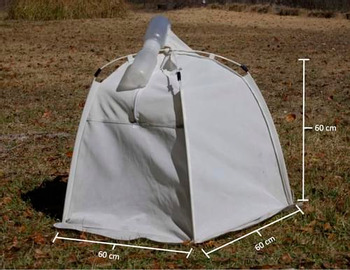
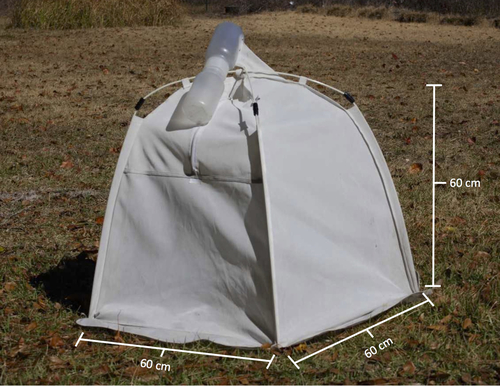
We used emergence traps in both case studies to assess ground-nesting bee and wasp abundance in different habitats. Emergence traps (MegaView Science Company, Talchung, Taiwan) were comprised of an enclosed, four-sided mesh structure that tapered into a collection jar at its apex (Fig. 1). As pollinators emerged from their nests, they were trapped by the enclosed mesh. They were then funnelled into the collecting bottle that was partially filled with soapy water. Once emerged, ground-nesting bees and wasps were unable to exit the emergence trap because each edge of the trap remained flush with the ground. We determined trap position by random placement within each plot and ensured that the traps were at least 5 m apart. To minimise the chances of placing emergence traps over the same area, a random number generator was used to determine initial trap placement. Additionally, a different cardinal direction was designated for entrance to each plot for each monthly/weekly trap setup.
Photograph of an emergence trap with dimensions used in our case studies to collect ground-nesting bees and wasps.
We also used two pan trap sets in each wildflower and fallow plot to assess the overall activity of bees and wasps in our study sites. Pan trapping has been used as an efficient method for sampling pollinators in agricultural landscapes and forest ecosystems (Campbell and Hanula Reference Campbell and Hanula2007; Westphal et al. Reference Westphal, Bommarco, Carré, Lamborn, Morison and Petanidou2008; Wilson et al. Reference Wilson, Griswold and Messinger2008). Each pan trap set consisted of a blue, yellow, and white bowl (355 mL Festive Occasion; Amscan International, Milton Keynes, United Kingdom) set on a rack system that allowed traps to be moved up as vegetation grew (see Campbell et al. Reference Campbell, Miller and Martin2016). The sets were placed 20 m apart in each wildflower and fallow plot. Pan traps were filled with soapy water, collected after 24 hours, and all bees and wasps were stored in ethanol for future identification. A synoptic set of voucher specimens for this study is deposited at the Florida State Collection of Arthropods, Gainesville, Florida, United States of America.
Case studies
Wildflower enhancement/fallow control study. We selected eight sites (hereafter “blocks”) located within intensive agricultural areas (blueberry (Vaccinium Linnaeus; Ericaceae) and Cucurbitaceae, etc.) in northcentral Florida. Each block contained two plots (e.g., treatments) (0.1 ha each) – one with a wildflower enhancement and a second as a fallow control plot. We located plots within a block approximately 500 m apart. The wildflower plots were prepared for seeding by application of glyphosate and mowing to minimise weed competition with the wildflowers (Bammer et al. Reference Bammer, Campbell, Kimmel, Ellis and Daniels2017). In October/November 2014, we hand-broadcasted nine native annual and perennial herbaceous flowering plant species in each wildflower enhancement plot. We selected species for wildflower enhancement plots that had been shown to perform well in north Florida agricultural systems (Williams et al. Reference Williams2015; see Campbell et al. Reference Campbell, Smithers, Irvin, Kimmel, Stanley-Stahr, Daniels and Ellis2017 for information on wildflower species, seeding rates, and maintenance). The unenhanced fallow control plots consisted primarily of grasses (Poaceae or Gramineae) and were similar in plant composition to that of the wildflower enhancement plots prior to manipulative seeding.
Once per month (April–November 2015 and April–October 2016), we placed 10 emergence traps within the wildflower enhancement and fallow control plots at dusk/night and collected samples the following morning. During the two-year experiment, we placed a total of 2400 emergence traps within the experimental plots (eight blocks × two plots per block × 10 emergence traps per plot × 15 sample periods). We also placed two sets of coloured pan traps within the fallow controls and wildflower enhancement plots; during the same days emergence traps were placed within the experimental plots [eight blocks x two plots per block x two sets of coloured pan traps per plot x 15 sampling periods (480 total coloured pan traps)].
Upland pine/hammock study. We studied ground-nesting bees and wasps in an upland pine stand and an area with hammock habitat (hereafter “block”) within a managed tract of upland forest at the University of Florida Natural Area Teaching Laboratory in Gainesville, Florida (29.6354° N, 82.3677° W). Blocks were divided into 12 50 × 50 m plots using a pre-existing grid system based on north–south and east–west gridlines. We deployed sets of five emergence traps at dusk/night in four different plots at each block, respectively, for a total of 40 traps each sampling period per block. Each block was separated by approximately 200 m. To ensure that the same plot was not used in consecutive weeks, we rotated plot selection (four plots per block per week) on a constant interval. All traps were collected during mid-morning on the following day. From April–October 2017, these traps were active one day per week. A total of 840 emergence traps were placed within the experimental plots (two habitat types × four plots per block × five emergence traps per plot × 21 sample periods). Unlike the prior case study, pan traps were not used in tandem because we were primarily interested in whether emergence traps could capture ground-nesting bees and wasps within forested habitats, rather than surveying the overall bee and wasp community.
Statistical analysis
For each of the two case studies, we conducted generalised linear models with Poisson distributions with total count of ground-nesting bees and wasps per trap type as dependent variables to test treatment-level responses of ground-nesting bees and wasps to varying habitat types. For one case study, we also conducted Poisson generalised linear models with the same dependent variables to test for differences in the number of ground-nesting bee and wasp captures between emergence and pan traps. For all models, we tested for correlation among covariates and assumed overdispersion when the residual deviance divided by the residual degrees of freedom was > 1.0; we used quasipoisson generalised linear models when we detected overdispersion. For categorical treatment covariates in all models, we performed post-hoc Tukey’s pair-wise comparisons of means using general linear hypothesis testing (glht function; single-step method) in the R package “multcomp” (Hothorn et al. Reference Hothorn, Bretz, Westfall, Heiberger and Schuetzenmeister2013). We set α = 0.05.
For each of the two case studies, we used treatment (i.e., wildflower enhancement versus fallow control; upland pine versus hammock) as the experimental units and total number of captured individuals of ground-nesting bees and wasps in each treatment plot as dependent variables (Grodsky et al. Reference Grodsky, Campbell, Fritts, Wigley and Moorman2018a, Reference Grodsky, Moorman, Fritts, Campbell, Bertone and Sorenson2018b). For the wildflower enhancement/fallow control study, we pooled the number of captured individuals of ground-nesting bees and wasps over all emergence and pan traps, respectively, in each treatment plot (dependent variable). We first included a year × treatment interaction term, treatment, year, block, and Julian date (without year; sensu intra-annual, seasonal variation) as explanatory variables in each model. If we detected a significant year × treatment interaction, we consequently developed a model for each year separately and included treatment, block, and Julian date as explanatory variables. Otherwise, we included treatment, year, block, and Julian date as explanatory variables. For comparisons between emergence and pan traps used in the wildflower enhancement/fallow control study, we used treatment as the experimental unit and total number of captured individuals of ground-nesting bees and wasps pooled over all traps per trap type in each treatment as dependent variables. We then followed the same modelling procedure outlined to test treatment-level effects. For the upland pine/hammock study, we pooled the number of captured individuals of ground-nesting bees and wasps over all emergence traps in each treatment plot (dependent variable) and only included block and plot as explanatory variables.
Results
Wildflower enhancement/fallow control study
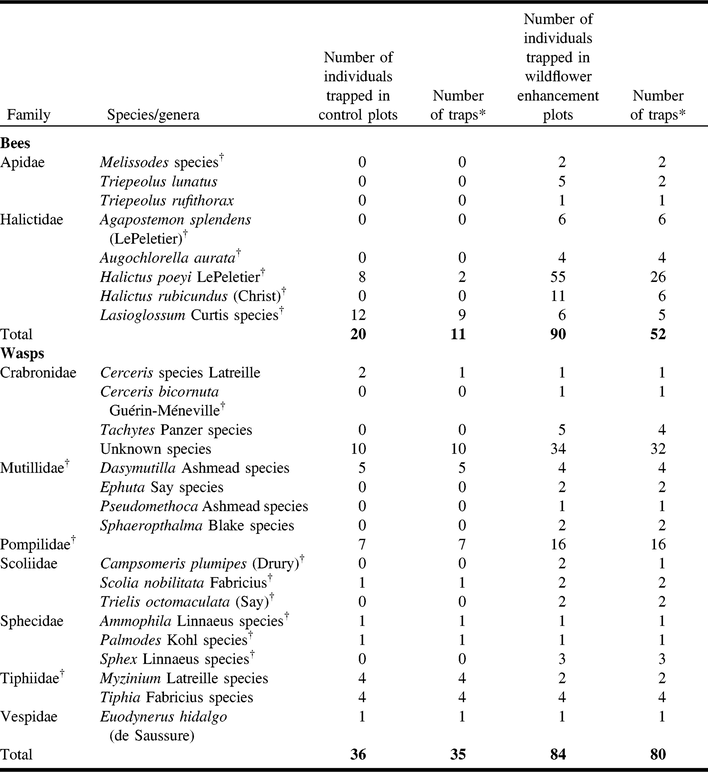
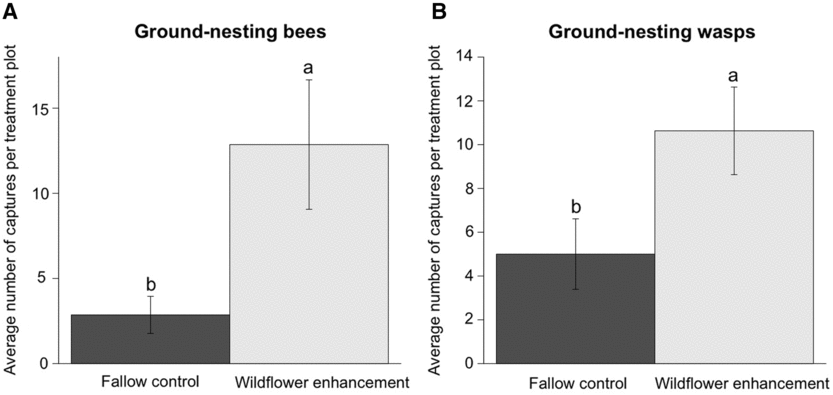
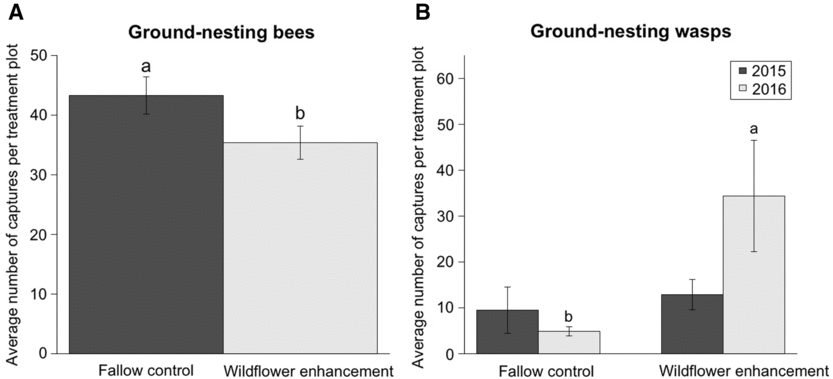
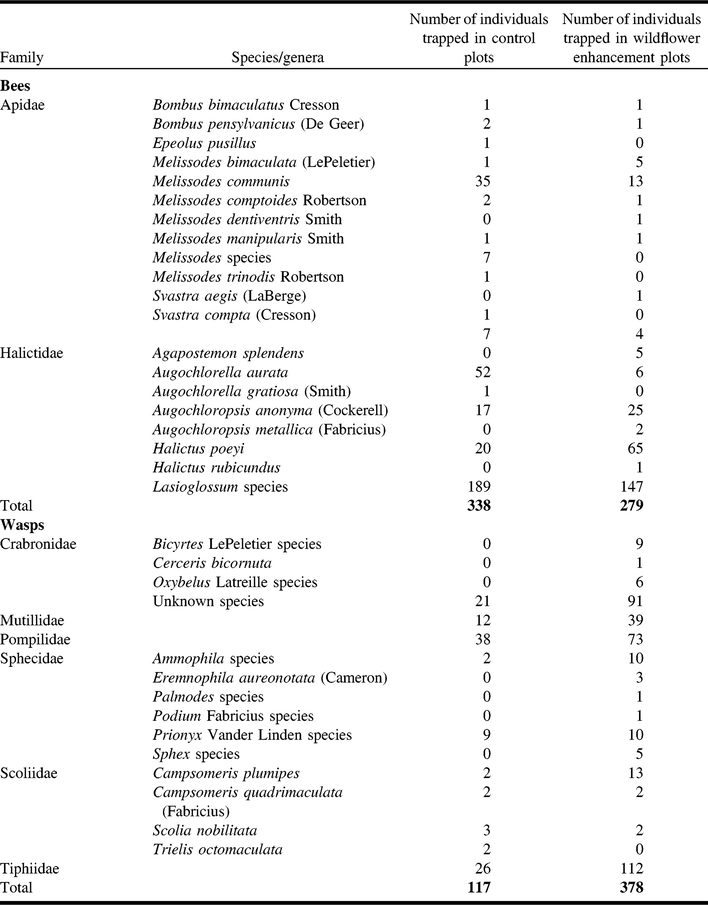
We captured 230 individual ground-nesting Hymenoptera (110 bees and 120 wasps) in emergence traps, which were comprised of eight ground-nesting bee species and 19 ground-nesting wasp species (Table 1). The fallow controls contained 18% of the ground-nesting bees and 30% of the ground-nesting wasps, whereas the wildflower enhancement plots contained 82% of the ground-nesting bees and 70% of the ground-nesting wasps. Ground-nesting bee (z-value = 3.94; P < 0.001) and wasp (z-value = 3.65; P < 0.001) relative abundance both were greater in wildflower enhancement plots than in fallow controls for the emergence traps (Fig. 2). Only 2.7% and 4.7% of the deployed emergence traps captured ground-nesting bees and wasps, respectively. Abundance of ground-nesting bees was greater in fallow controls than wildflower enhancement plots as collected by pan trap method (z-value = −2.16; P = 0.03) (Fig. 3A). This trend was primarily driven by two species: Melissodes communis Cresson (Hymenoptera: Apidae) and Augochlorella aurata (Smith) (Hymenoptera: Halictidae). Number of captures of ground-nesting bees in pan traps significantly decreased throughout the season (t-value = −6.42; P < 0.001). We detected a significant year × treatment interaction for ground-nesting wasps caught in pan traps. Abundance of ground-nesting wasps caught in pan traps in 2016 was greater in wildflower enhancement plots than in fallow controls (z-value = 4.13; P < 0.001) (Fig. 3B).
Ground-nesting bees and wasps collected from emergence traps from wildflower enhancement and fallow control plots, northcentral Florida, April–November 2015 and 2016

* Number of emergence traps out of 2400 traps deployed that contained ground-nesting bees or wasps.
† We also collected families, genera, or species of ground-nesting individuals in coloured pan traps.
Mean number of ground-nesting bees (A) and wasps (B) captured in emergence traps set in fallow control and wildflower enhancement treatments in intensive agricultural areas, northcentral Florida, April–November 2015 and April–October 2016. Different letters indicate significantly different, pair-wise comparisons of treatment means at α = 0.05. Errors bars = standard error.

Mean number of ground-nesting bees (A) and wasps (B) captured in pan traps set in fallow control and wildflower enhancement treatments in intensive agricultural areas, northcentral Florida, April–November 2015 and April–October 2016. Different letters indicate significantly different, pair-wise comparisons of treatment means at α = 0.05. Years were analysed separately for ground-nesting wasps due to a significant year × treatment interaction. Error bars = standard error.

In contrast, we captured 617 ground-nesting bees and 495 ground-nesting wasps comprising 21 bee species and 16 wasp species in coloured pan traps (Table 2). Between the two methods of trapping exercised in the blocks, the coloured pan traps collected a greater abundance of ground-nesting bees (z-value = 35.76; P < 0.001) and wasps (z-value = 32.83; P < 0.001) than the emergence traps. Eighty three per cent of all ground-nesting bees and wasps were collected in pan traps, which is nearly five times more than those collected in emergence traps. We captured many species of ground-nesting bees and wasps with pan traps that we never captured in emergence traps and vice versa (Table 2). For example, two parasitic bee species from emergence traps (Triepeolus lunatus (Say) and Triepeolus rufithorax Graenicher (Hymenoptera: Apidae)) and one parasitic bee species from coloured pan traps (Epeolus pusillus Cresson; Hymenoptera: Apidae) were captured. Additionally, we captured six of the eight bee species collected from emergence traps in coloured pan traps and nine of the sixteen wasp species collected from emergence traps in coloured pan traps.
Ground-nesting bees and wasps collected in coloured pan traps from wildflower enhancement and fallow control plots, northcentral Florida, April–November 2015 and 2016

Upland pine/hammock study
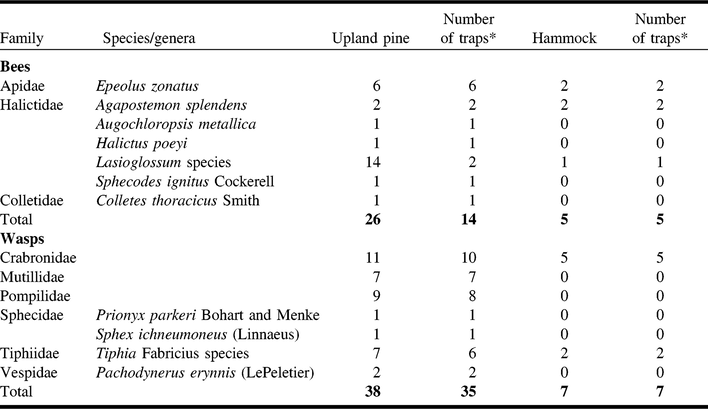
We captured a total of 76 individual ground-nesting Hymenoptera (31 bees and 45 wasps) in emergence traps (Table 3). The upland pine habitat contained 84% of the ground-nesting bees and wasps collected (three bee families and six wasp families), while the hammock habitat contained 14% of the ground-nesting bees and 16% of the wasps (two families of bees and two families at wasps). Relative abundances of total ground-nesting bees (z-value = 1.94; P = 0.049) and ground-nesting wasps (z-value = 3.79; P < 0.001) were greater in the upland pine habitat than in the hammock habitat. We only captured ground-nesting bees and wasps in 3.7% and 5.4% of the total emergence traps we set, respectively. We captured one parasitic bee species from emergence traps (Epeolus zonatus Smith; Hymenoptera: Apidae).
Ground-nesting bees and wasps collected from emergence traps in upland pine and hammock habitats, University of Florida Natural Area Teaching Laboratory, Gainesville, Florida, April–October 2017

* Number of traps out of 840 traps deployed that contained ground-nesting bees or wasps.
Discussion
In our wildflower enhancement and fallow control study, as collected by emergence traps, ground-nesting bees and wasps were more abundant in wildflower enhancement plots, whereas fewer ground-nesting bees and wasps were collected in the fallow control plots. The positive association of bees and wasps with wildflower enhancement plots may be a result of more abundant floral resources that could potentially increase foraging behaviours and encourage nesting site selection (Gathmann and Tscharntke Reference Gathmann and Tscharntke2002). Fallow control plots may have contained scarce suitable nesting sites because soil moisture and texture may have been unsuitable for some ground-nesting species (Cane Reference Cane1991).
The increased relative abundance of ground-nesting bees in fallow control plots in comparison to the wildflower plots by pan trapping could be related to bee body size and foraging distances. Many more large-bodied bees (e.g., Bombus Latreille, Melissodes Latreille, Svastra Holmberg; Hymenoptera: Apidae) were captured within pan traps compared with emergence traps. Foraging ranges of bees tend to be greater for larger-bodied bees than for smaller-bodied bees (Greenleaf et al. Reference Greenleaf, Williams, Winfree and Kremen2007). Therefore, the bees collected in our pan traps may have been foraging, but not nesting, within our plots. Additionally, the two most common bee species collected by pan trapping within the fallow plots (M. communis and A. aurata) were both generalists and may have been attracted to grasses (Poaceae) and other plants that were growing within the fallow plots.
Increased wasp abundance in wildflower enhancement plots relative to fallow control plots, in 2016, may have been driven not only by increased forage but also by increased insect prey availability. The majority of ground-nesting wasps collected in the wildflower and fallow plots collected by pan traps and emergence traps feed on a variety of insects, including Lepidoptera/Coleoptera larvae and spiders (Araneae). Wildflower plots have been shown to harbour increased arthropod abundance, including many that could act as prey items for ground-nesting wasps (Braman et al. Reference Braman, Pendley and Corley2002). Additionally, some ground-nesting wasp families (Hymenoptera: Mutillidae) use ground-nesting bees as hosts; therefore, increased ground-nesting wasp abundance could be dependent upon ground-nesting bee populations (Brothers et al. Reference Brothers, Tschuch and Burger2000).
As we hypothesised, ground-nesting bee and wasp abundances were greater in upland pine habitat than in hammock habitat, potentially owing to the soil composition of both respective ecosystems. Soil moisture, texture, and salinity varied between forest habitats, so ground-nesting bee and wasp abundances may have been driven by nest site selection in accordance with the preference of the species for certain soil characteristics (Cane Reference Cane1991; O’Neill Reference O’Neill2001). Soils in upland pine stands are well drained and loose, which may have provided more optimal nesting sites for certain species in comparison to highly compacted soils in hammocks. Furthermore, soils in hammocks are poorly drained and high in nutrients, which may have limited availability of suitable ground-nesting bee and wasp nest sites due to saturated soils.
Additionally, though there is no empirical data to show, there may have been more floral resource availability in upland pine stands compared with hammocks, owing to the greater bee abundance apparent in the upland pine habitat. Furthermore, greater wasp abundance in upland pine habitat than in hammock habitat may be explained by prey availability. Although adult wasps visit flowers, their young are fed other arthropods. Therefore, ground-nesting wasp abundance could also have been driven by greater prey and host abundance within the upland pine stands.
Emergence traps have been largely inefficacious at capturing species and are time-intensive to set; nevertheless, we were able to determine significant habitat-level differences in the abundance of ground-nesting bees and wasps in both studies. In contrast, Sardiñas and Kremen (Reference Sardiñas and Kremen2014) tested applications of emergence traps to sample ground-nesting bees and wasps and found them largely effective in identifying existing nesting sites and predicting other patterns of nesting for targeted ground-nesting bee populations. In our case studies, emergence traps had very low capture rates and, as seen in one case study, were less effective than coloured pan traps, a commonly implemented trapping method (Westphal et al. Reference Westphal, Bommarco, Carré, Lamborn, Morison and Petanidou2008; Morandin and Kremen Reference Morandin and Kremen2013).
Many ground-nesting bees are communal nesters (Danforth et al. Reference Danforth, Neff and Barretto-Ko1996) and, therefore, are not evenly spaced throughout the landscape. For example, we often captured numerous individual ground-nesting bees in one emergence trap, suggesting that the trap was near a communal nesting site. Thus, emergence traps not placed near communal nesting sites may underestimate abundance of many ground-nesting bees and wasps potentially present in an ecosystem. Accordingly, emergence traps placed near communal nesting sites may overestimate the abundance of many ground-nesting bees and wasps potentially present in the ecosystem. However, emergence traps captured a few parasitic bee species that were not captured in pan traps in wildflower enhancement and fallow control plots. Yet overall, we captured numerous ground-nesting bees and wasps with pan traps that we never captured in emergence traps. Our results suggest that emergence traps may not be an effective trapping method for studies using randomised trap placement to capture ground-nesting bees and wasps and that studies seeking to survey ground-nesting bee and wasp populations should use emergence traps as a supplement to other trapping methods.
In most other studies, pan traps were employed to survey ground-nesting pollinators (Campbell et al. Reference Campbell and Hanula2007; Sardiñas and Kremen Reference Sardiñas and Kremen2014; Campbell et al. Reference Campbell, Miller and Martin2016). Pan trapping may not provide information on the actual presence and location of nesting sites within a given area because it may capture transient, non-local foraging ground-nesting bees and wasps. As such, pan trapping may not be representative of nest site appropriateness and availability, especially for species of ground-nesting bees that have large foraging ranges. The efficiency of pan trapping can be limited because behavioural factors of foraging bees may not be evident; pan traps may be less attractive to bees and wasps in comparison to abundant floral resources (Cane et al. Reference Cane and Neff2000). Unlike pan traps, emergence traps have the ability to give information on nesting site location and preferences for bees and wasps.
However, we found it time-intensive and resource-intensive to use emergence traps to study the abundance of ground-nesting bees and wasps. In previous studies that examined the characteristics of ground-nesting bee nests, active nesting sites had to be previously identified or artificially started with nesting blocks and provisions (Cane Reference Cane1991; Cane and Neff Reference Cane, Minckley and Kervin2011). We suggest that emergence traps that cover larger tracts of soil should be used, or simply deployed in larger quantity, to increase the potential of sampling active nesting sites. Furthermore, though the scale of emergence traps that we used may not be as effective as a singular method of sampling ground-nesting bees and wasps, they could be incorporated as a supplement to other insect-monitoring methods. Emergence traps may collect species that are not commonly captured in coloured pan traps, providing insight into which ground-nesting bees and wasps are nesting within a localised area that may be foraging locally or elsewhere. Additionally, emergence traps intentionally placed over different soil types in different habitat types may aid in the understanding of preferences of ground-nesting species.
Ground-nesting bee and wasp nesting sites remain largely understudied; however, our data support the concept that ground-nesting bees and wasps have specific preferences for nesting sites. Nevertheless, declines in wild bee abundances are a contemporary concern and have been associated with land conversion and habitat modification (Koh et al. Reference Koh, Lonsdorf, Williams, Brittain, Isaacs, Gibbs and Ricketts2016). Therefore, it is important to support a wider breadth of knowledge on nesting habitats and sites to advance the respective techniques of surveying ground-nesting bees and wasps for conservation purposes.
Acknowledgements
We thank Hennelly Irvin, Alyn Irvin, Alexandra Tsalickis, and Cherice Smithers for insect collection and data entry. The wildflower enhancement/fallow control portion of the study was funded by Syngenta, as part of the Operation Pollinator Initiative. The upland pine/hammock study was funded by a University of Florida Natural Area Teaching Laboratory minigrant. We thank Anthony Abbate for constructive suggestions during manuscript development.