1. Introduction
In a recent study of the compositional variations of small mafic dykes (7–10 cm width) on Kestiö Island, SW Finland (Fig. 1a), we discovered spectacular internal zonation on a very fine scale (Chistyakova & Latypov, Reference Chistyakova and Latypov2009a). This was a surprise, since the dykes appear to be macro- and microscopically homogeneous. The internal zonation turned out to be compositionally anomalous since it is ‘normal’ in terms of some geochemical indices (predicted by liquidus phase equilibria) but ‘reverse’ in terms of others (opposite to that expected from liquidus phase equilibria). The processes responsible for this zonation remained unclear. The larger dykes (~0.5–1.0 m) revealed even more complex patterns of compositional zonation, indicating formation by a combination of several physical–chemical processes (Chistyakova & Latypov, Reference Chistyakova and Latypov2009b). Since an understanding of internal zonation in minor intrusions can be applied to larger magmatic bodies such as mafic sills and layered intrusions, taking account of the role of scale-dependent processes, here we extend our earlier work on this topic. Two key questions we address are: (1) whether the internal zonation represents a local feature, specific to these particular mafic dykes, or whether it is a general phenomenon; (2) what is the nature of physico-chemical processes operating during emplacement of small mafic dykes? It should be noted that published data on geochemical zonation of relatively large mafic dykes (~10–200 m thick) is abundant in the literature (Ragland, Rogers & Justus, Reference Ragland, Rogers and Justus1968; Steele & Ragland, Reference Steele and Ragland1976; Ross, Reference Ross1983, Reference Ross1986; Ross & Heimlich, Reference Ross and Heimlich1972; Ernst & Bell, Reference Ernst and Bell1992; Halama, Waight & Markl, Reference Halama, Waight and Markl2002). In contrast, similar data for centimetre-scale mafic dykes is scarce (e.g. Kretz, Hartree & Garrett, Reference Kretz, Hartree and Garrett1985; Brouxel, Reference Brouxel1991), so we have undertaken a detailed study of small mafic dykes from Torsholma Island, SW Finland (Fig. 1a). This study reveals that these small mafic dykes show remarkable internal zonation, with three distinct compositional patterns that are likely produced by at least three independent physical–chemical processes.
Simplified geological map showing the distribution of major dolerite dykes of the Åland–Åboland dyke swarm in southwestern Finland (a) and in the study area, Torsholma Island (b). Sampling profiles across Small Dyke Tor-2, Middle Dyke Tor-4 and Thick Dyke Tor-10 are indicated in bold along with GPS coordinates. The location of the simplified geological map (a) in the Fennoscandian Shield is shown in the inset. The map (a) has been modified from Eklund, Fröjdö & Lindberg (Reference Eklund, Fröjdö and Lindberg1994). Note that dolerite dykes are located on numerous small islands which are too small to be shown on the map.

2. Sampling and analytical methods
We measured whole-rock major and trace elements and mineral compositions across seven dolerite dykes in the Åland–Åboland dyke swarm, Torsholma Island (Fig. 1b). Data for three representative dykes of different sizes, Tor-2, Tor-4 and Tor-10, are presented here. By trial and error we found that the internal compositional structure was best revealed by sampling dykes at a 1–2 cm scale in the laboratory. Major and trace elements were determined by X-ray fluorescence (XRF) using a Siemens SRS-303AS spectrometer with Rh tube at the University of Oulu, Finland. Working curves were determined by analysis of rock standards NIM-N, NIM-P, NIM-D, BE-N, BIR-1, W-2, MRG-1 of known composition (Govindaraju, Reference Govindaraju1994). Analysis of standards suggests that relative accuracy for major elements is < 5% and for most trace element analyses is < 15%. FeO was determined by titration, and Fe2O3 by difference, at the University of Oulu, Finland. Mineral compositions were determined using a JEOL JXA-8200 electron microprobe with a 15 kV acceleration voltage, 10 nA cup current, 10–40 s counting times, and 10 μm beam diameter. A complete list of whole-rock major and trace elements for the dolerite dykes is published online as Appendix Tables A1–A3 (http://journals.cambridge.org/geo).
3. Geological background
The Åland–Åboland dolerite dyke swarm comprises about 500 dykes which form a NNE-trending zone, 40 km wide and 120 km long, extending from the Kökar rapakivi intrusion in the south towards the Vehmaa rapakivi batholith in the north (Fig. 1a) (Ehlers & Ehlers, Reference Ehlers and Ehlers1977; Laitakari, Reference Laitakari1991). Dykes range in width from a few millimetres to 400 metres, although most are about 1 m wide or less. Individual dykes are lens-shaped in plan and are seldom more than a few hundreds of metres long, but they often form en echelon groups which can be traced over much longer distances. Chemically the dolerites are subalkaline continental tholeiites transitional to alkali basalts (Lindberg, Eklund & Suominen, Reference Lindberg, Eklund, Suominen and Laitakari1991; Eklund, Fröjdö & Lindberg, Reference Eklund, Fröjdö and Lindberg1994). Most dykes dip vertically and lie parallel to the dominant fracture set in the country rocks. The wide range of chemical compositions and the occurrence of multiple dykes with both normal and reversed magnetic polarity suggest that they were intruded in pulses of slightly different age. Most dykes appear to have been intruded earlier than the rapakivi granites (1590 to 1540 Ma: Suominen, Reference Suominen, Aro and Laitakari1987, Reference Suominen1991; Rämö & Haapala, Reference Rämö, Haapala, Lehtinen, Nurmi and Rämö2005), and the most probable age of the dykes is considered to be about 1600 Ma (Suominen, Reference Suominen1991). There is close spatial, temporal and genetic relationship between the Åland–Åboland dyke swarm and the rapakivi granites in SW Finland (Lindberg & Eklund, Reference Lindberg and Eklund1990), and it has been proposed that mafic magmas feeding the dyke swarm caused heating and melting of the crust, generating the rapakivi granites (Eklund, Fröjdö & Lindberg, Reference Eklund, Fröjdö and Lindberg1994). Detailed descriptions of the geology, petrography and geochemistry of mafic dykes of the Åland–Åboland dyke swarm and related rocks can be found in Ehlers & Ehlers (Reference Ehlers and Ehlers1977), Bergman (Reference Bergman1986), N. Branigan (unpub. Ph.D. thesis, Univ. Dundee, 1987), Lindberg & Eklund (Reference Lindberg and Eklund1990), Lindberg, Eklund & Suominen (Reference Lindberg, Eklund, Suominen and Laitakari1991), Eklund, Fröjdö & Lindberg (Reference Eklund, Fröjdö and Lindberg1994) and Rämö & Haapala (Reference Rämö, Haapala, Lehtinen, Nurmi and Rämö2005).
4. Field relations and petrography of dykes
The study area lies on the southwestern shore of Torsholma Island (Fig. 1b), where the three dolerite dykes are exposed along a strip of shore. They strike at 35° NE and cut the host granites of the Archaean basement. Based on their widths, they are referred to as Small Dyke (3.2 cm thick, Tor-2), Middle Dyke (13.5 cm thick, Tor-4) and Thick Dyke (50 cm thick, Tor-10). The dykes have sharp parallel contacts with their host granites and show no field or petrographic evidence of in situ contamination by host rocks (Fig. 2). The dykes appear to be simple bodies: neither field nor laboratory petrographic studies revealed internal boundaries such as chilled zones or comb layers (e.g. Platten & Watterson, Reference Platten, Watterson, Halls and Fahrig1987; Platten, Reference Platten2000). Below we describe petrographic features of each of the three dykes.
Field photographs of Small Dyke Tor-2 (3.2 cm), Middle Dyke Tor-4 (13.5 cm) and Thick Dyke Tor-10 (50 cm) cutting granites of Archaean basement of Torsholma Island, SW Finland.

4.a. Small Dyke
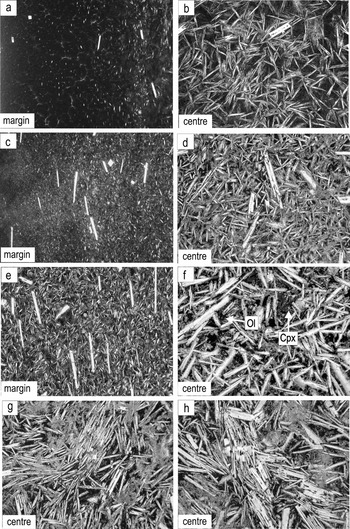
This aphanitic dyke lacks visible phenocrysts. In thin-section, the marginal parts of the dyke are characterized by a non-crystalline microporphyritic texture that changes gradually to intersertal towards the centre (Fig. 3a, b). Two generations of plagioclase crystals are present: microphenocrysts and in situ. Both are aligned parallel to the dyke contacts. Plagioclase microphenocrysts (< 0.7 mm) form elongated tabular crystals set in a fully devitrified groundmass. They are uniformly distributed across the dyke (< 1 vol.%). Core compositions of plagioclase microphenocrysts vary unsystematically across the dyke between An66 and An70. These microphenocrysts usually show normal zonation from core to rim of about 6–14% An. Towards the dyke centre, in situ plagioclase crystals appear, becoming more tabular in shape, increasing in size and abundance (up to 10 vol.%). They are unzoned, with compositions varying from An54 to An61. In this and other dykes, the centre contains a higher proportion of plagioclase compared to the margins, reflecting an increase in the amount of in situ plagioclase crystals. Microprobe analyses of plagioclase of both types in this and other dykes are close to the calculated normative An contents of rocks, indicating that plagioclase likely crystallized from supercooled magma in the subsurface. The groundmass across the entire dyke consists of fine-grained aggregates of plagioclase and ferro-magnesian hornblende. Small sub- to anhedral magmatic Ti-magnetite grains are present (< 1 vol.%) in the groundmass.
Photomicrographs of margins and interiors of (a, b) Small Dyke Tor-2, (c, d) Middle Dyke Tor-4, and (e, f) Thick Dyke Tor-10, of Torsholma Island, SW Finland (all are in non-polarized light). The texture of Small Dyke tends to gradually change from a non-crystalline microporphyritic at the margins (a) to intersertal in the centre (b). Throughout its entire section, rare microphenocrysts of tabular plagioclase and in situ grown acicular plagioclase are set in a groundmass of fully devitrified glass. The texture of Middle Dyke tends to change gradually from non-crystalline microporphyritic at the margins (c) to subophitic in the centre (d). In this texture, plagioclases of both generations are set in a groundmass of fine-grained aggregates of plagioclase and amphibole. At the margins, Thick Dyke exhibits a microporphyritic texture in which plagioclase occurs in a groundmass of fine-grained aggregates of plagioclase and amphibole (e). In the interior, the Thick Dyke shows subophitic to ophitic texture in which interstices between tabular plagioclase crystals and rare olivine grains are occupied by anhedral pyroxene, amphibole and plagioclase (f). Accumulation of relatively large plagioclase crystals tends to occur in the very centre of the dykes Tor-4 (g) and Tor-10 (h). Long dimension of field of view for all photomicrographs is about 3.5 mm.

4.b. Middle Dyke
The dyke is aphanitic to fine-grained. The texture of the dyke changes gradually from non-crystalline microporphyritic at the margins to subophitic in the centre (Fig. 3c, d). Plagioclase occurs as elongated tabular microphenocrysts and acicular skeletal crystals grown in situ. Both generations of plagioclase are aligned parallel with contacts of dyke. Microphenocrysts of plagioclase are uniformly distributed across the dyke (~4 vol.%). Towards the centre they increase in length from 1.0 to 3.0 mm and are normally zoned. Core compositions vary unsystematically between An65 and An70 across the dyke, with a difference between the cores and rims of crystals of 1 to 7% An. From the margins towards the centre, the acicular skeletal crystals of plagioclase become more abundant (40–50 vol.%) and become more tabular, increasing in length from 0.01 mm to about 1.5 mm. They are unzoned, with compositions varying from An57 to An63. Both generations of plagioclase are partially replaced by amphibole. The interstices between plagioclase laths are occupied by fine-grained aggregates of plagioclase and ferro-magnesian hornblende. Ti-magnetite occurs as fine anhedral disseminations and segregates. The very centre of the dyke is marked by accumulation of the plagioclase crystals (Fig. 3g) in the amount of 60–70 vol.%. The plagioclase crystals appear to preserve the orientation they had in flowing magma.
4.c. Thick Dyke
At the margins the dyke is microporphyritic but gradually changes to ophitic towards the centre. It has a primary fabric defined by elongated tabular microphenocrysts of plagioclase that are uniformly distributed across the dyke (~4 vol.%) but only show a preferential alignment at the dyke margins. The microphenocrysts of plagioclase are normally zoned and core composition varies across the dyke unsystematically between An67 and An70, with a difference between the core and rim of about 4–16% An. Similar to previous dykes, in Thick Dyke one can also observe the randomly distributed acicular skeletal crystals of plagioclase that have grown in situ. Towards the centre of the dyke they become tabular in shape and increase in size from 0.01 to 2 mm. The crystals of plagioclase grown in situ show no zonation, with compositions varying unsystematically across the dyke from An57 to An63. The total amount of the plagioclase in the dyke interior is approximately to 50–60 vol.%. The groundmass consists of fine-grained aggregates of plagioclase, Ti-magnetite and amphibole. In addition, the groundmass contains about 5–7 vol.% of augitic clinopyroxene (Wo38–43En29–33Fs25–29). Similar to Middle Dyke, the very centre of Thick Dyke is marked by an accumulation of plagioclase and occasionally altered olivine crystals (Fig. 3f), with a texture implying a preferred orientation of crystals in flowing magma (Fig. 3h).
5. Geochemical characteristics of dykes
5.a. Three types of internal zonation of dykes
One important finding is the discovery of three distinctly different types of internal zonation that are illustrated here using three dolerite dykes (Figs 4, 5); these types can be viewed as composed of a combination of three different compositional trends X, Y and Z.
Compositional variations in normative Pl, Cpx and An and whole-rock MgO and Mg number across Small (Tor-2), Middle (Tor-4) and Thick (Tor-10) dolerite dykes of Torsholma Island, SW Finland. Small Dyke shows one compositional trend X, Middle Dyke two different compositional trends X and Z, and finally, Thick Dyke three different compositional trends X, Y and Z. The boundaries between different compositional trends run through the crossover points. Distance is shown from southeastern contact of dykes. Compositional points for host granites are indicated by open circles and arrows on horizontal axes. Mg number = 100*Mg/(Mg + Fetotal); An(norm) = 100*An/(An + Ab). See text for further discussion.

Compositional variations in whole-rock TiO2, K2O, Zr, Sr, CaO and SiO2 across Small (Tor-2), Middle (Tor-4) and Thick (Tor-10) dolerite dykes of Torsholma Island, SW Finland. Small Dyke shows one compositional trend X, Middle Dyke two different compositional trends X and Z, and finally, Thick Dyke three different compositional trends X, Y and Z. The boundaries between different compositional trends run through the crossover points. Note that even the marginal samples in direct contact with country rocks show no compositional features indicating in situ contamination. Distance is shown from southeastern contact of dykes. Compositional points for host granites are indicated by open circles and arrows on horizontal axes. See text for further discussion.

Let us start by considering Thick Dyke Tor-10, which shows the most complex internal zonation (Figs 4, 5). A compositional trend X is characterized by an inward increase in normative Pl and Cpx, together with a decrease in normative An, Mg number, whole-rock MgO and Sr. This trend is terminated at two crossover points, giving way to the next trend Y, in which the behaviour of all parameters, except normative Pl, changes to the opposite: normative Cpx starts to decrease, whereas normative An, Mg number, whole-rock MgO and Sr increase inwards. The last centrally located trend Z is marked by distinctive positive peaks in normative Pl and whole-rock Sr (one point), normative An and Mg number (three points) and negative peaks in Zr and TiO2 (two and three points, respectively). A notable feature of this trend, compared to the previous one, is that a positive peak in normative Pl (and Sr) is complemented by a negative one in whole-rock MgO. This is not an accidental coincidence, since the same trend in Middle Dyke below shows a similar relationship between these parameters. All the above-mentioned trends are characterized by similar behaviour of incompatible components TiO2, Zr and K2O that tend to systematically decrease from the margins inwards.
Middle Dyke shows less complex internal zonation, consisting of two distinct compositional trends. The first is characterized by an increase in normative Pl and Cpx and a decrease in normative An, Mg number, whole-rock MgO and Sr (Figs 4, 5), and can therefore be identified as equivalent to trend X seen in Thick Dyke. The second reveals an increase in normative Pl and An, Mg number and Sr, and, what is most important, a decrease in whole-rock MgO along with an increase in TiO2 and can therefore be recognized as a trend Z. The boundary between these trends runs through the crossover points. Note that a compositional trend equivalent to trend Y in the Thick Dyke is absent from Middle Dyke.
Small Dyke is distinguished by the simplest type of internal zonation. It is difficult to define a compositional trend because we have only three data points. There is a trend, however, which can be equated with a compositional trend X because its centre-to-margin compositional tendencies are fully consistent with those observed in the marginal parts of the other two dykes. This trend is characterized by an increase in normative Pl and Cpx, along with a decrease in normative An, Mg number, whole-rock MgO and Sr (Figs 4, 5). The trend is additionally emphasized by an inward decrease in incompatible TiO2, Zr and K2O.
5.b. Significance of three compositional trends in terms of liquidus phase equilibria
It is instructive to comment briefly on the significance of the identified compositional trends X, Y and Z in terms of liquidus phase equilibria. The most interesting among them appears to be the first compositional trend X that occurs across the entire Small Dyke and marginal parts of Middle and Thick dykes. On the one hand, it is characterized by systematic inward decreases in whole-rock MgO, Mg number and normative An that are predicted by liquidus phase equilibria and are therefore commonly taken as an indication of ‘normal’ fractionation. On the other hand, it shows inward decreases in whole-rock incompatible TiO2, K2O and Zr that are opposite to those expected from liquidus phase equilibria and are therefore commonly taken as an indication of ‘reverse’ fractionation. The compositional trend X is thus anomalous in simultaneously showing features of ‘normal’ and ‘reverse’ fractionation. A similar trend was documented in small mafic dykes of Kestiö Island, SW Finland (Chistyakova & Latypov, Reference Chistyakova and Latypov2009a,Reference Chistyakova and Latypovb). The only difference between these trends is in the behaviour of normative An, which decreases inwards in a trend X of Torsholma dykes, but increases inwards in Kestiö dykes. A second compositional trend Y occurs only in the interior of Thick Dyke and differs from the above one in that the behaviour of its whole-rock MgO, Mg number and normative An changes to the opposite. As a result, the compositional trend Y possesses features of only ‘reverse’ fractionation. A third compositional trend Z is developed in the central part of Middle and Thick dykes. It shows many similarities with trend Y but differs in that variations in most parameters are more pronounced, and whole-rock MgO, instead of increasing, tends to decrease inwards. As a whole, this trend can also be characterized as showing ‘reverse’ fractionation. Note that we have chosen not to use normative Pl and Cpx and whole rock Sr for the characterization of compositional trends in terms of liquidus phase equilibria because their behavior during fractional crystallization of basaltic magma is not straightforward.
5.c. Negative correlation between normative An and thickness of dykes
One interesting feature shown by all seven studied dykes is that normative An correlates negatively with dyke thickness. The thicker the dyke, the lower its normative An (Fig. 6). This unexpected correlation has not, to our knowledge, been reported elsewhere. Its possible significance will be discussed later.
A diagram illustrating a negative correlation between a range of normative An and thickness of seven dolerite dykes of Torsholma Island, SW Finland. The location of dykes is indicated in Figure 1b.

6. Discussion
A question that needs to be addressed first is whether internal zonation of dykes is of primary or secondary origin. The dykes have been weakly affected by hydrothermal alteration, as shown by petrography and low values of loss on ignition (0.5–0.6 wt%, Small Dyke; 0.8–1.3 wt%, Middle Dyke; 0.5–1.2 wt%, Thick Dyke; online Appendix Tables A1–A3, http://journals.cambridge.org/geo). In addition, the extent of post-magmatic alteration, as implied by variations in loss on ignition, does not correlate with the observed compositional trends. This suggests that post-magmatic alteration played no role in the origin of internal zonation. In a similar manner, the cross-sectional distribution of major and trace elements reveals no in situ contamination. This is clearly indicated, for instance, by the steady increase of both MgO and TiO2 (Figs 4, 5) towards the dyke margins, despite the fact that the country rocks are depleted in these components. It is even clearer from two marginal samples of Thick Dyke and one marginal sample of Middle Dyke that show an abrupt decrease in SiO2, despite being in direct contact with granitic country rocks. Together with the surprisingly systematic compositional trends of dykes, this implies that the observed internal zonation can be safely regarded as being of primary magmatic origin, related neither to post-magmatic modification nor to in situ contamination. The most important compositional features of this primary internal zonation of dolerite dykes are schematically summarized in Figure 7. Internal zonation shows three different compositional patterns and becomes more complex with increasing thickness of the dykes: Small, Middle and Thick Dykes exhibit one (X), two (X and Z) and three (X, Y and Z) different compositional trends, respectively. Each compositional trend appears to reflect the operation of at least one separate physico-chemical process. To get a clue to the origin of such internal zonation, one needs therefore to understand how each of these compositional profiles has been produced. This issue is most convenient to address using Thick Dyke because it contains all three compositional trends (Fig. 8).
Generalized compositional profiles across Small (Tor-2), Middle (Tor-4) and Thick (Tor-10) dolerite dykes of Torsholma Island, SW Finland, which highlight the main compositional features of their internal zonation. Marginal contaminated samples are ignored for simplicity. Mg number = 100*Mg/ (Mg + Fetotal); An(norm) = 100*An/(An + Ab). See text for discussion.

A cartoon illustrating the successive formation of internal zonation of Thick Dyke Tor-10 of Torsholma Island, SW Finland, by three principle mechanisms: (a) successive changes in composition of inflowing magma (trend X); (b) in situ cumulate growth on dyke sidewalls (trend Y) and (c) flow differentiation (trend Z). Note that a symmetrical temperature profile imposed by cold country rocks results in a symmetrical internal zonation of the dyke. See text for discussion.

6.a. Origin of compositional trend X
The origin of trend X in Thick Dyke is enigmatic, since no conventional mechanism of magmatic differentiation can cause magma to evolve simultaneously along ‘normal’ and ‘reverse’ fractionation trends. This problem first emerged during our study of chemical zonation in small dolerite dykes of Kestiö Island (Chistyakova & Latypov, Reference Chistyakova and Latypov2009a,Reference Chistyakova and Latypovb). In an attempt to solve this puzzle, we examined a large number of natural processes (fractional crystallization, contamination, supercooling, magma stratification, crystal settling, flow differentiation, trapped liquid shift, inverse segregation, Soret effect, etc.), but all of them proved inadequate to explain certain features of this anomalous trend. Our final interpretation, which can also be applied to the present case, was the filling of dykes by magma which changed its composition with time (Chistyakova & Latypov, Reference Chistyakova and Latypov2009a,Reference Chistyakova and Latypovb). The major advantage of this interpretation is that it gives a straightforward answer as to how compositional zonation may have originated directly at the present position of dykes. A pre-emplacement history of inflowing magma is much less clear. One possible scenario appears to be the successive tapping of a deeper-level magma chamber that has been vertically stratified, as shown in Figure 9. Given such a stratification, a negative correlation between normative An and thickness of dykes can plausibly be explained in the following way. The smallest and most An-rich dykes may record an initial period of magma tapping from the uppermost part of the stratified chamber. The thicker and more An-poor dykes may record the advanced stages of this process, when larger volumes of magma became involved from the progressively deeper parts of the chamber (Fig. 9). A question that remains to be answered is: what process is responsible for origin of such anomalous magma stratification? This is an enigma and a great challenge for all igneous petrologists specializing in the field of magma differentiation processes (Chistyakova & Latypov, Reference Chistyakova and Latypov2009a,Reference Chistyakova and Latypovb).
A cartoon illustrating an inferred compositional stratification in a deeper-level magma chamber feeding dolerite dykes of Torsholma Island, SW Finland, and the process of magma chamber tapping that can provide a negative correlation between a range of normative An and thickness of dolerite dykes. See text for discussion.

6.b. Origin of compositional trend Y
At some distance from the margins marked by the crossover points (Fig. 7), the anomalous trend X of Thick Dyke suddenly changes to the next trend Y of the ‘reverse’ nature. Apparently, the drastic differences between compositional patterns of these trends are caused by changes in operating processes. Since the rocks in this part of the dyke become more crystalline, it is plausible that some crystal–liquid process started being active here. The simplest possibility is that the external changes in the composition of inflowing magma become overwhelmed by internal in situ cumulate growth on dyke sidewalls. The latter process has provided a progressive inward increase in the proportion of cumulus plagioclase and mafic phases (Chistyakova & Latypov, Reference Chistyakova and Latypov2009b). In other words, the crossover points mark the level at which the compositional contribution of inflowing magma towards decreasing whole-rock MgO, Mg number and normative An has been exceeded by that of the crystallizing cumulus minerals (plagioclase, clinopyroxene, olivine), increasing these parameters. As for incompatible components such as TiO2, Zr and K2O, they are not subject to trend changes at crossover points because both the cumulative process and magma emplacement lead to similar changes in these parameters. It is also conceivable that during formation of the trend Y, compositionally different portions of inflowing magma may become completely mixed and homogenized so that a cumulative process remains the only mechanism capable of forming an internal zonation. Thus, the ‘reverse’ trend Y in the interior of thick dyke likely reflects a tendency of rocks to become more cumulate inwards, owing to crystallization of flowing magma under progressively less supercooled conditions.
6.c. Origin of compositional trend Z
A transition to the last ‘reverse’ trend Z is less pronounced because it shows many similarities with the previous trend Y. It cannot be interpreted in the same way, however, because of features that indicate a change in the controlling processes: in particular, the fact that variations in most parameters become suddenly much more pronounced, and whole-rock MgO begins to decrease. Again, we assume that this was related to some crystal–liquid process. The simplest explanation based on petrographic observations (Fig. 3g, h) is accumulation of plagioclase phenocrysts in the centre of dyke by flow differentiation (e.g. Bhattacharji & Smith, Reference Bhattacharji and Smith1964; Bhattacharji, Reference Bhattacharji and Wyllie1967; Simkin, Reference Simkin and Wyllie1967). This interpretation is strongly supported by a relatively abrupt increase in normative Pl, whole-rock Sr and normative An, as well as an abrupt decrease in incompatible Zr and TiO2 that reflects a decrease in proportion of interstitial liquid in rocks. One interesting feature of trend Z is an increase in whole-rock Mg number indicating that, apart from plagioclase crystals, some mafic phases have also been concentrated by flow differentiation in the centre of the dyke. The question arises as to how to reconcile two apparently contradicting observations: a decrease in whole-rock MgO and an increase in whole-rock Mg number. Simple mass balance modelling shows, however, that such behaviour may result from an accumulation of a mixture of Pl and Ol crystals, with the former significantly predominating over the latter (e.g. 1.0 wt% Pl, 0.2 wt% Ol, 98.8 wt% rock). In this case, whole-rock Mg number will increase, whereas whole-rock MgO will conversely decrease because of the prevailing addition of plagioclase components.
6.d. Origin of internal zonation of dykes
Armed with the above knowledge of the origin of compositional profiles, we can now summarize short scenarios for the formation of internal zonation in our dolerite dykes. Small Dyke appears to have been exclusively produced by magma that was continuously changing its composition with time (trend X). Middle Dyke is also mostly formed by the same process (trend X), but its final stage was dominated by accumulation of plagioclase and olivine phenocrysts in the centre of the dyke by flow differentiation (trend Z). Thick Dyke also started forming by inflowing magma continuously changing its composition with time (trend X), but at some distance from the margins, the changes in composition of inflowing magma were completely overwhelmed by in situ cumulate growth on dyke sidewalls (a trend Y). The formation of Thick Dyke was completed by concentration of plagioclase and olivine phenocrysts towards its centre by flow differentiation (trend Z). It should be noted that systematic changes in operating processes and consequent changes in the type of internal zonation likely take place in response to crystallization of magma in less supercooled conditions with an increase in dyke width. Small Dyke cooled almost instantly, and therefore neither in situ cumulate growth nor flow differentiation was able to start operating. Middle Dyke still cooled sufficiently quickly to prevent the onset of in situ cumulate growth, but had enough time to concentrate plagioclase phenocrysts in the centre of the dyke by flow differentiation at the final stage of its crystallization. Finally, Thick Dyke was slowest in cooling, and this resulted in the effective operation of in situ cumulate growth in the interior of the dyke (trend Y), in addition to the two processes already mentioned. Completing this section, it should be noted that internal zonation of all three dykes is symmetrical because their cooling regime imposed by cold country rocks was apparently symmetrical (Fig. 8). During this study we came across only one case when the cooling regime of the dyke was not symmetrical, and this resulted in an asymmetrical shape of its internal zonation. This unusual example is presented separately in Appendix 1.
7. Conclusions
This study strongly supports our earlier finding that such seemingly simple and superficially homogeneous geological objects as small mafic dykes can be remarkably zoned (Chistyakova & Latypov, Reference Chistyakova and Latypov2009a,Reference Chistyakova and Latypovb). Systematic whole-rock variations in major and trace elements, as well as in some other petrochemical parameters, have been found across all the studied dykes of Torsholma Island, SW Finland. Of special interest is the fact that their internal zonation shows different compositional patterns and becomes more complicated with increasing dyke thickness. A reason for this probably lies in the different cooling histories of dykes: as they become thicker, magma crystallization takes place in progressively less supercooled conditions, allowing more processes to be involved. As a result, the compositional patterns of dykes become more complex. We find it extraordinary that chemical zonation of even such simple geological objects may record compositional features of several independently operating processes. The study of internal compositional variations in small mafic dykes (< 0.5 m) from other geological provinces is required to characterize general features of their chemical zonation and to improve our understanding of the physico-chemical processes operating during emplacement of mafic magma bodies.
Acknowledgements
We are grateful to Marian Holness and Steve Prevec for useful suggestions and encouraging comments on the paper, as well as editing that led to significant improvement in the wording of earlier versions of the text. We thank Olav Eklund for the good advice to choose Torsholma Island of the Åland–Åboland dyke swarm as the study area. We are indebted to Ralf Halama and an anonymous reviewer for their helpful comments and suggestions, which contributed to improving the manuscript. Editorial input by David Pyle is highly acknowledged. Rustam Latypov is warmly thanked for assistance with fieldwork. The research was supported by grants from the Finnish Academy of Science and the Renlund Foundation, Finland.
Appendix 1. Internal zonation of dolerite dyke Tor-5 crystallized under regime of asymmetrical cooling
The 18 cm thick dolerite dyke Tor-5 is unique in showing remarkably regular trends in incompatible TiO2, Zr, Y and K2O, simultaneously with very complex and seemingly chaotic trends in normative Cpx, An and whole-rock MgO (Fig. A1). At first sight, one can hardly find any reasonable interpretation of such conflicting compositional patterns of the dyke, but the case becomes much simpler if we subdivide the internal zonation into compositional trends identified in this study. Along its SE side, the dyke reveals an anomalous trend X that is safely defined by a systematic inward increase in normative Pl and a decrease in normative An, whole-rock MgO, and Mg number. Along both sides, the dyke also shows two ‘reverse’ trends Y that are unambiguously recognized by an inward decrease in normative Cpx and an increase in whole-rock MgO, Mg number and normative An. Finally, in its centre, the dyke exhibits a ‘reverse’ trend Z that is distinguished by a sudden decrease in whole-rock MgO accompanied by an increase in normative Pl and An, whole-rock Mg number and Sr. Incompatible TiO2, Zr and K2O are not diagnostic in defining compositional trends because these components behave similarly in all identified trends X, Y and Z. This is why these parameters show such systematic inward trends across the entire dykes. Clearly, asymmetrical internal zonation of this dyke is caused by lack of the anomalous compositional trend X at its NW side. What is the reason for its absence there? An answer to this question can be inferred from the geological position of the studied dykes (Fig. 1b). Note that dykes Tor-2, Tor-4 and Tor-10 are located in host granites and their symmetrical zonation is apparently due to the symmetrical shape of a thermal profile imposed by cold granites. In contrast, the asymmetrically zoned dyke Tor-5 is located in between the host granites and large dolerite dykes. Such a position allows us to assume that this dyke may have been intruded and crystallized between relatively hot, still evolving dolerite dykes and relatively cold country rocks. For this reason, the thermal profile of this dyke may have been asymmetrical, with a hotter NW side and a colder SE side (Fig. A2). Keeping in mind that the compositional trend X forms essentially by chilling of inflowing magma, one can imagine the following situation that may have resulted in asymmetry in internal zonation of dyke. At the initial stage of dyke filling, the temperature conditions for magma chilling were appropriate only at its colder SE side. As a result, the rocks with a compositional trend X crystallized only at this side, with no such rocks forming at the opposite NW side of the dyke. With time, thermal conditions became comparable on both sides of dykes, resulting in cessation of the regime of magma chilling and the onset of in situ cumulate growth against dyke sidewalls (a ‘reverse’ trend Y), which culminated in the accumulation of phenocrysts of plagioclase and olivine in the centre by flow differentiation (a ‘reverse’ trend Z). In general, it would be interesting in the future to undertake a special study of this type of mafic dykes that crystallized under a regime of asymmetrical cooling.
Compositional variations across the asymmetrically zoned dolerite dyke Tor-5 of Torsholma Island, SW Finland. Distance is shown from southeastern contact of dyke. Mg number = 100*Mg/(Mg + Fetotal); An(norm) = 100*An/(An + Ab). See text for discussion.

A cartoon illustrating the idea that an asymmetrical internal zonation of dyke Tor-5 (Fig. A1) is likely caused by an asymmetrical temperature profile imposed by a hot large dolerite dyke and cold country rocks. See text for discussion.