Following on the paper by Kjaer (Reference Kjaer2005) entitled ‘Belgica in the Arctic’, in which the discovery of the wreck of that famous ship in Harstad fjord, Norway, was revealed, reports of activity subsequent to this were presented in previous issues of this journal. The first reported the establishment of the Belgica Society (Loy Reference Loy2006), while a second was on the first activities of the society (Loy and Van Autenboer 2006). Since then, ownership of the wreck has been transferred to the society by Kristian Holst AS and family.
Between 14 and 17 May 2007, Marnix Pieters, of the Flemish Heritage Institute, and Yan Verschueren dived three times to the wreck of the ship. Dr. Stephen Wickler of Tromsö University Museum, Ivar Aarestad of the Norwegian Directorate for Cultural Heritage, and Karl Emil Rikardsen, a filmmaker, accompanied the Belgica Society members during this activity. These dives were needed to organise future archaeological work. These people, together with Willy Versluys, met the Harstad harbour master, Steffen Kristiansen, in order to consider the practical problems associated with the proposed raising of the wreck.
From 10 to 14 August 2007, Marnix Pieters and Wim Vermeire were in Harstad to clean up the wreck. In cooperation with the local diving club, two thirds of Belgica was cleared from nets and seaweed. However, the ammunition still on board has to be evacuated in order to carry out further archeological work. To achieve this the help of the Norwegian and Belgian navies will be sought.
On 7 and 8 November 2007, Tom Lenaerts and Marnix Pieters received some practical training concerning tests of wood stability of wrecks from Dr. David Gregory at the Centre for Maritime Archaeology of the National Museum of Denmark. Wood samples from Belgica should provide an indication of the practicability of raising the wreck. Both of these Belgica society-members had the opportunity to learn to handle the Pilodyne, increment borers, cork borers and the apparatus based on the measurement of the electrical conductivity of the wood. This set of combined methods has been developed by the Danish team and is very reliable for obtaining high quality information concerning structural stability of wood.
In order to benefit from maximum visibility in the fjord, the next dive mission is planned for February 2008.
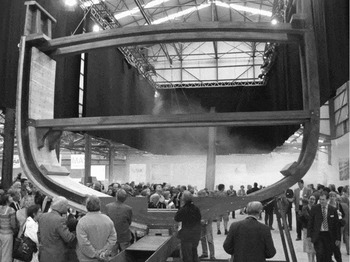
In the mean time, the De Steenschuit shipyard, near Boom in Belgium, is building a full size replica of Belgica (Fig. 1). The keel was laid on 9 September 2007 and construction should be complete within a period of five years. This will result in a three-master of about 35.40 m long by 7.50 m and rigged as a barque. This work enjoys the patronage of Her Majesty the Queen of the Belgians and the sponsorship of the Governor of the Province of Antwerp, of the Ministry of Defence and of the Flanders Employment Agency.
The replica of Belgica under construction. Photograph taken on 9 September 2007.

From its home base in Antwerp, the reborn Belgica will sail the world as an ambassador ship alerting the public to the climate change.