Implications
Ruminant livestock production is a significant contributor of greenhouse gases accounting for 17% to 37% of anthropogenic emissions. Various strategies have been investigated to mitigate enteric methane (CH4) emissions. Administration of Propionibacterium strains to cattle may offer a means of increasing ruminal propionate synthesis, thereby reducing enteric CH4 emissions. Results from the present study are helpful in analyzing the practical use of these strains in beef cattle production by evaluating their ability to integrate within the rumen microbiome and mitigate CH4 emissions by modifying ruminal fermentation.
Introduction
Enteric methane (CH4) is a normal product of ruminal fermentation and represents a mechanism to remove H+ and avoid the accumulation of reduced electron carriers during fermentation (McAllister and Newbold, Reference McAllister and Newbold2008). However, enteric CH4 is the single largest contributing source of greenhouse gases from Canadian beef production accounting for >60% of total emissions (Beauchemin et al., Reference Beauchemin, Henry Janzen, Little, McAllister and McGinn2010). Hence, substantial efforts are now being directed toward developing strategies to mitigate enteric CH4 emissions from beef cattle. The manipulation of the fermentative pathways in the rumen can have a significant effect on enteric CH4 emissions (Newbold et al., Reference Newbold, Lopez, Nelson, Ouda, Wallace and Moss1995). Several feed additives have been investigated to stimulate alternative pathways for disposal of H+ including the use of halogenated analogs and ionophores (McAllister and Newbold, Reference McAllister and Newbold2008); however, none of these strategies have been widely adopted because of their transient effects on CH4 emissions, toxicity to the host or their inability to gain regulatory approval for use as a feed additive.
Increasing ruminal synthesis of propionate at the expense of acetate favors reduced CH4 emissions, as propionate is a net H+ sink in the fermentation process (Murphy et al., Reference Murphy, Baldwin and Koong1982). The selection of Propionibacterium strains for dietary supplementation may offer an effective means of increasing molar proportions of propionate (Jeyanathan et al., Reference Jeyanathan, Marin and Morgavi2014). Recently, in vitro ruminal incubations of various Propionibacterium strains were shown to reduce CH4 production from concentrate and forage diets (Alazzeh et al., Reference Alazzeh, Sultana, Beauchemin, Wang, Holo, Harstad and McAllister2013). Likewise, a recent in vivo experiment showed significant drop in mean CH4 yield (i.e. emissions adjusted for feed intake), with Propionibacterium strains in beef cattle fed a high forage diet (Vyas et al., Reference Vyas, McGeough, McGinn, McAllister and Beauchemin2014). However, these effects need further confirmation with high grain diets before Propionibacterium can be recommended as a means of reducing CH4 from finishing cattle. Hence, the primary objective of this experiment was to identify strains of Propionibacterium that mitigate CH4 emissions from beef heifers offered a diet containing a high proportion of corn grain. Additionally, the effects of such strains on related variables including diet digestibility and ruminal fermentation were also investigated.
Material and methods
Experimental design, dietary treatments and animal care
The experiment was conducted using the Metabolism Barn and Controlled Environment Facility at Agriculture and Agri-Food Canada’s Research Center in Lethbridge, AB, Canada. All animals were cared for in accordance with the guidelines of the Canadian Council of Animal Care (1997) and the experiment was approved by Lethbridge Research Center Animal Care Committee protocol # 1129.
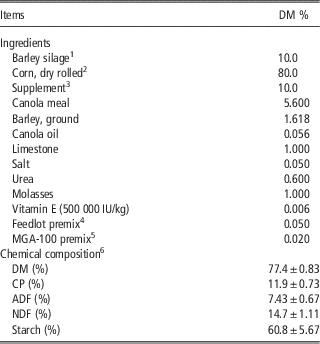
Twenty ruminally cannulated beef heifers were used in a randomized block design with 28-day periods. The heifers were blocked in five groups (i.e. blocks) on the basis of pre-experimental BW (kilograms; mean±s.d.: group 1=490±70, group 2=551±33, group 3=525±29, group 4=605±33, group 5=587±31). Treatments were: (1) Control, (2) Propionibacterium acidipropionici strain P169, (3) P. acidipropionici strain P5, and (4) Propionibacterium jensenii strain P54. Inoculae of each strain (5×10⁹ CFU) were administered daily just before feeding into the rumen with 10 g of a maltodextrin carrier in a porcine gel capsule (Torpac#10; Torpac Inc., Fairfield, NJ, USA) just prior to feeding. Control animals received gel capsules with carrier only. Treatments were allotted randomly to cows within each group. All heifers were fed the basal diet (10 : 90 forage to concentrate; Table 1) formulated to provide adequate ME and MP for 500 kg growing and finishing beef cattle with an average daily gain of 2 kg/day (National Research Council (NRC), 2000). The animals were housed in a ventilated tie-stall barn and had access to an open dry lot for daily exercise. They were fed ad libitum once daily at 1300 h. One animal on the P5 treatment suffered from prolapsed vagina and had to be removed from the experiment.
Ingredient and chemical composition of the basal diet

DM=dry matter.
1 Composition (mean±s.d.; % DM basis): 29.9±3.00 DM, 10.9±0.49 CP, 56.5±2.35 NDF, 38.9±1.39 ADF.
2 Composition (mean±s.d.; % DM basis): 90.1±0.20 DM, 9.46±0.51 CP, 13.3±1.01 NDF, 3.68±0.06 ADF.
3 Composition (mean±s.d.; % DM basis): 93.94±0.30 DM, 39.44±6.87 CP, 21.0±0.70 NDF, 14.6±0.62 ADF.
4 Supplied per kilogram of DM of diet: 49 mg of Fe, 56 mg of Zn, 14 mg of Cu, 27 mg of Mn, 0.57 mg of I, 0.25 mg of Se, 0.17 mg of Co, 8596 IU of vitamin A, 430 IU of vitamin D, and 42 IU of vitamin E.
5 Supplied per kilogram of MGA-100 premix: 220 mg Melengestrol acetate (Pfizer Animal Health, Kirkland, QC, Canada).
6 Based on samples composited by period.
Measurements
During each experimental period, days 1 to 14 were used to adapt heifers to their treatments. Rumen contents were collected on days 15 and 18, ruminal pH was measured continuously between days 15 and 22, enteric CH4 was measured between days 19 and 22, and total tract nutrient digestibility was measured between days 25 and 28.
Amounts of feed offered and orts were recorded daily. Diet and ort samples were taken daily during weeks of CH4 and digestibility measurements. Samples were pooled by week for each animal within each period. Dietary ingredients were sampled once weekly and analyzed for dry matter (DM) by drying at 55°C for 72 h. The forage inclusion level (as-fed basis) was adjusted if the DM concentration of barley silage deviated more than 3% units from the average. Samples were stored at −20°C until analyzed.
CH4 measurements
Environmental chambers were used for measuring CH4 emissions from individual heifers for 3 days as described previously (Beauchemin and McGinn, Reference Beauchemin and McGinn2006). All animals were trained for entry into the environmental chambers before starting the trial. Each of the four chambers measured 4.4 m wide×3.7 m deep×3.9 m tall (63.5 m3 volume; model C1330; Conviron Inc., Winnipeg, MB, Canada) and housed a single animal in a stall. Conditions of air circulation and sampling procedures were as described by Avila-Stagno et al. (Reference Avila-Stagno, Chaves, He, Harstad, Beauchemin, McGinn and McAllister2013).
Before and after each experimental period, chambers were calibrated by sequentially releasing 0, 0.2, and 0.4 l/min of CH4 separately into each empty chamber using a mass-flow meter (Omega Engineering, Stamford, CT, USA). A 3-point regression was developed by plotting actual against calculated CH4 emission (R 2=0.99). The slopes of these best fit linear relationships were used to correct for between-chamber variability. Concentrations of CH4 in the intake and exhaust air ducts were monitored using a CH4 analyzer (model Ultramat 5E; Siemens Inc., Karlsruhe, Germany). The CH4 analyzer was calibrated daily using reference gases, with CH4 as the primary standard for the span and N2 for the 0. The difference between the incoming and outgoing mass of CH4 was used to calculate the amount of CH4 generated in each chamber by each heifer. Emission of CH4 per kilogram of dry matter intake (DMI) was calculated by dividing total emissions by the total DMI of each heifer within the chamber.
Ruminal fermentation
Rumen pH profile was monitored continuously every minute from days 15 to 22 using LRCpH dataloggers (Penner et al., Reference Penner, Beauchemin and Mutsvangwa2006). The system was standardized using pH 4 and 7 buffers before insertion on the first day and after removal on the last day. The shift in the millivolt readings between the start and end standardizations was assumed to be linear and used to convert millivolt readings to pH units (Penner et al., Reference Penner, Beauchemin and Mutsvangwa2006). The severity of subacute ruminal acidosis was determined using two pH thresholds: 5.8 (Dohme et al., Reference Dohme, DeVries and Beauchemin2008) and 5.6 (Nagaraja and Lechtenberg, Reference Nagaraja and Lechtenberg2007).
Ruminal samples were collected on days 15 and 18 at 0, 3, 6 and 9 h post-feeding. Ruminal contents were sampled from four different sites, composited and strained through a double layer of polyester monofilament fabric (Pecap 7-1180/59, mesh opening 1, 180 µm; Tetko Inc., Scarborough, ON, Canada). Five milliliters of filtered rumen fluid was preserved by adding 1 ml of 25% (wt/vol) HPO3 for volatile fatty acid (VFA) determination, and 5 ml of filtered rumen fluid was preserved by adding 1 ml of 1% (wt/vol) H2SO4 for ammonia (NH3) determination. The samples were stored at −20°C until analyzed.
Diet digestibility
Total tract nutrient digestibility was determined by total fecal collection over 4 consecutive days from days 25 to 28. Feed intake was restricted to 0.95 of ad libitum consumption (determined from the days 10 to 17 DMI, before the animals going into the chambers) starting at feeding on day 25. A daily sub-sample of the feces from each heifer (~100 g) was oven-dried at 55°C. At the end of the digestibility trial, a composite sample from each animal was obtained by pooling the dried daily fecal samples based on their original DM concentration.
DNA extraction and quantitative PCR
Ruminal samples collected at 0, 3 and 9 h were processed separately by period for each heifer. Microbial pellets for DNA extraction were obtained based on the methods of Stevenson and Weimer (Reference Stevenson and Weimer2007) with some modifications as described earlier (Vyas et al., Reference Vyas, McGeough, McGinn, McAllister and Beauchemin2014).
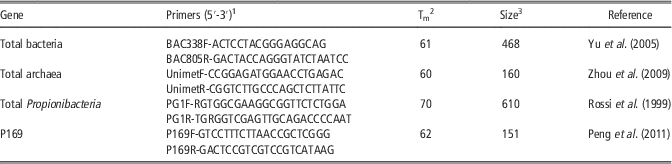
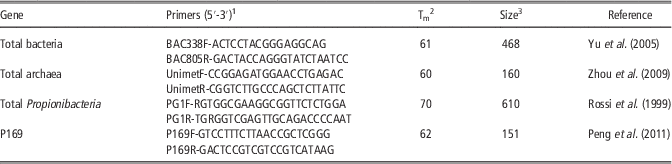
Primers used for quantitative PCR (qPCR) are shown in Table 2. Quantitative real-time PCR assays were performed according to the method of Vyas et al. (Reference Vyas, McGeough, McGinn, McAllister and Beauchemin2014). Briefly, qPCR assays were performed with 7900 HT Fast Real-time PCR system (Applied Biosystem, Foster city, CA, USA) using POWER SYBR Green PCR Master Mix (Applied Biosystems, Warrington, UK). Twenty-five microliters of reaction mixture contained 20 ng of template DNA along with 500 nM of forward and reverse primer per reaction. The following conditions were used for amplification: 95°C for 5 min, 95°C for 10 s, and a 30 s annealing/elongation for 40 cycles. The specificity of PCR product was verified by melt denaturation with an increment of 0.1°C per second from 60°C to 95°C, with fluorescence collection at 0.1°C intervals. Amplification products were verified by agarose gel electrophoresis using 1% agarose in Tris-acetate-EDTA (40 mM Tris acetate, 1 mM EDTA [pH 8.5]). Standard curves for total archaea and universal bacteria were constructed by using plasmid DNA containing 16S rRNA inserts of DNA purified from a pure culture of Methanobrevibacter spp. strain AbM4 (Zhou et al., Reference Zhou, Hernandez-Sanabria and Guan2009) and Ruminococcus spp. (Petri et al., Reference Petri, Forster, Yang, McKinnon and McAllister2012), respectively. Standard for total Propionibacteria was prepared from genomic DNA extracted from purified culture of P. acidipropionici P169 grown at 32°C for 48 h in sodium lactate broth. Standards were quantified using a ND-1000 spectrophotometer (NanoDrop Technologies, Wilmington, DE, USA) and were subjected to seven sequential 10-fold dilutions, each analyzed in triplicate. A linear relationship was observed between the threshold cycle (CT) and the log of DNA concentration when each primer pair was tested against purified DNA from its target bacteria (R 2, 0.98 to 0.99). The PCR cycle at which the reaction exceeded the fluorescence threshold was identified as the CT. The relative population size (RPS) of total Propionibacteria was determined as the ratio of the amplification of total Propionibacteria 16S rRNA to the amplification of the reference primers. In this study, a primer set (BAC338F and BAC805R) that amplified all eubacterial species was used as the reference primer set. Details of these calculations, with corrections for PCR efficiency are described by Stevenson and Weimer (Reference Stevenson and Weimer2007).
Features of primers used for quantitative PCR analysis
1 Primer direction (F – forward; R – reverse).
2 Annealing temperature (°C).
3 Amplicon size in base pairs (bp).
Laboratory analyses
Feed, orts, ruminal contents, and fecal samples were analyzed for DM, ash, NDF, ADF, N and starch. DM for all samples was determined by oven drying at 55°C for 72 h. Dried samples were ground through a 1 mm screen in a Wiley mill (A. H. Thomas, Philadelphia, PA, USA). Analytical DM concentration of ground samples was determined by drying at 135°C for 2 h (method 930.15; Association of Official Analytical Chemists (AOAC), 2005), followed by hot weighing. The organic matter (OM) concentration was calculated as the difference between 100 and the percentage ash (method 942.05; AOAC, 2005). The NDF was determined using heat stable amylase and sodium sulphite (method 2002.04; AOAC, 2005) while ADF was determined using method 973.18 (AOAC, 2005). Gross energy concentration was determined using a bomb calorimeter (model E2k; CAL2k, Johannesburg, South Africa). For the measurement of CP (N×6.25) and starch, samples were ground using a ball mill (Mixer Mill MM2000; Tetsch, Haan, Germany) to a fine powder. Total N was quantified by flash combustion and thermal conductivity detection (Carlo Erba Instruments, Milan, Italy). Starch concentration was determined by enzymatic hydrolysis of α-linked glucose polymers by the method of Rode et al. (Reference Rode, Yang and Beauchemin1999) with the following modifications. Tubes containing samples were initially incubated in a water bath at 90°C and vortexed at 10, 20 and 30 min of incubation without the use of activated carbon. Amyloglucosidase (200 µl; Megazyme, Wicklow, Ireland) was added, tubes were vortexed immediately and twice subsequently at 30 and 60 min during 2 h incubation at 60°C. Samples were centrifuged at 29 000×g for 15 min. Glucose color reagent was added (300 µl; Diagnostic Chemicals, Charlottetown, PEI, Canada), and glucose was determined colorimetrically at 505 nm using a microtiter plate reader.
Ruminal VFA and lactic acid were quantified using GC (model 5890; Hewlett Packard, Wilmington, DE, USA) equipped with a capillary column (30 m×0.32 mm×1 µm; ZB-FFAP, Phenomenex Inc., Torrance, CA, USA) and flame ionization detection. Crotonic acid was used as internal standard for determination of VFA. For VFA, the oven temperature was 170°C for 4 min, which was then increased by 3.5°C/min to 190°C and held at this temperature for 2.5 min. The injector temperature was 225°C, the detector temperature was 250°C, and the carrier gas was helium. Rumen NH3-N concentration was determined by the salicylate-nitroprusside-hypochlorite method using a flow injection analyzer (Sims et al., Reference Sims, Ellsworth and Mulvaney1995).
Statistical analysis
Normality of distribution and homogeneity of variance was determined using the Univariate procedure of SAS (SAS Institute Inc., Cary, NC, USA). The data were subsequently analyzed using PROC MIXED. For all traits of interest, heifer was the experimental unit. For CH4 emissions and diet digestibility, the statistical model included the fixed effects of treatment (Control or Propionibacterium strain), and the random effect of group. Ruminal fermentation data were analyzed as a repeated measure including the fixed effect of treatment, sampling time and their interaction, with sampling time considered as a repeated effect in the model. Denominator degrees of freedom were estimated using the Kenward–Roger operation in the MODEL statement. Group was used in the RANDOM statement. The PDIFF option was included in the LSMEANS statement to compare means. Time-series covariance structure was modeled using the options of autoregressive order one, compound symmetry, and unstructured order one. The best time-series covariance structure was selected based on the lowest Akaike and Bayesian information criteria. Data for ruminal pH were summarized by day according to Dohme et al. (Reference Dohme, DeVries and Beauchemin2008). The mixed model for pH data included the fixed effect of treatment. Day was used in the REPEATED statement. Data are presented as least squares means±standard error of the means. Statistical significance was declared at P⩽0.05.
Results
Ruminal pH and fermentation parameters
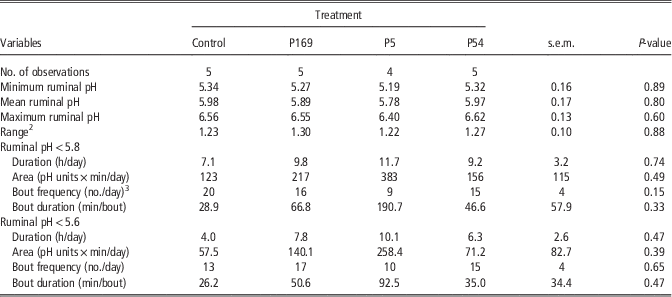
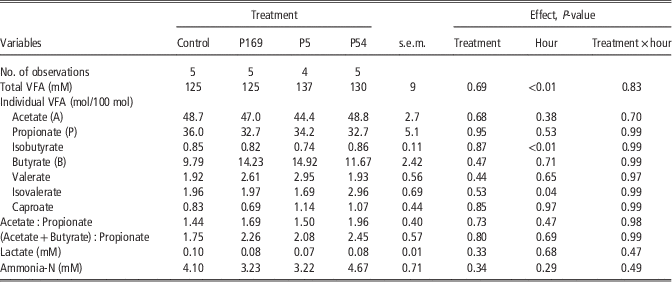
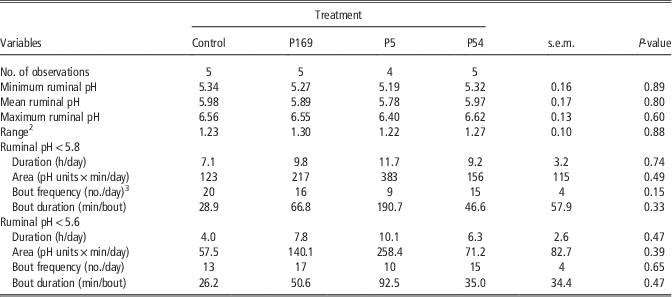
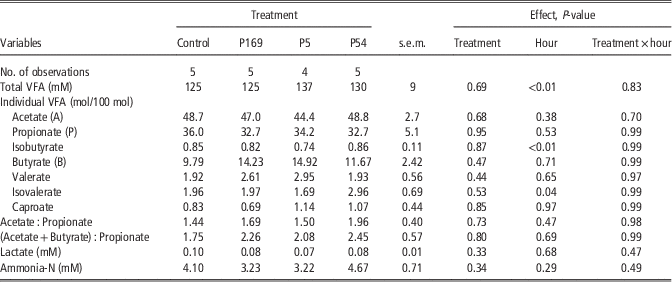
Mean ruminal pH was 5.91 and was not affected by treatments (P=0.80; Table 3). Similar responses were observed for minimum (P=0.89) and maximum (P=0.60) ruminal pH. No treatment differences were observed for duration (h/day), area, bouts (per day) and bout duration under pH 5.8, and 5.6. Total VFA, NH3-N and molar proportion of individual VFA including acetate, propionate, butyrate, valerate, isovalerate and caproate were similar for all the treatments (P>0.05; Table 4). No differences were observed for acetate : propionate ratio (P=0.47). Concentrations of total VFA in the ruminal fluid changed after feeding (P<0.01); however, no interaction was observed between treatment and sampling time (P=0.83). Ruminal concentrations of lactate were extremely low (<1 mM).
Ruminal pH variables measured continuously for 7 days in beef heifers fed a high corn grain diet and inoculated with Propionibacterium strains, P169, P54 and P5 or notFootnote 1
1 Propionibacterium strains P169, P5 and P54 (5×10⁹ CFU) were administered with 10 g maltodextrin carrier in a gel capsule; Control heifers received carrier only.
2 Range was calculated as difference between maximum and minimum ruminal pH.
3 A bout is defined to begin when ruminal pH was below the pH threshold and ended when ruminal pH met or exceeded the threshold.
Ruminal fermentation characteristics for beef heifers fed a high corn grain diet and inoculated with Propionibacterium strains, P169, P54 and P5 or notFootnote 1
1 Propionibacterium strains P169, P5 and P54 (5×10⁹ CFU) were administered with 10 g maltodextrin carrier in a gel capsule; Control heifers received carrier only.
DMI and nutrient digestibility
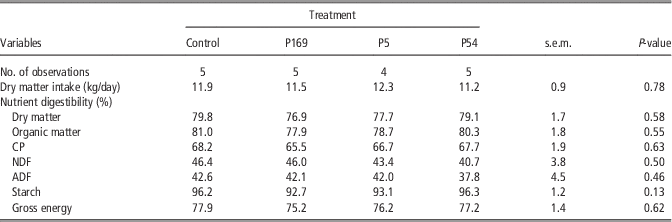
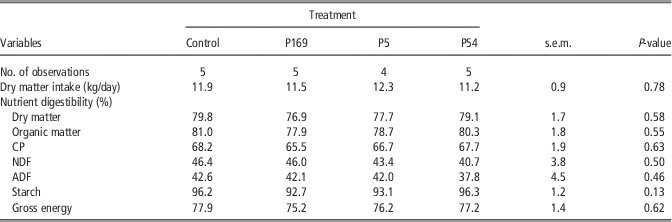
Inclusion of direct fed microbial (DFM) did not affect DMI (P=0.78; Table 5). Likewise, inoculated strains had no effect on total tract digestibility of DM, OM, CP, NDF, ADF, starch or gross energy (GE) (Table 5). However, starch digestibility was numerically lower with P169 and P5 treatments (P=0.13) compared with the Control and P54 treatments.
Dry matter intake and total tract digestibility of nutrients in beef heifers fed a high corn grain diet and inoculated with Propionibacterium strains, P169, P54 and P5 or notFootnote 1
1 Propionibacterium strains P169, P5 and P54 (5×10⁹ CFU) were administered with 10 g maltodextrin carrier in a gel capsule; Control heifers received carrier only.
CH4 emissions
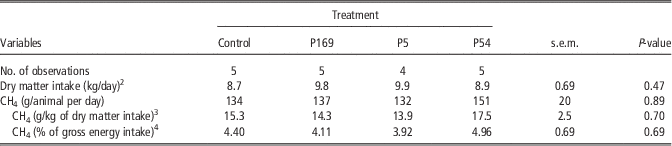
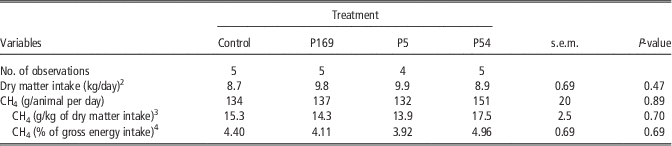
Total enteric CH4 production expressed as grams per day was not affected by Propionibacterium strains (P169, P5 and P54) as compared with Control and averaged 138 g/day (P=0.89; Table 6). Likewise, mean CH4 yield, expressed as g CH4/kg of DMI (P=0.70), and enteric CH4 emission, as a percentage of GE intake (P=0.69), were similar among treatments.
Enteric methane (CH4) emissions from beef heifers fed a high corn grain diet and inoculated with Propionibacterium strains, P169, P54 and P5 or notFootnote 1
1 Propionibacterium strains P169, P5 and P54 (5×10⁹ CFU) were administered with 10 g maltodextrin carrier in a gel capsule; Control heifers received carrier only.
2 Dry matter intake determined on the days of CH4 measurement.
3 Enteric CH4 production (g of CH4/animal per day) expressed relative to dry matter intake determined on the days of CH4 measurement.
4 Enteric CH4 production (g of CH4/animal per day) expressed relative to gross energy intake determined on the days of CH4 measurement.
DMI was lower in chambers (Table 6) as compared to in the metabolism unit (Table 5). Once in the chambers, the DMI of cattle fed the Control, P169, P5 and P54 was 73%, 86%, 80% and 79% of ad libitum intake, respectively. The DMI of heifers fed the Control diet was reduced to a greater extent than heifers given P169, P5 and P54 treatments; however there was no difference (P=0.47) among treatments.
Microbial profile
Log-transformed copy numbers of total bacterial (P=0.08) and archeal (P=0.33) 16S rRNA averaged 10.1 and 8.3, respectively, and remained similar for all the treatments. Inoculation of heifers with DFM increased the size of the Propionibacteria population in the rumen relative to Control heifers (P=0.04; Table 7). Likewise, sampling time affected (P=0.01) relative abundance of total Propionibacteria with greater abundance observed at 3 h as compared with 0 and 9 h post-dosing. Similarly, relative abundance of P169 was greater at 3 and 9 h as compared with 0 h post-dosing.
Relative abundance of total Propionibacteria and Propionibacterium acidipropionici P169 in beef heifers fed a high corn grain diet and inoculated with Propionibacterium strains P169, P5 and P54 or notFootnote 1

a–cValues within a row with different letters differ (P⩽0.05).
1 Propionibacterium strains P169, P5 and P54 (5×10⁹ CFU) were administered with 10 g maltodextrin carrier in a gel capsule; Control heifers received carrier only.
2 Relative abundance was determined as the ratio of copies of total Propionibacteria to copies of total bacteria and expressed as percentage.
3 Relative abundance was determined as the ratio of copies of Propionibacterium P169 to copies of total Propionibacteria and expressed as percentage.
Discussion
Enteric CH4 represents a loss of energy in the range of 2% to 12% of GE intake thereby reducing the efficiency of feed utilization. The range of emissions is primarily due to differences in the level of intake and changes in the diet composition (Johnson and Johnson, Reference Johnson and Johnson1995). When expressed as % of GE, the value reported (4.4%) for Control heifers is greater than that suggested by the Intergovernmental Panel on Climate Change (3.0%±1.0% of GE) for diets containing ⩾90% concentrate (IPCC, 2006). Using diet specific simulations, Kebreab et al. (Reference Kebreab, Johnson, Archibeque, Pape and Wirth2008) observed that using IPCC values for CH4 estimation underestimates emissions by about 9.8% for feedlot cattle. In contrast, Beauchemin and McGinn (Reference Beauchemin and McGinn2005) reported CH4 emissions as 2.8% of GE from cattle fed corn-based finishing diets containing ionophores. This type of diet typically reduces CH4 emissions by 25% (Johnson and Johnson, Reference Johnson and Johnson1995) compared with corn-based finishing diets without ionophores as used in present study.
Propionibacteria have been granted Generally Regarded as Safe (GRAS) status from the Food and Drug Administration (FDA) and are approved for human consumption (FDA: GRAS Notice 000240). Consequently, if they were found to reduce enteric CH4 emissions their use for this purpose could be expedited. Propionibacterium strains used in the present study were hypothesized to reduce CH4 emissions by promoting propionate synthesis in the rumen. Among various substrates, Propionibacterium strains use lactate as the preferred carbon source for propionate synthesis (Piveteau, Reference Piveteau1999). Theoretically, two moles of propionate, 1 M of acetate, and 1 M of carbon dioxide can be produced from 3 M of lactate (Piveteau, Reference Piveteau1999). However, Parrott et al. (Reference Parrott, Rehberger and Owens1997) observed significant differences in utilization of lactic acid among different Propionibacterium strains in vitro. While no difference in growth rate and lactate utilization was observed at pH 7.0, Propionibacterium freudenreichii was more effective at utilizing lactate at pH 5.0 as compared with other species, including P. acidipropionici, P. jensenii and Propionibacterium theonii. Similarly, the capacity of propionate production was shown to be dependent upon the type of substrate available and the species and strains of the Propionibacterium used (Himmi et al., Reference Himmi, Bories, Boussaid and Hassani2000). A comparative study in aerobic batch culture showed greater propionic acid production from glycerol with P. acidipropionici as compared with P. freudenreichii ssp. shermanii (Himmi et al., Reference Himmi, Bories, Boussaid and Hassani2000). Most of the previous studies have focused on only one strain of Propionibacterium (P169) and in vivo data from various other Propionibacterium strains is still lacking. Furthermore, none of the previous studies has focused on investigating the efficacy of Propionibacterium strains in mitigating enteric CH4 emissions with high grain diets. Hence, the present study is among the first to compare various Propionibacterium strains and their efficacy in increasing ruminal propionate and subsequently mitigating CH4 emissions in beef heifers fed a high grain diet.
Irrespective of the strains used, no treatment effects were observed on total enteric CH4 emissions or mean CH4 yield. The lack of response was consistent with no change in the molar proportion of ruminal propionate. Although no previous experiments dealing with administration of Propionibacterium have reported enteric CH4 emissions, a previous experiment, like the present experiment, reported a lack of effect on ruminal fluid pH when feedlot cattle were fed high concentrate diets supplemented with Propionibacterium (Ghorbani et al., Reference Ghorbani, Morgavi, Beauchemin and Leedle2002). In contrast, experiments using high forage diets showed increased ruminal propionate concentration in response to Propionibacterium strain P169 (Kim et al., Reference Kim, Standorf, Roman-Rosario, Yokoyama and Rust2000; Lehloenya et al., Reference Lehloenya, Krehbiel, Mertz, Rehberger and Spicer2008). The lack of response in the present study might be due to greater levels of pre-existing ruminal propionate production due to elevated levels of starch in a high concentrate diet. Greater propionate levels might have reduced the efficacy of supplemented Propionibacterium strains to further increase molar proportion of propionate (Foschino et al., Reference Foschino, Galli, Ponticelli and Volonterio1988).
The lack of treatment effect on ruminal fermentation might also be due to the absence of metabolically active Propionibacterium species in the rumen. Based on the results from the present study it is possible that supplemented Propionibacterium strains might not have been able to sufficiently integrate or remain sufficiently active in the ruminal microbiome to significantly alter the end products of ruminal fermentation. Although greater abundance of Propionibacterium P169 relative to total Propionibacteria was maintained until 9 h post-dosing, this difference may not have been large enough to elicit any effect on ruminal fermentation. A favorable environment is required for the establishment of ruminal microorganisms including substrate availability and optimal pH (McAllister et al., Reference McAllister, Beauchemin, Alazzeh, Baah, Teather and Stanford2011). Average ruminal pH observed in the present study probably did not inhibit growth of Propionibacterium strains as most of the strains of dairy Propionibacteria are acid tolerant and have been shown to continue to be metabolically active at a pH<5.5 (Piveteau, Reference Piveteau1999). In fact, some strains of P. jensenii are able to survive and grow at pH<5.0 (Rehberger and Glatz, Reference Rehberger and Glatz1998).
Propionibacteria, being heterotrophic microorganisms, require organic carbon sources for optimal growth and fermentative metabolism and can utilize various substrates including sugars such as glucose, galactose, lactose, fructose and organic acids including lactic and gluconic acids (Piveteau, Reference Piveteau1999). However, among all substrates, lactate is the preferred substrate for Propionibacteria (Piveteau, Reference Piveteau1999) Greater availability of lactate resulted in metabolically active Propionibacteria leading to greater production of acetate and propionate (Luo, Reference Luo2013). Ruminal lactate accumulates during abrupt transition from a high forage to a high grain diet in feedlot cattle because lactic acid utilizers are slow to adapt to abrupt changes in diet composition (McAllister et al., Reference McAllister, Beauchemin, Alazzeh, Baah, Teather and Stanford2011). However, animals that are gradually adapted to concentrates do not have significant amounts of lactic acid (Burrin and Britton, Reference Burrin and Britton1986). This explains the negligible ruminal lactate (<1 mM) concentrations observed in the present study as animals were gradually transitioned over 28 days from a high forage to a high grain diet. Thus, lack of preferred substrate might have reduced the survival of and activity of inoculated Propionibacterium strains.
Dairy Propionibacteria have been used as DFM to prevent ruminal acidosis in finishing beef cattle because of the characteristic metabolic feature of lactic acid utilization (Piveteau, Reference Piveteau1999) and high tolerance for acidic pH (Rehberger and Glatz, Reference Rehberger and Glatz1998). Ghorbani et al. (Reference Ghorbani, Morgavi, Beauchemin and Leedle2002) used Propionibacterium P15 in steers to minimize the risk of ruminal acidosis; however, no effects were observed on mean ruminal pH. Similar findings were observed with P. acidipropionici strain DH42 (Kim et al., Reference Kim, Standorf, Roman-Rosario, Yokoyama and Rust2000) and Propionibacterium P169 (Lehloenya et al., Reference Lehloenya, Krehbiel, Mertz, Rehberger and Spicer2008), results consistent with the findings observed in the present study. The lack of treatment effects on ruminal fermentation might possibly be due to reduced persistency of inoculated strains within the rumen microbiome as it was clear that in inoculated heifers, Propionibacterium populations returned to basal levels each day. Although inoculation did increase the numbers of Propionibacterium in the rumen it did not appear to sufficiently alter ruminal fermentation.
The effects observed on total tract nutrient digestibility are consistent with a previous study with steers fed a silage-based diet supplemented with Propionibacterium P169 (Lehloenya et al., Reference Lehloenya, Krehbiel, Mertz, Rehberger and Spicer2008) and in lactating dairy cows with P. freudenreichii strain PF24 (Raeth-Knight et al., Reference Raeth-Knight, Linn and Jung2007). Similarly, supplementing Propionibacterium P15 to finishing diets had no effect on nutrient digestibility in continuous culture (Yang et al., Reference Yang, Beauchemin, Vedres, Ghorbani, Colombatto and Morgavi2004). Insufficient literature is available to characterize the effects of bacterial DFM, essentially Propionibacterium species, on total tract digestibility of nutrients in cattle fed high concentrate diets, but the lack of treatment effects either reflects a low level of metabolically active Propionibacterium strains or indicates that these strains do not affect total tract digestibility.
As discussed, the lack of significant effects observed in this study might be attributed to absence of metabolically active Propionibacterium strains; however, numerical changes observed on mean CH4 yield in response to inoculated strains cannot be disregarded. The statistical power of the experiment may not have been high enough to detect these numerical differences. Hence, the lack of significant effects with Propionibacterium strains observed in this study need to be confirmed further in future experiments with greater replication.
Conclusions
The Propionibacterium strains used had no effects on enteric CH4 emissions or total tract nutrient digestibility in beef heifers fed finishing diets. Likewise, no effects were detected on DMI or ruminal fermentation parameters. In conclusion, the Propionibacterium strains used were not effective in mitigating CH4 emissions and were of limited value to feedlot cattle fed a high concentrate diet based on corn grain.
Acknowledgments
The authors thank B. Farr, A. Furtado, and R. Roth for sampling and laboratory assistance, D. Vedres for GC analyses, and the staff at the Metabolism Unit of the Lethbridge Research Center (Agriculture and Agri-Food Canada, Lethbridge, Alberta, Canada) for animal care. They also thank Dupont Nutrition and Health for providing funding for the study.