The prevalence of patent foramen ovale is 34.3% in the first three decades of life and declines with age.Reference Hagen, Scholz and Edwards1 The incidence of secundum atrial septal defect has been estimated at 1 in 2500 live births.Reference Carlgren2 Until the introduction of transcatheter closure and subsequent United States Food and Drug Administration approval of the Amplatzer® Septal Occluder device (St Jude Medical, St Paul, Minnesota, USA) in 2001,Reference Hailey and Topfer3 surgery was the standard of care in secundum atrial septal defect and patent foramen ovale closures. Since 2001, not only has percutaneous intervention supplanted surgical closure as the most prevalent method of secundum atrial septal defect and patent foramen ovale closure, but the absolute number of closures has also increased dramatically.Reference Karamlou, Diggs, Ungerleider, McCrindle and Welke4 It is unlikely that the prevalence of secundum atrial septal defect and patent foramen ovale has changed, and thus the more liberal approach to closure suggests a change in the indications for treatment concurrent with the introduction of the new technology.
The work of Wennberg et al, utilising small area analysis and culminating in the Dartmouth Atlas project, showed that health-care delivery varied substantially by geographic region.Reference Wennberg and Gittelsohn5, 6 Since the publication of the Dartmouth Atlas, geographic variation in health-care delivery has been a persistent findingReference O'Connor, Quinton and Traven7–Reference Feasby, Hude and Ghalie11 that likely reflects differing provider opinions regarding the thresholds or indications for treatments rather than differences in disease prevalence.Reference Gittelsohn and Powe9–Reference Beller12 In particular, more elective procedures correlate with high variability in treatment rates.Reference Gittelsohn and Powe9, Reference Peterson, Hollenberg, Szatrowski, Johanson, Mancuso and Charlson13 This issue has not yet been studied in the area of congenital heart disease. Secundum atrial septal defect and patent foramen ovale are congenital heart defects that serve as ideal models of congenital heart disease because there are current guidelines providing indications for closure; however, it is unknown how closely these guidelines are being followed. There are currently two treatment options, percutaneous closure and surgical closure. Both options provide outcomes with similar morbidity and mortality rates,Reference Berger, Vogel, Alexi-Meskishvili and Lange14 allowing for some degree of provider choice in the method used.
The purpose of this study is to elucidate practice patterns of secundum atrial septal defect and patent foramen ovale closure by comparing regional rates of percutaneous, surgical, and total closure in different age groups. Owing to the fact that the prevalence of secundum atrial septal defect and patent foramen ovale should not vary significantly by location, geographic variation in closure rates, as well as by closure type, may imply that closure is provider rather than patient driven.
Materials and methods
Patients and hospitals
For this study, we used the Florida State Inpatient Database, an all-payer administrative database covering all discharges from community, that is, non-federal, hospitals in the state.15 The Florida State Inpatient Database contains data initially collected by the Florida Agency for Health Care Administration and is compiled and distributed under the Healthcare Cost and Utilization Project of the Agency for Healthcare Research and Quality. The Florida State Inpatient Database contains numerous clinical and non-clinical variables included in a hospital discharge abstract, including principal and secondary diagnoses and procedures, admission and discharge statuses, patient demographics including the 5-digit Zone Improvement Plan code of the patient's residence, total charges, and length of stay. This study's data were derived from the combination of the Florida State Inpatient Databases from 2001 to 2006.
We searched the Florida State Inpatient Database for hospital discharges for which the primary International Classification of Diseases, 9th revision, clinical modification codes were for all closures of secundum atrial septal defect and patent foramen ovale – 35.51, 35.52, 35.61, or 35.71 – without diagnoses of endocardial cushion defects – subcodes of diagnosis code 745.6 – and for which a diagnosis of a secundum atrial septal defect and patent foramen ovale was also present (745.5). We excluded discharges with additional cardiac procedure codes. We identified surgical closures as those discharges with a procedure of open repair (35.51), tissue graft (35.61), or cardiopulmonary bypass (39.61). We identified device closures by selecting those discharges with a procedure for a closed repair (35.52) or other catheterisation procedure. We categorised secundum atrial septal defect repairs that could not be reliably categorised into percutaneous or surgical closure as the undetermined type.
Defining hospital service areas
We defined Hospital Service Areas to represent where local communities went for general inpatient health care. These were defined modelling the 1998 edition of the Dartmouth Atlas of Health Care (Dartmouth Medical School, Center for the Evaluative Clinical Sciences). First, we identified all acute care hospitals in the state of Florida using the Florida State Inpatient Database and assigned each one to a town or city according to their address. Second, we tabulated all acute care hospitalisations of patients in each Zone Improvement Plan code by the town or city of the hospital in which they were admitted to determine the proportion of residents’ stays that occurred in each of the hospitals. Zone Improvement Plan codes were assigned to the Hospital Service Area where the plurality of patients went for care. Finally, we analysed Zone Improvement Plan code regions to make sure Hospital Service Areas were contiguous. We obtained population-level data using the 2000 Census information.
Defining hospital referral regions
To represent where local communities went for more specialised medical care, we defined hospital referral regions also modelling the methods of the 1998 Dartmouth Atlas of Health Care (Dartmouth Medical School, Center for the Evaluative Clinical Sciences). We defined Hospital Referral Regions in an analogous way to the Hospital Service Areas. Each Hospital Service Area was assigned to a Hospital Referral Region based on where a plurality of patients in that Hospital Service Area went for secundum atrial septal defect and patent foramen ovale closures. This assignment was meant to mimic referral patterns for more complex treatments. Each Hospital Referral Region contained at least one Hospital Service Area that had a hospital or hospitals that performed secundum atrial septal defect and patent foramen ovale closures. We further aggregated Candidate Hospital Referral Regions derived from the plurality definition so that each Hospital Referral Region contained at least 2% of the state's population and performed at least 25 procedures over the 6-year period. We named Hospital Referral Regions based on a major community and/or area of Florida represented.
Defining age groups
We segregated ages into less than 18, 18–39, 40–59, and 60 and older. The less than 18-year age group was chosen to represent the paediatric population. The 40–59-year age group was specifically chosen as this was an age group previously noted to have a dramatic increase in the number of percutaneous closures performed.Reference Karamlou, Diggs, Ungerleider, McCrindle and Welke4 The other two age groups were defined based on the remaining population.
We obtained population estimates from the US Census Bureau. We used the Zone Improvement Plan Code Tabulation Area population data as the initial division of patients was at the Zone Improvement Plan code level.16 Tabulation at the Zone Improvement Plan Code Tabulation Area level only gives the total population, and is not broken down by age groups. To determine age-specific populations, county-level population distributions were obtained from the Census Bureau.17 Zone Improvement Plan Code Tabulation Areas were assumed to have the same age distribution as the county, or average of counties, in which they were contained. Shape files for Zone Improvement Plan Code Tabulation Areas, from which aggregated regions were created, were also obtained from the Census Bureau.18
We calculated regional closure rates by dividing the number of secundum atrial septal defect and patent foramen ovale closures in each Hospital Referral Region by the population of the Hospital Referral Region. Age group population estimates were used when age group-specific closure rates were calculated.
Florida was chosen on the basis of the following criteria: availability of State Inpatient Database for the state; availability of patient Zone Improvement Plan codes; lack of major metropolitan areas just outside of state borders; size of the population; and presence of multiple distinct urban areas, each with multiple hospitals, which would help define units of regionalisation.
Analyses were performed and maps generated using R.19 This study was approved by the Institutional Review Board at Oregon Health & Science University. Owing to the nature of this study, individual consent was not required.
Results
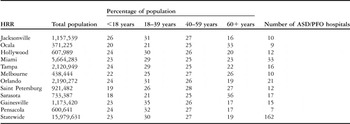
We identified 1830 secundum atrial septal defect and patent foramen ovale closures between 2001 and 2006. Of these, 751 were surgical closures and 1004 were percutaneous closures; the remaining 75 (4.1%) were unknown closure type and were excluded. Of 162 hospitals in Florida, we identified 64 hospitals performing at least 1 secundum atrial septal defect or patent foramen ovale closure. These were located in 11 Hospital Referral Regions (Table 1).
Population data by Hospital Referral Region.

Population data taken from 2000 Census
ASD/PFO = secundum atrial septal defect/patent foramen ovale; HRR = Hospital Referral Region
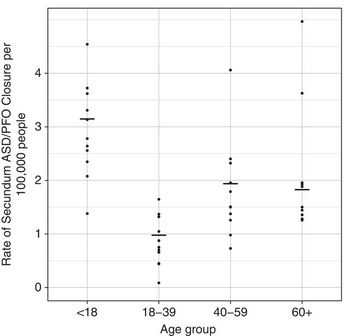
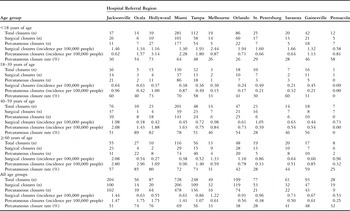
From 2001 to 2006, the average annual closure rate statewide was 1.91 per 100,000 people. Overall secundum atrial septal defect and patent foramen ovale closure rates by region varied 3.8-fold, from 0.78 per 100,000 people – Pensacola Hospital Referral Region – to 2.94 per 100,000 people – Jacksonville Hospital Referral Region. When the population was divided into age groups, similar heterogeneity of closure rates was seen (Fig 1). Despite only minor differences in population age distributions in adjacent regions of the state, we found marked variations in secundum atrial septal defect and patent foramen ovale closure rates in contiguous Hospital Referral Regions. The largest deviation occurred between the Gainesville Hospital Referral Region, with a closure rate of 1.32 per 100,000 people, and the Jacksonville Hospital Referral Region, with a closure rate of 2.94 per 100,000 people, a 2.2-fold difference. Regional surgical closure rates varied 2.7-fold across the state, from 0.53 per 100,000 people – Pensacola Hospital Referral Region – to 1.44 per 100,000 people – Jacksonville Hospital Referral Region. There was greater disparity in percutaneous closure rates with a 7.0-fold difference from 0.25 per 100,000 people – Pensacola Hospital Referral Region – to 1.75 per 100,000 people – Hollywood Hospital Referral Region (Table 2).
Rate of closure of secundum atrial septal defect and patent foramen ovale per 100,000 people. Each dot represents one hospital referral region. Horizontal lines represent the mean closure rates for each age group.

Population-normalised rate and type of secundum atrial septal defect and patent foramen ovale closure by age group.

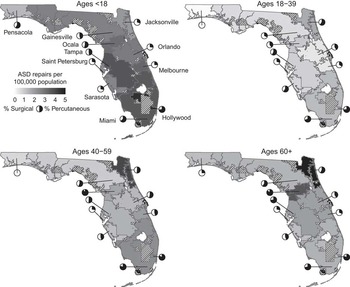
Statewide, the highest rate of closure was in children less than 18 years of age. The closure rate was lowest for 18–39-year-olds before increasing in adults aged 40–59 years. The rate for adults aged 60 years and above was slightly lower than that for adults aged 40–59 years (Table 2). However, the practice in some Hospital Referral Regions differed greatly from the state averages. For example, in the Jacksonville Hospital Referral Region, the closure rate for children less than 18 years of age was lower than the state mean at 2.08 per 100,000 children. Despite the fact that it was lower at 1.65 per 100,000 people, the closure rate for 18–39-year-olds was the highest in the state. Rates for adults aged 40–59 years and those aged 60 and above for Jacksonville Hospital Referral Region were by far the highest in the state at 4.06 and 4.97 closures per 100,000 people, respectively (Fig 2). These rates were 70% and 154% higher, respectively, than the next highest closure rates in their respective age categories.
Incidence of secundum atrial septal defect and patent foramen ovale repairs (grayscale shading) in 11 hospital referral regions and proportion of approach of repair (pie charts) that are percutaneous (black wedge) and surgical (white wedge) segregated by age groups.

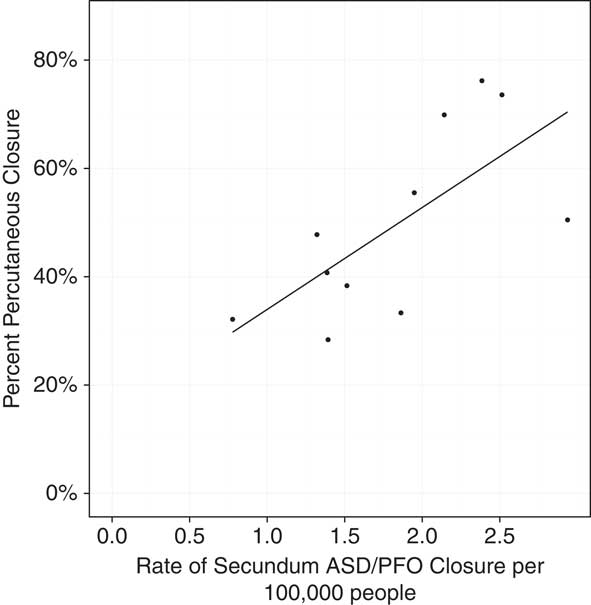
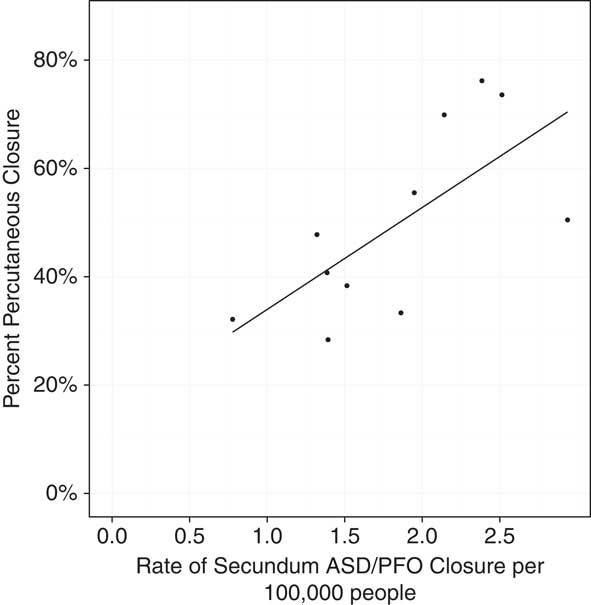
The prevailing type of closure also differed across regions. For instance, percutaneous closure was commonly chosen in the Hollywood Hospital Referral Region, 76% of closures, but less frequently in the Saint Petersburg Hospital Referral Region, 28% of closures. Large variations were even seen in adjacent regions. In the Melbourne Hospital Referral Region, 33% of secundum atrial septal defects and patent foramens ovale were closed percutaneously, while in the neighbouring Miami Hospital Referral Region 70% of closures were performed percutaneously. Notably, in regions where percutaneous closure was the preferred option, overall closure rates were highest (Pearson's correlation coefficient r = 0.69, p = 0.018; Fig 3).
Correlation between rate of secundum atrial septal defect and patent foramen ovale closure and percentage of closures done percutaneously. (Pearson's correlation coefficient r = 0.69, p = 0.018).
Discussion
We conducted a population-based study of regional practice patterns of secundum atrial septal defect and patent foramen ovale closure across the state of Florida. Despite similar population age distributions and an assumed uniform prevalence of secundum atrial septal defects and patent foramens ovale throughout the state, secundum atrial septal defect and patent foramen ovale closure rates varied greatly. Practice variation persisted when specific age groups were examined. In addition, the preferred type of closure, percutaneous or surgical, differed widely across regions. Even adjacent areas, where populations would be expected to be similar, displayed substantial differences in practice. High closure rates were associated with a preference for percutaneous closure.
Current American Heart Association/American College of Cardiology guidelines for adults with congenital heart disease state that secundum atrial septal defect closure is indicated if there is right atrial and right ventricular enlargement; it is recommended if there is evidence of paradoxical embolism or orthodeoxia-platypnia, and may be considered in the presence of net left-to-right shunting. The guidelines add that secundum atrial septal defect and patent foramen ovale closure is also reasonable when concomitant cardiac surgery is being performed for other reasons.Reference Warnes, Williams and Bashore20 Our study focused on isolated secundum atrial septal defect and patent foramen ovale closure, and therefore the latter group of patients was excluded. Given the relative homogeneity of the populations in broad geographic regions across Florida, it is unlikely that variation in the prevalence of secundum atrial septal defect and patent foramen ovale or the prevalence of agreed-upon indications for secundum atrial septal defect and patent foramen ovale closure accounted for the observed disparity in closure rates.
Rather than being driven by patient anatomy or physiology, the observed treatment rate differences are more likely due to variability in provider practice patterns. Asymptomatic secundum atrial septal defect and patent foramen ovale closure is almost exclusively an elective event. Despite the fact that the need for closure of an asymptomatic defect is more widely accepted in children, the procedure can usually be safely delayed for months or years. Elective procedures are associated with more variable treatment rates across geographic regions than urgent or emergent procedures.Reference Gittelsohn and Powe9, Reference Peterson, Hollenberg, Szatrowski, Johanson, Mancuso and Charlson13, Reference Birkmeyer, Sharp, Finlayson, Fisher and Wennberg21 Not only may most elective procedures be safely delayed for a period of time, but providers’ personal thresholds for recommending or performing elective treatments vary much more than they do for urgent or emergent procedures. Despite the fact that expert consensus guidelines exist for treatment of secundum atrial septal defect and patent foramen ovale, there is likely a variation in provider acceptance of the criteria in the guideline as the only indications for closure.
Reliance on administrative data limited our ability to determine the appropriateness of secundum atrial septal defect and patent foramen ovale closure. However, given that closure rates were widely disparate across the state, it is probable that patients in some areas were overtreated and those in other areas were potentially undertreated. The mere existence of a therapy or a larger capacity for providing a health-care service may drive treatment.Reference Wennberg, Freeman and Culp22 In addition, remuneration may be a conscious or subconscious incentive. The national rate of secundum atrial septal defect and patent foramen ovale closure in the United States increased dramatically concurrent with the approval of percutaneously placed atrial septal defect and patent foramen ovale closure devices.Reference Karamlou, Diggs, Ungerleider, McCrindle and Welke4 Our data suggest that use of this new technology has been heterogeneous. Conspicuously, enthusiastic adoption of percutaneous closure was associated with higher overall rates of secundum atrial septal defect and patent foramen ovale closure.
In adults, we found the highest rate of secundum atrial septal defect and patent foramen ovale closure in people 40–60 years of age and the second highest rate in those over 60 years of age. These populations are not traditionally known for high secundum atrial septal defect closure rates. Most secundum atrial septal defects in patients over 40 years of age are too small to necessitate treatment, and occasionally they are too large since fixed pulmonary hypertension precludes closure. Patent foramen ovale are usually asymptomatic. The pattern seen in adults may have more to do with rates of diagnosis than prevalence of disease. In general, 18–39-year-olds are less likely to seek medical care and less likely to be investigated for cardiac disease than older patients. Our data showed the lowest rate of closure in this patient population. Patients over 40 years of age are more likely to present with cardiac pathology or be screened for cardiac disease. Given the frequency of patent foramen ovale in the general population and the lower, but real, prevalence of small secundum atrial septal defect, echocardiograms, and cardiac catheterisations that are performed to investigate acquired cardiac disease will lead to the discovery of incidental atrial level communications. Depending on the provider's bias, the patient may or may not be referred for closure.
Our analysis has several limitations. In using the Florida State Inpatient Database, we relied on administrative data. Administrative databases were designed for claims data collection, and billing, not health services research, and can be limited by erroneous coding.Reference Romano, Zach, Luft, Rainwater, Renny and Campa23–Reference Welke, Karamlou and Diggs25 To reduce the probability of including coding errors, we included only discharges that contained both a diagnosis code and a treatment code for secundum atrial septal defect and patent foramen ovale. The International Classification of Diseases, 9th revision, clinical modification uses a common code for secundum atrial septal defect and patent foramen ovale, and thus we were not able to differentiate between the two diagnoses. Owing to the limitations of diagnosis coding, we were not able to determine the exact indication for closure, nor the providers’ thought processes. We were not privy to anatomic data that may have influenced the choice of surgical or percutaneous closure. We made the assumption that the incidence of secundum atrial septal defect and patent foramen ovale was uniform across the state. Given that both lesions are congenital and not related to known environmental risk factors combined with the relatively common nature of patent foramen ovale in the general population, we felt this was a reasonable assumption. Lastly, the use of Zone Improvement Plan Code Tabulation Areas as surrogates for Zone Improvement Plan codes can lead to representational errors that can impact spatial analyses.Reference Grubesic and Matisziw26 However, since we aggregated Zone Improvement Plan Code Tabulation Areas into Hospital Referral Regions, boundary effects should be minimised.
Our study benefited from a large, population-based database. The data allowed us to construct hospital referral regions that showed where patients actually went for treatment of secundum atrial septal defects and patent foramens ovale in Florida. Owing to the fact that patients are more likely to travel further for treatment of rarer medical conditions, such as congenital cardiac defects, than for more common diseases, these regions were larger than the Dartmouth Atlas regions, which were based on where patients went for adult cardiac surgery and neurosurgery. The geography of the state, a peninsula, combined with the large number of hospitals providing secundum atrial septal defect and patent foramen ovale closure in the state, makes this an unlikely major limitation while the population of Florida may not be representative of all areas of the United States, it is the fourth most populous state and contains a mix of urban and rural environments.
Our analysis suggests that rates of secundum atrial septal defect and patent foramen ovale closure vary more than that which could be expected because of population discrepancy alone. Variation is likely driven by provider predilection rather than patient pathology and may be influenced by the pressures of our health-care system including procedure-based remuneration and tort concerns. Undertreatment may result in unnecessary suffering, whereas overtreatment exposes asymptomatic patients to the infrequent, but real risks of both surgical and percutaneous procedures. Both have social and economic consequences. Efforts should be directed towards dissemination of the best available evidence-based and expert consensus guidelines, and reimbursement should reward the best care, not the most care. Standardisation of treatment indications and thresholds will result in a consistent and safe practice that allows physicians to work in the best interests of their patients.
Acknowledgements
The authors declare no financial support.