


Introduction
Perfectionism, and the related constructs of compulsivity and rigidity are implicated in a number of psychological disorders (Bouchard, Rheaume and Ladouceur, Reference Bouchard, Rheaume and Ladouceur1999; Hewitt and Flett, Reference Hewitt and Flett1991; Hewitt, Flett and Ediger, Reference Hewitt, Flett and Ediger1996; Shafran and Mansell, Reference Shafran and Mansell2001), including the eating disorders (Bastiani, Rao, Weltzin and Kaye, Reference Bastiani, Rao, Weltzin and Kaye1995; Bulik et al., Reference Bulik, Tozzi, Anderson, Mazzeo, Aggen and Sullivan2003; Davis, Reference Davis1997; Halmi et al., Reference Halmi, Sunday, Strober, Kaplan, Woodside and Fichter2000). Perfectionism appears to be a risk factor for the development of eating disorders (Fairburn, Cooper, Doll and Welch, Reference Fairburn, Cooper, Doll and Welch1999), and continues to be elevated after weight recovery (Srinivasagam et al., Reference Srinivasagam, Kaye, Plotnicov, Greeno, Weltzin and Rao1995). In more extreme manifestations, perfectionism is part of the broader range of obsessive compulsive personality traits (including rigidity of thought and behaviour) that are commonly comorbid with the eating disorders (Brecelj-Anderluh, Tchanturia, Rabe-Hesketh and Treasure, Reference Brecelj-Anderluh, Tchanturia, Rabe-Hesketh and Treasure2003; Serpell, Livingstone, Neiderman and Lask, Reference Serpell, Livingstone, Neiderman and Lask2002). However, there is some lack of clarity about its usefulness as a construct in understanding the eating disorders and psychopathology in general. For example, there has been considerable disagreement about how perfectionism can usefully be defined and measured (Frost, Marten, Lahart and Rosenblate, 1990; Hewitt, Flett, Besser, Sherry and McGee, Reference Hewitt, Flett, Besser, Sherry and McGee2003; Shafran, Cooper and Fairburn, Reference Shafran, Cooper and Fairburn2003; Stumpf and Parker, Reference Stumpf and Parker2000). Furthermore, despite evidence for its involvement in psychopathology, some aspects of perfectionism can be beneficial in daily life (Bieling, Israeli and Anthony, Reference Bieling, Israeli and Antony2004). This has led to a number of attempts to distinguish between adaptive and maladaptive, clinical and non-clinical perfectionism (Hewitt and Flett, Reference Hewitt and Flett1991, Reference Hewitt and Flett1993; Shafran, Cooper and Fairburn, Reference Shafran, Cooper and Fairburn2002)
It has recently been suggested (Serpell, Waller, Fearon and Meyer, Reference Serpell, Waller, Fearon and Meyer2009) that two facets related to but distinct from perfectionism are also important in understanding elements of psychopathology. The first facet is one that is relatively adaptive in many settings, where the individual sticks with tasks when they are tough or laborious in order to achieve a goal (persistence). The second facet is likely to be more maladaptive, and occurs where the individual gets stuck in the same pattern of behaviour, being unable to change tack when the task requirements or goals change (perseveration).
Within self-regulatory theory (Baumeister and Heatherton, Reference Baumeister and Heatherton1996; Baumeister, Heatherton and Tice, Reference Baumeister, Heatherton and Tice1994), persistence is an aspect of self-control - the trait of continuing towards a desired goal despite fatigue or distractions. Such self-control is associated with positive psychological characteristics (Tangney, Baumeister and Boone, Reference Tangney, Baumeister and Boone2004). However, it is also possible that some disorders (e.g. anorexia nervosa, obsessive compulsive disorder) exhibit the difficulties that can arise from excessive self-control (Srinivasagam et al., Reference Srinivasagam, Kaye, Plotnicov, Greeno, Weltzin and Rao1995). In contrast, in the Temperament and Character Inventory (TCI), Cloninger, Przybeck, Svrakic and Wetzel (Reference Cloninger, Przybeck, Svrakic and Wetzel1994) define persistence as “resistance to extinction of previously rewarded behaviour”. Using that definition, Fassino et al. (Reference Fassino, Abbate-Daga, Amianto, Leombruni, Boggio and Rovera2002) found that anorexia nervosa sufferers have higher levels of persistence than bulimia nervosa sufferers. However, this definition of persistence appears to be at odds with many of the items in the relevant scale of the TCI, which seem to be more reflective of perfectionism (e.g. “I am more of a perfectionist than most people”; “I usually push myself harder than most people do because I want to do as well as I possibly can”). Therefore it is possible that the findings of Fassino et al. (Reference Fassino, Abbate-Daga, Amianto, Leombruni, Boggio and Rovera2002) are more about perfectionism than persistence in the eating disorders.
While there are different forms of perseveration (Sandson and Albert, Reference Sandson and Albert1984), the one that is relevant to descriptions of the eating disorders (e.g. Vitousek and Manke, Reference Vitousek and Manke1994) is “stuck-in-set” perseveration – the “continuous and inappropriate maintenance of a current set or framework”. There is evidence of difficulties in this domain (particularly among patients with anorexia nervosa) in the form of impaired set-shifting (Roberts, Tchanturia, Stahl, Southgate and Treasure, 2007), which includes cognitive inflexibility (concrete and rigid approaches to problem solving) and response inflexibility (stereotyped behaviours). It has been suggested that set-shifting difficulty is a risk factor for the development of eating disorders (Southgate, Tchanturia and Treasure, Reference Southgate, Tchanturia and Treasure2005; Steinglass and Walsh, Reference Steinglass and Walsh2006), as well as being implicated in other disorders (e.g. Austin, Mitchell and Goodwin, Reference Austin, Mitchell and Goodwin2001; Jazbec et al., Reference Jazbec, Pantelis, Robbins, Weickert, Weinberger and Goldberg2007; Robinson et al., Reference Robinson, Thompson, Gallagher, Goswami, Young and Ferrier2006; Sergeant, Geurts and Oosterlaan, Reference Sergeant, Geurts and Oosterlaan2002). Response inflexibility is the element of set-shifting that is most related to Serpell and colleagues’ (2009) definition of perseveration.
Serpell et al. (Reference Serpell, Waller, Fearon and Meyer2009) have developed and validated a 22-item self-report measure that distinguishes persistence and perseveration from the concept of perfectionism – the Persistence, Perseveration and Perfectionism Questionnaire (PPPQ-22). In a non-clinical population, persistence was associated with good psychological health (as measured by the Brief Symptom Inventory; Derogatis and Melisaratos, Reference Derogatis and Melisaratos1983; Derogatis, Reference Derogatis1993), while perseveration was associated with poor psychological health. Another recent study of rigidity/perseveration in the interpersonal domain (Erickson, Newman and Pincus, Reference Erickson, Newman and Pincus2009) found the opposite relationship between rigidity and psychopathology, where high levels of pathology were associated with low levels of rigidity. The validity of the PPPQ-22 has not yet been established with clinical groups, particularly the eating disorders.
The aim of this study is to determine the clinical validity of the PPPQ-22 in the eating disorders. The study will examine whether the measure's three constructs differentiate women with eating disorders from non-clinical women, both in overall levels of the constructs and in their associations with eating attitudes. In order to determine whether any difference is specific to the eating disorders, there will be a further comparison with women with other psychological disorders (excluding those with disorders with a compulsive element). In keeping with the existing model and findings (Serpell et al., Reference Serpell, Waller, Fearon and Meyer2009), it is hypothesized that eating psychopathology (both the presence of an eating disorder and the degree of eating pathology) will be significantly associated with high levels of perseveration and low levels of persistence.
Method
Design
A mixed comparative and correlational design was used. The eating-disordered women were compared with two other samples - non-clinical and clinical comparison women. The three groups were compared in terms of both overall scores and within group associations between eating attitudes and persistence, perseveration and perfectionism.
Participants
The participants were all adult females, who were fluent in English.
Non-clinical comparison group. This group consisted of 91 women with no current or past eating disorder or other psychiatric disorder (by self-report). They were recruited on an opportunity basis from undergraduate and graduate student populations and from non-student sources (e.g. workplaces). Their mean age was 22.0 years (SD = 4.25), and their mean self-reported body mass index (BMI = weight/height2) was 22.4 (SD = 3.42).
Clinical comparison group. This group consisted of 25 women with no current or past eating disorder, but with another current psychiatric disorder (diagnosed by the responsible clinician). They were recruited from a general outpatient psychological and counselling service. Their primary diagnoses consisted of: depression (N = 10); posttraumatic reactions (N = 4); stress/depressive reactions (N = 3); anxiety disorders (N = 3); personality disorder (N = 2); emotional reactions to relationship problems (N = 2); and anger problems (N = 1). The group contained no patients with compulsive disorders (e.g. obsessive-compulsive disorder, compulsive exercise, compulsive self-harming behaviours). Their mean age was 37.7 years (SD = 8.97), and their mean self-reported BMI was 23.2 (SD = 5.40).
Eating-disordered group. This group consisted of 99 women with a current diagnosis of an eating disorder. Ninety-six were recruited from a specialist eating disorder service, and the remaining three were recruited from the general psychology and counselling service used to recruit the clinical comparison group. They were diagnosed by experienced clinicians using a semi-structured interview (Waller et al., Reference Waller, Cordery, Corstorphine, Hinrichsen, Lawson and Mountford2007), based on DSM-IV criteria (American Psychiatric Association, 1994). All were weighed and their heights were measured in the clinic. In keeping with recent recommendations (National Institute for Clinical Excellence, 2004), atypical cases (Eating Disorders Not Otherwise Specified) were generally grouped with the diagnosis that they most closely resembled. However, a further number of atypical cases (N = 7, including binge eating disorder and purging disorder) were excluded, as they were not similar to those with anorexia nervosa or bulimia nervosa and there were not large enough numbers to compare directly with the other groups.
Of the remaining 92 women in the eating-disordered group, 32 had diagnoses of anorexic disorders (full or atypical anorexia nervosa), with a mean age of 27.9 years (SD = 9.03) and a mean objective BMI of 16.2 (SD = 1.78). The remaining 60 women had diagnoses of bulimic disorders (full or atypical bulimia nervosa), with a mean age of 28.8 years (SD = 8.54) and a mean objective BMI of 22.8 (SD = 3.83).
Measures and procedure
Following informed consent, each woman completed two self-report measures, one measuring eating pathology and the other measuring levels of persistence, perseveration and perfectionism. The non-clinical comparison group completed them individually following direct contacts or contact at lectures. The clinical comparison group and the eating-disordered women completed the questionnaires as part of their assessment for treatment following referral to the relevant clinics.
Eating Disorder Examination - Questionnaire (EDE-Q; Fairburn and Beglin, Reference Fairburn and Beglin1994). The EDE-Q is a 36-item measure of eating disorder psychopathology, yielding four attitudinal scales (restraint; eating concern; weight concern; shape concern). It is based on the Eating Disorders Examination interview (Fairburn and Cooper, Reference Fairburn, Cooper, Fairburn and Wilson1993). The EDE-Q has good reliability and validity (Carter, Aime and Mills, Reference Carter, Aime and Mills2001), and non-clinical norms are available (Mond, Hay, Rodgers and Owen, 2006). While it is an effective preliminary screening measure, it cannot be used alone for diagnostic purposes (Mond, Hay, Rodgers, Owen and Beumont, Reference Mond, Hay, Rodgers, Owen and Beumont2004).
Perfectionism, Persistence, and Perseveration Questionnaire (PPPQ-22; Serpell et al., Reference Serpell, Waller, Fearon and Meyer2009). The PPPQ-22 is a 22-item self-report measure of three constructs associated with a range of psychological disorders. “Perfectionism” is defined in the measure as having high standards for oneself. An example item is: “One of my goals is to be perfect in everything I do”. “Persistence” is defined as the ability to keep going with a behaviour to reach a goal, even when the task is difficult or takes a long time. An example item is: “People describe me as someone who can stick at a task, even when it gets difficult”. “Perseveration” is defined as the tendency to continue a particular behaviour, even when it ceases to be effective or rewarding. An example item is: “When reading a book or magazine, I often feel that I must begin at the first page and read through to the very end, even if some of the parts are of no interest.” Factor analysis and reliability analyses support these three constructs, and they have adequate test-retest reliability in a non-clinical group (Serpell et al., Reference Serpell, Waller, Fearon and Meyer2009).
Data analysis
Kolmogorov-Smirnov tests established that all data were normally distributed. Hence, parametric analyses were used. In order to verify the psychometric properties of the PPPQ-22, internal consistency scores (Cronbach's alpha) were calculated for each scale, for each group. In order to determine group differences, the groups were compared on EDE-Q and PPPQ-22 scores using multivariate analysis of covariance (controlling for group differences in age and BMI), with post hoc Least Significant Difference tests (p < .05). Finally, correlational analyses (Pearson's r) were used to determine the association of the PPPQ-22 scales with the different facets of eating (EDE-Q scales). All tests were two-tailed.
Results
Psychometric properties of the PPPQ-22
Cronbach's alpha was calculated for each PPPQ-22 scale for each of the four groups. Most alpha scores were above the 0.7 level (Bland and Altman, Reference Bland and Altman1997; Nunally, Reference Nunally1978), though the alphas for the perseveration and perfectionism scales for the two comparison groups were in the 0.6–0.7 range, as was the alpha for the persistence scale among the anorexic group. Thus, the internal consistency of the scales was in the same range as in the original psychometric validation of the measure (Serpell et al., Reference Serpell, Waller, Fearon and Meyer2009). There were no items that could be removed with a resulting substantial improvement in alpha levels. Therefore, all items were retained and the original scoring system (Serpell et al., Reference Serpell, Waller, Fearon and Meyer2009) was used throughout this study.
Taking the sample as a whole, there was a significant association between age and persistence (two-tailed Pearson's r = –.236, p < .001), but there were no other associations with age or BMI that approached significance (p > .15 in all cases). The three PPPQ-22 scales were correlated moderately (r > .35, p < .001 in all cases), as found previously (Serpell et al., Reference Serpell, Waller, Fearon and Meyer2009).
Levels of persistence, perseveration and perfectionism across groups
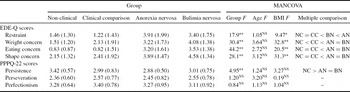
Table 1 shows participants’ EDE-Q and PPPQ-22 scores across the four groups (non-clinical control; clinical control; anorexic disorders; bulimic disorders). The scores were compared using MANCOVAs, controlling for differences in age and body mass index, with pairwise comparisons when there was a significant overall effect. There was a significant overall effect of group, even when controlling for the significant effect of BMI. There was no significant effect of age. As would be expected, the groups differed substantially on all four scales of the EDE-Q, even once differences in BMI were partialled out. The two eating-disordered groups had higher scores than either of the control groups. The only difference between the eating-disordered groups was that participants with anorexic disorders had higher levels of EDE-Q restraint than those with bulimic disorders. The clinical control and non-clinical control groups had scores in the normal range on the EDE-Q (Mond et al., Reference Mond, Hay, Rodgers and Owen2006), and differed from each other only in EDE-Q weight concern, with the clinical control group showing higher levels of weight concern than non-clinical controls.
Mean levels (SD) of eating pathology (EDE-Q scores) and PPPQ-22 scores across non-clinical women (NC), clinical comparison women (CC), and eating-disordered women (ED)

NS Non-significant; * p < .01; ** p < .001.
The groups differed on only one PPPQ-22 scale - persistence. There were no reliable differences in levels of perseveration or perfectionism. The anorexic and bulimic groups each had lower levels of persistence than the non-clinical group. However, although their scores were similar to those of the eating-disordered women, the clinical comparison group did not differ from the other three groups in their persistence levels. The lack of significant covariates indicates that neither age nor BMI had any influence on these differences.
Association of PPPQ-22 scales with eating attitudes
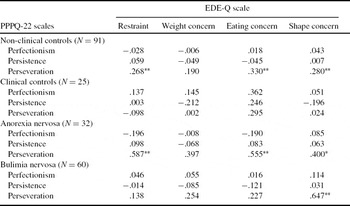
The PPPQ-22 scales were correlated with the EDE-Q scales, separately for the non-patient controls, clinical controls, and the two eating-disordered groups. Table 2 shows the results of these analyses.
Correlations (Person's r) of persistence, perseveration and perfectionism (PPPQ-22 scales) with facets of eating psychopathology (EDE-Q scales) among eating-disordered women and non-clinical and clinical comparison women

* p < .05; ** p < .01.
The PPPQ-22 scores were unrelated to EDE-Q scores in the clinical comparison group. In contrast, there were such associations for all the other three groups. The women with anorexia nervosa showed significant correlations between perseveration and all EDE-Q subscales except Weight Concern. A similar pattern emerged in the non-clinical controls. In the BN group, perseveration was significantly correlated only with EDE-Q Shape Concern. It is noteworthy that neither persistence nor perfectionism was correlated with eating pathology in any of the groups.
Discussion
This study has examined the relationship of persistence, perseveration and perfectionism with the psychopathology of the eating disorders. Contrary to prediction, the eating-disordered group did not show significantly higher levels of perseveration. Rather, both the anorexic and bulimic groups had lower levels of persistence than non-clinical women. Furthermore, it is noteworthy that having high standards for oneself (as measured by the perfectionism subscale) was not related to eating pathology, although this element is given central importance in several formulations of eating disorders (e.g. Slade, Reference Slade1982; Fairburn, Shafran and Cooper, Reference Fairburn, Shafran and Cooper1999). It is possible that this reflects the inclusion of elements of persistence and perseveration in some current measures of perfectionism. For example, on the Multidimensional Perfectionism Scale (Hewitt and Flett, Reference Hewitt and Flett1991), items such as “When I am working on something, I cannot relax until it is perfect” might be tapping persistence, rather than perfectionism. Similarly, items on the Doubts About Actions subscale of the Frost Multidimensional Perfectionism Scale (Frost et al., Reference Frost, Marten, Lahart and Rosenblate1990) such as “I tend to get behind in my work because I repeat things over and over” might show some overlaps with perseveration.
Alternatively, the lack of group differences or relationships with eating pathology for PPPQ-22 perfectionism could be because the current perfectionism subscale is inadequate, not tapping all relevant aspects of the construct. According to Shafran, Cooper and Fairburn (2002), clinical perfectionism is distinguished by its focus on a particular domain. Hence it is possible that questions tapping perfectionism in the PPPQ-22, which ask about a range of domains (including shopping and studying), fail to pick up high levels of perfectionism related to body weight and eating.
Women with eating disorders were distinguished from other groups by lower persistence (i.e. being less likely to stick at tasks to the point where they achieve their goals). One possible explanation for this is that those with eating disorders may be premorbidly high in persistence, but as the ED develops, their persistence becomes focused on weight and shape and they are relatively less persistent in the areas tapped by the PPPQ.
Surprisingly, the eating disorder group did not show higher levels of perseveration than non-clinical controls. It is not clear why the pattern observed in previous research (Serpell et al., Reference Serpell, Waller, Fearon and Meyer2009) was not observed in this study. It may be that the association between perseveration and eating pathology does not extend to the clinical population. Correlational analyses were more consistent with previous research, suggesting a limited role for perseveration in understanding eating pathology, as the eating disordered participants with particularly unhealthy eating attitudes were also more likely to perseverate on tasks, going beyond the point where their effort was useful. A clinical example of this pattern in the eating disorders is restrictive eating, where the individual might start with the goal of losing some weight to feel more socially acceptable and persists with that effort, but then continues with the behaviour beyond that goal and perseverates to the point where she or he is physically compromised.
Although initial hypotheses regarding the importance of perseveration in eating disorders were not fully supported, this set of findings provides preliminary validation for the PPPQ-22 in a clinical population. They also suggest that “pure” perfectionism might not be a pathological cognitive style (e.g. Fairburn, Shafran and Cooper, Reference Fairburn, Shafran and Cooper1999; Slade, Reference Slade1982) when the contributions of persistence and perseveration are teased out. Furthermore, they suggest that persistence and perseveration levels may also be important to consider when formulating individual cases. However, it will still be important to test the predictive validity of the PPPQ-22, in order to determine if these constructs can predict the onset of eating disorders, and to determine whether they predict the outcome of existing treatments for the eating disorders (or for other disorders where perfectionism or compulsivity are central to the pathology). It will also be important to administer the PPPQ alongside neuropsychological tests of perseveration such as set shifting tasks, in which deficits have been observed in ED groups (Roberts et al., Reference Roberts, Tchanturia, Stahl, Southgate and Treasure2007), in order to discover whether the same or similar constructs are being measured.
It is acknowledged that there are several limitations to the current study. These relate to the composition of control groups. The non-clinical control group was composed of university students, who may have different patterns of the features under study, particularly perfectionism, than the general population. The clinical control group was smaller and more heterogeneous than would have been ideal. It would be useful for future studies to explore the performance of the PPPQ in specific clinical subgroups where perseverative thinking or behaviour has been implicated, such as obsessive compulsive disorder and depression, particularly given that Serpell et al. (Reference Serpell, Waller, Fearon and Meyer2009) found that high levels of perserveration were associated with a range of different aspects of psychopathology in a non-clinical sample.
If these results are replicated and extended in such future research, it will be important to consider the relevance of these constructs to treatment. One key issue is to understand the contribution of starvation syndromes to perseveration and rigidity. Even short-term fasting has the potential to disrupt flexible thinking and responding (e.g. Green and Rogers, Reference Green and Rogers1995). However, if perseveration is not normalized following refeeding, then this cognitive style might need to be addressed cognitively and behaviourally. Cognitive remediation has been suggested as a useful approach in eating disorders (Davies and Tchanturia, Reference Davies and Tchanturia2005; Tchanturia and Lock, Reference Tchanturia, Lock, Adan and Kaye2010), and might be more effective in eating disorders if it is aimed at both enhancing persistence and reducing perseveration. Each of these routes will require the identification of unhelpful behavioural patterns (either giving up too early or sticking at a task for too long), the development of a more goal-oriented approach to undertaking tasks, and learning to monitor achievements against those goals. This approach is likely to need to be applied to other aspects of the individual's life, but will also need to be focused on eating behaviours (e.g. restriction, body checking). However, for individuals to develop these skills of enhancing goal-oriented activities, it will be important for them to learn to identify times when they are not sufficiently focused on higher order goals. While this self-monitoring could be an element of a conventional cognitive-behavioural approach, it might also be necessary to develop appropriate meta-cognitive skills.
Conclusions
Women with eating disorders show relatively poor levels of persistence compared with non-clinical women. Both low levels of persistence and high levels of perseveration are associated with more unhealthy eating attitudes in this clinical group, in broad contrast with the two comparison groups. In some cases, eating disorder treatment might be enhanced by addressing low persistence (and high perseveration), using approaches such as cognitive remediation therapy. It is also possible that stabilizing nutritional intake will have such an impact. Perfectionism was not elevated in the eating-disordered groups, and further research is needed to establish whether this lack of difference is related to the psychometric properties of the measure or whether it is an important finding in itself.
Acknowledgements
The authors would like to thank Harriet McIlwham for her help with data collection.



Comments
No Comments have been published for this article.