INTRODUCTION
The widespread development of anthelmintic resistance in sheep (Jackson and Coop, 2000) and the demand for non-chemical (organic, ecological, low-input) farming of livestock have increased the need for alternative ways to control gastrointestinal parasites. One of the proposed alternatives is the use of bioactive forages. Previous studies using natural or experimental challenges with Teladorsagia circumcincta have suggested that lambs grazing on bioactive forages, such as chicory (Cichorium intybus) or sulla (Hedysarum coronarium), have reduced parasite burdens, compared to lambs grazing on conventional forages (Scales, Knight and Saville, 1994; Niezen et al. 2002; Marley et al. 2003; Tzamaloukas et al. 2005). However, the mode of action of these forages remains unknown and possible explanations of the observed reductions may include (i) direct, anthelmintic-like effects of plant compounds, (ii) indirect, immune related effects of the forage, and/or (iii) effects on free-living larval development, migration and survival on the pasture. In a previous experiment the use of worm-naive animals and controlled experimental infections (Tzamaloukas et al. 2005) excluded the effects on free-living stages. However, the experimental design was unable to determine whether the observed effects of grazing on bioactive forages were direct anthelmintic effects, or indirect immunologically or physiologically mediated responses.
The objective of the present study was to investigate the effects of grazing bioactive forages, chicory or sulla, on the rate of development of immunity in growing lambs infected with T. circumcincta. The immune response was assessed by following the response of trickle-infected lambs to a single challenge infection, using an established experimental model (Smith et al. 1985; Barrett, Jackson and Huntley, 1998; Macaldowie et al. 2003).
MATERIALS AND METHODS
Experimental swards
The experiment was carried out at Scottish Agricultural College's Thomson fields (Midlothian, Southeast Scotland) where a 2·4 ha site was allocated for the experimental plots. The area was prepared by spraying existing vegetation (mixed grasses, white clover and herbs) with glyphosate (N-(phosphono-methyl) glycine) at a 1·2 kg/ha (autumn 2003), ploughed (winter 2003) and cultivated to prepare a firm seedbed (spring 2004). The experimental plots were sown (late spring 2004) using the rates of 7 kg/ha for C. intybus (chicory), 15 kg/ha for H. coronarium (sulla) and 37 kg/ha for Lolium perenne/Trifolium repens (grass/clover). Fertilizer (50 kg/ha of P & K; Yara UK Ltd) was applied to all experimental areas, while no insecticides or herbicides were used once plots were sown. Fencing divided the experimental area into 24 plots of 0·1 ha each, all of which had automated water troughs. All swards grew well and were in the vegetative stage of growth when the experiment started (August 2004).
Experimental design
Twenty female and 20 castrated male cross-bred lambs, three-and-a-half months old (mean liveweight±standard error of the mean (S.E.M.): 32±0·5 kg) were reared worm-free from birth and used in the present experiment. The animals were allocated into 4 groups of 10 animals each balanced in terms of liveweight and sex. Three groups were randomly assigned to 1 of the 3 different grazing treatments: chicory (C. intybus; IC), sulla (H. coronarium; IS) and grass/clover (L. perenne/T. repens; IGC), and trickle infected with T. circumcincta larvae, 3 times per week (Monday-Wednesday-Friday), for 6 weeks with a total of 10000 L3 per week. The fourth group was kept uninfected and given access to grass/clover pastures (UGC) for the same period. All pastures used were parasite-free prior to the trial and animals were moved every 2 weeks to a new plot to prevent autoinfection. On day 40 post-infection (p.i.), lambs were moved indoors and fed hay ad libitum for the rest of the trial. On day 42, all lambs, including the uninfected controls (UGC), were treated with levamisole (Levacide 3% drench; Norbrook Laboratories Ltd, UK; 7·5 mgs/kg liveweight) and ivermectin (Oramec drench, Merial Animal Health Ltd; 0·2 mg/kg liveweight) to remove all gastrointestinal nematodes. One week later (day 50), the lambs were challenged with 50000 L3 T. circumcincta and slaughtered 10 days later (day 60).
Sward measurements
Pre-grazing herbage mass availability and botanical composition of the experimental swards were determined by cutting 2 random quadrats (0·25 m2) per plot to ground level. The cut material was separated manually to the following fractions: sown species of the sward (forage treatment), dead material and ‘other’ species, and each fraction was then weighed, oven-dried (60 °C for 18 h) and re-weighed. Twenty measurements of pre- and post-grazing sward heights were taken from each plot 1 day before and 1 day after grazing, respectively, by using a sward stick device.
The samples cut from the pre-grazed experimental plots were pooled and analysed in duplicates for determination of dry matter (DM), ash, crude protein (CP), neutral detergent fibre (NDF), water soluble carbohydrate (WSC), neutral cellulase and gammanase digestibility (NCGD), potassium (K), calcium (Ca), phosphorus (P), sodium (Na), magnesium (Mg) and sulphur (S) (MAFF, 1986). The extractable condensed tannin content (CT) of the samples was measured according to the method of Porter, Hrstich and Chan (1986). The chemical composition of the hay offered to the animals indoors (days 40 to 60) was also analysed for DM, ash, CP, NDF, WSC content and NCGD value. Metabolizable energy (ME) values of the fresh forage samples were calculated using the equation for the prediction of ME of grasses (Agricultural and Food Research Council, 1993) since there are no equations available for the bioactive forages tested in the present experiment. The ME value of the hay was also calculated according to the recommendations of the AFRC (1993).
Animal measurements
Lambs were weighed weekly throughout the experiment and the daily liveweight gain of each animal over the 60-day experimental period was used to estimate the effect of feeding treatment on lamb performance. Faecal samples were taken weekly from the rectum of each lamb for faecal egg counts (FEC) determination using a modified flotation technique described by Christie and Jackson (1982). Faeces taken were scored for consistency on a scale of 1 to 5. The scores of 1 and 5 were given to loose diarrhoeic faeces and dry hard pellets, respectively, while the other scores were given to intermediate states of consistency. Immediately after post-mortem, the abomasum was removed from each lamb and small sections of abomasal folds were taken for histological enumeration of mucosal mast cells (MMC), globule leucocytes (GL) and eosinophils (EOS) (expressed per 0·1 mm2), as described previously (Huntley et al. 1995). The abomasum and its content were subjected to a saline digest to harvest all developmental stages (adult and larval stages) of T. circumcincta (Jackson, Jackson and Smith, 1984). The worms recovered from 1% (v/v) aliquots of the digest were counted and classified as early-L4 (EL4), middle-L4 (ML4), late-L4 (LL4) and adult-L5 stages using the morphological criteria defined by Denham (1969).
Statistical analysis
Liveweight gain (g/day) for each animal was estimated by linear regression of the weekly liveweights against time (least squares method) and analysed using one-way analysis of variance. FEC, worm recoveries (EL4, ML4, LL4, and adults) and total worm establishment (combined L4 and adult worms) were log-transformed (log10 (x+1)) prior to statistical analysis to remove positive skeweness and are reported as back-transformed means with 95% confidence intervals (lower and upper limit). Cell counts (MMC, GL, EOS) were normally distributed and are reported as means (±S.E.M.). The effects of the feeding treatments on FEC, worm numbers, worm establishment, and cell counts were compared using one-way analysis of variance, while the effect of trickle infection (trickle-infected animals versus uninfected controls) was investigated using Student's t-test. Correlations between log-transformed cell counts and log-transformed worm numbers were estimated (Minitab Inc. 2000. MINITAB Statistical Software, Release 14 for Windows, State College, Pennsylvania). No statistical analysis was performed on the agronomic or chemical composition data since these measurements aimed only to describe the plots and the forages on offer.
RESULTS
Sward biomass availability, botanical composition and heights
Pre-grazing herbage mass availability and botanical composition of the experimental plots are presented in Fig. 1. Pastures contained 2130–2537 kg DM/ha of total herbage biomass and the sown species (forage treatment) represented between 76 and 84% of the total dry matter (DM) available in all plots. Other species found in the experimental pastures (other grasses and weeds) contributed less than 9% in chicory and grass/clover plots, while they comprised 19% of the DM in sulla plots. Clover existed in small proportion in the grass/clover mixtures representing 9 and 5% of the DM in grass/clover plots grazed by UGC and IGC animals, respectively (Fig. 1). Pre-grazing sward heights were similar among the different treatments, overall mean (±standard deviation) of 21 cm (±5·9), 19 cm (±6·7), 17 cm (±5·3) and 15 cm (±4·5) for chicory, sulla, grass/clover (UGC) and grass/clover (IGC) plots, respectively. Sward heights were reduced by the end of the grazing period to 8 cm (±3·4), 6 cm (±2·3), 10 cm (±4·3) and 9 cm (±3·6), respectively.

Fig. 1. Pre-grazing herbage mass availability and botanical composition of the grazing swards. Main forages (horizontal lines) were Lolium perenne, Cichorium intybus and Hedysarum coronarium for grass/clover, chicory and sulla swards, respectively. Dry matter (DM) availability of Trifolium repens (grey) in the grass/clover plots as well as other species (white) and dead matter (black) in all experimental swards is also shown.
Sward chemical composition
The chemical analysis of the experimental swards grazed by the animals for the first 6 weeks of the experiment is shown in Table 1. Chicory swards had the lowest and grass/clover swards the highest dry matter content. Samples collected from chicory and sulla plots had higher crude protein content than those collected from grass/clover plots. The energy supply to the animals, as estimated by the metabolizable energy (ME) of the collected samples, was similar between the different treatments ranging from 11·2 to 12·1 (MJ/kg DM). Grass/clover had higher values of neutral detergent fibre (NDF) and water-soluble carbohydrate (WSC) content than the other forages. Chicory and grass/clover swards contained traces of condensed tannins (CT), whereas sulla had the highest amount of extractable CT. Grass/clover samples tended to be higher in most minerals measured (except sodium), than those of chicory and sulla samples. The DM content of the hay was 847 (g/kg fresh) while its chemical composition was 8, 44, 659, 110, 4·58 and 8·16 for Ash, CP, NDF, WSC, NCGD (g/kg DM) and ME (MJ/kg DM), respectively. Analysis of the hay samples suggested that the hay on offer was of lower nutritional value, in terms of CP, NDF and ME content, compared to fresh forages.
Table 1. Chemical composition of the grazing swards (Each sample was analysed in duplicate and the numbers in the table represent the mean value. For details on the chemical analysis and the prediction of metabolizable energy see text.)

Liveweight gains
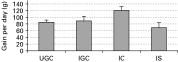
Mean daily liveweight gains of the different animal groups are shown in Fig. 2. The weight gains of the chicory group (IC) were significantly higher (P<0·05) than any other group (trickle infected, IGC and IS, or uninfected control UGC). During the course of the experiment all animals gained weight (average value±S.E.M.: 6±0·5 kg) except animals No. 852 (from IS group) and No. 860 (IGC group) that did not gain any weight, and animal 854 (IS group) which gained less than a kilogram. One lamb from the IGC group developed severe diarrhoea and lost weight during the first 3 weeks of the trickle infection and was removed from the experiment for humane reasons. All data from this animal have been excluded from the current and subsequent analysis.

Fig. 2. Mean (S.E.M.) daily liveweight gains of trickle-infected lambs grazing different forages for a 6-week period (grass/clover, chicory and sulla for IGC, IC and IS group, respectively) and uninfected control lambs grazing grass/clover (UGC group).
Faecal egg counts
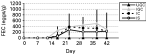
The average FEC of the different groups are shown in Fig. 3. The FEC of the trickle-infected animals were apparent after the second week of infection, varied markedly within the groups and followed a similar pattern with no significant difference between groups at any time-point. FEC from the previously uninfected group (UGC) were zero throughout the experiment. No differences were observed between treatments in faecal consistency scores, with all faeces falling into soft unformed or formed moist pellet categories (scores of 3 and 4, respectively).

Fig. 3. Back-tranformed group means (95% confidence intervals) of the eggs per gram faeces (eggs/g) recovered from lambs trickle infected with 10000 L3 Teladorsagia circumcincta per week (IGC, IC and IS group) or kept uninfected (UGC group). IGC and UGC animals were grazing on grass/clover while IC and IS were grazing on chicory and sulla swards, respectively.
Worm burdens and tissue MMC, GL and EOS counts
Table 2 shows the mean T. circumcincta worm numbers recovered from lambs and the mean cell (MMC, GL and EOS) numbers counted in abomasal fold sections. Comparing the previously uninfected controls (UGC) with the trickle-infected animals (IS, IC, and IGC), UGC animals had higher (P<0·01) total worm establishment (combined EL4, LL4, ML4 and adult numbers) and lower (P<0·001) MMC and GL cell counts. Significant differences were also observed in the attained stage of development of the recovered worms. UGC animals had higher adult (P<0·001), higher LL4 (P<0·01) and lower EL4 (P<0·001) worm populations compared to trickle-infected groups, most of whose worms were in early- or mid-L4 stage of development. Comparisons between trickle-infected groups (IS, IC, and IGC) showed that the grazing forage treatment significantly affected the adult worm (P<0·05), late-L4 (P<0·01) and the mid-L4 (P<0·01) larval-stage recoveries of the trickle-infected lambs, with the IGC group always carrying higher worm burdens than either IC or IS lambs. The total worm establishment tended to be higher and the GL cell counts tended to be lower for IGC animals compared to IS and IC lambs (Table 2), although these differences were not statistically significant. Correlations of the cell counts and the worm establishment, using trickle-infected animals only, investigated the relationships between cells recruited on the abomasal tissue and worm recoveries. Thus, higher GL and MMC counts were negatively correlated with the total worm numbers (correlation coefficient (r) values of −0·63 and −0·51, respectively; P<0·01). Similar analysis on the relationship between GL and MMC counts with worm development demonstrated positive relationships with the worms being in early-L4 stage (r values of 0·68 and 0·73 for GL and MMC, respectively; P<0·001) and negative relationships with the worms in the adult stage (r values of −0·74 and −0·71 for GL and MMC, respectively; P<0·001). No relationship was found between worm establishment and stage of development with the mucosal EOS counts.

Four trickle-infected animals, 3 from IS group (Nos 842, 852 and 854) and 1 from IGC group (No. 860), had 10-fold higher numbers of adult worm establishment (recoveries of 31300, 28600, 31200 and 33100, respectively) compared to other trickle-infected animals. These animals also had zero early-L4 worm numbers and zero GL cell counts, values very similar to those observed in non-trickle-infected animals (UGC). With the omission of these 4 animals from the analysis, the variation within the groups was reduced and the forage effect became significant (P<0·05) for both worm establishment (values of 33%, 20% and 9% for IGC, IC and IS group, respectively), and GL counts (mean±S.E.M. cells per 0·1 mm2: 4±1·1, 7±1·5 and 15±3·7 for IGC, IC and IS group, respectively).
DISCUSSION
There was evidence in the present study that grazing on sulla or chicory encouraged the development of immunity against T. circumcincta. The trickle-infected lambs grazing on sulla and chicory had reduced establishment of the challenge worms compared to those grazing on grass/clover pastures, while the worms recovered from lambs grazing these bioactive forages had also inhibited development. The finding that the reduced worm establishment and inhibited larval development were correlated with higher numbers of GL and MMC in abomasal tissues suggests that the observed effects were due to an enhanced immune response, since these cells are associated with immune responses against gastrointestinal parasites (Balic, Bowles and Meeusen, 2000). The chemical composition of the grazing forages showed that bioactive forages had higher nutritional value than grass/clover in terms of their crude protein content (184, 185 and 113 g/kg DM for chicory, sulla and grass/clover (IGC) samples, respectively). Higher dietary protein content and metabolizable protein supply of growing lambs had enhanced immune responses against gastrointestinal parasites in several past studies (Bown, Poppi and Sykes, 1991; van Hourtert et al. 1995), and the present findings are consistent with the enhanced immune response to T. circumcincta infection observed in lambs supplemented with protein (Coop, Huntley and Smith, 1995).
Previous studies using either T. circumcincta or Trichostrongylus colubriformis have reported reduced worm establishment in lambs grazing sulla or chicory (Scales et al. 1994; Niezen et al. 1995, 2002; Marley et al. 2003; Tzamaloukas et al. 2005). These effects on parasite burdens have been attributed to the plant secondary metabolite (PSM) content of these forages. Suggested potential ways of PSM action include an indirect immune-related effect and/or a direct anthelmintic effect. Further studies have investigated the possible PSM anthelmintic attributes of these forages either in vitro or in vivo. In vitro studies (Molan et al. 2000, 2003), using compounds extracted from chicory and sulla, have suggested an anthelmintic-like effect against immature stages of gastrointestinal parasites, although Athanasiadou et al. (2005) were unable to demonstrate similar effects on T. colubriformis infections of sheep in vivo. The present study aimed to investigate the immunological effects of sulla and chicory and, in order to avoid the direct contact of the potentially PSM-rich digesta with the challenge infection, the animals were removed from the bioactive forages and were offered basal hay, 10 days before the administration of the challenge dose. Given the relatively short retention times of sheep ingesta (less than 3 days for this type of forage; Van Soest, 1982), the time elapsed between the consumption of the bioactive forage and the administration of the challenge larvae should have minimized the possible PSM anthelmintic effects exerted through direct contact with the infection larvae, although this does not rule out the longer-term effects of any likely persistent active compound. However, given that in this study worm burdens correlated with the numbers of mucosal cells (MMC and GL) and the fact that the observed effects were more pronounced on larval development rather than on worm establishment, the findings support the view that the results seen were the outcome of enhanced immune responses. This also agrees with previous studies with T. circumcincta infections (Smith et al. 1985; Coop et al. 1995; Stear, Strain and Bishop, 1999), where the stage of development or worm length of the recovered worms was a more consistent indicator of development of immunity than the total worm establishment.
The effects of the bioactive forages on T. circumcincta populations in the present study can be viewed only in relation to the forage nutritional value and the possible effect on lamb immune response. Chicory and sulla had higher crude protein content compared to the control, grass/clover, forage. Although this was not observed in previous studies using these bioactive forages (Scales et al. 1994; Tzamaloukas et al. 2005) both chicory and sulla are considered forages with high nutritional value. Chicory has been associated with higher voluntary feed intake and higher apparent digestibility compared to grasses (Barry, 1998), whilst sulla is a tannin-rich forage with CT characteristics that can improve the protein availability to the host (Min et al. 2003). CT from sulla can bind dietary proteins and reduce their degradation in the rumen, without reducing the microbial protein produced, resulting in an overall increase of protein supply in the animal (Min et al. 2003). Sulla samples in the present study had higher extractable CT concentration than grass/clover (37 and 7 g/kg DM, respectively) and consequently the lambs of this group may also have benefitted from a higher metabolizable protein supply, which has been shown to enhance immune response against gastrointestinal parasites (Coop et al. 1995; Van Houtert et al. 1995; Coop and Kyriazakis, 1999; Houdijk et al. 2001).
A further finding of the present study was the significantly higher liveweight gain of the trickle-infected lambs grazing chicory compared both to the other trickle-infected groups (IS and IGC) and the previously uninfected lambs grazing grass/clover. However, the finding that the weight gains of trickle-infected (IGC) lambs were similar to their previously uninfected (UGC) counterparts grazing the same forage, suggests that the 6-week infection regime of the present experiment did not penalize performance profoundly. This has also been observed in previous studies, where comparable infection regimes (infections of 10000 L3 T. circumcincta per week), resulted in similar growth rates between trickle-infected and uninfected control, three-and-a-half-month-old lambs over an 8-week infection period (Coop, Sykes and Angus, 1982; Richardson, 2000). Nevertheless, in previous studies, (Fraser et al. 1988; Komolong et al. 1992; Niezen et al. 1994; Scales et al. 1994; Marley et al. 2003) lambs grazing chicory have shown superior growth rates compared to those grazing grasses under parasite challenge or not. Barry (1998) suggested that these differences could be explained by the higher voluntary feed intake and the digestibility characteristics of this forage. This may also apply to the present experiment and could explain the differences in weight gains or immune responses since grasses constituted more than 90% of the control forages. However, food intake measurements or digestibility data were not taken in the current study and further long-term feeding trials with chicory are required in order to confirm these findings.
In conclusion, the design of the present study has enabled the separation of direct (anthelmintic) and indirect (immunological/physiological) mediated effects on host responsiveness against the gastric nematode Teladorsagia. The findings support the view that some of the benefits from grazing bioactive forages derive from their effects on the development and expression of immunity. Further studies are needed both to confirm these effects, elucidate more fully the underlying mechanism and also to develop ways of incorporating these forages within grazing management systems, so as to reduce our reliance upon chemoprophylaxis.
We are grateful to the technical support teams of the Animal Nutrition and Health Department, Scottish Agricultural College and the Parasitology Division, Moredun Research Institute; also to Dr C. Theobald and Ian Nevison (Biomathematics and Statistics Scotland) for statistical advice. We also wish to thank Mr D. Younie (SAC) for advice on the establishment and management of the experimental swards. This work was supported by the European Commission as part of a collaborative programme between Scotland, France, Spain, Sweden and The Netherlands. O. Tzamaloukas was in receipt of a scholarship from the Hellenic State Scholarship Foundation (I.K.Y.). The Scottish Agricultural College and the Moredun Research Institute receive financial support from the Scottish Executive, Environment and Rural Affairs Department.