Aventricular septal defect is the commonest congenital cardiac malformation, and its surgical closure is the most frequent open-heart procedure performed in childhood.Reference Roos-Hesselink, Meijboom and Spitaels1 Since parts of the cardi7onduction system in many cases are in close relation to the defect, injury can easily happen during repair.Reference van Lier, Harinck and Hitchcock2 While complete heart block currently only occurs postoperatively in less than 1% of children with ventricular septal defect,Reference Andersen, de Leval and Tsang3, Reference Smerup, Hjertholm and Johnsen4 right bundle branch block is seen in up to three-fifths of those operated through an atriotomy.Reference van Lier, Harinck and Hitchcock2 Whereas right bundle branch block in healthy subjects does not seem to carry any negative implications,Reference Fleg, Das and Lakatta5 this apparently reassuring observation may not necessarily extend to children in whom this permanent abnormality of depolarization occurs in combination with other potential myocardial injuries, such as those caused by sutures and patches, perioperative myocardial damage, and perhaps longstanding preoperative ventricular volume overload. Under these circumstances, left ventricular function may theoretically decline over timeReference Abd El Rahman, Hui and Yigitbasi6, Reference Zannad, Huvelle and Dickstein7 analogous to the changes found in patients with left bundle branch block,Reference Bax, Bleeker and Marwick8 albeit not necessarily of similar clinical importance.
Echocardiography is the most widely used method for assessing cardiac function. Unfortunately, this technique has several limitations, particularly regarding the detection of early subclinical stages of left ventricular dysfunction.Reference Ho and Solomon9 Tissue Doppler imaging, however, not only provides quantitative assessment of regional myocardial function during the whole cardiac cycle, but also enhanced visual assessment of discrete abnormalities of regional wall motion.Reference Swaminathan, Ferrer and Wolff10 It may, therefore, identify changes in cardiac performance that would otherwise remain undetected. We hypothesised that, over years, surgically induced right bundle branch block in children with ventricular septal defect would lead to subtle changes in left ventricular function detectable by sensitive modalities for imaging.
Materials and methods
During the period from 1990 to 1995, 123 children underwent surgical closure of a ventricular septal defect at our institution. In the 66 patients with a normal electrocardiogram at admission, who had their ventricular septal defect closed through a right atriotomy, 26 (39%) accepted our invitation to become involved in this follow-up study. The population consisted of 15 males and 11 females. Surgery was generally contemplated on the basis of medical history, physical findings, and echocardiographic examination. Cardiac catheterisations were only used occasionally in decision-making.
We reviewed the 12 lead electrocardiogram obtained at discharge in all patients to identify any postoperative occurrence of right bundle branch block, defined as an rSR′ pattern in lead V1 or V2, with a wide slurred S wave in V5 or V6, and a duration of the QRS complex exceeding 0.12 seconds. We recruited 26 age and gender matched healthy children with a normal electrocardiogram as controls. The study was approved by our local Ethical Committee, and the parents of all patients and healthy controls gave their informed consent.
Surgery
All patients had undergone surgery through a median sternotomy, and put on cardiopulmonary bypass with the aorta cross-clamped. Moderate hypothermia and crystalloid cardioplegia was used throughout the whole period. The cardiac defect was approached through a right atrial incision. In 12 children, a small ventricular septal defect had been closed by direct suture, whereas the remaining 14 patients required insertion of a Dacron patch.
Echocardiography
All echocardiographic examinations were performed by the same two observers, and all off-line analyses after the event was performed randomly and blindly with respect to clinical data, including the electrocardiogram. Echocardiograms were performed on a GE Vivid Seven (GE Healthcare, Horten, Norway) using a 2.5 MHz transducer. Images were obtained from the parasternal and apical views. Left ventricular dimensions and mural thicknesses were obtained from standard parasternal M-mode recordings, and based on 5 consecutive cardiac cycles.Reference Lang, Bierig and Devereux11
Systolic function
Radial left ventricular function was assessed by conventional fractional shortening derived from the parasternal view.Reference Lang, Bierig and Devereux11 Left ventricular longitudinal function was examined from tissue Doppler based assessment of the basal-apical displacement, from peak systolic myocardial velocities and from tissue tracking with the tissue Doppler sample volumes, measuring 6 by 6 millimetres, placed in the lateral and medial part of the mitral ring.Reference Andersen and Poulsen12 In all cases, frames per second were above 140. The peak systolic velocity was defined as the highest value between the R-wave on the electrocardiogram and the timing of closure of the aortic valve, whereas tissue tracking, which displays the distance of motion during systole along the Doppler axis,Reference Pan, Hoffmann and Kuhl13 was defined as the peak displacement, expressed in millimetres, during the same time span. Timing of closure of the aortic valve was defined from a curved anatomical M-mode recording placed through the aortic valvar leaflets in the apical long axis view. Tissue Doppler values are presented as the mean from 3 consecutive heart cycles.
Longitudinal motion has been previously validated in childrenReference Arce, Knudson and Ellison14 and the intra-observer variability of tissue tracking and velocity recordings is known to be below 10%.Reference Andersen and Poulsen12
Diastolic function
Pulsed Doppler measurements of left ventricular filling were obtained in the apical four-chamber view with the Doppler beam aligned perpendicularly to the plane of the mitral annulus, and the sample volume placed between the tips of the mitral valvar leaflets. We acquired 5 consecutive beats obtained during quiet respiration for calculating mean early and late diastolic mitral annular velocities, as well as for determining the early diastolic mitral deceleration time.
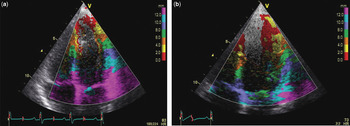
Left ventricular myocardial diastolic properties were assessed using tissue Doppler imaging. Measurement of the peak diastolic early and late diastolic mitral annular velocities in the lateral and septal mitral annulus were performed in the four chamber view.Reference Nagueh, Mikati and Kopelen15, Reference Ommen, Nishimura and Appleton16 Results are presented as the mean of 3 consecutive heart cycles (Fig. 1).
Tissue tracking images of the systolic function. Panel a illustrates a normal examination from a 12 year old boy with normal long axis function and 7 colour bands displayed with a peak systolic displacement of the mitral ring exceeding 12 millimetres. Panel b displays a similar recording from a 12 year old boy after surgical closure of a ventricular septal defect in infancy. Long axis displacement of the septum and septal part of the mitral ring are reduced with only 5 colour bands displayed. The lateral displacement is normal. VSD: ventricular septal defect.

Since measurements of myocardial velocities using off-line tissue Doppler are lower than if acquired with spectral tissue Doppler technique,Reference McCulloch, Zoghbi and Davis17 the ratio of velocity of early transmitral inflow divided by the early diastolic mitral annular velocity is overestimated compared to studies using only spectral tissue Doppler.Reference Ommen, Nishimura and Appleton16, Reference Nagueh, Middleton and Kopelen18
Statistics
Data were analyzed for normal distribution using the Shapiro-Wilk test and, if normal distributed, presented as means ± standard deviation. Ratios were compared using Fischer’s exact test.
We compared the findings in the group of children found to have right bundle branch block after closure of the ventricular septal defect to those in the children not having this finding after surgical closure, and to the findings in the control subjects using one-way ANOVA. An un-paired t-test was used for comparisons between the groups, taking a value of p less than 0.05 when 2-tailed to be statistically significant. The statistic calculations were done with SPSS 14.0 (SPSS Inc., Illinois, US).
Results
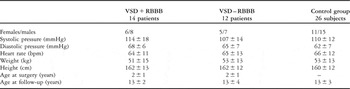
Demographics and clinical data are displayed in Table 1. We found that 14 children (54%) had developed right bundle branch block postoperatively, with 12 (46%) having preserved intraventricular conduction. The state of conduction had not changed over the years. Associated cardiac malformations had existed in 8 of the patients, with coarctation of the aorta present in 4, atrial septal defect in 3, and patency of the arterial duct in 1. All 4 children with coarctation had undergone aortic repair prior to closure of the ventricular septal defect, while the other associated malformations were corrected at the time of closure of the ventricular septal defect. Blood pressure, heart rate, weight and height were similar in all three groups. Follow-up exceeded 10 years, and was similar in both surgical subgroups. All patients were asymptomatic and at school, with normal effort tolerance and without medical treatment. All had normal blood pressure and none had aortic or mitral regurgitation. Only one child with right bundle branch block had a tiny residual ventricular septal defect. There was no evidence of recoarctation in the four patients previously undergoing repair.
Demographic and clinical data.

VSD: ventricular septal defect; RBBB: right bundle brunch block; mmHg: millimetres of mercury; bpm: beats per minute; Kg: kilogram; cm: centimeters.
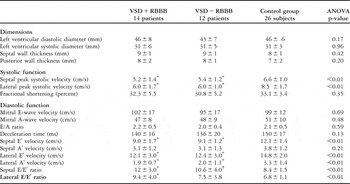
The conventional and tissue Doppler derived echocardiographic results are summarized in Table 2 and Figure 2. There were no differences in left ventricular dimensions or fractional shortening between patients with or without right bundle branch block and in controls.
Echocardiography.

*p < 0.05 compared to control group.
†p = 0.13 compared to control group.
VSD: ventricular septal defect.
RBBB: right bundle brunch block.
mm = millimetres.
cm/s = centimetres per second.
ms = milliseconds.
mmHg: millimetres of mercury.
E/A ratio: transmitral inflow early velocity divided by late diastolic mitral annular velocity; E′ velocity: early diastolic mitral annular velocity.
A′ velocity: late diastolic mitral annular velocity.
E/E′ ratio: transmitral inflow early velocity divided by early diastolic mitral annular velocity.
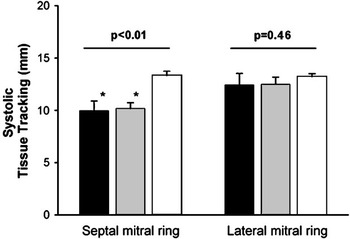
Peak systolic tissue tracking derived from the lateral and septal parts of the mitral ring. The bars indicate mean values and standard errors of the mean. Black bars: patients with right bundle branch block after closure of the ventricular septal defect. Grey bars: patients without right bundle branch block after closure of the ventricular septal defect. White bars: Control group. *p < 0.05: patients versus controls; RBBB: right bundle branch block; VSD: ventricular septal defect.

The systolic long axis function, as reflected by the peak systolic myocardial velocity, was reduced to the same extent in both surgical groups compared to controls, irrespective of the presence of right bundle branch block (Table 2). Similarly, the medial displacement of the mitral ring as measured from the tissue tracking was significantly lower in both groups undergoing surgical closure, whereas the lateral displacement did not differ between the three subgroups (Fig. 2). The changes in systolic function were neither related to age at surgery, to follow-up period nor to whether the defect had been closed by insertion of a patch or direct suture.
The indexes of diastolic mitral inflow were similar in both groups undergoing surgical closure, and not different from the healthy subjects (Table 2). Lateral and septal peak early diastolic mitral annular velocities derived using tissue Doppler, however, were significantly lower in the patients, although not dissimilar according to the presence or absence of right bundle branch block (Table 2). The late diastolic mitral annular tissue velocity derived at the lateral part of the ring was also lower in both sets of patients, but not particularly in the subgroup with right bundle branch block. The late diastolic mitral annular velocities derived at the septal aspect of the ring were also similar in all three groups.
Regarding the ratios of transmitral inflow early velocity divided by early diastolic mitral annular velocity, which combine the inter- and intramyocardial diastolic properties, the values derived both septally and laterally from the children with right bundle branch block were significantly higher than the control group. There was a similar tendency in the children without right bundle branch block, albeit that these values did not show statistical significance. Furthermore, there were no significant differences between the children with and without right bundle branch block after surgical closure (Table 2). The diastolic abnormalities were not related to age at surgery, the period of follow-up, nor whether the defect was closed by direct suture or insertion of a patch.
Discussion
Right bundle branch block is a frequent finding after surgical repair of congenitally malformed hearts,Reference Andersen, de Leval and Tsang3, Reference Smerup, Hjertholm and Johnsen4 and has in older reports been seen in more than half of children after closure of ventricular septal defects.Reference van Lier, Harinck and Hitchcock2, Reference Andersen, de Leval and Tsang3 Our data, acquired in a more recent cohort, confirms the high prevalence of this abnormality in conduction, even when access to the defect was through the right atrium. Isolated occurrence of right bundle branch block in presumed healthy young subjects is only seen in 1%,Reference Pelliccia, Culasso and Di Paolo19 and has so far been considered a benign phenomenon even in the long term.Reference Fleg, Das and Lakatta5
Experience drawn from biventricular pacing studies in adults with congestive heart failure, nonetheless, suggests that alleviation of the abnormality in conduction, and the associated electro-mechanical dyssynchrony, can improve cardiac function, indicating that right bundle branch block is of clinical importance at least in patients with underlying cardiovascular problems, including those with tetralogy of Fallot.Reference Abd El Rahman, Hui and Yigitbasi6, Reference Garrigue, Reuter and Labeque20
Although we hypothesized that postoperative right bundle branch block in children with ventricular septal defect would lead over time to changes in left ventricular function secondary to the altered right-sided depolarisation, the detailed echocardiographic evaluation only identified minor, albeit significant, abnormalities in the ratios of transmitral inflow early velocity divided by early diastolic mitral annular velocity in the patients with right bundle branch block. All other echocardiographic parameters, including the less robust velocities of mitral inflow, were similar in the subjects with and without right bundle branch block after closure of their septal defects. These observations are in accordance with data obtained in patients after repair of tetralogy of Fallot, in whom the presence of right bundle branch block also has been associated with some degree of left ventricular asynchrony, and secondary reductions in left ventricular diastolic function. It must be acknowledged, nonetheless, that the haemodynamics after repair of tetralogy of Fallot are far more complex, and often significantly influenced by severe pulmonary regurgitation and right ventricular overload and dilation.Reference Abd El Rahman, Hui and Yigitbasi6, Reference D’Andrea, Caso and Sarubbi21
Since diastolic function usually is affected prior to systolic performance, it may well be that the changes attributable to the right bundle branch block are of minor importance. This is supported by the fact that the diastolic difference between the patients with and without right bundle branch block could only be detected with sensitive tissue Doppler techniques, but not on conventional measurements of mitral inflow. It was also the case that the numeric differences in the ratios obtained septally and laterally from the early velocities were small.
Although our study failed to identify major abnormalities specifically in the patients showing right bundle branch block after closure of their defects, the data surprisingly revealed that left ventricular long axis function as assessed by systolic displacement and displacement velocities was significantly reduced more than a decade after surgical correction. Circumferential shortening as indicated by the fractional shortening, in contrast, was not reduced, and ventricular dimensions not enlarged.
Abnormalities identified using tissue Doppler also included indexes of diastolic myocardial performance, whereas the parameters for mitral inflow were normal. Neither the systolic nor the diastolic abnormalities were related whether the defect was closed by insertion of a patch or by direct suture, nor to the age at surgery or the length of follow-up.
The abnormalities in left ventricular systolic and diastolic function detected with tissue Doppler imaging remain unexplained, but may have a multifactorial background. Although it might be intuitive to expect the changes observed to be induced by the surgical procedure, such as the myocardial protection or the surgical trauma itself, preoperative factors may also be involved. Thus, changes in turnover of collagen, and other intrinsic tissue abnormalities in the muscular ventricular septum related to the pathogenesis of the defect, could lead to functional impairment of myocardium adjacent to the defect. Such abnormalities have been described in children with tetralogy of Fallot and pulmonary atresia, in whom disarrayed bundles of collagen, and increased expression of collagen III, have been found in the septal region.Reference Peters, de Jong and Klompe22 Postoperatively, a large patch will undoubtedly influence septal function negatively, and fibrosis either in the sutured area or around the patch could also lead to septal stiffness, influencing systolic and diastolic parameters sufficiently to make them detectable with advanced echocardiographic techniques.Reference Abd El Rahman, Hui and Yigitbasi6, Reference Brili, Alexopoulos and Latsios23 The changes specifically seen in the ventricular septum could represent the persistence of the abnormalities of septal motion seen early postoperatively after cardiac surgery in children and adults.Reference Hanseus, Bjorkhem and Brodin24, Reference Waggoner, Shah and Schuessler25
It is possible that the mechanisms for septal injury mentioned above also explain the reduction in the lateral displacement of the mitral ring, and thus the more global reduction in left ventricular function observed in the study, although it may seem surprising that left ventricular fractional shortening as an index of radial function remained normal. It is also possible that more advanced techniques would have disclosed minor changes in radial function. If the reduction in long axis function is secondary to the cumulative effect of the multiple perioperative myocardial risk factors acting immediately during or after the surgical trauma, the changes would be expected to be transient, rather than leading to a permanent reduction in ventricular function as indicated by our current observations. To our knowledge, this has neither been studied in detail nor prospectively, but only in cross-sectional designs and in studies with very short follow-up intervals, which make it impossible to evaluate the temporal evolution of these abnormalities.Reference Hanseus, Bjorkhem and Brodin24–Reference Lehmann, Lee and McKenzie26
Interestingly, a study comparing closure of atrial septal defects surgically and by insertion of devices percutaneously has similarly demonstrated impaired diastolic function after surgical repair.Reference Hanseus, Bjorkhem and Brodin24 In the children who underwent percutaneous closure, diastolic filling seemed to improve after treatment, which suggests that open heart surgery directly may impair not only diastolic but also systolic function.Reference Hanseus, Bjorkhem and Brodin24–Reference Lehmann, Lee and McKenzie26
The clinical impact of the abnormalities in myocardial function seen in the children undergoing surgery in our study remains speculative. A similar study performed on children after repair of tetralogy of Fallot revealed left ventricular asynchrony in over half of the patients with right bundle branch block, which was associated with reduced regional and global left ventricular function.Reference Abd El Rahman, Hui and Yigitbasi6 Moreover, the abnormal ratio of transmitral inflow early velocity divided by early diastolic mitral annular velocity, which was observed in the subset with right bundle branch block, correlates well with elevated pulmonary capillary wedgeReference Ommen, Nishimura and Appleton16, Reference Nagueh, Middleton and Kopelen18 and left ventricular end-diastolic pressure.Reference Ommen, Nishimura and Appleton16, Reference Nagueh, Middleton and Kopelen18, Reference Liang, Cauduro and Pellikka27 Such higher ratios may reflect stiffness and reduced compliance of the left ventricle in this subset, and could theoretically influence their exercise capacity.Reference Meijboom, Szatmari and Utens28 Similarly, the altered functional properties of the left ventricle may theoretically increase the arrhythmogenic potential, and thus the prevalence of atrial fibrillation as has been described after surgical closure of ventricular septal defect.Reference Bol, Meijboom and Kappetein29, Reference Li and Somerville30
Our present study, of course, is limited by the relatively small number of subjects studied. The cross-sectional design also means that we cannot determine the order of events that eventually lead to subclinical systolic and diastolic dysfunction noted in our children after surgical closure of their ventricular septal defects.
In conclusion, systolic long axis function is significantly reduced after surgical closure of ventricular septal defects in children, irrespective of the presence of right bundle branch block. Diastolic dysfunction, in contrast, seemed primarily related to the post-operative presence of right bundle branch block.
Acknowledgments
We appreciate greatly the skilled assistance of Bente Mortensen with the echocardiographic and tissue Doppler measurements. We acknowledge also the financial support provided by the research foundation at Aarhus University Hospital, Skejby. There are no competing interests to report.
Conflicts of interest: None