Introduction
Rhabdomyosarcoma is a malignant soft tissue tumour which constitutes 3.5 per cent of all cancers in children aged up to 14 years and 2 per cent of all cancers in adolescents up to 19 years of age.Reference Gurney, Severson, Davis and Robison1, 2 Thirty-five per cent of cases present in the head and neck region.Reference Hicks and Flaitz3 Rhabdomyosarcoma is the most common paediatric malignancy affecting the nose and paranasal sinuses.Reference Lee4
Rhabdomyosarcoma occurs sporadically, and no predisposing or risk factors have been recognised in the majority of cases.Reference Gurney, Young, Roffers, Smith, Bunin, Ries, Smith, Gurney, Linet, Tamra, Young and Bunin5 This tumour arises from the embryonal mesenchyma, having the same origin as striated muscle. Conventionally, rhabdomyosarcoma is classified into four histological types: (1) embryonal (with its botryoid variant), (2) alveolar, (3) pleomorphic and (4) mixed.Reference Pappo, Shapiro, Crist and Maurer6
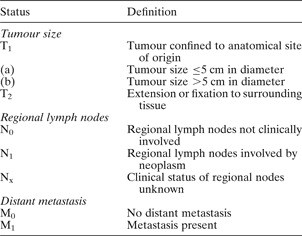
In the head and neck region, a distinction is drawn between non-parameningeal rhabdomyosarcoma and parameningeal rhabdomyosarcoma, with regard to prognosis. The nasopharynx, nasal cavity, paranasal sinuses, middle ear, mastoid region, infratemporal fossa and pterygopalatine fossa are considered parameningeal sites, and tumours in these sites have a poor prognosis.Reference Wiener7 Tumours confined to the orbit are treated separately because of their good prognosis.Reference Pappo, Shapiro, Crist and Maurer6, Reference Lawrence, Anderson, Gehan and Maurer8 The most common staging systems are the International Union Against Cancer (UICC) tumour–node–metastasis (TNM) system (Table I) and the Intergroup Rhabdomyosarcoma Study system.Reference Lawrence, Anderson, Gehan and Maurer8
Pre-treatment TNM-UICC 1991 classification system for paediatric rhabdomyosarcoma

T = tumour; N = nodes; M = metastasis; UICC = International Union Against Cancer
The mainstay of treatment for sinonasal rhabdomyosarcoma (as for all parameningeal rhabdomyosarcomas) is risk-based, multi-agent chemotherapy and radiotherapy. Surgery plays a role in resectable tumours or as salvage therapy in non-complete responders to chemoradiation.
Paediatric sinonasal rhabdomyosarcomas are very rare, their biological behaviour is largely unknown and their treatment is complex. Their sinonasal site poses additional management problems, due to proximity to the anterior skull base and orbit. The Intergroup Rhabdomyosarcoma Studies (IRS) do not evaluate treatment outcomes specifically for childhood rhabdomyosarcoma at this site. Few retrospective studies and case reports deal with rhabdomyosarcoma of the nose and paranasal sinuses in mixed populations of children and adults, or with paediatric rhabdomyosarcoma in the head and neck region.Reference Wiener7, Reference Newman and Rice9–Reference Wurm, Constantinidis, Grabenbauer and Iro17
In the current study, we specifically focussed on paediatric sinonasal rhabdomyosarcoma, and we reviewed our experience regarding the biological behaviour, treatment outcome and effectiveness of major surgery for this rare malignancy.
Materials and methods
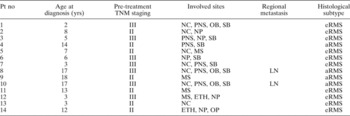
Between 1981 and 2005, 14 children and adolescents with rhabdomyosarcoma of the nose and paranasal sinuses were treated at the Departments of Otorhinolaryngology of the Aristotle University of Thessaloniki, Greece, and the University of Erlangen Nuremberg, Germany. These children's clinical records were retrospectively reviewed. The patients’ median age was 7.5 years (range two to 18 years) (Table II).
Patient characteristics

Pt no = patient number; yrs = years; TNM = tumour–node–metastasis; NC = nasal cavity; PNS = paranasal sinuses; OB = orbit; SB = skull base; NP = nasopharynx; MS = maxillary sinus; ETH = ethmoids; OP = oropharynx; LN = histologically positive cervical lymph nodes; eRMS = embryonal type rhabdomyosarcoma; aRMS = alveolar type rhabdomyosarcoma
Ten patients had embryonal type rhabdomyosarcoma and four had alveolar type rhabdomyosarcoma. For staging purposes, patients underwent clinical examination, basic laboratory tests, computed tomography (CT) of the skull and chest, magnetic resonance imaging of the head and abdomen, bone marrow biopsies, and a bone scan. Imaging modalities revealed skull base involvement in seven cases (50 per cent). Clinically or radiologically suspicious lymph nodes were found in seven patients (50 per cent). Patients’ tumours were equally distributed between stages II and III, as defined by the TNM classification.
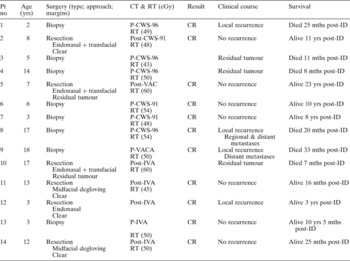
Following histological confirmation, eight patients (57.1 per cent) received chemoradiotherapy based on the German Soft Tissue Sarcoma Study protocols (CWS 91, 96) (CWS-91 stands for “German Cooperative Soft Tissue Sarcoma Study” of 1991. CWS-96 for the same group study in 1996), the vincristine–actinomycin-D–cyclophosphamide–adriamycin regime, and the International Society of Paediatric Oncology ifosfamide–vincristine–actinomycin-D protocol (Table III). Radiotherapy was used as the main treatment modality or as an adjunct to primary surgery (doses ranged from 43 to 60 cGrey). Six patients received major surgery as their main local treatment followed by chemotherapy and/or radiotherapy. A combined endoscopic-transfacial approach was employed in three patients, a combined endoscopic-microscopic approach in one patient and midfacial degloving in two patients.
Patient treatment and outcome

Pt no = patient number; yrs = years; CT = chemotherapy; RT = radiotherapy; P = primary; Post = post-operative; CR = complete remission; ID = initial diagnosis; CWS-96 = Cooperative Soft Tissue Sarcoma Study 96; CWS-91 = Cooperative Soft Tissue Sarcoma Study 91; VAC = vincristine, adriamycin & cyclophosphamide; VACA = vincristine, actinomycin D, carboplatin & adriamycin; IVA = ifosfamide, vincristine & adriamycin
Post-operative evaluation, comprising head CT, chest X-ray, bone scans and bone marrow biopsies, revealed local failures, relapses or distant metastases in seven patients. The length of follow up ranged from seven to 276 months, with a mean of 58 months.
All survival data were analysed with the Kaplan–Meier method. The log-rank test was employed to test differences between survival distributions, and the level of statistical significance was set at 0.05. Survival was calculated from the date of initial diagnosis to the last follow-up visit.
Results
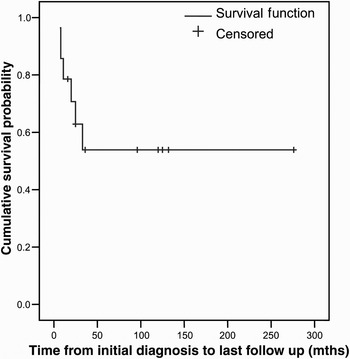
The patients’ overall five-year survival rate was 53.9 per cent (Figure 1). Eleven patients (78.6 per cent) had complete remission after treatment. Subsequently, two of them suffered a local recurrence; one died 25 months after the initial diagnosis, and the other awaited treatment at the time of writing. Two patients developed local recurrence and distant metastases simultaneously; one underwent further resection, thoracotomy, laminectomy and additional chemotherapy, while the other underwent resection after embolisation of the tumour and radiotherapy to the distant metastasis. Survival was prolonged to 20 and 33 months, respectively. There were three non- or partial responders to initial treatment. All died within a year of diagnosis due to complications (including sarcomatous meningitis in one patient).
Kaplan–Meier survival curve showing overall survival probability of the 14 patients with rhabdomyosarcoma. Mths = months

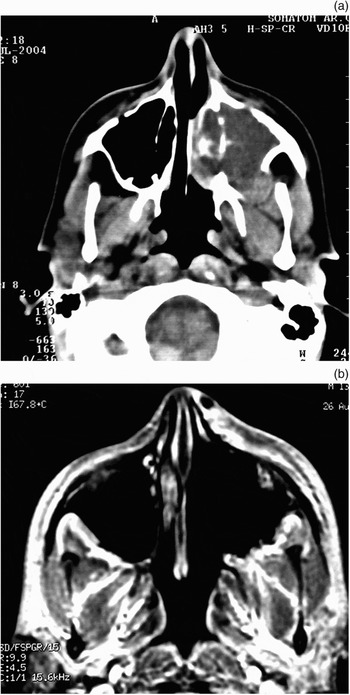
Four patients treated with primary surgery had clear margins and received chemotherapy. One of these patients had tumour involving the maxillary sinus. He underwent tumour resection via a midfacial degloving approach (Figure 2). Three of the four patients undergoing surgery received additional radiotherapy, and these three patients were alive and free of recurrence 16 months, 25 months and 11 years post-diagnosis, variously. The fourth patient, who post-operatively received only chemotherapy, suffered a local recurrence after three disease-free years. Two patients had residual tumour after primary therapy and received adjuvant chemotherapy and high dose radiotherapy (60 cGrey). One was alive 23 years after initial diagnosis, whereas the other survived only seven months (skull base erosion was present). The five-year survival rate for the group of surgically treated patients was 83.3 per cent, and that for the group of irradiated patients was 37.5 per cent. This difference was not statistically significant (p = 0.213).
(a) Pre-operative, axial computed tomography scan of paranasal sinuses of a 13-year-old patient. A soft tissue mass of variable intensity occupies the left maxillary sinus. The mass has prolapsed into the nasal cavity and eroded through the posterior wall of the maxillary sinus into the retromaxillary space. (b) Post-treatment, axial magnetic resonance imaging scan, showing complete removal of tumour.

Histological subtype influenced survival. Patients with embryonal type rhabdomyosarcoma had a 78.7 per cent three- and five-year cumulative survival probability, in contrast to patients with alveolar type rhabdomyosarcoma, whose equivalent survival probability was 0 per cent (p = 0.002). The mean survival time for alveolar type rhabdomyosarcoma was 17 months. Infiltration of the skull base adversely affected outcome; three- and five-year survival rates for these patients were 28.6 per cent (median survival time was 20 months), whereas lack of intracranial extension improved survival to 80 per cent (p = 0.028). Patients aged less than 10 years had a better prognosis compared with older children (three- and five-year survival rates were 75 per cent for the younger group and 0 per cent for the older group; p = 0.046). Disease stage also affected outcome but this was not statistically significant. Patients in stage II had 64.3 per cent three- and five-year survival rates, whereas those in stage III showed 42.9 per cent survival rates (p = 0.339).
Seven patients had positive cervical lymph nodes pre-operatively. However, only two patients had positive pathological specimens; both suffered from alveolar type rhabdomyosarcoma.
Discussion
Paediatric sinonasal rhabdomyosarcoma is an aggressive tumour presenting with non-specific signs and symptoms which are often initially attributed to allergy and infection.Reference Herrmann, Sotelo-Avila and Eisenbeis16 Persistence of nasal obstruction, proptosis, diplopia or epistaxis warrants evaluation with rigid or flexible nasendoscopy, which usually reveals a unilateral, polypoid mass. The differential diagnosis includes benign and malignant tumours such as lymphomas and, rarely, soft tissue sarcomas other than rhabdomyosarcoma.
Before taking a biopsy from the lesion, complete imaging investigation should be requested. Magnetic resonance imaging (MRI) is the radiological investigation of choice for parameningeal rhabdomyosarcoma.Reference Harnsberger, Hudgins, Wiggins and Davidson18 The tumour presents as a heterogeneous mass, iso-intense or hyper-intense to muscle, on T1 and T2 sequences, respectively. Intracranial and peri-neural spread, a poor prognostic sign, is readily identifiable on MRI scanning. In our series, seven patients had skull base infiltration. Metastatic cervical lymph nodes may be revealed with both imaging modalities. Lack of calcification is a useful radiological clue that distinguishes rhabdomyosarcoma from other malignancies of the sinonasal region such as chondrosarcoma and osteosarcoma. However, lymphoma and nasopharyngeal carcinoma share the same signal intensity characteristics as rhabdomyosarcoma, and therefore tissue biopsy is imperative for correct diagnosis.Reference Yousem, Lexa, Bilaniuk and Zimmerman19
The histological diagnosis of rhabdomyosarcoma requires experience. Disagreement among pathologists regarding rhabdomyosarcoma histological subtyping can occur in up to 30 per cent of cases.Reference Pappo, Shapiro, Crist and Maurer6 Misclassification of (unfavourable) alveolar rhabdomyosarcoma as the embryonal type may lead to administration of sub-optimal treatment.Reference Heffner20 The histological classification of rhabdomyosarcoma has been a subject of debate for several years. The different classification schemes (i.e. Horn–Enterline, Palmer, International Society of Paediatric Oncology and National Institute of Health) have added much confusion to rhabdomyosarcoma subtyping. Newton and co-workersReference Newton, Gehan, Webber, Marsden, van Unnik and Hamoudi21 assembled an international panel of experts representing each classification, and devised a new system based on the level of agreement and power of prognostic prediction. The International Classification for Rhabdomyosarcoma, widely used at present, categorises rhabdomyosarcoma into (1) favourable prognosis (botryoid and spindle cell types), (2) intermediate prognosis (embryonal type) and (3) unfavourable prognosis (alveolar type and undifferentiated sarcoma).
In the majority of sinonasal rhabdomyosarcoma cases, the tumour is advanced and radical surgery would result in substantial functional and cosmetic deficits. Multi-agent chemotherapy combined with radiation is the primary treatment modality offered to patients. Since the introduction of single agent chemotherapy in the early 1960s, several treatment protocol modifications have led to a dramatic improvement in survival rates, with acceptable morbidity. The first international sarcoma studies (the Intergroup Rhabdomyosarcoma Study, German Soft Tissue Sarcoma Study, Italian Cooperative Group and International Society of Paediatric Oncology study) defined prognostic factors which subsequently enabled the planning of effective, risk-based chemoradiotherapy. Negative prognostic factors comprised parameningeal site, meningeal involvement, tumour size more than 5 cm, gross tumour residual before or after surgery, and distant metastases. Patients aged less than 10 years and with embryonal type histology had a good prognosis.Reference Hicks and Flaitz3, Reference Raney, Meza, Anderson, Fryer, Donaldson and Breneman22 We too found that patients with embryonal type rhabdomyosarcoma, an age less than 10 years and no skull base erosion had improved outcomes. Our five-year overall survival rate (53.9 per cent) compares well with the 64 per cent survival rate for non-metastatic parameningeal rhabdomyosarcoma observed in the Malignant Mesenchymal Tumor 89 studyReference Stevens, Rey, Bouvet, Ellershaw, Flamant and Habrand23 and the rates of the Intergroup Rhabdomyosarcoma Studies II through IV (56 per cent if meningeal involvement was present and 76 per cent if meningeal involvement was absent.Reference Raney, Meza, Anderson, Fryer, Donaldson and Breneman22 Current treatment philosophies for parameningeal rhabdomyosarcoma differ between Europe and North America.Reference Donaldson and Anderson24 The International Society of Paediatric Oncology Malignant Mesenchymal Tumor 89 study was based on initial front-line chemotherapy followed by further chemotherapy in the event of a poor response, before local treatment was administered. A major objective of the European protocol was to reduce the use of radiotherapy; therefore, surgery was the preferred local treatment. As a result, no radiotherapy was instituted for parameningeal rhabdomyosarcoma patients who were (1) younger than three years with a complete response to chemotherapy or surgery, or (2) older with no meningeal involvement. The Intergroup Rhabdomyosarcoma Study IV used radiotherapy as primary local treatment soon after induction chemotherapy was completed. In contrast to the International Society of Paediatric Oncology Malignant Mesenchymal Tumor 89 study, all patients with parameningeal disease received radiotherapy irrespective of their age. Better results were achieved by the inclusion of radiotherapy in the treatment plan of all patients with parameningeal rhabdomyosarcoma. In the International Society of Paediatric Oncology Malignant Mesenchymal Tumor 89 study, non-irradiated patients younger than three years and older irradiated children had similar overall survival. Both studies underscore the importance of systematic local treatment for parameningeal rhabdomyosarcoma. In our study, surgery was the main local treatment modality in six patients, five of whom received additional radiotherapy.
Complications of treatment should be kept to a minimum without compromising survival. Intensive chemotherapy can cause severe acute complications, with toxic death being the worst outcome, occurring in 5–12 per cent of patients.Reference Pappo, Shapiro, Crist and Maurer6 Secondary neoplasms (occurring in 2.4 per cent), such as acute myeloid leukaemia and acute lymphoblastic leukaemia, may develop within three to four years of treatment.Reference Koscielniak, Harms, Henze, Jürgens, Gadner and Herbst25 Cardiomyopathy (occurring in 1.6 per cent), Fanconi syndrome (in 6 per cent) and renal damage are other potential consequences of chemotherapy. We observed Fanconi syndrome and aspergillosis of the maxillary sinus in one patient each. The latter patient was treated successfully with systemic antifungal agents and local therapy with amphotericin B irrigations. Radiotherapy has serious late complications, such as developmental delay (occurring in 48 per cent), growth retardation (35 per cent), learning difficulties (16 per cent), poor dentition (29 per cent), impaired vision (17 per cent) and hearing loss not attributable to cisplatin administration.Reference Raney, Asmar, Vassilopoulou-Sellin, Klein, Donaldson and Green26 Long term sequelae such as chondronecrosis, oesophageal stenosis, second malignancy and brain haemorrhage may become manifest 10 years after initial irradiation.Reference Paulino, Simon, Zhen and Wen27 Considering the serious adverse effects of radiotherapy, radical surgery is an important alternative in selected cases of parameningeal rhabdomyosarcoma.
Surgery as primary treatment modality
Primary surgery may lead to unacceptable morbidity, and several authors do not recommend it as the primary treatment modality.Reference Sercarz, Mark, Tran, Stopper and Calcattera10, Reference Anderson, Tom, Womer, Handler, Wetmore and Potsic28 Since the 1960s, developments in plastic and reconstructive surgery have allowed radical surgical procedures in the sinonasal region to be performed with acceptable cosmetic and functional results. We had no cases of severe facial disfigurement in our series. Surgery prior to or after cytoreductive chemotherapy is recommended if there is no intracranial extension and if complete resection seems feasible.Reference Wiener7, Reference Hess, Schroder, Schroder and Michel15, Reference Healy, Upton, Black and Ferraro29, Reference Daya, Chan, Sirkin and Forte30 Microscopic residual tumour may be treated with re-excision; if frozen section analysis shows that margins are negative, additional radiotherapy can be withheld.Reference Daya, Chan, Sirkin and Forte30 Alternatively, less intensive chemotherapy and radiotherapy can be used for microscopic residual disease after resection.Reference Blatt, Snyderman, Wollman, Mirro, Janecka and Albo31 Locally advanced parameningeal rhabdomyosarcoma can be treated according to a protocol which combines ablative surgery with moulage technique brachytherapy and surgical reconstruction.Reference Buwalda, Schouwenburg, Blank, Merks, Copper and Strackee32 This approach aims to intensify local treatment and to prevent the long term consequences of external beam radiotherapy. Three intermediate-risk paediatric patients with sinonasal rhabdomyosarcoma (Intergroup Rhabdomyosarcoma Study stage II without meningeal involvement) received the above treatment, with adequate local control.
Elective treatment of the N0 neck is not justified.Reference Sercarz, Mark, Nasri, Wang and Tran12, Reference Buwalda, Schouwenburg, Blank, Merks, Copper and Strackee32, Reference Raney, Anderson, Barr, Donaldson, Pappo and Qualman33 Controversy exists over treating the N+ neck with additional radiotherapy or neck dissection. The high incidence of metastasis to cervical lymph nodes and the pattern of spread of sinonasal tumours (via the retro-maxillary lymphatic route) necessitate inclusion of the neck in the radiotherapy field.Reference Callender, Weber, Janjan, Benjamin, Zaher and Wolf11 Despite the high rate of clinically N+ necks amongst parameningeal rhabdomyosarcoma patients, histological confirmation of cervical nodal status is necessary before any local neck treatment is planned.Reference Stevens, Rey, Bouvet, Ellershaw, Flamant and Habrand23, Reference Raney, Anderson, Barr, Donaldson, Pappo and Qualman33 In our study, two out of seven patients with a N+ neck had histologically proven nodal metastasis. Both patients suffered from alveolar type rhabdomyosarcoma and died within 20 months with distant metastasis or local failure. We recommend surgical evaluation of cervical nodal status at some point in the treatment course. For unresectable tumours, suspicious cervical nodes can be biopsied before or after initial chemotherapy; if they are histologically positive, they should be included in the radiotherapy field. If complete tumour resection is feasible, we recommend neck dissection at the time of major surgery to the primary tumour, for staging and therapeutic purposes.
• Rhabdomyosarcoma is the commonest malignant tumour of the nose and paranasal sinuses in children. The treatment of choice for advanced tumours is primary, risk-based chemoradiotherapy. Very few studies have focused on the feasibility and effectiveness of surgical resection
• This study found that early stage sinonasal rhabdomyosarcoma without infiltration of the skull base or orbit could be resected with minimal functional deficit and comparable survival to primary chemoradiotherapy
• Surgery as first line or salvage treatment of sinonasal rhabdomyosarcoma is an alternative to chemotherapy in select cases. When radical surgery is planned, the neck should be dissected simultaneously for staging or therapeutic purposes
Surgery as salvage treatment
Few treatment options are available for parameningeal rhabdomyosarcoma patients with a partial or absent response to chemoradiation. Second-line chemotherapy and radiotherapy are the main modalities, but have increased toxicity and low efficacy (due to resistance to chemotherapeutic agents and decreased tissue tolerance). Although surgery is advocated for resectable residual tumour or recurrent parameningeal rhabdomyosarcoma, the evidence for its efficacy in cases of rhabdomyosarcoma in the sinonasal region is very limited.Reference Sercarz, Mark, Tran, Stopper and Calcattera10, Reference Callender, Weber, Janjan, Benjamin, Zaher and Wolf11, Reference Paulino, Bauman, Simon, Nguyen, Ritchie and Tannous34, Reference Buwalda, Blank, Schouwenburg, Copper, Strackee and Voûte35
Conclusion
Paediatric rhabdomyosarcoma of the nose and paranasal sinuses is an aggressive tumour with a poor prognosis. Multi-modality treatment has increased survival considerably. Chemoradiotherapy is the mainstay of treatment, whereas radical surgery is reserved for patients with resectable primary tumours, partially shrunk tumours after initial chemoradiotherapy, and resectable metastases. Thus, selected patients can avoid radiotherapy and its long term complications. Radical surgery resulting in loss of form and function is not recommended. Treatment of this rare tumour is complex and requires a multi-disciplinary approach in centres with appropriate experience.