

INTRODUCTION
The Centre for Dating and Diagnostics (CEDAD) was established in 2001 at the University of Salento and is based on a 3 MV 4130 HC High Voltage Engineering TandetronTM equipped with experimental beamlines for accelerator mass spectrometry (AMS) and ion beam analyses (IBA), both in vacuum and in air and ion implantation (Calcagnile et al. 2004, Reference Calcagnile, Quarta and D’Elia2005). In particular, the AMS system, initially limited to radiocarbon (14C) dating, was expanded over the years to include another AMS beamline dedicated to the detection of rare nuclides such as 10Be, 26Al, 129I and actinides (Calcagnile et al. Reference Calcagnile, Quarta, Maruccio, Synal and Muller2015). Both the AMS beamlines shared the low energy mass spectrometer and 846A HVEE sputter ion source. The 846A ion source is equipped with a 59 position carousel wheel and an automatic system for sample loading and unloading and has shown reproducible and stable performance over the years. Nevertheless, the source could only accept solid graphite samples loaded in aluminium cathodes as pellets of 2 mm in diameter, which limited the minimum mass of sample that could be loaded and measured to ≈500 μgC. Indeed, the possibility to date low-mass samples, in the microgram range, with acceptable measurement uncertainty has recently shown a great potential in different research areas from archaeological to environmental sciences (Zhang et al. Reference Zhang, Perron, Ciobanu, Zotter, Minguillón, Wacker, Prévôt, Baltensperger and Szidat2012). From the instrumental point of view, very good performance is obtained with a state-of-the-art hybrid sputtering source capable of accepting both solid and gas samples. The gas samples are injected in the sputtering area in the form of carbon dioxide in He used as carrier. At the same time it is well established that the measurement of the C, N content and the determination of δ15N and δ13C by isotope ratio mass spectrometry (IRMS) can supply information highly complementary to 14C measurements for instance about the preservation status of samples submitted to dating (van Klinken Reference Van Klinken1999) or in paleoenvironmental reconstruction (Fiorentino et al. Reference Fiorentino, Caracuta, Calcagnile, D’Elia, Matthiae, Mavelli and Quarta2008). In order to extend the experimental potential of the CEDAD AMS system, a new combined system capable of performing 14C determination by AMS and carbon and nitrogen stable isotopes determination was designed and installed (Braione et al. Reference Braione, Maruccio, Quarta, D’Elia and Calcagnile2015). In this paper, we review the general features of the systems and present its current, improved performances in terms of sputtering yield, achievable precision and blank levels. The potential of the new system in environmental sciences is shown by discussing recent results obtained in a study of the dispersion of 14C-depleted carbon dioxide from industrial stationary sources in Southern Italy recorded by vegetal proxies.
EXPERIMENTAL SETUP
The hybrid IRMS-AMS system has been described in detail elsewhere (Braione et al. Reference Braione, Maruccio, Quarta, D’Elia and Calcagnile2015). The sample, loaded in tin capsules and placed in an EA (Flash 2000HT by Thermo) is combusted at high temperature in an oxygen flow. Combustion gases, analyzed by a gas chromatographic column, are then split into two fractions by an attenuated 1:10 tee connection: the smaller sample is sent to the IRMS spectrometer (Thermo Delta V plus) and the rest to a gas handling unit (GHU). In the GHU, CO2 is concentrated in He by freezing the carbon dioxide in a liquid nitrogen trap, pumping He with a vacuum pump and releasing CO2 in a reduced He flow (typically 1 mL/min). The concentrated CO2/He mixture is then stored in a 1 mL vacuum tight syringe whose piston can be controlled with a stepper motor to inject the gas in the ion source through a silica capillary and control the injection pressure. The speed of the piston can be adjusted in order to keep a constant gas flow to the source which ensures stable ion beam currents. The ion source was acquired from the Laboratory for Ion Beam Physics at ETH-Zurich (Ruff et al. Reference Ruff, Fahrni, Gäggeler, Hajdas, Suter, Synal, Szidat and Wacker2010; Fahrni et al. Reference Fahrni, Wacker, Synal and Szidat2013), while the GHU was designed and built in our laboratory. The control unit, the pumping system and the control software were developed in house at CEDAD. In particular the software, developed in a Labview environment, supports fully unattended operations and automatic gas injection and measurement routines.
The installation of the combined hybrid IRMS-AMS system was done in two different stages. In the first step, the feasibility of the integrated IRMS-AMS system and the functionality of the GHI was tested. This was done by modifying the existing 846A HVEE sputtering source, originally designed for only solid cathodes (Braione et al. Reference Braione, Maruccio, Quarta, D’Elia and Calcagnile2015). In the second phase, the new source was acquired and the control units developed. The installation of the new source also required the modification of the injector of the AMS system with the installation of a 54° electrostatic analyzer (ESA) equipped with rotable electrodes.
With this setup, we could demonstrate stable operating conditions and the possibility to analyze samples of mass as low as 10 μgC with uncertainty levels of 1% and with background levels of 5×10–14 (Maruccio et al. Reference Maruccio, Quarta, Braione and Calcagnile2017).
In this paper, we further explore the performances of the system as a function of the diameter of the glass capillary used to feed the source and the pressure of the gas mixture in the syringe. Preliminary results are also presented in the analysis of samples for an application in environmental monitoring.
In this experiment, seven grass leaf samples were taken at different distances from the industrial area in Brindisi, southern Italy. In this region, different industrial sources (such as coal and oil fired power plants) are present and are expected to release 14C-depleted carbon dioxide into the atmosphere which is expected to induce a local depletion effect recorded by grass samples. This was already studied in the past (Quarta et al. 2005, Reference Quarta, Rizzo, D’Elia and Calcagnile2007) but the same study was now repeated after 10–12 yr to assess possible changes in the magnitude of the measured effects and the potential of the new equipment in this field. In particular, in this case the main advantage is the reduced sample processing times associated with the absence of the sealed-tube combustion and the following cryogenic purification of the gas mixture and graphitization. In this case, samples were processed by following the standard AAA process and dried in oven at 60°C for 8 hr. About 50 µg of sample was then loaded in the tin capsule of the EA for the measurements. Since the sample contained about 45–50% of carbon, the mass of sample used corresponds to a carbon content of ~22–25 µgC.
RESULTS AND DISCUSSION
In our previous work, we found performance of the ion source comparable with those obtained with similar systems in other facilities in terms of ion beam output, sputtering yield and achievable precision levels. Nevertheless, we studied the response of the system to the changes of the gas flow in the capillary and the CO2 feeding rate of the ion source. This was obtained by changing the diameter of the glass capillary, the filling pressure of the syringe (and then the pressure drop across the capillary) and CO2/He dilution for IAEAC6 (sucrose) samples.
Three different glass capillary were tested with a diameter of 50, 60 and 110 μm by keeping the pressure in the syringe, the dilution and the injection time (and the velocity of the piston) constant. The results are shown in Figure 1 using 1.8 bar as filling pressure, 18 μgC as sample and setting the cesium reservoir temperature to 180°C. It can be seen that with the 110 μm capillary the extracted current is lower and much less stable than what is obtained with smaller diameter capillaries. After 4 min, the current drops dramatically. In these conditions, the sputtering yield is of the order of 1.5% but the low stability of the extracted current is reflected in the variable isotopic ratios. The situation is improved when smaller capillaries are used. In this case, the extracted beam currents are more stable over the whole injecting period of 12 min, corresponding to a reduced scattering of the measured isotopic ratios. Indeed the analysis of the data show that a sputtering yield of 3.5% and 7.0% are obtained for the 50 and 60 μm capillaries, respectively. The configuration employing using the 60 μm capillary was then set as the most optimal.
Measured 12C3+ beam current, 13C/12C and 14C/12C isotopic ratios (with an offset of 4×10–12) as a function of time for three different glass capillaries with a diameter of (a) 50, (b) 60, and (c) 110 µm.

Injection Time
The following experiment was designed to check the optimal injection time and the speed of the syringe piston during the measurement. The experiment was performed by combusting 18 µgC samples and by setting the He/CO2 pressure in the syringe to 2.4 bar when the cesium temperature in the ion source was set to 170°C, which had been determined to be optimal conditions. Figure 2 shows the relative uncertainty obtained as a function of the set injection time. In particular, the uncertainty is calculated both as Poisson counting statistics and the standard deviation, of the measured isotopic 14C/12C ratios.
Data scattering and counting statistics uncertainty as a function of the the set injection time of the syringe for 18 µg C samples.
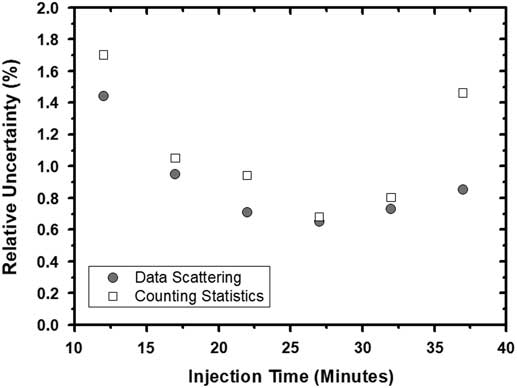
It can be seen that for injection times shorter than 27 min, both counting and scattering uncertainty decrease as the injection time increases. This is an indication that in this region the number of counted particles increases as the results of a higher yield of the source. For injection times longer than 27 min, the uncertainties increase for longer injection times indicating a reduced yield (and then counted 14C particles), while also the scattering of the data get worse as the results of the highly variable beam current. Overall in all the studied conditions, the scattering of the data is comparable to counting statistics indicating the capability of the AMS system to properly accept beam intensity which is variable in a quite wide range. The optimal conditions are found for injection times of the order to 25–27 min when counting and scattering statistics have essentiality the same value of 0.6–0.7%.
Blank Test
The following test was conducted to check the blank level achievable by the system. Twenty-three samples of unprocessed graphite (Alfa Aesar) with mass of 18 µgC were directly combusted in the EA. The measured isotopic ratios are given in Figure 3, all the measured value are in the range of 10–14 with an average value of 1.4×10⁻¹⁴ as 14C/12C, corresponding to ~35 ka in the 14C timescale. Further tests are planned in order to check whether these values can be improved by using different type of capsules in the EA or submitting them to further cleaning procedures.
Measured 14C/12C ratios for graphite samples from Alfa Aesar loaded in the EA without any processing.

These tests confirm that the system is capable of measuring samples containing micrograms of carbon with a precision of the order of 0.6–0.7% and with a blank level far in the 10–14 range.
Results on Grass Samples from an Industrial Area (Brindisi)
14C concentrations were measured in Cynodon Dactylon which is a C4 grass common in this area. All measurements were corrected for mass fractionation, background and 14C decay and expressed as Δ14C are shown in the upper panel of Figure 4 as a function of the distance from the industrial district in Brindisi. The average annual 14C concentration measured for Shauisland (Germany) in 2016 is shown as the clean air reference value (Hammer and Levin Reference Hammer and Levin2017). It can be seen that a clear pattern in the measured 14C concentration can be highlighted. In a first area, which is close to the industrial district, the 14C concentration decreases with the distance reaching a minimum at a distance of about 10 km from the sources. For larger distances, the measured 14C concentration increases with the distance until reaching a value undistinguishable from background at about 14 km from the different possible sources present in the industrial district. The measured pattern corresponds to the distribution of fossil, 14C depleted carbon dioxide from the sources in the industrial district and overlaps very well with the pattern measured in 2005 (Quarta et al. Reference Quarta, D’Elia, Rizzo and Calcagnile2005) and 2007 (Quarta et al. Reference Quarta, Rizzo, D’Elia and Calcagnile2007).
Measured 14C concentration (upper panel) and δ13C values (lower panel) for grass leaf samples as a function of the distance from the industrial district in Brindisi, southern Italy.

Together with the 14C concentration, the stable carbon isotopic ratios were measured by IRMS and the results are also shown in the lower panel of Figure 4. The δ13C term ranges from –15.1 to –14.0‰ with an average value of –14.9±0.5‰, which is a value typical of plants with a C4 photosynthetic pathway. The measured value overlaps within one standard deviation with the values measured in 2005 (Quarta et al. Reference Quarta, D’Elia, Rizzo and Calcagnile2005) in the same area with an average δ13C value of –14.9±0.6‰.
CONCLUSIONS
The integrated AMS-IRMS setup installed at CEDAD and based on an hybrid sputtering source is capable of accepting solid and gas samples and is now fully operational and shows reproducible results. The optimization of different parameters such as the pressure in the gas feeding syringe, the diameter of the glass capillary and the injection time allowed us to obtain uncertainty levels of ~0.6% in the measurement of the 14C concentration in samples containing less than 20 µg of carbon. Machine blank levels at the limit of 10–15 have been also demonstrated by measuring 14C-free unprocessed graphite. The new system allows also to significantly reduce the overall processing times of the samples since the combustion, cryogenic purification and graphitization steps are not needed anymore. This is particularly important when carrying out studies requiring the analysis of a large number of samples such as in environmental studies. As a first demonstration of the potential of the new system different grass leaves were sampled at different distances from the industrial district in Brindisi and analyzed to highlight the possible effects associated with the release of 14C-depleted carbon dioxide. The results indicate a clear pattern of 14C-depleted carbon dioxide that compares favorably with the results obtained in the same area previously using the “standard” graphite approach. Further studies are now being carried out, for instance for the determination of the fossil-biogenic fraction in carbonaceous airborne particles.
ACKNOWLEDGMENTS
The installation of the new IRMS/AMS system was part of the “IT@CHA” project financed by the Italian Ministry for Research and Education. We also wish to thank the group from Ion Beam Physics at ETH in Zurich (Prof. Dr. Hans-Arno Synal and Dr. Lukas Wacker) for collaborating with us on this project and for the helpful advice and stimulating discussions.



