Since 2003, reports of healthcare-associated epidemics of Clostridium difficile infection (CDI) have increased in Canada, the United States, and Europe, with increased associated morbidity and mortality due mainly to a hypervirulent strain known as NAP1/027.Reference McDonald, Killgore and Thompson 1 – Reference Lessa, Mu and Bamberg 4 Although CDI is traditionally considered a healthcare-associated infection (HAI), reports of community-associated CDI (CA-CDI) have been increasing in the last several years.Reference Chitnis, Holzbauer and Belflower 5 – Reference Noren, Akerlund and Back 8 An active population-based and laboratory-based CDI surveillance program in 8 US states revealed that among 984 patients with CA-CDI, 36% did not receive antibiotics and 18% had no outpatient healthcare exposure.Reference Chitnis, Holzbauer and Belflower 5 Furthermore, patients having CDI with minimal healthcare exposure were more likely to be exposed to infants and to household members with active CDI.Reference Chitnis, Holzbauer and Belflower 5
Individuals with asymptomatic carriage are defined as those who have C. difficile in their stool but have no diarrhea. Asymptomatic carriage with C. difficile ranges between 7% and 11% of adult inpatients in acute care facilities.Reference McFarland, Mulligan, Kwok and Stamm 9 , Reference Samore, DeGirolami, Tlucko, Lichtenberg, Melvin and Karchmer 10 Notably, infants and children are more likely to carry C. difficile asymptomatically in the gastrointestinal tract than adults.Reference Wendt, Cohen and Mu 11 – Reference Kociolek, Patel, Shulman and Gerding 13 Within the household, it is unknown whether asymptomatic carriage can occur among contacts and whether they are potential sources for reinfection for the index case as well as for transmission to other household members.
Animals may also contribute to C. difficile environmental contamination and may be a source of infection to humans. Carriage of C. difficile by household pets, notably dogs and cats, was also found to be common (23%) although carriage tended to be transient.Reference Borriello, Honour, Turner and Barclay 14 However, C. difficile strains in humans and pets within the same household have not been studied together.
Transmission of CDI to household contacts has been described but was not supported by strain analysis.Reference Baishnab, Banfield, Jones, Scott, Weightman and Kerr 15 Index cases who remain infected or colonized with C. difficile may be a reservoir for household members and pets, leading to CA-CDI. The aim of this study was to document the risk of transmission of C. difficile from index cases to their household contacts, including pets, in a prospective systematic manner in conjunction with analysis of C. difficile isolates.
METHODS
A prospective study was performed from April 2011 to June 2013 in 3 tertiary care hospitals in Montreal, Québec, Canada. The inclusion criteria were as follows: patients aged 18 years and older with recent CDI, defined as a diagnosis within 2 weeks of anticipated hospital discharge or as an outpatient (the “index case”), and household members of these patients. Index cases had to have at least 1 human household contact defined as an individual of any age who spent at least 7 hours/day at least 1 day per week in the same home with the index case. Household pets, notably mammals or birds, were also included in the study. All human participants gave written informed consent; parents consented on behalf of their children. Index cases were excluded if they resided >40 kilometers from the greater Montreal area or if they were not discharged home directly from the hospital.
For the index case and all household contacts, demographic information, data on risk factors and potential confounding factors, and information on the average time spent in the index household per week were collected at the time of enrollment and monthly for 4 months.
Stool samples were obtained at the first home visit and then monthly for 4 months. A rectal swab inserted past the anal verge was obtained if a stool sample could not be procured on the scheduled visit.Reference Kundrapu, Sunkesula, Jury, Sethi and Donskey 16 Stool or rectal swab samples were subjected to alcohol shock.Reference Clabots, Gerding, Olson, Peterson and Gerding 17 The mixture was inoculated onto Clostridium difficile moxolactam norfloxacin agar and incubated at 35°C for 48 hours under anaerobic conditions.Reference Aspinall and Hutchinson 18 Isolates were confirmed to be C. difficile using standard methods. A laboratory-developed C. difficile tcdB gene polymerase chain reaction (PCR) assay was performed on all C. difficile isolates to determine whether they were toxigenic. In a separate study, the laboratory-developed C. difficile tcdB gene PCR assay was compared against the BD GeneOhm C. diff PCR assay (Becton-Dickinson Diagnostics, Québec, Canada) using 1,186 unique consecutive stool samples. This laboratory-developed test has a sensitivity of 97.6%, a specificity of 99.7%, a positive predictive value of 98.2%, and a negative predictive value of 99.6%. Pulsed-field gel electrophoresis (PFGE) was performed, and strain relatedness was determined using the criteria of Tenover et al and with the use of BioNumerics (Applied Maths).Reference Fawley and Wilcox 19 , Reference Tenover, Arbeit and Goering 20
A positive contact was defined as a household contact having a stool or rectal swab culture that grew C. difficile. Probable transmission was defined as the conversion of a C. difficile culture–negative contact to C. difficile culture–positive contact with an indistinguishable or closely related PFGE pattern as the index case. Possible transmission was defined as a household contact with a positive C. difficile culture at the first baseline home visit and having a PFGE type indistinguishable from or closely related to that of the index case.
Results were analyzed using SAS 9.4 statistical software. A Yates-corrected χ2 test was used for the analysis of proportions. If the cell value was <5 in the 2×2 table, Fisher’s exact test was used. All P values were 2-sided.
Ethical approval was granted by the McGill University Institutional Review Board.
RESULTS
Study Population
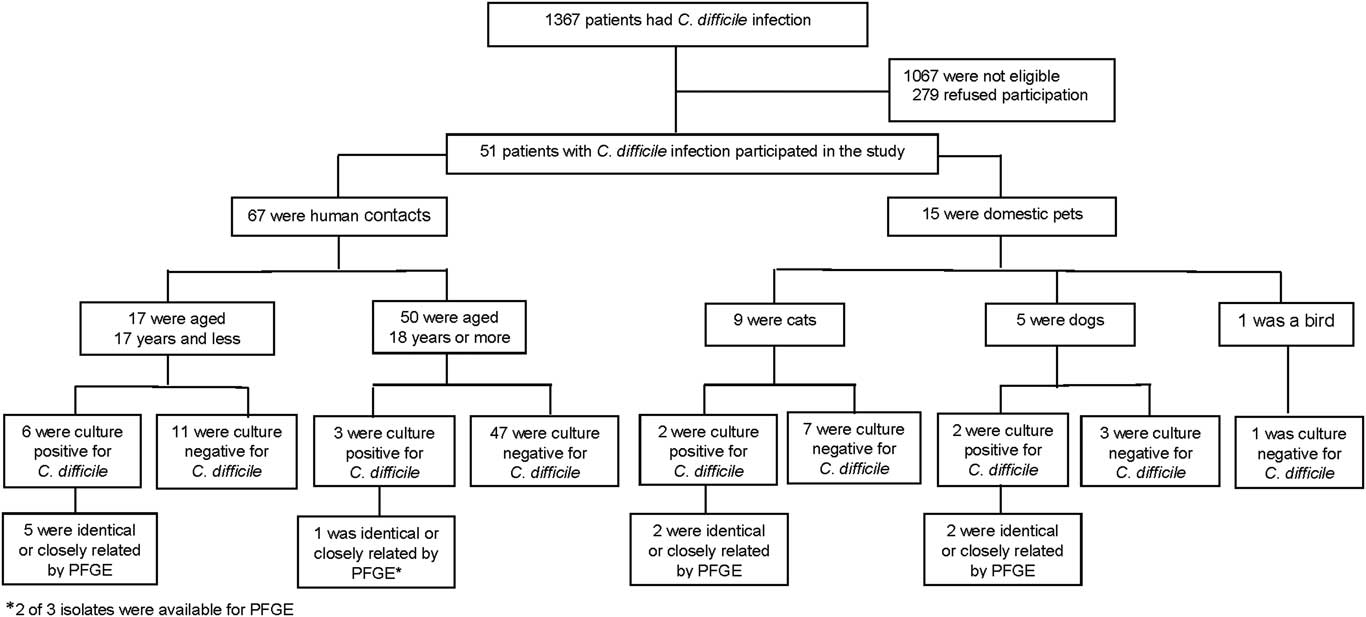
Of the 1,397 patients with CDI, 1,067 (76.4%) were excluded from the study: 662 (47.4%) were not directly going home, 160 (11.4%) lived alone, 128 (9.2%) lived too far from the hospital, and 117 (8.4%) were deemed palliative or were unable to give consent. Figure 1 shows the patient enrollment and overall results. Among the 330 eligible patients, 51 patients (15.4%) agreed to participate in the study. Among the 51 index cases with CDI, 31 (60.8%) were female and 20 (39.2%) were male; the average age was 61 years (range, 32–96 years). In total, 41 patients (80.4%) completed 3 or more follow-up visits; 39 patients (76.5%) were diagnosed during their hospitalizations; and 12 (23.5%) patients were diagnosed in hospital clinics.
Flow chart of index cases and their household contacts.

In total, 212 stool samples (45.3%) and 256 rectal swab samples (54.7%) were collected. Among the index case patients, 29 of 51 (56.8%) were still positive for toxigenic C. difficile at least once during the follow-up home visits, whereas 22 index cases (43.1%) were C. difficile culture negative. The average time from when the index case was first diagnosed as having CDI to the first household visit was 23 days.
Among 67 total household contacts, 6 (9.0%) were <1 year of age; 11 (16.4%) were aged 1–17 years; 50 (74.6%) were 18 years or older; 31 (46.3%) were female; and 36 (53.7%) were male. Household contacts ranged from 1 to 4 members; 38 of households (74.5%) had a single contact. In addition, 1 contact had a history of CDI 6 months prior to the index case having CDI but was no longer receiving treatment for CDI.
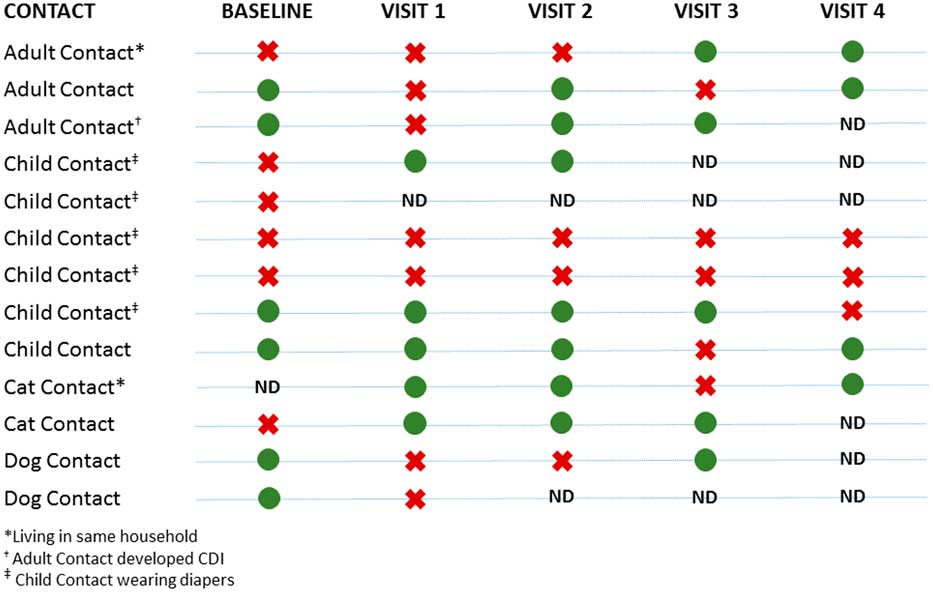
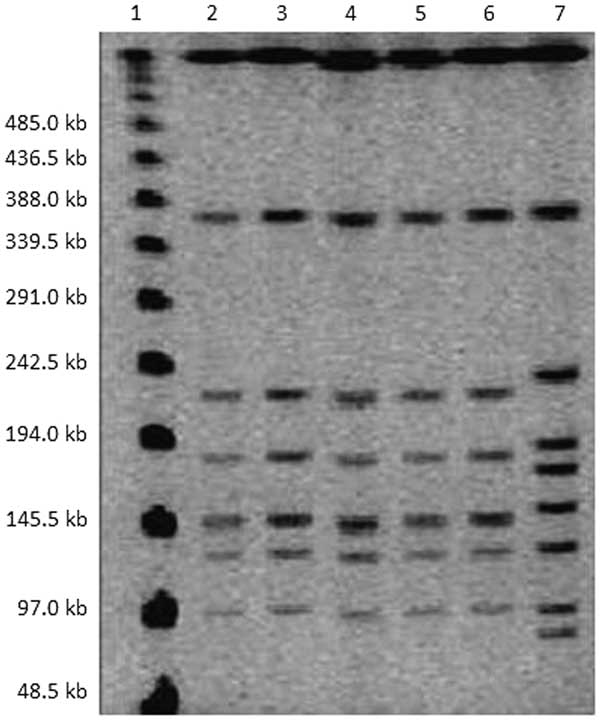
Of 67 human household contacts, 9 (13.4%) were culture positive for toxigenic C. difficile at a follow-up visit. Among the 9 C. difficile culture–positive contacts, 7 of the respective index cases were C. difficile culture positive at baseline and/or follow-up visits while 2 of the respective index cases were C. difficile culture negative at all visits. Figure 2 presents C. difficile culture positivity by visit for households where at least 1 C. difficile positive culture (human or animal) occurred. Among the 9 household contacts with at least 1 positive C. difficile positive culture, 4 patients had negative baseline C. difficile cultures and then converted to positive cultures on subsequent visits. Only 1 patient had an isolate that had an indistinguishable PFGE pattern to that of the index case indicating probable transmission; 2 household contacts had isolates with PFGE patterns different from their respective index case, and 1 other patient’s isolate failed to grow on subculture for PFGE analysis. The remaining 5 C. difficile culture–positive contacts were already positive at the baseline visit, and directionality of transmission from the index case to the contacts could not be established. For each of these 5 patients, the PFGE patterns of their isolates were indistinguishable or were closely related to that of their respective index case. Of the 3 adult contacts, 1 contact developed CDI; none of the pediatric contacts developed CDI. Persistent C. difficile colonization was observed in 2 children. Figure 3 shows an example of the PFGE patterns that were indistinguishable among the index case, human contact and pet contact living in the same household.
Clostridium difficile culture positivity, by visit and household, where at least 1 positive culture was documented in a human contact or domestic pet. Red X indicates toxigenic C. difficile culture positive; green circle indicates toxigenic C. difficile culture negative; ND, not done.

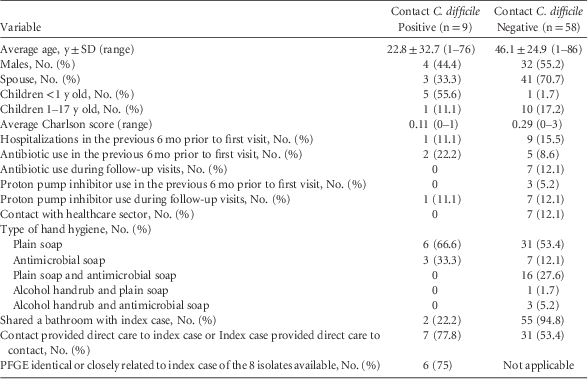
Table 1 compares the household contacts who were culture positive for toxigenic C. difficile with those contacts who were negative. A statistically significant difference was detected in the percentage of household contacts who were <18 years old among the C. difficile culture–positive contacts compared with those who were negative (66.6% vs 19.0%; P=.006). Stated differently, 3 of the 50 adult contacts (6.0%) and 6 of the 17 pediatric contacts (35.3%) were culture positive for C. difficile (P=0.006). Among the 6 C. difficile culture–positive pediatric contacts, all were <5 years old. A trend toward more antibiotic use was observed in the 6 months prior to the first visit among the positive contacts compared to those who were negative, but this trend did not reach statistical significance (22.2% vs 8.6%; P=.23). Furthermore, a higher percentage of direct care was being provided from index case-to-contact or contact-to-index case among the positive contacts than for those who were negative (77.8% vs 53.4%; P=.28). C. difficile culture–positive contacts shared the bathroom with the index case less often than negative contacts (22.2% vs 94.8%, P=.0001). However, of the 9 C. difficile culture–positive contacts, 5 (55.6%) were in diapers. There were no statistically significant differences in gender, previous hospitalizations, PPI use, and type of hand hygiene practice between C. difficile culture–positive or –negative household contacts.
Comparison of Household Contacts by Toxigenic C. difficile Status

NOTE. SD, standard deviation; PFGE, pulsed-field gel electrophoresis.
Domestic Pets
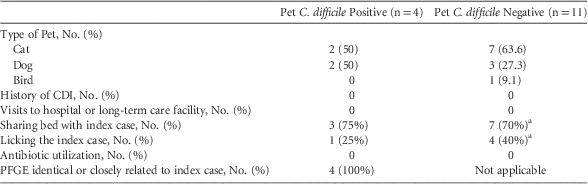
Our study included 15 domestic pets: 9 cats, 5 dogs, and 1 bird. Of these, 2 cats and 2 dogs were culture positive for C. difficile during follow-up visits. Probable transmission occurred in 3 of the 4 domestic pet contacts, whereas 1 cat was already C. difficile culture positive at the baseline visit, consistent with possible transmission (Fig. 2). PFGE indicated that all 4 domestic pet isolates were indistinguishable from those of their respective index cases. Household pets that were found to have toxigenic C. difficile on culture are compared with pets that were culture negative in Table 2. No statistically significant differences were detected in type of pet, history of CDI, antibiotic utilization, visits to hospital or long-term care facility, sharing a bed with the index case, or licking the index case among C. difficile culture–positive or –negative household domestic pets.
Comparison of Household Domestic Pets by Toxigenic Clostridium difficile Status

NOTE. CDI, C. difficile infection; PFGE, pulsed-field gel electrophoresis.
a Bird excluded from denominator
DISCUSSION
We report the results of a systematic prospective surveillance of household contacts of patients with CDI. Among adult and pediatric household contacts, the proportion of toxigenic C. difficile culture positivity was high at 13.4%. The same PFGE pattern as the index case was demonstrated among 6 of 8 contacts (75%) for whom isolates were available, which suggests household transmission. Probable transmission could be confirmed for 1 of 67 household contacts because this study participant had an initial stool or rectal culture that was negative for C. difficile. For the remaining 5 household contacts, the directionality of C. difficile transmission could not be firmly established because their initial baseline stool or rectal swabs were already positive for toxigenic C. difficile. It is possible that the household contacts acquired C. difficile from the index cases, and it is conceivable that they may have transmitted C. difficile to the index cases who later became ill with CDI. All of the toxigenic C. difficile culture–positive household contacts remained asymptomatic except for 1 adult contact who developed CDI. The majority of household contacts had transient C. difficile carriage.
Similar to what has been reported in the literature, our study showed that pediatric contacts were more likely to be asymptomatically colonized than adult contacts. It has been demonstrated that asymptomatic carriers contaminate the environment, albeit, less intensively than symptomatic patients.Reference McFarland, Mulligan, Kwok and Stamm 9 In our study, the infants who were asymptomatic carriers could have been sources of reinfection for the index case as well as for other household members. Often, the index cases in our study provided direct care to their infants, which included diaper changes. From cultures of single stool samples, it is estimated that 15%–50% of neonates, 3%–33% of infants and toddlers <2 years of age, and up to 5% of children >2 years of age can harbor C. difficile asymptomatically.Reference Wendt, Cohen and Mu 11 , Reference Kociolek, Patel, Shulman and Gerding 13 In a small longitudinal study of 10 infants in whom serial monthly C. difficile cultures were performed over 1 year, colonization occurred in all 10 infants.Reference Rousseau, Poilane, De Pontual, Maherault, Le Monnier and Collignon 21 Among them, 4 infants were colonized with a toxigenic strain, and 3 infants were colonized for 4–9 months.Reference Rousseau, Poilane, De Pontual, Maherault, Le Monnier and Collignon 21
We found that 26.7% of pets had asymptomatic carriage of C. difficile, whereas other studies have reported C. difficile carriage ranging from 10% to 39% among household pets.
C. difficile carriage does not appear to be associated with gastrointestinal illness among pets.Reference Borriello, Honour, Turner and Barclay 14 , Reference O’Neill, Adams, Bowman and Riley 22 , Reference Weese, Finley, Reid-Smith, Janecko and Rousseau 23 Shaughnessy et al investigated environmental contamination as well as transmission to humans and pets in households of patients with recurrent CDI.Reference Shaughnessy, Bobr and Kuskowski 24 Their results indicated that among 9 household human members, 1 had asymptomatic C. difficile carriage and none of the 8 pets were positive for C. difficile. These results differ from ours and could be explained as follows: (1) The proportion of index cases who remained C. difficile culture positive at least once during the household visits was higher at 56.8% in our study than the 25% in the study by Shaughnessy et al. This higher proportion of index-case C. difficile culture positivity may indicate increased risk of transmission to household human contacts and pets. (2) The follow-up in our study was more systematic and longer because we conducted household visits at baseline and monthly for 4 months, whereas only 1 visit was performed in the study by Shaughnessy et al. The longer follow-up in our study permitted a more precise determination of the risk of transmission to human contacts and pets. Furthermore, our study is unique in that it examined the strain relatedness between human and animal strains within the same household. All 4 pets found to be positive for toxigenic C. difficile had PFGE profiles indistinguishable or closely related to that of the index case, suggesting interspecies transmission between humans and animals. Pets can become reservoirs for reinfection of the index case or for transmission to others in the household.
Several national advisory organizations recommend that index cases observe normal personal hygiene precautions such as hand-washing after using the toilet and not sharing toilets if possible when they are discharged home. Alcohol-based antiseptics are popular due to their ease of use and effectiveness in reducing hand carriage of most vegetative bacteria and viruses. However, C. difficile spores are known to be resistant to killing by alcohol. In our study, more than 80% of households used hand-washing with plain or antimicrobial soap as the main method of hand hygiene. This could have led to decreased transmission of C. difficile spores to household members. The majority of our household contacts had to share a bathroom with the index case because of the lack of additional bathrooms in their homes. C. difficile culture–positive contacts were less likely to share a bathroom with the index case than the C. difficile culture–negative contacts. This could be explained by the fact that 5 of the 9 C. difficile culture–positive contacts (55.6%) were infants using diapers.
Using a database of all CDI cases detected through laboratory assays, Pepin et al estimated that the rate of secondary cases of CDI among household contacts was 4.7 per 1,000 for spouses and 5.99 per 1,000 for children.Reference Pepin, Gonzales and Valiquette 25 However, the study did not examine C. difficile carriage among household members and did not perform molecular typing to confirm the linkage of the cases. In a study of 984 patients with CA-CDI, patients with absent or low level healthcare exposure were more likely to be exposed to infants younger than 1 year old and to household members with active CDI.Reference Chitnis, Holzbauer and Belflower 5 However, these children were not evaluated clinically, and molecular typing was not conducted among the patients and the household members.
An important limitation of our study was the low participation of approximately 15%. We were not permitted to obtain clinical information from nonparticipants; hence, we were unable to determine whether there were clinical determinants or bias associated with household transmission. In addition, PFGE is not as discriminatory as whole-genome sequencing (WGS) to detect single-nucleotide polymorphisms and may have overcalled isolates as being indistinguishable or closely related.Reference Salipante, SenGupta, Cummings, Land, Hoogestraat and Cookson 26 However, WGS technology is not yet widely available for many laboratories. Our study has many strengths. It is the only prospective study that has established an epidemiological link between index cases and household contacts, both human and animal, with respect to C. difficile transmission and carriage. In addition, we have confirmed interspecies transmission of C. difficile between humans and pets, supported by molecular typing results.
In summary, among human household contacts of CDI cases, there was a high proportion of C. difficile culture positivity (13.4%), and carriage by domestic pets reached 26.7%. Of 9 human contacts, 8 remained asymptomatic and 1 developed CDI. Probable and possible household transmission occurred in 6 of 67 household contacts (9.0%). These data suggest that household transmission from index cases with CDI may be responsible for an ecological reservoir from which CA-CDI cases may arise.
Pulsed-field gel electrophoresis fingerprints of C. difficile isolates using SmaI restriction enzyme digestion. Lane 1, concatamerized λ molecular-weight marker; lanes 2, 3, 4 isolates from index case at monthly sampling: at baseline, visit 2, and visit 3 respectively; lane 5, isolate from household contact number 1 on visit 1; lane 6, isolate from household animal contact (cat); lane 7, unrelated C. difficile NAP1 strain.

ACKNOWLEDGMENTS
The authors would like to thank the patients and their families for participating in this study and for allowing the investigators into their homes.
Financial support. This work was supported by research grants from Infection Prevention and Control Canada, McGill University Health Centre Research Institute and the Department of Medicine Clinical Research Fund of the Jewish General Hospital in Montreal. The funding sources had no role in the design and conduct of the study; the collection, management, analysis, and interpretation of the data; or the preparation, review, or approval of the manuscript.
Potential conflicts of interest. Dr Loo has served on the scientific advisory boards of Merck and Otsuka Pharmaceuticals, Inc and has received honoraria from Merck for serving as a speaker. Dr Miller has served on the scientific advisory boards of Actelion, Iroko, The Medicines Co., NuQure, Optimer, Pfizer, Merck, Salix, and Sanofi; he has received research support from Actelion, Cubist, Merck, and Optimer; and he has been an employee of bioMerieux since October 2012. Dr Brassard has no potential conflict of interest to disclose.