1 Introduction
This article examines variation and change within the future temporal reference (FTR) system of English. The synchronic layering of variants represents different stages of its development offering the analyst a means to test the contemporary reflexes of diachronic change and the mechanisms which underlie such change. Contemporary variation in English FTR has been argued to reflect earlier and, in some cases, continuing, processes of grammaticalization – a type of language change in which lexical elements develop grammatical function (inter alia, Hopper & Traugott Reference Hopper and Traugott2003; Bybee, Perkins & Pagliuca Reference Bybee, Perkins and Pagliuca1994). Because of its attention to competing variants and the ability to model multidimensional correlates in corpus data, variationist methods are suited to the task of examining such grammaticalization and/or the suite of associated changes that are theorized to take place during the grammaticalization process. To date, most studies have examined English FTR in written sources (e.g. Nesselhauf Reference Nesselhauf2012) or abstracted away from social factors to focus on grammatical developments (e.g. Torres Cacoullos & Walker Reference Torres Cacoullos and Walker2009; Poplack & Tagliamonte Reference Poplack and Tagliamonte2000; Tagliamonte, Durham & Smith Reference Tagliamonte, Durham and Smith2014). However, as Janda (Reference Janda2001: 318) argues, to study the nature of grammaticalization, we need ‘sociolinguistically-oriented studies’ that consider how elements evolve (or not) over consecutive generations. Following Mair (Reference Mair, Lindqvist and Mair2004: 138) we approach the data with the expectations that ‘ongoing grammaticalization processes can be recognized and documented’ and that the study of the continuing evolution of apparently grammaticalizing forms beyond a single point in its history offers critical insight into our understanding of language change (Tagliamonte & Denis Reference Tagliamonte and Denis2010; Pichler & Levey Reference Pichler and Stephen2011; Denis Reference Denis2015). In this article, we offer a sociolinguistic perspective on English FTR by employing the variationist construct of apparent time (Bailey, Wikle, Tillery & Sand Reference Bailey, Wikle, Tinnery and Sand1991) which enables cross-generational analysis. The data come from the Toronto English Archive (TEA), a corpus of sociolinguistic interviews from Toronto, a large urban centre in Canada (e.g. Tagliamonte Reference Tagliamonte2006a, Reference Tagliamonte2012). Given that individuals in the corpus were born between 1911 and 1992, these materials are taken to mirror developments in the FTR system across most of the twentieth century.Footnote 2
While the grammaticalization of be going to (BGT) is said to have been ‘completed centuries ago’ (Mair Reference Mair, Hickey and Puppel1997: 1538), its share of the system has been increasing in recent history (e.g. Mair Reference Mair, Hickey and Puppel1997; Leech et al. Reference Leech, Hundt, Mair and Smith2009: 141; Tagliamonte et al. Reference Tagliamonte, Durham and Smith2014). Quantitative studies have demonstrated that this expansion is particularly gradual. Tagliamonte & D'Arcy (Reference Tagliamonte and D'Arcy2009: 80, table 3) show that BGT has risen to approximately half of FTR markers in Toronto. What is propelling this trajectory? Further, what can this large, sociolinguistically stratified archive of spoken data tell us about the underlying mechanism of change in English FTR in time and place?
1.1 Expressing future temporal reference
English FTR can be expressed with modals, will, shall, as in (1) and (2), a group of periphrastic verbal constructions, be going to, be about to, be fixing to, (3) and by bare present and progressive forms, with no future morphology, futurates, as in (4).
(1) I still have some trips to Europe that I want to do, so I will be going back, probably sooner than later. (F/29)Footnote 3
(2) I think Legolas says ‘You shall die before you touch or strike Gimli!’ (F/14)
(3) I’m going to apply to pharmacy in Toronto. (M/18)
- (4)
(a) All I need is two more in-classes and I’m on the road. (F/16)
(b) Two of the three kindergarten teachers are retiring next year. (F/39)
In this article, we concentrate on the robust variation between will and BGT (and their allomorphs), as in (5).
- (5)
(a) [Have you seen their house?] No I haven't but I'm sure when I see it I’m gonna be green with envy because it’s gonna be everything I wanted. So I’ll just have to visit and get it through them. But we’re gonna get it, we've decided. When that time comes we’ll move downtown. (F/43)
(b) I mean I’ll absorb what’s gonna be beneficial to me. (M/72)
(c) No, well you won't. But you’re going to be sick to your stomach. (F/82)
The reason for this focus is twofold. First, these variants comprise the lion's share of FTR expression. Shall is obsolescent in North American English, apart from some formulaic expressions (e.g. shall we go?) (e.g. Williams Reference Williams, Aarts, Close, Leech and Wallis2014). In our corpus of approximately 3 million words, shall occured only five times. Additionally, futurates, while infrequent (less than 5 per cent), also seem to have a different distribution (if not semantics) from will and BGT (e.g. Visser Reference Visser1963/Reference Bailey1973; Huddleston & Pullum Reference Huddleston and Pullum2002: 131–3). For example, Copley (Reference Copley2009: 15–16) discusses the contrast in (6).
- (6)
(a) The Red Sox play/are playing the Yankees tomorrow.
(b) #The Red Sox defeat/are defeating the Yankees tomorrow.
(c) The Red Sox will/are going to play/defeat the Yankees tomorrow.
While futurates are licit in contexts in which future events are planned/scheduled, as in (6a), they are not available when the future event being described is not plannable, as in (6b). In contrast, both will and BGT are acceptable in either context, (6c).
While we leave aside futurates on the basis of their unique semantics, we must also acknowledge that will and BGT have been argued to convey different meanings, occupy different functional spaces, and have different morphosyntactic restrictions. Indeed in some contexts the forms are not interchangeable, as in (7) and (8).
- (7)
(a) Look out! That rock is going to fall!
(b) *Look out! That rock will fall! (based on Haegeman Reference Haegeman1989: 298)
- (8)
(a) If interest rates are going to climb, we'll have to change our plans.
(b) *If interest rates will climb, we'll have to change our plans.
(Hopper & Traugott Reference Hopper and Traugott2003: 3)
In other contexts, one or the other of will or BGT is nearly categorical, reflecting enduring semantic distinctions.Footnote 4 Copley (Reference Copley2009: 65) reports that for many speakers will more strongly conveys ‘intention’ than ‘pure prediction’. Compare a context of intention (9a) to a context of pure prediction (9b).Footnote 5
(9) I think that I’ll buy a new guitar tomorrow. . .
(a) . . .I've been meaning to do that for some time. intention
(b) . . .that's the kind of thing I might do on a Saturday. prediction
However, many linguists, for example Haegeman (Reference Haegeman1989), have argued that the forms, though pragmatically nuanced, are truth-conditionally the same. The strongest argument is that one cannot affirm (10a) while denying the truth of (10b) and vice versa.
- (10)
(a) I’ll send you an email tomorrow.
(b) I’m going to send you an email tomorrow.
Indeed, Binnick (Reference Binnick1971: 47) suggests that the ‘tantalizingly subtle differences’ between will and BGT are likely ‘matters of style and not of semantics’.
Thus, we begin with the assumption that differences between will and BGT are largely ‘neutralized in discourse’ (Sankoff & Thibault Reference Sankoff and Thibault1981; Sankoff Reference Sankoff and Newmeyer1988). An advantage of using variationist techniques is that this methodology excels at pinpointing those contexts in which forms are indeed interchangeable (or not) and, critically, is able to uncover the probabilistic tendencies where one or the other is favoured or disfavoured (Labov Reference Labov, Lehmann and Malkiel1982). This procedure can illuminate our understanding of how variants evolve and change and has been productively employed to study other tense, aspect, and modality variation in a variety of languages (e.g. Poplack & Turpin Reference Poplack and Turpin1999 and Wagner & Sankoff Reference Wagner and Sankoff2011 on French future tenses; Poplack & Tagliamonte Reference Poplack and Tagliamonte2001 on tense and aspect in Early African American English; Tagliamonte & D'Arcy Reference Tagliamonte and D'Arcy2007 on variation in deontic and epistemic modals in English). Following this approach, we conduct a systematic quantitative analysis of the constraints on the expression of FTR by will and BGT.
2 Change and grammaticalization of be going to and will
Competition between will and BGT has been underway since the fifteenth century; BGT has gradually risen in frequency (e.g. Danchev & Kytö Reference Danchev, Kytö and Kastovsky1994). While the form is on the rise, Szmrecsanyi (Reference Szmrecsanyi2003: 296) notes that ‘no matter what register and variety’, will out-numbers BGT in contemporary English. Yet, in recent studies of vernacular speech in North America, the two forms compete at near equal frequencies (e.g. Torres Cacoullos & Walker Reference Torres Cacoullos and Walker2009, Tagliamonte & D'Arcy Reference Tagliamonte and D'Arcy2009).
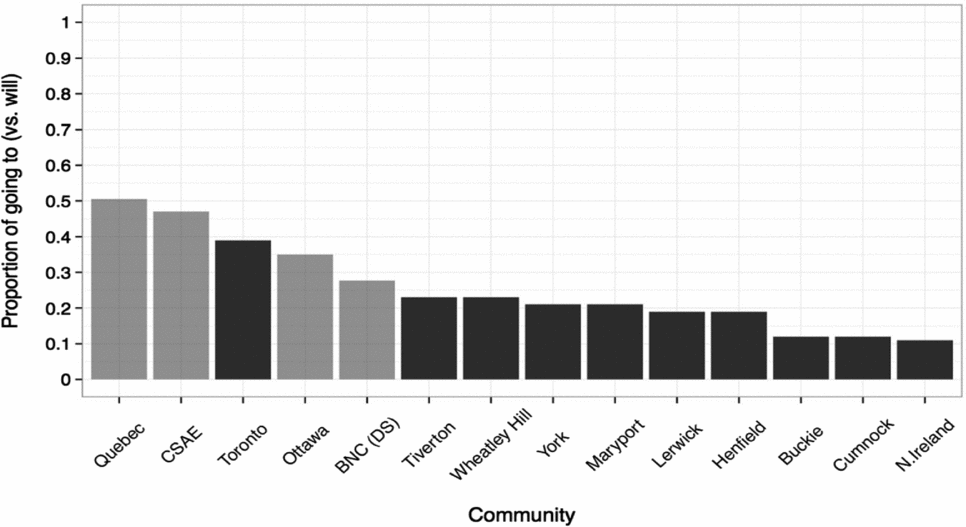
Figure 1 presents a compilation of the reported frequency of BGT (vs will) from a range of different studies. These data come from figures reported in Poplack & Tagliamonte (Reference Poplack and Tagliamonte2000; Ottawa), Szmrecsanyi (Reference Szmrecsanyi2003; Santa Barbara Corpus of Spoken American English, British National Corpus), Torres Cacoullos & Walker (Reference Torres Cacoullos and Walker2009; Quebec), Tagliamonte & D'Arcy (Reference Tagliamonte and D'Arcy2009), Tagliamonte (Reference Tagliamonte2012; Toronto) and Tagliamonte et al. (Reference Tagliamonte, Durham and Smith2014; for other British varieties). Dark bars represent data for speakers over 60 years old while pale bars represent the whole community.
Cross-variety comparison of the proportion of BGT in fourteen speech communities

Consistent with the reports in the literature (Wekker Reference Wekker1976; Berglund Reference Berglund1997; Mair Reference Mair, Hickey and Puppel1997; Szmrecsanyi Reference Szmrecsanyi2003; Tagliamonte et al. Reference Tagliamonte, Durham and Smith2014), figure 1 shows that BGT is more frequent in the North American varieties (Quebec, CSAE, Toronto and Ottawa) than in British varieties. Only in Quebec English is it more frequent than will.
This robust variation may be a case of what Kroch (Reference Kroch and Beals1994: 1) refers to as ‘morphological doublets’. Doublets are short lived; either one variant will win out over the other or the semantic/grammatical properties of the forms will become distinct (Kroch Reference Kroch and Beals1994: 8). If one form obsolesces, the prediction is that the rate of change across all contexts will be constant. For Kroch (Reference Kroch1989 et seq.), this Constant Rate Effect (CRE) is a reflection of the fact that competition is an artifact of a more abstract, underlying change in the grammar.Footnote 6 The prediction of constant constraints over time hinges on the assumption that the semantic and pragmatic nature of each variant also remains constant. However, differentiation of variants (i.e. specialization) may also occur. If so, the consequence is that particular forms will take on differentiating semantic or grammatical nuances and in so doing develop a different distributional footprint. Such a development will produce a trajectory distinct from the constant rate.
Specialization is widely attested in the literature on grammaticalization. Key processes underlying these shifts include semantic bleaching and pragmatic enrichment (Hopper & Traugott Reference Hopper and Traugott2003). Indeed, underlying the rising frequency of BGT since the fifteenth century are a suite of grammatical and semantic-pragmatic tendencies that have led to BGT becoming a definitive example of grammaticalization (e.g. Hopper & Traugott Reference Hopper and Traugott2003; Bybee et al. Reference Bybee, Perkins and Pagliuca1994). Its development embodies the hallmark mechanisms of grammaticalization: phonetic reduction ([gowɪŋtu] > [gʌnə]), decategorialization (lexical verb > auxiliary, little v or modal) (see Copley Reference Copley2009 for discussion of the syntax of BGT), and semantic-pragmatic change (movement > FTR). Two pathways of semantic development have been theorized for the grammaticalization of BGT. Hopper & Traugott (Reference Hopper and Traugott2003: 88–9) propose a metonymic shift in which the dual conversational inferences of ‘later time’ (indexed from go) and ‘intention’ (indexed from purposive to) are together semanticized for the expression of future. Others propose a shift from expressing actual motion of an agent, as in (11a), to movement towards a figurative goal, as in (11b), and lastly to pure prediction as in (11c) (e.g. Bybee, Perkins & Pagliuca Reference Bybee, Perkins and Pagliuca1994; Nesselhauf Reference Nesselhauf2012).
- (11)
(a) I hitchhiked east. Said, ‘Everybody's going west, I’m gonna go east.’ (M/55)
(b) We’re probably going to record like ten songs. (M/22)
(c) It’s going to ruin the neighbourhood. (M/29)
In both cases, the concept of intention is involved. It has also been suggested that BGT retains its movement sense in collocating with verbs of motion (e.g. go, come) (see Torres Cacoullos & Walker Reference Torres Cacoullos and Walker2009: 331). However, several studies have found no such connection (at least in Modern English) (Poplack & Tagliamonte Reference Poplack and Tagliamonte2000: 336; Roy Reference Roy2007; Tagliamonte Reference Tagliamonte, Chambers, Trudgill and Schilling-Estes2002: 754; Torres Cacoullos & Walker Reference Torres Cacoullos and Walker2009). The FTR sense of will also developed via grammaticalization, though along a different path, from a verb of desire/volition (Old English willan ‘to wish, want’) to willingness to intention to prediction (Bybee, Perkins & Pagliuca Reference Bybee, Perkins and Pagliuca1994: 254–7).
In sum, the historical trajectory and ongoing development of English FTR expressions, combined with our apparent-time perspective, allows us to probe questions about grammatical change. What is the difference between morphological doublet competition and semantic-pragmatic change associated with grammaticalization? Are these two possibilities antithetical, given that one predicts shifting trajectories over time and one predicts constancy? Finally, what is the applicability of the CRE with respect to a variable undergoing simultaneous multiplex linguistic processes involving different levels of grammar (syntax, semantics, morphology and phonology) and potentially different underlying mechanisms of change?
3 Methodology
3.1 Data
Our data come from the TEA, one of the largest corpora of vernacular speech from a socially stratified sample of a single speech community (Tagliamonte 2005 et seq.). The TEA comprises more than two hundred and fifty sociolinguistic interviews, mostly recorded in 2003 and 2004, with individuals born and raised in Toronto, Canada. Speakers range in age from 9 to 92 and are relatively evenly distributed by sex, education and occupation. The use of TEA makes this study of FTR concordant with other recent studies based on informal conversations from speakers born and raised in the same community (Poplack & Tagliamonte Reference Poplack and Tagliamonte2000; Tagliamonte Reference Tagliamonte, Chambers, Trudgill and Schilling-Estes2002; Torres Cacoullos & Walker Reference Torres Cacoullos and Walker2009; Tagliamonte et al. Reference Tagliamonte, Durham and Smith2014). Uniquely, this analysis of a subsample of 126 speakers is stratified by age, allowing us to draw inferences from apparent time regarding the ongoing evolution of English FTR.
Our analyses follow variationist methods; we focus on a single variable in a circumscribed envelope of variation (Labov Reference Labov1972; Poplack & Tagliamonte Reference Poplack and Tagliamonte2001; Tagliamonte Reference Tagliamonte2006b). Previous analyses of FTR in other Canadian English varieties showed that futurates are highly circumscribed to temporal clauses and scheduled events as in (12) (Poplack & Tagliamonte Reference Poplack and Tagliamonte2000: 318; Torres Cacoullos & Walker Reference Torres Cacoullos and Walker2009: 335). We exclude these from this analysis.
- (12)
(a) And he says, ‘You meet me next week.’ (F/74)
(b) So I’m going, the end of September, for sure. (M/16)
Shall is essentially non-existent in contemporary vernacular Toronto English, restricted to formal contexts and formulaic expressions, as in (13).
- (13)
(a) Yeah, and God said, ‘There shall be light.’ (F/82)
(b) There was a lot of emphasis on people who were anti-socialist shall we say, and not really ready to trust the NDP. (M/73)
Be about to is not considered in the present study as it strongly implies immediate futurity (Huddleston & Pullum Reference Huddleston and Pullum2002: 212). Consistent with earlier research, we also exclude future-in-the-past contexts, which constitute an independent variable system with distinct variable grammars and semantic contrasts (Poplack & Tagliamonte Reference Poplack and Tagliamonte2000: 334; Torres Cacoullos & Walker Reference Torres Cacoullos and Walker2009: 327; Copley Reference Copley2009), tag questions (e.g. Oh, you'll spoil my chances, will you?; Tagliamonte et al. Reference Tagliamonte, Durham and Smith2014), and fixed expressions such as I'll bet you. . . and we'll see.
This results in a dataset of 2,299 tokens, 1,260 will and 1,039 BGT (including all allomorphic realizations of both variants).
3.2 Predictors of variation
We embed this study in other variationist research in testing different hypotheses about grammatical development and change in FTR (Poplack & Tagliamonte Reference Poplack and Turpin1999; Torres Cacoullos & Walker Reference Torres Cacoullos and Walker2009; Tagliamonte et al. Reference Tagliamonte, Durham and Smith2014). First, we include in the variable context only those tokens that can be formulated with either form without a change in function. Second, we test five predictors (or factors) that have been theorized to correspond with various aspects of the grammaticalization of the variants of FTR or have been shown to correlate with the variable distribution of forms. We consider the syntactic context in which each token is embedded, coding each token for sentence type and clause type. We identify the temporal proximity of events to the utterance time as this has been implicated in the alternation. Likewise, implicated in the grammatical development of BGT is the nature of the main verb of FTR clauses (motion vs non-motion). The nature of the subject distinguishes nuances of volition and intention from pure prediction. To accountably distinguish dimensions of these meanings we also consider the interaction of grammatical person and the animacy of the subject (see Tagliamonte et al. Reference Tagliamonte, Durham and Smith2014: 19). We discuss each of these predictors in detail in the next section. Importantly, each predictor is underlain by an explicit hypothesis regarding the underlying grammatical mechanisms contributing to the evolution of English FTR.
As a general rule, ambiguous tokens and those that could not be straightforward coded for these predictors are left aside. That said, none of these predictors were onerous to annotate, except perhaps temporal proximity, which often required consideration of the broader discourse context.
4 Results
In the first half of this section we present a series of figures that plot the proportion of will vs BGT in apparent time with respect to each of the predictors. This analysis shows how the data are distributed and provide the first indication that different developmental processes – specialization, levelling and the stability of constraint rankings – are in progress simultaneously in the system. In the second half of this section we present the results of statistical modeling. The combined perspective of distributional and multivariate analysis leads to a comprehensive picture of twentieth-century developments in English FTR.
4.1 Distributions over time
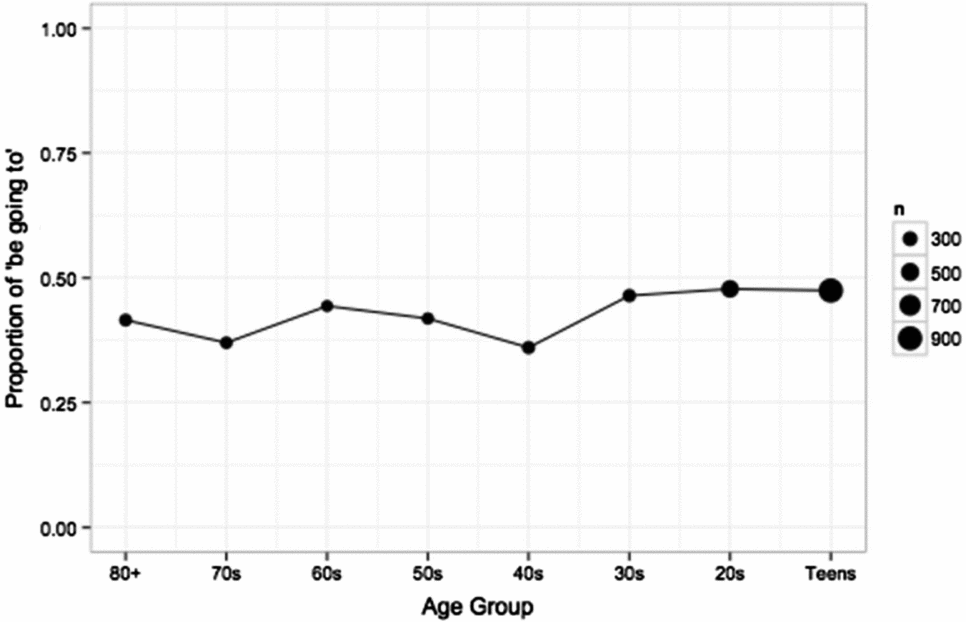
Figure 2 presents the overall apparent-time trajectory of BGT vs will (see also Tagliamonte & D'Arcy Reference Tagliamonte and D'Arcy2009: figures 6b, 7f, 8f).Footnote 7
Apparent-time trajectory of BGT vs will in the TEA. Circle size corresponds to the number of tokens in each age group

In this figure (and figures that follow), tokens are binned into age groups of ten years according to the age of the speaker.Footnote 8 The size of each circle corresponds to the number of tokens in each group; there is a roughly even distribution with about 200 tokens in each group, although the Teens category contributes the most with just over 900 tokens.Footnote 9
Figure 2 exhibits a flat pattern, which suggests diachronic stability; however, we know from Tagliamonte & D'Arcy (Reference Tagliamonte and D'Arcy2009: 86, table 5) that there is a statistically significant correlation between the frequency of BGT and speaker age. Indeed, the three youngest age groups use BGT at a frequency of 46 per cent while the older age groups have a frequency of 38 per cent. This confirms a slow but ongoing development consistent with the long-term trajectory of competition between BGT and will. However, this gradual trajectory belies a series of more rapid changes in the underlying grammar of FTR. By examining the interaction between speaker age (as a proxy for time) and each of our predictors, we are able to offer new insight into how the change to BGT has evolved over the twentieth century.
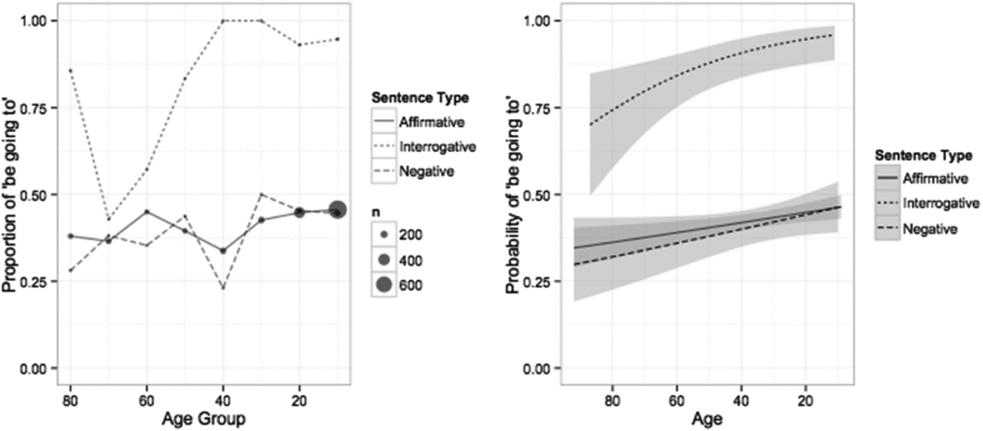
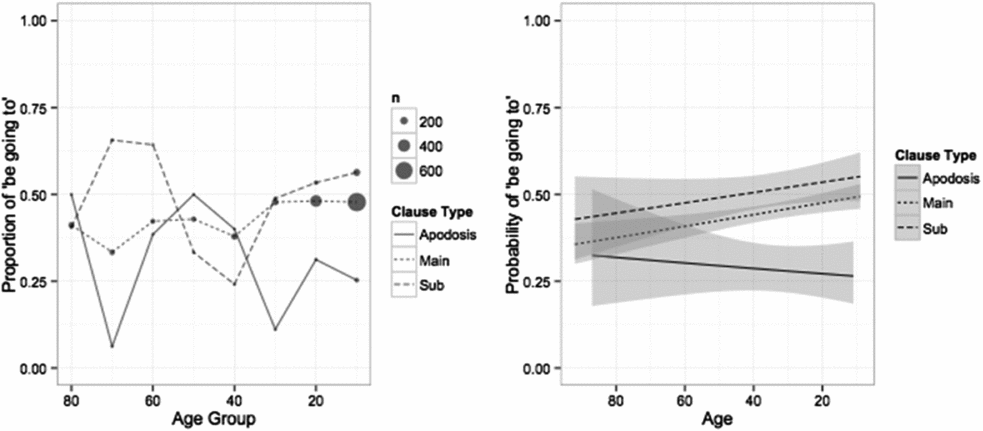
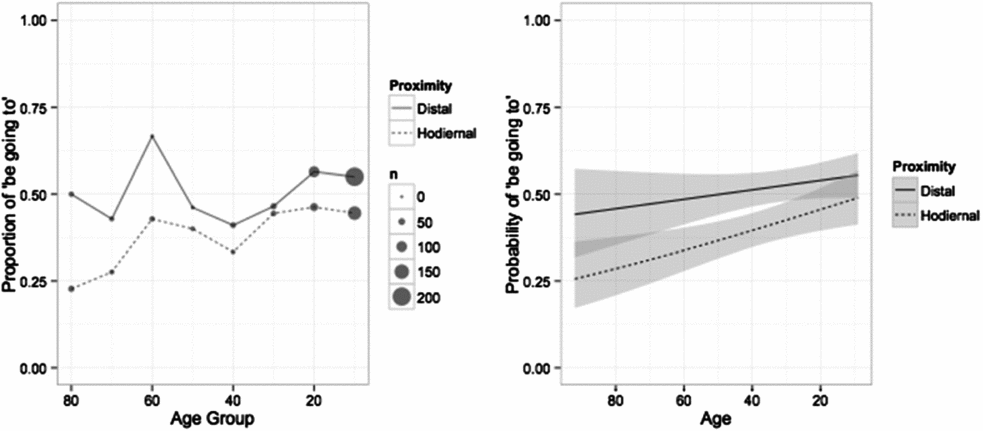
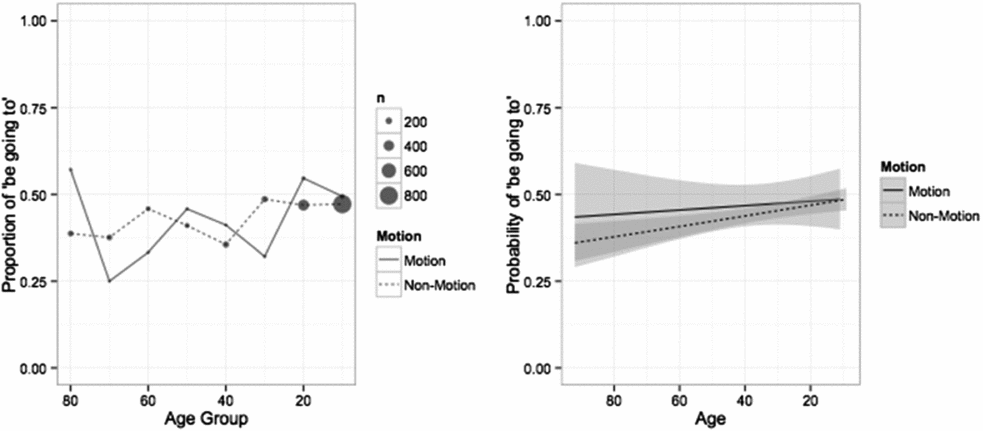
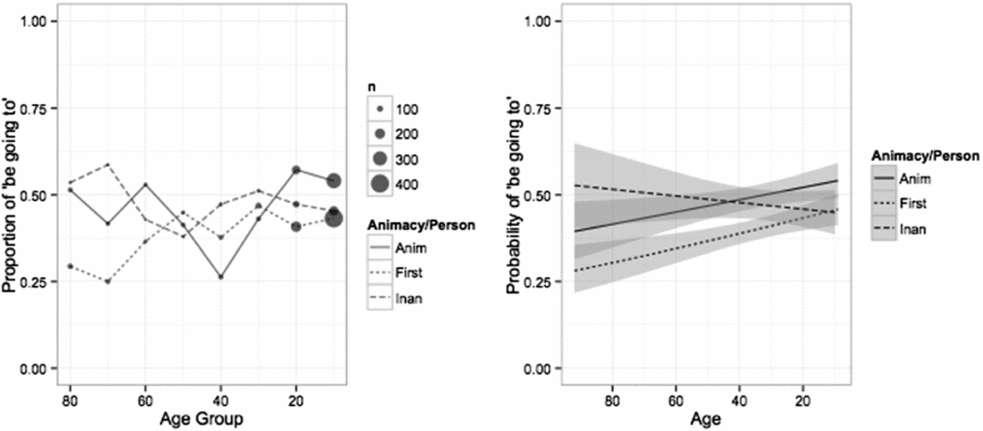
Figures 4–9 in sections 4.1.1–4.1.5 below each consist of two charts. The charts on the left plot the relative frequency of BGT (as a proportion of BGT and will) by age group. For each level of a predictor, we plot a separate line (distinguished by solid, dashed and dotted lines). The size of the circle plotted on the line for each age group corresponds to the number of tokens from that age group for that level of the predictor, providing an accountable view of the trajectory of each predictor over time. In the right-hand charts, we plot the binomial probability of BGT by the interaction of each predictor and speaker age. In this perspective, speaker age, ordered from oldest on the left to youngest on the right, is treated as a continuous variable (see Tagliamonte & Baayen Reference Tagliamonte and Baayen2012). Each line in these charts shows how the predicted probability of BGT in a particular context (i.e. a level of a predictor) varies as a function of speaker age.
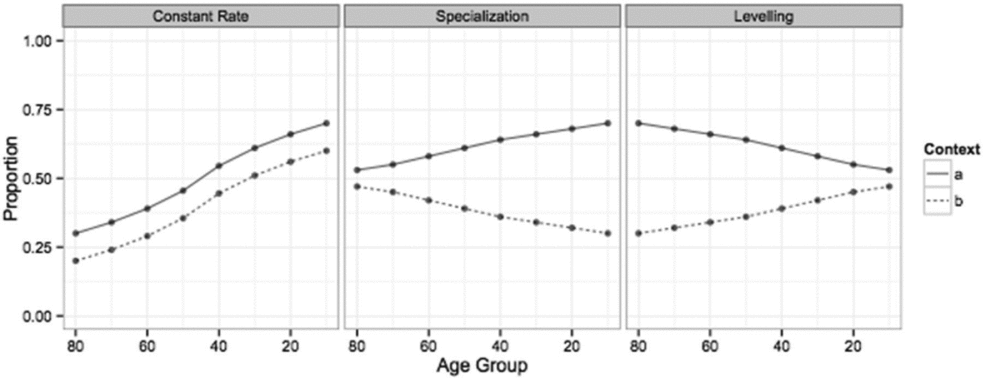
At least three types of change could underlie the trajectory in figure 2. Figure 3 demarcates these hypothetical trajectories, each indicative of a different process (see Tagliamonte Reference Tagliamonte2012: 76, 90).
Three hypothetical trajectories of change

In the first hypothetical trajectory, the probability of an innovation changes at a constant rate in each context. The intercept of the solid and the dashed contexts is offset, but the slope of change is the same. This is the trajectory consistent with the CRE (Kroch Reference Kroch1989, Reference Kroch and Beals1994). The second trajectory is consistent with semantic and/or grammatical specialization (Kroch Reference Kroch and Beals1994). In this case, the trajectories for each level of the predictor diverge, the result of one variant or the other becoming highly favoured in some context(s). This pattern is also consistent with specialization according to the grammaticalization literature: ‘the process of reducing the variety of formal choices available as the meanings assume greater grammatical generality’ (Hopper & Traugott Reference Hopper and Traugott2003: 116). A third possibility is the levelling or neutralization of a constraint. Here, the variants are ‘de-specializing’ so that the proportion of the variants in the two contexts become more like each other.Footnote 10 From a grammaticalization perspective, levelling is typically driven by semantic bleaching, which effectively removes the associations between variants and contexts.Footnote 11 With these possible patterns in mind, we turn to our analyses of each predictor, showing proportions on the left and probabilities on the right.
4.1.1 Sentence type
Sentence type is noted to have an effect on the realization of FTR (Berglund Reference Berglund1997; Szmrecsanyi Reference Szmrecsanyi2003; Torres Cacoullos & Walker Reference Torres Cacoullos and Walker2009; Tagliamonte et al. Reference Tagliamonte, Durham and Smith2014). We distinguish four sentence types: affirmative declaratives, negative declaratives, affirmative interrogatives and negative interrogatives. In figure 4 we plot the trajectories of affirmatives (n=1,806), negatives (n=264) and (affirmative) interrogatives (n=135) but exclude negative interrogatives from our analysis due to paucity of data (n=9). Berglund (Reference Berglund1997) and Szmrecsanyi (Reference Szmrecsanyi2003) argue that negative sentences, as in (14a), favour BGT, while others argue that BGT is favoured in interrogatives, as in (14b) (Torres Cacoullos & Walker Reference Torres Cacoullos and Walker2009; Tagliamonte et al. Reference Tagliamonte, Durham and Smith2014).
- (14)
(a) I’m not gonna say all Torontonians are tolerant. (M/73)
(b) Like who’s going to be the garbage men in the future? (M/16)
Proportion and probability of BGT by sentence type

Although the chart on the left in figure 4 plotting the proportions is uneven, a typical finding when numbers per cell are modest, the trends are clear in the chart on the right. Affirmative and negative sentences are not significantly different, as indicated by their overlapping trajectories; together the two contexts shift (albeit slowly) towards a higher probability of BGT among younger speakers. Thus, these data show no alignment with earlier reports on the favouring effect for negatives. Here, interrogatives are set apart from the non-interrogatives and the trajectory for this context is dramatically distinct from the overall trajectory for BGT. Even among the oldest speakers, BGT is highly favoured with interrogatives and this favouring effect increases over time to near-categorical.
Torres Cacoullos & Walker (Reference Torres Cacoullos and Walker2009: 343) argue that the retention of the ‘agent on a path toward a goal’ meaning of BGT means that it can be used in interrogative sentences that ‘inquire about already-decided intentions or plans’, e.g. are you going to wash the dishes?, and this contrasts with will which is used in interrogatives when inquiring about an addressee's future willingness, e.g. will you wash the dishes?. This may be related to the fact that BGT indicates ‘greater focus’ on the utterance time (Huddleston & Pullum Reference Huddleston and Pullum2002: 211). However, figure 4 indicates that interrogatives in general are specializing to BGT regardless of this subtlety.Footnote 12 Furthermore, while this pattern is evident in the apparent-time span of our data, there is reason to believe that the roots of this specialization trend may be even older. Whyte (Reference Whyte1944: 336–7) quotes Fries, writing in 1925, who observes that will in interrogatives is ‘rarely used’ while BGT is the ‘the first choice of the large majority’ for future interrogatives. Furthermore, in conservative, rural locales in the UK where BGT represents modest proportions of the FTR system, the trend towards BGT in interrogatives is already apparent and expands incrementally across incipient, active and vigorous varieties (as defined by Nevalainen & Raumolin-Brunberg Reference Nevalainen and Raumolin-Brunberg1996: 213–55) of BGT use (see Tagliamonte et al. Reference Tagliamonte, Durham and Smith2014: 96–7, figures 5–7). These observations suggest that specialization of BGT for interrogatives may have been present in earlier stages of grammatical development.
4.1.2 Clause type
A second linguistic predictor that has been implicated in the variable realization of FTR is clause type. Many researchers have observed that BGT is favoured in subordinate clauses, as in (15) (Poplack & Tagliamonte Reference Poplack and Tagliamonte2000; Szmrecsanyi Reference Szmrecsanyi2003; Torres Cacoullos & Walker Reference Torres Cacoullos and Walker2009; Tagliamonte et al. Reference Tagliamonte, Durham and Smith2014).
(15) Nobody told me that I’m going to be walking on a ledge with an elephant. (F/37)
This is potentially unexpected given Bybee's (Reference Bybee, Bybee and Noonan2001) argument that main clauses tend to foster grammatical innovation while subordinate clauses are conservative. That said, Bybee's (Reference Bybee, Bybee and Noonan2001) argument is primarily about early grammaticalization and would not be expected to apply in the present case. On the other hand, Leech (1971), Torres Cacoullos & Walker (Reference Torres Cacoullos and Walker2009) and Copley (Reference Copley2009) observe that BGT is disfavoured (or even barred) in apodosis clauses, as in (16).
(16) If we last until February then he’ll be my date. (F/16)
Apodosis and protasis clauses, which are subsets of main and subordinate clauses respectively, have been observed to behave differently from other main and subordinate clauses.
To test these hypotheses, we categorized four types: main clauses (n=1,701), subordinate clauses (n=422), apodosis (or the consequent clause in a conditional sentence, here defined as clauses introduced by if only) (n=176) and protasis (or the clause expressing the condition of a conditional) (n=26). The small number of protasis clauses were all BGT (see Huddleston & Pullam Reference Huddleston and Pullum2002: 211). These were excluded from further analysis.
Figure 5 shows that the main vs subordinate clause contrast is supported by our data. In comparison to main clauses (the dotted line), subordinate clauses (the dashed line) favour BGT and both increasingly disfavour will. In contrast, will is increasingly favoured in apodosis clauses. In this case, the trend is ongoing specialization. While we excluded the categorical protasis context, we note that its categorical nature is consistent with specialization as well.
Proportion and probability of BGT by clause type

4.1.3 Temporal proximity
The temporal proximity of the future event has been widely discussed as linked to the variation between BGT and will. In the grammaticalization literature, it has been argued that because BGT retains aspects of its earlier ‘purposive movement’ meaning, it is favoured with more proximal events (Hopper & Traugott Reference Hopper and Traugott2003: 89). However, as Torres Cacoullos & Walker (Reference Torres Cacoullos and Walker2009: 326) point out, as BGT further grammaticalizes, this association is expected to become bleached. Indeed, Tagliamonte et al. (Reference Tagliamonte, Durham and Smith2014: 99) report that a statistically significant effect of proximity is present only in speech communities where BGT has just begun to penetrate the grammar. By the time it reaches approximately 20 per cent of the system, the effect of proximity is gone. Others have argued that BGT and will are pragmatically distinct with respect to whether or not there is an implicature that ‘there are present indications or circumstances which suggest that something will happen’ (Wekker Reference Wekker1976: 128; cf. Haegeman Reference Haegeman1989). For example, Huddleston & Pullum (Reference Huddleston and Pullum2002: 211) note the contrast in (17); (17a) suggests that the dog will imminently take the roast, while (17b) lacks ‘the focus on matrix [clause] time’ (in this case interpreted as lack of immediacy).
- (17)
(a) The dog’s going to take the roast.
(b) The dog will take the roast.
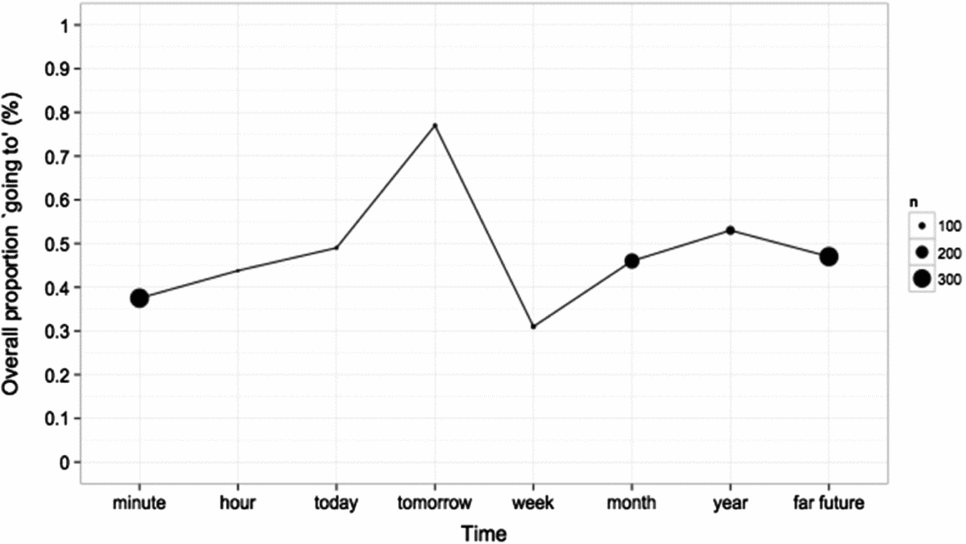
The temporal proximity of events and whether or not one expresses a focus on the matrix time are related by virtue of the rules of the world (i.e. we are more likely to have present indications about events that will happen in the more proximal future than in the more distal future). However, this correlation is not strict (Huddleston & Pullum 2003: 212). Indeed, Torres Cacoullos & Walker (Reference Torres Cacoullos and Walker2009: 330) observe no ‘straightforward linear correlation between degree of temporal proximity and any of the variants [of FTR]’. We replicate Torres Cacoullos & Walker's (Reference Torres Cacoullos and Walker2009) examination of temporal proximity and code each token for the proximity of the future event from matrix clause time (= speech time as we do not consider future-in-the-past contexts): within a minute, an hour, a day, tomorrow, within a week, a month, a year and beyond a year.Footnote 13 Figure 6 plots the overall proportion of BGT according to these eight temporal categories.
Overall proportion of BGT by temporal proximity breaks

Consistent with Torres Cacoullos & Walker (Reference Torres Cacoullos and Walker2009) and Tagliamonte et al. (Reference Tagliamonte, Durham and Smith2014), we find no correlation between proximity and the frequency of will and BGT. There is a surprising upswing in the frequency of BGT with crastinal (tomorrow) futures but otherwise the trajectory shows stability. A lack of temporal proximity distinctions could be the result of semantic bleaching of both variants (see Torres Cacoullos & Walker Reference Torres Cacoullos and Walker2009). However, consider the polar ends of the chart; the more proximal events have relatively lower rates of BGT, while more distal events have relatively higher rates. To assess the significance of this result, we partition the data into a binary predictor for proximity. This new predictor contrasts hodiernal events (happening today), as in (18a), with distal events (happening beyond today), as in (18b). This contrast is common in languages that distinguish temporal proximity morphologically (either in future or past tense) (Dahl 1984: 112–13).
- (18)
(a) This is my frivolous day. I’m going to play badminton. (F/78)
(b) He’ll be in grade four next year. (F/37)
Figure 7 shows the apparent-time trajectory of BGT with respect to the binary proximity effect. Across the age range of the TEA, distal futures favour BGT. This is the opposite effect from what is predicted for BGT if it retains its hypothesized ‘purposive movement’ sense. Furthermore, both distal and hodiernal future times are changing towards BGT. While Torres Cacoullos & Walker (Reference Torres Cacoullos and Walker2009: 326) suggest that this semantic nuance may be bleaching (or may have already been bleached), figure 7 suggests a change in line with the CRE across apparent time with BGT rising at a constant rate in both contexts.
Proportion and probability of BGT by temporal proximity

4.1.4 Verbs of motion
The fourth predictor we consider is whether the main verb is a verb of motion. There is some contention in the literature as to whether BGT’s collocation with go (and other motion verbs) indicates early or late grammatical development. While some researchers have argued for initial resistance to BGT with the verb go and an increase in this collocation over time (Poplack & Tagliamonte Reference Poplack and Tagliamonte2000: 335; see also Tagliamonte Reference Tagliamonte and McWhorter2000: 376–7), others have argued that a collocation with go is symptomatic of early grammaticalization (Torres Cacoullos & Walker Reference Torres Cacoullos and Walker2009: 331). These hypotheses can be tested by partitioning the data into two groups: verbs with no movement interpretation and verbs that embody motion as in (19).
- (19)
(a) I don't think I’m going to go tell my orthodontist. (F/17)
(b) You have to watch where you’re going to drive because it's very difficult to get back. (F/60)
(c) He said, ‘I’m gonna come and give you a hand with your books tomorrow.’ (M/85)
Figure 8 shows that there is no correlation according to verb type in any age group. This is consistent with Poplack & Tagliamonte's (Reference Poplack and Tagliamonte2000) analysis of Ottawa English as well as with Torres Cacoullos & Walker's analysis of Quebec English (Reference Torres Cacoullos and Walker2009: 338): both analyses revealed no effect of a verb of motion. Our data are silent on whether the lack of effect for verb type in Toronto is the result of earlier semantic bleaching (and thus the tail-end of a levelling trajectory) or if this effect was never present (see Roy Reference Roy2007). In either case, the recent development of this system does not involve verbs of motion one way or another.
Proportion and probability of BGT by type of verb (non motion vs motion)

4.1.5 Animacy and grammatical person
Our last predictors are the effects of animacy and grammatical person of the subject. These factors have been used to operationalize both the retention of volition (associated with will) and the retention of intention (associated with BGT by way of its early association with ‘purposive motion’) (see Torres Cacoullos & Walker Reference Torres Cacoullos and Walker2009: 331; Bybee et al. Reference Bybee, Perkins and Pagliuca1994: 255–6, 268–70). Because the two factors inherently overlap (first- and second-person subjects are always animate but third person can be either animate or inanimate), we combine them into a single predictor following Tagliamonte et al. (Reference Tagliamonte, Durham and Smith2014). First-person subjects, as in (20a), are predicted to imply the highest volition and intention, followed by other animate subjects, as in (20b), and lastly inanimates, as in (20c), which embody neither volition nor intention.
- (20)
(a) I’ll go trick-or-treating until I'm like uh twenty-four! (F/11)
(b) This beautiful naked woman is going to give me anything I want. (M/17)
(c) The slush is going to freeze around it. (F/75)
Notice that the hypotheses for this constraint are difficult to disentangle because both BGT and will are predicted to pattern with the same hierarchy – first-person > second/third-person animates > inanimates. Torres Cacoullos & Walker (Reference Torres Cacoullos and Walker2009: 332) argue that because BGT is the newer form, it should retain its sense of ‘purposive motion’/intention more strongly than will retains its sense of volition. In other words, will is hypothesized to be more semantically bleached in contemporary English. Thus BGT is predicted to be more favoured with agentive subjects (first-person subjects and animate subjects) than inanimate subjects. Will, which is assumed to be more semantically bleached, should show a levelled pattern across contexts, and thus, in contrast with BGT, is predicted to exhibit increasing use with inanimate subjects. In any case, shifts in the distribution of the variants across the levels of this predictor could indicate semantic bleaching within the timeframe of our data.
Figure 9 exposes a trajectory different from the previous four figures. Over the temporal period covered by these data, we observe reorganization. For older speakers, the hierarchy of constraints (first person > animate > inanimate) follows from the retention of volition with will; first-person and other animate subjects favour the older variant, evident here as lower probabilities for BGT in these contexts. This is contrary to Torres Cacoullos & Walker's (Reference Torres Cacoullos and Walker2009) hypothesis that the newer BGT will exert its semantic nuances more strongly than older will. However, this pattern is not consistent in apparent time. For the youngest speakers, the effect levels. This is consistent with ongoing semantic bleaching: BGT increases in probability for first-person and animate subjects and decreases in probability with inanimate subjects. We discuss the implications of this reorganization in section 5.
Proportion and probability of BGT by animacy and grammatical person of subject

4.2 Modelling the variation
To confirm the validity of these patterns we must ensure that they remain significant when all are treated simultaneously (i.e. over and above the combined effects of each other). Thus, multivariate analysis is required (Tagliamonte Reference Tagliamonte2006b). In this section, we test the significance of these patterns in a two-step analysis. First, we partition out (near-)categorical contexts – those contexts in which we observe disproportionate usage of BGT or will to the point of (near) specialization – using a conditional inference tree. Once it is confirmed that these contexts are outside the general scope of variation, we conduct a mixed-effects logistic regression to test the effects of the remaining predictors.
4.2.1 Conditional inference tree
Conditional inference trees are a non-parametric statistical model that ‘provide . . . estimates of the likelihood of the value of the response variable [in this case BGT vs will] on the basis of a series of binary questions about the values of predictor variables’ (Tagliamonte & Baayen Reference Tagliamonte and Baayen2012: 159). Conditional inference trees are particularly useful for visualizing the effect of multiple (potentially interacting) factors in data sets. We utilize a conditional inference tree to tease apart the contrast between near-categorical contexts (i.e. those that we have hypothesized to have specialized or to be undergoing specialization) and contexts in which BGT and will vary robustly. The hypothesis is that specialized contexts will be set apart in the conditional inference tree. An alternative possibility is that those contexts which appear to be specializing in figures 4 and 5 are the result of collinearity with other contexts that highly favour one or the other variant. In this scenario, the trajectory which we have attributed to specialization would be epiphenomenal.
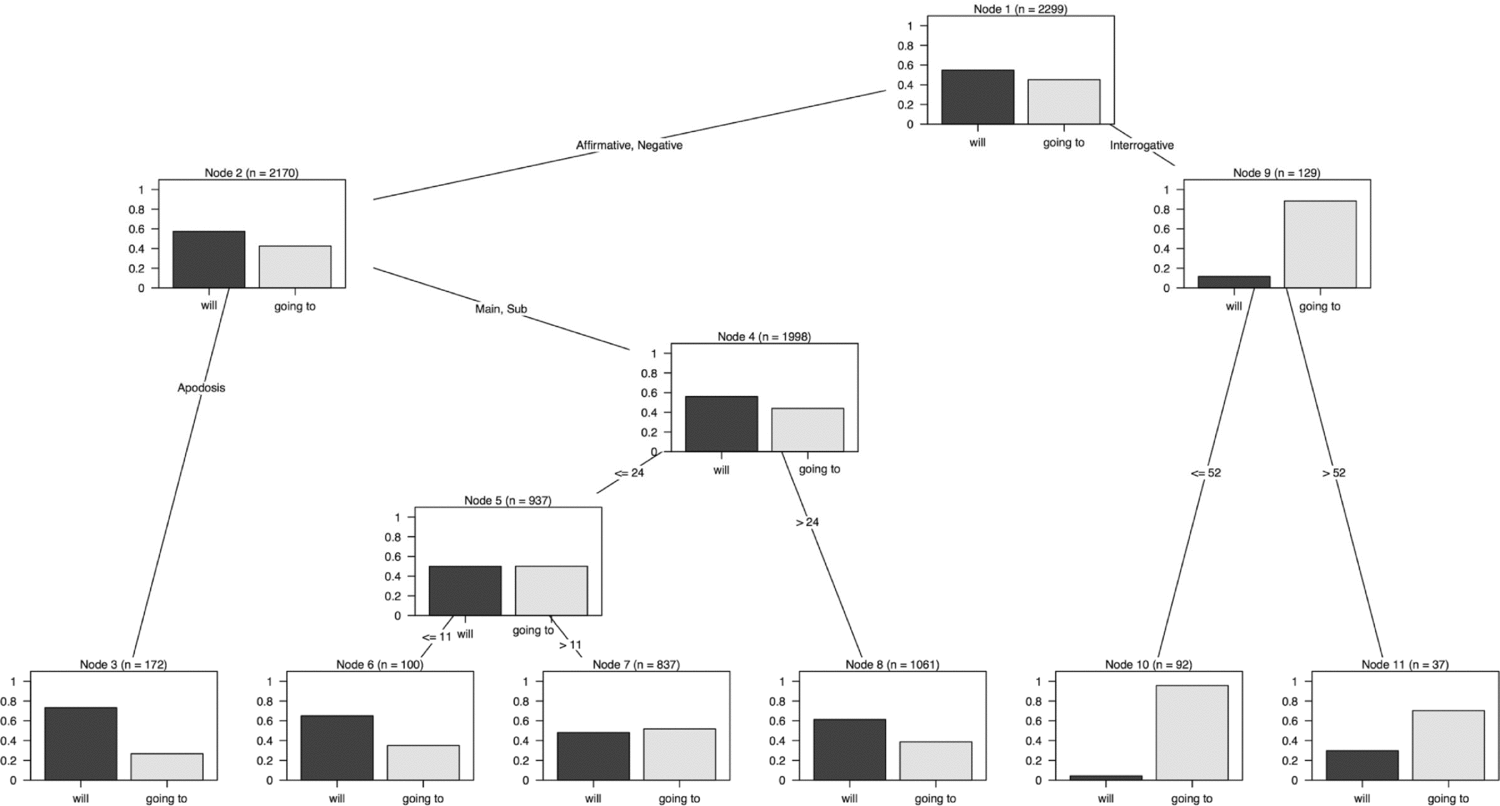
We initially constructed a maximal model in the conditional inference tree, including all our predictors (sentence type, clause type, proximity, verb type, animacy/grammatical person of the subject and speaker age); however, we present the output of a pruned model for expository purposes. This model, shown in figure 10, includes only sentence type, clause type and speaker age. Critically, in both the maximal model and pruned model the first splits made in the conditional inference trees were: (i) interrogatives distinct from affirmative declaratives and negatives and (ii) within the latter partition, apodosis clauses from other clause types.
Conditional inference tree on the proportion of BGT and will considering the factors of sentence type, clause type and age

The bar plots in the nodes of the conditional inference tree represent the distribution of will (darker grey) and BGT (lighter grey) in various subsets of the data. The topmost plot (node 1) shows the distribution in the whole data set with will only slightly more frequent than BGT (see also figures 1 and 2). The first partition made in the data partitions out interrogatives. As observed above, interrogatives highly favour BGT (node 9) and this favouring effect increases over apparent time – compare those over 52 (node 11) and those under 52 years old (node 10). The next partition is with clause type such that apodosis clauses are distinguished from other clauses. Within apodosis clauses (node 3), will is preferred as we noted above. Within the remaining 1998 tokens, we observe evidence for change in progress complete with an adolescent peak in apparent time (Labov Reference Labov2001; Tagliamonte & D'Arcy Reference Tagliamonte and D'Arcy2009): speakers younger than 24 exhibit a higher use of BGT than those over 24, while those under 11 pattern more similarly to those over 24.
We interpret the partitioning out of the interrogative and apodosis contexts as confirmation of their specialization with BGT and will respectively. While the specialization of will with apodosis does not exhibit change over the time span of our data, the age partition within the interrogatives context suggests that BGT has become increasingly specialized in this context, nearly categorical with speakers under 52.
4.2.2 Mixed-effects logistic regression
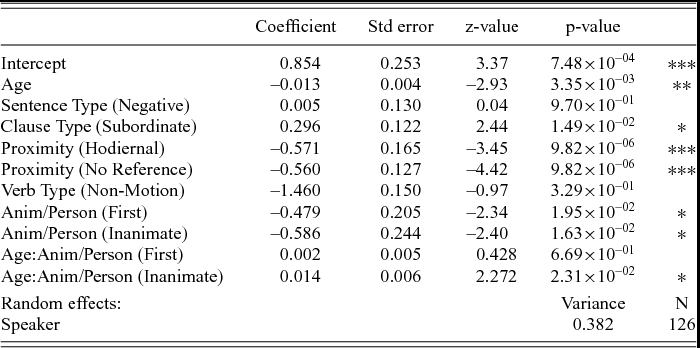
We now turn to a mixed-effects logistic regression analysis to determine the statistically relevant predictors in contexts of robust variation (non-interrogative, non-apodosis). Table 1 presents the results of a model that includes each of the predictors as main effects. It also includes an interaction term between ‘Animacy/Grammatical Person of the Subject’ and speaker age in order to disentangle the competition between BGT and will and to test the possibility of systemic reorganization of the variable grammar in apparent time that we noted in discussion of figure 9.Footnote 14
Mixed-effects logistic regression on the realization of BGT vs will by main effects Age (continuous), Sentence Type (reference level = Affirmative), Clause Type (Main), Proximity (Distal), Verb Type (Motion) and Animacy/Grammatical Person of the Subject (Animate), the interaction of Age and Animacy/Grammatical Person. A random intercept for speaker is included. Treatment contrast coding. Coefficients presented as log-odds. N=1998.

The model shown in table 1 provides statistical confirmation for all of the distributional patterns discussed above. First, the negative coefficient for the main effect of Age indicates a negative correlation between a speaker's age and the probability of BGT (i.e. younger speakers are more likely to use BGT than older speakers). While the overall distribution of the variants in figure 2 suggests relative stability, once all the factors that contribute to the variable choice are taken into account, change over time towards BGT is confirmed. This is expected given our interpretation in figure 10 of an adolescent peak, consistent with Tagliamonte & D'Arcy (Reference Tagliamonte and D'Arcy2009). Once interrogative sentences are accounted for, there is no significant effect of Sentence Type (affirmative vs negative). This result aligns with Torres Cacoullos & Walker (Reference Torres Cacoullos and Walker2009: 338), who likewise find the effect of interrogatives to be the main sentence type constraint. Together with the findings for Quebec English (Torres Cacoullos & Walker Reference Torres Cacoullos and Walker2009), the non-significance of this effect may be evidence that Canadian English is relatively advanced with respect to BGT. Tagliamonte et al. (Reference Tagliamonte, Durham and Smith2014: 97–100) find that only in communities in which BGT is vigorous is this constraint non-significant. In communities which lag behind in the development of BGT, negatives favour the incoming variant.Footnote 15 There is a significant main effect of Clause Type such that subordinate clauses favour BGT consonant with the literature (Poplack & Tagliamonte Reference Poplack and Turpin1999; Szmrecsanyi Reference Szmrecsanyi2003; Torres Cacoullos Reference Torres Cacoullos and Walker2009; Tagliamonte et al. Reference Tagliamonte, Durham and Smith2014). With respect to Proximity, the significant negative coefficients for hodiernal reference and no reference (each in comparison to distal reference) suggest that distal futures favour BGT while hodiernal futures and futures with no overt reference disfavour (favouring will). The similar effect sizes for hodiernals and futures with no overt reference suggests that these contexts behave similarly. While this effect may be unexpected given the association of BGT with proximate events, it is consistent with Torres Cacoullos & Walker's (Reference Torres Cacoullos and Walker2009: 338) significant, albeit small, effect in the same direction. This further suggests that the association between BGT and proximal events is a result of the variant's implicature that ‘there are present indications or circumstances which suggest that something will happen’ (Wekker Reference Wekker1976: 128; cf. Haegeman Reference Haegeman1989) rather than a deictic/grammatical-tense distinction as morphologicalized in some languages. The implicature is consistent with both proximal and distal events. The lack of interaction with Age and Clause Type and Age and Proximity is consistent with the CRE: the rise of BGT takes place at a constant rate in both contexts in both constraints. As suggested in our distributional analysis and other analyses of contemporary varieties, there is no significant effect of Verbs of Motion. Lastly, consider the effect of Animacy/Grammatical Person of the Subject and its interaction with Age. In comparison to the reference level, animate subjects, both first-person and inanimate subjects disfavour BGT overall. However, there is also a significant interaction with Age indicating that younger people have an increasingly levelled use of BGT across all subjects. Coupled with the main effect of Age, the coefficients in the model corroborate the pattern in figure 9: older speakers favour will with first-person and animate subjects, but BGT has become increasingly favoured in these contexts over apparent time. This is observed in the main effect of Age and lack of significant interaction between Age and first-person subjects (in reference to animate subjects), which confirms a parallel rise of BGT in these two contexts. In contrast, inanimates became less favoured, as indicated by the significant interaction between this level (in reference to animate subjects) and Age. This is statistical validation of our interpretation of levelling and reorganization of this effect.
5 The contemporary grammatical development of will and be going to
We began our analysis of variation between will and BGT as variants of FTR in English with the observation that across almost 100 years of apparent time the relative frequency of these two variants fluctuates by less than 10 per cent. However, underlying the unremarkable distributional frequency trajectory we have exposed a complex series of changes underway in the conditioning of the variants. Moreover, we have presented evidence that the patterning of these changes is diagnostic of different developmental processes.
On one hand, we have evidence for the two predicted results of morphological doublet competition offered by Kroch (Reference Kroch and Beals1994): (i) Specialization: over the last century or so, BGT has specialized as the variant for use with interrogatives and is categorical for protasis clauses; will is specialized for use with apodosis clauses. With those contexts accounted for, we observe evidence for (ii) the Constant Rate Effect: two predictors, Clause Type and Proximity, exhibit an increasing preference for BGT leading to obsolescence of will, and this competition occurs at a constant rate across contexts.
On the other hand, we have presented evidence for an additional process of change with respect to the nuances of volition and intention associated with will and BGT respectively. The pattern visible in figure 9 and confirmed in table 1 points to a semantic reorganization of the variants, which can be interpreted in two ways. The first possibility is encroachment of BGT into first-person (and animate) subjects, the previous stronghold of (volitional) will. This type of development suggests that the semantic bleaching of will (predicted by Torres Cacoullos & Walker Reference Torres Cacoullos and Walker2009) is a contemporary and ongoing process. As will loses its sense of volition, it also expands beyond its earlier association with first-person and animate subjects. As a result, the intentional nuance of BGT becomes more consequential. In such a scenario, the prediction is a complete reversal of the animacy hierarchy. A second possibility is the bleaching of both variants. In this scenario, the constraint is predicted to weaken as the idiosyncratic correspondences of each form are bleached.
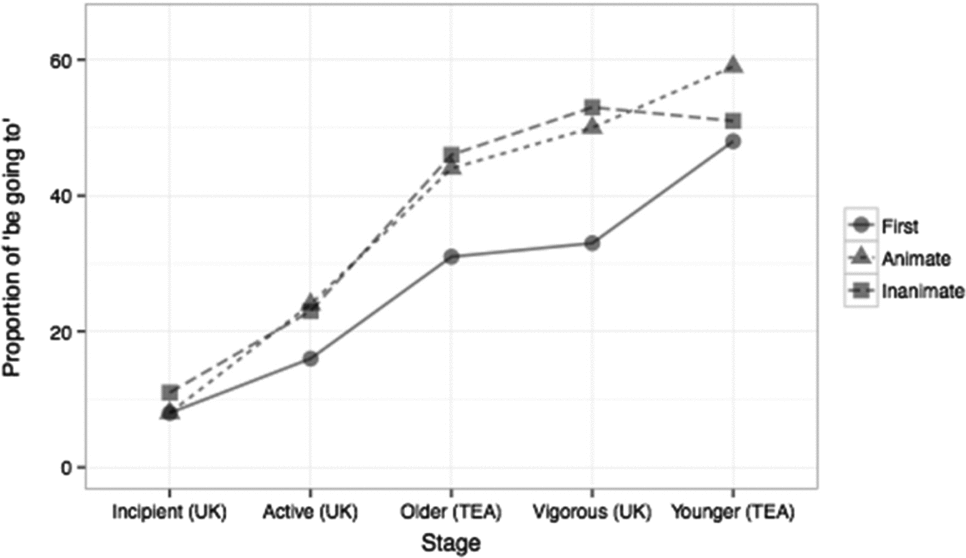
To further substantiate the validity of this shift we compare the patterning of Animacy/Grammatical Person of the Subject in TEA (c. 1911–2004) to Tagliamonte et al.’s (Reference Tagliamonte, Durham and Smith2014) data from multiple varieties of British English, which are taken to represent a somewhat deeper time depth. Tagliamonte et al. (Reference Tagliamonte, Durham and Smith2014) categorize these varieties with respect to the overall frequency of incoming BGT. Incipient varieties exhibit less than 15 per cent BGT, active varieties have between 21 and 28 per cent, and the one vigorous variety (speakers from York under 30) has 43 per cent. Figure 11 plots these data: TEA, split into older (over 24) and younger (11–24), and the three categories from Tagliamonte et al. (Reference Tagliamonte, Durham and Smith2014).Footnote 16 We plot these varieties along the x-axis ordered as relative stages in the development of BGT. We place the vigorous UK variety between the two TEA age groups, assuming that young people from York will be more advanced than older TEA speakers but less advanced than younger TEA speakers as is the case with other variables (e.g. general extenders, Denis Reference Denis2011; intensifiers, Tagliamonte Reference Tagliamonte2008). The lines depict the frequency of BGT for each of the three Animacy/Grammatical Person of the Subject categories.
The effect of Animacy/Grammatical Person of the Subject in comparative perspective

In the incipient variety, there is a small (albeit statistically significant) effect such that first-person and animates occur more with will. This first-person effect is maintained with the active, older and vigorous stages. We interpret this to reflect retention of volition for will. However, notice that BGT incrementally advances in each context. Instead of a consistent preference for will with first person, BGT has infiltrated this context in the last stage to the point where the strength of the constraint weakens (see also table 1). In this phase, the two contexts that formerly should be the most distinct (first-person and inanimate subjects) have levelled. While the four earlier stages exhibit a pattern consistent with the CRE and the rise of BGT, the latest stage in the trajectory (younger TEA speakers) shows that a semantic shift has occurred. We suggest that this is an indication of a reorganization of the FTR system. Where once two morphological doublets competed and exhibited a contextual constraint, presumably as a result of preferences established at the onset of the change (see Kroch Reference Kroch1989: 205), this finding shows that these constraints may not remain constant for the entire trajectory of the change. In essence, if the nature of a constraint is affected by independent semantic-pragmatic change (whether or not the result of grammaticalization), it may interact with morphosyntactic change and disrupt the predicted constant rate trajectory.
6 Conclusion
We have now completed an extensive analysis of the variation between will and BGT in Toronto English. At the surface the data show a slow rise in the use of BGT. This is consistent with the nature of this longitudinal change, which began in the 1400s and has continued to the present day, yet still represents only a little above 50 per cent of the system at most. While most researchers agree that the grammaticalization of BGT as a marker of FTR occurred at the outset of this change, its subsequent development offers a unique view on what happens afterwards. Our finding of the CRE confirms the presence of grammar competition. As BGT rises and will falls into obsolescence, different contexts exhibit different intercepts but the rate of change is constant over time, each context a reflex of the more abstract competition. The new finding is that in the case of English FTR, other developments are also underway.
When Kroch (Reference Kroch and Beals1994: 187) detailed the concept of grammar competition, he allowed for the possibility of specialization. In discussing the case of the English past tense he says:
Over time, these fluctuations led to one of two outcomes: 1) in the absence of further linguistic change, one form eventually disappeared through disuse, just because of stylistic preferences or random statistical fluctuations. . . 2) the doublet pair became stable due to differentiation in meaning and grammatical properties.
Indeed, evidence for patterns of specialization in the competition between forms has long been reported in historical linguistics (e.g. French negation; Hopper Reference Hopper, Traugott and Heine1991). The same outcomes have been reported in some quantitative studies of morphosyntactic variation, including the variation among forms used to mark stative possession (Tagliamonte Reference Tagliamonte, Rohdenberg and Mondorf2003) and the alternation between was and were (Tagliamonte Reference Tagliamonte1998). As Tagliamonte (Reference Tagliamonte, Rohdenberg and Mondorf2003: 550, Reference Tagliamonte1998: 86) notes, ‘constraints and weights on these variables shift in apparent time, suggesting that these developments are an intrinsic and viable characteristic of the process’.
Consistent with these reports, the shifts we have uncovered in the present analysis exhibit alternative developments to the CRE. On the one hand, we have specialization. On the other hand, orthogonal changes can disrupt a constraint hierarchy. In either of these cases, we no longer expect to see evidence for the CRE. Moreover, it appears that all these processes can occur within the same longitudinal change. Indeed, not every constraint we considered exhibited the same trajectory over time. It is worth highlighting the fact that such distinctions could only have been revealed by probing beneath overall frequencies and modelling all potential factors operating as forms undergo grammatical development. Furthermore, in light of potential specialization, it is critical to actively monitor the variable context as constraints are considered across time (e.g. figure 11). This study also demonstrates the utility of representative socially stratified corpora that include speakers of different ages (generations) in order to more fully understand grammaticalization and change (see Janda Reference Janda2001: 318). Indeed, we predict that as English FTR continues to evolve, BGT will continue to expand; however, because will has established its own functional/grammatical niches (e.g. apodosis clauses), this change may never go to completion. Rather than one form obsolescing, the end point of this grammatical change may be longitudinal partitioning (see e.g. D'Arcy & Tagliamonte Reference D'Arcy and Tagliamonte2015). While Labov (Reference Labov, Lehmann and Malkiel1982: 76) emphasized the need for in-depth linguistic analysis in order to uncover the ‘ordered series of shifts in underlying probabilities associated with each environmental factor’, he possibly did not foresee that different constraints within the same variable might exhibit distinct trajectories. However, Labovian variationist methods and practices have enabled us to offer up a new perspective on the continuing development of English FTR. We have even been able to make predictions about the future: what's it going to be like? If we wait long enough, we’ll find out.