Cognitive impairment affects well over half of stroke patients (Barker-Collo et al., Reference Barker-Collo, Krishnamurthi, Feigin, Jones, Theadom, Barber and Bennett2016; Jokinen et al., Reference Jokinen, Melkas, Ylikoski, Pohjasvaara, Kaste, Erkinjuntti and Hietanen2015; Taylor & Broomfield, Reference Taylor and Broomfield2013), and has a considerable impact on long-term outcome, including work capacity, independence in activities of daily living, wellbeing and quality of life (Das Nair, Martin, & Sinclair, Reference Das Nair, Martin and Sinclair2015). As a result, ‘What are the best ways to improve cognition after stroke?’ was recently identified as the top priority of 226 unanswered research questions relating to life after stroke (Pollock, St George, Fenton, & Firkins, Reference Pollock, St George, Fenton and Firkins2012). In Australia, assessment and management of cognitive difficulties has been identified as a research priority within the Stroke Foundation's Clinical Guidelines for Stroke Management (National Stroke Foundation, 2010). Despite this, access to cognitive rehabilitation remains one of the greatest unmet long-term needs for stroke survivors in Australia (Andrew et al., Reference Andrew, Kilkenny, Naylor, Purvis, Lalor and Moloczij2014).
While cognitive rehabilitation research in stroke has significant gaps preventing clear recommendations for clinical practice (Gillespie, Best, & O'Neill, Reference Gillespie, Best and O'Neill2012), the broader brain-injury rehabilitation literature supports the use of compensatory strategies and assistive technology (AT) for managing cognitive impairments and optimising independence (Charters, Gillett, & Simpson, Reference Charters, Gillett and Simpson2015; Jamieson, Cullen, McGee-Lennon, Brewster, & Evans, Reference Jamieson, Cullen, McGee-Lennon, Brewster and Evans2014; Wilson, Gracey, Evans, & Bateman, Reference Wilson, Gracey, Evans and Bateman2009). While paper-based strategies, such as diaries, lists and notebooks, are accessible and familiar to most people, they also have a number of disadvantages, including reliance on the user to remember to use and check them, and inability to provide time-dependent reminders, which have been found to improve timely task completion (Dowds et al., Reference Dowds, Lee, Sheer, O'Neil-Pirozzi, Xenopoulos-Oddsson, Goldstein and Glenn2011). Older technological devices such as Personal Digital Assistants (PDAs) and older-style mobile phones showed promise in supporting cognition, but were limited by users’ lack of familiarity with them and by their limited capability and ease of use. For example, a survey study by de Joode, van Boxtel, Verhey, and van Heugten (2012) found that while most patients with acquired brain injury (ABI), care givers and professionals were positive about using AT devices in the future, only a minority were currently using them due to high price and lack of device familiarity. Furthermore, many health professionals lack confidence to teach and support patients with these devices (de Joode et al., 2012).
Smartphones have the potential to address these limitations, possessing the ability to incorporate multiple functions into one portable, user-friendly, socially acceptable and affordable device. There were an estimated 31 million mobile services in operation in Australia as of June 2013 (Australian Communications and Media Authority, 2013). Despite the permeation of smartphones into modern society, rehabilitation practice has been slow to adopt these new technologies (de Joode et al., 2012).
There is emerging evidence from small samples that smartphones have potential to improve everyday memory and organisational skills following stroke. In one of the only studies investigating AT for cognitive support following stroke, Lindqvist and Borell (Reference Lindqvist and Borell2012) found that a computer program providing information about upcoming events, assistance with task completion, and reminders relating to specific locations or actions, resulted in increased independence, daily structure and social contact for four stroke survivors. Svoboda, Richards, Leach, and Mertens (Reference Svoboda, Richards, Leach and Mertens2012) found that 10 individuals with ABI could learn how to use PDAs and smartphones, and that their use was associated with improvement in everyday memory functioning. More recently, Ferguson, Friedland, and Woodberry (Reference Ferguson, Friedland and Woodberry2015) found that smartphone calendar prompts used by six participants with ABI improved task completion rates as well as independence, confidence in coping with memory difficulties and mood.
In a survey of memory aid use in people with ABI, Jamieson, Cullen, McGee-Lennon, Brewster, and Evans (Reference Jamieson, Cullen, McGee-Lennon, Brewster and Evans2015) found that 38% of participants used a mobile phone (either smartphone or older-style mobile phone). Younger age and greater use of technological memory aids prior to injury predicted greater use of such aids post injury. However, as their sample included mixed ABI aetiologies, and did not separate smartphones from older-style mobile phones, it was not possible to determine how people with stroke were using smartphones. This may plausibly differ from that in younger TBI survivors, who have fewer motor and language difficulties and more experience with technology. Furthermore, Jamieson et al. did not include a non-injured comparison group, so it was not clear whether and/or how patterns of smartphone use differed from the general population. Moreover, as their study was a broader examination of multiple types of memory aids, it did not look at patterns of use of smartphone apps.
In a recent study of participants with TBI and a healthy comparison group that addressed these gaps, Wong, Sinclair, Seabrook, McKay, and Ponsford (Reference Wong, Sinclair, Seabrook, McKay and Ponsford2016) found that smartphone use was common in both groups, but older participants were less likely to use them. Participants with TBI were more likely to state that the main benefit of their smartphone was its use as a memory aid. Difficulty learning and remembering how to use the smartphone was identified as a barrier by participants with TBI, however, only 10% had been shown how to use their smartphone by a clinician. Interestingly, participants who reported more subjective cognitive complaints were also more likely to use memory and organisational apps; and more frequent use of communication apps was associated with better social integration in participants with TBI.
While these findings suggest that smartphones represent a flexible, multipurpose and potentially effective platform for supporting cognitive and psychosocial functioning following brain injury, experiences of and attitudes towards smartphone use following stroke have not been systematically examined. We cannot assume that findings in younger people with TBI are applicable to older stroke survivors, particularly given that age was a significant predictor of smartphone use in that study, and stroke survivors tend to be older than those with TBI (Australian Bureau of Statistics, 2016). While smartphone design has been refined in many ways to increase user friendliness, these developments are driven by the needs of a young and healthy population, which may conflict with the requirements of cognitively impaired older adults. For example, multi-functionality is a key benefit for the smartphone, yet memory impaired individuals may be confused by excessive information (Zajicek & Morrissey, Reference Zajicek and Morrissey2001). Technological challenges such as difficulty installing new apps or a lack of internet access can also represent barriers for older individuals (Gregor, Newell, & Zajicek, Reference Gregor, Newell and Zajicek2002). The impact on smartphone use of sensory, motor and language impairments, which are more common in stroke than TBI, is also unclear.
In order to gauge the potential of smartphones as AT to support cognition and independence following stroke, the needs, attitudes and barriers for this cohort must first be identified. The current study therefore aimed as follows:
-
1. Investigate patterns of and perspectives on smartphone use in people with stroke, in comparison to healthy participants.
-
2. Identify barriers to smartphone use in people with stroke.
-
3. Examine associations between smartphone use and everyday functioning, including self-reported sensory, motor, language, and cognitive functions, mood, and community integration.
Method
Ethics approval for this study was provided by Epworth HealthCare Human Research Ethics Committee (EHHREC) and Monash University Human Research Ethics Committee (MUHREC).
Participants
Inclusion criteria for all participants were: age over 18 years, adequate ability to speak and read English and no history of neurological conditions besides stroke (as reported by the participant and verified using medical records where possible). Participants were excluded if they demonstrated severe aphasia or severe cognitive impairment as defined by a score <17 on the Montreal Cognitive Assessment (MoCA), based on the cut-off recommendation for vascular dementia (Freitas, Simões, Alves, Vicente, & Santana, Reference Freitas, Simões, Alves, Vicente and Santana2012), due to the likelihood that this would preclude reliable completion of the main measures. Previous or current experience with smartphones was not required. Recruitment was from stroke support groups around Melbourne, via online advertising, or through word of mouth between clinicians working in stroke services. Comparison participants with no history of neurological conditions, including stroke, matched for age, gender and education, were recruited from the general community using word-of-mouth and poster advertising.
Measures
The Smartphone Survey used in this study was a slightly modified version of that used in Wong et al. (Reference Wong, Sinclair, Seabrook, McKay and Ponsford2016), which was based on the survey conducted by Hart, Buchhofer, and Vaccaro (Reference Hart, Buchhofer and Vaccaro2004) examining experiences and attitudes towards portable electronic devices. Modifications were made to terminology (i.e., stroke rather than TBI) and examples of apps used for various app categories were updated. The survey comprised 309 items, using both multiple choice and open-ended formats. Not all questions were asked of each respondent, depending on whether the respondent was a current, former, or non-user of smartphones. Question topics included the duration and frequency of smartphone use and various app types; perceived usefulness of various apps and functions; and smartphone use within rehabilitation settings (for participants with stroke only). Items also explored barriers to use of smartphones, and factors contributing to difficulty using the technology (e.g. accessibility, interface aesthetics, range of functions, learning method). Current and former users of smartphones were asked about the frequency of use of 26 app types, which were later divided into four categories based on the primary function of each app: memory and organisation, communication, entertainment and therapy (see Wong et al., Reference Wong, Sinclair, Seabrook, McKay and Ponsford2016). Test-retest reliability of the Smartphone Survey was adequate in a sample of participants with TBI (Wong et al., Reference Wong, Sinclair, Seabrook, McKay and Ponsford2016). The content of the version used for participants with stroke in this study was reviewed by three experts and was piloted on two participants to ensure that content was easy to understand and appropriate, with resulting minor changes to wording on a few items.
The Cognitive Failures Questionnaire (CFQ; Broadbent, Cooper, Fitzgerald, & Parkes, Reference Broadbent, Cooper, Fitzgerald and Parkes1982) was used as a self-report measure of everyday cognitive functioning. It assesses the frequency of everyday cognitive lapses (e.g., forgetting appointments) on a five-point Likert scale. The total score (ranging from 0 to 100) was used in analyses, with higher scores associated with poorer perceived cognitive functioning.
The Depression Anxiety Stress Scales (DASS; Lovibond & Lovibond, Reference Lovibond and Lovibond2004) is a 42-item self-report questionnaire measure of symptoms of emotional distress over the past week. It includes three subscale scores: Depression, Anxiety and Stress. It has demonstrated validity as a screening measure for depression and anxiety in individuals with brain injury (Dahm, Wong, & Ponsford, Reference Dahm, Wong and Ponsford2013; Wong, Dahm, & Ponsford, Reference Wong, Dahm and Ponsford2013).
The Community Integration Questionnaire (CIQ; Willer, Rosenthal, Kreutzer, Gordon, & Rempel, Reference Willer, Rosenthal, Kreutzer, Gordon and Rempel1993) is a 15-item self-report questionnaire used to assess home, social and occupational functioning following a brain injury. There are three subscales: Home Integration (e.g., shopping, cooking); Social Integration (e.g., leisure activities, time with friends) and Productivity (includes work, study and volunteer activities). Higher scores indicate greater community integration.
A Sensory, Motor and Language Screen (SMLS) was designed to assess the self-reported degree of sensory, motor and language impairment in participants with stroke. It was created for this study using selected components of a history-taking questionnaire from Strauss, Sherman, and Spreen (Reference Strauss, Sherman and Spreen2006). Twenty-three items were identified that corresponded with sensory, motor or language impairments (6, 10 and 7 items, respectively) observed following stroke, as indicated by current literature (e.g. ‘Visual impairment’, ‘Weakness on one side of the body’ or ‘Difficulty understanding written things’). Participants were asked whether they had experienced these symptoms in the past month, on a five-point Likert scale ranging between ‘0 = Not at all’ to ‘4 = Very often’, and ratings were summed to create domain scores for the sensory, motor and language domains.
The Montreal Cognitive Assessment (MoCA; Nasreddine et al., Reference Nasreddine, Phillips, Bédirian, Charbonneau, Whitehead, Collin and Chertkow2005) is a short 10 minute screening tool for cognitive impairment, intended as a more sensitive alternative to the Mini-Mental State Examination. It has been shown to be sensitive to cognitive deficits following stroke (Cumming, Bernhardt, & Linden, Reference Cumming, Bernhardt and Linden2011). It is scored out of 30 and tests the participant on a number of common cognitive domains, including executive function, visuospatial ability, language, memory and attention. It was administered to participants with stroke only.
Procedure
Written informed consent was obtained prior to participation. Participants completed the survey and other measures either in person, over the telephone, or on-line via survey software Qualtrics. Participants could elect to have a care giver present during the interview to maximise accuracy of responses on the Smartphone Survey. The MoCA was completed in person for all participants with stroke.
Stroke classification and lesion location information was collected where possible, however given the community-based convenience sample there were a number of participants for whom this information was not available. For the same reason, stroke severity information was not available in a sufficiently consistent format to enable its inclusion in analyses.
Data Analysis
Qualtrics data was downloaded and collated into an SPSS database, from which data were visually screened for valid responses and missing items. All other data were entered manually and then screened. Data analysis was performed using SPSS version 22.
For Aim 1, descriptive statistics were used to summarise the sample demographic and injury characteristics, Smartphone Survey responses and other measures. Group differences (e.g., between stroke and comparison groups) were analysed using chi-square tests for categorical variables and independent samples t-tests for continuous variables, or where appropriate Mann–Whitney U-test was used as a nonparametric alternative. For Aim 2, the qualitative responses obtained on the Smartphone Survey were examined for emerging themes by two raters, focussing on the facilitators and barriers to smartphone use.
To examine relationships between app use and everyday functioning variables (CFQ, DASS, CIQ and SMLS) for Aim 3, the median app use frequency for each app type was calculated separately for the stroke and comparison groups, and then each group was split into high- and low-app users (with high = frequency of use above the median, and low = frequency of use below the median). Independent samples t-tests were then used to compare high- and low-app users on the daily functioning variables.
Results
Participant Characteristics
Forty-one potential participants with stroke were identified, three of whom declined to participate. Of the remaining 38, five were unable to be contacted, one had a history of schizophrenia, and three had severe aphasia as well as scoring <17 on the MoCA, leaving a final sample of 29 participants with documented history of stroke. Thirty comparison participants matched for age, gender and education were recruited. One participant was excluded due to a large amount of missing data, leaving 29 in the comparison group.
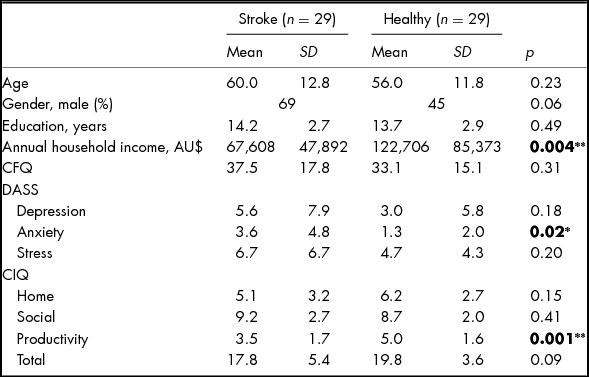
Demographic characteristics of both groups are presented in Table 1, along with performance on measures of cognitive, mood, and everyday functioning. Participants with stroke were on average 8.2 years post stroke (SD = 6.8 years; range: 6 months – 21 years). Of the 23 participants for whom we had stroke location information, 62% had left-sided, 33% right-sided and one participant had a multi-territory infarct distributed across both hemispheres; of the 20 participants with known stroke type, 70% had ischaemic and 30% had haemorrhagic strokes. The mean MoCA score in the stroke group was 24.86 (SD = 2.65, Range = 21–29).
Demographics and Test Performances in the Two Participant Groups

Notes: AU$ = Australian dollars; CFQ = Cognitive Failures Questionnaire; DASS = Depression Anxiety Stress Scales; CIQ = Community Integration Questionnaire. Chi-square was used for gender; Independent-sample t-tests were used for all other group comparisons. *p<.05; **p<.01
There was no significant difference between stroke and comparison groups in age, gender or education. Participants in the comparison group had a significantly higher annual household income than stroke survivors. Unexpectedly, there was no significant difference between the groups in self-reported frequency of everyday cognitive failures on the CFQ. Participants with stroke reported significantly higher levels of anxiety on the DASS. Unsurprisingly, the stroke group also demonstrated significantly lower productivity on the CIQ, likely due to a reduced rate of employment.
Aim 1. Patterns of and Perspectives on Smartphone use
Of the participants with stroke, 62% identified themselves as current smartphone users, with over half of those indicating they had started using a smartphone after their stroke (56%). A significantly higher proportion of the comparison group (86%) were current smartphone users, χ 2 (1,58) = 4.41, p < .05. The majority of smartphone users in both groups (88% of stroke group, 100% of comparison group) reported that they used their smartphone on a daily basis.
In both groups, the most frequently cited main use for smartphones was for communication (either phone calls or text-messaging). This was followed by use as a memory and organisational device, and for accessing the internet. Memory and organisation apps were used daily for the majority of current users (61% of the stroke group, 67% of the comparison group). The memory and organisation aids used by smartphone users with stroke included: alarms (89%), calendars (78%), personal contacts lists (67%), notes pages (67%), text-messages (61%), cameras (55%) and to do lists (44%).
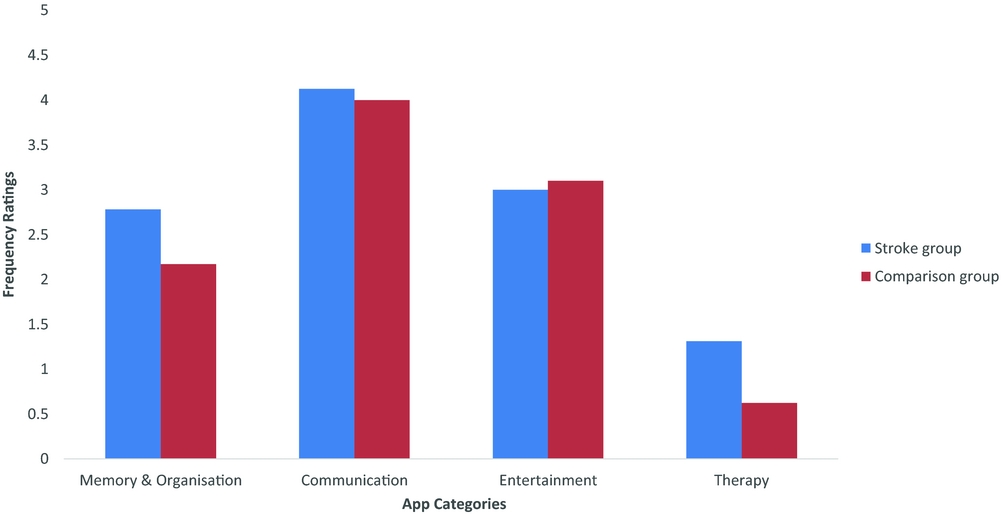
Broad patterns of app use were examined by investigating the self-reported frequency of use and usefulness of apps in each of the four categories (memory and organisation, communication, entertainment and therapy). Figure 1 shows each category's average median frequency of app use (i.e., median frequencies for each app type were divided by the number of app types in the category) for the stroke and comparison groups.
Average median frequency ratings of apps within each category (i.e., median frequencies for each app type were divided by the number of app types in the category) for each participant group (1 = Less than once a fortnight; 2 = Once every 1–2 weeks; 3 = 2–6 times per week; 4 = once per day; 5 = twice or more per day).

There was no significant difference between the stroke and comparison groups in the frequency of use of apps within each of the app categories (all ps > .3 using Mann–Whitney U-test). The comparison group rated communication apps as more useful than the stroke group, with the magnitude of the difference classified as medium in size (d = .61), though the difference was not statistically significant, t(42) = −2.08, p = .06. Very few participants used therapy apps. For the majority of smartphone users with stroke who did not use therapy apps, this was either because they had not heard of them (for stroke specific, relaxation, brain training), or because they did not need them (for communication aid, social skills apps); these two reasons were equally endorsed for behaviour tracking and mood/anxiety apps.
Participants were asked an open question about the most significant benefit to them of using a smartphone. For participants with stroke, its use as a memory and organisational aid and its portability and convenience were listed equally as often (10 times each), followed by connectivity with others (8 times), access to the internet (5 times) and multifunctionality (3 times). The comparison group listed different main benefits, with the most common being portability and convenience (14 times), then connectivity with others (9), multifunctionality (6 times), and internet access (5 times). Unlike stroke survivors, no comparison participants mentioned the smartphone's use as a memory and organisational aid as a main benefit.
Using a four-point Likert scale, participants were also asked to rate the importance of various smartphone features. Participants with stroke rated the most important features as being simple to learn how to use (with 62% rating this as ‘extremely important’); having large, easy to see displays (55%); having a long-lasting battery (55%); having a touch screen (55%); being small and lightweight (48%) and being able to use search functions to find apps, information and contacts (48%). Participants in the comparison group reported somewhat similar priorities, though in comparison with the stroke group a higher proportion rated being able to store a large amount of information (52% vs. 38%) and having a long lasting battery (83% vs. 55%) as extremely important; and a lower proportion rated being able to use search functions as extremely important (31% vs. 48%).
Aim 2. Barriers to Smartphone Use after Stroke
For the 11 participants with stroke who had never used a smartphone, the reasons provided for this varied, including ‘I don't need one’ (n = 4) ‘they're too difficult’ (n = 2), ‘the print on the screen is too small’ (n = 1) and ‘I was discouraged from using one by another person’ (n = 1). Among participants with stroke, smartphone use (as compared with no use) was not associated with household income, gender or education (p > 0.3), suggesting that these factors were not a barrier to smartphone use; though it is noted that there was a restricted range of education in our sample. Smartphone use in stroke survivors was, however, associated with age, such that smartphone users (M = 55.3 years, SD = 12.6) were significantly younger than non-users (M = 67.6 years, SD = 9.37), t(27) = −2.79, p < .01.
A higher proportion of participants with stroke (39%) than comparison participants (12%) reported that their smartphone was difficult to learn or use. The small size of the screen, problems operating the interface (e.g., swiping) and difficulty using certain apps were problems mentioned by several participants with stroke who found their smartphone difficult to use. In addition, more participants with stroke reported that ‘being shown by others’ (33%, compared with 28%) and ‘watching a training video’ (11% vs. 0%) was most helpful in learning to use their smartphone, whereas fewer participants with stroke (44%) than without stroke (60%) preferred ‘learning by doing’.
Given the difficulty in learning to use smartphones reported by participants with stroke, another potential barrier is a lack of assistance from clinicians in facilitating smartphone use in a rehabilitation context. Only 20% of the stroke group (n = 6) reported that a rehabilitation therapist had suggested use of smartphones in therapy, for example by suggesting the use of calendar alerts to remember appointments, to-do lists to remember tasks, and medication reminder alarms. Only one stroke participant (3%) indicated that a rehabilitation therapist had assisted them in learning to use their smartphone, and three stroke participants (10%) had used smartphone functions to help them remember things for therapy.
Aim 3. Relationships with Daily Functioning
Among smartphone users, comparisons of high and low users of memory/organisational apps, communication apps and entertainment apps (therapy apps were not included given the low number of participants using them) were conducted for the variables relating to everyday functioning (CFQ, DASS, CIQ and SMLS). In the stroke group, frequent users of memory and organisational apps had significantly fewer reported motor symptoms on the SMLS, t(17) = 2.57, p < .05, with a very large effect size (d = 1.20). There was also a large effect size indicating that frequent users of memory and organisational apps reported higher productivity on the CIQ (d = 0.84), however the difference was non-significant, t(17) = −1.84, p = .08. Similarly, there was a medium effect size for the finding that high users of entertainment apps reported fewer motor symptoms on the SMLS (d = .68), however, again the difference was not statistically significant, t(17) = 1.97, p = .06. Within the comparison group, there were no significant differences between high and low users of the various app types on any of the daily functioning variables.
Discussion
Results of this study indicated that while the majority of participants in both groups used smartphones, significantly fewer participants with stroke (62%) than in the comparison group (86%) were smartphone users. This differs from our previous study of younger participants with TBI, in which an equal proportion used smartphones as in an age-matched comparison group (Wong et al., Reference Wong, Sinclair, Seabrook, McKay and Ponsford2016). While noting that both studies had relatively small and highly educated samples, this suggests that although smartphones are widely accessible, there may be more barriers to use following stroke. Nevertheless, smartphone users from both groups had a similar high frequency of use. Both groups cited their main uses of the smartphone as for communication (e.g. calls, text messages); to support memory and organisation (e.g., calendars, reminders, notes); and for internet access. Broad patterns of the frequency of use of apps were also similar in participants with and without stroke.
When asked about the main benefit of using a smartphone, both groups listed portability and convenience, connectivity with other people, and access to the internet. While no participants in the comparison group listed their smartphone's use as a memory and organisational aid as its main benefit, this was the equal top-listed benefit for stroke survivors, highlighting the perceived usefulness of the smartphone as AT for stroke-related cognitive difficulties. This pattern of results is very similar to our previous study in TBI (Wong et al., Reference Wong, Sinclair, Seabrook, McKay and Ponsford2016). However, a notable difference from that study was that multifunctionality was listed less often as a main benefit in this older cohort, particularly in the stroke group. This is consistent with the idea that older and/or memory impaired individuals may be easily overwhelmed by excessive amounts of information (Zajicek & Morrissey, Reference Zajicek and Morrissey2001).
Participants with stroke rated the most important features of their smartphone as being simple to learn how to use; having large, easy to see displays; a long-lasting battery; having a touch screen; being small and lightweight and being able to use search functions to find apps, information and contacts. Participants in the comparison group reported somewhat similar priorities, though in comparison with the stroke group a higher proportion rated being able to store a large amount of information as extremely important; and a lower proportion rated being able to use search functions as extremely important. These results indicate that ease of use is the primary concern for individuals with stroke.
Consistent with this, we found that difficulty learning and remembering how to use the smartphone was the main barrier to use for our participants with stroke. Similar to findings in a TBI sample (Wong et al., Reference Wong, Sinclair, Seabrook, McKay and Ponsford2016), 97% of the stroke group reported that they had not received any specific instruction in using it by rehabilitation clinicians. A higher proportion of participants with stroke than the comparison group reported that their smartphone was difficult to learn or use, citing reasons such as small screen size, problems with the user interface (e.g., swiping), and difficulty with certain apps. A higher proportion of the stroke group than the comparison group also preferred being shown how to use their smartphone by others or by watching a video rather than learning by doing, again pointing to the benefit of direct instruction.
As in previous studies by Jamieson et al. (Reference Jamieson, Cullen, McGee-Lennon, Brewster and Evans2015) and Wong et al. (Reference Wong, Sinclair, Seabrook, McKay and Ponsford2016), older age was the other potential barrier to smartphone use, with younger stroke survivors more likely to be currently using smartphones. Gender, household income and education were not associated with smartphone use in our sample, suggesting that smartphones are accessible across the socio-economic and demographic spectrum. However, low numbers prevented analysis of whether the influence of these factors on smartphone use differed between participants with and without stroke.
Within the stroke group, there was some indication that motor impairments negatively affected use of certain types of apps. Those with more motor symptoms used memory and organisational apps less frequently, and also tended to use entertainment apps less frequently. It is theoretically possible that the causal direction runs the other way, such that more frequent use of those apps reduced the severity of motor symptoms, however that seems less likely. Several participants with stroke-related motor problems spontaneously mentioned that they preferred using iPads or tablets due to the larger screen and associated better ease of use. However, there is a lack of prior evidence guiding use of smartphone and tablet technologies for those with stroke-related motor impairments, as also acknowledged by Thilarajah, Clark, and Williams (Reference Thilarajah, Clark and Williams2016).
Although the difference was not statistically significant, there was also a large effect size indicating that frequent users of memory and organisational apps reported higher productivity (i.e., participation in work, study and volunteer activities). This promising finding that suggests either that more frequent use of memory and organisational apps could improve productivity in people with stroke, or that those who participate more in work, study or volunteer activities tend to use those apps more, or both. This difference was not found in the comparison group, suggesting that they are not as closely linked outside of the context of stroke (e.g., it may be that healthy individuals do not rely as much on cognitive aids to support their productivity).
Given these findings suggest that participants with stroke required and benefited from cognitive support, it is interesting that there was no significant difference from the comparison group in their reporting of cognitive failures. The reasons for this are unclear, but possible explanations include (1) this is a relatively high functioning stroke group; and/or (2) it reflects a lack of self-awareness of cognitive deficits in the stroke group. Given the mean MoCA score in our stroke group fell below the standard cutoff for dementia of 26/30, this suggests the latter explanation may be more likely. Consistent with this, Boosman, van Heugten, Winkens, Heijnen, and Visser-Meily (Reference Boosman, van Heugten, Winkens, Heijnen and Visser-Meily2014) found over-estimation of cognitive functioning was common in stroke patients with a good functional outcome. An informant rating of everyday cognitive function may be a worthwhile inclusion to future research in this area.
The results of this study should be viewed with caution, given the relatively small sample size and the fairly well-educated nature of our sample, which may not be representative of the broader stroke population. Another possible source of bias is that people with stroke who have a particular interest in smartphones may have been more interested to participate in this study, and therefore may be over-represented in our sample. Additionally, our groups were not matched on household income (likely due to the fact that many of the participants with stroke had stopped working and that the comparison group had above average incomes). However, there was no relationship between smartphone use and household income in our sample, suggesting these factors may not have influenced the results substantially. Nevertheless, our findings require replication in a larger sample that is as representative as possible of the broader stroke population, and that preferably includes a comparison group well matched on household income.
It is also not clear how stroke severity, type, or location may have influenced patterns of smartphone use, given we did not have consistent data on these factors in our convenience sample; this would be useful to examine in future studies to enable more targeted recommendations regarding smartphone use in rehabilitation contexts. Similarly, time post-stroke varied considerably in our sample; it would be useful to examine the influence of this in larger studies to determine if there is an ideal window of time during rehabilitation within, which it is most helpful to focus on smartphone use. As the sample was on average eight years post-stroke, their recall of their experiences with smartphones during rehabilitation may not have been reliable; and within that period there has been a rapid increase in the uptake of smartphones, so our findings about the limited use of smartphones in rehabilitation may not reflect current practice. Additionally, as stroke survivors with severe aphasia and severe cognitive impairment were excluded from our study, our findings cannot be applied to those with significant language or cognitive impairment, who are likely to experience specific difficulties with the language demands associated with smartphone use, and/or apps with high cognitive demands. Indeed, none of the three potential participants who were excluded on the basis of a MoCA score <17 used smartphones. Nevertheless, Brandenburg, Worrall, Copland, Power, and Rodriguez (Reference Brandenburg, Worrall, Copland, Power and Rodriguez2016) showed promising results for the usability of an app designed for people with aphasia following stroke, suggesting that smartphones can be accessible if adapted sufficiently to user needs.
In sum, our results indicate that smartphones are accessible, convenient AT devices for many individuals with stroke; that they are perceived as a useful memory and organisational aid; and that they may support increased productivity. However, they present particular challenges for older stroke survivors, especially those with motor impairments. In order to fulfil the potential of smartphones as AT devices following stroke, survivors may benefit from direct instruction from others, including rehabilitation clinicians, in learning how to use and navigate their smartphone and its apps. Developers of apps designed for this population should prioritise ease of app use, large displays, and availability of technical support, while maintaining an engaging design and interface that does not require overly complex fine motor control. Training of clinicians who can support their patients with stroke to learn how to effectively utilise the benefits of their smartphone and other electronic devices will be an essential component of integrating these technologies into stroke rehabilitation.
Financial Support
This research received no specific grant from any funding agency, commercial or not-for-profit sectors.
Conflict of Interest
None.
Ethical Standards
The authors assert that all procedures contributing to this work comply with the ethical standards of the relevant national and institutional committees on human experimentation and with the Helsinki Declaration of 1975, as revised in 2008.