

Perspective taking involves perceiving another person's world through that person's point of view (Piaget, Reference Piaget1924). Past research has examined the effect of perspective taking on a variety of interpersonal outcomes, including helping (e.g., Batson, Reference Batson2011), negotiation (e.g., Galinsky, Maddux, Gilin, & White, Reference Galinsky, Maddux, Gilin and White2008), and maintaining satisfying romantic relationships (Long, Reference Long1993a, Reference Long1993b; Schroder-Abe & Schutz, Reference Schroder-Abe and Schutz2011). The current study investigated the mechanisms underlying the process of perspective taking in romantic relationships. Specifically, using drawing and writing tasks, we explored whether romantic intimates who take the perspective of their partner pay more attention to contextual or background information about the partner's need situation (i.e., information about the romantic partner's precarious situation). We also examined whether perspective taking operates differently in long-distance relationships (LD) than in geographically close relationships (GC), given LD intimates’ limited physical access to their romantic partner's everyday context or situations.
How Does Perspective Taking Work?
Perspective taking has beneficial effects for interpersonal relationships because it leads individuals to change their behaviours as a function of the other person's needs and preferences (Long, Reference Long1993a; Scaffidi Abbate, Isgrò, Wicklund, & Boca, Reference Scaffidi Abbate, Isgrò, Wicklund and Boca2006). However, one question remains unexplored: When people take the perspective of another person, do they focus their attention on the context surrounding that other person or do they focus only on the other person (i.e., his/her feelings, thoughts, and dispositions)?
Prior work exploring differences in cognitive orientation between Easterners and Westerners provides some answers to this question. This body of work suggests that East Asian artwork focuses more on context-inclusive styles (landscape and background detail; i.e., background), whereas Western art displays mainly object-focused styles (i.e., figure, Masuda, Gonzalez, Kwan, & Nisbett, Reference Masuda, Gonzalez, Kwan and Nisbett2008). Compared to Americans, East Asians are more sensitive to contextual changes than to focal object changes in the environment (Masuda & Nisbett, Reference Masuda and Nisbett2006). Thus, individuals who have a collectivist orientation focus more on the background information than on the characteristics of an object or person, and they may do so because they are more prone to using perspective taking to understand another person's situation. Indeed, Wu and Keysar (Reference Wu and Keysar2007) used eye-gazing to measure perspective taking and found that the Chinese participants playing a communication game that required perspective taking were more tuned into their partner's perspective than were the American participants. One implication from this body of work is that being oriented toward taking the perspective of others could be associated with an enhanced visual orientation towards the others’ context or situations. In romantic relationships, it is thus possible that when intimates take their partner's perspective, they may pay more attention to the context of the other (e.g., stressful events affecting the partner) than to figure-related information (e.g., the partner's preferences or personality characteristics).
Actors and observers process information differently because of their divergent visual perspectives (Jones & Nisbett, Reference Jones and Nisbett1971). For the actor, the attention is focused outward toward their own context, which makes them more prone to recognising the situational forces affecting their own behaviour. Observers focus their attention on the actor, causing them to explain the target person's behaviour in terms of the actor's personality characteristics (Jones & Nisbett, Reference Jones and Nisbett1971). Nevertheless, perspective taking can affect the attributions people make when explaining others’ behaviours. Regan and Totten (Reference Regan and Totten1975) asked participants to actively adopt the perspective of the person they were observing. Perspective taking caused participants to make the same (situational) attributions for the target person that they would have made if they themselves had been in that situation. In intergroup contexts, perspective taking can reduce negative attitudes toward an outgroup by focusing ingroup members’ attention to the outgroup's difficult situation (Vorauer & Sasaki, Reference Vorauer and Sasaki2012), or by making people more aware of the influence of situational factors in producing the outgroup's negative behaviours (Vescio, Sechrist, & Paolucci, Reference Vescio, Sechrist and Paolucci2003). Thus, taking the perspective of one's romantic partner should increase the focus on the partner's situation (i.e., their context). This means switching the default focus of attention from the other person as a figure (i.e., the other person's assumed personality traits, thoughts, and feelings) to the other's context (situational features that explain the other's behaviour).
Geographical Distance and Perspective Taking
There is some initial evidence that perspective taking leads to different outcomes in long-distance (LD) and geographically close (GC) romantic relationships. In an experiment assessing preferences for sensory modalities in romantic relationships, Miron, Wicklund, Diestelmann, Moore, and Schroeder (Reference Miron, Wicklund, Diestelmann, Moore and Schroeder2015) found that taking the perspective of one's romantic partner led individuals involved in GC relationships to become more sensory specific, that is, more attuned to their partners’ preferred sensory modalities (e.g., touch, hearing). However, perspective taking did not produce similar sensory attunement in LD participants. The authors argued that this difference occurred because GC romantic intimates have more access to their partners’ situational context than do LD couples.
It is possible that the absence of face-to-face sensory contact deprives LD intimates of opportunities for exercising perspective taking and for obtaining information about their romantic partner's feelings and thoughts in context (Miron et al., Reference Miron, Wicklund, Diestelmann, Moore and Schroeder2015). Indeed, Gross (Reference Gross1980) documented that couples in commuter marriages miss the daily discussions of ‘trivial’ matters with their spouses that is often seen in non-commuter relationships. These conversations can provide important information about the everyday ‘background’ of the other person. Similarly, Gertsel and Gross (Reference Gertsel and Gross1984) found that many LD romantic partners reported that because most of their interactions took place on the phone, they had no visual cues (i.e., the other's behaviour-in-context) to gauge how their partners felt about particular topics. In order for individuals to infer what another person is seeing, hearing, or smelling, they must be present in a shared physical context with the other (Wicklund, Reference Wicklund2007). This ‘other-plus-context’ information (Wicklund & Vandekerckhove, Reference Wicklund, Vandekerckhove, Postmes, Spears, Lea and Reicher2000) is not readily available for LD intimates, especially for those who meet infrequently. This led us to predict that perspective taking would produce more focus on the partner's background for GC romantic partners, but not for LD intimates.
Self-Anchoring and Imputing One's Own Perspective Onto Another Person
Research has consistently shown that individuals use themselves as a referent when judging others’ opinions and attitudes but they insufficiently adjust because they do not take into consideration the differences between the self and the other (Epley & Carusso, Reference Epley, Caruso, Markman, Klein and Suhr2009; Epley, Keysar, van Boven, & Gilovich, Reference Epley, Keysar, Van Boven and Gilovich2004; Nickerson, Reference Nickerson1999). Using one's own thoughts and feelings and over-imputing them onto others’ perspectives can thus undermine perspective-taking outcomes because these outcomes are based on one's own feelings and thoughts rather than on the other's particular situation and context (Royzman, Cassidy, & Baron, Reference Royzman, Cassidy and Barron2003).
There are two explanations for why LD intimates may not focus on the context of the partner and instead use the self to make inferences about their romantic partners’ feelings and thoughts in a new situation. The first explanation involves LD intimates having difficulty adopting their partners’ visuospatial perspective because they do not have routine visual access to the physical environment of the other. Gallese (Reference Gallese2003) argued that a sense of shared interpersonal space, or self-other equivalence, is a basic condition for empathy. Amorim (Reference Amorim2003) similarly proposed that imagining how the physical scene appears from another person's perspective requires the coordination of one's own perspective and the perspective of the other person, reflecting the mental translocation of the egocentric perspective into the hetero-centred (centred on the other's body) perspective. Specifically, Amorim (Reference Amorim2003) proposed that the more the orientation of the perceiver departs from the target person's viewpoint, the more time it takes and the less accurate perceivers are to recognise the target person's physical environment. However, observers can take advantage of a virtual avatar that specifies their future ‘embodied’ visual perspective on the environment. To test these ideas, Amorim (Reference Amorim2003, Study 3) asked participants to memorise the location of an object in a virtual scene (a lamp) where a virtual avatar was present and then to detect the lamp's displacement when seeing the scene from the avatar's perspective. Adopting the avatar's visual perspective led participants to produce faster responses when they later observed the scene from the avatar's perspective than when the following perspective was not supplied or was wrongly anticipated. In a follow-up study, Sulpizio and colleagues (Reference Sulpizio, Committeri, Metta, Lambrey, Berthoz and Galati2015) found evidence for a link between the tendency to vicariously experience the other's emotions and the ability to perform self-other spatial transformations. Altogether, these findings suggest that LD partners may lack the skills to mentally translocate their own egocentric perspective onto their partner's perspective because they lack opportunities to observe their partner's physical environment from that person's visual perspective.
A second explanation for LD intimates’ decreased focus on their partners’ context entails a cognitive explanation. LD partners may use themselves as an anchor to estimate their partners’ feelings and thoughts in a novel situation, but then insufficiently adjust their estimates to account for their partners’ actual feelings and thoughts. Davis, Hoch, and Ragsdale (Reference Davis, Hoch and Ragsdale1986) found that married couples routinely engage in this anchoring and adjustment process when making predictions about their spouses’ preferences. These researchers asked wives and husbands to predict the preferences of their spouses for 20 new product concepts (e.g., a disposable ‘fashion’ raincoat). The researchers found that when making predictions about their spouses’ preferences, both husbands and wives anchored heavily on their own preferences and then consistently adjusted for beliefs about the relative influence their spouses would have on the purchase decision. However, on average, participants were not very accurate in predicting spousal preferences as most of them had difficulty identifying systematic factors that were more diagnostic of spousal preferences than their own preferences. In fact, almost half of the participants would have been more accurate by simply recording their own preferences.
One implication of this work is that in order for anchoring and adjustment processes to produce accurate predictions, romantic intimates must have knowledge of their partner's context-dependent factors affecting the partner's behaviours and use that information to adjust their initial self-anchored estimates. Given that LD intimates lack this knowledge more so than do GC intimates, they should be more vulnerable than GC intimates to the shortcomings of this process. This should produce more heavily self-anchored estimates of partner's thoughts and feelings in LD partners, particularly when they attempt to imagine the partner's feelings and thoughts in a new situation.
Overview of the Current Study
Participants were asked to read a letter and imagine that the letter was written by their romantic partner. In this letter, the person describes a difficult situation in his/her life. To manipulate perspective taking, half of the participants were asked to imagine the partner's feelings about the situation, whereas the other half were asked to remain objective and detached about the partner's situation. Then, ostensibly, as part of a visual imagery task, participants were asked to draw their romantic partner in the situation that they had previously read about in the letter, and then to write down everything that came to their mind when reading the letter from the partner.
References to their shared past experiences and third person pronouns can be conceptualised as manipulation checks for the perspective-taking manipulation. Bertacco and Deponte (Reference Bertacco and Deponte2005) used memories about past shared experiences in letters written to close friends to gauge whether their participants engaged in perspective taking. The use of third-person pronouns should also reflect a focus on the other (Powell, Branscombe, & Schmitt, Reference Powell, Branscombe and Schmitt2005). We extracted several other variables from the drawing and writing tasks and conceptualised them as measures of attention to the partner's context and self-anchoring respectively. We operationally defined attention to context as the participants drawing elements around the figure of their romantic partners. This conceptualisation of attention to context is analogous to Masuda et al.’s (Reference Masuda, Gonzalez, Kwan and Nisbett2008) conceptualisation of background (i.e., contextual objects in a drawing). Self-anchoring was conceptualised as follows: (1) over-imputing one's own thoughts onto the other by drawing a thought bubble for the partner, which included the imagined partner's thoughts and feelings; (2) including oneself in the drawing and narratives because, in the past, that is how they learned about the partner's thoughts and feelings-in-context — from situations in which both the participant and the partner were together physically; and (3) anchoring the self and the partner in the cognitive representation of the relationship (operationalised as the number of times participants used ‘we’ in the narratives).
We predicted that seeing the partner's difficult situation from the partner's own perspective (imagine-other condition) would allow participants to pay more attention to context-related information about the partner's situation, compared to remaining detached and objective about the partner's situation (stay-objective condition). This should occur for GC partners, but not for LD partners (Hypothesis 1). We also predicted that, when asked to take the perspective of their romantic partner (vs. staying objective), LD participants would be more likely to engage in the above-mentioned self-anchoring strategies in the imagine-other condition than in the stay-objective condition and they would: include a thought bubble in the drawing of their partner (Hypothesis 2), include themselves in the drawings and narratives (Hypothesis 3), and use ‘we’ pronouns more frequently (Hypothesis 4). No such self-anchoring effects were expected for GC participants as a function of the perspective-taking manipulation because GC intimates should adjust their estimates using other-plus-context knowledge.
While prior work has examined the positive effects of perspective taking in romantic relationships (Arriaga & Rusbult, Reference Arriaga and Rusbult1998; Long, Reference Long1993a; Scaffidi Abbate, Isgrò, Wicklund, & Boca, Reference Scaffidi Abbate, Isgrò, Wicklund and Boca2006), to our knowledge, no research has examined how and why perspective taking may involve different cognitive and motivational processes in LD and GC romantic intimates. By exploring the differential perspective-taking processes occurring in LC and GC close relationships, the current work has widespread theoretical and practical implications for both relationship research and couple therapy.
Statistical Analyses
To test these hypotheses, we conducted ANOVAs for the continuous dependent measures with the perspective-taking manipulation (1 = stay-objective vs. 2 = imagine-other) and relationship type (1 = long distance vs. 2 = geographically close) as the independent variables. We followed up significant interactions between these two variables with planned comparisons in a one-way ANOVA. To do so, a new independent variable was created with four levels (1 = long distance/stay-objective, 2 = long distance/imagine-other, 3 = geographically close/stay-objective, and 4 = geographically close/imagine-other). To test the hypotheses, we conducted the following planned comparisons: (1) comparing GC intimates in the imagine-other condition to GC participants in the stay-objective conditions (contrast codes: 0 0 -1 +1); and (2) comparing LD intimates in the imagine-other condition to LD partners in the stay-objective condition (contrast codes: +1 -1 0 0). For dichotomous dependent variables, we conducted binary logistic regressions with perspective-taking manipulation and relationship type as the independent variables. We followed up significant interactions between these two variables with chi-square analyses and planned comparisons that contrasted the stay-objective and imagine-other conditions within each type of relationship.
Method
Participants
In total, 172 undergraduate students from a Midwest university (United States), who answered affirmatively the prescreening question: ‘Are you currently involved in an exclusive romantic relationship?’ participated in the study. The data from 15 additional participants who reported no longer being in a relationship at the time of the study were not included in the analyses because we were interested in relationships dynamics in current relationships. In addition, the data from one participant were excluded as this participant was 5.44 standard deviations below the mean for love for her partner. The results were the same with this outlier included. The final sample included 136 women and 36 men; 95 in geographically close and 77 in long-distance relationships; M relationshipduration = 1.99 years, SD = 2.04. Participants reported knowing their current partner for an average of 3.36 years (SD =3.05). Nine participants were engaged to be married or married, whereas the rest (N = 163) were not.
Procedure
As the participants arrived individually for the study, they were invited to a research room and asked to read and, if they agreed to participate, sign a consent form. Then they were given a general information sheet to read. Participants read that the study was investigating ‘visual imagery — the vividness of mental images that we carry in our minds and allow us to think about others and interact with them in meaningful ways’. Participants further read that, ‘in close relationships, we interact with our significant others face-to-face but also via other modalities, such as via telephone, or the Internet. When our significant others are not around, we engage in mental imagery, and imagine what they are doing, how they are feeling, and what they are thinking.’ Participants further read that, to study visual imagery in romantic relationships, they would be asked to complete several tasks that would involve reading a letter from a particular perspective, drawing a picture, and completing a writing task. Participants were instructed to try to follow the directions as closely as possible and to call for the researcher when they were ready to begin.
Afterwards, they were handed an instructions form stating that they would be asked to read a letter and to imagine that it was written by their romantic partner. This task was successfully used by Miron et al. (Reference Miron, Wicklund, Diestelmann, Moore and Schroeder2015) to manipulate perspective taking in romantic partners. Specifically, participants were asked to read the letter according to a particular set of reading instructions, ostensibly because past research has shown that people process information better if they are given a prior reading perspective. The letter was written in the first person, with the letter writer conveying that since starting school, he/she has been stressed over his/her financial situation and how he/she soon became overwhelmed by holding down two jobs and trying to do well in school. The letter finished with: ‘I do not feel I can handle this schedule much longer but financially I have no choice. I am tired and stressed and do not know what to do.’
After reading the letter, participants were asked to turn the page and complete the drawing task. Specifically, they were asked to draw a picture of their romantic partner in the situation that they had previously read in the letter. Participants were asked to not be concerned about the quality of drawing and to just draw the best as they could. A blank page followed the instructions sheet. After finishing the drawing task, participants flipped the page and read the instructions for the next task titled ‘Imagery Writing Instructions’. Participants were asked to use the space below to write down ‘all the thoughts that came to your mind when reading the letter from your partner’.
Manipulation of perspective taking
Participants were randomly assigned to one of two orientations: imagine-other and stay-objective. Those in the imagine-other condition read: ‘As you read the information included in the next paragraph, try to imagine what your romantic partner is thinking and feeling about the situation. Picture to yourself their thoughts and feelings about the situation and how he or she is dealing with this situation. Concentrate on trying to understand what your partner is thinking and feeling.’ Participants in the stay-objective condition read: ‘As you read the information included in the next paragraph, try to be as objective and detached as possible about your partner's situation. To remain objective, don't let yourself get caught in imagining how your partner is feeling or thinking. Make careful and objective observations of their situation and try to remain detached as you read the information.’
Relationship type
Participants were asked whether they were in a long-distance relationship (Yes/No).
Drawing Task Measures
Participants’ drawings were coded for context and figure elements. Three coders coded the drawings (kappa values were .90 for context, 1.00 for bubble, 1.00 for the presence of self), and two coders coded the written narratives (kappa values were .96 for third-person pronouns, .84 for the number of ‘we’ pronouns, .76 for shared past experiences, and .92 for self-anchoring). Disagreements among coders were resolved through discussion. For all coding tasks, the coders were blind to the participants’ perspective-taking condition assignment and relationship type.
Contextual information
Any drawing that included more than just a human figure was coded as including extra contextual information. The contextual information itself was coded as well. The following were coded as separate categories: thought bubbles, topics mentioned in the letter participants read, novel information (i.e., information not included in the letter), total number of elements in the drawings, and whether the participants included information about themselves. In total, 137 participants drew more than a figure, whereas 35 drew only a figure.
Thought bubble
Any drawing that included an area in the drawing that appeared to be representing the figure's own internal thoughts, whether the space included words, drawn items, or both, was coded as a thought bubble.
Presence of self
Drawings were coded as ‘self present’ if the participant either drew an additional person in the drawing and labeled it as the girlfriend/boyfriend, or if they referred to themselves in words (e.g., ‘Will I have time for my girlfriend?’).
Letter elements, novel elements, and total elements
A list of topics mentioned in the letter was created for coding (N = 24 topics). Any time the participant explicitly included one of the items using either words or drawings, these items were coded as present. If a participant included at least one item in the letter in their drawing, they were coded as letter elements. Any item or word in the drawing that referred to something that was not the figure of the partner, the thought bubble itself, or an item from the list of topics in the letter was coded as a novel element. Some examples include specific college courses (e.g., science books, math homework, and the grade in the psychology course) and specific jobs and job locations (e.g., McDonald's uniform, signs for specific buildings on campus, company information/logo on nametag). Total elements included all items drawn in the picture.
Writing Task Measures
Participants’ written responses were coded for the following variables:
Third-person pronouns
Written responses were coded for third-person pronouns by counting all the times participants used he, she, they, her, his, and/or their in their writing task.
‘We’ pronouns
Written responses were coded for ‘we’ pronouns by counting the times participants used we, our, ours, and/or us in their writing tasks.
References to the shared past
Any time a participant used past tense and made explicit references to past shared events with their partner, they were coded as referencing the past. Examples of past references include past fights or arguments the couple has had, or providing each other with support during previous times of hardship.
Self-anchoring
Any inclusion of the participant's own thoughts or emotions into the response was coded as self-anchoring. Examples of self-anchoring thoughts include how participants themselves would handle college stress, or times they themselves had gone through similar situations mentioned in the letter. Examples of self-anchoring emotions include mentioning how worried they are about their partner, how stressed they are themselves, or how bad they felt for their partner.
Manipulation Checks
To assess the effectiveness of the manipulation, participants were asked to answer three questions, ‘To what extent did you try to imagine how your partner is feeling about the situation when reading their letter?’, ‘To what extent did you try to understand what your partner is thinking about the situation when reading their letter?’, and ‘To what extent did you try to remain objective and detached when reading your partner's letter?’, all on 11-point scales ranging from 0 (not at all) to 10 (very much). References to the shared past and third-person pronouns were also used as checks on the effectiveness of the perspective-taking manipulation.
Demographic Information
We assessed several relationship characteristics, as follows. Participants were asked how long they had been in the relationship with their current romantic partner (relationship duration; in years and months; converted to years), how long the participant and their partner had known each other, taking into consideration the time before the two of them were in a romantic relationship (duration of knowing the partner; in years and months, converted to years); how many hours per day they interacted with their partner over the phone or by text, messaging, email, Facebook, and so on (duration of mediated contact, in hours); and how many hours per day (across all 7 days of the week) they interacted with their partner face to face (duration of face-to-face contact, in hours).
We also assessed feelings of love (five items, Cronbach's α = .77; e.g., ‘To what extent are you in love with this person?, all on 7-point scales ranging from 1 = not at all to 7 = extremely); relationship satisfaction (1 item, ‘How would you rate your feelings of satisfaction with your current romantic partner?’, on a 7-point scale ranging from −3 = very negatively; to +3 = very positively). Finally, we measured difficulty of taking the partner's perspective with the following question, ‘How difficult is it for you to take your partner's point of view?’ on a 7-point scale ranging from 0 = not at all to 6 = extremely.
Results
Differences Between LD and GC Participants
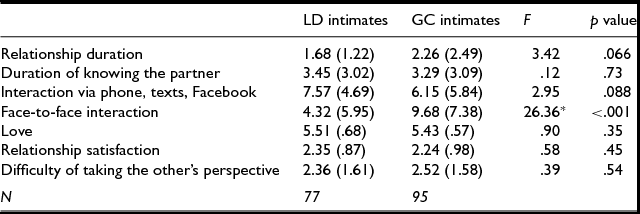
There were no significant perspective-taking main effects and no significant interactions of perspective condition and type of relationship on all relationship characteristics, shown in Table 1, all Fs < 1. LD and GC participants differed significantly only with regard to the time spent interacting face to face with their partners, F(1, 168) = 26.36, p < .001, η2 = .14. There were also two marginally significant differences between LD and GC participants with regard to relationship duration, F(1, 170) = 3.42, p = .066, η2 = .02, and amount of time in hours interacting via phone, email, text, and on Facebook, F(1, 167) = 2.95, p = .088, η2 = .02. All other comparisons as a function of relationship type were not significant, Fs < 1, all ps > .50.
Relationship Measures as a Function of Relationship Type

Note: LD denotes long-distance intimates and GC denotes geographically close participants. The numbers in parentheses denote the standard deviations.
Manipulation Checks
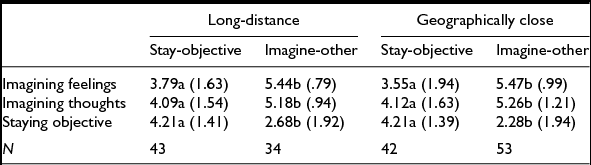
As shown in Table 2, the manipulation checks revealed that the manipulation of perspective taking was successful. There was a main effect of perspective-taking manipulation on the extent to which participants tried to imagine how their partner was feeling about the situation when reading the letter, F(1, 168) = 66.79, p < .001, η2 = .28. Participants in the imagine-other condition tried more than stay-objective participants to imagine their partners’ feelings than those in the stay-objective condition, M = 5.46, SD = .91 versus M = 3.67, SD = 1.78. Neither the main effect of type of relationship, nor the interaction between relationship type and perspective-taking manipulation was significant, both Fs < 1, both ps > .52. Similarly, imagine-other participants tried more than stay-objective participants to understand what their partner was thinking about the situation when reading the letter, M = 5.23, SD = 1.11 versus M = 4.11, SD = 1.57, F(1, 168) = 27.93, p < .001, η2 = .14. Neither the main effect of type of relationship, nor the interaction was significant for this manipulation check, both Fs < 1, both ps > .72. Finally, stay-objective participants tried more than imagine-other participants to remain detached and objective when reading their partner's letter, M = 4.21, SD = 1.39 versus M = 2.44, SD = 1.93, F(1, 168) = 44.20, p < .001, η2 = .21. Neither the main effect of type of relationship, nor the interaction was significant for this last manipulation check, both Fs < 1, both ps > .44.
Manipulation Checks for the Perspective-Taking Manipulation

Note: N = 172. Means with different subscripts are different from each other at p ≤ .001, within each type of relationship, as a function of the perspective-taking manipulation. The numbers in parentheses denote the standard deviations.
References to shared past events
Only perspective taking had a significant effect on this measure, F(1, 168) = 13.65, p < .001, η2 = .075, as imagine-other participants included more references from the past in their writing, M = .13, SD = .33, than stay-objective participants, M = .00, SD = .00. The effect of relationship type and the interaction of the two independent variables were not significant, both Fs < 1.27, both ps > .25.
Third person pronouns
Reflecting a higher focus on the partner, participants in the perspective-taking condition used more third-person pronouns in their writing narratives, M = 6.17, SD = 4.61, than those in the stay-objective condition, M = 4.94, SD = 3.69, F(1, 168) = 4.09, p = .045, η2 = .025. The effect of relationship type and the interaction of the two independent variables were not significant, both Fs < 1, both ps > .49.
Drawing Task Variables
Novel elements, letter elements, and total elements in the drawings
While there was no significant main effect of relationship type on number of letter elements, F(1, 168) = .06, p =.80, η2 =.001, there was a significant perspective-taking effect on this measure, F(1, 168) = 8.26, p = .005, η2 = .047. Stay-objective participants included more elements from the letter in their drawing than imagine-other participants (M =.91, SD = .29 vs. M = .75, SD = .44). The interaction of relationship type and perspective taking was not significant, F(1, 168) =2.03, p = .16, η2 = .012. None of the effects of perspective taking, relationship type, and their interaction was significant for the number of novel elements, all Fs < .84, all ps > .36. While there was no significant main effect of relationship type on total number of drawing elements, F(1, 168) = 1.08, p = .30, η2 = .006, there was a significant perspective-taking effect, F(1, 168) = 5.31, p = .022, η2 = .031. Stay-objective participants included more elements in their drawing than imagine-other participants, M = 3.91, SD = 2.45 vs. M = 2.95, SD = 2.72. The interaction of relationship type and perspective taking was not significant, F(1, 168) = .24, p = .62, η2 = .001.
Context
A logistic regression was performed with context (1 = Yes; 2 = No) as the dependent variable. The perspective-taking manipulation and relationship type were entered as predictors in block 1, and the main effects and the interaction in block 2. In block 2, there was a marginally significant perspective-taking effect on context, indicating that participants who imagined their partner's feelings were more likely than those who remained objective to draw context, B = -.94, SE = .58, Wald = 2.66, Exp(B) = .39, p = .10. The effect of relationship type on context was not significant, B = -.78, SE = .56, Wald = 1.94, Exp(B) = .46, p = .16. In addition, the interaction was significant, B = 1.64, SE = .78, Wald = 4.41, Exp(B) = 5.13, p = .036.
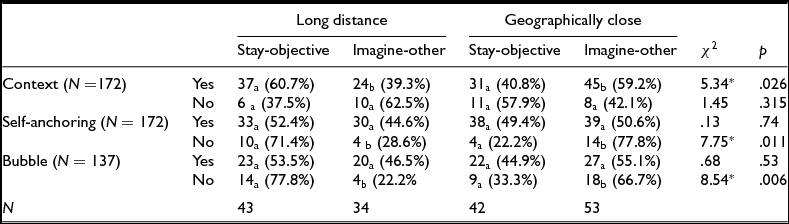
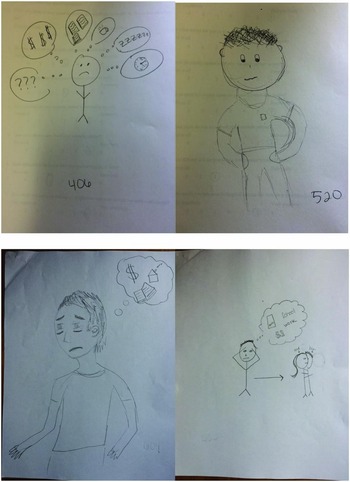
Given that all variables were dichotomous, a multi-way frequency analysis was conducted, to follow up on the statistically significant interaction. For those who drew context, there was a significant association between relationship type and the perspective-taking manipulation, χ2(1, N = 137) = 5.34, p = .026. As reported in Table 3, column comparisons indicated that among GC intimates, more participants who took the perspective of the partner (59.2%) drew a context compared to those who remained detached (40.8%), both ps < .05. Similarly, column comparisons indicated that fewer LD participants in the imagine-other condition drew a context (39.3%) compared to LD participants who stayed objective (60.7%), both ps < .05. There were no differences among those who did not include context in their drawings, χ2(1, N = 35) = 1.45, p = .32; all condition effects within each relationship type were not significant; all ps > .05. We included in Figures 1 and 2 examples of drawings produced by GC and LD participants in the perspective-taking condition.
Coded Elements in Drawing and Writing Tasks for Participants in Long Distance versus Geographically Close Romantic Relationships

Note: For those who included context in their drawings (N = 137), the cell sizes were 37 in LD/Stay-objective condition, 24 in LD/Imagine-other condition, 31 in GC/Stay-objective condition, and 45 in GC/Imagine-other condition, where LD = Long-distance and GC = Geographically close. Cell proportions with different subscripts are statistically significant from each other at p ≤ .05, within each type of relationship as a function of the perspective-taking manipulation.
Example drawings created by the GC intimates in the perspective-taking condition.

Example drawings created by the LD intimates in the perspective-taking condition.

Thought bubble inclusion
Drawing a thought bubble denotes an attempt by the participant to override the partner's perspective by including the partner's assumed thoughts in the thought bubbles. In order to identify how the specific contextual elements drawn by the participants differed as a function of the perspective-taking manipulation and relationship type, we performed the following analysis only with participants who drew context (N = 137). This allowed us to examine whether or not participants included a thought bubble when they drew some context around the figure.
A logistic regression was performed with the thought bubble (1 = Yes; 2 = No) as the dependent variable. The perspective-taking manipulation and relationship type were entered as predictors in block 1, and the main effects and their interaction in block 2. In block 2, the effect of relationship type was marginally significant, B = 1.20, SE = .63, Wald = 3.69, p = .055, Exp(B) = 3.33, indicating that long-distance participants were 3.33 times more likely to include a bubble than GC participants. In addition, the interaction of relationship-type and perspective-taking manipulation was statistically significant, B = -1.60, SE = .82, Wald = 3.86, Exp(B) = .20, p = .049. The main effect of condition was not statistically significant, Exp(B) = 1.63, p = .33.
Given that all variables were dichotomous, a multi-way frequency analysis was performed. As shown in Table 3, among those who did not draw a thought bubble, there was a significant association between relationship type and perspective taking, χ2(1, N = 45) = 8.54, p = .006. Column comparisons indicated that more GC intimates did not include a bubble in the imagine-other condition (66.7%) than in the stay-objective condition (33.3%), p < .05. Similarly, column comparisons indicated that the opposite effect occurred for LD partners: more LD participants did not include a bubble in the stay-objective condition (77.8%) than in the imagine-other condition (22.2%), both ps < .05. There were no significant differences among those who included a bubble in their drawings, χ2(1, N = 92) = .68, p = .53; all perspective-taking effects within each relationship type for those who included a bubble were non-significant; all ps > .05.
Including the self in the picture
A logistic regression was performed with inclusion of self (1 = Yes; 2 = No) as the dependent variable. The perspective-taking manipulation and relationship type were entered as predictors in block 1, and the main effects and the interaction in block 2. In block 2, none of the effects were significant, all Exp(B)s < 3.01, all ps > .36. This may be due to the fact that very few participants included themselves in the drawing and/or labelled the characters as themselves (n = 14).
Writing Task Variables
‘We’ pronouns
Neither the main effect of condition nor the main effect of relationship type was significant, both Fs <1, both ps > .32. There was a significant interaction of perspective taking and relationship type on this measure, F(1, 168) = 3.79, p = .05, η2 = .021. Planned comparisons revealed that LD participants used more ‘we’ pronouns in their writing narratives in the imagine-other condition (M = .62, SD = .99) than in the stay-objective condition (M = .09, SD = .48), t(167) = 1.97, p = .05, whereas no such effect occurred for GC participants (M = .38, SD = 1.00 for imagine-other condition versus M = .56, SD = 1.80 for stay-objective condition), t(167) = .76, p = .45.
Self-anchoring
A logistic regression was performed with sentences about self in the writing narrative (1 = Yes; 2 = No) as the dependent variable. The perspective-taking manipulation and relationship type were entered as predictors in block 1, and the main effects and the interaction in block 2. In block 2, there was a significant effect of perspective taking on self-anchoring, B = 1.23, SE = .61, Wald = 4.03, Exp(B) = 3.41, p = .045, indicating that the imagine-other participants were 3.41 times more likely to self-anchor than the stay-objective participants. There was also a non-significant effect of type of relationship, B = .99, SE = .62, Wald = 2.58, Exp(B) = 2.69, p =.108, indicating that LD intimates were 2.69 times more likely than GC partners to self-anchor. Finally, there was a significant interaction of these two independent variables on self-anchoring, B = -2.05, SE = .89, Wald = 5.33, Exp(B) = .13, p = .02. Given that all variables were dichotomous, we performed a multi-way frequency analysis (see Table 3). There was a statistical significant association between perspective and relationship type for those who did not self-anchor, χ2(1, N = 32) = 7.75, p = .011. Column comparisons indicated that more GC participants did not self-anchor when taking the perspective of the partner (77.8%) than when remaining objective (n = 22.2%), both ps < .05. In contrast, column comparisons indicated that the opposite effect occurred for LD partners: more LD participants did not self-anchor in the stay-objective condition (n = 71.4%) than in the imagine-other condition (28.6%), both ps < .05. There were no differences among those who self-anchored, χ2(1, N = 140) = .13, p = .74; all condition effects within each relationship type for those who self-anchored were non-significant; all ps > .05).
Discussion
As we predicted, a higher percentage of GC participants included context in their drawings of their romantic partner after adopting their partner's perspective than after remaining objective, whereas the opposite was true for LD participants (Hypothesis 1). LD participants in the imagine-other condition (vs. stay-objective condition) were more likely to: (1) put their own thoughts in their partners’ thought bubbles (Hypothesis 2), and (2) include themselves in relation to the partner in the narratives, as evidenced by the higher number of ‘we’ pronouns (Hypothesis 4). Hypothesis 3 was not supported, as LD intimates were equally likely to include themselves in the writing narratives in the two perspective conditions. In contrast, perspective taking reduced self-anchoring (i.e., including oneself in the narratives) for GC partners. Moreover, a higher percentage of GC partners did not include a bubble in the imagine-other condition compared to the stay-objective condition. GC participants were also equally as (un)likely to include ‘we’ pronouns in their narratives in the two perspective conditions, suggesting that their cognitive representations of their romantic relationship involve perceiving their romantic partner as a distinct person whose identity is not necessarily defined by what the partners do together.
Regardless of relationship type, stay-objective intimates reproduced more elements from the letter in their drawings than did imagine-other participants, and, in general, stay-objective participants included more elements in their drawings than the imagine-other participants. Remaining detached and objective about the partner's precarious situation might have made it easier for participants to recall basic information from the letter without interference from the act of imagining their romantic partner's situation.
Different Perspective-Taking Outcomes and Mechanisms in LD and GC Relationships
The manipulation checks, the data on past shared events, and the third-person results all suggest that LD intimates can engage in perspective taking. However, when adopting the perspective of their romantic partner, LD and GC participants appear to rely on different kinds of knowledge to estimate their partner's feelings and thoughts, which in turn leads to different outcomes.
Our data suggest that LD partners in the imagine-other condition rely extensively on self-anchoring to make inferences about their partners’ feelings and thoughts. Perhaps because they do not have ‘the other-plus-context’ knowledge, those in LD relationships cannot calibrate their estimates of their partner's thoughts and feelings in a given context. In order to understand what their partner is feeling and thinking in the given situation, LD intimates instead rely on cognitive representations of their relationships (i.e., ‘we’ representations and memories) and thus mentally place themselves in past relationship situations where the participant and their partner were together experiencing similar events as the one depicted in the study vignette. Moreover, presumably basing their inferences on this relationship-dependent knowledge, LD participants were more likely to include a thought bubble in their drawings of their romantic partners in the imagine-other condition compared to the stay-objective condition. This is because these participants lacked pertinent information about the partner's context.
Past work has found that people typically do not set aside their own perspective when adopting another person's perspective but instead use it as a starting point (Davis et al., Reference Davis, Hoch and Ragsdale1986; Nickerson, Reference Nickerson1999) and then insufficiently adjust their estimates made based on those anchors (Epley et al., Reference Epley, Keysar, Van Boven and Gilovich2004). It appears that, in contrast, GC intimates’ estimates of their partners’ feelings and thoughts in a given context are not as affected by this self-anchoring bias as LD intimates’ estimates are, as GC intimates may be more willing and capable of orienting towards their partner's context to gather information about the partner's unique and specific situation. These findings are in agreement with results from experimental work conducted by Miron et al. (Reference Miron, Wicklund, Diestelmann, Moore and Schroeder2015). These researchers found that when GC intimates were asked to imagine their romantic partner in the same scenario as the one used in this study, they were more specific in their preferences for sensory modalities of relating to their distressed partner compared to when asked to remain detached and objective. In contrast, the perspective-taking manipulation did not produce differential sensory specificity in LD partners. Altogether, these findings suggest that perspective taking leads to different outcomes in LD and GC intimates.
Limitations, Implications, and Future Work
One limitation of the current study is that its sample was comprised of university students. This may reduce our ability to generalise the findings to different demographic groups and relationships. While we believe that our study has uncovered important insights about the underlying cognitive and motivational processes that occur in romantic couples, regardless of their demographic characteristics, future work should test a more diverse sample to increase the external and internal validity of the current findings.
Our study findings indicate that LD participants rely on different knowledge than do GC intimates when making inferences about their partners’ feelings and thoughts in new situations. Specifically, GC participants were focused on their romantic partners’ context, whereas LD participants used themselves and past relationship events as sources of information. Future work could further investigate whether providing LD intimates with cues about their romantic partners’ specific context would produce perspective-taking outcomes that match those experienced by GC intimates. Scaffidi Abbate et al. (Reference Scaffidi Abbate, Boca and Gendolla2016) found that making participants self-aware and providing them with a cue for a fellow student's opinion caused them to make more accurate estimates of that student's opinion.
Research on cultural differences on sensitivity to context can also be informative. The proneness of individuals from Eastern cultures to focus on the background and of Westerners to focus on focal objects is due in part to socialisation and in part to the affordances of the environments that Asians and Westerners inhabit. Eastern environments focus attention on context, whereas American scenes appear to facilitate attention to foreground objects (Masuda & Nisbett, Reference Masuda and Nisbett2006). Thus, learned visual experience related to contextual factors influences the way individuals allocate attention (Chun, Reference Chun2000). GC partners are more oriented than LD intimates toward their partner's context because their physical environments afford different attentional strategies. That is, GC intimates literally inhabit their romantic partners’ physical contexts, whereas LD intimates do not, and therefore must rely on other kinds of knowledge such as the partners’ preferences, values, and behaviours they learned about when interacting with them in the context of their relationship. It is also possible that the range of romantic partners’ contexts to which LD partners are exposed is more restricted than that of GC partners, which could also create differences in knowledge and orientation towards those contexts.
Prior work (Amorim, Reference Amorim2003; Sulpizio et al., Reference Sulpizio, Committeri, Metta, Lambrey, Berthoz and Galati2015) suggests that visual access and social perception are conceptually linked. One derivation from this work is conceptualising LD intimates’ perspective-taking outcomes as a product of their lack of routine visual access to the physical environment of their romantic partner. It follows that changing the physical environment of LD partners through employment of video-chatting techniques can enhance a focus on the context of the other. The advent and development of personal technologies (e.g., Google Hangouts—a video chatting platform that could be used on smartphones) could reduce the LD partners’ reliance of self-anchoring processes to make inferences about their partners by allowing LD intimates to virtually inhabit their partners’ contexts.
Interestingly, our data show that while GC participants spent significantly more time face to face with their partners than LD participants, they spent only marginally significantly less time than LD intimates interacting with their partner via mediated interaction channels (e.g., email, messaging, chat, and Facebook). This suggests that LD partners are facing communication obstacles across interaction channels, and programs designed to improve relationship outcomes should focus on the content of communication (e.g., encourage intimates to talk about trivial events that occurred during the day) in addition to increasing the length of communication and the variety of communication channels. Mediated communication channels (e.g., text-based, asynchronous, and mobile) can also cause romantic partners to idealise their partner (Jiang & Hancock, Reference Jiang and Hancock2013; Tidwell & Walther, Reference Tidwell and Walther2002) away from perceiving him or her in the concrete context of everyday events. Moreover, deficiencies in concrete knowledge about the other may be caused by the speed of mediated communication rather than by a reduction in communication cues (i.e., contextual, visual, and auditory). Indeed, Bertacco and Deponte (Reference Bertacco and Deponte2005) found that, compared to communication via postal letters, emailing a long-lost friend caused participants to abbreviate their communication and to experience reduced perspective taking. This is because people assume that the recipient of an email can be reached and dealt with quickly (Manger, Wicklund, & Eikeland, Reference Manger, Wicklund and Eikeland2003), which reduces fantasising about the message and the message writer (Wicklund & Vandekerckhove, Reference Wicklund, Vandekerckhove, Postmes, Spears, Lea and Reicher2000).
Some programs aimed at producing positive relationship outcomes have focused on empathy training programs for romantic couples. Some of these programs (e.g., Long, Angera, Carter, Nakamoto, & Kalso, Reference Long, Angera, Carter, Nakamoto and Kalso1999) involve elements that could reduce self-anchoring, such as suspension of one's thoughts and feelings, empathic listening, and empathetic checking with the partner. However, because self-anchoring appears to be produced by insufficient knowledge about how the romantic partner reacts outside the relationship context, what is needed is to provide LD and GC intimates with opportunities to observe their romantic partners’ behaviour, thinking, and feeling across various contexts and particularly outside relationship situations. In other words, this would involve providing romantic intimates with ‘other-plus-other's unique context’ knowledge. This knowledge could be particularly useful when solving relationship conflicts or helping one's romantic partner cope with stressors, as depicted in our study vignette.
Finally, while our data revealed no differences in love, relationship satisfaction, and difficulty of taking the partner's perspective as a function of relationship type, future work should employ a longitudinal design to investigate the long-term consequences of LD intimates’ limited access to their partner's context on relationship maintenance and satisfaction. Research has revealed that adopting the partner's perspective (rather than one's own) predicts more relationship-enhancing attributions, more positive emotions, and more constructive and accommodating responding in accommodative dilemmas — situations in which a close romantic partner engages in a potentially destructive behaviour (Arriaga & Rusbult, Reference Arriaga and Rusbult1998). Moreover, adopting the perspective of one's partner facilitates empathic accuracy (Kilpatrick, Bissonnette, & Rusbult, Reference Kilpatrick, Bissonnette and Rusbult2002), defined as ‘the ability to accurately infer the specific content of another person's thoughts and feelings’ (Ickes, Reference Ickes1993, p. 588). Empathic accuracy, in turn, was found to predict couple wellbeing and important adaptive behaviours in dealing with conflict in newly married couples (Kilpatrick et al., Reference Kilpatrick, Bissonnette and Rusbult2002). Given the documented importance of perspective taking in promoting relationship stability and satisfaction (Arriaga & Rusbult, Reference Arriaga and Rusbult1998; Long, Reference Long1993a, Reference Long1993b), we are hopeful that clinical psychologists, therapists, and relationship researchers alike will incorporate the insights from this article about the differences between GC and LG partners in perspective-taking outcomes when developing differential theoretical and therapeutic models for LD and GC romantic relationships.
Acknowledgments
We thank Katlyn Christiansen, Edrose Heiny, Jennifer Buelow, and Tyler Jackels for their assistance with data collection and coding.
Financial Support
This research received no specific grant from any funding agency, commercial or not-for-profit sectors.
Conflict of Interests
None.
Ethical Standards
All procedures contributing to this work comply with the ethical standards of the relevant national and institutional committees on human experimentation and with the Helsinki Declaration of 1975, as revised in 2008.