1. Introduction
The growth of English Medium Instruction (EMI) worldwide has been matched by a rapid growth in the number of research publications on the subject (see Macaro et al., Reference Macaro, Curle, Pun, An and Dearden2018a) such that it has now become an established field of study featuring not only research papers in high-prestige journals but also full-length books, dedicated research groups, and even its own journal.
In this presentation, I am going to propose that there are at least ten important questions that researchers into EMI need to continue asking in order that we can better understand the phenomenon, so that we can inform policy, and so that we can provide students with the best opportunities for learning possible. I will not be able to answer each of these questions separately or sequentially as they are often interrelated, but I hope to at least touch on all of them. Also, when I refer to EMI settings, I am primarily talking about those in Higher Education (HE). When bringing into the discussion those settings (for example, in secondary education) which have been designated Content and Language Integrated Learning (CLIL), I will refer to them specifically as CLIL settings.
The ten important questions are:
1. Can we define what EMI is?
2. To what extent does English proficiency improve as a result of EMI?
3. How should we measure proficiency in EMI settings (teachers and students) and, in particular, students’ vocabulary knowledge?
4. To what extent does content learning through EMI ‘keep up’ with learning through L1?
5. What is the impact of EMI on different student groups (e.g. gender; social-economic)?
6. What strategies do students use to support/enhance their learning through EMI, and could they improve upon them?
7. How should pedagogy change in an EMI setting with a particular focus on interaction?
8. What kind and level of English for Special Purposes (ESP) support is needed for EMI to be successful?
9. What kind of professional development do EMI teachers need, and what barriers are imposed?
10. Who ‘owns’ EMI?
2. The tricky problem of defining EMI
Let us begin with the problems surrounding the name and definition of EMI, as there does not appear to be a consensus in the research field about what it is. For example, it is sometimes referred to as English Medium Education (a label variation I consider to be fairly unproblematic) or Bilingual Education (which does throw up some quite interesting considerations and research questions I will look at below). However, perhaps the greatest area of contention centred on its definition is in establishing its geographical boundaries. To deal with the lack of consensus on this point, we need first to examine the definition that I (Macaro, Reference Macaro2018) and other authors have now been using for some time. EMI is:
The use of the English language to teach academic subjects (other than English itself) in countries or jurisdictions in which the majority of the population's first language is not English.
If we consider this definition, we can assert that the phrase ‘use of the English language’ is relatively unproblematic because there is no suggestion in the definition that English is the only language that is being used to teach an academic subject. I will return to the issue of ‘academic subjects other than English itself’ in a moment. What has really given rise to a lack of consensus is the ‘location’ in which EMI is taking place, i.e. ‘in countries…in which the majority of the population's first language is not English’. A number of authors (e.g. Baker & Hüttner, Reference Baker and Hüttner2017; Pecorari & Malmström, Reference Pecorari and Malmström2018) have proposed that an EMI situation is created, in Anglophone countries (e.g. UK, USA, Australia), when the majority of the population of a particular class of students’ first language (L1) is not English. I can accept that the student experience in some situations may be similar (and indeed could be the focus of several interesting comparative studies). For example, an Arabic-speaking student studying Physics at a Japanese university (through the medium of English) may experience similar, but not identical, challenges to an Arabic-speaking student studying Physics in the UK. However, what I find difficult to accept in the critique of the above definition is its consequent dismissal of the issue of ‘policy’. In non-Anglophone countries, the decision to introduce academic subjects (previously taught through the home language) now taught through English, is a policy decision taken at the national or institutional level – indeed sometimes even at the individual teacher level. That policy decision, taken for reasons such as enhancing the marketability of home students (inter alia through improved English proficiency), or to attract international students, entails a number of fundamental questions regarding its impact on the home country, the home culture and the home language. One would have to search very diligently indeed for such impacts in an Anglophone country. There are some countries in which it is not clear what the home language of the majority of the population is (e.g. Nigeria, Ethiopia) because there are many home languages and this does pose a problem for the definition. Nevertheless, in those countries it is still a policy decision taken at some level to teach through the medium of English rather than in one of the home languages (a case in point being South Africa, where the medium of education in HE is not only English).
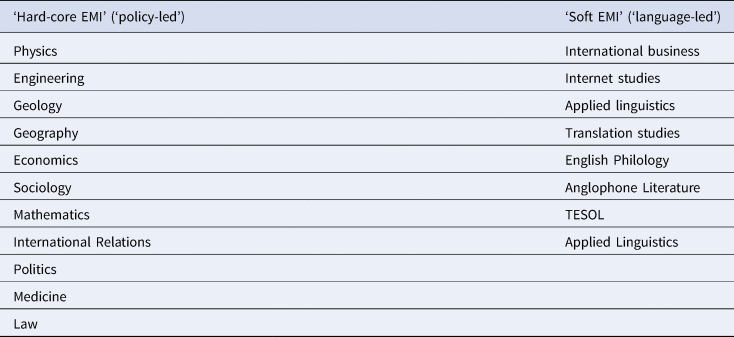
There are also questions to be asked about which academic subjects classify as EMI subjects (see Macaro Reference Macaro2020). Again, I would argue, a distinction might be made on the basis of policy-led decisions. Subjects such as Chemistry, Engineering, Sociology, Mathematics and Medicine can be perfectly well taught in the home language of the country, at the HE level, unless the speech community represented by a particular country is so small that academic materials are scarce or unavailable in that language. But there is no obvious reason why Physics cannot be taught through Chinese in China or Sociology taught through Spanish in Spain – by and large the academic materials are available in those languages. It is therefore even more of a policy-led decision to teach those subjects in those countries through English. There are some subjects, however, which when taught through English may be the result of language-led decisions taken by academics or policy makers. Although I only have anecdotal evidence, it seems that International Business and Internet Studies are often taught through the medium of English because of the need for their content to go well beyond national frontiers. Applied Linguistics, dominated as it is by research into second language (English) learning, would certainly fall into this language-led category. And as we go further down the right-hand column in Table 1 it becomes increasingly difficult not to conduct lessons, at least in part, through English. These distinctions in academic subjects in relation to EMI raise a number of important questions that research can try to answer, particularly in relation to student and teacher English language proficiency.
Differences among disciplines with respect to EMI

My adopted definition of EMI also does not suggest that there is only one uniform model of EMI. There are in fact at least four models currently being introduced and developed and even each of these may vary according to several aspects. I will only summarise these models here. For a more elaborated account, see Richards and Pun (Reference Richards and Pun2021).
The first is what is often called the Preparatory Year Model that researchers have identified as operating in countries such as Turkey and the United Arab Emirates. Here, a specified period (up to a year) of intense English language tuition is offered (or made mandatory) for students prior to embarking on an EMI programme. This model assumes that the level of a student's English is inadequate to thrive on an EMI course but may not distinguish between different starting proficiency levels among students. Moreover, it is still not established what the preparatory year will consist of in terms of English language support – whether it should be English for general academic purposes (EAP) or geared specifically for a particular course or discipline. There are, moreover, resource implications for this model: additional staffing salaries for the institution to pay and the loss of a year's potential earnings for students because they will inevitably graduate a year later than their first language medium of instruction (L1MOI) counterparts. Furthermore, there are resource and time implications because of the increased collaboration needed between content specialists and English language specialists, to the point where a set of criteria may need to be established about the best form of distributed expertise.
We then have what I would call the ‘pre-institutional selection model’. Here, a selection for entry to a particular EMI programme is made on the basis of a student's English proficiency, usually at the transition point from secondary to tertiary education, although it may also occur at the transition point between undergraduate and postgraduate education. This model seems to me problematic for a number of reasons. First, selection based on English proficiency for, say, an architecture degree, is highly problematic because the process may not be selecting and promoting the best future architects. Second, it brings with it an element of injustice because social-economic class may play a part in favouring students from more wealthy backgrounds whose parents can afford private language tuition prior to the proficiency test. Third, this model may allow EMI teachers (and indeed the institution as a whole) to assume that ‘the job's done’ – that is, selected students will not need additional language help and (perhaps more importantly) the EMI teacher need not adjust to the differing levels of English language proficiency in her/his class.
The ‘institutional concurrent support model’ is based on the premise that all students who have graduated from secondary education have both a reasonable command of English and shown a flair for a particular academic subject, should be admitted onto an EMI programme. In other words, English proficiency is not the key attribute sought. In this model, additional EAP or ESP is offered perhaps at an individual level. Clearly, this is the most egalitarian of the models so far described but it does bring with it a number of requisites: content teachers need to understand and communicate a student's linguistic needs from their content perspective, and English specialists need to acquire a level of understanding of the specific academic genre and the difficulties that it poses. As Galloway and Rose (Reference Galloway and Rose2021) demonstrate, collaboration across these disciplines is a major challenge for EMI development, not least because of the changing roles that models in general and this model in particular imply.
The ‘multilingual model’ can be mapped onto any of the previous models but additionally it offers flexibility as to the reliance on the English language for teaching a content subject. For example, some sessions/modules might be taught in L1 and some in English. Or all sessions, from the start, might involve the use of a considerable amount of English but with frequent switching to L1. Or the overall programme might begin with a minimal amount of English being spoken by the teacher and gradually increase. This model poses problems for international students who do not speak the home language (or at least not to a level sufficient for them to access complex academic concepts) thereby undermining national or institutional aspirations to attract large numbers of international students and to internationalise their university. Moreover, it may lead to a teacher identity problem where they might ask themselves who exactly am I doing this EMI for? Lastly, switching between languages, I believe, requires principled decisions about when to switch for not only the short-term benefit of getting the immediate message across but also the long-term benefit of gradually enhancing the students’ capability to operate in English in their subject.
The models I have described above need to be the subject of research. I am not suggesting they should be compared for their effectiveness but that the success of an EMI programme should always be measured against the particular model adopted. This leads us to learning outcomes in EMI contexts.
3. Assessing EMI outcomes
I have argued elsewhere (Macaro, Reference Macaro2018) that policy makers and teachers, having decided on which model of EMI to adopt, need to carry out some sort of cost-benefit analysis. Of course, it is also incumbent on the research community to provide evidence of EMI outcomes. However, to date, the research literature on outcomes has, inter alia, not been sufficiently able to identify what successful outcomes might look like, as well as there being a dearth of outcome studies anyway. So, in order to carry out a cost-benefit analysis, policy-makers need to address the following two hypotheses to the specific model they are implementing:
• Hypothesis 1: Learning content through second language (L2) English leads to better learning of English (and better context-relevant English) than learning L2 English through English as a Foreign Language (EFL) courses offered alongside content courses delivered in L1.
• Hypothesis 2: Learning content through L2 English leads to at least as good learning of academic content as learning content through the students’ L1.
It would seem to me uncontroversial that these two hypotheses should be considered together conceptually, even if not simultaneously, in research. However, Hypothesis 1 immediately poses several challenges for researchers. First, what kind of test could be used to compare increases in English proficiency through EMI as opposed to EFL? Is it valid to administer the same test? Probably not given that the content of the two courses is going to be vastly different in terms of (at the very least) vocabulary, grammar, communication objectives, topics chosen (see below), and mode of delivery. Yet, some studies (e.g. Chostelidou & Griva, Reference Chostelidou and Griva2014; Lei & Hu, Reference Lei and Hu2014; Rogier, Reference Rogier2012) have compared English language outcomes by using the same language tests for both groups of students. Another issue is the following: in order to limit the possible variation in course content, should researchers limit themselves to receptive skills only but somehow use different vocabulary levels for each cohort? That would probably favour the EMI students unfairly because of the greater focus on academic language. Another comparison might be to investigate which approach (EMI or General English university classes) does the job better of preparing students for further study in their own field; for example, transitioning from first to a higher degree. But that would not really work either because of the narrower and more highly specialised nature of the two degree levels; for example, if we were to compare the transition in engineering from undergraduate to postgraduate level, with English language learning at undergraduate level leading to, say, a higher degree in English literature. A further problem with comparing the linguistic progress of the two cohorts is that often EMI students are in addition attending General English courses and/or receiving ESP support.
So, if Hypothesis 1 is tricky to research, can we fare any better with Hypothesis 2? The problem, as I see it, is in the words ‘leads to’. What do we mean by this? Several studies (Hellekjaer, Reference Hellekjaer2010; Vu & Burns, Reference Vu and Burns2014; Wang et al., Reference Wang, Yu and Shao2018) have demonstrated the challenges students face, which in turn would suggest a slowing down in content learning when taught through EMI. These have usually been reported through student or EMI teacher perspectives rather than actual objective tests of content. On the other hand, some studies using testing have not found any lower achievement when comparing EMI with L1MOI students (e.g. Dafouz & Mar Camacho-Miñano, Reference Dafouz and Mar Camacho-Miñano2016; Dafouz et al., Reference Dafouz, Mar Camacho-Miñano and Urquia2014; Zaif et al., Reference Zaif, Aydin Karapinar and Eksi2017). Nevertheless, let us assume for a moment that there is a slowing down of content learning or a ‘detrimental effect’ of EMI as would seem natural given the additional linguistic hurdles that students have to face. The issue then is would we be looking for any detrimental effect, at any stage, or would we be looking for a long-lasting detrimental effect? Put differently, if research could demonstrate that EMI students catch up in academic content learning with their L1MOI peers in the end (perhaps as their linguistic proficiency goes over a certain threshold), would that be a satisfactory outcome and assuage the concerns of EMI's critics? It seems to me this would certainly help. However, it still leaves the question of how long-lasting might the detrimental effect be and to what extent that period of time is acceptable, and, in any case, who decides? The students, the teachers, the institution, the wider nation?
These two outcomes could additionally be measured against a number of independent variables; for example, the social-economic groups already mentioned above. Here, there is already some evidence that EMI increases the Matthew effect (where the rich get richer and the poor get poorer), or that it accentuates disparities between social groups (Hamid et al., Reference Hamid, Jahan and Islam2013). Another independent variable that could be investigated is gender in relation to EMI. It is well known that many disciplines are ‘gendered’. For example, females preferring to opt for language-related subjects and males opting for science and engineering. Could it be that the combination of language and content in EMI might bring about a change in the gendering of academic subjects? Might it be that females would be more likely to opt for (or feel encouraged to apply for) STEM subjects because they are taught through English? Some research in this field carried out in Turkey (Macaro & Akincioglu, Reference Macaro and Akincioglu2017) and in Thailand (Hengsadeekul et al., Reference Hengsadeekul, Koul and Kaewkuekool2014) suggests quite positive attitudes held by females towards EMI in general and, by implication (because the academic subjects examined in the first of these studies were indeed traditionally ‘male gendered’) towards STEM subjects. However, Lasagabaster (Reference Lasagabaster2015) did not find significant differences in motivation between male and female EMI students in Spain. Therefore, this area of research is very much in its early stages and needs many more studies to identify if there is any beneficial trend.
4. Language and learning strategies in EMI settings
Earlier, I highlighted possible differences in academic subjects, suggesting some were more likely than others to be associated with (by their very nature) the English language. Another difference among disciplines is the focus of the language and particularly on the students’ strategies in relation to (inter alia) vocabulary learning. Let us compare an EMI lecture on oncology with one on economics in terms of future use of the language – that is, after the student has successfully graduated. I would maintain that in the case of the medical student studying oncology, their future use of the language will not only be in the context of discussing an aspect of cancer with her/his professional equals but also s/he will have to project language use to future patients who are very likely not able to speak English or at least will want their medical problems explained in L1. In the case of the economics student, it is very likely that projected future use of her/his language will be only with professional peers. Thus, the learning strategies adopted in the two EMI settings will likely be different. Moreover, there will be differences in the two disciplines in terms of the level of abstraction imposed by the genre. ‘Game theory’ in economics is quite an abstract concept requiring learning strategies that will go far beyond the label given to the concept. A ‘soft-tissue sarcoma’ is much less of an abstract concept (sadly) and therefore the strategic effort is in understanding and remembering how it differs from other types of sarcomas.
A difficulty which EMI students often refer to is understanding and learning the technical words in a teacher's lesson, something which has for some time already been noted in EAP settings. These technical words are often signalled by the teacher as ‘keywords’. I would propose that the keywords in an EMI lecture are of a different nature to the keywords that students in language learner strategy research have often been encouraged to identify – where the keyword will be the ‘key’ (or one of the keys) to assist understanding of the text. To illustrate the difference in the two settings, I have used an extract from a study by Francesca Costa where the content subject appears to be agricultural science:
. . . as you can see there are three or four uh (.) keywords (.) the first word is fast (.) what fast means? (.) means that we have to pre cool (.) between 30 minutes and one hour (.) fast equals efficiency (.) what means immediately (.) after harvest? (.) immediately means six hours five hours? (Costa, Reference Costa2012, p. 39)
Here, it is the actual teacher that signals the keyword (‘fast’). But what I would propose is that the keyword the teacher asks the students to focus on is not the keyword that helps them access the rest of the text. The keyword here is the technical term for the concept which is being explained by the teacher – the label given to the complex concept.
A similar process is happening in this Geography class:
Okay. (pause) Okay. (pause) This one and this one, thank you for (student's name) for the answer. Channel A would have a greater velocity, have a higher river energy. And then the explanation, actually you can use another explanation. Gradient, use keyword gradient. The steeper the gradient, the faster the flow, and the higher the energy . . . (Lo & Macaro, Reference Lo and Macaro2015, p. 247)
Here again, the keyword in this EMI setting is not the keyword which may facilitate understanding of a text in a language learning class but the label given to the concept itself.
What I have tried to illustrate in these two very different examples is that language learner strategies (LLS) cannot easily be mapped on to EMI learning strategies because the content of a text is presented in a very different way.
Some similarities to LLS in language classes do exist. For example, the advice to look for cognates in the language being learnt with the student's L1 and the dangers of overdoing this and being derailed by ‘false friends’. This History lesson from data collected in our Italy project (Macaro et al., Reference Macaro, Briggs Baffoe-Djan, Rose, di Sabato, Hughes, Cuccurullo, Coonan, Menegale and Bier2019b) shows just how frequently cognates can occur:
. . .you have to consider where Cuba is because its location is very very important in terms of er the political influence and the interests of the United States on Cuba on Cuba erm Cuba is here <POINTS AT PRESENTATION SLIDE> so it's just er a few miles in terms of navigation from er Florida and er it closes in a certain sense the Gulf of Mexico and it's the sort of border between the Gulf of Mexico and the Caribbean, erm, this is the er the island it's very long and erm this area in particular er has a lot of mountains so here is the capital city which was created, founded by the Spanish and erm what you have to take into account is this bay here which is something we are going to er talk about later it is called in English it's called the Bay of the Pigs and this area here which is the most mountainous area and it er it was the place where er, Fidel Castro and Che Guevara arrived, landed er when they adopted) the revolution, er the rest of the island is has a lot of scattered islands here here here and creates a sort of lagoon so from the point of view of the environment er the area is particularly relevant and very interesting from the point of view of tourism not just now but, even <SLIDE CHANGE 1:44C>, erm something very important to say not just about Cuba.
Here, the sheer number of English cognates (in italics) with Italian are clearly an opportunity for these EMI students to use the cognate strategy. However, of course, this strategy is not available to a student with a non-cognate L1. So, research could try to identify the extent to which students use the cognate strategy and when it is misused and, what they do when the strategy is not available to them.
Vocabulary crops up again and again in studies which identify the challenges that students are experiencing in EMI settings. These challenges appear to be essentially in terms of listening to the teacher who is usually presenting information in the uni-directional lecture format. We can therefore use the technique of examining lexical coverage to ascertain whether a particular class of students is likely to experience difficulties understanding the teacher's talk. Lexical coverage involves taking measurements of the students’ vocabulary knowledge in lexical frequency bands and comparing this to the vocabulary used by the teacher in the lecture or lesson. This is the method we adopted as part of a project on CLIL and EMI in Italy (Macaro et al., Reference Macaro, Briggs Baffoe-Djan, Rose, di Sabato, Hughes, Cuccurullo, Coonan, Menegale and Bier2019b) where 148 students in their last year of secondary school took these vocabulary tests and 12 CLIL lessons were recorded. Setting the threshold for ‘adequate comprehension’ at a very minimum of 80%, we found that it was unlikely that these students would have sufficiently mastered any of the vocabulary frequency bands and therefore would have difficulties understanding the teacher. Students tested in the first year of a university EMI course appeared to have a better chance of understanding the teacher based on their vocabulary test results, a finding which we hypothesised was due to self-selection at the enrolment for the university course stage.
It needs to be pointed out, however, that the conclusion that the school students would have considerable difficulty understanding the teacher was based on the vocabulary tests alone. There is more involved in listening to a teacher than vocabulary. One factor which can compensate for inadequate vocabulary knowledge (provided that this inadequacy is not enormous) is the student's strategic behaviour – the strategies they deploy to overcome their difficulties. However, as I have already intimated, strategic behaviour in EMI cannot easily be mapped on to existing general language learning strategies and especially, I would suggest, we cannot take existing strategy inventories (e.g. Oxford & Burry-Stock, Reference Oxford and Burry-Stock1995; Vandergrift, Reference Vandergrift2003) and use them with EMI students. Indeed, I would suggest that an EMI approach to eliciting strategic behaviour in students requires first to identify the goal orientation of EMI students. This would involve first asking them questions such as ‘When you are listening to your teacher in your Biology lesson, do you spend more time thinking about the Biology or about the English, the language that s/he is using?’ In the aforementioned study in Italy, we found that the overwhelming response to the question ‘When you enter an EMI class do you focus more on the subject or more on improving English?’ was that they focused much more on the academic subject. Having identified this overarching goal orientation, a semi-structured interview could then ask subordinate questions such as ‘What are the listening strategies that you use in your Biology lesson? What do you do when you are listening and some difficulty occurs?’, followed by more specific questions such as ‘Do you listen out for your teacher's discourse markers?’ and ‘Are there times when you cannot make out the words that s/he is saying and if so how do you deal with these?’
Another area that researchers into EMI strategic behaviour will have to consider is prior knowledge of the topic and if and how this differs from prior knowledge of the topic in general language learning classes. Again, I should point out that skilled use of ‘prior knowledge of the topic’ is a strategy that is very frequently cited in the LLS literature as being an important tool in overcoming listening or reading difficulties (Macaro et al., Reference Macaro, Vanderplank and Graham2005). The idea is that if you have a great deal of familiarity with the topic of the text then it should be possible to infer the meaning of unknown words or bits of language. In general language classes, topics are usually selected by the teacher and ‘graded’ to suit the proficiency level of the students, thus enabling them to use the prior knowledge strategy. It would be odd for a language teacher to give beginner learners a topic that is outlandish or completely outside their sphere of experience. EMI oral texts (i.e. the topic in the teacher's talk) are not ‘graded’ in the same way but rather they follow a topic curriculum which means that the topic being listened to by EMI students could be completely new to them. Moreover, and once again, the prior knowledge issue may well differ according to the academic discipline being taught in the EMI class. Let us compare Particle Physics and Politics. In the latter, most students in their late teens (CLIL environment) or early adulthood (EMI environment) will have some ‘world knowledge’ of politics. They will also have some ‘event specific knowledge’ (a conference attended by politicians to discuss climate change), and even possibly some personal knowledge of political activity. Thus, the layer of academic knowledge will be grafted on top of these other layers. In the case of Particle Physics, students may well be coming completely new to this topic (apart perhaps from some limited ‘world knowledge’).
In the Italy study, we asked questions about strategic behaviour before, during and after the lesson or lecture. Our findings, I would maintain, were of great interest to us and, I hope, to future researchers in this specific field. By far the greatest strategic effort that the first-year university students said they made was in class, during the lecture or lesson: making notes of keywords used by the teacher; making notes of explanations; being aware of the different vocabulary types being used; guessing the meaning of an unknown word from its context. Some reviewing of notes and materials they had been given did occur but the main effort was clearly during the lecture or lesson. They said they rarely previewed notes, vocabulary or topics or tried to find similar subjects on the internet prior to the lesson. Furthermore, there was clearly little evidence of interaction with the teacher as, for example, asking for concept explanations or explanations of technical or general academic or everyday words. They very rarely asked the teacher to clarify, in English or in L1 (Italian), a point s/he had made. Of course, it may well be that the EMI teachers did not create the atmosphere in which asking such questions was encouraged or even acceptable. In other words, the classes were not sufficiently interactive. It is to interaction to which we now turn.
5. Interaction as a key to EMI pedagogy
Several researchers (e.g. Bradford, Reference Bradford2019) have argued that, for EMI to be successful, pedagogy has to change and that a key component of that change is an increase in teacher–student(s) interaction. Incidentally, there are some suggestions that lack of interaction in EMI settings is due to a teacher's fear that their level of English is not high enough for them to deviate from their script. There may be some truth in this, and future research may identify more precisely where the problem lies, but a study by An et al. (Reference An, Macaro and Childs2021) of EMI (secondary school) teachers in China, all native speakers of English (i.e. imported foreign teachers), did not show any major increase in interaction with students.
Linguists would hardly be surprised to be told that interaction is important for language learning. It is a belief that goes back to the early 1980s when modification of input, meaning negotiation and forced output were being researched and promoted. However, pedagogical experts in other subjects such as science (Mortimer & Scott, Reference Mortimer and Scott2003) have long since been arguing that interaction is an important component of good pedagogy with features such as higher order questioning, extended Initiation-Response-Feedback (IRF) sequences and appropriate wait time being given to students allowing them to compose more meaningful answers. I will return to the topic of quality interaction in a moment under the heading of teacher professional development. Let us look briefly within the general area of interaction at L1 use by the teacher. I prefer in this talk to opt for this more neutral term than the more complex ‘codeswitching’ and ‘translanguaging’. However, we should note that in the general language learning field, the academic viewpoint has shifted dramatically over the past two decades from predominant use of L2 (some would argue that it was L2-only) to much greater acceptance of L1 use.
One student in our EMI Italy project said:
I've never studied before physics in English, so I have to try to translate my technical vocabulary from Italian to English at the beginning of the course because I mean I've never tried to hear a lecture in physics in English so I had a couple of problems.
So, what should an EMI teacher do? Provide students with L1 translations and explanations of certain types of vocabulary or give L2 explanations and hope that the students will understand? I have already mentioned the problem with L1 use in EMI classes where there are large numbers of international students. But putting that aside, might we come up with certain criteria to identify when using the L1 might be principled and when it might not be? There are studies in the EMI field which have shown that teachers considered the use of the L1 as a valuable, perhaps even a necessary, tool in their pedagogy (Galloway et al., Reference Galloway, Kriukow and Numajiri2017). Others have shown that, whilst students do not rule out the use of the L1, they would prefer the teacher to attempt a paraphrase or other technique to put across the meaning of a word or a concept. So, let us consider two possible examples of L1 use (from Macaro et al., Reference Macaro, Tian and Chu2018b) in predominantly L2 teacher talk from EMI classrooms in China. The first is taken from a Management and Accounting course, the second from a Business Studies course:
Example 1
Teacher: some indirect material, like the wood, like the glue, these are indirect material, 胶水(tr. glue), something like that.
Example 2
Teacher: T3: At the age of 15, he (Jeremy Bentham) went to law school. And he was admitted to the Bar. You know what is the Bar? You know what is the Bar? 律师资格考试 (tr. exam, qualification to become a lawyer), right?
We should note that, in the first example, the translated word ‘the glue’ is not directly a technical term in Management and Accounting but is being used merely as an example of ‘indirect material’. The reason for the teacher providing an L1 equivalent is hard to ascertain. Perhaps she knows that the students are not familiar with the word ‘glue’, perhaps not. The reason for the translation of ‘The Bar’, on the other hand, in example 2 is probably more transparent. The Bar is a technical term in the field of law (so once again not directly connected to Business Studies) but in describing the life of Jeremy Bentham it is probable that the teacher realises there is no direct equivalent in Chinese, it being a term restricted, as far as I am aware, to the UK and the US. Nonetheless, the reason for providing the Chinese paraphrase (note that it requires six characters) is also not transparent in the sense that an English paraphrase could have been provided. The L1 switch in example 3 is different from the previous two in that ‘constructive abstention’ is a technical term to be found in International Relations – the actual subject being taught. The teacher's provision of the L1 equivalent seems to be therefore an attempt to ensure thorough understanding of a technical term within the subject.
Example 3 (International Relations)
Teacher: And also treaty introduces the rule of constructive abstention, constructive abstention were also very important for member states to consider in CSPE, constructive abstention called 建设性弃权 (tr. constructive abstention), constructive abstention.
Yet even here, as Macaro et al. (Reference Macaro, Tian and Chu2018b) point out, ‘the equivalent appears to require five characters suggesting that a paraphrase (“abstaining in order to give up a right”) rather than a Chinese-specific technical term is being used’ (p. 391).
These deliberations over the use of L1 to make understanding of words and concepts clearer are not trivial. They are part and parcel of what it is to build up a flexible curriculum of what should be the professional competencies of an EMI teacher. It is important, therefore, that we should next consider the question of EMI teacher professional development.
6. EMI teachers and professional development
EMI teachers are aware that, in EMI settings, teaching has to change (Macaro et al., Reference Macaro, Akincioglu and Han2019a) from the lecture style approach that can (perhaps) suffice when using the students’ home language to teach an academic subject. In the 2019 study (op. cit.), we approached this topic from a number of perspectives by asking these broad research questions: To what extent have EMI teachers in HE taken part in professional development courses? To what extent do they consider teacher certification of the competencies important? What type of certification do they see as appropriate?
Very importantly we also asked: What learning would they be prepared to undertake in order to obtain certification and what might be the potential obstacles to EMI teacher development and certification? Space only allows a brief resume of our findings. In the sample taken from six countries, respondents provided evidence that most had not undertaken any professional development. Yet, as already mentioned, they were aware that teaching had to change, that ‘you can't just translate your slides into English’ as one teacher offered. However, most teachers were not keen on developing what I like to call ‘minimum required competencies in applied linguistics’. These might include an understanding of how vocabulary is learnt and of the different varieties of vocabulary, how to improve the quality of interaction (as already touched upon earlier), the problems the hearer faces when confronted with an incoming speech stream in terms of intelligibility, the relationship between teacher talk and supporting materials, and so on. Moreover, most teachers sampled said they would prefer a short intensive course rather than a more protracted one where their development might be tracked by them or others. We also know from fairly extensive research on teacher professional development that short intensive courses frequently do not lead to sustained change (e.g. Borg, Reference Borg2018).
We then come to the question of what type of professional development might be the most acceptable to EMI teachers whilst at the same time being productive and of benefit to students. Several authors have called for collaboration between content specialists and English language specialists. For example, Costa and Coleman (Reference Costa and Coleman2013) found that universities reported that the lack of collaborations between these two specialists was probably one of the greatest obstacles they had to overcome. Galloway and Ruegg (Reference Galloway and Ruegg2020) recommend that collaboration is needed for consistent and focused EMI programmes, as general EAP is not enough and Mancho-Barés and Arnó-Macià (Reference Mancho-Barés and Arnó-Macià2017) propose that ‘One of the challenges to interdisciplinary collaboration in an EMI context is that the implementation of EMI is left almost exclusively in the hands of content lecturers in an institutional context of compartmentalised departments and areas of knowledge’ (p. 269).
A model of collaboration was attempted on a small scale in China by Macaro and Tian (Reference Macaro and Tian2020). In this experimental study, two EMI teachers in the same institution (one in Human Resource Management and the other in International Relations) agreed to collaborate with an applied linguist in the same institution. The objective was to ensure an equal status between them and for the research design to be non-judgemental. The experiment involved a series of lessons being audio recorded. These were then transcribed by the applied linguist and analysed along an agreed set of features. The EMI teachers agreed to listen to the recordings, examine the transcription and the analysis, and then record their reactions in the form of an audio-diary. The analysis parameters were as follows:
• The amount of teacher and student talk
• The proportion of L2/L1 use
• The proportion of turn-taking patterns
• The ratio of verb use to noun use
• The occurrence of lexical explanations
• The number of student-initiated questions
Most of the above features should be self-explanatory in the context of the quality interaction described earlier – a more student-centred approach to pedagogy in general and interaction in particular. The ratio of verb to noun use was there because previous EMI interaction research has demonstrated that students can give one word noun answers to complex EMI teacher questions and that these often satisfy the teacher. It was our contention that one word verb answers are almost impossible when demonstrating content knowledge and that, in any case, particularly in science-related subjects, a demonstration of the understanding of processes requires students to use a verb phrase at the very least.
Our findings were that both teachers found the collaboration very useful but only one teacher made sufficient attempts to change her/his interaction patterns. As this teacher said in her/his audio diary:
I should give positive feedback to student talk in class, so as to build students’ confidence in class talk and in turn talk more. It is a challenge for teachers to give students’ effective feedback to help them build up their knowledge through responding to their questions . . . I improved in class interaction due to my efforts. There are more teacher feedbacks to student response, which encouraged students to participate more actively.
Even though the other teacher acknowledged that the ‘audio recording was just like lecturing’, s/he did not change her/his interaction approach and instead of increasing the students’ talk and asking questions s/he ‘arranged students’ discussion class’ but even here s/he was concerned that the ‘L1 is often used by students during group discussion’ and that s/he didn't expect ‘students to answer my questions, because students’ proficiency level not good enough and [they are] unwilling to talk individually in class’.
A more uniformly successful intervention was carried out in Turkey (Macaro et al., Reference Macaro, Akincioglu and Dearden2016), where collaboration between content specialists and English language specialists was conceived in the form of working together on planning lessons. Recall that in Turkey they have the preparatory year system. Yet, despite this preparatory year the content teachers in this study complained of lack of discipline-specific language in English. As one teacher said before the intervention, ‘I think they [PYP English specialists] prepare [students] just for regular English lectures not for scientific lectures not for physics not for other scientific lectures’. The design of the project was intended to bring together these pairs of teachers and for them to plan lessons using a specifically designed tool which focused on vocabulary use, interaction, etc. Interestingly, before the intervention one EMI teacher commented, ‘I don't write this [lesson plan] down [because] I have all this in my mind, it's automatic’. Another pointed out the difficulties of collaborating: ‘. . . we don't come together with my colleagues . . . they are too busy’. In the minds of the content lecturers prior to the intervention there was no separation of language and content and if students showed lack of understanding by not answering questions, there was no attempt to identify whether this was a language problem or a conceptual/content problem. By the end of the study, most of the collaborating pairs thought that the experience had been beneficial and that the collaborative planning tool had been useful particularly in the early planning sessions. Some teachers wanted the collaboration to continue. As one teacher said:
I'd love to do that [continue to plan collaboratively]. I got feedback when I prepare the videos and the other materials for my lectures. My presentations became better and better, this project helped me. I asked the principal and the university admin to continue to this collaboration, in the same way I experienced, being in communication with PYP. We want to continue this because this [collaboration between the Engineering Department and PYP] is good for our students and also for our instructors.
Before the intervention, one Maths teacher appeared to believe that language was not an issue in explaining mathematical problems. S/he said, ‘They mostly need to calculate, the language doesn't come into play’, and some problems ‘don't require any language skills such as multiplying two entities’. However, after several sessions of joint collaboration using the tool the same Maths teacher said:
We take Maths as a language, we give formulas, we say F is equal to Mxa. Technically speaking if the students are perfect in Maths they don't need to know the language you are using, they will perfectly understand what you mean. But in reality we need to explain these formulas, we need to support mathematics with language.
These early professional development interventions need to be re-tried and in different contexts. This might give further insights as to why some collaborations are successful and others less so. From the two projects mentioned, I come away with the tentative conclusion that it may be down to personalities and whether the content teacher feels their identity is being threatened by the presence of the language specialist and the latter's role in suggesting what might be a more productive pedagogy. Therefore, it may be that we have to look more deeply at how EMI is being researched and how professional development programmes are being conceived and by whom. We now come to the final area of research which I would like to touch upon: Who owns EMI?
I have recently been working at Oxford with Ikuya Aizawa (Macaro and Aizawa in process) in trying to answer that question and we have concluded that the field of EMI research and commentary has been appropriated almost entirely by applied linguists. By examining many research papers in journals, we have ascertained that most author/researchers in the EMI field are language specialists. Yet, from other research carried out on the profiles of EMI teachers (Macaro et al., Reference Macaro, Sahan and Rose2021), we know that EMI teachers are more likely to fall into the ‘policy-led’ EMI subjects I alluded to above. In other words, they are teaching subjects which have little to do (in direct manner) with the English language – yet they are teaching in English. Ikuya and I have also ascertained that most EMI publications are in Second Language Acquisition (SLA) or SLA-related journals. Conferences on tertiary EMI and even secondary school CLIL are, in my experience, almost entirely populated by language specialists and these audiences are addressed by applied linguists.
Professional development programmes, as far as we have been able to ascertain, are being ‘offered’ by applied linguists – quite often in Anglophone countries. This is not a happy state of affairs and it is indeed a growing concern in the research field. I do, of course, recognise that, as an applied linguist publishing in language-related journals, I am contributing to that state of affairs. I wonder, therefore, if part of the reticence of some content specialists to take part in long term and consolidated professional development is because they do not own the EMI agenda but are merely passive consumers of it. It therefore seems to me that if we are to make real progress with EMI pedagogy (which it appears most people believe has to change in order to do the best for their students), then the collaboration between content and language specialists has to begin at the research agenda setting stage. What do both see as the key pedagogical changes that need to be made? And if there is divergence of views, why is that? Is it possible that as applied linguists (even the ones involved in EAP and ESP) we do not really understand the complexity of certain concepts nor what it means for a concept to have been adequately explained and understood?
Having jointly established a research agenda (which may have some common-core and some divergences for specific academic disciplines), then it would be extremely useful and indeed enabling for content specialists to carry out and write up/publish the research jointly with language specialists. This may go a little way to overcoming the objection that EMI professional development takes time away from research. Even so, we should always remember that many EMI teachers are under a great deal of pressure to publish in their own specific academic field. It would, nevertheless, be a start.
Ernesto Macaro is Emeritus Professor of Applied Linguistics at the University of Oxford in the Department of Education. His current research focuses on second language learning strategies and on the interaction between teachers and learners in second language classrooms or in classrooms where English is the Medium of Instruction. He has published widely on these topics.