New healthcare technologies, medical devices, and techniques have been steadily increasing and are still expanding. New health technologies not only can offer solutions to strictly medical problems, they can also have secondary advantages such as the reduction of hospital length of stay, the improvement of quality and safety of care, the comfort of the patient, and so on. The drawback, however, is that current medical technological evolution is a major cost driver of healthcare expenditure. Demands for reimbursement of emerging technologies in the phase before adoption and usually before any reliable evidence exists on their clinical effectiveness and cost-effectiveness is a particular challenge to many healthcare systems. Decision makers responsible for funding health care need high quality and impartial information derived from rigorous assessments to make decisions in an environment of limited resources. On the one hand, a premature introduction of a medical technology in the system can lead to patient harms and inadequate use of resources. On the other hand, a policy that is too restrictive can hamper patient access to and benefits from a new technology.
Currently, there is already a regulatory base in the Belgian health insurance legislation allowing conditional reimbursement of new implants in Belgium. The application of this regulation, however, rarely involves a rigorous scientific evaluation with an appropriate research design to assess an emerging technology. This can lead to budgetary failure or inappropriate use of resources. Moreover, the absence of sufficient regulation for technologies such as medical devices in general can lead to the diffusion of unevaluated medical technologies and possible safety problems and patient harms.
To come forward to these deficiencies, a transparent and scientifically valid framework for the early evaluation of medical devices was set up by the Belgian Health Care Knowledge Centre and the Health Insurance institute (RIZIV/INAMI). Although this procedure was specifically set up for Belgium, it was based on an international survey and may be applicable for the managed uptake of new and emerging technologies in other countries (13). To date, the procedure is not operational yet. A legal initiative to implement the procedure is expected in the near future.
THE EUROPEAN CONFORMITY LABEL: A STEP TO GUARANTEE TECHNICAL SAFETY
On the European level, medical devices are mainly regulated by three Directives. The primary Directive covers most medical devices; the other two Directives provide specific requirements for implantable and in vitro diagnostic devices (2–4). The Directive concerning medical devices sets the general outline for medical devices and particularly focuses on the process of CE (European Conformity) marking. CE marking is a legal requirement through which a manufacturer claims that the product complies with minimum product safety requirements. A product that is marked with the CE label may enter all countries of the European Economic Area (EEA).
To obtain the CE label, several stages have to be completed. The Directive concerning medical devices distinguishes four medical device classes (I, IIa, IIb, and III) according to the risk the device poses to the patient and/or the user. For Class I devices (except custom-made devices or devices containing sterility function), manufacturers must perform a self-declaration. For classes IIa, IIb, and III, a notified body must be involved. Technical documentation has to be collected to demonstrate that the essential requirements specified in the respective directives are met. Furthermore, a declaration of conformity of the device to these requirements has to be drawn up by the manufacturer or the authorized representative.
CE Marking is not a quality standard but a simple declaration by the manufacturer that a product complies with the essential requirements of the relevant Directives. Those requirements primarily focus on safety and device performance, but do not guarantee clinical or cost-effectiveness. Especially for high-risk devices, this might be problematic. Several implants and invasive devices easily obtained their CE label in the past, most while there were ongoing clinical trials. For some devices, only several years later were the first trials published, possibly not showing clear clinical benefits. In Belgium for example, aortic endovascular devices were reimbursed by social security during several years in seventy hospitals outside a clinical trial setting. Endovascular stentgrafts were used to repair abdominal aorta aneurysms (EVAR). The rationale behind EVAR is to offer an alternative for otherwise inoperable patients and to reduce the severe postoperative mortality and morbidity of open repair, speed up recovery, and reduce costs through decreased length of stay in hospital and intensive care. Later on, clinical trials in other countries demonstrated that this technique offered only limited added (clinical) value, depending on the patient population (1;5;6;8–11). Several of the EVAR devices were withdrawn from the market in the past decade. Furthermore, there were elaborate discussions in the Belgian health insurance bodies on the reimbursement of carotid stenting. These stents are already being used in several Belgian hospitals outside a randomized clinical trial (RCT) setting. Recently, the SPACE and EVA-3S trials were halted early for reasons of safety and futility (7;12). In both trials, there were more strokes and higher mortality than in the control group with carotid endarterectomy.
This questions the extent and the rigor of the CE labeling process. It can be regarded as a necessary first step to guarantee technical safety and good manufacturing of a device. Its contribution to judge the added value of the device in health technology assessment (HTA) and in reimbursement discussions, however, is virtually nonexistent. From an ethical point of view, the unlimited dissemination of CE-marked implants without evidence for an acceptable balance between benefits and harms is highly questionable. It leads to uncontrolled experimenting on patients and can induce considerable harms. Therefore, a well-elaborated procedure for the managed uptake of new and emerging technologies is indispensable.
THE INTERNATIONAL LANDSCAPE
Several countries with a long HTA tradition served as a source of inspiration for the new Belgian procedure. The Australian and UK procedures can be considered as the most complete ones. An active system of horizon scanning is available in both countries, details of manufacturers and devices have to be registered, early assessments of new and emerging technologies is performed, a postmarket surveillance system mandatory for manufacturers and voluntary for users exists, and there is a possibility for conditional or interim funding. Particularly for the United Kingdom is the existence of a “Review Body.” The Interventional Procedures Advisory Committee (IPAC), which makes recommendations to the National Institute for Health and Clinical Excellence (NICE) about the safety and efficacy of interventional procedures, may select procedures for referral to the review body for further investigation. This body organizes data collection and informs NICE of matters of urgency of procedures that appear to be associated with an unduly high rate of adverse events.
In Australia, the Australian Safety & Efficacy Register of New Interventional Procedures of the Royal Australian College of Surgeons (ASERNIP-S) assesses new surgical procedures and provides advice to the Medical Services Advisory Committee (MSAC). For prostheses and devices, clinical advisory groups provide advice to the Prostheses and Devices Committee (PDC). Details of manufacturers and devices have to be registered to the Therapeutic Goods Administration (TGA). A difference is made between products with a high and low level of risk to become respectively “registered” or “listed” on the register of therapeutic goods. The high-risk products not only have to be evaluated for quality and safety but also for efficacy. Another unique characteristic of the Australian system is the electronic applications system “DEAL” (Device Electronic Application Lodgement). Concerning postmarket surveillance, there is a mandatory reporting system for manufacturers and a voluntary system for users. With respect to reimbursement, trusts and hospitals may negotiate about the additional funding of new innovative technologies not yet covered by their tariff.
The United States also has a well-elaborated system. Similar to the previous countries, horizon scanning activities exist, the Food and Drug Administration (FDA) registration consists of both establishment registration and medical device listing, early assessments are performed, and postmarket surveillance systems for manufacturers and users (MAUDE) and for consumers or health professional (MedWatch) are available. In other countries, similar activities and institutes are fragmentarily available. For a broad overview, we refer to the full report of the Belgian Health Care Knowledge Centre (KCE) (13).
Several countries have joined forces to improve horizon scanning activities, which resulted in the establishment of EuroScan, the European Information Network on New and Changing Health Technologies. EuroScan's primary aim is to share and evaluate information on selected emerging health technologies or new applications of existing ones to address their effects and the anticipated short- and long-term consequences of their use for health care and society. It is too early to assess its impact.
A NEW PROCEDURE FOR THE MANAGED UPTAKE OF NEW AND EMERGING HEALTH TECHNOLOGIES
Horizon Scanning
Ideally, the first phase in the process of managed uptake of new and emerging technologies should be a systematic horizon scanning. Currently, there is no structured process of horizon scanning in Belgium. The devices market is clearly an international market and several EU member states will be dealing with the same technologies simultaneously. In that scope, the EUNetHTA-project (2006–08) that aims at developing an organizational framework for a sustainable European Network for HTA includes EuroScan as a collaborating partner and contains a specific working package on emerging and new technology development and prioritization.
Registration
Before new and emerging technologies enter the market, there should be a registration. A recent Belgian legislation imposes only the notification of CE-marked devices. However, neither the CE mark nor the notification in itself assesses the clinical effectiveness of the devices or the implants at stake. This may be sufficient for devices with a minor impact. For new and emerging technologies with a major impact, such as invasive class III devices, controlled clinical trials on sufficiently long-term patient safety and clinical effectiveness on relevant outcomes should first be available and should be registered, as is the case with the US FDA. Such a register should be centralized nationally or at the European level and publicly accessible to guarantee transparency and public accountability. Currently, EUDAMED (European Database on Medical Devices), an information system for exchanging legal information related to the application of Directives on medical devices, has been created. Unfortunately, not all European member states are willing to participate in this European database.
Availability of Evidence
To categorize an emerging health technology, a preassessment on the available evidence for both efficacy and safety of the technology has to be performed. According to a system rating the levels of evidence, technologies can be categorized into technologies with “Good or at least average evidence of efficacy as well as safety” and technologies with “Poor evidence for efficacy or safety.” One of the most renown and for medical devices probably most practical classification system is that of ASERNIP-S.
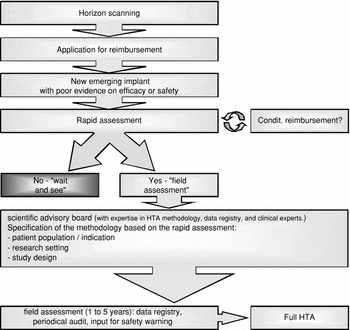
For the first category for which “good or at least average evidence of efficacy as well as safety” is available, a procedure for reimbursement is regulated by law. From a scientific and societal point of view, this will not be the case for the majority of invasive emerging technologies. In this manuscript, a proposal for a new procedure for the category for which poor evidence for efficacy and safety is available is focused on. A general schedule is provided in Figure 1.
A new procedure for the managed uptake of new and emerging health technologies. HTA, health technology assessment.

Good or at Least Average Evidence of Efficacy as Well as Safety
If there is good or at least average evidence of efficacy as well as safety, the question has to be raised whether the new device or technology has a potential added (therapeutic and economic) value. Therefore, the impact and the relevance of the outcome that has been modified by the new health technology needs to be assessed. The Belgian legislation regulates reimbursement of implants or invasive devices, having an established added therapeutic value compared with other already existing therapeutic alternatives, within a limited time frame.
Poor Evidence for Efficacy or Safety
To decide upon the strategy, a rapid assessment on safety and efficacy has to be performed. The rapid assessment can lead to the following results:
1. For the efficacy of the device:
• At least as efficacious compared with comparator procedure(s) or efficacy is not yet sufficiently determined because it is an emerging technology or
• Less efficacious compared with comparator procedure(s).
2. For the safety of the device:
• At least as safe compared with comparator procedure(s) or
• Safety was not yet determined sufficiently or it is less safe compared with comparator procedure(s).
If the rapid assessment concludes that the emerging technology is less efficacious or that there are still substantial safety concerns, this technology cannot be regarded as an emerging technology (yet) and a “wait and see” strategy should be followed. In the other case, the assessment will provide arguments for a promising emerging health technology (possibly as efficacious and at least as safe), and if budgetary possibilities exist, conditional reimbursement can be allowed.
CONDITIONAL REIMBURSEMENT AND SCIENTIFIC EVALUATION BY FIELD ASSESSMENT (HOSPITAL HTA)
In a preparatory phase, the research design and formalities of the implementation are discussed. Next, there is an evaluation phase over a period extending in general from 1 to 5 years including data registry, intermediary analysis, and possibly auditing. Finally, a full HTA concludes on the clinical effectiveness and cost-effectiveness of the new technology.
Research Design
The controlled diffusion of an emerging technology is accompanied by a research design to objectively prove the hypothesized added value of the technology. To specify the research design behind the conditional reimbursement, an advisory expert group with clinical experts and methodological experts in clinical research, HTA, and data registry is pivotal. The members of this expert group should be selected for their scientific merits and not merely for their representation. Only trained and experienced operators should be allowed to carry out the procedure. At this stage, the presence of patient groups is not advisable, because patient issues will be assessed during the HTA later on (cfr. infra).
To strengthen the evidence base of the emerging technology, either a controlled clinical trial, ideally with random allocation to the emerging technology and an established treatment, or an observational trial with longitudinal data registry and possible audit are the two main research designs. In some cases, an RCT will not be possible, based on practical issues such as feasibility or problems with patient recruitment. Rarely, ethical issues will prevail. From a scientific and societal point of view, this will not be the case for the majority of invasive emerging technologies. To the contrary, uncontrolled dissemination of experimental implants, without evidence that more benefit than harm is invoked to patients, can be coined as unethical behavior.
For the conditional reimbursement, the use of the new technology will often be restricted to a specific population and for specific indications. Moreover, the research setting has to be specified. In that scope, it is necessary to establish criteria determining which research settings can be eligible for the technology at stake. Clinical experiments can only be performed if they are guided by scientific interest. To guarantee the independence and transparency of the research team, potential conflicts of interest must be declared. Moreover, the clinical trial should have the approval of an ethical committee and should be registered.
Data Registry and Audit
Depending on different criteria such as the amount of patients involved, the nature of the technology of the device at stake, and the potential budgetary impact on health insurance, the evaluation period should be specified and in general will cover 1 to 5 years. During this period, data collected from the collaborating hospitals should be registered and possibly audited. To allow a timely intervention in case of lapses in the research (e.g., extreme mortality rates in one center), data should be exploitable for intermediary analysis and the research team should present a brief yearly progress report. At the end of the evaluation period, there should be an evaluation of the clinical effectiveness and cost-effectiveness by a full HTA. In that scope, the results of the HTA can offer an independent guiding tool for decisions regarding reimbursement on a governmental level.
Process of Appeal
There is no specific process of appeal for disagreements regarding content and/or procedural aspects of the new procedure. The new procedure, however, will be regulated by the general Belgian health insurance law, which provides the possibility to lodge an appeal with the Labor Court in case of a dispute regarding rights and duties resulting from that law.
Vigilance for Medical Devices
The purpose of medical device vigilance is to protect health and safety of patients, users, and others by reducing the likelihood of the same type of adverse incidents being repeated in different places at different times. This is to be achieved by adverse incidents notification and the evaluation of reported incidents. Ideally, information that could be used to prevent such repetitions of adverse events should be disseminated. Nowadays, the Belgian legislation on medical devices provides a reporting system of incidents with medical devices for the producer, the authorized representative, the distributors, the notified bodies, the physicians and the persons responsible for the reception and the distribution of devices to the subdivision “Medical devices” of the directorate general Pharmaceuticals. However, information on incidents and failures of devices is not publicly accessible.
Funding of the System
The system will mainly be funded by health insurance. It should also be made clear, however, which contribution the manufacturer or distributor will make, because health insurance is financing part of its research and development.
POLICY IMPLICATIONS
The framework offers an innovative approach to the Belgian health insurance: the combination of a managed uptake that limits budgetary risks with the production of solid impartial evidence on the clinical effectiveness and cost-effectiveness of emerging technologies. On the international level managed uptake of new and emerging technologies is in a relatively initial stage, with the United Kingdom and Australia providing the most advanced procedures. The proposed Belgian procedure gives the Belgian health insurance the opportunity to play a leading role in the support and assessment of some promising innovative technologies in Europe.
Conclusions
In this manuscript, we describe a framework for a future procedure for the assessment of new and emerging technologies in Belgium, in particular for new implants and invasive devices, within the current existing legal boundaries. Although this procedure was specifically set up for Belgium, a similar framework may be applicable for the managed uptake of new and emerging technologies in other countries. The framework is promising for several stakeholders/interested parties as it limits budgetary risks and aims at the production of solid impartial evidence on the clinical effectiveness and cost-effectiveness of the emerging technology.
For the manufacturers that produce innovative devices with “added value” the framework can offer several advantages: the managed uptake procedure allows the gradual and controllable introduction of an emerging device on the market, preventing wrong use and operator problems; a (partially or full) government-supported clinical trial—either randomized or observational—and an HTA forwarding impartial conclusions on the effectiveness, costs, and possibly cost-effectiveness and in addition organizational and patient issues. What is more, the application of a new procedure for medical devices should result in a faster and wider diffusion of innovative cost-effective technologies on the market.
On a governmental level too, the framework offers significant advantages. The procedure and in particular the rapid assessment should enable timely and well-informed decisions avoiding budgetary failures and misuse of public resources.
The framework also assures patients that new interventional technologies have established safety and effectiveness and that they are being monitored and reviewed to protect their safety. Moreover, they have access to information about the existing products, procedures, and possible incidents. The use of a similar framework should be subject to evaluation, on the level of output as well as on time frames, and probably adapted and optimized after a few years.
CONTACT INFORMATION
Imgard Vinck (Imgard.vinck@kce.fgov.be), Legal Expert, Mattias Neyt, PhD (Mattias.neyt@kce.fgov.be), Expert Economic Analysis, Nancy Thiry (Nancy.thiry@kce.fgov.be) Expert Economic Analysis, Belgian Health Care Knowledge Centre, Wetstraat 62, B-1040 Brussels, Belgium
Marleen Louagie (Marleen.louagie@riziv.fgov.be), Industrial Engineer, National Health Insurance Institute, Tervurenlaan 211, B-1150 Brussels, Belgium
Dirk Ramaekers, MD, PhD (Dirk.ramaekers@kce.fgov.be), General Director, Belgian Health Care Knowledge Centre, Wetstraat 62, B-1040 Brussels, Belgium