Introduction
The alluaudite supergroup includes phosphate and arsenate minerals characterised by monoclinic symmetry, space group C2/c or P21/n, and by unit-cell parameters a ≈ 12, b ≈ 12.5, c ≈ 6.5 Å and β ≈ 115° (Hatert, Reference Hatert2019; Tait et al., Reference Tait, Hawthorne and Halden2021). The general formula of the members of the alluaudite supergroup is A(2)’A(1)M(1)M(2)2(TO4)3, [where A = Na, Ca, Cu2+ or □ (vacancy); M = Mn2+, Fe3+, Fe2+, Mg, Al, Cu2+, Zn, Cd, Ca or Na; T = P or As (Hatert, Reference Hatert2019; Tait et al., Reference Tait, Hawthorne and Halden2021)]. This supergroup is divided into four groups, i.e. the alluaudite, wyllieite, bobfergusonite and manitobaite groups. All the members of these groups are characterised by the same topology and they can be identified on the basis of different cation-ordering schemes at the octahedral sites (Hatert, Reference Hatert2019; Tait et al., Reference Tait, Hawthorne and Halden2021). The alluaudite group, mainly formed by arsenate minerals, contains the largest number of species.
Arsenates are usually supergene minerals related to the weathering of As-bearing ores (e.g. As-rich pyrite, arsenopyrite and As-bearing sulfosalts). However, other geological environments can be characterised by the occurrence of arsenate minerals (e.g. Auernhammer et al., Reference Auernhammer, Effenberger, Hentschel, Reinnecke and Tillmanns1993; Majzlan et al., Reference Majzlan, Drahota and Filippi2014, Pekov et al., Reference Pekov, Koshlyakova, Zubkova, Lykova, Britvin, Yapaskurt, Agakhanov, Shchipalkina, Turchkova and Sidorov2018, Hatert, Reference Hatert2019, Tait et al., Reference Tait, Hawthorne and Halden2021). An intriguing mineral assemblage has been discovered at the active Arsenatnaya fumarole, Second scoria cone, Tolbachik Volcanic field, Kamchatka Peninsula, Russia, where more than fifty arsenates have been identified so far. Among them, forty-six are still endemic, and ten of them have led to the description of novel crystal structures (Pekov et al., Reference Pekov, Koshlyakova, Zubkova, Lykova, Britvin, Yapaskurt, Agakhanov, Shchipalkina, Turchkova and Sidorov2018). The most common arsenate minerals occurring at the Arsenatnaya fumarole belong to the alluaudite group and nine have this as their type locality, i.e. badalovite (Pekov et al., Reference Pekov, Koshlyakova, Agakhanov, Zubkova, Belakovskiy, Vigasina, Turchkova, Sidorov and Pushcharovsky2020a), calciojohillerite (Pekov et al., Reference Pekov, Koshlyakova, Agakhanov, Zubkova, Belakovskiy, Vigasina, Turchkova, Sidorov and Pushcharovsky2021), calciohatertite (Koshlyakova et al., Reference Koshlyakova, Pekov, Belakovskiy, Vigasina, Zubkova, Agakhanov, Britvin, Sidorov and Pushcharovsky2021), hatertite (Krivovichev et al., Reference Krivovichev, Vergasova, Filatov, Rybin, Britvin and Ananiev2013), khrenovite (Pekov et al., Reference Pekov, Koshlyakova, Belakovskiy, Vigasina, Zubkova, Agakhanov, Britvin, Sidorov and Pushcharovsky2022a), magnesiohatertite (Pekov et al., Reference Pekov, Lykova, Koshlyakova, Belakovskiy, Vigasina, Agakhanov, Britvin, Turchkova, Sidorov and Giester2016), manganobadalovite (Koshlyakova et al., Reference Koshlyakova, Pekov, Belakovskiy, Vigasina, Zubkova, Agakhanov, Britvin, Sidorov and Pushcharovsky2020), manganohatertite (Koshlyakova et al., Reference Koshlyakova, Pekov, Agakhanov, Bullock, Belakovskiy, Zubkova, Chukanov, Britvin, Bulakh, Burns, Hazen and Zhitova2024), and paraberzeliite (Pekov et al., Reference Pekov, Koshlyakova, Belakovskiy, Vigasina, Zubkova, Agakhanov, Britvin, Sidorov and Pushcharovsky2022b). All of them are endemic.
During the 45th Sicily Mineral Show, in November 2023, a specimen from the Monte Calvario quarry (Biancavilla, Etna volcanic complex, Sicily, Italy) was given to one of us (D.M.) by the mineral collector Gaetano Sicurella in order to investigate an unknown phase previously reported as ‘Unnamed Mineral (UM2)’, characterised as having major Na and As, with minor Fe, P and Ca (Sicurella et al., Reference Sicurella, Ciriotti, Gianfagna, Mazziotti-Tagliani and Blass2010). The Monte Calvario quarry is well-known for being the type locality for two F-bearing phases, i.e. fluoro-edenite and fluorophlogopite (Gianfagna and Oberti, Reference Gianfagna and Oberti2001; Gianfagna et al., Reference Gianfagna, Scordari, Mazziotti-Tagliani, Ventruti and Ottolini2007a). A review of the geological, volcanological, mineralogical and environmental features of the Monte Calvario area can be found in Burragato et al. (Reference Burragato, Comba, Baiocchi, Palladino, Simei, Gianfagna, Paoletti and Pasetto2005). This area was interpreted by these authors as a locally metasomatised benmoreitic lava dome and dyke complex with associated autoclastic breccias.
This paper provides further data on badalovite and associated calciojohillerite from the investigation of this new Italian occurrence, representing the second world finding of these alluaudite-group minerals.
Experimental
Specimen studied
The hand specimen containing the sample is a fragment of altered benmoreitic rock, 2.5 × 1.5 × 1.7 cm in size, characterised by cavities, up to 1 cm across. The walls of the cavities are covered by vitreous to resinous yellowish to brownish prismatic crystals, in some cases forming sheaf-like aggregates up to 0.5 mm in length, associated with equant to tabular crystals of hematite (Fig. 1). Other associated minerals are pseudobrookite and an amphibole-supergroup mineral (probably fluoro-edenite). The grains used for single-crystal X-ray diffraction are deposited in the mineralogical collection of the Museo di Storia Naturale of the Università di Pisa, under catalogue number 20080; one grain, used for quantitative chemical analyses, is stored in the mineralogical collection of the National Museum, Prague, under the catalogue number P1P 55/2024.
Badalovite, aggregates of prismatic crystal associated with black tabular crystals of hematite. Monte Calvario quarry, Biancavilla, Etna volcanic complex, Sicily, Italy. Private collection, photo D. Mauro.

Chemical analysis
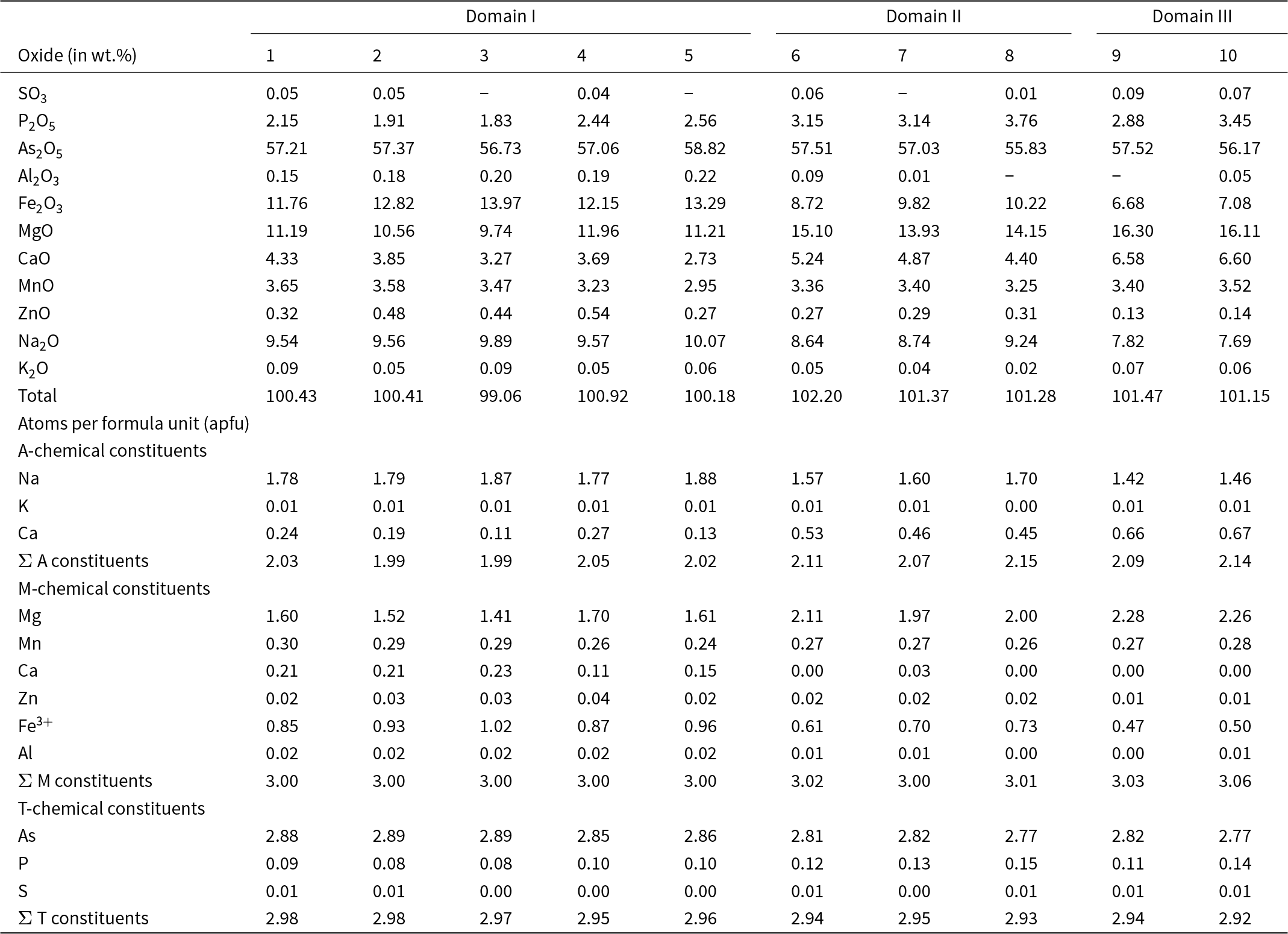
An orange-brownish prismatic crystal was sampled from the specimen studied in order to perform electron microprobe analyses. Quantitative chemical analyses were collected at the National Museum of Prague (Czech Republic), using a Cameca SX100 electron microprobe. The following analytical conditions were used: WDS mode, accelerating voltage = 15 kV, beam current = 5 nA and beam size = 10 μm. The following standards (element, emission line) were used: celestine (SKα); fluorapatite (CaKα, PKα); clinoclase (AsLα); sanidine (AlKα, KKα); hematite (FeKα); diopside (MgKα); rhodonite (MnKα); ZnO (ZnKα); and albite (NaKα). Fluorine, Si, Cl, Co and Pb were sought but were below the detection limit. Peak counting times were 20 s on the peak and 10 s on each background. Matrix correction using the PAP algorithm (Pouchou and Pichoir, Reference Pouchou and Pichoir1985) and automatic corrections of overlaps Ca/P and Na/Zn were applied to the data. Quantitative chemical data and the empirical chemical formulae are given in Table 1.
Electron microprobe data for alluaudite-group minerals from the Monte Calvario quarry.

Micro-Raman spectroscopy
Micro-Raman spectra of badalovite were collected, in the range between 100–4000 cm–1, on the same grain used for single-crystal X-ray diffraction and for electron microprobe analyses in WDS mode using a Horiba Jobin-Yvon XploRA Plus apparatus, equipped with a motorised x–y stage and an Olympus BX41 microscope with a 50× objective (Dipartimento di Scienze della Terra, Università di Pisa). Raman spectra were excited using a 532 nm line of a solid-state laser, attenuated to 25% (i.e. 6.25 mW). The minimum lateral and depth resolution was set to a few μm. The system was calibrated using the 520.6 cm–1 Raman band of silicon before each experimental session. Spectra were collected through multiple acquisitions (3) with counting time of 80 s. Back-scattered radiation was analysed with a 1200 gr/mm grating monochromator. Experimental precision can be estimated at ± 2 cm–1. The possibility of thermal damage at the measured points was excluded by the visual inspection of the excited surface after measurement, by the observation of the possible decay of spectral features in the start of excitation and checking for thermal downshift of the Raman lines. Raman spectra were processed using Fityk (Wojdyr, Reference Wojdyr2010). Table 2 gives the position of observed bands and their possible interpretation.
Raman bands (in cm–1) and assignments for badalovite from Monte Calvario quarry, Biancavilla, Sicily, compared with those of badalovite and calciojohillerite from the Arsenatnaya fumarole, Tolbachik volcano, Kamchatka, Russia.

Note: bold indicates the strongest Raman bands; italic indicates the band positions interpreted as due to Fe–O vibration modes by Pekov et al. (Reference Pekov, Koshlyakova, Agakhanov, Zubkova, Belakovskiy, Vigasina, Turchkova, Sidorov and Pushcharovsky2020a) and Pekov et al. (Reference Pekov, Koshlyakova, Agakhanov, Zubkova, Belakovskiy, Vigasina, Turchkova, Sidorov and Pushcharovsky2021).
X-ray crystallography
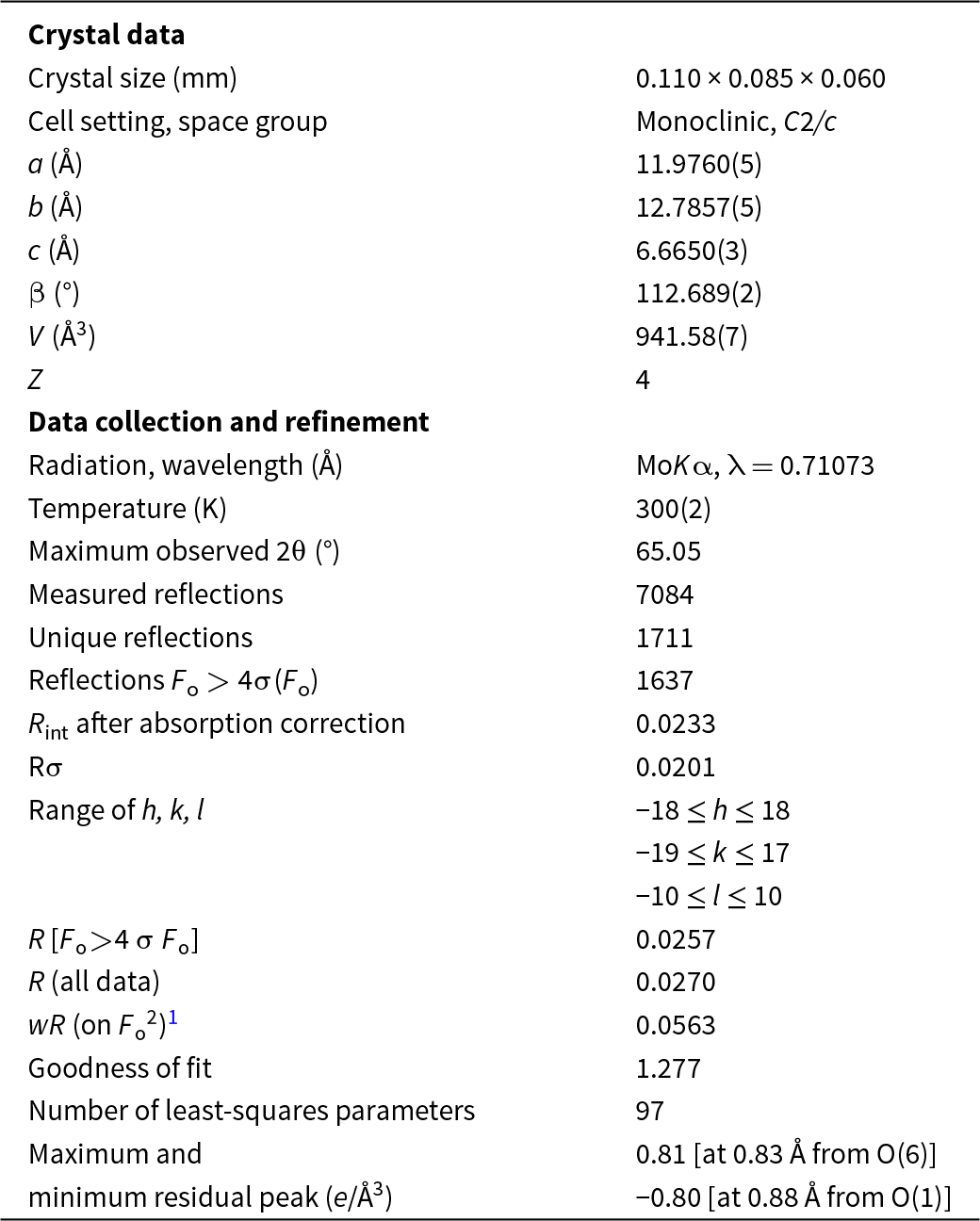
Single-crystal X-ray diffraction (SCXRD) data for badalovite were collected using a Bruker D8 Venture diffractometer (50 kV and 1.4 mA) equipped with an air-cooled Photon III detector, and microfocus MoKα radiation (Centro per l’Integrazione della Strumentazione scientifica dell’Università di Pisa, University of Pisa, Italy). The detector-to-crystal distance was set to 38 mm. Data were collected using φ and ω scan modes, in 0.5° slices. Intensity data were integrated and corrected for Lorentz, polarisation, background effects, and absorption using the APEX4 software package (Bruker AXS Inc., 2022). Badalovite is monoclinic, space group C2/c, with unit-cell parameters: a = 11.9760(5), b = 12.7857(5), c = 6.6650(3) Å, β = 112.689(2)°, V = 941.58(7) Å3. Crystal structure refinement was performed using Shelxl-2018 (Sheldrick, Reference Sheldrick2015) starting from the atomic coordinates given by Pekov et al. (Reference Pekov, Koshlyakova, Agakhanov, Zubkova, Belakovskiy, Vigasina, Turchkova, Sidorov and Pushcharovsky2020a). Taking into account the results of chemical analysis, the following neutral scattering curves were used from the International Tables for Crystallography (Wilson, Reference Wilson1992): Na vs. Ca at the A(1) and Na at A(2)’ sites; Mg vs. Mn at the M(1) site; Mg vs. Fe at the M(2) site; As vs. P at the T site; and O at O(1)–O(6) sites. Several cycles of isotropic refinement converged to R 1 = 0.0439, thus confirming the correctness of the structural model. After modelling the anisotropic displacement parameters of only cations, R 1 was lowered to 0.0297, then further lowered to 0.0254 after the introduction of anisotropic displacement parameters for O sites. At this step of refinement, the As/(As+P) ratio at the two independent T sites was 0.898, to be compared with a value of 0.96 measured through electron microprobe data (see below). Because the average <T–O> distances do not suggest a significant P content, it was preferred to fix the As and P content at the T(1) and T(2) sites in accord with the site occupancies calculated on the basis of the observed average bond distances and the <As–O> and <P–Φ> (where Φ = O and OH) grand values given by Majzlan et al. (Reference Majzlan, Drahota and Filippi2014) and Huminicki and Hawthorne (Reference Huminicki and Hawthorne2002), respectively. The crystal structure refinement converged to R 1 = 0.0257 for 1637 unique reflections with F o > 4σ(F o) and 97 least-square parameters.
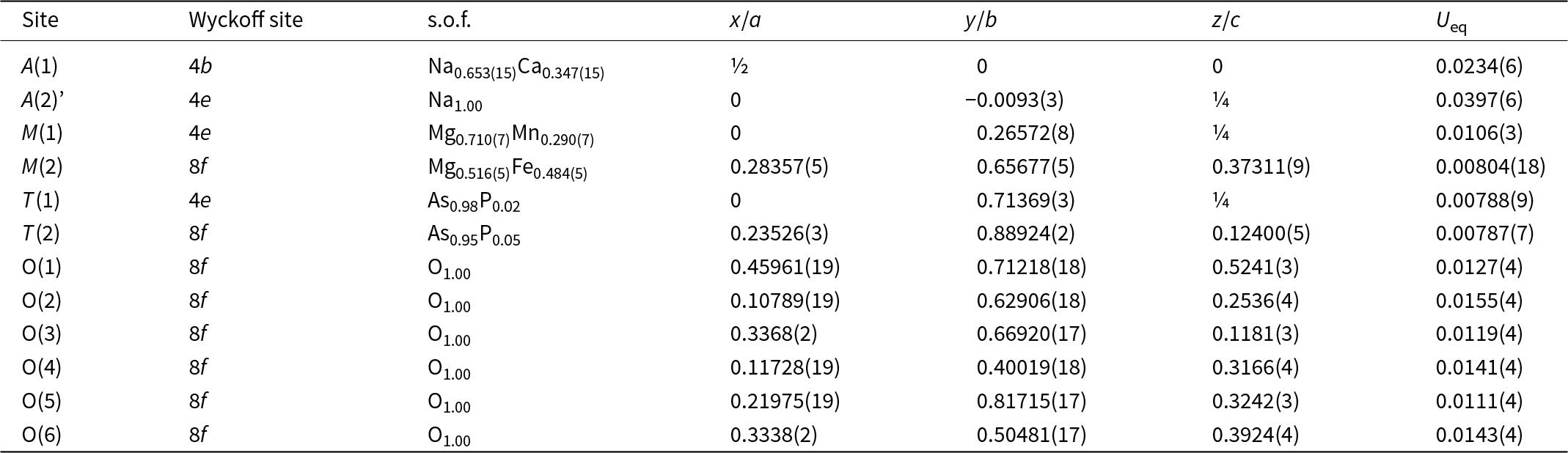
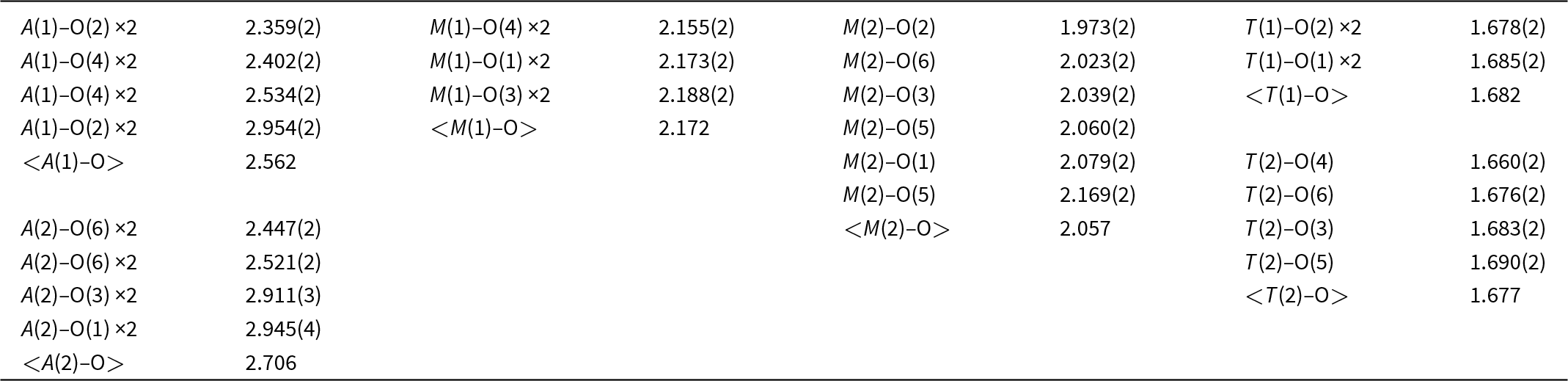
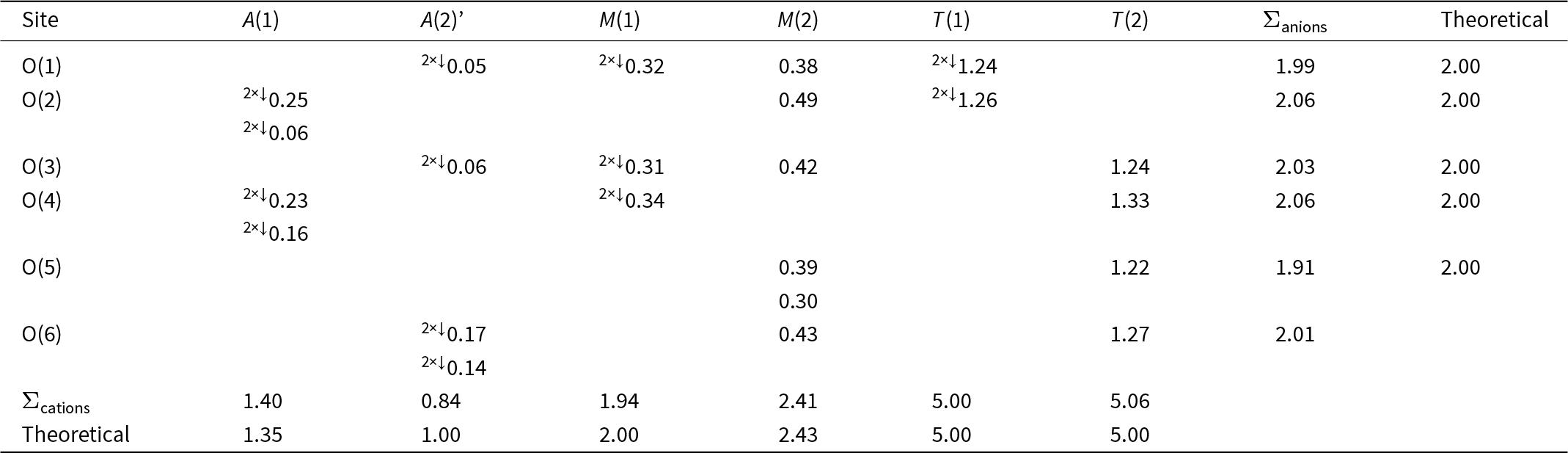
In Table 3, details of data collection and crystal structure refinement are reported. Atomic coordinates and equivalent isotropic displacement parameters are given in Table 4. The selected bond distances of badalovite are reported in Table 5. Bond valence sums (BVS), calculated using the bond parameters of Gagné and Hawthorne (Reference Gagné and F.C2015) and taking into account the proposed site populations, are given in Table 6. The Crystallographic Information File (CIF) of badalovite is available as Supplementary Material.
Summary of crystal data and parameters describing data collection and refinement for badalovite from the Monte Calvario quarry, Biancavilla, Sicily, Italy.

1 w = 1/[σ2(F o2)+8.3102P], where P = (F o2+2F c2)/3.
Sites, Wyckoff site, site occupancy factors (s.o.f.), fractional atom coordinates and equivalent displacement parameters (Å2) for badalovite from the Monte Calvario quarry Biancavilla, Sicily, Italy.

Selected bond distances (Å) for badalovite from the Monte Calvario quarry, Biancavilla, Sicily, Italy.

Weighted bond-valence sums (in valence units, vu) for badalovite from the Monte Calvario quarry, Biancavilla, Sicily, Italy

Note: left superscripts indicate the number of equivalent bonds involving anions. The following site occupancy were used for calculating the bond-valence sums: A(1) = Na0.65Ca0.35; A(2)’ = Na0.99K0.01; M(1) = Mg0.65Mn0.25Ca0.10; M(2) = Mg0.55Fe3+0.42Zn0.02Al0.01; T(1) = As0.98P0.02; and T(2) = As0.95P0.05.
Results and discussion
Chemical data
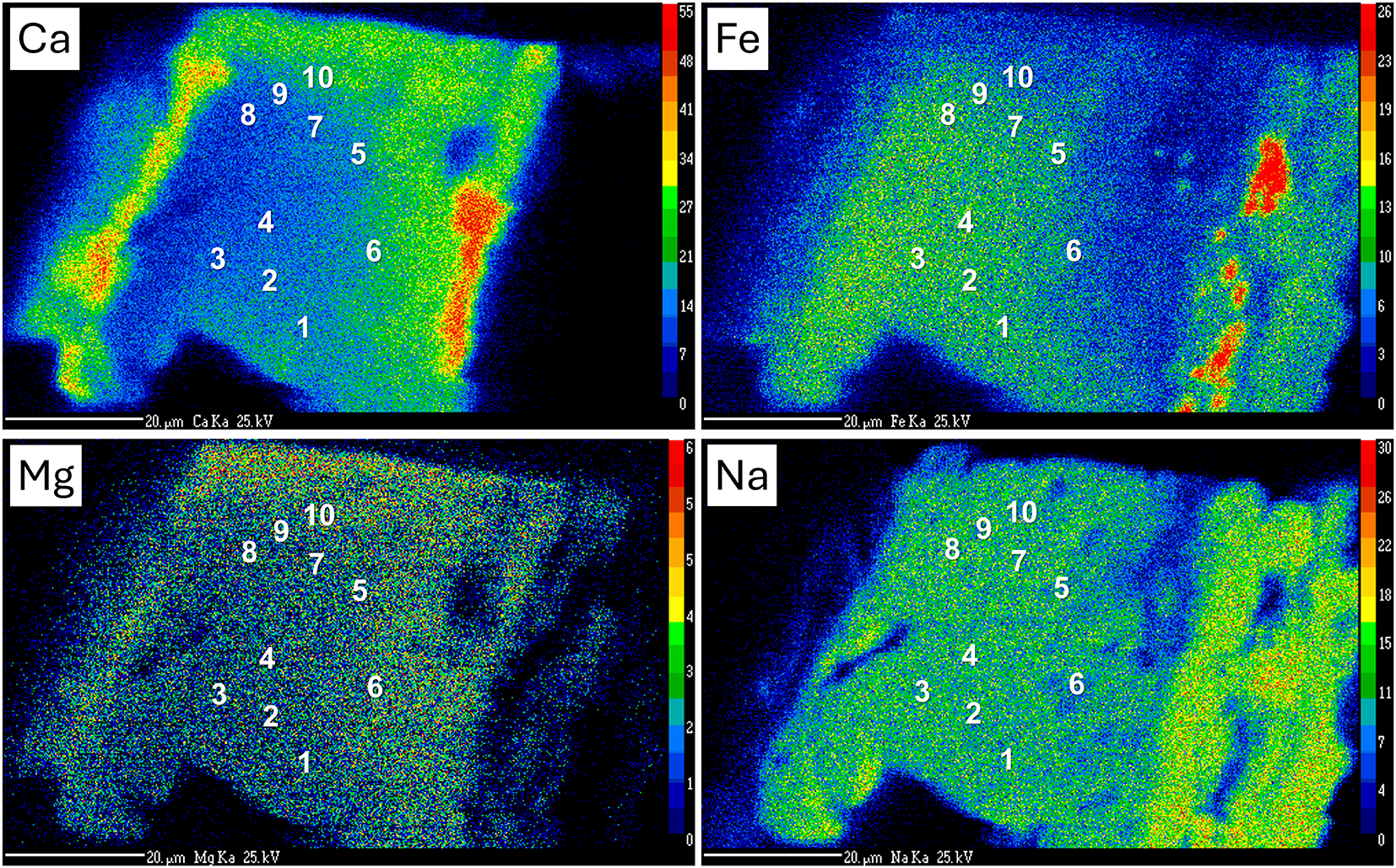
X-ray elemental maps (Fig. 2) revealed, within the studied grain, the occurrence of an inner portion enriched in Na and Fe and depleted in Ca, whereas crystal rims are enriched in Ca and Mg, with a detectable depletion in Fe. The bond distances and the bond valence sums for the M(2) site (see below) strongly support the occurrence of iron as Fe3+, in agreement with the oxidised nature of the mineral assemblage, as suggested by the occurrence of hematite and pseudobrookite, as well as the results of the Mössbauer study on fluoro-edenite by Gianfagna et al. (Reference Gianfagna, Andreozzi, Ballirano and Mazziotti-Tagliani2007b) and Andreozzi et al. (Reference Andreozzi, Ballirano, Gianfagna, Mazziotti-Tagliani and Pacella2009). The observed element distribution agrees with the heterovalent substitution Na+ + Fe3+ = Ca2+ + Mg2+.
X-ray maps showing Ca, Fe, Mg and Na distribution and the position of the spot analyses for the studied sample.

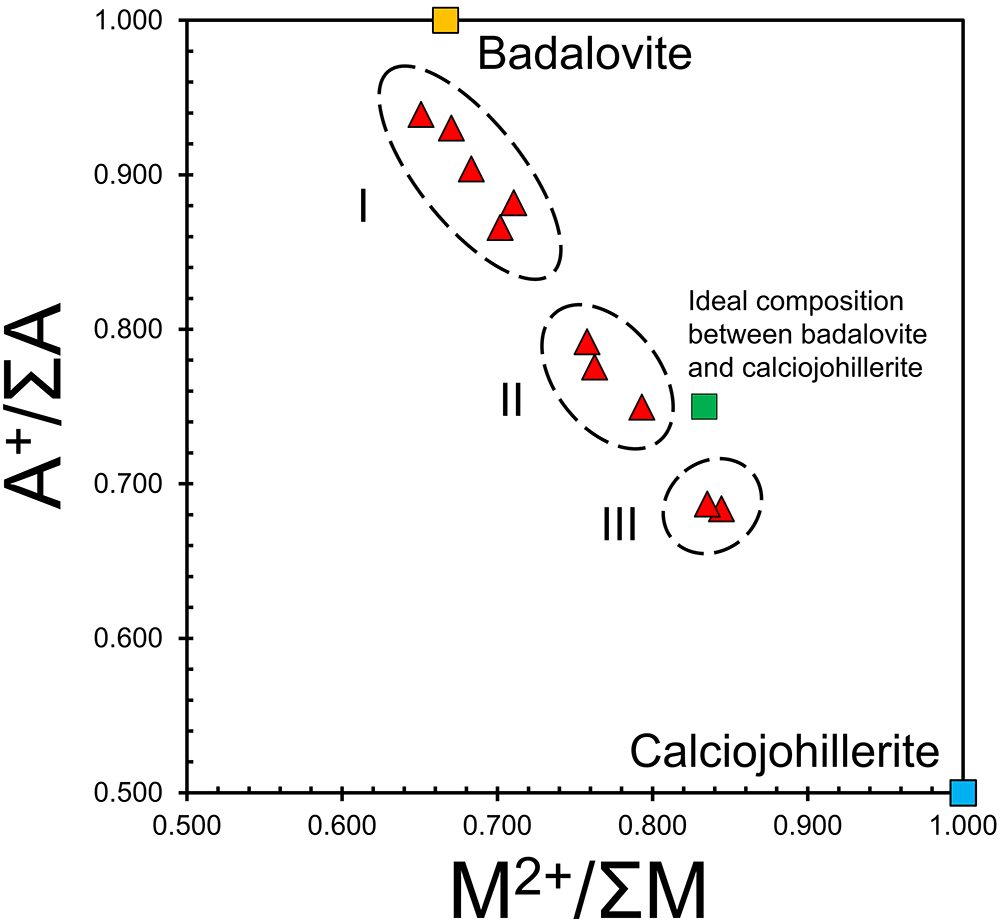
The compositions of the studied grain and the chemical formulae corresponding to the ten spot analyses, recalculated on the basis of 12 O atoms per formula unit (apfu) are given in Table 1. Defining ƩM as the sum of all octahedrally-coordinated cations and ƩA as the sum of the chemical constituents at the A(1) and A(2)’ sites, Fig. 3 shows the relation between M2+/ƩM (where M2+ is the sum of divalent octahedral cations) and A+/ƩA (where A+ is the sum of Na and minor K). It becomes clear that three chemical domains occur, corresponding to the following average chemical formulae:
Relations between the atomic ratios M2+/ƩM and A+/ƩA for the studied sample (red triangles). For the sake of clarity, the positions of the ideal compositions of badalovite (orange square), calciojohillerite (light blue square), and the intermediate member between these two species (green square) are shown. Roman numbers indicate the three different chemical domains.

Domain 1: (Na1.82(11)K0.01(1)Ca0.24(8))Ʃ2.07(Mg1.57(2)Mn0.28(2)Ca0.13(8)Zn0.03(1)Fe0.93(14)Al0.02(2))Ʃ3.00(As2.87(4)P0.09(3))Ʃ2.96O12;
Domain 2: (Na1.62(11)Ca0.49(8))Ʃ2.11(Mg2.02(2)Mn0.27(2)Zn0.02(1)Fe0.68(14)Al0.01(2))Ʃ3.00(As2.80(4)P0.11(3))Ʃ2.91O12;
Domain 3: (Na1.44(2)K0.01(1)Ca0.66(1))Ʃ2.11(Mg2.27(1)Mn0.28(1)Zn0.01(1)Fe0.48(2))Ʃ3.00(As2.79(3)P0.13(2))Ʃ2.92O12.
The first domain shows a chemical composition near to the end-member formula of badalovite, i.e. A (1)NaA (2)’NaM (1)MgM (2)(MgFe3+)(AsO4)3. However, minor chemical substitutions were identified in the studied sample with respect to the ideal composition. These chemical variations are in agreement with the known crystal chemistry of the alluaudite-group minerals (Hatert, Reference Hatert2019). The occurrence of Mn, Zn and Ca in arsenate members of the alluaudite group has been found in several species, for instance, in zincobradaczekite, caryinite and arseniopleite (Pekov et al., Reference Pekov, Lykova, Koshlyakova, Belakovskiy, Vigasina, Turchkova, Britvin, Sidorov and Scheidl2020b; Ercit, Reference Ercit1993; Tait and Hawthorne, Reference Tait and Hawthorne2003).
The second domain still has an end-member formula corresponding to that of badalovite, even if its content of calciojohillerite component is higher, with an empirical composition very close to the boundary between the two species. Finally, the remaining two spot analyses (third domain), correspond to the end-member formula of calciojohillerite, A (1)NaA (2)’CaM (1)MgM (2)Mg2(AsO4)3.
Domains I and II are the most abundant in the grain studied as shown clearly in Fig. 2. For this reason, the average composition of spots 1–8 is considered as representative of the average chemistry of the crystal investigated through single-crystal X-ray diffraction, i.e. (Na1.74(11)K0.01(1)Ca0.30(8))Ʃ2.05(Mg1.74(2)Mn0.27(2)Ca0.11(8)Zn0.03(1)Fe0.84(14)Al0.02(2))Ʃ3.01(As2.85(4)P0.11(3))Ʃ2.96O12, thus corresponding to badalovite. Comparing the average chemistry of the sample studied with those of the Russian badalovite, the Italian one shows higher Mn content as well as minor enrichment in Ca, Na and P [i.e. A = (Na1.74(11)K0.01(1)Ca0.30(8))Ʃ2.05 vs. (Na1.67K0.02Ca0.20)Ʃ1.89, M = (Mg1.74(2)Mn0.27(2)Ca0.11(8)Zn0.03(1)Fe0.84(14)Al0.02(2))Ʃ3.01 vs. (Mg1.92Mn0.02Cu0.1Zn0.02Fe0.90)Ʃ2.87 and T = (As2.85(4)P0.11(3))Ʃ2.96 vs. (As3.01P0.03Si0.01)Ʃ3.05, respectively].
Micro-Raman spectroscopy
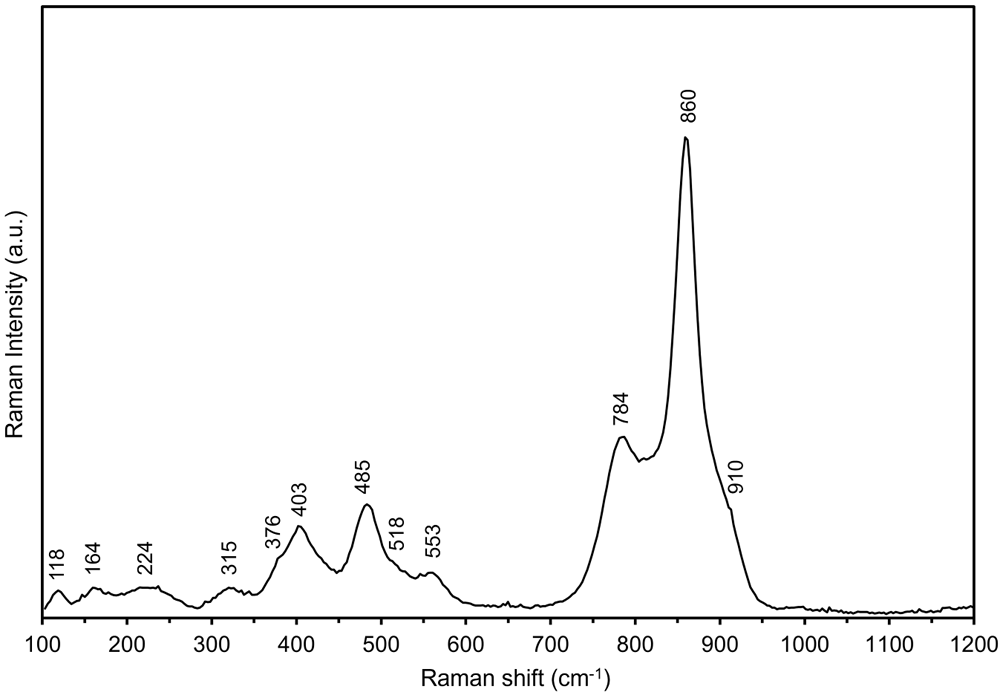
The micro-Raman spectrum of badalovite is characterised by the occurrence of the four fundamental modes of (AsO4)3– groups, by the vibration modes of the A– and M–O cations hosted in its crystal structure as well as to lattice vibration modes (Fig. 4). Three spectral ranges can be recognised, in agreement with the previous data (Pekov et al., Reference Pekov, Koshlyakova, Agakhanov, Zubkova, Belakovskiy, Vigasina, Turchkova, Sidorov and Pushcharovsky2020a), i.e. between 100–300 cm–1, 300–600 cm–1, and between 750–950 cm–1. The strongest Raman bands occur in the latter region and are related to the symmetric (ν 1) and antisymmetric (ν 3) stretching modes of the (AsO4)3– groups (e.g. Sejkora et al., Reference Sejkora, Plášil, Čejka, Dolníček and Pavlíček2020). The arsenate bending modes (ν 2 and ν 4) occur in the range between 300–570 cm–1 (e.g. Sejkora et al., Reference Sejkora, Plášil, Čejka, Dolníček and Pavlíček2020). Raman bands below to 300 cm–1 can be attributed to the vibration modes of the A– and M–O cations as well as to the lattice vibration modes (Pekov et al., Reference Pekov, Koshlyakova, Agakhanov, Zubkova, Belakovskiy, Vigasina, Turchkova, Sidorov and Pushcharovsky2020a; Pekov et al., Reference Pekov, Koshlyakova, Agakhanov, Zubkova, Belakovskiy, Vigasina, Turchkova, Sidorov and Pushcharovsky2021; Sejkora et al., Reference Sejkora, Plášil, Čejka, Dolníček and Pavlíček2020). Raman bands of Italian and Russian badalovite as well as of Russian calciojohillerite are given in Table 2. In agreement with the isotypic relationship occurring between the last two member of the alluaudite-group minerals they show similar Raman spectra. Minor differences between badalovite and calciojohillerite spectra could be interpreted as a consequence of chemical changes (e.g. below 300 cm–1), as well as to the methods used for the identification of the band positions. Moreover, in agreement with the previous data, no bands due to the occurrence of H2O groups were observed in the O–H bending or stretching regions. Finally, no evidence of vibration modes due to the occurrence of (AsO3OH)2– groups occurs (e.g. Sejkora et al., Reference Sejkora, Plášil, Čejka, Dolníček and Pavlíček2020).
Raman spectrum, in the range between 100–1300 cm–1, and band positions of badalovite from the Monte Calvario quarry.

Crystal structure description
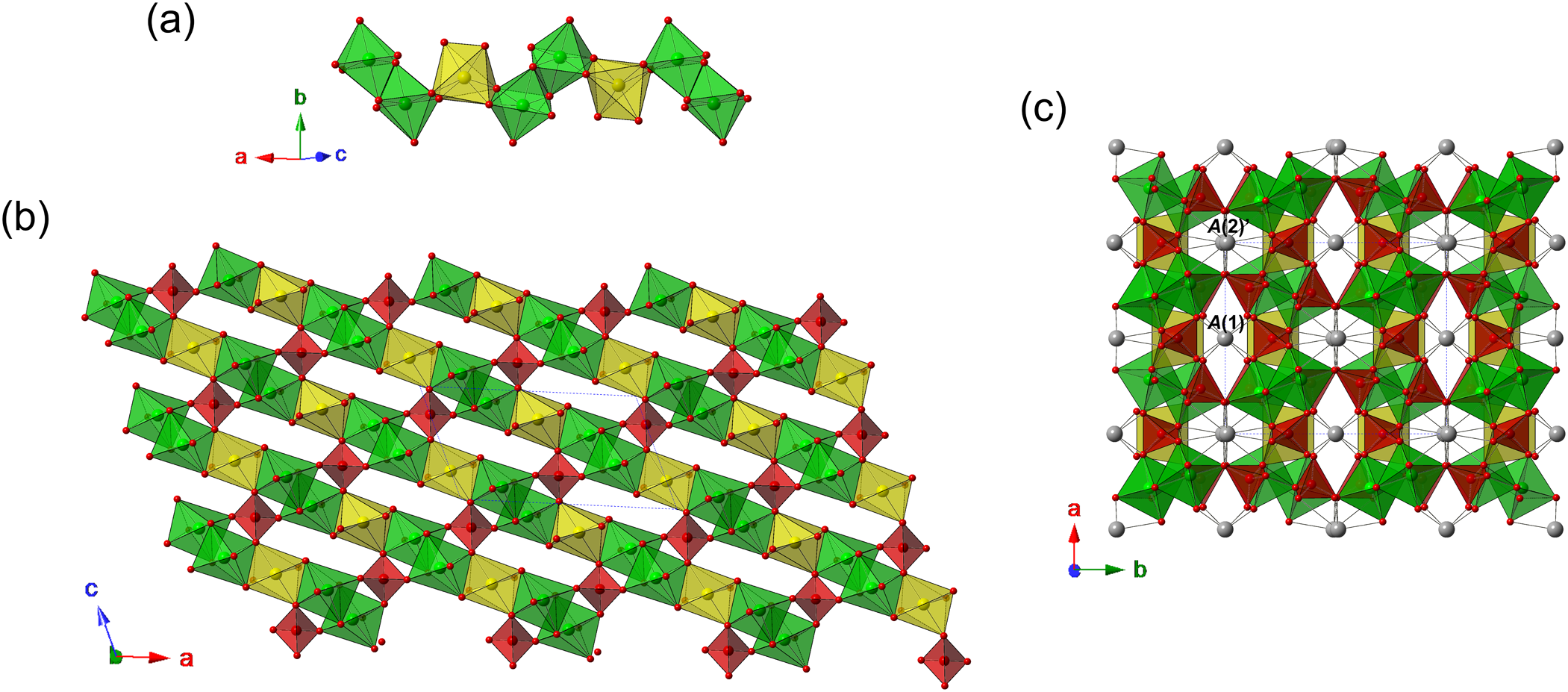
The crystal structure of badalovite, in agreement with the previous study by Pekov et al. (Reference Pekov, Koshlyakova, Agakhanov, Zubkova, Belakovskiy, Vigasina, Turchkova, Sidorov and Pushcharovsky2020a), is composed of zig-zag chains, running along [10–1], formed by edge-sharing [M(2)2O10] dimers connected through distorted M(1)O6 octahedra. Adjacent chains are connected through corner-sharing of T(1)O4 tetrahedra, giving rise to {010} heteropolyhedral layers. Successive layers are then connected through T(2)O4 tetrahedra, forming a three-dimensional heteropolyhedral framework where there are two kinds of channels hosting the A(2)’ and A(1) sites in eight-fold coordination (Fig. 5).
Details of the crystal structure of badalovite. (a) The octahedral chains running along [10–1], with M(2)2O10 dimers (in green) connected through M(1)-centred octahedra (yellow). (b) The heteropolyhedral layer formed by octahedral chains interconnected through T(1)O4 tetrahedra (red), as seen down b. (c) The crystal structure as seen down c. The heteropolyhedral layers are connected through T(2)O4 tetrahedra, forming a framework hosting A(1) and A(2)’ sites (grey circles). Drawn using CrystalMaker (Palmer, Reference Palmer2014)

Cation sites
Six independent cation sites occur in badalovite. Arsenic is hosted at the T(1) and T(2) sites. The former has bond distances ranging between 1.678 to 1.685 Å, with average <T(1)–O> distance of 1.682 Å whereas the T(2)–O bond distances vary between 1.660 and 1.690 Å, with average <T(2)–O> distance of 1.677 Å (Table 5). These values are in agreement with those reported by Pekov et al. (Reference Pekov, Koshlyakova, Agakhanov, Zubkova, Belakovskiy, Vigasina, Turchkova, Sidorov and Pushcharovsky2020a) for badalovite and can be compared with the value of 1.685 Å reported by Majzlan et al. (Reference Majzlan, Drahota and Filippi2014) for the average <As–O> distance. The slight contraction can be related to the partial replacement of As by P. Considering the average <P–Φ> distance of 1.537 Å (Huminicki and Hawthorne, Reference Huminicki and Hawthorne2002), the observed values point to the site occupancies (As0.98P0.02) and (As0.95P0.05) for T(1) and T(2), respectively. These are the site occupancies fixed during the crystal structure refinement. The BVS at the T(1) and T(2) sites is 5.00 and 5.06 valence units (vu), respectively.
The M(1) site is octahedrally coordinated and has a refined site occupancy (Mg0.71Mn0.29), corresponding to a mean atomic number (MAN) of 15.77 electrons. On the basis of electron microprobe data, the site population (Mg0.65Mn0.25Ca0.10) may be proposed, corresponding to a MAN of 16.05 electrons. Bond distances range between 2.155 and 2.189 Å, with an average <M(1)–O> distance of 2.172 Å. This value can be compared with that calculated using the proposed site population and the ionic radii given by Shannon (Reference Shannon1976), i.e. 2.156 Å. The BVS at the M(1) site, calculated assuming such a population, is 1.94 vu.
The M(2) site is bonded to 6 O atoms in octahedral coordination. Its refined site occupancy is (Mg0.52Fe0.48), corresponding to MAN = 18.72 electrons. Considering the results of chemical analysis, the site occupancy (Mg0.55Fe0.42Zn0.02Al0.01) can be proposed, corresponding to a MAN of 18.25 electrons. Bond distances range between 1.973 to 2.169 Å, with an average <M(2)–O> distance of 2.057 Å. This value can be compared with those calculated using the ionic radii of Shannon (Reference Shannon1976), i.e. 2.060 Å. The BVS calculated at the M(2) site is 2.41 vu, agreeing with the mixed (Mg2+/Fe3+) nature of its occupancy.
The A(1) and A(2)’ sites are eight-fold coordinated. The A(1) site was refined as a mixed (Na,Ca) position, with the refined site occupancy (Na0.65Ca0.35); on the contrary, A(2)’ was refined as a pure Na position. The A(1)–O and A(2)’–O bonds range from 2.358 to 2.962 Å and from 2.447 and 2.945 Å, respectively. The <A(1)–O> and <A(2)’–O> average distances are of 2.562 and 2.706 Å, respectively. Minor K could be hosted at the larger A(2)’ site. Bond valence sums at the A(1) and A(2)’ sites, calculated with the site occupancy of (Na0.65Ca0.35) and (Na0.99K0.01), respectively, are of 1.40 and 0.84 vu.
Anion sites
Six independent O positions occur in badalovite, namely O(1)–O(6). All O atoms but that hosted at O(5) are four-fold coordinated; the O atom at O(5) is three-fold coordinated by two atoms hosted at the M(2) site and one tetrahedrally coordinated cation at T(2). The BVS of these O atoms range between 1.91 and 2.06 vu, thus confirming that all anion positions are occupied by O2– ions.
Structural formula of badalovite
Considering site multiplicity and the proposed site populations, the crystal chemical formula of badalovite from the Monte Calvario quarry can be written as A (1)(Na0.65Ca0.35)A (2)’(Na0.99K0.01)M (1)(Mg0.65Mn0.25Ca0.10)M (2)(Mg0.55Fe0.42Zn0.02Al0.01)2T (1)+T(2)(As2.88P0.12)O12 (Z = 4).
Comparison between badalovite from Italy and Russia
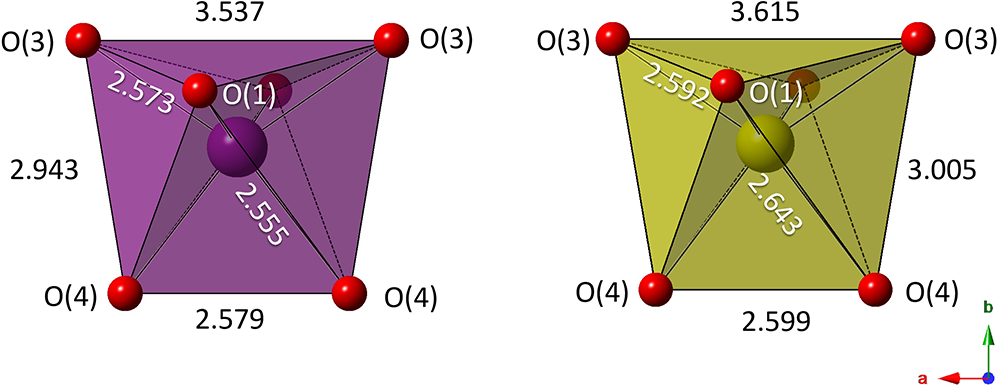
A comparison between this new identification and the type material described by Pekov et al. (Reference Pekov, Koshlyakova, Agakhanov, Zubkova, Belakovskiy, Vigasina, Turchkova, Sidorov and Pushcharovsky2020a) has some interesting details. Chemical data of badalovite from Sicily show a distinct enrichment in Mn with respect to type badalovite, i.e. 0.27 vs. 0.02 apfu in the Italian and Russian sample, respectively. Moreover, a minor enrichment in Ca (0.30 vs. 0.20 apfu) and P (0.11 vs. 0.03 apfu) was found in the sample from the Monte Calvario quarry. The main consequence of this chemical variability is the detectable expansion of the unit-cell volume observed in the Sicilian badalovite, i.e. 941.6 Å3 vs. 936.6 Å3, with a ΔV = +0.53%. This volume increase seems to be related only to the lengthening of the a parameter, whereas the b and c parameters do not seem to be significantly affected by these chemical changes. The volume increase is in accord with the replacement of Mg2+ (ionic radius r = 0.720 Å – Shannon, Reference Shannon1976) in octahedral environment with larger Mn2+ (r = 0.83 Å) and Ca2+ (r = 1.00 Å). Probably, this replacement occurs at the M(1) site, which is actually expanded with respect to the Russian sample, with an average <M(1)–O> distance of 2.172 Å, larger than the corresponding value in badalovite from Tolbachik, i.e. 2.134 Å. It is worth noting that all geometrical features of the M(1)-centred octahedron are expanded, as shown in Fig. 6 where a comparison of the M(1)-polyhedra in the Russian and Italian samples is given. On the contrary, the average distances observed for the other cation sites are in agreement with those reported for the Russian sample, supporting the key role played by the M(1) site in the observed unit-cell expansion.
Comparison between the M(1)-centred octahedron in badalovite from Tolbachik (on left) and Sicily (on right). Selected values of O···O distances are given in Å.

Remarks on the genesis of badalovite from Biancavilla
The second world occurrence of members of the badalovite–calciojohillerite series deserves further discussion. Indeed, these two minerals have been so far endemic of the Arsenatnaya fumarole at the Second scoria cone of the Northern Breakthrough of the Great Tolbachik Fissure Eruption, Tolbachik volcano, Kamchatka, Russia (Pekov et al., Reference Pekov, Koshlyakova, Agakhanov, Zubkova, Belakovskiy, Vigasina, Turchkova, Sidorov and Pushcharovsky2020a, Reference Pekov, Koshlyakova, Agakhanov, Zubkova, Belakovskiy, Vigasina, Turchkova, Sidorov and Pushcharovsky2021). Pekov et al. (Reference Pekov, Koshlyakova, Zubkova, Lykova, Britvin, Yapaskurt, Agakhanov, Shchipalkina, Turchkova and Sidorov2018) stressed the occurrence of H-free, (Mg,Na,Ca)-bearing arsenates in the deep zones of the fumaroles. There, alluaudite-supergroup minerals were useful to understand the geochemical gradients within the fumaroles. Calciojohillerite and badalovite were found only in the deepest sectors of the Arsenatnaya fumarole and, in particular, in zone IIIb of Pekov et al. (Reference Pekov, Koshlyakova, Zubkova, Lykova, Britvin, Yapaskurt, Agakhanov, Shchipalkina, Turchkova and Sidorov2018), along with major hematite and fluorophlogopite and minor svabite and tilasite.
The mineral assemblage described at the Monte Calvario quarry is similar to the mineral association described by Pekov et al. (Reference Pekov, Koshlyakova, Zubkova, Lykova, Britvin, Yapaskurt, Agakhanov, Shchipalkina, Turchkova and Sidorov2018). Indeed, badalovite and calciojohillerite are associated with hematite, and in the same altered volcanic rocks abundant fluorophlogopite has been identified. Moreover, Gianfagna et al. (Reference Gianfagna, Mazziotti-Tagliani, Croce, Allegrina and Rinaudo2014) described the As-enrichment in fluorapatite, with As/(As+P+Si+S)at. = 0.212, pointing to a solid solution with svabite, ideally Ca5(AsO4)3F. As for the Arsenatnaya fumarole, the mineral assemblage from Monte Calvario points to high fO2 conditions, low (atmospheric) pressure, and T ≥ 450°C, in agreement with the measurements of Pekov et al. (Reference Pekov, Koshlyakova, Zubkova, Lykova, Britvin, Yapaskurt, Agakhanov, Shchipalkina, Turchkova and Sidorov2018).
Pekov et al. (Reference Pekov, Koshlyakova, Zubkova, Lykova, Britvin, Yapaskurt, Agakhanov, Shchipalkina, Turchkova and Sidorov2018) pointed out that the Arsenatnaya fumarole is an unusual kind of arsenate mineralisation. Indeed, only some possible fossil analogues are known. For instance, some arsenates have been described from fissures of rhyolite and andesite (e.g. durangite – Wilson, Reference Wilson1986; maxwellite – Foord et al., Reference Foord, Hlava, Fitzpatrick, Erd and Hinton1991) and a member of the alluaudite supergroup, nickenichite, was first found at Nickenich, in the Eifel volcanic region, Germany (Auernhammer et al., Reference Auernhammer, Effenberger, Hentschel, Reinnecke and Tillmanns1993). The Monte Calvario quarry can be added to this short list of fumarolic arsenate mineralisation.
Conclusions
The finding of intermediate members of the badalovite–calciojohillerite series and subsequent investigation has highlighted the structural flexibility of alluaudite-supergroup minerals, with the possible replacement of Mg2+ by Mn2+ and Ca2+ at octahedral positions. In addition to this crystal-chemical data, this work suggests that the Monte Calvario quarry could represent a fossil analogue of the exceptional kind of arsenate mineralisation associated with fumarolic environments accurately described by Pekov et al. (Reference Pekov, Koshlyakova, Zubkova, Lykova, Britvin, Yapaskurt, Agakhanov, Shchipalkina, Turchkova and Sidorov2018) from the currently active Arsenatnaya fumarole. In particular, the mineral assemblage of Monte Calvario seems to be characteristic of the deepest portion of the fumarole system. Considering the wide mineralogical variability of the arsenates assemblage from Tolbachik, more studies on the altered benmoreitic outcrops in the Biancavilla area as well as in others analogue localities of the Etna volcanic complex (e.g. Scordari et al., Reference Scordari, Schingaro, Ventruti, Nicotra, Viccaro and Mazziotti-Tagliani2013) seem to be mandatory. These investigations would be able not only to give a better knowledge of the mineralogy of fumaroles of the Etna volcanic complex, but also to favour an improvement in our understanding of the possible dispersion of As and other potentially toxic elements in this sector of Sicily. Indeed, whereas Mazziotti-Tagliani et al. (Reference Mazziotti-Tagliani, Angelone, Armiento, Pacifico, Cremisini and Gianfagna2012) discussed the potential role of As-rich fluorapatite in the dispersion of As, the current study suggests that other hitherto unknown arsenate assemblages may occur in the Etnean region.
Supplementary material
The supplementary material for this article can be found at https://doi.org/10.1180/mgm.2025.8
Acknowledgements
D.M. wishes to thank the mineral collector G. Sicurella for making available the studied specimen. The Centro per l’Integrazione della Strumentazione scientifica dell’Università di Pisa (CISUP) is acknowledged for the access to the CISUP X-ray Laboratory. The authors wish to thank the two anonymous reviewers for their useful revision.
Competing interests
The authors declare none.
Financial statement
The study of chemical composition was supported by the Ministry of Culture of the Czech Republic (long-term project DKRVO 2024-2028/1.II.b; National Museum, 00023272) for J.S. and Z.D.