Background
In 1980, Fyler et alReference Fyler 1 from the New England Regional Infant Cardiac Program coined the term “critical CHD”, defined as CHD severe enough to require surgery or cardiac catheterisation before 1 year of age. At that time, the prognosis for many neonates with critical CHD was grim, because of the following reasons:
-
∙ stabilisation with prostaglandin E1 had just been approved by the Food and Drug Administration in the United States of America,
-
∙ two-dimensional echocardiography was in its infancy, and
-
∙ the fields of cardiac intensive care, perfusion, anaesthesia, and neonatal surgery were less developed.
Mortality was high following surgery in the 1st month of age, and the longer-term outcomes were purely speculative. Those with critical CHD surviving the neonatal period without surgery to reach infancy frequently received palliative procedures before definitive correction at a later date; typical examples of such patients include the following:
-
∙ transposition of the great arteries with a ventricular septal defect,
-
∙ common arterial trunk,
-
∙ tetralogy of Fallot, and
-
∙ large ventricular septal defects or atrioventricular septal defects
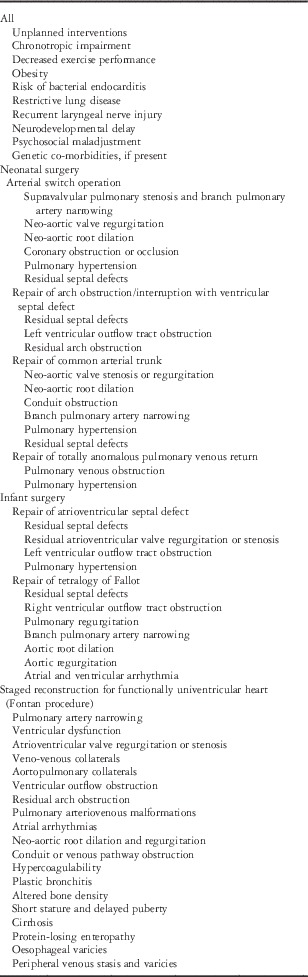
Over the past 20 years, the successes of neonatal and infant surgery, including “corrective” procedures for those with two ventricles and “palliative” procedures for babies born with a functionally univentricular heart, have resulted in dramatically changed demographics in ambulatory cardiology. These school-aged children and young adults have complex, and in some cases, previously unexpected cardiac consequences of their surgical and/or transcatheter proceduresReference Norozi, Wessel and Alpers 2 – Reference Helfricht, Latal, Fischer, Tomaske and Landolt 29 (Table 1). Some of these consequences seem to affect many of these patients to some degree, such as the following:
-
∙ diminished exercise performance,
-
∙ chronotropic impairment, and
-
∙ a risk of obesity and sedentary lifestyle.
Important longer-term consequences of selected cardiac surgical procedures in neonates and infants.

Meanwhile, some of these consequences are lesion specific, such as the following:
-
∙ arrhythmia,
-
∙ valvar regurgitation, and
-
∙ asymmetric pulmonary blood flow.
In addition, there is a growing recognition of additional non-cardiac consequences, including the following:
-
∙ challenges with school performance,
-
∙ social disintegration,
-
∙ anxiety and depression,
-
∙ restrictive lung disease,
-
∙ reactive airways disease,
-
∙ sensorineural hearing loss,
-
∙ reduced health-related quality of life,
-
∙ significant medication burden,
-
∙ post-traumatic stress, for the patient and the family,
-
∙ anti-social behaviour, and
-
∙ challenges with employment and healthcare insurance.
For those with a functionally univentricular heart, additional burdens may include the following:
-
∙ delayed puberty and short stature,
-
∙ thrombosis,
-
∙ renal dysfunction,
-
∙ protein-losing enteropathy,
-
∙ cirrhosis, and
-
∙ plastic bronchitis.
As these interdisciplinary challenges have become more apparent, ambulatory cardiology has become increasingly complicated for these patients, and now consists of much more than simply the following aspects:
-
∙ physical examination including auscultation,
-
∙ an electrocardiogram,
-
∙ the evaluation of an echocardiogram, and
-
∙ discussion of recommendations.
There is a growing need for additional cardiac and non-cardiac subspecialists, and coordination of care may be quite challenging. Unfortunately, routine office visits are frequently time constrained, particularly for those with the most complex disease and/or multiple cardiac and non-cardiac consequences. In fact, time may not allow for all information and counselling to be given. Some questions of a patient or family may go unaddressed.
Traditionally, ambulatory care has focussed on health maintenance and management of acute changes in health, but there is now a growing need for chronic interdisciplinary care, sometimes termed the “medical home”. In 2004, Palfrey et al introduced the concept of paediatric alliance for coordinated care. The study consisted of a paediatric nurse practitioner who was assigned as the case manager of children with special healthcare needs, most with severe chronic illness and with more than five conditions. In one study,Reference Palfrey, Sofis, Davidson, Liu, Freeman and Ganz 30 after 2 years of utilisation of the “medical home”, evaluations by the family (n=117) of the “medical home” were obtained and revealed marked improvement in patient satisfaction scores in the following areas:
-
∙ a decrease in emergency room visits throughout the year,
-
∙ a decrease in sick leaves taken from work,
-
∙ improved accessibility to resources,
-
∙ earlier intervention when the child was acutely ill, and
-
∙ enhanced communication with the medical team.
Current approach to outpatient follow-up
As the focus of outcome studies shifts to the long term, outcomes in the ambulatory setting play an increasingly important role. The outcomes measured in childhood, adolescence, and young adulthood not only describe the patient cohort but also serve to inform and modify earlier care strategies; however, in contrast to hospital-based care, where inpatient care protocols are common and perioperative expectations are more or less predictable for most children, ambulatory cardiologists have evolved strategies of care more or less independently, based on their education, training, experience, and individual styles. Systematic collection of data may occur for specific, targeted research proposals, typically utilising a chart review or a cross-sectional study design, with limitations and biases inherent in those approaches. The care local cardiologists provide is likely to vary because there have been a few standards for these children as there have been little systematically collected data to inform their care. Instead, clinicians may be influenced by multiple factors leading to variability and potential inefficiencies in follow-up strategies, including the potential for over-testing; these factors, including recall bias, the struggles of “that last difficult case”, concern of “missing something”, or worse the concept of “I had a patient once who …”. In some developed countries, there may be financial incentives to perform more diagnostic testing, whereas in other countries there may be financial incentives to do just the opposite.
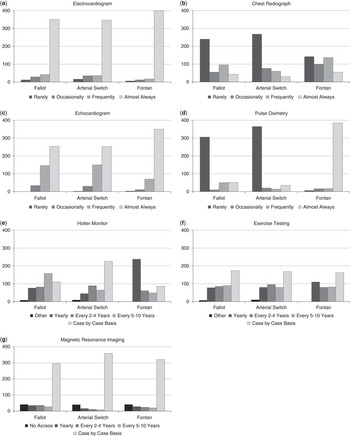
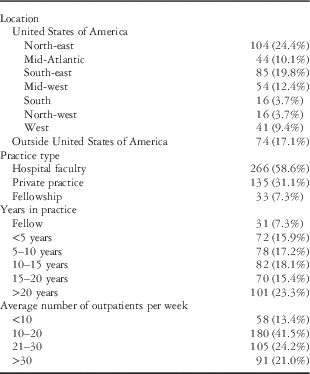
To illustrate the variability in outpatient practices following surgery for critical CHD, between 10 October, 2006 and 4 November, 2006, the internet was used to conduct a survey of ambulatory paediatric cardiologists to determine strategies used for follow-up after the Fontan operation, arterial switch operation, and repair of tetralogy of Fallot (previously unpublished data, presented at the Scientific Sessions of the American Heart Association in 2006). A previously piloted questionnaire consisting of 43 items was distributed via an internet listserv (PediHeart) and known email addresses. Demographics of the survey respondents (n=434) are shown in Table 2 and results in Figure 1a–g. Although this survey was conducted ~10 years ago, the results are likely to be similar if conducted today and show significant practitioner-based variability in diagnostic testing. Preliminary analysis of the data suggested that more “senior” cardiologists performed diagnostic testing less frequently, but because of the subjective nature of the responses, and lack of subsequent validation, formal statistical analysis was not undertaken.
Results from an internet survey conducted in 2006 regarding frequency of diagnostic testing following surgery for tetralogy of Fallot, the arterial switch operation, and Fontan palliation for functionally univentricular heart. See text for details. Number of respondents are noted on the y-axis.

Survey respondents (n=434).

This “case-by-case” approach in the ambulatory setting, however, has important drawbacks:
-
∙ Unless the cohort is well defined and within one healthcare network or academic setting, the results of ambulatory testing may not provide feedback to the surgical and inpatient team, limiting or delaying modifications of technique to address problems.
-
∙ There are often too few patients at any one centre or practice to inform local care guidelines. Frequently, follow-up of a surgical cohort is spread among many different clinicians, frequently in multiple locations.
-
∙ The cost–benefit analyses of follow-up testing are difficult if not impossible to undertake.
Indeed, in their landmark publication “Crossing the Quality Chasm”, the Institute of Medicine stated that “patients should receive care based on the best available scientific knowledge. Care should not vary illogically from clinician to clinician or from place to place”. 31 The report further states that clinicians and institutions should actively collaborate and communicate to ensure an appropriate exchange of information and coordination of care.
Recently, landmark work by the team at Boston Children’s Hospital has resulted in the development of standardized clinical assessment and management plans – “SCAMPs”.Reference Friedman, Rathod and Farias 32 – Reference Farias, Ziniel and Rathod 37 This initiative was produced as a means to reduce variation in practice and promote standardisation, with the ability to individualise the care provided, and thereby provide a means for ongoing modification of the plan. This breakthrough approach to care was first initiated for the care of children with critical CHD due to variation in cardiology practices. Similar to this approach, the goal of a “roadmap” approach is to decrease the variability in medical practice, while allowing for individual variation in practice and collection of data. In most non-academic settings, collection of data and evaluation of strategies of surgical care may face challenges when multiple cardiologists throughout the community provide postoperative care, a care model that centres on individual providers rather than centres. Developing a roadmap for children born with critical CHD is meant to be complimentary to a “SCAMP” approach, and it is community-based as well as patient-based approach, such a roadmap will provide the following:
-
∙ pre-set parental expectations for the type and timing of routine surveillance,
-
∙ an understanding of the expected consequences of surgery for critical CHD, and
-
∙ a framework for screening that will be necessary over the lifetime of the patient.
In 2006, following meetings to determine consensus at the Children’s Hospital of Philadelphia, establishing follow-up guidelines for patients with critical CHD was attempted,Reference Wernovsky, Rome and Tabbutt 38 but the proposal did not meet with sustained success. As has been previously described by Cabana et al, the inertia of the individual practice was, and is, hard to overcome.Reference Farias, Friedman and Powell 36 , Reference Farias, Ziniel and Rathod 37 , Reference Cabana, Rand and Powe 39 , Reference Cabana and Kim 40 A number of additional barriers became apparent, as in many guidelines, including the following:
-
∙ provider lack of agreement,
-
∙ resistance or lack of knowledge of the guidelines,
-
∙ an inadequate database for tracking outcomes, and
-
∙ at the time, an electronic health record with only rudimentary capabilities to identify patients who would best be served by these guidelines and the appropriate intervals for follow-up and testing.
In addition, the plan may have been too ambitious, with yearly or biannual recommendations of diagnostic testing. Many of these factors have changed in the last decade, as bioinformatics and the electronic health record have matured.
Lost in all of this variability of management have been the patient and family. Many go from year to year, hoping nothing will “come up” during the annual or biannual visit, reassured by the “see you next year” and “everything looks great” sometimes paternalistic style of medicine. Results of tests may not be communicated in a manner that is understood. Barriers of language may exist. Health literacy, a key component to improved health-related quality of life and improved medical compliance, is quite variable across patients, and may be related to socio-economic status as well as the interest and experience of the provider. The anxiety of the annual check-up can be severe at times, leading to incomplete “hearing” and processing of the information presented. Casually stating that a new test “might be helpful” can be received in a variety of ways, but in our experience may lead to anxiety, uncertainty, and worry, and some families re-live the trauma of the initial diagnosis and uncertainty of the future. Transition programmes to self-care are sparse or non-existent in some areas,Reference Kovacs and Utens 18 although online resources are recently available. 41 Consultants for the non-cardiac consequences are frequently at a disadvantage. Often, these consultants may never have seen a child or young adult with the particular critical CHD and may not see the relationship of the problem in “their organ system” to the underlying critical CHD. This is particularly problematic in patients with neurodevelopmental challenges and in those with a functionally univentricular heart and multi-system consequences.
Strategy
We have proposed a combination proactive–reactive collaborative model with a patient’s primary cardiologist, primary-care provider, and family in order to address the following aspects:
-
∙ the complexities of critical CHD consequences, or “complications” as they are sometimes referred to,
-
∙ the variability of the timing and severity of presentation, and
-
∙ the need for non-cardiac specialists.
To illustrate the combination proactive–reactive model, we frequently use the analogy of planned maintenance in the automotive industry. When we purchase an automobile, we are given a suggested maintenance schedule, a plan of surveillance for potential mechanical issues that are suggested at predictable intervals. This represents a “proactive” strategy, usually based on time or miles or kilometres driven, and not because the owner identifies a problem. Not each “check-up” is comprehensive, but at important epochs – for example, at 100,000 km – a very comprehensive evaluation is performed, in contrast to a less-complete evaluation performed every 10,000 km. If the owner senses something unusual in the drive of the automobile, or the wipers need changing, a “reactive” strategy is always available, and is analogous to an unplanned visit to the cardiologist. Many families have embraced this approach, with “major” check-ups occurring infrequently but coordinated by the surgical centres – “dealership” – and less comprehensive and/or unplanned visits occurring locally – “the local expert mechanic”. This strategy results in a number of major benefits:
-
∙ from the time of the surgical procedure, the family knows what to expect moving forward, when certain tests will be ordered, what the purpose of the test is, and what will be done with the results,
-
∙ the primary-care provider and primary cardiologist direct these evaluations locally whenever possible, communicating the results with the surgical centre, and
-
∙ over time consistency in follow-up creates a database of “expected” findings and consequences for each particular critical CHD.
The roadmap: standardised testing and routine surveillance – “STARS” – for critical CHD
A good deal of thought was put into the frequency of surveillance testing. These recommendations are likely to be different in different scenarios, including the following:
-
∙ different models of care
-
∙ different socio-economic situations,
-
∙ rural versus urban settings,
-
∙ free-market health care versus single-payer national health coverage, and
-
∙ many more.
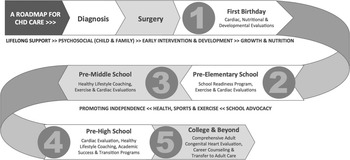
Nevertheless, it seems reasonable from a developmental perspective, fiscal perspective, as well as extensive review of the literature and discussion with families that five planned visits between surgery and transition to self-care as an adult is a good starting point (see Fig 2). Importantly, these recommended comprehensive evaluations include non-cardiac evaluations and recommendations. We advocate comprehensive evaluations at the following five time points:
-
∙ at the first birthday,
-
∙ upon entering elementary education (~5–6 years of age),
-
∙ between elementary and middle school (~10–11 years of age),
-
∙ during transition between middle school and high school (~14–15 years of age), and
-
∙ upon transfer to adult care (~18–21 years of age).
Schematic representation of “the roadmap”.

These times are just starting points for discussion, but setting up a lifelong plan for patients and their families has multiple advantages – such a “roadmap” has the following advantages:
-
∙ manages expectations and anxiety,
-
∙ leads to in-depth conversations about the critical CHD and current status of the repair, improving health literacy,
-
∙ emphasises the need for lifelong care, particularly if introduced early in follow-up,
-
∙ emphasises and evaluates the safety and importance of exerciseReference Takken, Giardini and Reybrouch 42 , Reference Chen, Su, Wang, Yang, Chiang and Moons 43 and primary prevention of atherosclerotic cardiovascular disease,Reference Kavey, Daniels and Lauer 44 , Reference Hayman, Meininger and Daniels 45
-
∙ leads to simultaneous investigations of other organ systems, particularly neurodevelopment, as recently recommended by the American Heart Association and American Academy of Pediatrics,Reference Marino, Lipkin and Newburger 46 and
-
∙ may aid in transition and self-reliance.Reference Kovacs and Utens 18 , Reference Sable, Foster and Uzark 47
Following the comprehensive “100,000 km check-up”, a full summary of the results, including interpretation, is reviewed with the patient’s primary cardiologist, primary-care provider, and family, with all questions addressed as best as possible.
Examples of a potential roadmap, including non-cardiac and cardiac evaluations, are included in the Appendix. Note that for each lesion there are specific tests for known consequences specific to the repair, as well as more general screens for consequences such as the following:
-
∙ exercise performance,
-
∙ level of activity,
-
∙ arrhythmia,
-
∙ obesity,
-
∙ neurodevelopment, and
-
∙ general health status.
It is also important to recognise and emphasise the importance of the 1st year of life following surgery for critical CHD. Some of these patients remain physiologically fragile following palliative or corrective procedures. Many, particularly those requiring intervention in the 1st weeks of life, have a higher incidence of challenges with feeding, nutrition, heart failure, developmental delay, medication burden, and a heightened level of family stress and anxiety. For neonates, with a functionally univentricular heart, many programmes have instituted an intensified level of ambulatory surveillance and support with “interstage monitoring programmes”, but we would argue that the same level of support and interdisciplinary involvement should be extended to infants with biventricular repairs, particularly if there are multi-system challenges as mentioned above. Setting up the framework and expectations for interdisciplinary follow-up and family support should start immediately after the surgical repair and continue throughout childhood. Critical in this process is a structured “hand-off” from the surgical centre to an interdisciplinary team, led by the child’s primary cardiologist and primary-care provider.
One may argue that it is over ambitious, or perhaps not indicated, for the cardiology programme where surgery was performed to provide the medical home for these patients. Some may feel that it is not the responsibility of the primary cardiologist to coordinate the evaluation of non-cardiac domains, including the following:
-
∙ neurodevelopment,
-
∙ growth failure,
-
∙ sedentary behaviours, and
-
∙ lack of separation from parents.
We disagree. Although it is certainly not the responsibility of the cardiologist at the surgical centre to provide all of these services, we feel it is the responsibility of the child’s cardiologist to coordinate the care team, and know what colleagues need to collaborate in order to provide the medical home, along with the child’s primary-care physician, primary cardiologist, and family. The cardiology team best knows the mid-term and longer-term consequences of heart surgery, and we feel they are responsible for educating the rest of the stakeholders in the care of the patient, including psychosocial and mental health support as indicated. This strategy is precisely the model used for inpatient care, where one individual is not responsible for all aspects of optimal care, such as surgery, imaging, nutrition, nursing, anaesthesia, etc.; rather, a team is assembled to provide the best possible outcome utilising the expertise of multiple different individuals. This strategy of care is the model we propose to bring to the ambulatory setting. In addition to educating the rest of the care team, members of the medical home team should provide the patient and family education in the ambulatory setting to assist in real-time understanding of multiple topics:
-
∙ the name and anatomy of the critical CHD,
-
∙ the interventions performed,
-
∙ the current cardiovascular assessment,
-
∙ the potential long-term consequences of the procedures, and
-
∙ the importance of transition to self-care.
Models implementing advanced practice nursing after discharge from critical CHD surgery have been shown to reduce maternal worry as well as improve outcomes of infants, and it is our expectation that similar benefits would be seen over time in the ambulatory setting.Reference McCusker, Doherty and Molloy 48
Finally, it is our hope that this model will provide the following advantages:
-
∙ will stimulate discussion and information sharing between centres, practitioners, patients, and families,
-
∙ be modified constantly over time, and
-
∙ potentially adopted by other invested parties such as the Society of Thoracic Surgeons and European Association for Cardio-Thoracic Surgery.
These groups have collaborated for a number of years to create very large databases to examine short-term outcomes. Their results have been impressive.Reference Jacobs, Maruszewski and Tchervenkov 49 – Reference Jacobs, Jacobs and Maruszewski 52 Adding a longer-term care module will allow improved feedback on surgical and in-hospital strategies of care and speed up the process of collaborative learning across centres. Reliance solely on perioperative studies to improve outcomes is helpful but short-sighted. Similarly, reliance on outpatient cardiology appointments with highly variable follow-up strategies to determine the “success” of cardiac surgery for critical CHD is inconsistent and incomplete. Ambulatory strategies must evolve for continued improvement in outcomes; tens of thousands of data points are being wasted.
We anticipate the following aspects:
-
∙ some will disagree with this strategy,
-
∙ additional technology and/or later findings will change these recommendations,
-
∙ many, if not most, will disagree with the exact type and timing of testing, and
-
∙ implementation will necessarily be variable across centres and geography depending upon interest and resources.
To our knowledge, routine, standardised follow-up protocols do not exist for most critical CHD, although there is increasing interest in standardisation for patients with a univentricular heart, including at institutions such as Children’s Healthcare of Atlanta (Mahle W, personal communication), Lucille Packard Children’s Hospital (Wright G, personal communication), and undoubtedly others. Much of what we have learnt in this regard is based on the recognition of multi-system consequences of the Fontan procedure from the seminal work from the Single Ventricle Survivorship Program at the Children’s Hospital of Philadelphia.Reference Rychik, Veldtman and Rand 53 – Reference Avitabile, Leonard and Zemel 58 We speculate that other forms of critical CHD, particularly with residual physiological perturbations such as in tetralogy of Fallot, may also have as-yet-to-be-defined multi-system consequences as well; only systematic follow-up of large cohorts of patients will identify these potential morbidities. Our roadmap put forth here for patients with a univentricular heart, although similar, is somewhat different than that recently proposed by Rychik,Reference Rychik 7 both in terms of frequency of testing and by non-inclusion of standardised invasive testing. Which protocol is “right”, most cost-effective, or likely to become standardised remains to be seen; however, we must start somewhere.
The authors, as well as the editors of Cardiology in the Young, welcome contrary and conflicting opinions and look forward to the dialogue.
Acknowledgements
The authors thank Chitra Ravishankar, MBBS, Girish Shirali, MBBS, Carole M. Lannon, MD, MPH, and Andrea Baer (mendedlittlehearts.org) for their critical review of the manuscript and thoughtful comments during the preparation. The authors also thank their colleagues in Cardiology and Cardiac Surgery at the Nicklaus Children’s Hospital of the Miami Children’s Health System for their enthusiasm of the concept and their support.
Financial Support
The research received no specific grant from any funding agency, commercial, or not-for-profit sectors.
Conflicts of Interest
None.
Appendix
Roadmap following arterial switch operation

Roadmap following repair of total anomalous pulmonary venous return

Roadmap following repair of ventricular septal defect with arch obstruction or interruption

Roadmap following repair of common arterial trunk

Roadmap following repair of tetralogy of Fallot

Roadmap following repair of ventricular septal defect

Roadmap following repair of atrioventricular septal defect

Roadmap following repair of neonatal repairs (other)

Roadmap following repair of infant repairs (other)
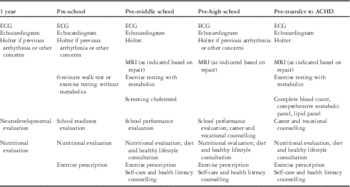
Roadmap following staged reconstruction for univentricular heart (Fontan)