A major public university is located in or very near over half of American state capitals, and political science departments at these universities advertise the special advantages that such a location brings to their students. For example, the political science department of the University of Nebraska-Lincoln advertises its internship programs: “As Lincoln is the seat of state government, students have an opportunity to observe government in action. Political Science has a vibrant internship program where students may intern with the state legislature, the governor's office, and other agencies of state government. Internships are also available with local interest groups, non-profit agencies, corporations, and political parties” (University of Nebraska-Lincoln 2005). Such opportunities for students are meaningful, however, only if they have some significant effect on student learning or engagement. It is reasonable that colleges and universities would emphasize the advantages that their location in a state capital might offer; colleges use both their campus and their local community to appeal to students (Choy and Ottinger 1998). Yet there is scant research to confirm any of the effects that colleges advertise.
We wanted to investigate what effect a university's location in the state capital has on the civic knowledge and engagement of its undergraduates. First, we sought information about the civic knowledge and engagement of political science majors attending college in state capitals and in other settings. How much political knowledge did political science majors have about their government? How much involvement did they have in political groups and organizations? How interested were they in careers in state government? Second, if students who attended college in the state capital had higher levels of civic engagement, what student experiences and characteristics led to this?
The Importance of Place for Civic Engagement
Levels of civic engagement vary not only by individual characteristics but also by context. As Macedo et al. (2005, 67) explain, “Place matters for civic engagement…. the local circumstances in which citizens live and work have significant independent effects on whether they will get involved, with whom (and against whom) they will engage, and how successful their efforts will be.” Interacting with other politically engaged people likely increases one's level of political engagement (Huckfeldt 1979; Huckfeldt and Sprague 1995; Rosenstone and Hansen 1993; Verba, Schlozman, and Brady 1995). A state capital presents political science majors with more opportunities to interact with those who are politically engaged, and to become politically involved themselves, than would most other cities.
The institutions of government have a great employment reach in their communities, and those who reside near a state capital likely interact with those who work in and around state government, even if they themselves do not. In a state capital, even students, who generally have fewer interactions with those outside the university, would be likely to interact with state workers through their classes or friends. As Huckfeldt and Sprague (1995, 11) note, “Once [people] decide to take the job—or to attend a church or live in a neighborhood or bowl in a league—they have little control over the people they encounter as part of their activities within the boundaries of the environment.” In a state capital, there are many ever-present reminders of the machinery of government, such as greater state government coverage in the local news, the presence of political events such as rallies and protests, and the physical presence of government buildings. Even among students who are less engaged, context matters. While we have not found any literature specifically on how state capitals influence the political socialization of students, we know that community politics can influence students; for example, partisan competition in a district increases both political discussion and political knowledge among students in the district who do not plan to attend college (Gimpel, Lay, and Schuknecht 2003).
We would also expect that undergraduate students in state capitals would have increased interaction with state government through their courses. University political science departments in state capitals often have faculty members who work in some professional capacity with the state government, and these faculty members might draw on their professional experiences to tailor their classes to state-level politics. The contextual effects of attending college in the state capital are the sum total of small currents such as these: students have state government brought into their classrooms, know more state employees, or simply live amidst the workings of state government.
In addition to these contextual effects, students in state capitals might interact directly with the government. Since civic education—the teaching of skills needed to participate in public life (Galston 2001)—is often taught through non-traditional and experiential programs, we believe it is important to talk about these programs in particular. Most notable are the wide variety of undergraduate internships that are particularly attractive to students seeking education in political science and politics. Political internships have a long tradition (Frantzich and Mann 1997; Pederson and Provizer 1995), and have been shown to produce a higher and more effective learning rate for students (Galston 2001). Students who are involved in local politics have been found to obtain better grades, enjoy class more, and report a better understanding of the ideas or topics taught in class (Ehrlich 2000). Though internships do not necessarily lead to large academic shifts such as a change of major, they do cement and define career choices (Scannell and Simpson 1996); students learn both what they might want to do and what they do not want to do for a career (Baker 2003). Internships empower students by increasing self-esteem, self-efficacy, knowledge and skills, and political awareness (Schwerin 1997). Furthermore, internships serve as “catalysts” to job offers (Gabris and Mitchell 1989), and so can encourage a lifetime of political involvement.
With this framework in mind, we seek to test three hypotheses regarding the effects of attending college in a state capital on students' civic engagement.
- Political science majors who attend college in a state capital have a greater level of political knowledge than those who do not.
- Political science majors who attend college in a state capital participate in more political groups and activities than those who do not.
- Political science majors who attend college in a state capital have a greater desire to work in government after graduation, or to become involved in politics in some other way, than those who do not.
Our models also include several variables for other factors likely to influence civic engagement levels. This allows us to measure the effects of attending university in the state capital versus other alternative influences, such as internships themselves, having a high grade point average, attending high school in a state capital, or taking a state and local government course.
The Collegiate Environment and Career Goals Survey
We selected a total of four universities, two in one state and two in another, to investigate the effect of going to college in a state capital on undergraduate political science majors. Two universities were located in a state capital, and two were located more than two hours from the state capital. In one state, the flagship university was outside the capital; in the other state, there is no “flagship” in the university system. Each of the four is a research university with a doctoral program in political science; the Carnegie Foundation's classification system lists each as a “more selective” undergraduate institution. The ratio of political science majors to political science faculty members is roughly equivalent at the four universities. For purposes of this study, we labeled our campuses Northern Capital University, Northern Campus University, Southern Capital University, and Southern Campus University. Collectively, these schools have approximately 3,100 undergraduate political science majors.
Between the late fall of 2004 and the spring of 2005, we conducted an Internet survey of political science majors at both universities, which we generically labeled the “Collegiate Environment and Career Goals Survey.” While surveys have some limitations as devices to investigate processes and contextual effects (Schlozman 2002), they allowed us to contact a large number of students and collect considerable information from each respondent. Both schools located in “Northern State” provided email lists of their political science majors, and by emailing students enrolled in several introductory classes at both schools we were able to include students who were planning to major in political science but had not yet declared their status. We were unable to contact all political science majors at the two schools located in “Southern State.” We were able to contact Southern Campus and Southern Capital students in specific courses, but unfortunately we reached considerably fewer students at Southern Campus University, and only one-third of respondents from Southern Campus University were juniors or seniors. We wanted to focus on students who had attended only their current university, and so we eliminated transfer students from our pool.
Internet surveys allow researchers to collect partially completed surveys, those that might be put in the trash rather than the mailbox if they were paper surveys. We included a survey in the quantitative analysis only if the student had answered at least half the questions, which eliminated respondents who dropped out before responding to questions regarding attitudes or career goals. This left us with 459 responses. (Additional nonresponses left us with just under 400 surveys for our regression analyses.) Since we do not know the number of students at the Southern State universities who received the survey information via a course listserv or course web site, and we do not know the number of transfer students at any campus who were ineligible for the survey, we cannot calculate a precise survey response rate. However, these 459 students represent nearly 15% of the population of majors at the four universities—a fairly robust proportion of a population.
Though only 13% of respondents were freshmen—not surprising, given that many freshmen have not chosen a major—the remaining respondents were distributed equally across the three class years. Sixty-one percent of respondents attended school in a state capital. Students' demographic characteristics roughly matched those of their universities. Half of our respondents were male, and three-quarters were White; nearly one-half were Democrats, 30% were Republicans, and almost all of the rest were unaffiliated, with a few students belonging to minor parties.
Analysis
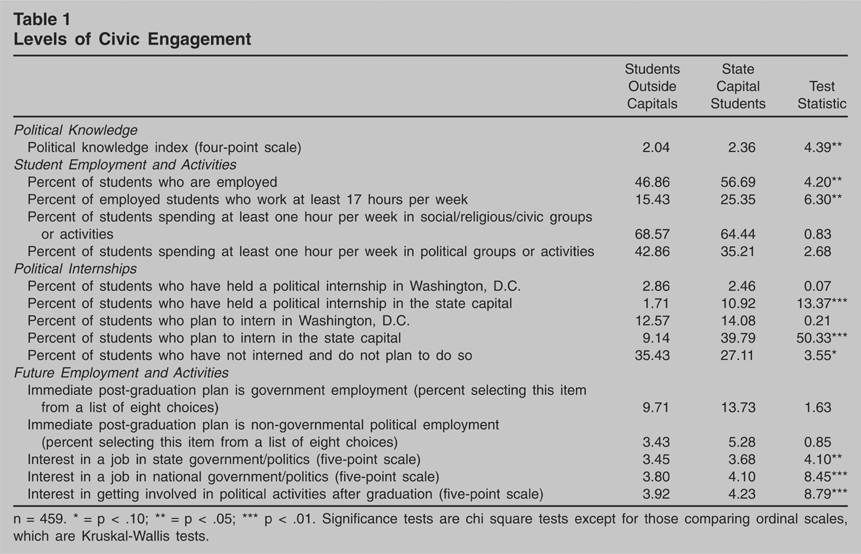
In our analyses, we first used chi-square or Kruskal-Wallis tests to distinguish whether there were differences between students located at our capital campuses and those at their two counterparts. While these tests do not indicate causality, they do allow us to investigate whether the two groups differ from each other on a number of important characteristics. We present a summary of these statistics in Table 1. Then, for differences where we wished to examine the relationship between our variables, we turned to logistic regression. Since we are seeking to determine whether attending college in a state capital has a unique socialization effect on political science majors, we include college location as a dichotomous independent variable in our regressions. Our dependent variables in these regressions are different aspects of civic engagement. These can be placed into three categories: knowledge about politics, political involvement during college, and plans for careers related to politics.
Levels of Civic Engagement

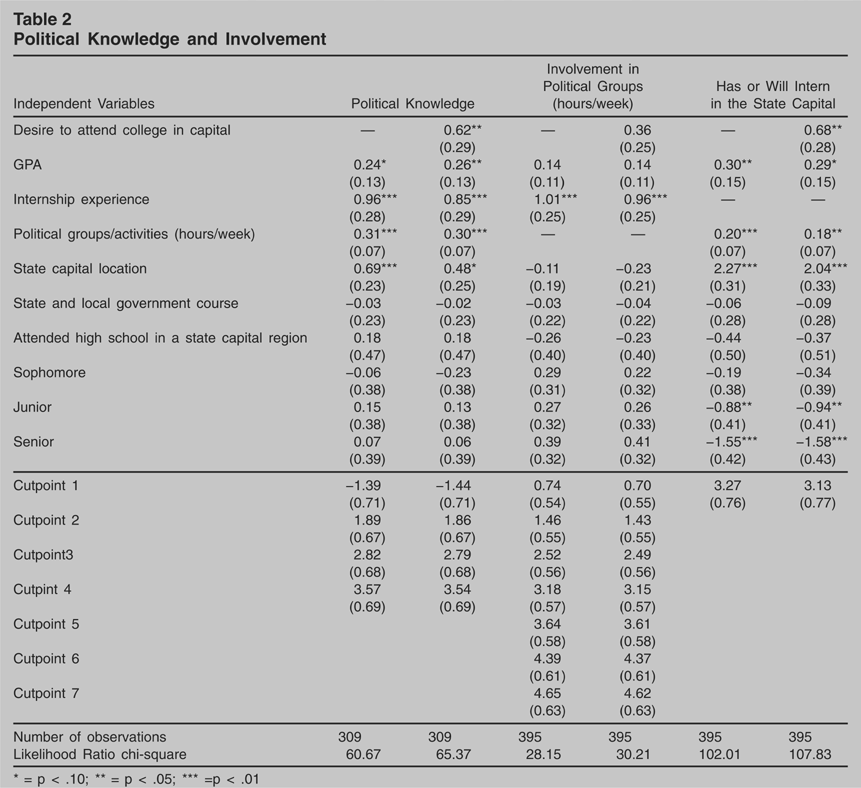
Our biggest concern as we tried to determine whether campus location in a capital influenced civic engagement in political science majors was controlling for pre-existing effects. Our survey results indicated that many college students in state capitals had selected their university with an eye toward taking advantage of the capital's political opportunities. If this were true, we would need to try to control for any pre-existing differences in the pools of students at the two types of schools. To do this, we present two regressions for each model. In the first regression for each dependent variable, we control for a student's grade point average, hours per week of participation in a political organization or group, as well as whether the student had held a political internship, had attended high school in a state capital, and had taken a state and local government course. In the second regression on the same dependent variable, we include a variable capturing whether a student chose to attend school in a state capital at least in part because of the capital's presence. We use ordered or dichotomous logistic regression models with fixed effects for year in school.
Levels of Political Knowledge
The survey asked students to identify the governor, speaker of the House of Representatives, Senate majority leader, and attorney general for the state in which they attended college. We then created a political knowledge index, a four-point scale ranging from zero to four. This is a narrow measure of political knowledge—we certainly do not claim that naming a handful of politicians is all that is involved in being politically well-informed—but it has the advantage of being a reliable measure (Cronbach's alpha = .74) that we believe has considerable validity. It provides students a chance to identify undoubtedly the best-known political figure in the state (the governor) as the most basic level of knowledge; the legislative leaders as a means to test knowledge of the state legislature; and, finally, a statewide elected official who is not a household name but who holds an office often in the news (the attorney general).
The average respondent could identify two of these four political actors in their state; 27% properly identified all four, but 40% could identify no more than one. The mean score for respondents at Southern Capital and Northern Capital is 2.36; the mean score for respondents at Southern Campus and Northern Campus is 2.04 (a difference that is statistically significant at p < .05). A logistic regression model also supports the hypothesis that those attending colleges in a state capital will have a higher level of political knowledge than those who attend colleges not located in a state capital (Table 2). Notably, the statistical significance of attending college in a state capital does not disappear when we add the variable for a student's considering the state capital when selecting a college. Both variables are statistically significant, although the significance of attending college in a state capital decreases. A student who attends college outside the capital has an 8% chance of naming all four officials correctly; a student who attends college in a state capital, but didn't see the capital as important in her choice of college, has a 12% chance of naming all four officials correctly; and a student who sought to attend college in a state capital and is currently doing so has a 20% chance of naming all four officials correctly.1
For calculating the predicted probabilities, we presumed that the student had a GPA between 3.00 to 3.50; had not held an internship or taken a state and local government course; did not attend high school in a capital; and participated in political groups, but for less than one hour per week.
Political Knowledge and Involvement

Political Group Participation
We asked students how much time they spent working at a paying job, participating in a political group or activity, and taking part in other organizations that were not political but were social, religious, or volunteer/civic in nature. Activity rates for students varied by campus, but no campus appeared particularly unusual in how its students spent their time. Respondents attending school at Northern and Southern Capital Universities were more likely to have a paying job, but somewhat less likely to spend their time at organized extracurricular activities. Fifty-seven percent of respondents from these two schools, but only 47% of respondents at Northern and Southern Campus Universities, were employed; the differences in the number of employed students, and the number of hours worked each week by students with jobs, were the only statistically significant differences in activity levels between the two sets of students (p < .05). Students located in state capitals also worked far more hours per week; nearly 25% of students at capital universities worked 17 hours per week or more, compared to 12% of students at our campus universities.
Surprisingly, the students in state capitals spent less of their extracurricular activity time with political activities. Thirty-five percent of students in capitals, and 43% of students outside capitals, spent at least one hour per week involved in a political group or activity. Students in our capital cities were also a bit less active in other activities, participating less in groups or activities that are social, religious, or volunteer/civic in nature. These differences in hours spent in extracurricular activities were not statistically significant, however, and it seems logical that if students in state capitals spend more time in paid employment, then they would have less time for other activities. When we ran a regression model on the number of political hours committed each week, only having interned was significant in either model; neither variable related to the state capital mattered (Table 2). Thus we lack support for our second hypothesis, that students who attend college in state capitals will become more involved with political groups. In addition to the employment constraints that students at Northern Capital University and Southern Capital University face, we seem to have erred in our hypothesis that participation would be more common in the capital because opportunities would be more prevalent. Students at Northern Campus University and Southern Campus University apparently enjoy ample access to political groups and activities on campus or in the community.
Participation in political internship programs is one area of substantial difference in the activities of these two groups of students. It is extremely clear that attending college in a state capital increases the chances of interning in the capital. While this effect is not particularly surprising, it is notable for exactly how few of our respondents from Northern and Southern Campus Universities had interned in the state capital. One hundred of our respondents had held a political internship. Of the 34 students who had held state capital internships, only three attended college outside the capital. We found this especially surprising because Northern State offers a semester-long internship program through its state legislature that both grants a full term's worth of credit to students at any state university, and offers a stipend of more than $3,500 for the semester. Given this, it is surprising that only two political science majors from Northern Campus University—arguably the stronger of the two undergraduate institutions in that state—had participated in the program.
Future Plans for Involvement in Politics
If going to college in a state capital increases the likelihood of a political science major's working in state government, then the socialization and vocational influences of college location would be long-lasting indeed. As most political science professors will tell you, political science majors' single most common path after graduation is to go to law school. Might schooling in a state capital change that tendency and nudge students toward employment in state government or politics in some other arena? We measured post-college plans through a number of different survey items, and each presents a somewhat different picture of the influence of attending college in the state capital on political science majors. First, we asked students to identify their primary, immediate post-graduation plan from a list of eight options. Sixty-five percent of seniors—and 68% of respondents overall—intend to continue with further study. Twelve percent of seniors plan to pursue work in the private sector, either through self- or family employment or work in business or industry. Three percent of seniors plan to travel immediately following graduation, and another 3% expect to begin teaching careers. The remaining 18% of seniors identify some political employment following graduation: two-thirds of that group expects to work for some level of government, and the remaining 6% expects to be employed in some other political position. Career intentions appear to stay remarkably consistent as students progress through college; the only career plan that shows a general trend is that of government employment, which interests only 5% of freshmen but at least 12% of sophomores, juniors, and seniors. Does this interest vary by college location? No. Neither chi-square tests nor regression analyses of the two different measures produce statistically significant effects related to attending college in the state capital.
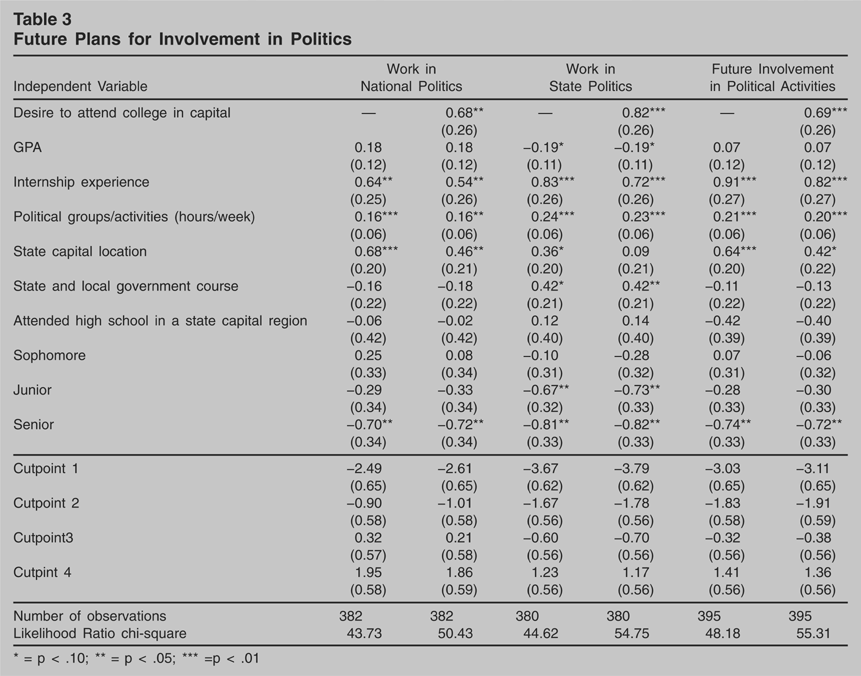
Yet two other survey items indicate that students who attend college in state capitals have more interest in government careers. These survey items are broader than the one discussed immediately above, as they do not limit a student to his or her immediate post-graduation plans but instead ask, “How interested are you in a job in state government/politics?” and “How interested are you in a job in national government/politics?” Responses were on a five-point Likert scale. The average response from students at Northern and Southern Capital Universities was 3.68, or leaning slightly toward “agree”; those elsewhere had an average response that was just a bit lower at 3.45 (p < .05). Students at both types of college location express a bit more interest in working in national politics; here the responses averaged 4.1 for those in a state capital and 3.8 for those outside it (p < .01). A student attending school in a state capital is 10% more likely than his or her non-capital counterpart to strongly agree that he or she is interested in a job in national politics, even controlling for those students who sought out a state capital experience when choosing their college.
We were surprised when regression analyses indicated that going to school in a state capital was a more powerful explanatory variable for desire to work in national politics than for the desire to work in state politics (Table 3). Perhaps this is because students in state capitals want to “move up” to the prominence of the national arena, or perhaps they simply want to move away from the city where they attended college. Even after controlling for students who consciously sought to go to college in a state capital, going to college in a state capital retains much of its impact on the desire to work in national government. The effect on the desire to work in state government is not so robust. Going to college in a state capital loses its statistical significance once we control for a student's seeking such a program, although having interned, being active in political groups, and having taken a state and local government course are each positively related to the desire to work in state politics. The negative effect for grade point average was somewhat surprising, and a bit disappointing; the students with the highest grades do not seem bound for state government. Perhaps this is because those with the highest GPAs are focused on private practice legal careers.
Future Plans for Involvement in Politics

Our last measure of the effects of college location on life plans was avocational involvement in politics. The survey asked students to respond to another item that stated, “I am interested in getting involved in politics at some point after I have my degree,” with a five-point response scale from “completely uninterested” to “very interested.” This survey item is much vaguer than others; getting involved in politics could mean anything from a little local volunteering to becoming a major political player in any number of arenas, vocational or avocational. It could also include running for elective office. The mean response for students in state capitals is 4.23; for those outside state capitals, it is 3.92. This significant difference (p < .01) continues to hold up in both regression specifications (Table 3), although the statistical significance in the second regression drops somewhat (p < .10) when the model includes a variable for seeking to attend college in the capital (p < .01). It is interesting that going to school in a capital still has an effect, even controlling for the desire to be in a capital. Perhaps this taps the general impact of going to school in a state capital. It might not change most students' immediate professional plans, but it opens more of them to the possibility of a politically involved life after college—even if they were not oriented that way before heading to the university.
Discussion
So, does attending college in a state capital have an effect on political science majors? Does it increase political knowledge, and does it have any influence on activities in college and on life plans? The survey results described above certainly demonstrate differences between those political science majors attending a university in a state capital and those attending a university located elsewhere. Those attending the capital universities can better identify state political officeholders. While they do not spend more time participating in political groups or organizations, they are far more likely to intern in the state capital. There is also some evidence that they have more interest in state or national government employment, and are more likely to want to get involved in politics at some point after graduating.
College students are often perceived as being uninvolved in and unaffected by the cities where they attend school. This study indicates that political science majors are influenced by the political environment around them, at least if it is as distinctive as the state capitals that we study here. Since political socialization literature indicates that people's level of political knowledge is difficult to change, our finding that attending a university in a state capital can increase knowledge of state politics is a non-trivial effect. Likewise, in an era when political participation and civic commitment among college students are at historic lows (Galston 2004), our finding that a state capital can provide a motivating environment seems substantively significant. Finally, for the political science majors who sought out colleges in a state capital, we have provided an indication that this college selection tactic probably brought them some real benefits.
Although a complete exploration of their substance belongs in another paper, we would like to say a brief word about the effects of our other independent variables. Grade point average was usually statistically significant, but not always; it was least important in the models involving post-college plans. We were not surprised by this; brilliant and not-so-brilliant students enter careers of all types, and brilliant and not-so-brilliant students seek to continue their engagement with politics after they have left the classroom. Although enrollment in a state and local government course was statistically insignificant in most models, we believe that it was an important control variable, as this class more than any other—at least in theory—would introduce students to many of the same benefits as living in a state capital. Finally, the internships variable was highly statistically and substantively significant in most models. This is notable, as the empirical research on the effects of internships is mixed (Gryski et al. 1992). We believe that internships and similar experiential learning opportunities play a major role in the benefits that a state capital has to offer. We draw this conclusion based on the open-ended comments provided by our respondents, the extensive literature that discusses the benefits of internships, and our own perceptions as former interns and (in one case) as an internship advisor. While some might argue that the effect of internships stems from the superior qualities of the interns rather than from the internship themselves, we disagree for two reasons. First, internships are very widespread today, and one cannot assume that every intern is a gifted undergraduate. Second, matched cohort studies find that structured internships improve political skill and sophistication (Eyler and Halteman 1981), crystallize vocational ambitions, and improve employment opportunities (Taylor 1988). We believe that the value of internships for undergraduate political science majors is worthy of further exploration.
We leave the reader with three additional suggestions for future research. First, we have left untouched how our “state government junkies”—the students who sought out a state capital for their university environment—might influence their classmates. Investigating these politically motivated students more closely for their own sake is also one path for fruitful research; these students are likely to join our cadre of political elites at later stages in life. Second, although we present several pathways in which the environment of a state capital might influence political science majors, this article is limited to finding support for causal effects rather than identifying the causal process at work. We encourage others to delve more deeply into our individual hypotheses. Finally, although our campuses come from states that are quite different, more variation in campus representation would strengthen our results. For this reason, we encourage replication and extension of our lines of inquiry. In order to assist in this, we have made a replication dataset and the survey questions used for this study available on the Internet at http://bingweb.binghamton.edu/∼jjensen/.
Author Bios
Jennifer M. Jensen is visiting assistant professor at Binghamton University (SUNY), where she specializes in state and local government. Much of her current research addresses career motivations and ambitions of political actors.
Lauren L. Hunt is a law student at Albany Law School.