Introduction
The intercropping of annual crops with forages in integrated crop-livestock systems (ICLS) has become an effective strategy to intensify agricultural production and rehabilitate degraded pasture areas (Andrade et al., Reference Andrade, Borghi, Bortolon, Bortolon, Camargo, Avanzi, Guarda, Cunha, Silva and Fidelis2020). In addition to their forage function, forages are widely used as cover crops, being desiccated to form mulch in no-till systems. This practice enhances crop resilience to intermittent droughts, improves physical, chemical, and biological soil attributes, and contributes to progressive increases in grain yield (Peterson et al., Reference Peterson, Deiss and Gaudin2020; Oliveira et al., Reference Oliveira, Santos, Chizzotti, Bretas, Franco, Lima, Freitas, Cherubin and Cerri2024).
However, the success of intercropping in integrated systems strongly depends on the proper selection of forage species, which must be well adapted to local edaphoclimatic conditions, exhibit low competitiveness with the main crop, and ensure high persistence in the field (Muniz et al., Reference Muniz, Costa, Severiano, Bilego, Almeida, Furtini Neto, Vilela, Lana, Leandro and Dias2021). While Urochloa ruziziensis cv. Kennedy has been extensively studied in integrated systems, other cultivars, and genetically improved genotypes, such as U. ruziziensis cv. BRS Integra still requires further investigation regarding its performance under intercropping conditions. Under monoculture, BRS Integra has shown high forage mass, profuse tillering, a favourable leaf-to-stem ratio, and promising nutritional value (Rodrigues et al., Reference Rodrigues, Paciullo, Soares, Gomide, Morenz, Lopes, Sobrinho and Lana2023). Other grasses with intermediate stature, such as Andropogon gayanus cv. BRS Sarandi also demonstrates potential for use in intercropping, particularly in low-fertility, acidic soils with high aluminium saturation, as commonly found in the Cerrado biome (Braga et al., Reference Braga, Ramos, Carvalho, Fonseca and Karia2024).
Beyond forage mass and nutritional traits, biomass decomposition and nutrient cycling play a fundamental role in the sustainability of ICLS. As mulch is decomposed by soil microorganisms, part of the absorbed nutrients is gradually returned to the soil, potentially reducing fertilize costs and improving fertility in areas with a continuous history of integration (Baptistella et al., Reference Baptistella, de Andrade, Favarin and Mazzafera2020; Grzyb et al., Reference Grzyb, Wolna-Maruwka and Niewiadomska2020). Although previous studies have quantified nutrient return from biomass decomposition in areas already cultivated with ICLS (Dias et al., Reference Dias, Costa, Severiano, Bilego, Neto, Almeida, Brand and Vilela2020; Dias et al., Reference Dias, Costa, Severiano, Bilego, Vilela, de Souza, de Oliveira and da Silva2021; Muniz et al., Reference Muniz, Costa, Severiano, Bilego, Almeida, Furtini Neto, Vilela, Lana, Leandro and Dias2021; Silva et al., Reference Silva, de Pinho, Severiano, da Silva, Vilela, Leandro, Muniz, da Silva, Magalhães and Barros2024), there is still a lack of research assessing different forages in Cerrado soils characterized by naturally low fertility and an absence of prior cultivation history.
To the best of our knowledge, this is the first study to simultaneously evaluate the forage mass, nutritional value, and biomass decomposition dynamics of Urochloa genotypes (‘BRS Integra’, ‘R86’, and ‘254-1’) and A. gayanus cv. BRS Sarandi intercropped with maize, in an ICLS, under typical Cerrado soil conditions without prior cultivation.
We aimed to evaluate the agronomic performance, nutritional value, and residue decomposition dynamics of different forages intercropped with maize in an integrated system under tropical conditions. We hypothesized that (i) forages intercropping simultaneously with maize will establish and maintain growth during the maize cycle; (ii) forage genotypes will differ in forage mass and nutritive value (e.g.: crude protein and fibre concentrations); (iii) forages intercropped with maize will accumulate forage mass to serve as animal feed or as cover crop during the off-season; and (iv) forage genotypes will differ in nutrient release dynamics of biomass (nitrogen, phosphorus, potassium, calcium magnesium, and sulphur), but will not reduce the yield of a subsequent soybean crop.
Materials and methods
Description of the area
The experiments were conducted at Embrapa Cerrados in Planaltina/DF, Brazil (15º36’36.31 ‘ S, 47º42‘11.63’’ W and 987 m altitude) from 2022 August to 2024 March. The region’s climate, according to Köppen and Geiger, is of the Cwa type: humid subtropical with a dry winter and hot summer (Alvares et al., Reference Alvares, Stape, Sentelhas, de Moraes and Sparovek2013). The experimental area’s soil characterization is red ferralsols (WRBS, 2006). The physical and chemical characterize of the soil was carried out at a depth of 0–20 cm, before setting up the experiment, which had the following composition: clay, 507 g/kg; sand, 142 g/kg; silt, 351 g/kg; pH in CaCl2: 5.20; Ca: 1.97 cmolc/dm3; Mg: 0.530 cmolc/dm3; Al: 0.050 cmolc/dm3; Al + H: 4.80 cmolc/dm3; K: 70 and S: 20 mg/dm3; cation exchange capacity (T; pH 7): 7.50 cmolc/dm3; V: 35.7 % and P (Mehlich-I): 1.05 mg/dm3 and MO: 32 g/kg.
The experimental area, which had no previous history of agricultural crops, was initially corrected with 3 tons/ha of dolomitic limestone and 1.5 ton/ha of agricultural gypsum, distributed by hand and incorporated with a harrow in August 2022. In October 2022, the soil’s P content was corrected using 600 kg/ha of simple superphosphate (SSP), according to the recommendations of Sousa et al. (Reference Sousa, Lobato, Rein, Sousa and Lobato2004). Accumulated rainfall and average temperature were measured at the Embrapa Cerrados Main Weather Station during the experimental period (Figure 1).
Accumulated rainfall and average temperature recorded from November 2022 to March 2024.

Experiment design
The experiment consisted of four phases: corn intercropped with forages (2022/23 harvest); free growth of the forages; regrowth of the forages; desiccation and cultivation of soybeans (2023/24 harvest) on the biomass of the desiccated forages.
The first trial, corn intercropped with forages, was conducted in a randomized complete block design (RCBL) with a split-plot arrangement with four replications per treatment, with the soil fertility gradient being the block factor. The plots (main factor) consisted of maize intercropped with seven forages: Urochloa decumbens, genotypes ‘254-1’ (decumbens hybrid – HD4), ‘R86’ (decumbens hybrid - HD1), and the ‘Basilisk’ cultivar; U. ruziziensis, cultivars ‘Kennedy’ and ‘BRS Integra’; ‘1242-10’ (Interspecific hybrid of Urochloa brizantha, U. decumbens, and U. ruziziensis - H12), and A. gayanus cv. BRS Sarandi. The subplots (secondary factor) corresponded to three evaluation periods: April, June, and September 2023. The second trial, soybeans grown on the straw of forages in succession, was conducted in a RCBL with four replications per treatment and eight treatments: soybeans grown in succession on the biomass of the forages U. decumbens, genotypes ‘254-1’, ‘R86’ and the cultivar ‘Basilisk’; U. ruziziensis, cultivars ‘Kennedy’ and ‘BRS Integra’, Urochloa hybrid, genotype ‘1242-10’, A. gayanus cv. BRS Sarandi and the soybean grown on the area cultivated with ‘single’ corn in the previous harvest, which was left fallow, without a cover plant in the off-season of 2022.
Establishment of crops
The maize hybrid LG 36790 VTPRO3, specialized for grain production, and the forages were sown simultaneously on 23 November 2022. Maize seeds were mechanically sown in plots measuring 5 × 2.5 m, with furrows at a depth of 0.03 m, spaced 0.50 m apart, and at a seeding density calculated to achieve a population density of 66000 plants/ha. Basal fertilization was carried out with 400 kg/ha of 4-30-16 fertilizer, applied directly in the planting furrow. The forages were sown manually by broadcasting within the plots, using a seeding rate of 4 kg/ha of pure viable seeds. At the maize V4–V6 growth stage (Fancelli, Reference Fancelli, Bórem, Galvão and Pimentel2017), topdressing was performed with urea fertilizer, applying a total of 135 kg/ha of nitrogen. Post-emergence weed control, targeting Digitaria sanguinalis, was conducted using atrazine and 2,4-D (2,4-dichlorophenoxyacetic acid) at application rates of 1.5 and 0.5 litre/ha, respectively, 15 days after maize emergence (DAE), followed by an additional application of atrazine at 2.5 litres/ha at 30 DAE. Insecticide treatments for pest control were applied at 25 and 36 DAE, and manual weeding was performed at 42 DAE to control D. sanguinalis. Grain maize was harvested at 139 DAE, on 17 April 2023.
Canopy height and forage mass
The forage canopy height, forage mass and nutritive value were evaluated in April, June and September 2023, corresponding to 0, 58 and 154 days after maize harvest, respectively. For each sampling period, data were collected from different randomly selected areas within each plot. Forage canopy height was measured at five random points within these areas using a ruler. The reference height was defined as the distance from the soil surface to the ‘leaf horizon’ at the top of the forage canopy. For assessing forage mass, plants were cut at ground level within a 2.5 m2 usable area, delineated using a 1 × 1 m metal quadrat repositioned as needed. From the harvested and homogenized material, subsamples of approximately 300 g were collected, placed in paper bags, and pre-dried in a forced-air oven at 55°C for 72 h. Subsequently, samples were ground to pass through a 1 mm sieve using a Willey-type knife mill and then subjected to chemical analyses to determine nutritive value.
Analysis of the nutritive value of forages
The chemical analyses were conducted to determine dry matter (DM) content at 105°C (AOAC, 1996; Method 930.15), ash content (AOAC, 2006; Method 942.05), and organic matter (OM), calculated as the weight loss after combustion in a muffle furnace at 600°C. Crude protein (CP) concentration was determined using the Kjeldahl method (AOAC, 2005; Method 2001.11). Neutral detergent fibre corrected for nitrogenous compounds (NDFcp) was determined following the sequential method of Van Soest et al. (Reference Van Soest, Robertson and Lewis1991), with corrections for contamination by nitrogenous compounds as described by Detmann et al. (Reference Detmann, Souza, Valadares Filho, Queiroz, Berchielli, Saliba and Azevedo2021), using an ANKOM 200 Fibre Analyser (ANKOM Technology Corp., Macedon, NY, USA). During NDFcp determination, thermostable α-amylase (Termamyl 120, Sigma–Aldrich, St. Louis, MO, USA) was used.
In vitro dry matter digestibility (DMD) and in vitro organic matter digestibility (OMD) were determined using the two-stage procedure described by Tilley and Terry (Reference Tilley and Terry1963), as adapted by Holden (Reference Holden1999), with a DaisyII rumen fermentation system (ANKOM Technology Corporation). Rumen fluid was collected from a fistulated Holstein cow, 3 h after feeding, with a diet consisting of maize silage, 2 kg of concentrate (composed of ground maize and soybean meal), and a free-choice mineral mix. F57 filter bags containing the forage samples were incubated with the rumen fluid–buffer solution at 39°C for 48 h. Subsequently, 40 ml of 6N HCl and 8 g of pepsin were added to each digestion jar, and incubation continued for an additional 24 h. After incubation, the bags were rinsed under running water, pre-dried at 55°C overnight (12 h), then dried at 105°C for 2 h, and finally weighed.
Evaluation of cover biomass and total nutrients
To achieve canopy uniformity, the forages were mowed on 18 September 2023, immediately after the final forage mass assessment. The plots were then maintained under unrestricted regrowth conditions for 50 days to allow for biomass accumulation before no-tillage soybean planting. Subsequently, the forages were chemically desiccated on 7 November 2023 (25 days before soybean sowing for the 2023/24 growing season) with an application of 4 litres/ha glyphosate [containing 793 and 720 g active ingredient (a.i.)/kg N-phosphonomethyl glycine and glyphosate acid equivalent, respectively]. A second application was conducted on 17 November 2023, using 4 litres/ha glyphosate and 0.5 litre/ha mineral oil. The forages were then cut at ground level on 27 November 2023, three days before soybean sowing for the 2023–24 season. A portion of the harvested biomass was ground to 1 mm using a Willey-type knife mill (AOAC, 1996; Method 930.15) for chemical composition analysis of the original material, targeting nitrogen (N), phosphorus (P), potassium (K), magnesium (Mg), sulphur (S), calcium (Ca), NDFcp and lignin. The remaining biomass was used as a cover crop for evaluating the decomposition dynamics and nutrient cycling.
Biomass decomposition was assessed using the dead, desiccated, and pre-dried material in a forced-air oven at 55°C for 72 h, kept intact (not ground), and placed into nylon litter bags measuring 20 × 20 cm with a 2 mm mesh size, according to Thomas and Asakawa (Reference Thomas and Asakawa1993). For each plot, nine litter bags (three bags per sampling time), each containing 20 g of forage sample, were placed in direct contact with the soil. After 40, 80 or 120 days of soil contact, three litter bags per plot were collected at each interval to determine remaining biomass (decomposition rate) and chemical composition. The final decomposition period (120 days) was intentionally scheduled to coincide with the period close to soybean harvest on 21 March 2024. Biomass loss was calculated as the ratio between the final and initial mass (20 g) in the litter bags after pre-drying at 55°C for 72 h, with the percentage loss multiplied by the initially produced biomass (kg/ha) to estimate biomass reduction per hectare.
After weighing, the litter bags collected at each time point were pre-dried in a forced-air oven at 55°C for 72 h. The biomass samples were then ground to 1 mm using a Willey-type knife mill for the determination of N, P, K, Ca, Mg and S concentrations. Inductively coupled plasma optical emission spectrometry was used to determine the concentrations of P, K, Mg, S and Ca, while nitrogen and NDFcp concentrations were determined using the previously described methodologies. Acid detergent fibre corrected nitrogenous compounds (ADFcp) were determined following the sequential method of Van Soest et al. (Reference Van Soest, Robertson and Lewis1991), with corrections for contamination by nitrogenous compounds as described by Detmann et al. (Reference Detmann, Souza, Valadares Filho, Queiroz, Berchielli, Saliba and Azevedo2021), and lignin concentrations were determined from the ADFcp residue according to Robertson and Van Soest (Reference Robertson, Van Soest, James and Theander1981). The lignin-to-nitrogen ratio was calculated, and the macronutrient concentrations were multiplied by the produced biomass, with results expressed in kg/ha. The nutrient equivalents of N, phosphorus pentoxide (P2O5) and potassium oxide (K2O) in the forage cover crop biomass were quantified based on the atomic mass of the elements, using conversion factors of 2.29 for P and 1.20 for K, and the measured N, P and K concentrations in the biomass, following Santos et al. (Reference Santos, Albuquerque Filho, Vilela, Ferreira, Carvalho and Viana2014).
Soybean crop establishment, management and evaluation of agronomic characteristics
The soybean cultivar BRS 7080 IPRO was sown on 30 November 2023 (2023/24 growing season) in rows spaced 0.50 m apart. Seeds were treated with 0.225 l insecticide/100 kg of seeds (600 g a.i./l cyantraniliprole), 0.070 litre/100 kg of commercial product containing insecticides (150 and 450 g a.i./l imidacloprid and thiodicarb, respectively), and inoculated with a product containing Bradyrhizobium elkanii SEMIA 587 and SEMIA 5019 (Gelfix, 5 × 10⁹ CFU/ml) at a rate of 0.100 litre/100 kg of seeds of the commercial inoculant. Fertilization at sowing consisted of applying 470 kg/ha of 00-20-20 (NPK) fertilizer in the planting furrow.
Fungicides and herbicides were applied at 35 days after sowing (DAS): 0.500 litre/ha of the commercial product Fox (containing 150 and 175 g a.i./l fluoxastrobin and prothioconazole, respectively), 2 kg/ha glyphosate (792.5 and 720 g a.i./kg N-phosphonomethyl glycine and glyphosate acid equivalent) and 0.750 litre/ha clethodim (240 g a.i./l cyclohexanedione oxime); at 49 DAS: 0.400 litre/ha of the commercial product Orkestra (167 and 333 g a.i./l pyraclostrobin and fluxapyroxad, respectively), 0.300 litre/ha Terminus (200 and 250 g a.i./l acetamiprid and lambda-cyhalothrin, respectively), and 0.300 litre/ha mineral oil; and at 77 DAS: 0.400 litre/ha Fox, 0.300 litre/ha Terminus, and 0.300 litre/ha mineral oil.
Soybean agronomic traits were evaluated at 125 DAS along 3 m in the three central rows of each plot (assessing three representative plants/plot). Yield estimation was performed by mechanized harvesting of all plants along 5 m of the central rows using a Wintersteiger® harvester. The evaluations included plant height and first pod insertion height (mean distance from the soil surface to the insertion of the first pod); number of pods per plant (mean number of pods per plant, calculated as the total number of pods with seeds); 1000-grain weight and yield (kg/ha), both adjusted to 13 % moisture content, as determined using a G810 moisture metre (GEHAKA AGRI).
Statistical analysis
Data were tested for normality of residuals and homoscedasticity using the Shapiro–Wilk and Bartlett tests, respectively. The variables forage mass, biomass decomposition, and concentrations of N, P and Mg in the biomass did not meet at least one of these assumptions and were therefore log-transformed. Analysis of variance (ANOVA) was performed to test the effects of the isolated factors (forages and cutting treatments) and their interaction in an RCBL with a split-plot arrangement. To compare means among forages, Duncan’s and Tukey’s tests were used according to the coefficient of variation of the variable (≥ 15 and ≤ 10 %, respectively), and orthogonal contrasts were applied to compare means between cutting treatments using Fisher’s test.
To describe the decomposition of the cover crop biomass and nutrient quantities, the data were fitted to the exponential model (
 $y = {\rm{a}}{{\rm{e}}^{{\rm{kx}}}}$
) (Wieder e Lang, Reference Wider and Lang1982), where
 ${\rm{y}}$
is the amount of remaining biomass at time
 ${\rm{x}}$
,
 ${\rm{a}}$
is the amount of pre-dried biomass at time zero,
 ${\rm{k}}$
is the decomposition rate constant of the dry biomass, and x is the time in days. This model was linearized by applying the logarithmic transformation (
 $\log {\rm{y}} = \log {\rm{a}} + {\rm{loge\;kx}}$
), considering that
 $\log {\rm{e}}$
is approximately 0.4343. ANOVA was applied to evaluate the estimated equations, testing data homogeneity and the significance of the regression coefficients (
 $0.4343{\rm{k}}$
) and intercept (
 $\log {\rm{a}}$
). The half-life time (
 ${\rm{t}}{/_2}$
), defined as the number of days required for 50 % of the apparent residual biomass to be completely mineralized to CO2, as calculated according to Paul and Clark (Reference Paul and Clark1989), using the equation
 ${\rm{t}}{/_2} = \ln \left( {0.5} \right)/{\rm{k}}$
, where
 ${\rm{ln\;}}\left( {0.5} \right)$
is approximately 0.693 and
 ${\rm{k}}$
is the decomposition constant of the dry biomass.
Total nutrient data, fertilizer equivalent, agronomic characteristics, and soybean productivity were subjected to ANOVA in a RCBL, and means were compared by hypothesis tests (Duncan’s and Tukey’s), assuming a Type I error α = 0.05 and considering coefficients of variation ≥ 15 and ≤ 10 % for the respective tests. Statistical analyses were performed using R Core Team software (2024).
Results
Agronomic characteristics and forage mass
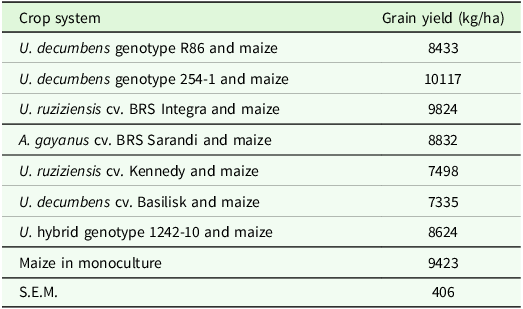
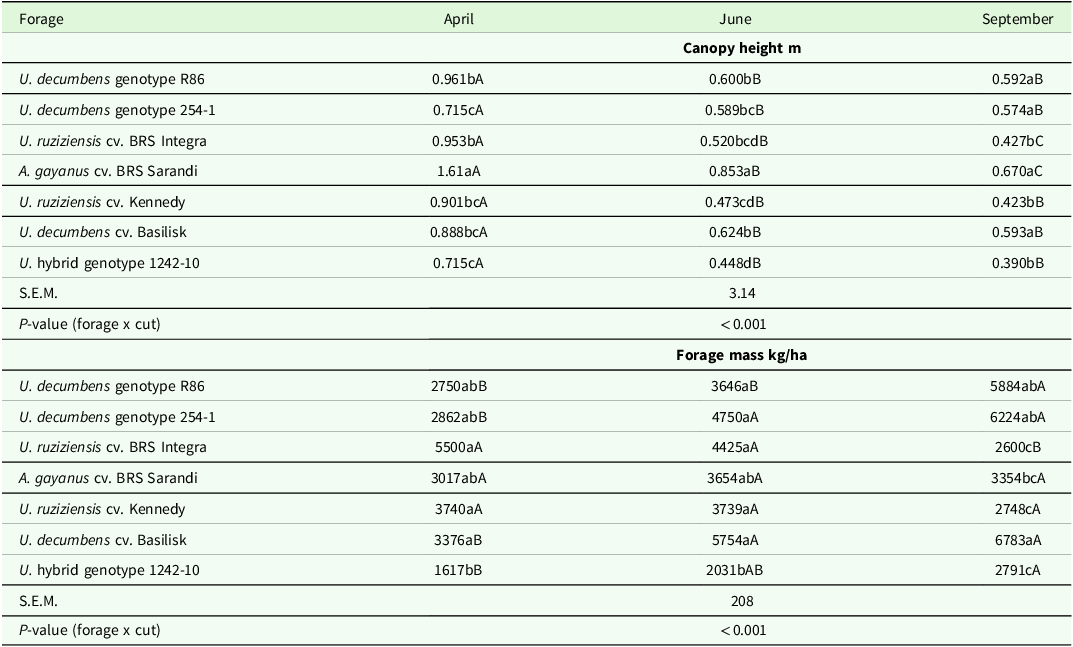
The average maize grain yield was 8464 kg/ha (Table 1). There was an interaction (P < 0.05) between forage genotypes and harvest times for canopy height and forage mass (Table 2). The cultivar ‘BRS Sarandi’ showed the greatest canopy height in the harvests carried out in April and June (P < 0.05). In April, the genotypes ‘1242-10’ and ‘254-1’ exhibited similar and lower canopy heights compared to the average of forages ‘BRS Sarandi’, ‘R86’ and ‘BRS Integra’ (0.715 vs.1.17 m). In June, the genotype ‘1242-10’ presented a canopy height 34.8 % lower than the grasses ‘BRS Sarandi’, ‘Basilisk’, ‘R86’ and ‘254-1’ (0.448 vs. 0.604 m). In September, it remained among the forages with the shortest canopy height. All forages showed greater canopy height in April compared to the other harvests, except for the cultivars ‘BRS Integra’ and ‘BRS Sarandi’, which exhibited a linear decrease in canopy height (P < 0.05).
Grain yield of maize hybrid LG 36790 VTPRO3 in monoculture or intercropped with forages during the first growing season

SEM: standard error of mean. Maize corrected to 13% moisture.
Canopy height and forage mass of the forages intercropped with maize during the first growing season at different cutting times (April, June and September)

Means followed by different lowercase letters in the column and uppercase letters in the row differ according to the Tukey test (P < 0.05) and the Fisher test (P < 0.05), respectively. Means between cuts were compared using orthogonal contrasts, and forages were compared using the Tukey test. Standard error of mean (S.E.M.), Urochloa (U) and Andropogon (A).
The cultivar ‘Basilisk’ and the genotypes ‘254-1’ and ‘R86’ of U. decumbens remained among the most productive forages across the three evaluated harvests, whereas ‘1242-10’ was one of the least productive. The U. ruziziensis cultivars and ‘BRS Sarandi’ produced similarly to U. decumbens in the first two harvests; however, U. ruziziensis showed a 108 % reduction in forage mass (P < 0.05) at the last harvest (5561 vs. 2674 kg/ha). The cultivar ‘BRS Integra’ reduced forage mass by 111 % at the September harvest compared to the April harvest (5500 vs. 2600 kg/ha), while the U. decumbens genotypes increased forage mass by 110 % over the same period (2996 vs. 6297 kg/ha).
Nutritive value of forages
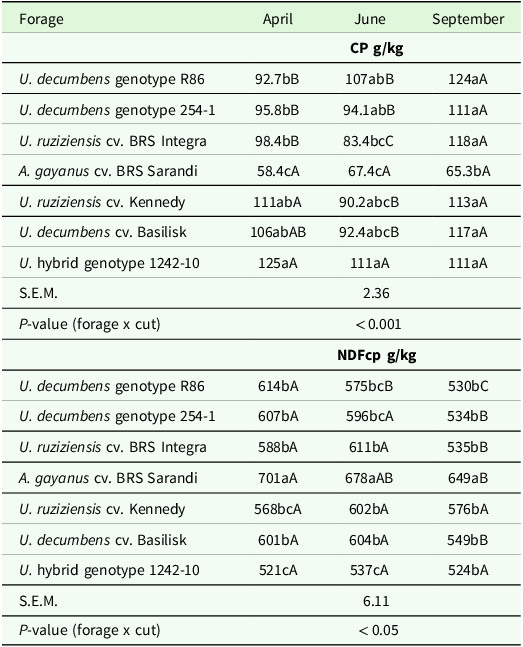
There was an interaction (P < 0.05) between forage genotypes and harvests for CP and NDFcp (Table 3). The CP concentration of the genotype ‘1242-10’ was higher (P < 0.05) than all other forage grasses except ‘Kennedy’ and ‘Basilisk’ at the first harvest (125 vs. 86.3 g/kg DM). In June, the CP concentrations of genotypes ‘R86’, ‘254-1’ and ‘1242-10’ (104 g/kg DM) exceeded that of ‘BRS Sarandi’ (67.4 g/kg DM) by 54.3 %. At the last harvest, ‘BRS Sarandi’ exhibited the lowest CP concentration, which was 77.6 % lower than the other forages (116 vs. 65.3 g/kg DM). The cultivar ‘BRS Sarandi’ and genotype ‘1242-10’ maintained similar CP concentrations from the second to the third harvests, while the other forages increased CP concentrations.
Concentrations of CP and NDFcp of the forages intercropped with maize during the first growing season at different cutting times (April, June and September)

Means followed by different letters lowercase in the column and uppercase in the row differ according to Tukey’s test (P < 0.05) and Fisher’s test (P < 0.05), respectively. Means between cuts were compared using orthogonal contrasts, and forages were compared using Tukey’s test. Standard error of mean (S.E.M.), Urochloa (U), Andropogon (A), crude protein (CP) and neutral detergent fibre corrected for nitrogenous compounds (NDFCP).
The cultivar ‘BRS Sarandi’ showed the highest concentration of NDFcp in all harvests evaluated (P < 0.05) (701, 678, and 649 g/kg DM in April, June, and September, respectively). Except for the cultivar ‘Kennedy’, the lowest NDFcp concentration was found in the genotype ‘1242-10’ among the forages at the April harvest (521 g/kg DM). In June, the grasses ‘BRS Integra’, ‘Kennedy’ and ‘Basilisk’ exhibited 128 % higher NDFcp compared to the genotype ‘1242-10’ (P < 0.05) (606 vs. 537 g/kg DM). At the last harvest, the cultivar ‘BRS Sarandi’ presented 199 % more NDFcp than the other forages (541 vs. 649 g/kg DM). Generally, the NDFcp concentration of the forages was lower at the third harvest compared to the first (P < 0.05), except for the cultivars ‘Kennedy’ and ‘Basilisk’.
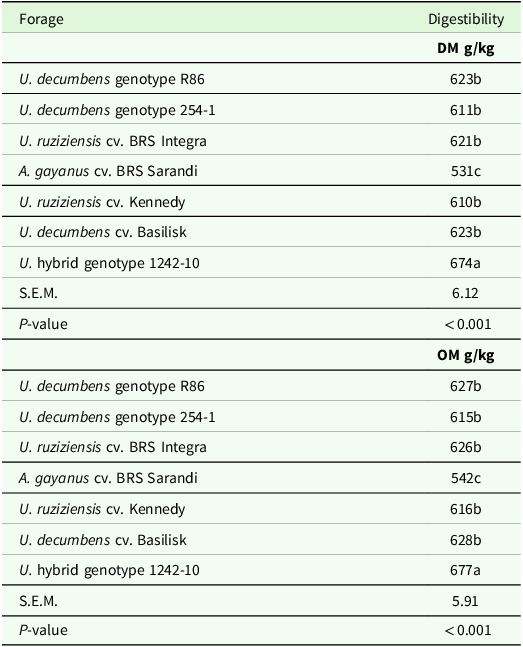
There was no interaction (P > 0.05) between forages and harvests for the variables DMD and OMD (Table 4). Regarding the main effects, these variables showed a significant effect for forages (P < 0.05) but no significant effect for harvests (P > 0.05). Potential digestibility of OM and DM followed a similar pattern among the forages. The genotype ‘1242-10’ exhibited the highest digestibility coefficients, whereas the lowest values were observed for ‘BRS Sarandi’ (P < 0.05). The remaining cultivars showed intermediate and similar values (P > 0.05).
In vitro digestibility of dry matter and organic matter of the forages intercropped with maize during the first growing season

Means followed by different letters differ according to Tukey’s test (P < 0.05). Standard error of mean (S.E.M.), Urochloa (U), Andropogon (A), dry matter (DM) and organic matter (OM).
Evaluation of cover biomass and nutrient cycling
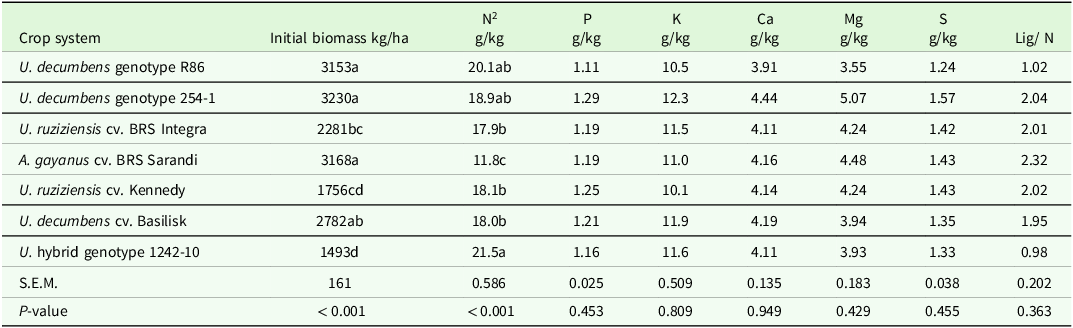
The initial biomass accumulation differed (P < 0.05) among the forages (Table 5). The grasses ‘R86’, ‘254-1’, ‘BRS Sarandi’ and ‘Basilisk’ produced 95.9 % more initial biomass compared to the forages ‘Kennedy’ and ‘1242-10’ (3184 vs. 1625 kg/ha). The initial nutrient concentration in the biomass differed (P < 0.05) only for N. The cultivar ‘BRS Sarandi’ showed the lowest concentration of this nutrient compared to the other forages evaluated (11.8 vs. 19.1 g/kg DM). The grass ‘1242-10’ exhibited the highest N concentration in the initial biomass relative to the cultivars ‘Basilisk’, ‘Kennedy’, ‘BRS Sarandi’ and ‘BRS Integra’ (21.5 vs. 16.5 g/kg DM). The lignin: nitrogen ratio at time zero averaged 1.76, with no significant difference between the cropping systems (P > 0.05).
Initial biomass, initial concentration of nutrients (N, P, K, Ca, Mg and S), and lignin: nitrogen ratio in the biomass of the forages intercropped with maize in the first crop and managed for subsequent no-till soybean planting in an integrated production system

Means followed by different letters differ by the Duncan1 and Tukey2 tests (P < 0.05). Standard error of mean (S.E.M.), Urochloa (U), Andropogon (A), nitrogen (N), phosphorus (P), potassium (K), calcium (Ca), magnesium (Mg), sulphur (S) and lignin (Lig).
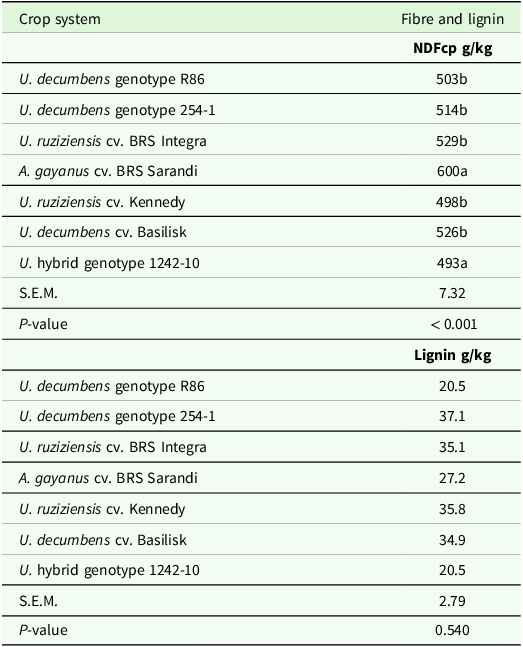
The initial biomass of the cultivar ‘BRS Sarandi’ showed the highest concentration of NDFap compared to the other evaluated forages (P < 0.05) (Table 6). Regarding lignin concentration, the forages did not differ from each other (P > 0.05).
Initial concentrations of NDFcp and lignin in the biomass of the forages intercropped with maize in the first crop and managed for subsequent no-till soybean planting in an integrated production system

Means followed by different letters differ according to the Tukey’s test (P < 0.05). Standard error of mean (S.E.M.), Urochloa (U), Andropogon (A) and neutral detergent fibre corrected for nitrogenous compounds (NDFcp).
There was an interaction (P < 0.05) between forage type and decomposition days for all evaluated variables (remaining biomass, N, P, K, Mg, S and Ca). The cultivar ‘BRS Sarandi’ exhibited the highest amount of remaining biomass compared to the other forages at the end of the soybean development cycle (Figure 2a) (1084 vs. 570 kg/ha). The half-life time ranged from 39 to 46 days for the Urochloa spp. forages; however, the cultivar ‘BRS Sarandi’ showed a half-life of 63 days. Approximately 78.1, 80.3, 78.1, 77.5, 78.2, 76.9 and 68.8 % of the biomass of the grasses ‘1242-10’, ‘254-1’, ‘Basilisk’, ‘BRS Integra’, ‘R86’, ‘Kennedy’ and ‘BRS Sarandi’ was decomposed after 120 days, respectively.
Amount of biomass remaining from forage biomasses (a), and dynamics of the apparent disappearance of nitrogen (b), phosphorus (c) and potassium (d) in the biomass of forages during the soybean production cycle (0–120 days) in an integrated production system – Cerrado biome, 2023/24. Error bars represent ± standard error of the means and **significant at 1 %.

At the beginning of the decomposition evaluation (disappearance, time zero), the amount of N (kg/ha) was higher in the biomass of the forages ‘R86’, ‘254-1’ and ‘Basilisk’ compared to the other forages (Figure 2b). Slower N decomposition was observed for the cultivar ‘BRS Sarandi’, which exhibited the longest half-life compared to the other grasses (148 vs. 56 days). When the amount of N in the initial biomass was compared with the values recorded at the last evaluation period (120 days), the biomass of the forages ‘1242-10’, ‘254-1’, ‘Basilisk’, ‘BRS Integra’, ‘R86’, ‘Kennedy’ and ‘BRS Sarandi’ released approximately 71.9, 72.5, 67.2, 66.5, 69.4, 66.5 and 41.7 %, respectively.
The biomass of the cultivar ‘BRS Sarandi’ had the highest amount of P, while the forage ‘1242-10’ showed the lowest amount of this nutrient throughout the decomposition period (Figure 2c). The amount of P decomposed from the biomass of ‘BRS Sarandi’ was higher but slower compared to the other forages, which had a shorter half-life (72 vs. 132 days). The biomass of the grasses ‘1242-10’, ‘254-1’, ‘Basilisk’, ‘BRS Integra’, ‘R86’, ‘Kennedy’ and ‘BRS Sarandi’ returned approximately 69.8, 79.2, 65.3, 65.4, 64.6, 68.2 and 48.0 % of P after 120 days of decomposition, respectively.
The initial amount of K in the biomass of the grasses ‘254-1’, ‘BRS Sarandi’, ‘R86’ and ‘Basilisk’ was higher than that of the forages ‘1242-10’ and ‘Kennedy’ (Figure 2d). The half-life of K was relatively short (12 to 21 days) for all grasses. The K release was high for all evaluated forages, being 96.2, 97.0, 96.2, 96.4, 96.3, 95.1 and 92.7 % for the grasses ‘1242-10’, ‘254-1’, ‘Basilisk’, ‘BRS Integra’, ‘R86’, ‘Kennedy’ and ‘BRS Sarandi’ after 120 days, respectively.
The highest accumulation of Mg was observed in the biomass of the grasses ‘254-1’ and ‘BRS Sarandi’ compared to the other grasses at time zero (Figure 3a). Conversely, the lowest amount of this mineral was found in the genotype ‘1242-10’ throughout the decomposition period. When comparing the final (120 days) Mg content to the initial (time zero), nutrient return was 75.5, 82.1, 69.3, 74.2, 76.3, 72.1 and 76.2 % for the biomass of the grasses ‘1242-10’, ‘254-1’, ‘Basilisk’, ‘BRS Integra’, ‘R86’, ‘Kennedy’ and ‘BRS Sarandi’, respectively.
Dynamics of the apparent disappearance of magnesium (a), sulphur (b) and calcium (c) in the biomass of forages during the soybean production cycle (0–120 days) in an integrated production system – Cerrado biome, 2023/24. Error bars represent ± standard error of the means and **significant at 1 %.

The biomass of the grass ‘BRS Sarandi’ had the highest amount of S, while the genotype ‘1242-10’ had the lowest amount of this nutrient throughout the entire soybean development cycle (120 days) (Figure 3b). The half-life of S in the biomass of ‘BRS Sarandi’ exceeded that of the other evaluated grasses (126 vs. 72 days). Approximately 66.7, 75.5, 65.6, 68.0, 59.0, 61.0 and 52.8 % of the initial S content in the biomass of the grasses ‘1242-10’, ‘254-1’, ‘Basilisk’, ‘BRS Integra’, ‘R86’, ‘Kennedy’ and ‘BRS Sarandi’ was released after 120 days of decomposition, respectively.
The biomass of the cultivar ‘BRS Sarandi’ maintained the highest amount of Ca compared to the other grasses throughout the decomposition period (Figure 3c). The opposite behaviour was observed for the grasses ‘1242-10’ and ‘Kennedy’, Ca was the nutrient with the lowest amount released during decomposition. The percentage of Ca released from the biomass of the grasses ‘1242-10’, ‘254-1’, ‘Basilisk’, ‘BRS Integra’, ‘R86’, ‘Kennedy’ and ‘BRS Sarandi’ during the 120-day soybean cycle was 48.7, 60.1, 50.9, 45.1, 57.4, 43.0 and 33.0 %, respectively, relative to the initial amount.
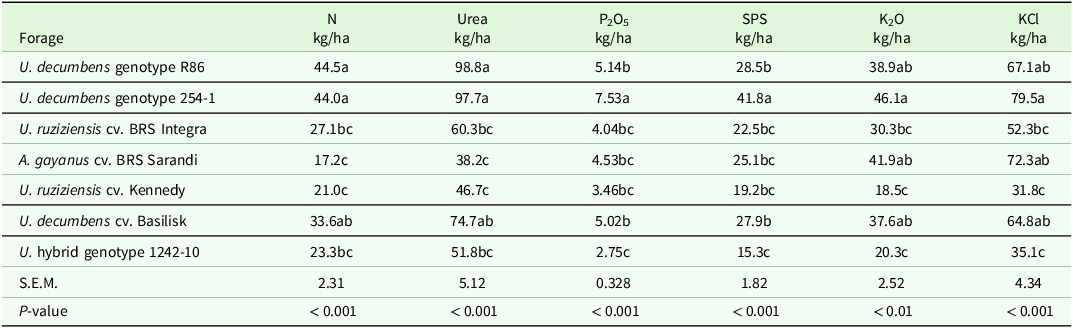
The biomass of the grasses ‘R86’ and ‘254-1’ released 99.4 % more urea equivalent compared to the biomass of the grasses ‘BRS Integra’, ‘BRS Sarandi’, ‘Kennedy’ and ‘1242-10’ (98.3 vs. 49.3 kg/ha) (Table 7). For the fertilizer P2O5, the grasses ‘R86’ and ‘Basilisk’ released 84.7 % more compared to the forage grass ‘1242-10’ (P < 0.05) (5.08 vs. 2.75 kg/ha). The biomass of these grasses also released 97.4 % more KCl compared to the grasses ‘1242-10’ and ‘Kennedy’ (P < 0.05) (38.3 vs. 19.4 kg/ha).
Equivalent amounts of nitrogen, urea, diphosphorus pentoxide, simple superphosphate, potassium oxide and potassium chloride released from the desiccated biomass of forages over 120 days under cultivation with soybeans

Means followed by different letters differ by the Duncan test (P < 0.05). Standard error of mean (S.E.M.), Urochloa (U), Andropogon (A), nitrogen (N), urea: (45 % N), diphosphorus pentoxide (P2O5), simple superphosphate (SPS, 18 % P2O5), potassium oxide (K2O), potassium chloride (KCl, 58 % K2O).
Plant population density, agronomic characteristics, and soybean productivity
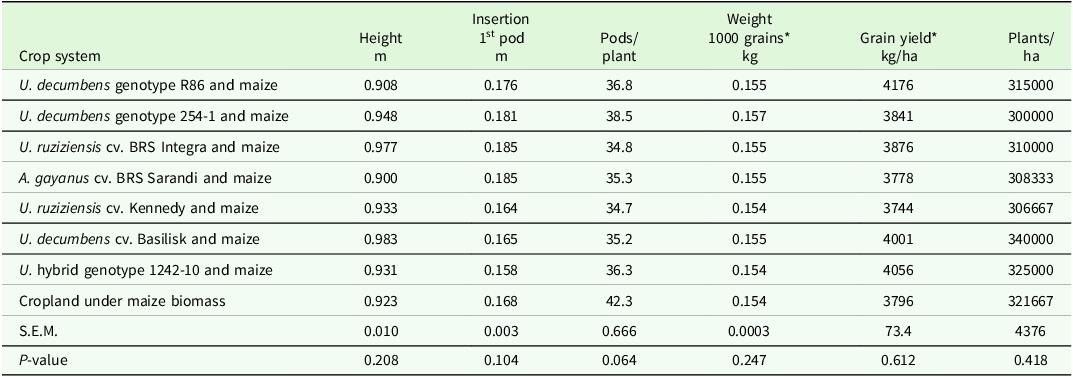
There was no effect of the cropping system on any of the variables evaluated (Table 8). The average plant height and first pod insertion height were 0.938 m and 0.173 m, respectively. The average number of pods/plant and plants/ha were 36.7 and 315833, respectively. The average soybean yield was 3908 kg/ha, and the weight of 1000 grains was 0.155 kg.
Plant height and first pod insertion, number of pods per plant, number of plants per area, weight of 1000 grains and grain yield of soybean grown on biomass of forages from maize cultivation in the previous crop year

* Soybeans corrected to 13 % moisture. Standard error of mean (S.E.M.), Urochloa (U) and Andropogon (A).
Discussion
Although some studies have already demonstrated the potential of forage genotypes for establishing pastures in the Cerrado biome, such as the ‘BRS Sarandi’ (Braga et al., Reference Braga, Ramos, Carvalho, Fonseca and Karia2024), there is still a gap in the literature on the performance of these materials in integrated production systems. This is the first study to present results on the agronomic performance, forage accumulation and nutritional value, as well as the decomposition and nutrient cycling of crop residues from the cultivars ‘BRS Sarandi’ and ‘BRS Integra’ and three promising genotypes (‘R86’, ‘254-1’ and ‘1242-10’) in integrated systems with corn and soybeans in the Cerrado biome. This study reinforces the hypothesis that these genotypes establish well when intercropped with corn during the main growing season, showing potential for use both as pasture and as cover crops. Future studies could investigate animal performance on these pastures to better understand their potential use.
Agronomic characteristics and forage mass
Usually, tussock grasses reach greater canopy heights compared to those with a stoloniferous growth habit, a pattern observed for the cultivar ‘BRS Sarandi’. In the present study, this grass species exhibited an average height of 1.04 m, corroborating the mean value reported by Braga et al. (Reference Braga, Ramos, Carvalho, Fonseca and Karia2024) (1.10 m) for pastures of the same species under grazing conditions. This finding indicates that the plant can develop tall canopies but also suggests that, even under free-growth conditions, this grass did not exhibit excessive stem elongation, which may facilitate pasture management.
The genotype ‘1242-10’ demonstrated low growth potential, even after maize harvest, when competition for nutrients, moisture and light among plants was reduced. This suggests that the plant has a limited capacity for stem elongation, which could be favourable for its nutritive value but may compromise its forage accumulation, as evidenced in the present study.
The grasses ‘BRS Integra’ and ‘1242-10’ exhibited similar canopy heights in the harvests conducted in June and September. The absence of grazing may have influenced this outcome, considering that the cultivar ‘BRS Integra’ is characterized by high leaf production and can reach greater canopy heights than those observed in this study (Rodrigues et al., Reference Rodrigues, Paciullo, Soares, Gomide, Morenz, Lopes, Sobrinho and Lana2023). Defoliation during grazing stimulates plant regrowth (Martuscello et al., Reference Martuscello, Rios, Ferreira, Assis, Braz and Cunha2019); however, when allowed to grow freely, excessive forage mass accumulation may lead to lodging, especially in plants with thin stems (Machado et al., Reference Machado, Cecato, Comunello, Concenço and Ceccon2017), as is the case for ‘BRS Integra’.
The forage yield of ‘BRS Sarandi’ was not affected by the linear reduction in canopy height. This is a positive outcome, as accelerated stem elongation in A. gayanus spp. is one of the main factors limiting its management in grazing systems (Sousa et al., Reference Sousa, do Nascimento Júnior, da Silva, Monteiro, Rodrigues, da Fonseca, da Silveira and Sbrissia2010). The cultivar ‘BRS Sarandi’ was genetically selected specifically to improve this trait (Carvalho et al., Reference Carvalho, Macedo and Zimmer2021). Similar results were reported by Braga et al. (Reference Braga, Ramos, Carvalho, Fonseca and Karia2024), who observed up to a 6.55 % reduction in canopy height for this cultivar compared to A. gayanus Kunth cv. Planaltina. This highlights the easier management of the ‘BRS Sarandi’ cultivar, favouring its use in livestock production systems.
The genotype ‘254-1’ showed a marked increase in forage mass from the first to the second harvest, demonstrating its sensitivity to competition within the intercrop system. This result indicates that the plant significantly increases its forage mass during the period when animals typically begin grazing in this integrated production model. Substantial increases in forage mass were also observed for the genotypes ‘R86’ and ‘254-1’ in the final harvest compared to the first. The forages ‘R86’ and ‘254-1’ are the genotypes of U. decumbens, a species with high production potential and well-adapted to the edaphoclimatic conditions of the Cerrado biome (Lima et al., Reference Lima, Paciullo, Morenz, Gomide, Rodrigues and Chizzotti2019; dos Santos et al., Reference dos Santos, Dubeux Junior, dos Santos, Lira, Apolinário, Costa, Coêlho, Peixôto and da Silva2020). These characteristics, combined with rapid regrowth following the first rains, likely explain the observed yield increases, which are beneficial both for animal grazing and for biomass accumulation for no-till systems.
The cultivar ‘BRS Integra’ exhibited a drastic reduction in forage mass in April and September. ‘BRS Integra’, a new cultivar of U. ruziziensis (Rodrigues et al., Reference Rodrigues, Paciullo, Soares, Gomide, Morenz, Lopes, Sobrinho and Lana2023), likely maintains the expression of genes that confer lower tolerance and regrowth capacity during the dry season (Dias et al., Reference Dias, Costa, Severiano, Bilego, Neto, Almeida, Brand and Vilela2020; Reference Dias, Costa, Severiano, Bilego, Vilela, de Souza, de Oliveira and da Silva2021). This grass species flowers later (May–August) and may drastically reduce its forage mass during this period. Moreover, as flowering progresses, the proportion of senescent forage mass increases, making it more susceptible to decomposition, which may explain the observed decline in forage mass.
Nutritive value of forages
Except for the hybrid ‘1242-10’ and for the cultivar ‘Kennedy’, all forages of the genus Urochloa spp. exhibited higher CP concentrations in the third harvest compared to the first. During the first harvest, shading caused by leaf overlap from maize plants likely stimulated stem elongation in the forage grasses, resulting in lower CP concentrations. Guarnieri et al. (Reference Guarnieri, Costa, Severiano, Silva, Oliveira and Santos2019) reported a similar pattern for Urochloa brizantha cv. ‘BRS Paiaguás’ intercropped with maize. Conversely, in the present study, the third harvest likely saw an increase in the leaf-to-stem ratio and in CP concentration due to more favourable climatic conditions for axillary bud sprouting and tillering (Soares et al., Reference Soares, Sartor, Adami, Varella, Fonseca and Mezzalira2009).
The cultivar ‘BRS Sarandi’ presented the lowest CP concentration among all evaluated forage grasses. In this cultivar, the CP content did not reach 70 g/kg DM, the minimum content considered necessary to avoid limiting ruminal fibre fermentation (Van Soest, Reference Van Soest1994). However, since cattle exhibit selective grazing behaviour, they would likely harvest forage with a higher CP concentration than the average values observed in this study. Moreover, strategic supplementation could easily meet their protein requirements. Therefore, the low CP concentrations recorded for this forage species cannot be considered a limiting factor for its use as pasture.
Forages in integrated production systems can exhibit high CP concentrations. Practically, the average CP concentration of the ‘1242-10’ genotype (116 g/kg DM) could meet the requirements (107 g/kg DM) of a non-castrated male animal weighing 300 kg with an average daily weight gain of 0.650 kg (Valadares-Filho et al., Reference Valadares-Filho, Saraiva, Benedeti, Silva and Chizzotti2023). On the other hand, the intermediate CP concentrations (100 to 108 g/kg DM) observed in the other forages indicate a low need for supplementation, which implies a reduction in production costs. Tropical forages grown in integrated systems during the dry season have shown CP concentrations similar to those found in the present study (Dias et al., Reference Dias, Costa, Severiano, Bilego, Vilela, de Souza, de Oliveira and da Silva2021; Leal et al., Reference Leal, Paim, de Castro, Fernandes, dos Santos, Souza, Bueno, Valicheski, Gonçalves, Claudio and Alves2024; Oliveira et al., Reference Oliveira, Costa, Severiano, da Silva, Dias, Oliveira and Costa2020). The establishment of first-year pastures in integrated systems is an additional advantage, as it allows the provision of high-quality forage for animal feeding during the dry season.
The forages ‘Kennedy’ and ‘1242-10’ NDFcp concentrations did not vary across harvests, likely due to their reduced stem elongation. In contrast, ‘BRS Sarandi’ exhibited the highest NDFcp concentration in all harvests, owing to its greater canopy height and lower CP concentration, which together suggest a low leaf-to-stem ratio. For this grass, the average NDFcp concentration was 662 g/kg DM, a value similar to that reported by Braga et al. (Reference Braga, Ramos, Carvalho, Fonseca and Karia2024) (634 g/kg DM). The NDFcp can limit feed intake through the physical fill mechanism in ruminants (Nasem, 2021). However, digestibility is more closely associated with this limitation than the NDF concentration itself (Detmann et al., Reference Detmann, Sousa, Lima and Franco2024). Therefore, future studies evaluating the digestibility of these components in this forage species are necessary for more robust inferences.
The Urochloa spp. cultivars exhibited high DMD; however, the genotype ‘1242-10’ presented 8.77 and 24.9 % higher in vitro organic matter digestibility OMD compared to the Urochloa spp. forages and ‘BRS Sarandi’, respectively. This genotype displayed slow growth, which resulted in low NDFcp concentration and consequently high digestibility. This work recorded an OMD of 674 g/kg DM for this grass, a value similar to that reported by Euclides et al. (Reference Euclides, Nantes, Montagner, Araújo, Barbosa, Zimmer and Valle2018) for leaves of Urochloa brizantha cv. BRS Ipyporã (680 g/kg DM). In contrast, the Urochloa spp. cultivars showed an average DMD of 618 g/kg DM, consistent with the findings of Dias et al. (Reference Dias, Costa, Severiano, Bilego, Vilela, de Souza, de Oliveira and da Silva2021), who reported a DMD of 626 g/kg DM for Megathyrsus maximum cv. BRS Tamani. These results indicate that the evaluated forages have high potential for ruminal fermentation and, consequently, efficient nutrient utilize.
Cover crops and nutrient cycling
The biomass accumulation of the genotypes ‘R86’, ‘254-1’, ‘BRS Sarandi’ and ‘Basilisk’ highlighted the regrowth capacity of these plants after area levelling. These are plants adapted to the edaphoclimatic conditions of the Cerrado biome and exhibit rapid regrowth after the first rains (Machado et al., Reference Machado, da Fonseca, Lima, Martuscello, Paciullo and Chizzotti2020; Sousa et al., Reference Sousa, do Nascimento Júnior, da Silva, Monteiro, Rodrigues, da Fonseca, da Silveira and Sbrissia2010). This explains the biomass accumulation observed within just 50 days of regrowth with a cumulative rainfall of 115 mm.
We observed an average biomass production of 3083 kg/ha DM, likely influenced by the lack of previous agricultural history and grazing in the area. This average was close to that reported by Dias et al. (Reference Dias, Costa, Severiano, Bilego, Neto, Almeida, Brand and Vilela2020) for the grass ‘Kennedy’ (3137 kg/ha DM); however, it was lower than the average of 5197 kg/ha DM recorded for other tropical forages grown in areas with approximately six years of prior integration history, with an average rainfall of 46.6 mm over about 44 days of regrowth and/or under cattle grazing (Dias et al., Reference Dias, Costa, Severiano, Bilego, Neto, Almeida, Brand and Vilela2020; Muniz et al., Reference Muniz, Costa, Severiano, Bilego, Almeida, Furtini Neto, Vilela, Lana, Leandro and Dias2021; Silva et al., Reference Silva, de Pinho, Severiano, da Silva, Vilela, Leandro, Muniz, da Silva, Magalhães and Barros2024).
The highest N concentration was observed in the genotype ‘1242-10’, while ‘BRS Sarandi’ had a low N concentration in its biomass. Leaves accumulate most of the plant N (Soares et al., Reference Soares, Sartor, Adami, Varella, Fonseca and Mezzalira2009; Irving, Reference Irving2015); therefore, the higher the leaf proportion, the greater the N concentration in the biomass. This could explain the high N concentration observed in the biomass of the hybrid ‘1242-10’, which exhibited reduced stem elongation and consequently a high leaf-to-stem ratio. In contrast, in the present study, ‘BRS Sarandi’ demonstrated a low leaf-to-stem ratio due to its high and low concentrations of NDFcp and N in the biomass, respectively.
The lignin: N ratio did not differ among forage grasses; however, the low leaf-to-stem ratio of ‘BRS Sarandi’ likely increased the biomass decomposition half-life (Freschet et al., Reference Freschet, Cornwell, Wardle, Elumeeva, Liu, Jackson, Onipchenko, Soudzilovskaia, Tao and Cornelissen2013). The average lignin: N ratio was 1.76, though de Carvalho et al. (Reference de Carvalho, Coelho, Dantas, Fonseca, Guimarães Júnior and Figueiredo2012) observed relatively lower values (0.81 and 0.90) for ‘Kennedy’ grass biomass at flowering and maturity stages, respectively. Temperature is a relevant factor for crop residue decomposition on the soil surface (Grzyb et al., Reference Grzyb, Wolna-Maruwka and Niewiadomska2020). In tropical regions, especially in the Cerrado biome, high temperatures accelerate decomposition; however, a higher lignin: N ratio can delay this process (Walela et al. Reference Walela, Daniel, Wilson, Lockwood, Cowie and Harden2014) and help maintain soil cover for a longer period under such conditions (Silva et al. Reference Silva, de Pinho, Severiano, da Silva, Vilela, Leandro, Muniz, da Silva, Magalhães and Barros2024).
Plants absorb nutrients in proportion to their DM, grain concentration, and export quantity (Oliveira Junior et al., Reference Oliveira Junior, Prochnow, Klepker, Seixas, Neumaier, Balbinot Junior and Leite2020). The N requirement for soybean plants is approximately 79.4 kg/ha/ton of grain produced (Oliveira Junior et al., Reference Oliveira Junior, Prochnow, Klepker, Seixas, Neumaier, Balbinot Junior and Leite2020). The average N released from forage biomass may partially meet soybean nutrient requirements; notably, the genotypes ‘251-1’ and ‘R86’ released N quantities equivalent to 37.9 % of the requirement to produce one ton of soybean grain. It is estimated that biological nitrogen fixation in the soil supplies 70–80 % of the soybean N requirement (Santos et al., Reference Santos, Fontaneli, Spera and Maldaner2013). Thus, the N cycling from forage biomass can contribute significantly to meeting soybean nutritional demands.
Among macronutrients, P was the element with the lowest concentration and quantity in forage biomass. Crop residues contain large amounts of inorganic P (Baptistella et al., Reference Baptistella, de Andrade, Favarin and Mazzafera2020), which may or may not become available for plant uptake, with its release depending on microbial activity (Grzyb et al., Reference Grzyb, Wolna-Maruwka and Niewiadomska2020). We observed an average P concentration of 1.20 g/kg DM, a result that contrasts with the higher concentrations of 2.17 g/kg DM and 2.22 g/kg DM reported by Dias et al. (Reference Dias, Costa, Severiano, Bilego, Neto, Almeida, Brand and Vilela2020) and Silva et al. (Reference Silva, de Pinho, Severiano, da Silva, Vilela, Leandro, Muniz, da Silva, Magalhães and Barros2024), respectively. However, the present study was conducted in an area characteristic of the Cerrado biome, where naturally low soil fertility likely contributed to our observed lower value. Nevertheless, the average of 4.64 kg/ha of P2O5 released over 120 days corresponds to 30.9 % of the requirement (15 kg P2O5/ha/ton) to produce one ton of soybean grain (Sousa et al., Reference Sousa, Nunes, Rein and Santos Júnior2016; Oliveira Junior et al., Reference Oliveira Junior, Prochnow, Klepker, Seixas, Neumaier, Balbinot Junior and Leite2020), demonstrating the potential contribution of mulch to soil fertility improvement.
We found a relatively long P half-life (average of 81 days), likely due to its role in the formation of structural plant tissues, making its release dependent on microbial action. However, even when concentrated in residual biomass, P is not readily available to subsequent crops (Costa et al., Reference Costa, Severiano, Costa, Souza, Brandstetter and Castro2017). Ionized phosphate (H2PO4⁻) is the primary form absorbed by roots (Baptistella et al., Reference Baptistella, de Andrade, Favarin and Mazzafera2020). For this reason, forage grass roots release excess protons, organic acids (citric, oxalic and malic) and enzymes such as acid phosphatase to increase the availability of inorganic phosphate (Baptistella et al., Reference Baptistella, de Andrade, Favarin and Mazzafera2020). Thus, the introduction of forage grasses in integrated systems can enhance P availability for plant uptake.
On average, 95.7 % of the initial K content in biomass cycled within 120 days, meaning that only 4.30 % of the K remained in the residual biomass at the end of this period. The K half-life was short, averaging 16 days. The average rainfall of 272 mm likely accelerated K cycling and reduced the half-life. Other studies reported a half-life of 25 days for this element (Dias et al., Reference Dias, Costa, Severiano, Bilego, Neto, Almeida, Brand and Vilela2020; Muniz et al., Reference Muniz, Costa, Severiano, Bilego, Almeida, Furtini Neto, Vilela, Lana, Leandro and Dias2021; Silva et al., Reference Silva, de Pinho, Severiano, da Silva, Vilela, Leandro, Muniz, da Silva, Magalhães and Barros2024), with an average rainfall of 207 mm during the first 30 days of decomposition. K has rapid release and short half-life due to its weak association with organic compounds (Davi et al., Reference Davi, Nogueira, Gasques, Dalla Côrt, Camargo, Pacheco, Silva and Souza2022) and its predominant presence as highly mobile free cations, which are easily leached following cell membrane rupture (Muniz et al., Reference Muniz, Costa, Severiano, Bilego, Almeida, Furtini Neto, Vilela, Lana, Leandro and Dias2021). Forage biomass released an average of 33.4 kg/ha of K2O equivalent during the soybean cycle, equivalent to 56.8 % of the requirement to produce one ton of soybean grain (58.8 kg/ha/ton) (Oliveira Junior et al., Reference Oliveira Junior, Prochnow, Klepker, Seixas, Neumaier, Balbinot Junior and Leite2020), highlighting the significant potential of crop residues to supply nutrients to annual crops through decomposition.
Regarding Mg, approximately 75.1 % of the initial content cycled from forage biomass within a short period, with an average half-life of 39 days. Typically, 70 % of Mg is released from biomass and becomes quickly available to the subsequent crop, as it is a macronutrient stored in cell vacuoles. However, the remaining 30 %, being part of structural plant components, has a slower, gradual release (Costa et al., Reference Costa, Severiano, Costa, Souza, Brandstetter and Castro2017). Conversely, less S was released over 120 days due to its role in amino acid and structural tissue formation, requiring microbial action for decomposition (Grzyb et al., Reference Grzyb, Wolna-Maruwka and Niewiadomska2020). Compared with N and K, S exhibited a more moderate cycling rate, which is favourable as it is a divalent anion prone to leaching. Thus, its gradual decomposition benefits agricultural systems by enhancing plant use efficiency (Davi et al., Reference Davi, Nogueira, Gasques, Dalla Côrt, Camargo, Pacheco, Silva and Souza2022).
Among the macronutrients, Ca had the lowest amount cycled and the longest half-life. Although Ca accumulates in large quantities in plant tissues, only about 30 % of the Ca in crop residues is slowly released through decomposition, as this macronutrient is a component of the plant cell wall and also acts as a cofactor for enzymes involved in cellular respiration, limiting its release (Costa et al., Reference Costa, Severiano, Costa, Souza, Brandstetter and Castro2017). In the cell wall, Ca2+ binds to pectin, forming calcium pectates, polysaccharides that provide cell wall firmness but decompose slowly (Buchelt et al., Reference Buchelt, Teixeira, Oliveira, Rocha, de Mello and Caione2020).
Forage biomass released on average 8.38, 2.35 and 5.26 kg/ha of Mg, S and Ca, respectively, over 120 days. Even without losses and assuming complete nutrient uptake by plants, this contribution would be partial in meeting soybean nutrient requirements. For each ton of soybean grain produced, the crop demands approximately 11.0, 4.23 and 22.0 kg/ha of Mg, S and Ca, respectively (Oliveira Junior et al., Reference Oliveira Junior, Prochnow, Klepker, Seixas, Neumaier, Balbinot Junior and Leite2020). However, subsequent crops have significant potential to utilize these nutrients. Moreover, nutrient return to the soil progressively improves its fertility.
Nutrient cycling from residual biomass on the soil surface does not eliminate the need for external fertilizer inputs. This process should be understood as a partial return of nutrients absorbed from the soil solution by the roots of the preceding crop. The amount of fertilizer equivalent produced by biomass depends on nutrient concentration, but especially on the quantity of biomass produced. This was evident for the forages ‘254-1’, which produced the highest amount of fertilizer equivalent (N, P2O5 and K2O). Similarly, the ‘R86’ grass showed intermediate performance for this variable, whereas ‘BRS Integra’ and ‘1242-10’ produced lower amounts of fertilizer equivalents, though this does not imply a limitation to their use. The nutrient amounts released by forage biomass do not fully meet the total demand of crops in a consortium or succession, but can cover a significant portion. However, there is often a mismatch between nutrient cycling and plant demand according to its physiological stage. In the early decomposition stages, when biomass is still moist and rich in substrates, decomposition is rapid (Davi et al., Reference Davi, Nogueira, Gasques, Dalla Côrt, Camargo, Pacheco, Silva and Souza2022). However, this stage coincides with the start of the crop cycle, when root systems are still poorly developed and insufficient to absorb all nutrients released into the soil, reducing nutrient use efficiency (Baptistella et al., Reference Baptistella, de Andrade, Favarin and Mazzafera2020). Nevertheless, cover crops represent a pathway to increase fertilizer use efficiency, particularly due to the role of roots (Baptistella et al., Reference Baptistella, de Andrade, Favarin and Mazzafera2020), which in the long term may reduce fertilizer use, benefiting both production systems and the environment.
Plant population density, agronomic characteristics, and soybean productivity
The average plant height and first pod insertion height did not differ among the cropping systems. Soybean plants vary in average height and first pod insertion height depending on the genotype, but exhibit a certain degree of plasticity to adjust these metrics in response to environmental variations (Franchini et al., Reference Franchini, Balbinot Junior, Debiasi and Procópio2014). The height of the first pod insertion is related to grain yield since values below 0.155 m may hinder the adjustment of the harvester platform, resulting in greater grain losses. This study recorded mean values of 0.938 m for plant height and 0.173 m for first pod insertion height. These values were similar to those reported by Muniz et al. (Reference Muniz, Costa, Severiano, Bilego, Almeida, Furtini Neto, Vilela, Lana, Leandro and Dias2021) and Leal et al. (Reference Leal, Paim, de Castro, Fernandes, dos Santos, Souza, Bueno, Valicheski, Gonçalves, Claudio and Alves2024), who found average plant height and first pod insertion height of 0.932 m and 0.155 m, respectively.
The number of pods per plant, plant density (plants/ha), and 1000-grain weight did not differ among the cropping systems. We found mean values of 37 pods/plant, 316000 plants/ha and 0.155 kg for these variables, respectively. Similar values were observed by Tanaka et al. (Reference Tanaka, Crusciol, Soratto, Momesso, Costa, Franzluebbers, Oliveira Junior and Calonego2019), who reported 33 pods/plant and 332,000 plants/ha for soybean cultivated over grass straw residues, while Leal et al. (Reference Leal, Paim, de Castro, Fernandes, dos Santos, Souza, Bueno, Valicheski, Gonçalves, Claudio and Alves2024) reported a 1000-grain weight of 0.185 kg. Regarding soybean grain yield, this study observed an average of 3908 kg/ha, a value comparable to those reported in other studies (approximately 4000 kg/ha) (Leal et al., Reference Leal, Paim, de Castro, Fernandes, dos Santos, Souza, Bueno, Valicheski, Gonçalves, Claudio and Alves2024; da Silva et al., Reference da Silva, Habermann, Costa, Costa, Silva, Severiano, Vilela, Silva, da Silva, Marques, Rodrigues and Martinez2025; Silva et al., Reference Silva, Laroca, Coelho, Gonçalves, Gomes, Pacheco, Carvalho, Pires, Oliveira, Souza, Freitas, Cabral, Wruck and Souza2022). These results indicate that cultivating soybean over the biomass of the evaluated forages did not negatively affect plant population density, agronomic traits or grain yield, suggesting that these genotypes can be safely used as cover crops for biomass production in integrated cropping systems.
Conclusion
The forages ‘Basilisk’, ‘254-1’, ‘R86’ and ‘BRS Sarandi’ can be used for intercropping with corn and soybeans in the Cerrado biome. The high forage mass, biomass, and fertilizer equivalents produced by these forages underscore the significant value to be selected for use in ICLS. The high nutritive value of the ‘1242-10’ forage highlights its potential for use in grazing systems. However, future research, particularly long-term grazing studies using cattle, is necessary to fully validate the potential of these forages to improve animal performance within ICLS.
Acknowledgements
The authors would like to thank the Coordination for the Improvement of Higher Education Personnel (CAPES); the Veterinary School of UFMG; the National Council for Scientific and Technological Development (CNPq); the Association for the Promotion of Forage Breeding Research (Unipasto) and the Brazilian Agricultural Research Corporation (Embrapa), especially the Embrapa Cerrados Research Center.
Author contributions
The authors GHSC, RGJ, AKBR and MAC contributed to the study conception and design. Material preparation, data collection and analysis were performed by GHSC and RGJ. The first draft of the manuscript was written by GHSC, and the final version was performed by RGJ, LCG, AFO and AMQL. All authors read and approved the final manuscript.
Funding statement
This research was funded by Unipasto.
Competing interests
The authors declare there are no conflicts of interest.
Ethical approval
Not applicable.