INTRODUCTION
Children appear to absorb new words rather like small sponges soaking up water. Consider the typical exchanges in (1) and (2) (from Painter 1984: 236–37):

In the first exchange, the child's mother identifies an object by labeling it, It's a beaver, and Hal immediately repeats the unfamiliar word beaver. This repeat in the next turn of the word offered both acknowledges the offer and ratifies beaver as a word for that kind of thing. In the second, Hal again asks what something is, and after his mother offers bag of wool, he embeds this phrase into his next utterance as part of his comment on the picture. In both cases, the child's immediate uptake of the offer, I propose, acknowledges and ratifies the expression offered. In short, Hal has attended to the adult's terms, and he indicates this through his repeats.
In this article, I examine the role of repetition in signaling attention to new words and their initial uptake in conversation. Children use repetition, I argue, to show the following: (i) that they have recognized the adult's X as a new term or expression; (ii) that they are ratifying the adult's use of X on this occasion; and (iii) that they are adding this use of X to common ground. My analyses draw on longitudinal records of children's spontaneous conversations with adults, and the offers of new words the adults make to the children. The focus in the analyses is on how children show that they have noticed a new word (if they have), and whether their uses of repetition for this purpose differ from their uses of repetition elsewhere in adding to common ground. I conclude by considering some consequences of the present findings for the general process of uptake in language acquisition.
Scenarios for uptake
Children, it has been argued, must on average acquire some 10 new words a day from age two to age six, if they are to attain the 14,000-word-level estimate established for this age (e.g., Carey 1978, Clark 1993, Anglin 1993). Where do they get all these words? Under what circumstances do they add new words to their lexical store in memory? What evidence is there that children attend to new words when they are offered? And what evidence can one draw on to show that children are in fact attending to and so likely to be taking up the offers they receive?
Consider how frequently young children are exposed to new words. Some of these occasions are readily observed, and it is from these that it is possible to make inferences about the general process required for uptake. Others occur only “under cover,” so to speak, where the process of uptake can only be inferred, not observed. In the observable cases, evidence that children are attending provides one index of how children add new words to their store in memory.
First, though, consider some covert scenarios: Adults make many offers that children take up only tacitly, with little or no overt indication that they are attending specifically to the new words and what they might mean in context. This state of affairs probably characterizes the majority of new words offered and taken up by young children. Take Anna in the hypothetical scenario in (3):

Notice that beyond holding out her mug to be filled, which she can do on the basis of their joint attention and common ground in context, Anna need give no overt sign in such scenarios that she has paid any attention to the new word, mug, itself. Yet to track further uses of mug from others, she must store this first instance in memory, along with whatever inferences she makes on this occasion. Now consider Ben in a second hypothetical scenario, in (4):

In this scenario, the child is faced with three main possibilities but can eliminate two of them as soon as he hears the adult's response to his initial action. Again, the child gives no overt sign of taking up the new word, spaniel, since he doesn't say anything. But in both scenarios, the children must make pragmatic inferences about possible meanings; they then act on those inferences in deciding how to respond to the adult's utterances. Such inferences provide a starting point, in each case, for their establishing conventional meanings for the new terms mug and spaniel. This uptake is a prerequisite for their own later usage of the terms.
Covert inferences like the ones undertaken here are fully consistent with Brown's (1958) “original word game,” where the adult speaker (the expert) provides unfamiliar words and the child (the apprentice) makes inferences about their meanings. Notice that these inferences are made in context, guided by joint attention and common ground, in combination with any subsequent adult contributions to the exchange (Clark 2001).
On some occasions, though, children give overt evidence that they are attending to the new terms being offered, as in (5) and (6) (Clark, diary data):

In (5), the child repeats the new word offered, bug, in the next turn after the adult introduces it. This repeat provides evidence that the child was listening to the adult and attending to the word in question. In (6), the same child, now a year older, listens to his mother offer a correction – pretend in lieu of the child's tease – as she checks up on what he meant, and then, a minute later, he makes use of that correction in the subsequent exchange with his father. The child's repeats on both occasions strongly suggest that he was attending to the new words offered, and his falling intonation was consistent with ratification of those uses.
Attention and uptake
To take up information, including new words, children need to attend to what adults are saying. Reliance on attention holds for any exchange, whether between adults or between adult and child (e.g., Goodwin 1981, 2001; Baron-Cohen, Baldwin & Crowson 1997; Woodward 2003; Bangerter 2004). In exchanges between adults and very young children, in fact, adults may work hard to make sure their children are indeed attending before they introduce new words or facts (Clark 2001, Clark & Estigarribia 2005).
What counts as evidence that children are attending in such exchanges? Adults typically wait until the child looks, either at the adult speaker or at the joint locus of attention just established (Tomasello 1995, Estigarribia & Clark 2006). Other kinds of evidence for attention at the start of an exchange could be child gestures, where the child picks up or points to an object or event that is physically co-present. By doing this, children identify their own locus of attention. Or children can ask questions about the current joint locus of attention, such as That? or What's that? And they can comment on the object or event under consideration, such as Spoon! or That's a spoon, identifying (or misidentifying) the object in question.
Further evidence that children are attending may come from their responses to adult comments and questions that follow the establishment of joint attention. They may repeat part of what the adult says or repeat unfamiliar words; they may acknowledge an adult offer with yeah, uh-huh, or a head nod; they may continue talking about the same object or event using a pronoun or a demonstrative like that, or additional terms relevant to the same domain. Responses like these in an exchange all signal attention on the part of the child to what the adult is talking about. But the most explicit evidence that young children are attending to a new term, I suggest, comes from their repetitions of the new words or expressions, because these pick out the specific forms the adult has used.
Some uses of repetition
In conversations with adults, children frequently repeat one or more words from the adult utterance, as in (7) (from Bloom, Hood & Lightbown 1974:380):

After the child's initial uses of open, the adult checks up on the intended meaning by asking about the action (open), and then follows that up by checking on what the child had opened (tape recorder). In this exchange, the child appears to repeat the new information presented by the adult, and thereby transforms it from new to given (see also Ochs 1977, McTear 1978). As Ochs (1977:137) notes, “The second mention of the referent (the repetition) ratifies the information as known, and subsequent mentions take for granted that it is established, old information.” That is, the repeat shifts new to given and so adds that information to common ground.
In many acquisition studies, exchanges like this have been identified merely as instances of imitation by the child, and then virtually ignored. But notice that what has been called imitation in adult–child conversational exchanges like (7) would not be called imitation in an exchange between adults. Why not? Because when adults repeat something someone else has said, one reason they do so is to acknowledge the other's use of some term or expression and thereby place it in common ground (as given) on that occasion (e.g., Schegloff 1997). Yet when children repeat something an adult has said, this has typically been called “imitation,” with the act of imitation rarely regarded as playing any direct role in the process of acquisition (e.g., Speidel & Nelson 1989).
Repeats like the one in (7) have a distinct function in conversation. By repeating, the current speaker accepts and ratifies the term or expression just proposed by the prior speaker. When children repeat something, they too are typically accepting terms or expressions just offered by the adult (e.g., Veneziano, Sinclair & Berthoud 1990). Repeats of words and expressions that are unfamiliar to them could therefore provide evidence of initial uptake, by children, of new terms.
For repeats to count as marking the uptake of a new term, one would expect children to repeat the target term in the next turn after it is introduced by the adult. But some studies of imitation have identified children's uses as imitations as long as they occur within five turns of the adult's use. How often do children's repeats actually occur in the very next turn? Inspection of the data from the six children observed over several months, from 1;7–1;9 until age 1;11 or 2;0 by Bloom and her colleagues (1974), showed that four of them (Eric, Jane, Peter, and Kathryn) repeated an adult term in their next turn 76% of the time, on average. (This percentage was computed from Table 3 in Bloom et al. 1974:389.) The other two children, Gia and Allison, “imitated” immediately after the adult's utterance about half the time, on average, but they produced many fewer imitations – repeats – overall than the other four children did.
Do children learn from their imitations of adult forms? If so, one should be able to observe consistent imitations by children of adult uses of a new word before spontaneous uses in the same children's speech. This was indeed the pattern observed by Bloom and her colleagues (1974). The reverse pattern did not occur, which suggests that children are more likely to repeat words not yet in their repertoires than words they already know (see also Réger 1986).
Where else might children use repeats? They could rely on repetition to place new information in common ground. That is, by repeating some portion of the preceding adult utterance, the child both links his own utterance to the adult's, and, in shifting the repeated element from “new” to “given,” adds it to common ground. At the same time, like adults, children may mark additions to common ground without relying on repetition: They could use pronouns, demonstratives, or pro-verbs to make continuing references to the objects or actions first identified by the adult speaker, or they could continue on the same topic by using terms from the same semantic field, and show in that way instead that their utterances were relevant to what the adult had just said. Repeats, then, present just one way to mark what had been new information as given from now on.
From the point of view of conversational function, the children Bloom studied could be viewed as ratifying the terms offered by the adult in the preceding turn. Notice that this should happen more often with unfamiliar terms than with familiar ones. With unfamiliar terms, children are likely to be aware that they don't know the right term (or any term) for the apparent referent (in joint attention), and so attend more to the adult term. With familiar terms, children can readily identify the term they themselves would have chosen for the referent, and so they generally accept it without overt acknowledgment. Repetition, then, could have at least two functions from the child's point of view: first, to connote ratification and acceptance of an adult term for X; and second, to offer the opportunity to try to produce the target term in a recognizable fashion and thus practice the production of an as yet unfamiliar term. At the same time, the extent to which children choose to ratify new terms through repeats may vary – as individual differences in their willingness to imitate or repeat suggest. Variation in the amount of repetition with both new words and in conversation more generally could be a function of children's phonological skills, as well as of how much they already know about how to structure turns, and the contents of turns, in conversation.
NEW WORDS
Adults offer children new words both indirectly and directly. In direct offers, they tend to rely on a small number of fixed syntactic frames that typically contain a deictic term like this or here, as in This is an owl or Here's a whisk (Clark & Wong 2002). But do young children register that these words are new? What kinds of evidence do they give of noticing these offers? For example, if they repeat a new word on its own or embed it in their next utterance, this would be evidence that they have registered the word in context and are making clear, by repeating it, that they have done so. Their repetition ratifies the adult offer. They could, of course, simply acknowledge a new word with yeah or uh-huh instead. This too would indicate that they have noticed it. Or they could move on in their next turn to talk about another aspect of the object or action that appears to be its intended referent. That is, children have taken enough notice of the new word to identify its apparent referent. All three response types therefore provide evidence, in differing degrees, of child attention to new words. This study examines which responses children favor for adult offers of new words in conversation, and hence the extent to which children attend to such offers.
Hypotheses
If children notice new words, words that are unfamiliar to them, words whose meanings they must construe on that occasion, they may signal this notice by repeating the words in question. Such a repetition would have several simultaneous functions: It would indicate that they have noticed the new word; it would ratify the adult's use of that word; it would present children with the opportunity of trying the new word for themselves (a first utterance of it); and it would place the new word in common ground. All this predicts that children should repeat new words at a higher rate than they do familiar ones.
But children, like other participants in conversational exchanges, also repeat words in order to signal that some piece of “new” information is now being treated as “given.” That is, they may have taken up material from an immediately preceding (adult) utterance, and repeated it in order to link what they themselves have to add to what the other participant has just said. Repetition is one device for signaling that some new information is now given (i.e., in common ground). How might repetitions with this function be related to repetitions of new words?
One hypothesis is that the repetition of new words and the shift of “new” to “given” information are equivalent. That is, repeating a new word is simply a way for children to place that word in common ground. There should therefore be no difference in the repeat-rates for the two types of material. But this hypothesis ignores some of the functions that repeats appear to have in the case of new words.
An alternative hypothesis is that the repeat-rate for the new-to-given shift should be lower than the repeat-rate for new words because repetition is just one way to indicate that a piece of new information has been added to common ground and is now “given.” For instance, speakers can assume given information and not mention it at all in the next turn; they can use pro-forms instead of lexical nouns and verbs to refer to objects or actions already identified; or they can draw on other pertinent terms from the relevant semantic domain. The prediction here is that the repeat-rate for new words should be higher than the repeat-rate in new-to-given shifts because, with new words, repetition is used to ratify new-word uses in addition to placing them in common ground.
These predictions are tested by comparing children's repetitions of new words to their repetitions in new-to-given shifts in conversation.
Method
Adult offers of words to young children were extracted from five corpora in the CHILDES Archive (Child Language Data Exchange System; MacWhinney & Snow 1985, 1990). The corpora analyzed were those contributed by Stanley Kuczaj (Abe), Jacqueline Sachs (Naomi), and Roger Brown (Adam, Eve, and Sarah), all originally collected for longitudinal studies of first language acquisition, with goals quite different from those of the present analyses of children's uptake of new words. The Kuczaj corpus, with 210 transcripts, contains data for Abe from age 2;4 to age 5;0 (Kuczaj 1977). Abe's parents recorded two one-half-hour sessions every week from age 2;4 to 4;1, and one half-hour session per week from 4;1 to 5;0. The Sachs corpus, with 93 transcripts, is quite similar to Kuczaj's, but with less regular sampling: It consists of a longitudinal study of Naomi's spontaneous speech with her parents from age 1;1 to 5;1 (Sachs 1979). Finally, the Brown corpora contain data for three children recorded at home with their parents and observers (Brown 1973). For Adam (2;3 to 4;1), there are 55 transcripts; for Eve (1;6 to 2;3), 20 transcripts; and for Sarah (2;3 to 5;1), 137 transcripts. Two of the children, Adam and Eve, were recorded for one two-hour session per month. The third, Sarah, was recorded for one half-hour every week. Each of the three children studied by Brown has two hours of transcribed speech for every month.
All the transcriptions are orthographic, with only some notations of special (non-adult-like) pronunciations by the children. Intonation contour is marked as falling (with a period) or rising (with a question mark). Contextual information is available from the content of the adult utterances in each exchange, as well as from occasional notes about the physical context. All the contextual and intonational information available was taken into account for each exchange included in the analyses that follow.
Offers of new words
To extract instances of direct offers of unfamiliar words for analysis, a list of key words frequently used in direct offers (e.g., That is.., That's…., This is …, That's called…) were used in lexical searches using COMBO, a CLAN (Computerized Language Analysis) program designed to search text for specified combinations of words (MacWhinney & Snow 1985, 1990). Direct offers of new words in English typically introduce the new word in sentence-final position (Clark & Wong 2002), so the new word would normally be marked prosodically with stress as new. All the transcripts were also read closely to catch any additional direct offers of words not picked up by the key-word searches.
Once a list of direct offers to each child had been identified, each word offered was examined further in two ways. All the transcripts for the child prior to the offer of that word were searched to identify any earlier adult or child uses. The criterion set for identifying words as new and hence unfamiliar to the child-addressee here is a deliberately conservative one, so as to minimize overestimates of what the child knows. Only if there were no earlier adult or child uses was the word judged as unlikely to be already known to the child, and therefore counted as a new word.
For each exchange where the adult offered a new word (identified by the current criteria), the child's next turn was then coded for whether the child repeated the word just offered, acknowledged it (with yeah, yep, uh-huh, etc.), or simply moved on in the next turn on the same topic. In move-ons, children sometimes used relevant pronouns or demonstratives to refer to the target object or event that had been picked out by the new word, and so indicated that they were still talking about the same topic. For example, they would use other terms from the same semantic domain and add information relevant to the target object or event. Finally, on a few occasions, the children simply changed the topic, apparently ignoring the new term the adult speaker had just offered. Also coded were any further responses from adults.
Overall, application of these criteria identified a total of 701 exchanges containing direct offers of new words in the five corpora. The analyses that follow are based on these exchanges.
From new to given
Conversation itself often involves some repetition as one speaker takes up new information provided in the preceding turn. The next speaker may choose to repeat a specific noun or verb, say, to signal that new information from the preceding turn is now being treated as given. I therefore also extracted samples from the transcripts of the first 200 child utterances with all accompanying adult utterances, from two periods for each child: from the transcripts containing (i) the first new word offer identified, and (ii) the last new word identified for the present analyses.
In these samples, every adult utterance that immediately preceded a child utterance was tagged, and the following child utterance was coded for the repetition of any information from the preceding adult utterance – a noun, verb, particle, or phrase identical to one just used by the adult speaker. This coding allowed for comparisons between the general rates of repetition in new–given shifts and the rates of repetition for new words, for each child.
RESULTS
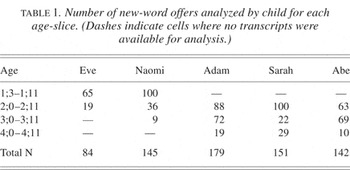
The new-word offers were distributed across the five children as shown in Table 1. Most of these offers, 68%, are drawn from exchanges when the children were under age three. For two of the five, all (Eve) or nearly all (Naomi, 94%) the exchanges analyzed were recorded before age three. For the other three children, about half the exchanges analyzed occurred between ages two and three, and the remainder mainly between three and four. For Sarah, the split was 66% to 34%; for Abe, 44% to 56%, and for Adam, 49% to 51%.
Number of new-word offers analyzed by child for each age-slice. (Dashes indicate cells where no transcripts were available for analysis.)

Overall, half the exchanges were initiated by the child and half by the adult, but the five children differed in how often they initiated such exchanges. Sarah and Adam initiated them 33% and 30% of the time respectively, while for Naomi the rate was 58%, for Abe 68%, and for Eve 60%. Typical child initiations began with questions like What's that? or That?, as in (8), while adult-initiated exchanges often began with D'you know what that is? or Do you remember what that is? as in (9):

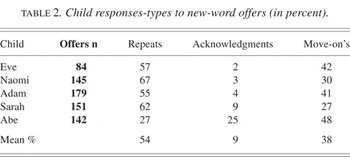
Children's responses to these offers took several forms. Table 2 summarizes the percentage of time that the child's immediately following turn, after the adult offer, included a repeat of the word offered, an acknowledgment (marked by use of uh-huh, yeah, yes, oh, etc.), or a relevant move-on that maintained the same topic in the subsequent exchange.
Child responses-types to new-word offers (in percent).

The children repeated the new word offered, either on its own or embedded in a longer utterance, 54% of the time. Four of the five children did this nearly 60% of the time on average, while the remaining child, Abe, did it just under one-third of the time. Their repeats of new words occurred equally often in exchanges initiated by the child and the adult, except for Abe, who was more likely to repeat the new word if the adult initiated the exchange (χ2(1) = 3.94, p < .05). (Abe repeated new words much less frequently than the other four children.)
The next commonest response was to move on with an utterance relevant to the current topic. The children did this 38% of the time overall. They also, on occasion, acknowledged the new word with forms like yeah (9% of the time on average). These acknowledgments sometimes occurred alone, and sometimes prefaced a relevant move-on. A few offers received no overt response – the children would simply change the topic or abandon the conversation altogether – but this was rare.
Repeats
On average, children repeated the new word offered 54% of the time, in their next turn. Naomi repeated new words most often, at 67%. Eve, Adam, and Sarah all repeated over 50% of the new words offered, but Abe did so for only 27% of them. While most child repeats (73%) consisted of just the new word on its own, as in (10), all five children repeated new words as parts of longer utterances as well, and did so more frequently as they got older, as shown in (11).

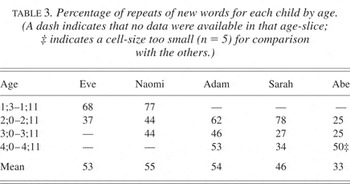
Adults offered new words as parts of larger utterances 81% of the time, overall, and as single words 19% of the time. Single-word repeats accounted for 70% of the five children's repeats of new words before age three. After age three, the number of isolated-word repeats dropped somewhat, to 58%, because the children now used the new word immediately as part of their next utterance, in the next turn, on many more occasions. The percentage of repeats in each child's data is given in Table 3. Three of the children – Eve, Naomi, and Sarah – showed a marked drop in the percentage of new words that they repeated as they got older. Eve went from 63% before age two to 36%; Naomi from 77% to 44% at age two and three; and Sarah from 78% at age two to around 30% at ages three and four. Adam also repeated new words slightly less often with age, going from 62% repeats of new words at two to around 50% at age three and four. Abe, who repeated new words less often than the other four children, offered repeats about 25% of the time at two and three, and at age four repeated 5 of the 10 new words analyzed. However, as Table 2 shows, there were many fewer new words identified by the criteria used here in the children's later transcripts.
Percentage of repeats of new words for each child by age. (A dash indicates that no data were available in that age-slice; [Dagger] indicates a cell-size too small (n = 5) for comparison with the others.)

What are children doing when they repeat a new word? With few exceptions, earlier research generally classified repeats as “imitations” and paid little or no attention to their role in conversation (but see Ochs 1977). A few researchers examined them for evidence that children imitated forms that they did not yet produce spontaneously. They proposed imitation as a mechanism for acquiring more advanced forms (e.g., Ervin 1964, Bloom et al. 1974, McTear 1978; see also Speidel & Nelson 1989). But while children often seemed to imitate words, they appeared not to imitate structures they didn't yet produce spontaneously. These and other studies also noted that children's imitations typically appeared in the very next turn after the adult said something (Bloom et al. 1974, Réger 1986, Strapp & Federico 2000). In short, most imitations were in fact immediate repeats of a term that had just been produced by the adult interlocutor.
In adult conversation, repetition can play many roles. It can assure the prior speaker that the current speaker is paying attention; it can mark the uptake of information just presented; it can ratify information; it can signal the addition of new information to common ground; it can mark the receipt of information, or joking, agreement, or skepticism about the truth or accuracy of a claim; it can request a repair, and so on (e.g., McTear 1985, Walker 1996, Merritt 1994, H. Clark 1996, Schegloff 1997, Svennevig 2004). In the present case, young children's repeats of new words appear to achieve two things simultaneously: (i) They acknowledge the adult proposal, and thereby show that they are attending to what the adult is saying; and (ii) by repeating, children ratify or accept that proposal. In addition, the repeats themselves mark children's first attempts to produce a new word, and hence the setting up of an initial articulatory program for the pronunciation of that word. Under this view, child repeats constitute strong evidence that children have detected and are attending to new words.
Adults followed up children's repeats just over one-third of the time (36%), and repeated in their turn, as shown in (12) and (13). When they did this, adults either repeated the word they had offered in their previous turn (84%) or acknowledged the child's repeat with forms like uh-huh, yeah, or yep (16%). Adult follow-up repeats appeared more often when children couldn't pronounce the new word very well, as in (12). But as children got older, any adult repeats were generally accompanied by additional information about the word meaning, as in (13), and, on occasion took the form of reformulations in side sequences (see Chouinard & Clark 2003).

By repeating a new word, children also ground it in the conversational exchange. That is, their ratification of the adult term effectively places that term, from now on, in common ground for current purposes (H. Clark 1996, Clark 2001). Repetition, then, is multifunctional, and even child uses exploit more than one function simultaneously. At the same time, repetition is just one of the devices in the adult repertoire for marking information as grounded. Others include assertions of understanding (e.g., nods, smiles, uses of uhhuh, mm, I see); presuppositions of understanding (typically, the initiation of the next turn as a signal of having understood so far); displays of understanding (for instance, answering a question, supplying further relevant information); and exemplifications of understanding (e.g., a paraphrase or a verbatim repeat, a grimace, a disappointed look, other iconic gestures).
Acknowledgments
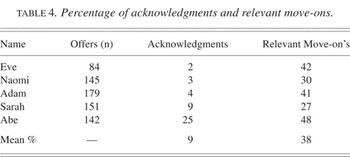
When children didn't repeat the word offered, they occasionally acknowledged the offer itself with yeah, yes, uh-huh, and, occasionally, oh. These, of course, are also assertions of understanding, and they appear to be used here to ground new terms offered by adult speakers. There was only one acknowledgment of this sort from Eve (the child for whom recording ended by age 2;2). Naomi, Adam, and Sarah all used such acknowledgments sparingly (in response to between 4% and 9% of adults offers), while Abe did so considerably more frequently – in response to 25% of the offers analyzed here. The children's uses of these acknowledgments in responses to new-word offers are summarized in Table 4.
Percentage of acknowledgments and relevant move-ons.

The commonest acknowledgment type was yeah (40%), followed by oh (22%), uh-huh (19%), yes (6%), and huh (5%). The remaining acknowledgments consisted of no, yup, a head nod, and one Well, that's what it is! after the adult had offered a label. The acknowledgments with yeah, yes, yup, and uh-huh all seemed to connote acceptance of the term offered; uses of oh may have marked slight surprise: this acknowledgment was usually produced on its own, not followed by anything else in that same turn. Huh appeared to mark acceptance with some slight reluctance on the child's part. These acknowledgments, like repeats, connote some overt acceptance of the term offered by the adult, and thereby show that the child is attending to the offer despite the absence of any attempt to actually produce the new word (see also Chouinard & Clark 2003). In one-third of these cases (32%), the children followed their acknowledgments with further information relevant to the current context, in the same turn.
Relevant move-ons
Table 4 also gives the percentages of relevant move-ons, turns where the child followed up on the topic at hand, but without either a repeat or an explicit acknowledgment of the adult offer. These move-ons typically allude to or presuppose the content of the new-word offer. On some occasions, this takes the form of a follow-up reference with a pronoun (usually he, him, it, or they) or demonstrative (usually that) to the entity denoted by the new word just offered. Uses of both pronouns and demonstratives on such occasions are also evidence that the child has registered what the new word was intended to refer to.
The children made use of pronouns or demonstratives in this way 24% of the time in their move-ons. Pronoun uses accounted for 56% of these references, and demonstratives 44%. Abe made the most frequent use of both, accounting for 48% of these uses overall. Eve and Naomi each contributed 9%, Adam 13%, and Sarah 22%. The example in (14), from Adam, using a pronoun in continuing to talk about the animals in a picture, is typical. (The new word in this exchange is yak.)

The children's move-ons continue the talk on the same topic, with references to the same semantic field (with use of other terms from the same domain, for example) or references pertinent to the general setting presented so far in the conversational exchange, as shown in (15), where the new term offered was mailing tube, tacitly accepted by Eve, who follows up by talking about where she found it:

In the exchange in (16), where the new term is lipstick, Adam persists in wanting to use one he's found:

In (17), Abe tacitly accepts the term orchards, and then contrasts it with our garden:

And in (18), Sarah follows up on nest, the new word offered, with a relevant question, but without referring directly to the nest itself:

When children move on in this way with their next turn, continuing to talk about the same domain, they display adult-like acceptance of the topic introduced by the new word even though they do not make immediate use of the word itself. Effectively, such move-ons signal some degree of tacit acceptance of the new words offered by adults.
Summary
When children repeat, acknowledge, or produce a relevant move-on, they are giving evidence that they are attending to and have accepted, to some degree, the new words on offer. These responses to adult offers of new words also function to ground the new information conveyed by that word within each exchange. That is, uptake and grounding in these contexts represent two faces of the same coin. In order to ground new information, the speaker must provide evidence of having noticed it in some way, by asserting, presupposing, or displaying acceptance of the information added by the prior speaker. Moreover, in grounding a new word, children must make some inferences (albeit preliminary ones) about what that word is likely to mean in the current context. This is where joint attention and physical co-presence, combined with conversational co-presence, play a critical role (e.g., Tomasello & Farrar 1986, Akhtar, Dunham, & Dunham 1991, Clark 2001, Tomasello & Haberl 2003): They converge on a specific locus for adult and child attention – the intended referent of the new word.
Preliminary inferences about possible meanings for new words instantiate so-called fast mapping, the first assignment of some meaning to a new word (Carey & Bartlett 1978, Dockrell 1981, Heibeck & Markman 1987; see also Clark 2002). Overall, the five children studied here offered strong evidence of attending to new words they were offered. They repeated these words in their next turns, alone or embedded in a larger utterance, 54% of the time. They acknowledged new words without repeats a further 9% of the time, and they provided semantically and referentially relevant move-ons 38% of the time.
From new to given: Repetitions in conversation
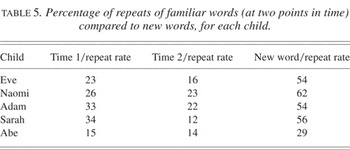
How do children's rates of repetition for new words compare to their rates for known words? To measure this, I used two samples, one from an early and one from a late transcript, for each child. In each sample, I looked at all child turns that immediately followed an adult utterance and compared the rates of lexical repetitions in these child utterances to their rates of repetition for new words. These repetition rates – early (Time 1) vs. late (Time 2) in each child's transcript, alongside the rates for new words – are shown in Table 5. All the children made repetitions in conversation, picking up on words and phrases just uttered by the adult speaker, and so treating them as “given.” These constituted information that was now in common ground. On average, the five children repeated adult words or phrases 22% of the time, with a range of 14% to 34% across the 10 samples.
Percentage of repeats of familiar words (at two points in time) compared to new words, for each child.

The five children differed somewhat in how much they repeated words and phrases as they shifted new information to given in conversation. With the exception of Naomi, they repeated less often as they got older, as shown by the percentages in Table 5. (The percentages for Eve were based on 145 and 163 data points, for Naomi on 136 and 66, for Abe on 107 and 86, for Adam on 64 and 119, and for Sarah on 150 and 136.) For all the children except Abe, the counts of conversational repeats were taken from samples of 200 child utterances at Time 1 (the age of the earliest new-word offer identified) and Time 2 (the age of the last new-word offers). For Abe, the samples were smaller, with 118 utterances analyzed at 2;4 and 100 at 4;11.
Notice that the repeat-rate exhibited in conversation, at both Time 1 and Time 2, is approximately half the repeat-rate the children used for new words. For three of them, Eve, Adam, and Sarah, there was a drop in the amount of repetition in conversation as they got older, but Naomi and Abe showed no change. Comparison of the repeat-rates in conversation and the repeat-rates for new words showed highly significant differences for all five children. They consistently repeated new words at a much higher rate than they did familiar material from preceding adult utterances. This held for both Time 1 and Time 2, with all p's less than 0.01: for Naomi at Time 1, X2 (1) = 37.32, and at Time 2, X2 (1) = 27.85; for Eve at Time 1, X2 (1) = 24.13, and at Time 2, X2 (1) = 40.81; for Adam at Time 1, X2 (1) = 8.98, and at Time 2, X2 (1) = 32.80; for Abe at Time 1, X2 (1) = 32.03, and at Time 2, X2 (1) = 6.79; and for Sarah at Time 1, X2 (1) = 16.14, and at Time 2, X2 (1) = 65.23. All five children, then, made significantly more use of repetition when they heard an unfamiliar word than when they were taking up new information from the adult's preceding utterance in an exchange.
Their reliance on differential rates of repetition suggests that the function filled by repetition in the two cases is in fact different. When participants in a conversation repeat a familiar word or phrase in linking their current utterance to the one that immediately preceded it, they typically mark what had been new information as given and go on from there. But when they repeat a new word that is unfamiliar to them, this repeat signals rather that they have noticed the word and are ratifying its use by the adult for whatever object or event is in joint attention at that instant. These ratifications simultaneously place the new word into common ground.
Additional evidence for this interpretation is the preferred intonation contour on children's repeats. On average, they used a falling contour on their repeats 81% of the time. Eve relied on this intonation 98% of the time, Naomi 92%, Adam 78%, Sarah 71%, and Abe 68%. Note that falling intonation, in one of its functions, marks the receipt of what the preceding speaker has just said (Schegloff 1997:527). The rest of the children's repeats employed a rising intonation, but these can be divided into rises on single words and rises on questions where the questions included the new word. These uses therefore also presuppose that the new word is the relevant term for the entity under discussion. Adam's repeats, for example, included such questions 16% of the time, and Abe's did so 25% of the time, Sarah's 6%, Naomi's 3%, and Eve's 2%. Overall, the dominance of falling intonation supports the notice-and-ratify interpretation of children's repeats.
Summary
Children repeat new words unfamiliar to them about twice as often as they repeat information from a preceding adult utterance in the ordinary course of conversation. This finding supports the hypothesis that the function of repetition with new information differs from the function of repetition with new words. With the latter, repetition of a word new to the child simultaneously signals that the child has noticed the word, registered that it is new, and is ratifying that word as one to use on such an occasion.
DISCUSSION
The findings show that young children pay attention to new words. One cue for children may well be adults' propensity to rely on fixed frames, typically introduced by a deictic like this or that, when they offer new words, as in That is a walrus. Children, for their part, signal their attention to new words by repeating the words in their next utterance, by acknowledging them, and by presupposing them in their move-ons. And they repeat new words at a much higher rate (roughly double) than they do familiar ones in the course of conversation.
Uptake in conversation
Unlike adults, when children take up new words, they must start at the beginning and assign some meaning to the word. Knowledge of the meaning cannot be taken for granted, so direct offers of new words like those analyzed here allow one to observe how children take up new words in the course of conversation. There appear to be at least four steps involved. First, children must assign some preliminary meaning to the new word on this occasion. This typically requires that they map the word to the intended referent – an object, action, event, or relation, say – in the locus of attention shared with the adult speaker on that occasion. This initial identification of the probable referent is equivalent to what has been called “fast mapping” (e.g., Carey & Bartlett 1978, Dockrell 1981, Heibeck & Markman 1987). For this, children should draw on information provided by the context of the utterance plus any syntactic information about part of speech – say, whether the new word is a noun, verb, or adjective (see Brown 1957, Dockrell & McShane 1990, Gleitman 1990, Hall, Lee, & Bélanger 2001).
The second step is for children to make a first round of inferences about any near neighbors of the new word. They need to relate it to other words they already know for objects or actions in the same domain or in domains that are close by. For example, if they already know something about words like robin, duck, and chicken, they need to be able to place a new word like owl or swan with those they already know, as members of the same semantic and conceptual domain. Adults may encourage this by bringing up other terms from the same semantic field as they try to link new terms to familiar ones (e.g., Rogers 1978, Masur & Gleason 1980, Shipley & Kuhn 1983, Adams & Bullock 1986). This applies as much to adult talk about activities (opening, breaking, cutting) as about objects (birds, vehicles, tools) as they talk to children about the relevant semantic fields and relations (e.g., Pye, Loeb, & Pao 1995, Wilkins 2002, Bowerman 2005, Clark 2005b).
The third step is to identify properties that allow them to distinguish among sets of near neighbors in a domain, and so begin to catalogue differences between swans and ducks, say, or chickens and owls. Identifying distinguishing factors will help children maintain the contrasts carried by different words within a single domain. Notice that children start by grouping things by their apparent membership in the same conceptual domain, where they rely on similarities among properties and functions, say, or in the same semantic domain, where they may know only that a word is being used alongside others that are already familiar. Conceptual vs. semantic assignments can differ (e.g., Malt, Sloman, Gennari, Shi, & Wang 1999, Malt, Sloman, & Gennari 2003). However, distinguishing features among near neighbors help children maintain contrasts among the meanings of different words (e.g., Waxman, Shipley, & Shepperson 1991, Diesendruck & Shatz 1997, Clark 2002).
The fourth step in uptake is to add any information about the relations linking a new word to other words already known. The new word could be a subordinate or a superordinate of a familiar term, with the relation in either case being one of set or class membership. This information is typically conveyed by adult utterances containing links like …is a… or …is a kind of… in fairly fixed frames (e.g., Shipley, Kuhn, & Madden 1983; Callanan 1989, 1991; Clark 1998; Clark & Wong 2002). Other relations that adults offer explicit information on include parts (…is part of…), properties (…has…, …is made of…), and functions (…is for…, …is used for …) (Clark 2002, 2005a). Children as young as two years old make use of such links to relate new words they have been taught (e.g., Waxman & Senghas 1992, Clark & Grossman 1998). These links also allow children to establish different conceptual perspectives on the same entity or event. By choosing different terms for the same referent, speakers can present it to their addressees from different perspectives (e.g., Schober 1993, Brennan 1996, Clark 1997, Callanan & Sabbagh 2004), and young children appear to grasp this possibility in language at an early age (e.g., Clark & Svaib 1997, Clark & Grossman 1998, Deák & Maratsos 1998).
These steps characterize the mental process of assigning a plausible meaning, in context, to a new word. While they have been validated in a variety of experimental and observational studies, however, they do not capture what children do with new words as they pursue a conversational exchange. How do children respond to adult offers? What overt evidence do they present of taking up a new word explicitly or implicitly in the next turn?
First, children provide explicit evidence that they have noticed a new word. They repeat it in their next turn. They do this frequently (although not always correctly), using the new word either on its own or incorporated into a longer phrase or construction. These repeats have at least two functions here: They signal that the child has noticed the new word, and they signal a ratification or confirmation that this is the word for the entity or action in the current locus of joint attention. This ratification allows the adult to pursue the conversation, knowing that the child has registered the new word as relevant to what is being talked about. Repeats also show that children are trying to establish for themselves the phonological form of the new word as well as identifying its likely referent on that occasion. This, of course, is central to children's initial fast mapping of plausible meanings in context. Repeats constitute demonstrations of understanding that the new term is relevant at that point in the exchange (Clark & Schaefer 1989).
On other occasions, though, children provide only implicit evidence of having noticed and taken in the new word. In their next turn, they simply acknowledge the adult's prior utterance with uh-huh, mm, or yeah, or they simply move on in the conversation with a further contribution on the same topic. Acknowledgments are sometimes the preface to a move-on in the same turn. In order to move on appropriately, children must tacitly relate the new word to other terms that are already familiar, near neighbors in the same semantic field. This strongly suggests that children have registered the new word and a likely meaning, which then allows them to link it to an appropriate domain. In adult–adult conversations, move-ons typically presuppose the preceding turn and are taken to indicate understanding. In children, however, it is harder to be sure that move-ons signal that they have registered the new word per se. Observational analyses will need to be supplemented experimentally before such evidence can be fully evaluated.
Indirect offers
Adults offer only a small proportion of new words explicitly. Most of the time, they simply use new words in the flow of conversation, probably without much attention to whether children know the words or not, although they probably monitor for signs of comprehension or incomprehension during an exchange (see Goodwin 1981, H. Clark 1996, Schegloff 1997). At the same time, adult–child exchanges in conversation all depend on joint attention along with the physical co-presence of the intended referent and the conversational co-presence of other words already familiar to the child. What do children need under these circumstances to supplement their initial inference about a possible meaning for a new word?
Although the word-offer itself is not direct, I would argue that uptake here involves the same steps as when children hear direct offers of new words:
(a) If possible, identify the intended referent of the unfamiliar word, X, on this occasion, and the domain it belongs to.
(b) Identify any other (known) terms from that same domain.
(c) Find some point(s) of contrast for X with any familiar terms.
(d) Relate X to those familiar terms in whatever way(s) possible.
In short, the process of uptake should be the same for both direct and indirect offers of new words within conversational exchanges. However, unlike with direct offers, where the next steps in the conversational exchange allow inferences about what children have taken up (Clark 2002), indirect offers provide no overt clues to children's progress in uptake nor to any initial uses of the word in question. These are words that are taken up covertly and emerge in children's usage on some later occasion, apparently already established from the adult usage children have been exposed to along the way.
Children learn new words from both direct and indirect offers in conversation. With direct offers, one can track many of the steps as children take up new words and first use them. Findings from direct offers, therefore, offer us important insights into how children take up indirect offers as well.
The role of repetition
The role of repetition here is one of a larger set of uses found in conversation. For example, in adult–child exchanges, adults continually check up on whether they have understood what the child is trying to say (e.g., Brown & Bellugi 1964, Ochs 1977). In fact, they check up significantly more often when the child has made an error (Chouinard & Clark 2003). When they check, they typically do so by reformulating in conventional form what the child appeared to mean. Take an exchange observed by Ochs (1977:134–35, from example 134), where the adult Jill (the nanny) initially misunderstands one of the twin boys she has been making a picture with:

Exchanges like this, where the adult checks on the child's intended meaning (here Toby's failure to produce a recognizable version of room), are particularly common before age three to three and a half. In such exchanges, the adult is the one who repeats (with corrections) what the child seems to have intended. Some of the time children follow up, immediately after the adult check, by repeating the corrected element, underlined, in their next turn (Chouinard & Clark 2003: 656), as illustrated in (20) and (21):

Although children do repeat such corrections and give other evidence of attending to them, their repeat rate when adults offer them unfamiliar words, as in the exchanges analyzed here, is much higher. In these cases, the child consistently repeats part of the adult's immediately preceding utterance and does so with a falling, confirmatory intonation. Adult repeats in reformulations that check on child meanings, though, are nearly always produced with rising intonation. The consistent difference in intonation supports the interpretation that children's new-word repeats differ in function from adult repeats that check on and repair children's intentions.
The acquisition of meanings is gradual
The first step in uptake may be all children achieve for some time – an initial mapping for the meaning of a new word. And it may only be the acquisition of further terms in the same domain that provokes any addition to the partial meaning that is all they have established so far. That is, when forced to find ways to keep more terms distinct from one another, children necessarily add to the meanings of each one already stored in memory.
At the same time, this suggests that children (like adults) may be able to get away with partial meanings for some time. They need just enough overlap with the conventional adult meaning to make communication feasible on most occasions. But as their vocabulary becomes more extensive, and as they are exposed to more words, they will have to elaborate their preliminary meanings in order to keep them distinct from one another. This in turn will require that they store more information about the uses they observe in adult speech and about the kinds of relations that link less familiar words to more familiar ones.
Even adults often stick with partial meanings only. Consider how much many adults know about words for trees like bay, alder, hornbeam, rowan, or gingko. How many of us can identify the leaves, bark, fruit, or the tree itself for each of these? Most adults in fact know simply that each of these is a kind of tree. That's all. Or take tools: Again, we may know that awl, adze, chisel, gouge, plane, mattock, and trowel are tools, but nothing else. Birds present the same challenge. We often know nothing beyond the fact that the terms black-cap, bullfinch, bushtit, cardinal, crossbill, grosbeak, osprey, and waxwing denote kinds of birds. And for many everyday purposes, this is enough (Clark 2005b). This suggests that speakers may not need to share every detail of a word meaning to communicate effectively with someone else. They need just enough overlap with their conversational partner in what they have represented for word X for their communicative goals on that occasion.
Speakers do not invariably build up enough of the meaning for many terms, over time, in the process of uptake, to have extensive shared knowledge of the meanings conventional for experts in their speech community. Rather, they acquire enough of the meanings to be able to communicate effectively on most occasions. Children start taking up meanings for words very early, and during their first few years they probably have only partial meanings for nearly all of them. For many words, they will proceed through all the steps in the process of uptake and even continue adding to the connections within some semantic domains throughout their life. To do this, they need to observe how the words are used by other speakers, on many different occasions. For many other words, they will stop far short of full mastery and never in fact try to achieve it. As speakers, though, we all master enough of the conventional meanings of everyday terms to be able to understand one another.
CONCLUSION
In this article I have explored one of the first steps in the uptake of new words in conversation. This step requires that children attend to new words. With direct offers, they give evidence of their attention, I have argued, in their repetitions of the words offered. These repetitions signal both attention to and ratification of the adult offers on each occasion. The next step is to explore which further inferences children make use of as they learn more about each word they store while they gradually build up to more adult-like representations for use.