Introduction
Suicide rates have climbed 35% in the U.S. general population over the last 20 years (Hedegaard, Curtin, & Warner, Reference Hedegaard, Curtin and Warner2020), even with the implementation of national goals to reverse this pattern (U.S. Department of Health and Human Services, 2010). Rates of suicide in U.S. military veterans have increased even more rapidly, and now exceed those of civilian populations by 41–60% (Kang et al., Reference Kang, Bullman, Smolenski, Skopp, Gahm and Reger2015), accounting for 13.5% of total U.S. suicides (U.S. Department of Veterans Affairs, 2019). These worrying trends persist despite a substantial scientific literature identifying risk factors for suicidal ideation (SI) and future suicidal behavior (Franklin et al., Reference Franklin, Ribeiro, Fox, Bentley, Kleiman, Huang and Nock2017; Nock et al., Reference Nock, Deming, Fullerton, Gilman, Goldenberg, Kessler and Schoenbaum2013). One challenge to suicide prevention is the heterogeneity in long-term courses of SI. More specifically, SI may not always take a stable longitudinal course (Witte, Fitzpatrick, Warren, Schatschneider, & Schmidt, Reference Witte, Fitzpatrick, Warren, Schatschneider and Schmidt2006) but rather might intensify or remit over time, or fluctuate in response to changing circumstances (Allan, Gros, Lancaster, Saulnier, & Stecker, Reference Allan, Gros, Lancaster, Saulnier and Stecker2019). Variability in long-term patterns in SI might therefore be associated with unique constellations of risk factors and clinical presentations (Smith et al., Reference Smith, Mota, Tsai, Monteith, Harpaz-Rotem, Southwick and Pietrzak2016), thereby complicating the task of establishing descriptive profiles of SI risk to inform clinical interventions. The current study sought to characterize common courses of SI over a 7-year period and assess their relationship to a range of risk and protective correlates associated with SI and behavior.
Although the majority of those who experience SI do not go on to attempt or complete suicide (Nock et al., Reference Nock, Borges, Bromet, Cha, Kessler and Lee2008), SI is the single-most common factor in attempted suicide (Baca-Garcia et al., Reference Baca-Garcia, Perez-Rodriguez, Oquendo, Keyes, Hasin, Grant and Blanco2011), much more so than prior suicidal behavior (Pagura, Cox, Sareen, & Enns, Reference Pagura, Cox, Sareen and Enns2008). Moreover, the presence of SI is an indicator of severe distress (Have et al., Reference Have, de Graaf, Van Dorsselaer, Verdurmen, van't Land, Vollebergh and Beekman2009), and markedly increases likelihood of risk-taking behaviors, psychopathology, and non-suicidal self-injury (Nock et al., Reference Nock, Borges, Bromet, Alonso, Angermeyer, Beautrais and Gluzman2008; Witte et al., Reference Witte, Fitzpatrick, Warren, Schatschneider and Schmidt2006), as well as eventual suicide (Franklin et al., Reference Franklin, Ribeiro, Fox, Bentley, Kleiman, Huang and Nock2017). Epidemiological frameworks (Mościcki, Reference Mościcki1997) characterize suicide as the outcome of multiple interacting risk factors, both proximal (e.g. stressful life events, interpersonal losses, health deterioration, and physical pain) and distal [e.g. mental illness, prior suicide attempts (SAs), and childhood trauma exposure], as well as protective (e.g. adaptive coping, spirituality, and social support). Of note, many of these risk and protective factors are potentially modifiable, particularly those related to mental health, such as depression and posttraumatic stress disorder (PTSD), anxiety disorders, alcohol and substance use (Fuehrlein et al., Reference Fuehrlein, Mota, Arias, Trevisan, Kachadourian, Krystal and Pietrzak2016; Pietrzak et al., Reference Pietrzak, Goldstein, Malley, Rivers, Johnson and Southwick2010; Sareen et al., Reference Sareen, Cox, Afifi, de Graaf, Asmundson, Ten Have and Stein2005), impaired executive functioning (Bomyea, Stout, & Simmons, Reference Bomyea, Stout and Simmons2019), and engagement with mental healthcare. Historical risk factors such as prior SA (Franklin et al., Reference Franklin, Ribeiro, Fox, Bentley, Kleiman, Huang and Nock2017), childhood trauma (Bruffaerts et al., Reference Bruffaerts, Demyttenaere, Borges, Haro, Chiu, Hwang and Alonso2010), and combat trauma (Maguen et al., Reference Maguen, Metzler, Bosch, Marmar, Knight and Neylan2012), as well as age-related factors such as disability (Pietrzak, Pitts, Harpaz-Rotem, Southwick, & Whealin, Reference Pietrzak, Pitts, Harpaz-Rotem, Southwick and Whealin2017) and chronic health difficulties (Fanning & Pietrzak, Reference Fanning and Pietrzak2013), may be additionally informative for suicide risk prediction and monitoring. However, despite recommendations to account for the complex interplay between risk and protective factors to understand vulnerability and resilience to SI and behavior (Mościcki, Reference Mościcki1997, Reference Mościcki2001), few studies examine how these factors are related to varying long-term trends in SI.
To date, only a handful of studies have examined longitudinal courses of SI in military and veteran populations, and these studies have demonstrated considerable fluctuation in SI over time. Using latent growth mixture modeling (LGMM), Allan et al. (Reference Allan, Gros, Lancaster, Saulnier and Stecker2019) identified four distinct courses of SI in military servicemen over 12 months: stable-low, stable-moderate, stable-high, and rapidly declining-high SI. The moderate- and high-stable SI groups demonstrated the greatest likelihood of SA at follow-up, indicating that the course and stability of SI are not homogenous over time and may be important indicators of risk. Additionally, in large national veteran sample, only 35.0% of veterans who reported lifetime SI at baseline also reported SI over the subsequent 10 years (Borges, Angst, Nock, Ruscio, & Kessler, Reference Borges, Angst, Nock, Ruscio and Kessler2008), and 6.2% of veterans without prior SI/SA at baseline reported new onset SI during the follow-up period. Using LGMM, Wang et al. (Reference Wang, Ursano, Gonzalez, Russell, Dinh, Hernandez and Galea2018) identified four longitudinal trajectories of SI in U.S. Reserve soldiers over 4 years – resilient, chronic, remitted, and new onset SI. A similar grouping method was used in a study of broadly-sampled U.S. veterans (Smith et al., Reference Smith, Mota, Tsai, Monteith, Harpaz-Rotem, Southwick and Pietrzak2016), wherein approximately 14% endorsed SI at baseline or after a 2-year follow-up period (8.7% and 9.9% at baseline and 2-years, respectively), and roughly half of SI cases at follow-up had new onset SI.
Although the aforementioned studies suggest heterogeneity in the long-term course of SI, few have examined risk and protective factors that are linked to SI courses, with the exception of Smith et al. (Reference Smith, Mota, Tsai, Monteith, Harpaz-Rotem, Southwick and Pietrzak2016). This study assessed the relative likelihood of a range of baseline risk and protective correlates of suicidal thoughts and behavior in predicting varying patterns of SI over 2 years. Results revealed that greater psychiatric distress was related to reporting SI at any time point (i.e. baseline or follow-up), while physical health difficulties were associated with chronic SI and new onset SI. Furthermore, adaptive psychosocial traits and attitudes (e.g. resilience and gratitude) were associated with a lower likelihood of new onset SI. Other studies have examined SI courses in relation to a narrow range of potential risk factors, mostly limited to PTSD (Madsen, Karstoft, Bertelsen, & Andersen, Reference Madsen, Karstoft, Bertelsen and Andersen2014; Zerach, Levi-Belz, & Solomon, Reference Zerach, Levi-Belz and Solomon2014). Thus, further research is needed to longitudinally characterize the nature of longer-term courses of SI (i.e. >3 years) and their associated risk and protective factors, in representative population-based samples of individuals at high risk for suicide, such as veterans. Such data can provide a more granular characterization of long-term suicide risk profiles, potentially identifying those at greater risk for transitioning from SI to attempt (Allan et al., Reference Allan, Gros, Lancaster, Saulnier and Stecker2019).
Toward this end, the current study aimed to build on prior literature by longitudinally following a large national sample of U.S. veterans over the course of four timepoints spanning 7 years and assessing a wide range of risk and protective factors associated with SI. Specifically, we aimed to: (1) characterize the prevalence of common courses of SI over a 7-year period; and (2) examine sociodemographic, military, trauma, health, and psychosocial factors associated with these courses.
Method
Sample recruitment
A national probability sample of U.S. military veterans were drawn from the 2011–2018 cohort of the National Health and Resilience in Veterans Study (NHRVS), a prospective cohort study of veterans aged 21 and older. A total of 2291 veterans completed the baseline assessment and at least one follow-up over a 7-year period, with assessments at baseline, and 2-, 4-, and 7-year follow-ups. The NHRVS sample was drawn from KnowledgePanel®, a probability-based, online non-volunteer survey panel of more than 50 000 U.S. households that is maintained by research firm GfK Knowledge Networks, Inc. (now Ipsos). To participate, individuals have to be randomly selected and invited, and KnowledgePanel therefore differs from most online panels (often called opt-in or consumer access panels) where participants volunteer or opt into studies.
Significant resources and infrastructure are devoted to KnowledgePanel's recruitment process so that it can accurately represent the adult population of the United States. Ipsos' recruitment process employs an address-based sampling methodology using the latest Delivery Sequence File, a database with all U.S. delivery point addresses serviced by the USPS, and they provide web-enabled tablets and free internet service to households without internet access. KnowledgePanel samples therefore cover all households regardless of their phone or internet status in effort to provide broadly representative online samples to the research community. To permit generalizability of study results to the entire population of U.S. veterans, post-stratification weights were applied (described by Fuehrlein et al., Reference Fuehrlein, Mota, Arias, Trevisan, Kachadourian, Krystal and Pietrzak2016) based on demographic distributions (e.g. age, gender, race/ethnicity, education, region, and metropolitan area) from the U.S. Census Bureau Current Population Survey (U.S. Census Bureau, 2011). All participants provided informed consent and the study was approved by the Human Subjects Subcommittee of the VA Connecticut Healthcare System.
The full panel recruitment rate in 2011 was 15.9% and the household profile rate was 62.3%, yielding a response rate of 9.9%. Of the 4750 veterans in the panel, 3188 participated in the baseline survey (67.1% participation rate). The final sample consisted of 2291 veterans who completed the baseline assessment and at least one follow-up over the course of 7 years. Follow-up assessments were conducted 2 (2013), 4 (2015), and 7 years (2018) after baseline. Veterans completed an average of 2.2 follow-ups (s.d. = 0.8, range = 1–3); 41.8% completed all three follow-ups, 31.1% completed two follow-ups, and 27.1% completed one follow-up. There were no significant differences in the number of completed follow-ups across groups (all pairwise contrasts p's >0.48). The average age of the sample at baseline was 61.5 (s.d. = 14.2, range = 22–93); most were male (91.5%), White/Caucasian (77.1%), and married/partnered (74.9%), with a minimum of some college or higher education (68.5%) and a yearly household income of less than $60 000 (53.8%). Veterans reported an average of 7.1 years in military service (s.d. = 7.7, range = 1–42), and most were non-combat veterans (67.3%).
Assessments
Sociodemographic and military variables
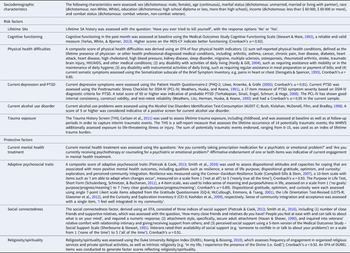
Table 1 describes measures used to assess sociodemographic and military characteristics.
Sociodemographic characteristics and risk and protective factors

Suicidal ideation
Current SI was assessed at baseline and all follow-up periods with two items adapted from the Patient Health Questionnaire-9 (PHQ-9; Kroenke, Spitzer, and Williams, Reference Kroenke, Spitzer and Williams2001) that assess the frequency with which veterans experienced thoughts of being better off dead (i.e. passive SI) or of hurting themselves (active SI) in the 2 weeks prior to assessment. Response options ranged from 0 (‘not at all’) to 3 (‘nearly every day’), and responses of 1 (‘several days’) or higher were coded positive for the presence of SI.
Groups were stratified on the basis of SI endorsement during the 2 weeks prior to assessments at baseline and follow-up periods. Follow-up data were aggregated into a single timepoint to provide a stable and more statistically powered indication of the incidence or absence of SI over the follow-up period. Veterans who denied SI at baseline and all completed follow-up assessments were classified as ‘no SI’, while those who endorsed SI at baseline but denied SI at all completed follow-ups were classified as ‘remitted SI’. Veterans who denied SI at baseline but endorsed SI at any completed follow-up were classified as ‘new onset SI’, while veterans who endorsed SI at baseline and any completed follow-up were classified as ‘chronic SI’.
Risk and protective correlates
To minimize multicollinearity in multivariable analyses, exploratory factor analyses (EFAs) were conducted to reduce highly correlated, thematically related variables into factors. The following risk factors were assessed at baseline: lifetime SA, cognitive functioning, physical health difficulties (e.g. disability, medical diagnoses, and somatic symptoms), current depression [major depressive disorder (MDD)] and/or PTSD, current alcohol use disorder, and childhood and lifetime trauma exposure. Interim potentially traumatic events were also assessed at each follow-up assessment. The following protective correlates were examined at baseline: current mental health treatment, adaptive psychosocial traits (e.g. trait curiosity, resilience, and dispositional gratitude); social connectedness (e.g. supportive relationships, perceived support, and secure attachment style); and religiosity/spirituality. Table 1 provides a full description of component measures and assessment instruments of each of these measures.
Data analysis
One-way analyses of variance (ANOVA) and χ2 analyses were conducted to compare sociodemographic and military characteristics, and baseline risk and protective factors, by the SI group variable. Post-hoc group comparisons were conducted with Fisher's least significant difference test and pairwise χ2 tests. Variables that differed by SI group status at the p < 0.05 level in bivariate analyses were entered into a subsequent multinomial logistic regression examining differences in demographic, risk, and protective factors between those who endorsed SI at either baseline or follow-up compared to the no-SI reference group. The remitted and chronic SI groups were also compared. Finally, post-hoc analyses were conducted to identify component variables of composite factors that significantly differed by group in the multinominal regression.
Results
Sample characteristics
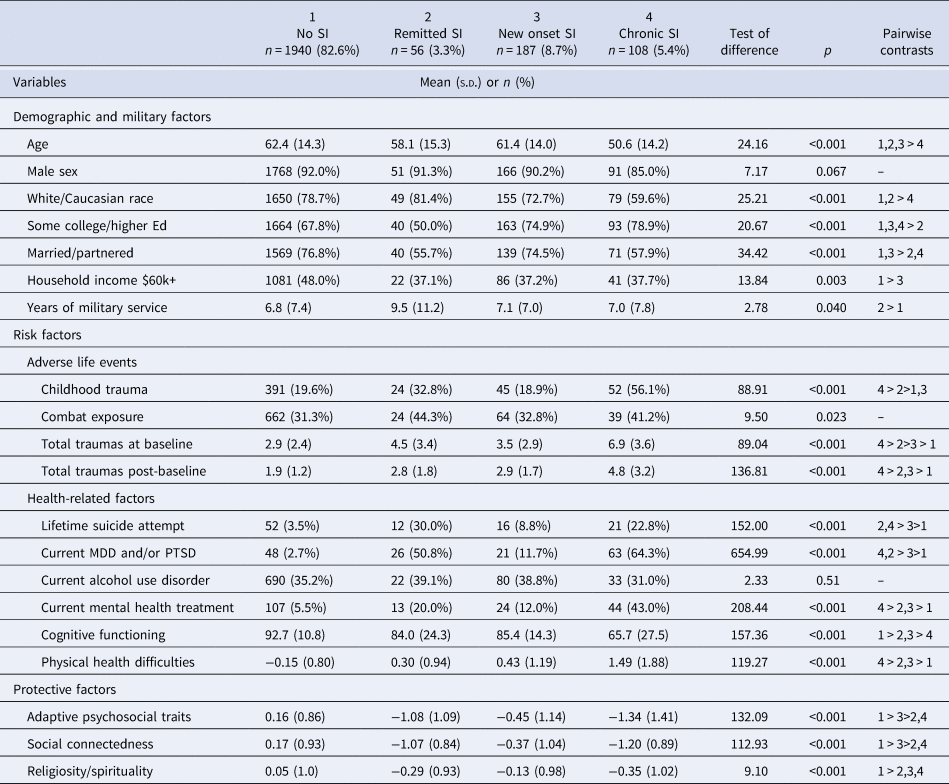
The majority of the sample, 1940 veterans (82.6%), denied SI at baseline and all follow-up assessments (i.e. ‘no SI’), while 187 veterans (8.7%) denied SI at baseline but endorsed SI on at least one of three subsequent assessments (i.e. ‘new onset SI’). Another 108 veterans (5.4%) were classified as ‘chronic SI’, having endorsed SI at baseline and on any of three follow-up assessment, and 56 veterans (3.3%) endorsed SI at baseline but denied SI at all follow-up assessments and were classified as ‘remitted SI’.
One-way ANOVA and χ2 analyses indicated that age, race, partnered status, education, income, combat veteran status, and years of military service differed significantly by SI group; these variables were therefore included as covariates in the multinomial regression analysis. Table 2 lists comparisons of sociodemographic and military characteristics by group, and group differences in risk and protective factors. Overall, the no-SI group was more likely than other groups to be older, White, and partnered, with higher income and educational attainment, and fewer years of military service. The chronic SI group was more likely than other groups to be younger, non-White, and not partnered. Prevalence of prior SA differed significantly by group, ranging from 3.5% in the no-SI group to 30.0% for remitted SI. Table 3 shows results of the multivariable analysis summarized below.
Sociodemographic, military, trauma, and clinical characteristics by SI status

SI, suicidal ideation; MDD, major depressive disorder; PTSD, posttraumatic stress disorder.
Results of multinomial logistic regression analysis predicting incident SI status

SI, suicidal ideation; MDD, major depressive disorder; PTSD, posttraumatic stress disorder; 95% CI, 95% confidence interval.
Bold font indicates significant RRR: ***<0.001 level; **<0.01 level; *<0.05 level; †<0.10 level.
Predictors of remitted SI compared to no SI
The remitted SI group was the only group more likely than the no-SI group to report a prior SA. They were also nearly eight times more likely than the no-SI group to report current MDD/PTSD. Additionally, the remitted SI group scored lower than the no-SI group on measures of adaptive psychosocial traits and social connectedness. Specifically, post-hoc tests indicated that the remitted group scored lower on trait curiosity/exploration [relative risk ratio (RRR) = 0.74, 95% confidence interval (CI) 0.57–0.96, p = 0.025] and were less likely to endorse having a secure attachment style (RRR = 0.21, 95% CI 0.10–0.45, p < 0.001).
Predictors of new-onset SI compared to no SI
The new onset SI group scored higher than the no-SI group on a measure of physical health difficulties, and post-hoc tests indicated that this association was driven by greater likelihood of endorsing disability with instrumental activities, RRR = 2.49, 95% CI 1.53–4.03, p < 0.001. They also experienced more potentially traumatic events between baseline and follow-up assessments. The new onset SI also scored lower on a measure of adaptive psychosocial traits, which was driven by lower scores on measures of purpose in life (RRR = 0.93, 95% CI 0.89–0.98, p = 0.004) and trait curiosity/exploration (RRR = 0.85, 95% CI 0.72–0.99, p = 0.040); they also scored lower on a measure of social connectedness, which was driven by lower scores on measures of structural and perceived support (RRR = 0.96, 95% CI 0.93–0.99, p = 0.021 and RRR = 0.95, 95% CI 0.91– 0.99, p = 0.013, respectively).
Predictors of chronic SI compared to no-SI
The chronic SI group scored significantly higher than the no-SI group on a measure of physical difficulties, which was driven by greater likelihood of endorsing a disability with instrumental activities (RRR = 2.08, 95% CI 1.08–4.00, p = 0.029) and higher scores on a measure of somatic symptoms (RRR = 1.10, 95% CI 1.03–1.17, p = 0.003). They were more than five times more likely to screen positive for current MDD/PTSD. Chronic SI was the only group more likely than the no-SI group to report childhood trauma exposure and to have received mental health treatment. Experiencing a greater number of interim potentially traumatic events was also associated with chronic SI. The chronic SI group also scored lower on measures of adaptive psychosocial traits and social connectedness, which were driven by lower scores on dispositional optimism (RRR = 0.70, 95% CI 0.57–0.86, p = 0.001) and perceived social support (RRR = 0.89, 95% CI 0.84–0.95, p < 0.001), respectively.
Predictors of remitted SI compared to chronic SI
Compared to the chronic SI group, those with remitted SI were more likely to be younger and have lower educational attainment. The remitted SI was associated with a nearly five times greater likelihood of a prior SA compared to the chronic SI group. They also scored lower on a measure of physical health difficulties, although none of the component variables of this factor were significant after adjustment for multiple comparisons. The remitted SI group was less likely than those with chronic SI to be engaged in mental health treatment but did not differ on other protective factors.
SI and SA during the follow-up period
We analyzed the likelihood of reporting SI in the chronic and new onset groups to further differentiate them. In the chronic SI group, 91.3% reported SI at wave 2, 71.0% at wave 3, and 76.8% at wave 4; with an 80% average probability of SI across follow-up assessments. In the new onset SI group, the average probability of SI at any follow-up was 55%; 58.7% at wave 2, 48.1% at wave 3, and 59.4% at wave 4.
We also examined the incidence of post-baseline SA in these groups. The chronic group had a 17.5% incidence of attempted suicide over the 7-year follow-up period, which was significantly higher than the other three groups (p < 0.01 for all comparisons). The new onset group had a 3.3% incidence of SA during this period, which did not differ significantly from the remitted and no-SI groups (0%, p = 0.12 and 2.3%, p = 0.43, respectively). Groups also did not differ in the number of years since their most recent SA prior to baseline, F = 1.20, p = 0.31 (p > 0.39 for all comparisons); no SI: M = 23.6 years, s.d. = 2.0; remitted SI: M = 20.3, s.d. = 3.1; new onset SI: M = 22.2, s.d. = 4.1; chronic SI: M = 16.8, s.d. = 3.1.
Discussion
The current study sought to characterize the nature of common courses of SI, and their associated risk and protective factors, over a 7-year period in a national probability sample of U.S. veterans. Results revealed a pattern of chronic SI in 5.4%, new onset SI in 8.7%, and remitted SI in 3.3% of the sample. The 7-year prevalence of SI was 17.4%, which is higher than previous estimates of lifetime SI in national studies of veterans (e.g. 10.0–13.9%, Herzog, Fogle, Harpaz-Rotem, Tsai, & Pietrzak, Reference Herzog, Fogle, Harpaz-Rotem, Tsai and Pietrzak2019; Nock et al., Reference Nock, Stein, Heeringa, Ursano, Colpe, Fullerton and Schoenbaum2014), and twice that of cross-national studies of civilian adults (9.2%; Nock et al., Reference Nock, Borges, Bromet, Alonso, Angermeyer, Beautrais and Gluzman2008). Conceivably, longer-term longitudinal follow-up with multiple assessments may provide more accurate estimates of the prevalence of SI in the U.S. veteran population compared to cross-sectional or short-term follow-up designs. The current data suggest that the burden of SI in the general veteran population is quite high, with nearly one-in-five veterans endorsing SI at some point over 7 years. Of the veterans who reported SI at some point during the study period (n = 351), about half were new-onset cases, and only a third endorsed SI more than once. Consistent with prior literature (Smith et al., Reference Smith, Mota, Tsai, Monteith, Harpaz-Rotem, Southwick and Pietrzak2016), these results suggest that the course of SI in veterans is dynamic rather than static, with a considerable proportion exhibiting changes in SI over time (Allan et al., Reference Allan, Gros, Lancaster, Saulnier and Stecker2019).
This study is one of the first population-based longitudinal studies to identify risk and protective factors associated with long-term chronic SI in veterans. This group was three times more likely to endorse childhood trauma, even after controlling for lifetime trauma burden, psychiatric history, combat exposure, and sociodemographic characteristics. Indeed, childhood trauma has been found to be a distal independent risk factor for both SI and SA among veterans (Afifi et al., Reference Afifi, Taillieu, Zamorski, Turner, Cheung and Sareen2016; Nichter, Hill, Norman, Haller, & Pietrzak, Reference Nichter, Hill, Norman, Haller and Pietrzak2020a). It has also been linked to greater stress sensitivity (Grasso, Ford, & Briggs-Gowan, Reference Grasso, Ford and Briggs-Gowan2013), lifetime trauma exposure (Desai, Arias, Thompson, & Basile, Reference Desai, Arias, Thompson and Basile2002), and psychopathology (Molnar, Berkman, & Buka, Reference Molnar, Berkman and Buka2001) in adulthood. Chronic SI was also associated with MDD/PTSD, physical health difficulties, and a greater interim trauma. Thus, ongoing traumatic stressors may serve as a maintaining factor of SI among veterans who experience chronic SI, particularly when coupled with elevated psychiatric distress and health difficulties. Notably, 17.5% of those with chronic SI reported attempting suicide during the follow-up period compared to 0–3.3% in the other groups. The chronic SI group is therefore demonstrably at highest risk for prospective SA. Of note, the chronic SI group was the only group with greater likelihood of current mental health treatment engagement. Specifically, veterans with chronic SI were 2.5 times more likely to report mental health treatment utilization relative to those in the no-SI group. This finding accords with prior literature demonstrating that history of suicidality is a strong predictor of treatment engagement among high-risk veterans (Nichter, Hill, Norman, Haller, & Pietrzak, Reference Nichter, Hill, Norman, Haller and Pietrzak2020b). Taken together, the chronic SI group may reflect a longitudinal pattern of suicidality characterized by a propensity for self-harm or non-lethal suicidal behavior, and greater help-seeking behavior.
A total of 3.3% of the sample had a remitted SI course. Relative to those with no SI, this group had the highest likelihood of a past SA and baseline MDD/PTSD. They were also nearly five times more likely to have had a prior SA compared to the chronic SI group. Although high rates of MDD/PTSD in the remitted group are consistent with past findings (Smith et al., Reference Smith, Mota, Tsai, Monteith, Harpaz-Rotem, Southwick and Pietrzak2016), the high rate of SA in this group is unexpected, and contrasts with Smith et al.'s findings of lower prior SA rates in remitted veterans. Prior SA is considered one of the most robust risk factors for future SA and completed suicides [Joiner et al., Reference Joiner, Conwell, Fitzpatrick, Witte, Schmidt, Berlim and Rudd2005; World Health Organization (WHO), 2019], even more so than the presence of SI (Ribeiro et al., Reference Ribeiro, Franklin, Fox, Bentley, Kleiman, Chang and Nock2016) or chronicity or duration of SI from onset (Nock et al., Reference Nock, Millner, Joiner, Gutierrez, Han, Hwang and Zaslavsky2018). However, despite the high-risk history in the remitted group, these veterans did not exhibit elevated prospective risk of SA over the study period relative to those with new onset SI or no SI. Remitted veterans were, however, nearly eight times more likely than those with no SI to screen positive for baseline MDD/PTSD, and had 66% lower odds than the chronic SI group to be currently engaged in mental health treatment. One interpretation of this finding is that individuals with a history of suicidal behavior may be less willing to disclose SI or approach mental health treatment for fear of consequences such as hospitalization. Inadequate treatment engagement in this group might also serve to maintain high levels of psychological distress. Thus, the remitted group may potentially reflect a ‘closeted’ high-risk group of veterans that are both more likely to experience psychiatric distress and have a history of SA, but less likely to seek mental health treatment.
New onset SI was associated with greater physical health difficulties and exposure to a greater number of potentially traumatic events post-baseline, similarly to those with chronic SI. Previous study has likewise found that new onset SI is associated with physical health difficulties (Smith et al., Reference Smith, Mota, Tsai, Monteith, Harpaz-Rotem, Southwick and Pietrzak2016). In fact, physical illness and disability constitute a major risk factor for suicide in older adults, and in aging veterans specifically (Fanning & Pietrzak, Reference Fanning and Pietrzak2013; Pietrzak & Cook, Reference Pietrzak and Cook2013; Russell, Turner, & Joiner, Reference Russell, Turner and Joiner2009; Thompson et al., Reference Thompson, Zamorski, Sweet, VanTil, Sareen, Pietrzak and Pedlar2014). For example, Thompson et al. (Reference Thompson, Zamorski, Sweet, VanTil, Sareen, Pietrzak and Pedlar2014) found evidence of a ‘dose–response’ relationship between number of physical health problems and past-year SI among a sample of Canadian veterans, wherein each condition increased risk for past-year SI by 22%. Collectively, this finding underscores the importance of assessing, monitoring, and treating suicidality in veterans with physical health difficulties.
In addition to risk factors, the current study identified a number of protective psychosocial variables associated with different courses of SI. Specifically, the remitted and new onset groups scored lower on a measure of trait curiosity/exploration, and the latter group also reported lower purpose in life. Curiosity and sense of purpose might both reflect an openness or enthusiasm for novel or rewarding experiences that constitutes an important attitudinal factor that may distinguish individuals at increased risk for SI. Indeed, greater purpose in life, as well as the search for meaning, are both associated with lower risk of SI/SA (Corona, Van Orden, Wisco, & Pietrzak, Reference Corona, Van Orden, Wisco and Pietrzak2019; Kleiman & Beaver, Reference Kleiman and Beaver2013). In addition to adaptive psychosocial traits, decrements in social connectedness and support were observed in all symptomatic SI groups. Specifically, the chronic and new onset SI groups reported lower perceived support, while the latter group additionally reported fewer structural supports (i.e. number of supportive individuals), and the remitted SI group was less likely to endorse having a secure attachment style. Consistent with interpersonal theories of suicide (Van Orden et al., Reference Van Orden, Witte, Cukrowicz, Braithwaite, Selby and Joiner2010), poor social integration or thwarted belongingness are important risk factors for suicidality, and the current data suggest that reductions in social connectedness may be particularly implicated in the development of SI in veterans. Relatedly, loneliness is quite pervasive in older veterans, and has been linked to higher rates of depression, PTSD, and suicidality (Kuwert, Knaevelsrud, & Pietrzak, Reference Kuwert, Knaevelsrud and Pietrzak2014; Teo et al., Reference Teo, Marsh, Forsberg, Nicolaidis, Chen, Newsom and Dobscha2018). Social connectedness might therefore be an important clinical target in the prevention of SI in veterans.
A number of limitations of the current study warrant mention. First, SI at each measurement period, including baseline, was only assessed in relation to the past 2 weeks – a relatively narrow ‘snapshot’ – and it is therefore possible that individuals who denied SI still experienced relatively recent ideation that was not captured in our outcome assessment. Second, we do not have data on SI prior to the 2-week baseline assessment timeframe (i.e. lifetime SI), and group categorization is based only on the 2-week cross-sections at each follow-up assessment. Third, the relatively homogeneous sociodemographic composition of the U.S. national veteran population sampled here may limit generalizability to more diverse veteran subpopulations (e.g. specific regional or cohort samples), or civilian populations. Fourth, as is often the case in survey panels, enrollment response rates in the current study were low, possibly limiting the generalizability of results. However, low response rates are not necessarily indicative of biased data (Groves et al., Reference Groves, Fowler, Couper, Lepkowski, Singer and Tourangeau2009). Additionally, post-stratification weights were applied in inferential analyses to promote generalizability to the general U.S. veteran population.
Despite these limitations, to our knowledge, the current study represents the longest population-based prospective study to investigate courses of SI in a large national probability sample of U.S. veterans. Findings indicate that SI is substantially more prevalent among older veterans than previously conceptualized (Fanning & Pietrzak, Reference Fanning and Pietrzak2013), with nearly one-in-five veterans experiencing SI over a 7-year period. Results further underscore the heterogeneity of long-term courses of SI and suggest that unique profiles of risk and protective factors predict different SI courses. Of particular public health importance, results of the current study suggest that older veterans with chronic SI are at significantly elevated risk for future SA, as nearly 20% attempted suicide over the 7-year study period. Additionally, veterans with a remitted course of SI may represent a covertly high-risk group, with an almost five-fold greater likelihood of prior SA relative to those with chronic SI, and greater isolation from social and mental health supports. Further research is needed to identify more proximate changes and transitions in SI in relation to suicidal planning, attempts, and fatalities; and evaluate the efficacy of interventions targeting empirically derived risk and protective factors to mitigate suicide risk in veterans and other populations at increased risk for suicide.
Acknowledgements
The authors thank all of the veterans who participated in the National Health and Resilience in Veterans Study and the Ipsos research staff for coordinating data collection.
Financial support
This study was supported by the U.S. Department of Veterans Affairs National Center for Posttraumatic Stress Disorder.
Conflict of interest
All authors declare no conflicts of interest.
Ethical standards
The authors assert that all procedures contributing to this study comply with the ethical standards of the relevant national and institutional committees on human experimentation and with the Helsinki Declaration of 1975, as revised in 2008.