Introduction: capitalism, Eurocentrism, and uneven and combined development
European sixteenth-century history occupies a peculiar place in historical narratives.Footnote 1 Compared to the preceding medieval age, it was a period of striking social alteration and development; both in its encounter with unchartered territories and in its own self-definition, this was very much Europe's ‘Age of Discovery’. And yet, the sixteenth century bore none of the explosive marks of social unrest, revolution, and radical transformation that came to define the seventeenth, eighteenth, and nineteenth centuries. Such a duality is represented in the period's very characterisation as ‘Early Modern’. The term ‘Modern’ anticipates the developments of the next three hundred years, whereas the prefix ‘Early’ suggests an epochal budding that has not quite blossomed, or the embryonic shaping of a society that is yet to come. Just as the culture of the Renaissance was defined by a Janus-faced view of the past and future, its geopolitics was characterised by new inventions in diplomacy and warfare that were nonetheless bound by the social relations of the old. And while filling the womb of a bloated aristocracy, trade, commerce, and production displayed its first signs of tearing open this archaic order with the deep breath of primitive accumulation that preceded capitalism's screeching birth.
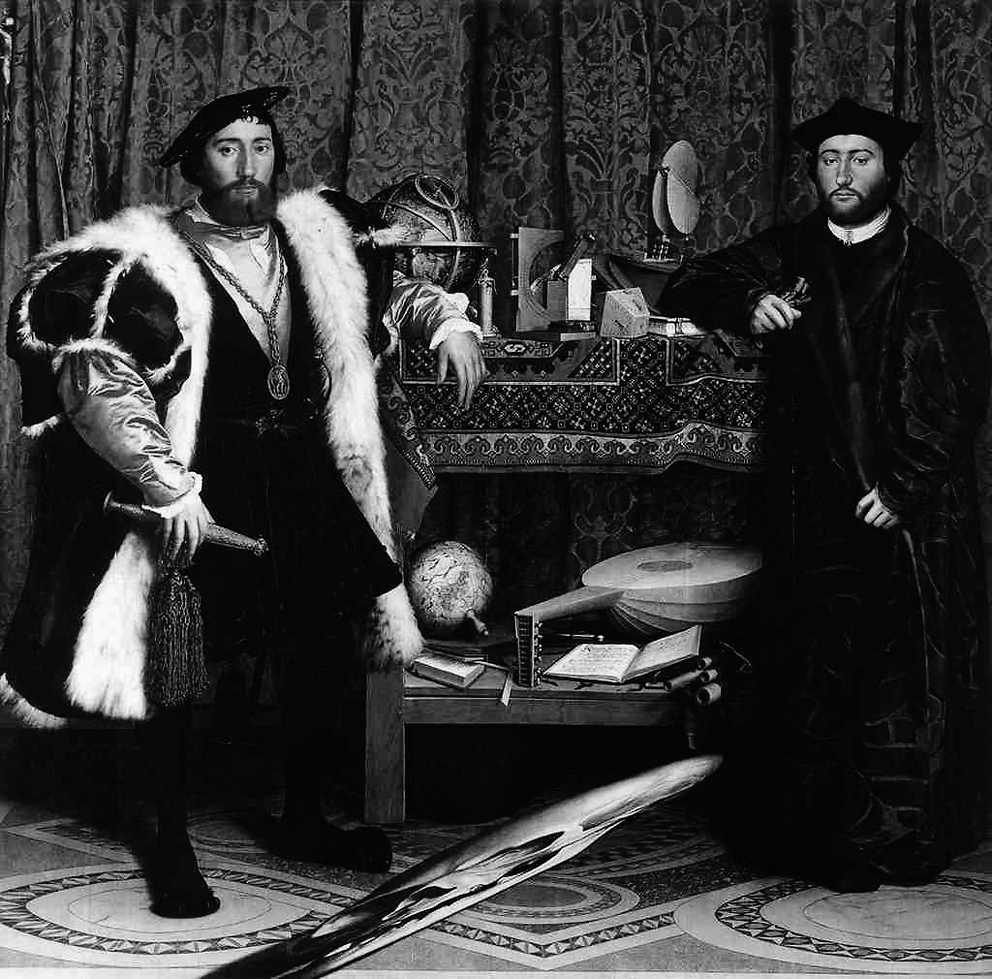
The flux of this historical moment is brilliantly captured in German Renaissance painter Hans Holbein's 1532 masterpiece The Ambassadors (Figure 1), which illustrates a meeting between French envoys Jean de Dinteville and George de Selve in London. The painting astounds because these two aristocratic subjects are placed at the periphery, and the only explicitly religious symbol, a cross, is heavily veiled by a curtain. While these two pillars of medieval power – the church and the aristocracy – are symbolically pushed to the side, the painting's focal point – the table – is littered with objects, with commodities. Was this a prophetic, if unwitting, forecast of feudalism's imminent decline? Did it anticipate a capitalist future where social relations would become ‘mediated by things’?Footnote 2
Hans Holbein, The Ambassadors, 1533

Notwithstanding such speculation, the objects on Holbein's table constitute a vivid record of the geopolitical milieu that defined European International Relations in the early sixteenth century.Footnote 3 On the bottom right hand side of the table, a book of Lutheran hymns sits by a broken lute signifying the discord and growing divisions in Christendom. To the left of these items rests Martin Benhaim's terrestrial globe, made under the commission of Nuremberg merchants seeking to break the Portuguese hold on the spice trade. The globe is tilted, so that after European towns, ‘Affrica’ and ‘Brisilici R.’ (Brazil) are the most legible markers, portraying the significance of the noticeable Linea Divisionis Castellanorum et Portugallenum (‘Line of division between Spain and Portugal’). This line demarcated the division of the New World between Habsburg Spain (west of the line) and Portugal (east of the line), signifying the growing import of Atlantic sea routes, and the subsequent competition between European states over commercially profitable territories.
In front of the globe is Peter Apian's A New and Well Grounded Instruction in All Merchant's Arithmetic, an early textbook of commercial scholarship that covered profit-loss calculation, trading customs, navigation, and route mapping. Placed alongside Benhaim's globe, it demonstrates the inseparability of commercial interests from maritime exploration, as well as the increasingly global – and increasingly competitive – character of trade. Above these items, on the top of the table, numerous scientific instruments highlight the rapid development of techniques in seafaring. Continuing the theme of Christendom's decline, it also indicates a mounting shift away from the divinity of religion as the predominant episteme toward the rationality of scientific inquiry and humanism.
Finally, linking the resting arms of the two ambassadors, and tying the objects together, is a Turkish rug. This alerts us to the fact that in the context of growing Atlantic trade, rebellion against Habsburg rule, and the primitive accumulation of capital, the Ottoman Empire was a persistent and prominent presence, lying behind and in many ways underpinning these manifold European developments.Footnote 4 In this period, the Ottomans constituted the most prevalent non-Christian ‘Other’ that confronted Europe,Footnote 5 ‘persistently capturing the headlines and profoundly transforming the geopolitics of (and beyond) the Mediterranean world’;Footnote 6 this was ‘an Ottoman Europe almost as much as it was a Venetian or Habsburg one’.Footnote 7 Yet despite the latent centrality implied by Holbein's painting, dominant theorisations of Early Modern Europe have been constructed with the Ottomans in absentia. Whether in the sphere of the politics, economy, culture or ideology, the emergence of capitalist modernity is generally understood as a sui generis development specific to Europe. In short, the history of capitalism's origins is an unmistakably Eurocentric history.
There are two moments to the Eurocentric approach that I will be the subject of scrutiny and criticism in this article. The first is historical priority: based on the assumption that any given trajectory of development is the product of a society's own immanent dynamics, Eurocentrism ‘posits the endogenous and autonomous emergence of modernity in Europe’.Footnote 8 Thus we find in cultural history that the flowering of the Renaissance was an intra-European phenomenon.Footnote 9 Analyses of absolutism and the origins of the modern form of state are similarly conducted entirely on the terrain of Europe, with non-European cases appearing (if at all) comparatively.Footnote 10 And the rise of capitalism is understood as an exclusively Western Europe phenomenon, wherein non-European societies appear only as an exploited and passive periphery.Footnote 11 In such accounts, Eurocentric historical priority tends to be fortified by the idea that it was the inherent superiority of Europe socially, politically, culturally, and materially which made it exceptionally conducive to the development of capitalist modernity.
This is not to say that studies of the sixteenth-century Ottoman Empire have been heedlessly avoided.Footnote 12 But where its imperial apogee has been studied, it has been considered ‘social formation apart … largely a stranger to European culture, as an Islamic intrusion on Christendom’.Footnote 13 Here becomes evident the second moment of Eurocentrism: an internalist methodology. Expressed either through the comparative approachFootnote 14 or methodological nationalism,Footnote 15 Eurocentrism tends to overlook the multiple and interactive character of social development. Through this method the Ottomans (among other non-Europeans) have been opposed to Europe, either as an ideological ‘Other’Footnote 16 or as a comparative case study, against which the specificity and distinctiveness of Western modernity has been defined.Footnote 17 Through numerous sociological trends the East has in turn been (re)constructed as an intransigent and threatening primordial foe, representing a fundamental and irreconcilable challenge to the values and traditions of the West.Footnote 18 In establishing this ‘Iron Curtain’Footnote 19 of mutual obstinacy, both Eurocentric internalism and notions of historical priority have been reinforced, not only ideologically but also materially.
One might expect International Relations (IR) – ‘a discipline that claims to be … of relevance to all peoples and states’Footnote 20 – to offer a way out of this Eurocentric cul-de-sac. However, IR too has been built largely on Eurocentric assumptions.Footnote 21 Mattingly's classic account of Renaissance diplomacy rests on the discoveries of the Italian city-states in their relations with each other.Footnote 22 Similarly, the 1648 treaty of Westphalia – the very foundational ‘myth’ of modern IR as a distinct practice and academic disciplineFootnote 23 – is generally considered the product of intra-European dynamics.Footnote 24 Where they do exist, substantive engagements with the East tend to emphasise the ‘Iron Curtain’ of ideological and cultural difference.Footnote 25 The historical sociological turn in IR (HSIR)Footnote 26 has not fared much better. Concerned explicitly with challenging ahistorical and unsociological conceptions of the international, HSIR has developed convincing arguments that uncover the transience, mutability, and thus the historical specificity of modern IR. But HSIR too has predominantly conducted its analysis on the basis of European history.Footnote 27
Recent scholarship in the field of World HistoryFootnote 28 and Postcolonial StudiesFootnote 29 has attempted to ‘ReOrient’Footnote 30 historiography in order to both destabilise and potentially escape the Eurocentric trap. However, despite providing extensive additional empirical frameworks that have decentred the historical priority of Europe, these works have tended to eschew any concomitant theorisation of capitalism's origins in light of these empirical findings. In the absence of such an endeavour the dominant Eurocentric theorisations of capitalism's origins have either suffered no fatal blows or, at worst, been actively reproduced.Footnote 31 To modify Frederick Cooper's call to arms: in order to truly ‘provincialise’ Europe one must dissect European history itself, and there is no more central myth to be dissected than that of narrating European history around the history of capitalism.Footnote 32 A truly non-Eurocentric interpretation of history should seek to pose an alternative theoretical framework to Eurocentric conceptions in which to conduct historical and sociological study.Footnote 33
Attempts to expand Trotsky's theory of Uneven and Combined Development (U&CD) as an historically and sociologically sensitive theory of the internationalFootnote 34 have sought to rescue historical materialist accounts from the charge of Eurocentrism, and in doing so provide precisely the sort of alternative theorisation of history that World Historical and Postcolonial approaches have hitherto elided.Footnote 35 However, there remain certain tensions that the theory is yet to overcome. John Hobson suggests U&CD is no less guilty of conflating ‘the international’ with exclusively ‘intra-European relations’, thus falling prey to the typical Eurocentric assumption of ‘Western priority and Eastern passivity’.Footnote 36 Similarly, Gurminder Bhambra suggests that for all of U&CD's focus on societal difference, its very origins and dynamism remains wedded to a Eurocentric conception of capitalism derived from the Enlightenment conception of stadial development.Footnote 37 Without problematising the European origins of capitalism, the non-West remains excluded as an empirically significant yet theoretically secondary entity.Footnote 38 For U&CD to simply invoke inter-societal processes is therefore not enough. It must also be capable of establishing an alternative conception of capitalism that includes the historical significance of non-European societies as active agents while departing from a stadial conception of development.
In this article, I propose we ‘return to Holbein’ via Trotsky, and attempt to recapture the significance of the Ottomans in the geopolitics of the long sixteenth century by deploying the U&CD as a theoretical framework. In particular, I seek to bring out the causal impact of the Ottoman Empire on the primary historical themes in The Ambassadors – the political fragmentation of feudal Europe in resistance to Habsburg attempts at Empire building, the structural shift away from the geopolitical and commercial centrality of the Mediterranean towards the Atlantic, and the primitive accumulation of capital. I argue that these developments – each crucial to the emergence of capitalism – were causally inseparable from Ottoman geopolitical pressure on Europe. In developing this argument, I seek to challenge and criticise Eurocentrism through the theory of U&CD and in the process defend its non-Eurocentric credentials. I argue that U&CD can make a positive and illuminating contribution to these debates because it speaks directly to each of the two moments of Eurocentrism identified above. By positing the multilinear character of development as its ‘most general law’,Footnote 39 uneven development provides a corrective to the ontological singularity and attendant unilinear conception of history that underpins assumptions of historical priority.Footnote 40 By positing the inherently interactive character of this multiplicity, ‘combined development’Footnote 41 challenges the methodological internalism of the comparative approach.
How this theoretical framework is operationalised can be demonstrated through an outline of U&CD's core concepts – unevenness and combination. Unevenness denotes spatial and temporal variations between societies as an ontological feature and thus perennial sociological condition of human history. As both cause and effect of this international differentiation, unevenness is also expressed in the forms of internal differentiation that give localities their own peculiar form of development.Footnote 42 For example, in The History of the Russian Revolution, Trotsky emphasises how imbalances in Russia's institutional, cultural, and class relations contrasted with ‘more advanced’ European formsFootnote 43 due to its peculiar inter-societal position standing both geographically and historically between Europe and Asia.Footnote 44 The ontological fact of multiplicity thus disrupts any conception of unilinearity implied by stadial theories of development:
[A]t any given historical point, the human world has comprised a variety of societies, of differing sizes, cultural forms and levels of material development. Empirically speaking, there is not, and never has been, a single path taken by social development.Footnote 45
Moreover, such differentiation in social forms is not generated hermetically and autonomously, but interactively. Developmentally differentiated societies constantly impact upon one another's development – what Trotsky called ‘the whip of external necessity’.Footnote 46 Consequently the unevenness of social development is constituted not only by internal social relations but also by social relations between societies. The relational character that emerges out of this interactive multiplicity is what Trotsky terms ‘combined development’. For example, Trotsky argues that the impulse for Russia's capitalist development was the necessity of ‘catching up’ with the developmentally more advanced European states. The ‘privilege’Footnote 47 of Russia's backwardness meant that this catch up occurred by assimilating the ‘ready-made’ developmental achievements of advanced capitalist countries, allowing Russia to skip over the ‘intermediate steps’ of development.Footnote 48 In contrast to the European model that Russia sought to emulate, capitalist development was refracted through pre-existing local social relations, giving rise to further developmental unevenness between Russia and its European counterparts. It was this peculiarity of Russia's combined development that made it uniquely open to proletarian revolution. Combined development thus involves a ‘drawing together of the different stages of the journey’Footnote 49 – of combining the spatio-temporally variegated experiences of different societies – into amalgams of ‘contemporary and more archaic’.Footnote 50
In short, U&CD posits that historical processes are always the outcome of multiple determinations arising from spatially diverse developmental trajectories that converge or combine in any given conjuncture. Thus instead of reproducing a stadial conception of development, U&CD ‘scrambles and subverts it’.Footnote 51 And rather than eliding the significance of non-Western agency, U&CD opens the potential to reinsert it into our historical narratives and theoretical conceptualisations. Seen in this light, the Eurocentric emphasis in the historiography of capitalism's origins becomes questionable. For a singular emphasis on Europe would constitute only one of many ‘spatio-temporal vectors of U&CD’Footnote 52 that would have to be complimented and combined with other determinations analysed from alternative spatial vantage points;Footnote 53 one that would have to be related to – among others – extra-European determinations bound in the histories of colonialism,Footnote 54 slaveryFootnote 55 and global trade.Footnote 56 Put simply, U&CD stresses an ‘internationalist historiography’Footnote 57 of the origins of capitalism.
However, I do not intend to argue that capitalism's origins were entirely extra-European, for this would substitute one ethnocentrism with another; nor do I seek to substantially diminish the centrality or uniqueness of Europe in this process. As such, and despite the provocative nature of the title, this article does not provide a full or total account of the origins of capitalism. It is rather restricted to the considerably more modest claim and demonstration that the Euro-Ottoman relations of the Early Modern period constituted one of many determinations that needs to be integrated, indeed combined, with other spatio-temporally distinct historical determinations, both European and extra-European. But this article seeks to go beyond simply adding an alternative empirical framework to our understanding of capitalism's origins. What must also be stressed is that in addition to challenging Eurocentrism in a negative sense, a positive elaboration of U&CD can also provide an alternative theoretical framework in which capitalism's origins can be understood.
In the ensuing examination of Euro-Ottoman relations, these two core concepts – unevenness and combination – will order the structure. In the first section I aim to challenge the Eurocentric assumption of historical priority, by demonstrating that sixteenth-century Euro-Ottoman relations were marked by material relations of uneven development. Accordingly unevenness denotes, firstly, the political, military, economic, and territorial advantages held by the Ottoman Empire over Europe; and secondly, the unevenness in social forms of internal differentiation – of ruling and ruled class in agrarian production on the one hand, and between merchant and state on the other. These forms of unevenness entailed both an Ottoman ‘whip of external necessity’ and a European ‘privilege of backwardness’, which I argue were crucial preconditions for the eventual emergence of capitalism within Europe.Footnote 58 In the second section, I attempt to expose the limitations of methodological internalism by examining the importance of the extensive interactivity that this whip of external necessity entailed – a form of combined development. In particular I argue that the Euro-Ottoman ‘combination’ causally impacted European development in three crucial ways. Firstly, it curtailed the imperial threat of the Habsburgs, abetting the fragmentation of Europe; secondly, in doing so it brought about a structural shift from Mediterranean to Atlantic trade and north-west European dominance; thirdly, these two factors combined to give England the geopolitical space in which the primitive accumulation of capital could take place.
Unevenness: a clash of social reproduction
Ottoman relations with the outside world have primarily been constructed through an idealised and uncritical notion of diplomatic precepts rooted in Sharia law.Footnote 59 Here, the supposed self-regarded superiority of the Ottomans constituted the basis of a unilateral policy toward international affairs, and a religious commitment to permanent war with Europe. This mystified conception of Euro-Ottoman relations – articulated as a continuation of the eternal clash between Christianity and Islam – was captured in the literature, philosophy, and art of Early Modern Europe. In the work of artist Leonardo Dati, Sultan Mehment II was portrayed as a minion of the devil,Footnote 60 while Martin Luther argued that the Ottomans were a punishment from God for the degeneration of Christianity.Footnote 61 Yet alongside this widespread belligerence, there were also significant levels of European appreciation for Ottoman achievements. For example, reflecting the resistance to the Habsburg alliance, German pamphleteers downplayed the need to intervene militarily against the Ottomans, with some pointing to the Turks’ efficiency as a model for German reform,Footnote 62 while the legal code established by Suleiman II was studied by a legal mission sent from England by Henry VIII.Footnote 63 In their examinations of European state forms, Machiavelli, Bodin, Bacon, Montaigne, and Giovolo all heralded Ottoman military discipline and administrative efficiency.Footnote 64
This mixture of fear, awe, belligerence, and admiration reflected a material relation of unevenness in which the Ottomans held numerous direct advantages over their European allies and foes.Footnote 65 The Ottomans were able to raise vast and loyal armies for military campaigns, while maintaining comparatively uninterrupted lines of communication and supplies.Footnote 66 Ottoman intra-ruling class unity also contrasted significantly with the fragmentation associated with the parcellised sovereignty of feudal Europe,Footnote 67 a developmental advantage often exploited by the Ottoman Empire in military campaignsFootnote 68 making them geopolitical accumulators – empire builders – extraordinaires. This relation of unevenness was neatly captured by Aeneas Sylvius (future Pope Pius II) who, after the fall of Constantinople in 1453, reflected on the existential threat the Ottomans posed to a disunited Christendom:
[Christendom] is a body without a head, a republic without laws or magistrates … every state has a separate prince, and every prince has a separate interest … Who will make the English love the French? Who will unite the Genoese and the Aragonese? Who will reconcile the Germans with the Hungarians and Bohemians? … If you lead a small army against the Turks you will easily be overcome; if a large one, it will soon fall into confusion.Footnote 69
While Europe struggled with divisions, the Ottomans faced them as a unified resourceful and disciplined force,Footnote 70 one that was able to consistently expand into Europe and beyond, absorbing and converting Europeans to the ‘Ottoman way’. As a contemporary lamented:
how it comes to pass, that so many of our men should continually revolt, and abjuring all Christian rites, become affectors of that impious Mahumetane sect, whilst on the other part we finde none or very few of those repaying unto us.Footnote 71
The unevenness between the Ottomans and Europe was underpinned by the predominant practices of social reproduction created by forms of internal differentiation. This internally differentiated form of unevenness was expressed in two ways. The first was in the relations that pertained among social classes based on predominantly agrarian production: between exploiter and exploited (and therefore also in the forms and character of surplus appropriation by the ruling class in these respective societies); and between different sections of the ruling class (and hence political relations as such). The second was the relationship between merchants and states that these respective forms of social reproduction gave rise to. These forms of unevenness will be considered in turn.
Agrarian class relations and ruling class reproduction
Ottoman society was characterised by a tributary mode of production, defined firstly, by the vertical opposition of a ruling, tax collecting, class in a contradictory relationship with a class of peasants that were exploited for the appropriation of productive surplus;Footnote 72 and secondly, by the horizontal differentiation between ‘landed nobility’ and ‘patrimonial authority’ within the tax collecting class, wherein the latter controlled the former as well as the means of production.Footnote 73
The first – ruling class-peasant – division was distinct from the lord-peasant relation in Europe due to the appropriation of surplus through tax (as opposed to rent) collection and the regulation of appropriation by regional and central agents of the Ottoman state.Footnote 74 This meant that in comparison to Europe, peasants had greater access to their surplus because of the preservation of subsistence plots, as well as state fixed limitations on taxation by local intermediaries.Footnote 75 Peasants also had inalienable rights to land,Footnote 76 were better protected from market fluctuations,Footnote 77 had the option – albeit limited – to legal recourse should their conditions worsenFootnote 78 and were legally considered free.Footnote 79
The second division – between landed nobility and patrimonial authority – was distinct from intra-ruling class relations in Europe because all land was formally owned by the Sultan, while military fiefs were predominantly non-hereditary, changeable, and regularly rotated amongst individuals in the ruling class.Footnote 80 This created a contradictory distribution of political power and surplus, forming a centre-periphery sociopolitical structure between sections of the ruling class.Footnote 81 Located primarily in Constantinople, the Ottoman centre consisted in the Sultan and his slave corps – comprising a large and unified bureaucratic administration and the Janissary standing army. This centralised state was coupled with devolution of power and relative autonomy of authority, jurisdiction, and religion in the Ottoman provinces.Footnote 82
As an offshoot of the devolution of power, the Ottomans often conquered territories without fundamentally transforming their own peculiar rules of reproduction be it legal, ideological, and even material.Footnote 83 Consequently the Ottomans proved adept at mobilising local resources and absorbing the material and ideational advances of occupied territories. (Geo)political accumulation also played an essential role in maintaining the loyalty of disparate sections of the ruling class, as well as coercing rebellions when necessary. Provincial power holders and Janissaries were allocated spoils of conquest – often booty, but primarily land – as a means of maintaining consent, while the practice of relocating notables to different regions of the empire displaced any potential accumulation of provincial power.Footnote 84
These devices of ruling class reproduction proved remarkably efficient, considerably more so than the contemporaneous feudal form found in Europe. Due to the nature of Ottoman power-sharing and the relocation of provincial landholders, there was limited potential for unified class interests acting outside the purview of – or counter to – the interests of the Ottoman state.Footnote 85 Instead, discontented sections of the ruling class sought to articulate disaffection within the confines of the extant political system, while the state was able to maintain the internal integrity of the empire by co-opting local elitesFootnote 86 or coercively centralising power.Footnote 87 Furthermore, the relatively lenient form of surplus extraction levied on Ottoman peasants, as well as tolerance for local religions and identities, meant that rebellion in the countryside was a less marked feature of the Ottoman tributary mode than the European feudal mode.Footnote 88 Hence there was little impulse or necessity for reform of the tributary system from above, or significant pressure for revolution from below.
The unity and stability of the Ottoman Empire contrasted significantly with European forms of social reproduction. These too were predominantly based agrarian production where peasants had direct access to means of production and also therefore subsistence. And as with the Ottoman Empire this condition meant that an aristocratic ruling class required political, ideological, and military means in order to exploit this peasantry and extract a surplus for the purpose of lordly consumption. However, unlike the Ottoman Empire these means were not controlled by or concentrated in a centralised and unified state, but were dispersed across the nobility. Consequently peasants were more susceptible to coercive squeezes on their productivity, and had no recourse to outside legal protection from their lords. This regularly led to declining living conditions and in turn, rural rebellions. At the same time, the dispersion of coercive capabilities meant that political authority in Europe was fragmented, parcellised, and therefore also highly competitive, with heightened intra-lordly struggle taking place over territory both within and outside of feudal ‘states’.Footnote 89 In short, both war and rebellion was more pronounced within Europe than it was within Ottoman territories.
Merchants, the state, and war
These conditions determined peculiar and uneven relations between merchants and the state. Because of the fragmented and parcellised character of political power, Europeans that wanted to make war required extraordinary financing outside of day to day ruling class reproduction. In order to raise armies, European rulers borrowed from international banking housesFootnote 90 or asked wealthy and powerful sections of society for contributions, either in terms of military support or taxes.Footnote 91 This was often conducted via ‘local estates and assemblies or city-leagues in which the merchant-entrepreneurial class wielded significant – even military – power’.Footnote 92 Hence a by-product of European feudal war-making was an attendant rise in the political autonomy, power and influence of merchants, with increasing degrees of representation in the decision-making structures of states.Footnote 93
In contrast, the Ottoman Empire had little requirement for monetary financing outside of the customary levies already imposed on agrarian production. Consequently, there was scarce potential for autonomous merchant activity outside of the functional requirements of the tributary state. The relations between merchants and the Ottoman ruling class were balanced considerably in favour of the latter, who exercised significant control over merchant activity through the guild system;Footnote 94 conflicts or tensions between merchants and guilds tended to curtail merchant autonomy and power,Footnote 95 while merchant access to state apparatuses and decision-making was limited.Footnote 96 Accumulation of wealth was discouraged and restricted by controlling coin circulation, production, and prices and anti-luxury laws were deployed to confiscate merchant fortunes.Footnote 97 Interregional trade was heavily regulated, in which provisions for towns came almost entirely from their own hinterlands thus narrowing the geographical remit of production and distribution to local regions.Footnote 98 Caravan endpoints geographically coincided with seats of government authority, ensuring close supervision of prices and commodities traded. Tax on trade enabled state extraction of surpluses from mercantile activity.Footnote 99
The tension between the state and merchants was also present geopolitically. For a ruling class fundamentally dependent on agriculture and tribute for their reproduction, the capture of trade routes was considered functional to tributary power, to bring those outside of it imperial purview within its tributary regime.Footnote 100 While the state could at times show signs of ‘economic intentionality’,Footnote 101 merchants were not considered important enough for state protection or support – agriculture remained the priority. Following the capture of the Mamluk Empire in 1517, the Ottoman naval commander Selman Reis believed that the Portuguese could have been driven out of the India Ocean.Footnote 102 But instead, imperial policy reverted to territorial expansion into the agriculturally more fertile and populous territories of South East Europe. That the Ottomans did not pursue the Indian course was primarily due to the reproductive requirements of a ruling class based on agrarian production,Footnote 103 reflecting the swelling claims made by provincial notables on access to booty, land, and thus power as such.Footnote 104
In contrast, European powers were explicitly and intimately focused on bringing under direct conquest and political control commercially valuable territories for specifically commercial purposes. The reason was due to the relative backwardness of European feudal reproduction, which was dependent of the wealth drawn from merchants and financiers to either fund (geo)political accumulation (in the case of Habsburg Spain and Austria) or for the direct reproduction of the ruling class itself (in the case of city-states such as Genoa and Venice). Consequently, the state was sensitive to, or at the behest of, merchant interests, wherein state resources, especially military, were deployed in order to obtain commercial advantages.Footnote 105 And such was the extent and autonomy of merchant power that no European Emperor could have withdrawn or demanded the return of ships in the Indian Ocean as the Ottomans had done.Footnote 106
These uneven internal relations – between ruling and ruled class in agrarian production on the one hand, and between state and merchant of the other – can therefore be demonstrated as a determinant of an international relation of Euro-Ottoman unevenness – the relative backwardness of the European ruling classes, and the comparative weakness in its form of social reproduction when opposed to the Ottoman Empire. These European ‘privileges of backwardness’ encouraged and compelled its people – both ruling and ruled classes – to develop and adopt new ways of securing their social reproduction. At the same time, the relative strength of the Ottoman social form entailed a ‘disadvantage of progressiveness’, wherein the stability of social reproduction provided no immanent impulse for change or development. This relation of unevenness goes some way to explaining why the so-called miracle of capitalism would occur in Europe, and why it would not be repeated in Ottoman territories. That this divergence was a product of Ottoman progressiveness and European backwardness suggests that Eurocentric assumptions of historical priority need to be reconsidered. Moreover, these two elements – Ottoman strength; European privilege of backwardness – were ultimately interrelated and co-constitutive phenomena. As a consequence of its comparative strength, the geopolitical pressure of Ottomans constantly affected and redirected European development, in turn compelling changes in its forms social reproduction.Footnote 107 This meant that while the Ottomans were faced as a significant existential threat, they were also an opportunity for the most backward part of Europe – the north-west – to outflank and outstrip the more advanced Habsburg Empire and Italian city-states.
Combination: Euro-Ottoman geopolitical relations
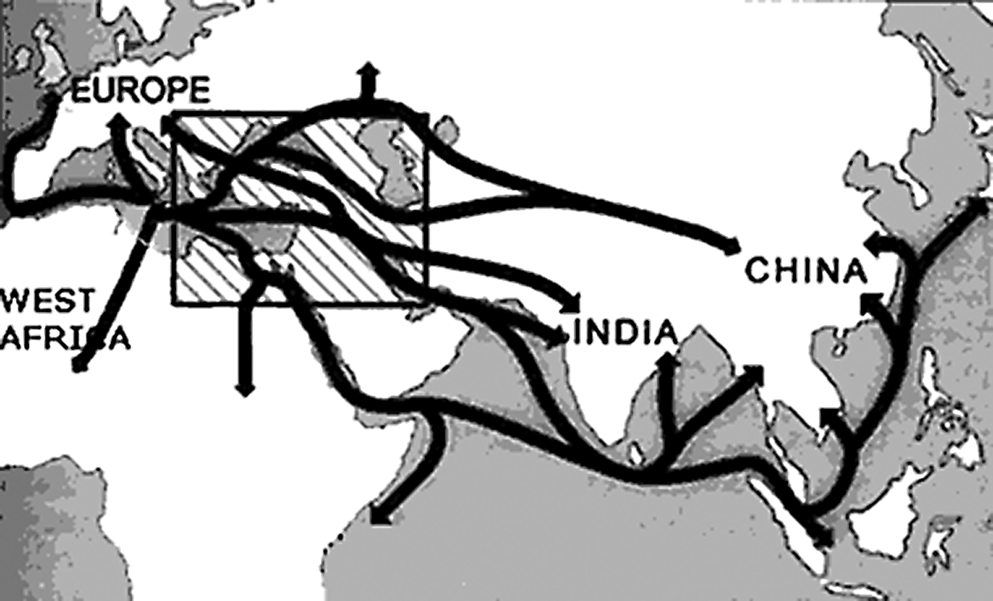
Due to the European condition of backwardness, the fifteenth- and sixteenth-century recovery of European feudalism, and the flourishing of commerce and the cultural Renaissance that accompanied it, were directly connected to the establishment of peaceful lines of communication and trade between East and West that followed the expansion and consolidation of the Ottoman Empire.Footnote 108 Through the institutional support of the Ottoman state, Pax Ottomana lowered commercial protection and transaction costs, established relatively uniform trading practices and hastened the alacrity of trade. On land and sea Ottoman rule was crucial to safeguarding traders from banditry or piracy, while building roads and canal routes that would facilitate interregional trade.Footnote 109 The emergence of a Pax Ottomana brought together highways of commerce linking Russia and Central Asia with Europe via the Black Sea, and the Levant and North Africa to the Indian Ocean where the bulk of Euro-Asian trade was conducted.Footnote 110 The Ottoman Empire thus brought about an economic and geographic combination of otherwise disparate communities, acting as ‘the hinge that connected the rapidly growing economies of Europe with those of the East’ (see Figure 2).Footnote 111
Eurasian trade routes during Pax Ottmana
Trade and communication between the Ottomans and Europe gave rise to various kinds of combined development assisting the transmission of social and technological knowledge, leading to a spurt of development in European manufacturing, particularly those sectors imitating Eastern products.Footnote 112 The boost in French economic activity following a trade agreement with the Ottomans led to the proto-industrialisation of towns such as Marseille.Footnote 113 The competition in silk markets between the Levant and Venice inspired the creation of the hydraulic mill in Bologna, which would later be adapted to construct Lombe's Mill in Derby in the early eighteenth centuryFootnote 114 – arguably the world's first fully mechanised factory.Footnote 115 Because Ottoman merchants themselves were active agents in bolstering trade within the Empire and beyond, their own credit system and methods of accumulation such as the simsar monopoly association and mudaraba advance system became woven into the fabric of European commercial relations, prefiguring the ‘complete control of a commodity from production to sale’Footnote 116 that would become the hallmark of company capitalism.Footnote 117
Such combination was especially pronounced in the development of European culture over the course of the Renaissance.Footnote 118 In certain cases, European artists such as Gentile Bellini and Constanzo da Ferrara spent time in the Ottoman court and worked under the Sultan's commission.Footnote 119 Ottoman imagery was widely featured often by Italian Renaissance painters seeking to elicit support for crusades by featuring the Ottomans as the embodiment of the Islamic threat.Footnote 120 Humanist literature – from Thomas More to William Shakespeare – would similarly deploy the Ottomans as a comparative of allegorical vehicle through which medieval forms European statecraft could be analysed and criticised.Footnote 121 This emphasis of Euro-Ottoman comparison therefore reflected a period of self-examination and criticism in the context of Christendom's breakdown as a unifying principle.Footnote 122 It was in the context of the Ottoman threat that propagandists, politicians, and thinkers began talking about Europe as a normative as well as geographical concept: the aforementioned Aneaus Sylvius invented the very adjective ‘European’ following the fall of Constantinople to the Ottomans,Footnote 123 while Habsburg and Polish publicists began appealing to secular European values in order to defend Hungarian territories from Ottoman incursions.Footnote 124
An Ottoman ‘whip of external necessity’
Euro-Ottoman combined development was however most pronounced under the ‘whip’ of Ottoman geopolitical pressure on Europe. Indeed, despite the regenerative effects of Pax Ottomana, for most of Europe the growth of the Ottoman Empire was met with trepidation and hostility in equal measure. The efficacy of the Ottoman military meant that from the mid-fifteenth century and ‘[u]p to 1596 there was no question of international politics, which did not somehow involve the Ottomans.’Footnote 125 Such involvement was permanent and regularly hostile. In an event that shook Europe, the Ottomans conquered Constantinople in 1453. By the end of fifteenth century, they had captured Greece, Serbia, Bosnia, Albania, and Croatia. The Ottoman whip of geopolitical pressure was not restricted to land and was often at its fiercest in the Mediterranean, where military conflict tended to blight seafaring conditions often ‘cutting the arteries of Venetian seaborne trade’.Footnote 126 The Spanish and the Portuguese fared little better, failing to push into a sea rife with Ottoman sponsored corsair attacks on merchant ships.Footnote 127 Moreover, following Ottoman conquests of the Black Sea and Red Sea, hitherto dominant European traders were only allowed conditional admittance.Footnote 128 Having obtained these territories, commercial activity became subject to aforementioned state regulations and supervision thus limiting the export of key commodities such as timber, horses, grain, and alum.Footnote 129
Having pressed on to Budapest and Vienna in the 1520s, Ottoman armies came into direct conflict with the Habsburgs, thus instantiating a geopolitical rivalry that would continue unabated until the end of the seventeenth century. But aside from the regular use of ‘hard power’ the Ottomans also sought to break the unity of the Habsburg Empire by deploying the more ‘soft’ methods of alliance building.Footnote 130 The significance of these ‘unholy alliances’ was revealed in a candid admission by Francis I in 1531:
I keenly desire the Turk powerful and ready for war, not for himself, because he is an infidel and we are Christians, but to undermine the emperor's power to force heavy expenses upon him and to reassure all other governments against so powerful an enemy.Footnote 131
The military pressure of the Ottoman Empire was a crucial contributing factor in the origins and expansion of the Reformation.Footnote 132 Lutheran revolts swept through Germany during a period in which the Habsburgs were especially dependent on German military support and financial aid in wars against the Ottomans. This only proved forthcoming on the condition that Charles V agreed to religious reforms. In this context, Lutherans sought to carve out greater religious freedom whenever conflict between the Ottomans and Habsburgs surfaced, using the Ottoman threat as a bargaining chip in negotiations with Charles V.Footnote 133 The ensuing spread of the Reformation often occurred in territories that bore the mark of an Ottoman impact – especially those affected by Calvinism.Footnote 134 These pressures underwrote the break-up of the Habsburg Empire – first into Austro-Hungarian and Spanish divisions, secondly with independence for the Dutch. Here the Ottomans again played active role, by attempting to cultivate coalitions with Protestants in the Low Countries and Moriscoes in Spain.Footnote 135 As the unifying power of Christendom receded under military duress, Ottoman attitudes towards religious freedom and local autonomy came to be replicated in European territories.
One of the more pertinent historical peculiarities of the fifteenth and sixteenth century was the inability of the Habsburg Emperors to fulfil the holy mission of establishing and maintaining an imperial hegemony in the lands of Christendom.Footnote 136 In many ways it was the causal impact of the Ottoman ‘whip of external necessity’ that ‘frustrated universal imperial ambitions’ by perpetuating the ‘multiple polities within the cultural unity of Christian Europe’.Footnote 137 The uneven and combined development of relations between the Ottomans and Europe therefore created further developmental unevenness by exacerbating the fragmented and divided character of European feudalism. Consequently, ‘combination’ was itself felt unevenly, with its specific causal effects varying across different European states. The more ‘advanced’ European states constituted the primary focus of Ottoman military operations, while alliances with more ‘backward’ European states were utilised to balance against the Habsburgs. As such, while the Habsburgs, Genoese, Venetians, Spanish, and Portuguese were habitually engaged with the Ottomans, north-western European states such as France, the Low Countries, and particularly Britain were afforded the geopolitical space required to conduct modern state-building. This ‘privilege of backwardness’ became manifest along two causal vectors of combination – firstly, by bringing about a structural shift away from the dominance of the Mediterranean to the Atlantic; secondly, by isolating England from Habsburg geopolitical pressure.
The Ottoman blockade and the emergence of the Atlantic
Through imperial conquest, many of the key channels of European trade with the East fell under Ottoman control. Thus besides facilitating European commerce in general, Pax Ottomana broke the monopoly previously held by leading traders (primarily Venetian and Genoese) in the Mediterranean and Black Sea,Footnote 138 exposing these markets to competition from north-west Europeans, as well as Ragusan, Armenian, and Jewish merchants under Ottoman suzerainty.Footnote 139 By blocking the most dominant European powers from their customary conduits to Eastern markets, the Ottomans directly compelled them to pursue alternative routes. Having lost its Black Sea monopoly, Genoa sought to circumvent the Ottoman passage to Indian and Far Eastern markets,Footnote 140 while turning to private business and financial operations in Western Europe and the Atlantic.Footnote 141 With the Ottoman dominated Mediterranean inaccessible to Genoese capital, the Atlantic became a considerably more promising avenue for commercial activity.Footnote 142 Thus both in Spain and in Portugal, the relationship between Genoese merchant-financiers and New World colonialists grew as Genoa's position in the Eastern Mediterranean declined. The Atlantic ventures that this alliance gave rise to were ultimately possible through the investments of Genoese capital that had been forced out of the Mediterranean by the Ottomans. ‘It was’, writes Eric Mielants, ‘precisely the inter-city-state competition for access to Eastern markets and the threat of the expanding Ottoman Empire that led to the discovery of the Americas’.Footnote 143
CapitulationsFootnote 144 came to play a major role in this process, mediating European commercial and Ottoman geopolitical interests through alliance building on the one hand and blockading rivals on the other. The most commercially ‘advanced’ European states – the Habsburgs, Genoese, Venetians, Spanish, and Portuguese – were excluded, while the more ‘backward’ French (1536), English (1583), and Dutch (1612) were granted capitulations. Political in scope for the Ottomans, these commercial agreements proved an economic boon for the merchants of north-west Europe. States that had been otherwise peripheral to the Mediterranean (and thus Eurasian) commerce were now able to trade under significantly advantageous terms compared to their competitors. Plugged into the security afforded by the Ottoman state along its trade routes, north-west European connections with Asian commodity markets were significantly expedited.Footnote 145
Over the course of the sixteenth century, Ottoman geopolitical manoeuvres thus brought about a ‘structural shift’,Footnote 146 from the commercial dominance of Adriatic city-states such as Genoa and Venice, towards English and Dutch supremacy. The competition over markets that arose from this shift gave a major impulse to the development of company capitalism and anticipated the increasing unity of merchant and state interests that became a hallmark of the English and Dutch politics in the seventeenth and eighteenth century.Footnote 147 These developments would stimulate efforts to build permanent circuits of capital through the advance system, in turn escalating merchant intervention and control over international production.Footnote 148
The Ottoman buffer and English primitive accumulation
The states best placed to take advantage of this structural shift were those where the Ottoman geopolitical buffer was most keenly felt. As we have seen the protagonists most intensely involved in the continental conflicts of the fifteenth and sixteenth centuries were concerned with the Ottoman presence in the Mediterranean and south-east Europe. In this context England featured as little more than an ‘impotent onlooker’Footnote 149 in European affairs. Compared to the near permanence of warfare on the continent, Early Modern England was marked by a condition of geopolitical isolation. England's lack of involvement in continental conflicts from 1450 onwards was a fundamental factor in its development towards capitalism.Footnote 150
One of the more peculiar features of Tudor ‘absolutism’ flowed directly from this isolation – a regression in the military resources held by the state and aristocracy. For example, in the 1470s the Spanish and English military manpower numbered 20,000 and 25,000 men respectively. By the 1550s, Spain's manpower had risen to 150,000 while England's manpower had fallen by 5,000 to 20,000.Footnote 151 Disarmament among the English aristocracy was even more pronounced: ‘in 1500, every English peer bore arms; by Elizabeth's time … only half the aristocracy had any fighting experience’.Footnote 152 This demilitarisation meant that England effectively ‘skipped over’ the development of strong, tax appropriating bureaucratic state structures characteristic of French and Spanish absolutism in the sixteenth century onwards.Footnote 153
This exceptional historical trajectory proved especially conducive to capitalist development in the sixteenth century. Firstly, demilitarisation within the nobility meant limited access to the means of coercion required to raise feudal rates of exploitation. This inability to ‘squeeze’Footnote 154 peasant surpluses meant that the option of dispossessing peasants and exploiting them through market mechanisms became an increasingly preferable means for ruling class reproduction.Footnote 155 Secondly, the English state did not possess the coercive or administrative strength to prevent attempts by the nobility to ‘engross, consolidate and enclose land’.Footnote 156 This contrasted with, for example, the French state, which competed with the nobility over agrarian surpluses by habitually protecting the peasantry from attempts at dispossession.Footnote 157 Thus, thirdly, isolation meant that the English ruling class was unusually homogenous,Footnote 158 with a relative absence of social stratification across the state, the pre-existing landed aristocracy and an emergent commercial class. This was because under conditions of demilitarisation, influence and office replaced patented peerage as a basis for aristocratic power, making the landed class peculiarly ‘civilian’, ‘commercial’, and ‘common’.Footnote 159
These three factors help to explain one of the fundamental propositions of Robert Brenner's argument of the origins of capitalism: that it was in England alone that agrarian revolts were met with a unified and successful attempt by the state and landed class to remove the peasantry from their land through the enclosures.Footnote 160 As peasants were dispossessed, they turned to an alternative means to secure their means of subsistence and thus social reproduction: selling their labour to landlords and capitalist tenants in return for a wage.Footnote 161 The persistent success of the state-nobility alliance in dispossessing the peasantry of the means of production therefore led to the emergence of ‘free’ class of wage-labourers. The social property relations through which surplus was appropriated were thus transformed, from the extra-economic means of feudalism to the ‘economic’ or ‘market’ mechanisms of agrarian capitalism.
Considering that English isolation was such a crucial condition for the processes outlined in the ‘Brenner thesis’,Footnote 162 a fuller exposition of capitalism's origins requires that this isolation is satisfactorily accounted for. As the preceding argument has shown, this isolation should be understood as an inter-societal condition arising from the continental preoccupation with the Ottoman Empire. The peculiar social form that this isolation gave rise to proved especially conducive to the symbiotic unity of state and landed class interests that underpinned the growth agrarian capitalism in England. When considered in this specifically international context, English development in the sixteenth century can be best understood as a form of ‘combined development’; the developmental outcomes of an inter-societal condition rooted in the uneven relation of England to the Euro-Ottoman geopolitical milieu. Ottoman geopolitical pressure must therefore be seen as a cause in the emergence of agrarian capitalism in England.
Conclusion: the Ottoman Empire as a vector of U&CD
The duality of Euro-Ottoman relations – both belligerent and collaborative – was thus a crucial driver in some of the key developments in the Early Modern period. By establishing a node of international trade, the Ottomans contributed to the internationalisation of merchant activity and a cultural revival in Europe. But more significantly, through its military conflict with the Habsburgs, the Ottomans abetted the Reformation and break-up of Habsburg hegemony. This gave north-west Europe the geopolitical space to conduct modern state-building. In particular, this buffer gave rise to peculiar fusion of interests among the landed nobility and the state in England, which was a crucial cause in the process of primitive capitalist accumulation. Moreover, through its geopolitical policies, the Ottomans actively and directly brought about a structural shift away from Mediterranean trade and the concomitant ascendancy of Italian city-states, toward the Atlantic powers that would eventually come to dominate the world through colonialism. It must be emphasised that none of these developments were sufficient conditions for the emergence of capitalism; there were numerous other causal chains – vectors of uneven and combined development – both European and extra-European that must be incorporated into a full understanding of capitalism's origins. Yet it is difficult to establish a proper appreciation of the key developments in sixteenth-century history and the European trajectory towards capitalism without looking at the Euro-Ottoman relation as a fundamental determinant.
This additional empirical framework raises serious questions around the theorisation of capitalism's origins. Indeed, a central contention of this article is that the spatial limitations imposed by Eurocentrism have had significant consequences for the manner in which we theorise historical processes. In presenting this argument, I hope to have contributed to the recent explosion in literature that has sought to ‘provincialise Europe’, by bringing out the international dimension of capitalism's development. But moreover, I have sought to provide an alternative theoretical framework – Trotsky's theory of Uneven and Combined Development – within which this non-Eurocentric historical analysis can contribute to a renewed conceptualisation of capitalism's origins. For U&CD not only helps us capture the historical significance of interactive relations between societies, it also gives these relations theoretical expression, thus elevating their importance as a field of investigation; one that is irreducible to, yet fundamentally related to, the sociology and history of any given society. In doing so, U&CD broadens our field of vision beyond the confines of Eurocentrism, by internalising at the level of theory a dimension of concrete reality – ‘the international’ – hitherto considered external to dominant studies of the origins of capitalism. My argument thus also raises the significance of (a sociologically sensitive) IR as a privileged vantage point from which to analyse the socially distinct determinations arising from the international that fed into the origins of capitalism.
What of the supposed Eurocentrism of U&CD itself? As we have seen, the limitation of U&CD to the capitalist epoch tends to reproduce the Eurocentric assumptions of historical priority and methodological internalism. I have argued that by breaking out of the temporal fetters of capitalism, U&CD can also transcend the spatial provincialism associated with Eurocentric social theory. By theorising the very history of capitalism's origins as the combined product of a multiplicity of spatio-temporally uneven determinations, the incorporation of non-Europeans into this process is opened as a potentially illuminating avenue for further research. As such, both theoretical and historical elements also support calls for the extension of U&CD beyond the epoch of capitalism alone by positing its transhistorical and therefore general applicability.