Subjective cognitive impairment (SCI) is a potential early marker for cognitive decline and subsequent dementia (Reisberg et al., Reference Reisberg2008). SCI is however prevalent in the normal population (Jonker et al., Reference Jonker, Geerlings and Schmand2000) and also associated with depression (Lautenschlager et al., Reference Lautenschlager, Flicker, Vasikaran, Leedman and Almeida2005). Mild cognitive impairment (MCI) is an intermediate stage between normal cognitive aging and dementia. The SCI stage has been suggested as a stage prior to MCI with an approximate duration of 15 years before decline to MCI (Reisberg and Gauthier, Reference Reisberg and Gauthier2008), which was supported by a longitudinal study (Prichep et al., Reference Prichep2006).
The study of self-reported difficulties in relation to cognitive impairment and dementia varies greatly in dimensions/domains examined, populations studied, and methods applied. The widely used method of a single question to define SCI, e.g. “do you have memory problems?”, is common but has been criticized for being too unspecific (Abdulrab and Heun, Reference Abdulrab and Heun2008). There are several available comprehensive questionnaires on subjective memory/cognitive functioning developed and evaluated for normal populations (Newson and Kemps, Reference Newson and Kemps2006), MCI populations (Frank et al., Reference Frank2006; Locke et al., Reference Locke2009; Pedrosa et al., Reference Pedrosa2010), or developed prior to launching of the MCI concept (Broadbent et al., Reference Broadbent, Cooper, Fitzgerald and Parkes1982; Dixon and Hultsch, Reference Dixon and Hultsch1983; Crook and Larrabee, Reference Crook and Larrabee1990; Gilewski et al., Reference Gilewski, Zelinski and Schaie1990), but not for patients with pure SCI. Many SCI studies, and related questionnaires, have not excluded MCI patients from their samples, which makes determination of SCI's predictive value difficult (Reisberg and Gauthier, Reference Reisberg and Gauthier2008). In questionnaire development, item generation through expert panels or by clinical experience is common, but qualitative data collection though recommended as a step key to best practice is seldom used (Frank et al., Reference Frank, Lenderking, Howard and Cantillon2011). Cognitive functions other than memory are often affected in MCI (Nordlund et al., Reference Nordlund, Rolstad, Hellstrom, Sjogren, Hansen and Wallin2005) but the range of cognitive manifestation of the SCI stage is not clearly known and needs to be studied (Reisberg et al., Reference Reisberg2008). Social functioning has also been identified as a potentially important but under-studied area in pre-dementia phases (Frank et al., Reference Frank, Lenderking, Howard and Cantillon2011). In addition, it is unclear whether general or specific questions are more valid when examining cognitive difficulties. Questionnaires focusing on specific everyday examples of cognitive failures have been suggested to attain greater ecological validity than more general questions about cognitive functions (Hertzog et al., Reference Hertzog, Park, Morrell and Martin2000). On the other hand, people tend to use general estimations rather than episodic enumeration when asked to report everyday behaviors (Blair and Burton, Reference Blair and Burton1987), which could make general questions more sensitive. The issue of general or specific is important because of the nature of impairment in pre-dementia phases. Autobiographical, or episodic, memory is well known to be one of the earliest impaired memory functions in incipient dementia. Recalling specific events depends on episodic memory functioning. Hence, impaired episodic memory may reduce the patient's capacity to recall specific events, and instead patients may report more problems when questions are asked that do not require them to recall specific events.
Our aim was to develop a patient-based comprehensive questionnaire on everyday cognition, with the ability to distinguish patients with subjective, but not objective, cognitive impairment seeking care at a memory clinic, from healthy controls. Additionally, we aimed to examine the cognitive spectrum in SCI and difficulties related to social functioning, and evaluate the discriminant ability of general versus specific questions.
Materials and methods
The questionnaire items were generated through a qualitative interview phase aimed at identifying behaviors and everyday difficulties that may depend on cognitive function. A subsequent quantitative phase was aimed at identifying which of the interview-generated questions discriminated between healthy controls and SCI patients. See Figure 1 for an overview of the development phase.
Overview of the steps from interviews to the final version of SASCI-Q.

Qualitative phase
The original version of the questionnaire was developed to assess self-reported cognitive difficulties in everyday life among testicular cancer survivors (Skoogh et al., Reference Skoogh2012), following established principles at the Division of Clinical Cancer Epidemiology (Steineck et al., Reference Steineck, Bergmark, Henningsohn, Al-Abany, Dickman and Helgason2002). Starting with an 18-month qualitative phase, co-author JS interviewed patients with MCI diagnosed at the Sahlgrenska memory clinic (N = 13) and their relatives (N = 7), subsequently interviewing cancer survivors (N = 20) recruited from the Department of Oncology at Sahlgrenska University Hospital.
The interviews had an open format, and participants were asked for detailed examples about various functional difficulties experienced in their everyday lives. To ensure that the themes emerging from the interviews were not limited to the interviewees’ personal understandings of “cognition” or “memory,” the questions asked were deliberately designed to address everyday activities and behaviors instead of referring to specific cognitive domains.
The interviews were recorded and transcribed by a secretary. A content analysis was performed, with focus on identifying everyday difficulties that could be related to cognition. Examples were categorized according to content, resulting in concepts such as “forgetfulness” and “communication.”
The examples were thereafter rephrased as questions. In this process, the wordings used by the interviewees were carefully maintained, and concrete examples were favored above indistinct ones. The phrase “in the last month” was added to all questions, to ensure that problems reported were experienced recently. A limited number of response scales were selected and applied to fit each question well. For some questions we found it suitable to ask for the number of times that a problem was encountered, e.g. “In the last month, has someone else pointed out that you repeat yourself? No/Yes, but less than once a week /Yes, at least once a week /Yes, at least three times a week /Yes, at least once a day.” For other questions, respondents were more inclined to report a general occurrence of the problem without being able to state the number of occasions, e.g. “In the last month, have you had difficulties concentrating while reading? No/Yes, occasionally /Yes, but less than half of the times /Yes, about half of the times /Yes, more than half of the times /Yes, always.” Some questions were considered more sensitive or difficult to quantify and were therefore phrased in an attitude scale format: “Some people have difficulties learning new things, even if it is something they are interested in. How has that applied to you, in the last month? Not at all/Partly/To a large extent/Completely.” The global question “in the last month, have you experienced memory problems?” was also included.
The questionnaire also included questions about well-being and demographics.
Content validity during qualitative phase
A face validation procedure was performed to ensure that the questions and response alternatives were relevant and fully understood, and that no essential cognitive difficulties were omitted. Co-author JS accompanied 20 cancer survivors while they filled out the questionnaire and adjustments to the questions were made continuously until no further comments emerged. A similar face validation process was subsequently made by author ME at the Sahlgrenska memory clinic with seven individuals diagnosed with MCI. Sahlgrenska memory clinic, the clinical site for this study, is a Swedish outpatient clinic investigating cognitive disorders both in their early and later phases.
Study-specific modifications
Minor modifications were made before introducing the questionnaire for use in the memory clinic sample. A section on subjective cognitive decline was added by inclusion of one key question on current functioning related to each cognitive domain (memory, attention, speed, visuospatial function, language, and executive function), and two questions on global functioning. Respondents were then asked to assess their level of functioning on a 7-point Likert scale, referring to three points in time: (i) current functioning; (ii) 10 years ago; and (iii) when they were 25 years old. The scores of rated current functioning were then subtracted from scores of rated past functioning, to obtain discrepancy scores (thus, originally 24 questions in this section resulted in 16 discrepancy scores). When further mentioning items from this section, we refer to these discrepancy scores, which indicate how much respondents estimate themselves to have changed over the years.
Figure 1 shows an overview of the steps from interviews to the final version of the questionnaire. The questionnaire contained 97 items on cognitive functioning following the face validation procedure at the memory clinic.
Participants
The questionnaire was completed by 93 consecutive SCI patients (MCI excluded) and 50 healthy controls, examined between 2007 and 2010 at the Sahlgrenska memory clinic. Some episodes of cognitive difficulties, such as memory lapses, can naturally be experienced also by healthy controls – the crucial difference between patients and controls in this study is that the SCI patients sought medical care for their experienced cognitive decline.
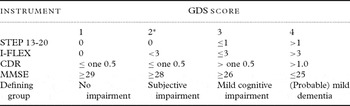
Patients were either referred from primary care or self-referrals. A main objective of the study was to investigate patients with solely subjective cognitive symptoms, requiring exclusion of those with objective cognitive symptoms (MCI and mild dementia). Thus, patients were defined as “no SCI/no MCI”; “SCI”; “MCI”; and “probable mild dementia,” by stages 1–4, respectively, on the Global Deterioration Scale (GDS; Reisberg et al., Reference Reisberg, Ferris, De Leon and Crook1982). Only patients classified as GDS 2 (SCI) were included in this analysis. GDS stages were set using clinical assessment based on medical history, symptom checklists, and instruments for cognitive symptoms. Table 1 presents the GDS operationalization in detail. Other inclusion criteria for patients were: seeking medical care for cognitive problems and age >40 years. The controls were all enrolled in the Gothenburg MCI study and were mainly recruited from information meetings about dementia, from senior citizen organizations, and a few as relatives to patients. They were older than 40 years, underwent the same examinations as patients, and were assessed by expert clinicians to not have subjective nor objective cognitive impairment.
Operationalization of the GDS staging at the Sahlgrenska Memory Clinic

*Subjective cognitive complaints mandatory.
STEP and I-FLEX were prioritized in the assessment procedure. MMSE and CDR were consulted if results on STEP or I-FLEX were ambiguous.
STEP = Stepwise comparative status analysis (Wallin et al., Reference Wallin1996) for basic cognitive symptoms; cognitive variables 13-20 (memory disturbance; disorientation; reduced abstract thinking; visuospatial disturbance; poverty of language; sensory aphasia; visual agnosia; apraxia).
I-FLEX (a short form of the executive interview EXIT; Royall et al., Reference Royall, Mahurin and Gray1992), for executive symptoms. Items: number–letter task; word fluency; anomalous sentence repetition; interference task; Luria hand sequences; counting task).
MMSE = Mini-Mental State Examination (Folstein et al., Reference Folstein, Folstein and Mchugh1975); CDR = Clinical Dementia Rating (Morris, Reference Morris1997); GDS = Global Deterioration Scale.
Subjects were excluded if they had severe somatic disease, severe psychiatric illness, or substance abuse. Subjects with mild depressive symptoms were not excluded; Hospital Anxiety and Depression Scale (HADS) was administered to measure depressive symptoms. The cognitive state of patients (and controls) will be followed up longitudinally.
The local ethics committee approved the study (Dnr. 649-08).
Procedure
Patients were recruited by the coordinating RN during their first visit to the clinic. Controls were recruited by mail, but the subsequent data collection procedure in the control group was identical to the procedure in the patient group. The questionnaire was administered independent of other examinations – that is, all patients were already enrolled at the clinic and scheduled for further examination when they were asked to participate and when the form was completed. Also, they had not yet undergone neuropsychological testing and thus had not received feedback from clinicians about their cognitive status. Participants received written and oral information about the purpose of the study, procedure, confidentiality, and about the possibility to withdraw from the study at any time. Those who consented to participate were asked to complete the questionnaire at home and to return it to the clinic in an enclosed envelope. After 14–20 days, a reminder was sent to participants who had not yet returned the questionnaire. In the case of several omitted items (entire pages), these were returned to the patient who was asked to complete them.
Statistical analysis
Distributions and group differences for sex, age, education years, and Mini-Mental State Examination (MMSE) were calculated with independent samples t-tests or Pearson's χ2 tests with Yates’ correction for continuity, where appropriate.
Questionnaire items were statistically analyzed in two steps. First, all items were analyzed separately to find which items showed significant differences between patients and controls, and therefore were retained as “final version items” (discriminant analysis). Second, convergent validity and internal consistency reliability were analyzed for the final version items.
Discriminant validity and item reduction
Discriminant validity was obtained by comparing patient group mean scores to healthy control group mean scores, using a one-way between groups analysis of covariance (ANCOVA) controlling for age. The analysis was performed despite the fact that variance was not equal across groups, as equal variance was not expected in a comparison between healthy controls and the heterogeneous clinical sample. The α level for significance was adjusted for multiple comparisons, using Bonferroni correction. Items were subsequently retrieved to the final questionnaire if responses (1) showed significant difference between healthy controls and patients, and (2) the difference displayed an effect size (partial eta squared; η2) of at least 0.06; moderate size, according to Cohen's criteria (Cohen, Reference Cohen1988).
Analyses were also performed for all non-discriminatory questions to control for floor effects (very few reported problems in both patients and controls) or ceiling effects (equally high frequency of problems in both groups).
Convergent validity
A Pearson's correlation analysis was performed to check the relation between questionnaire items on current functioning and the single global question “in the last month, have you experienced memory problems?” (a widely used question to identify SCI). Cognitive decline items were analyzed correspondingly against the question “rate your current global memory functioning compared to when you were 25 years old.”
Internal consistency reliability
Questions discriminating between controls and patients were analyzed for internal consistency using Cronbach's α, with higher scores indicating higher scale reliability. Minimum value for item correlation to total score was set at 0.3; otherwise, items would be eliminated from the final instrument.
Item categorization
To keep close to the qualitative base of the instrument development, questions were not categorized until after development and data collection, but prior to statistical analysis. Questions were then categorized by cognitive domain by a group of clinicians/experts on cognition (see Skoogh et al., Reference Skoogh2012) and by general or specific question type and load on social functioning.
(i) Cognitive domain: memory; attention/speed; language; visuospatial; executive; mixed domains.
(ii) General or specific question type: specific – question and response format requiring the respondent to recall a specific event when the problem occurred, such as “have you received any reminders for unpaid bills?” general – questions and response formats allowing the respondent to assess her difficulties without having to recall a specific event, such as “have you had difficulties concentrating?”
(iii) Load on social functioning: This category involved questions referring to others’ evaluations (someone else pointing out the patients’ difficulties), as well as difficulties becoming apparent in conversation situations (e.g. finding words, completing sentences).
Results
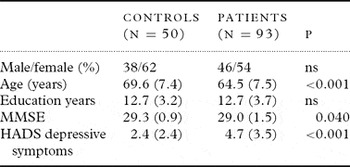
Characteristics of the groups are presented in Table 2. There were no differences between the groups regarding gender or years of education. Patients had, as expected, only slightly lower MMSE scores than controls. Controls were older than patients and patients reported more depressive symptoms although scores were generally low. Age was included as a covariate in the ANCOVA. To enable future analysis of depressive symptoms in relation to SCI, these were not included as a covariate in the analysis producing final questionnaire items. However, it was subsequently checked if significant p values remained after adding depressive symptoms as a covariate. The response rate for patients meeting inclusion criteria and consenting participation was 90%.
Characteristics of healthy controls and SCI patients

Values are means and standard deviations (±), or percentages where appropriate. Significance level p < 0.05. MMSE = Mini-Mental State Examination; HADS = Hospital Anxiety and Depression Scale.
Discriminant validity and item reduction
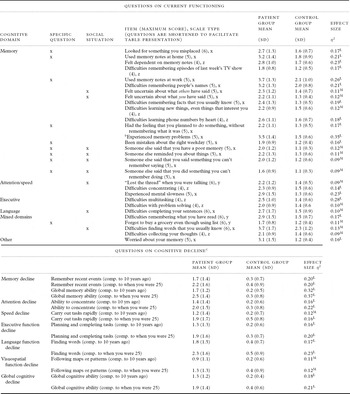
Significant differences of medium to large effects sizes between patients and controls were found for 29 (36%) of the 81 questions on difficulties in current functioning and for all questions related to cognitive decline (Table 3). Significant differences remained when depressive symptoms were controlled for (data not shown).
SASCI-Q items, mean scores for groups. All items differentiating between SCI patients and healthy controls on the p < 0.0006a level with medium or large effect sizes (≥0.06)

aBonferroni corrected for multiple comparisons.
bSingle question “Have you experienced memory problems, in the last month?”, which was correlated with other questions (results reported in the text).
cFor the Decline section, each item was sub-divided into three parts, requesting the respondents to assess their level of functioning in relation to peers (i) now (in the last month); (ii) 10 years ago; and (iii) when they were 25 years old. Minimum score 1 (“very low”), maximum score 7 (“very high”). The 24 questions (3*8 = 24) are not presented in full length in this table; but items are presented here as discrepancy scores. These were calculated by subtraction of scores on experienced “current functioning” from scores for experienced functioning “10 years ago” and “when you were 25” – that is, higher scores represent a larger experienced change. For example, a score of 2.0 means that the patient mean of experienced cognitive change is a reduction (compared to earlier in life) by 2.0 points on a 7-point scale. A score of 0.0 would correspond to “no change,” and a negative score would correspond to an improved cognitive ability.
x = person-incidence scale, e.g. “no/yes but less than once a week/yes et least once a week/yes at least three times a week/yes at least once a day/yes several times a day”; range of scores: 1–6, 1 = no; 6 = yes several times a day.
y = person-prevalence scale, e.g. “no/yes on single occasions/yes but less than half of the times/yes about half of the times/yes more than half of the times/yes on every occasion”; range of scores: 1–6, 1 = no; 6 = yes on every occasion.
z = verbal attitude scale, e.g. “don't agree/partly agree/largely agree/completely agree”; range of scores: 1–4, 1 = don't agree; 4 = completely agree.
m = medium effect size, partial η2 = 0.06–0.13.
l = large effect size, partial η2 ≥ 0.14.
The number of questionnaire items were reduced from 97 to 45 (29 on current functioning and 16 on cognitive decline) based on results from ANCOVA. All excluded items were from the section on current functioning. For all 52 excluded questions mean scores were relatively low in both groups, indicating that absence of differences between groups was due to floor effects.
Questions remaining after item reduction constitute the 45-item Sahlgrenska Academy Self-reported Cognitive Impairment Questionnaire (SASCI-Q).
Internal consistency reliability
The internal consistency for the items was satisfying; for the sections on current functioning and cognitive decline, Cronbach's α was 0.96 and 0.95 respectively for the patient group and 0.90 and 0.93 for the control group. All items correlated significantly with the total score (data not shown). Cronbach's α analysis did not implicate further item reduction.
Convergent validity
The 29 remaining items on current functioning correlated significantly with the global single question about current memory functioning (r = 0.30–0.57).
All cognitive decline items correlated significantly with the single memory decline question (r = 0.38–0.74).
The correlation coefficients toward the single memory question did not implicate further item reduction.
Analysis of item categories
In the initial interview material, there was an over-representation of self-reported difficulties related to memory (28/81), whereas fewer difficulties emerged regarding for example visuospatial problems (3/81). Items were related to other domains as follows: 13 executive functions; 9 attention/speed; 8 language function; 19 mixed domains; and 1 question was about worrying for your memory.
Following the item reduction, most remaining items (62%) were related to memory although other cognitive domains were represented (see Table 3 for domain distribution). Three of the four questions loading on mixed domains involved attentional functions. For the 16 items on experienced cognitive decline, no item was excluded. There was a tendency for questions with more general phrasing and response formats to discriminate better between groups than questions demanding specific recall, although not significant (χ2 analysis p = 0.077). Both question types were represented in the final questionnaire.
About one-third of the final questions on current functioning (9/29) were related to social functioning or social situations.
Time of administration for the final version was not measured, but estimated to be 10–15 minutes (four questions per minute).
Discussion
The SASCI-Q is a comprehensive patient-based questionnaire on everyday cognitive function evaluated for its discrimination between patients identified with SCI and healthy controls. Items were reduced based on discriminative properties (between SCI patients and controls), using a conservative α level and demanding medium or high effect sizes. Measures of internal consistency reliability and convergent validity showed satisfying results. Patient input was carefully considered during the entire development phase.
Parts of the questionnaire content is overlapping with previous questionnaires, such as the Multidimensional Assessment of Neurodegenerative Symptoms Questionnaire (MANS; Locke et al., Reference Locke2009) and the Patient-Reported Outcomes in Cognitive Impairment (PROCOG; Frank et al., Reference Frank2006), for which patient input was also an important part of the development. However, MCI patients were excluded in the final forming of the SASCI-Q, which distinguishes it from previous questionnaires. For patients in the MCI phase, neuropsychological tests may be used to examine cognitive difficulties. For SCI patients, such “objective” measures show no pronounced impairment – their self-experienced symptoms are “all they have.” Given that SCI patients are potentially in a pre-MCI phase (Reisberg et al., Reference Reisberg2008), it is important to examine this group of persons separate from more advanced stages of cognitive decline. Type and intensity of subjective cognitive complaints may not be the same in a pre-MCI phase as in the MCI phase.
Forty-five out of the originally 97 items (81 current cognitive functioning + 16 on cognitive changes) discriminated between healthy controls and SCI patients. Thus, more than half of the original current functioning-questions were excluded because of a lack of differentiation between groups. This was expected, due to the rather high frequency of subjective cognitive complaints also in healthy populations – problems experienced by few or by almost “everyone” offer no useful information when it comes to identifying “at-risk” problems. Floor effects for the non-discriminatory questions however indicate that the problems asked for were rather too unusual (e.g. forgetting to turn off the stove) than frequent enough to generate discernible differences. The “unusual problems” could impart considerable distress for affected individuals, but may not be useful items in the target population.
A main finding in our sample of SCI individuals was that they reported difficulties largely related to memory, although a few questions were related to attention/speed, executive functions, language functions, and mixed domains. When categorized into cognitive domains, only one question related to language discriminated between the groups, but when categorized according to load on social functioning (allowing questions that were not strictly related to the language domain), several of the final questions (9/29) were related to social communication (conversation situations and referring to other's evaluations). On the contrary, no questions related to the visuospatial domain discriminated between the groups. A possible explanation for these results is that difficulties with non-verbal functions may be less obvious and difficult to self-assess compared to verbal functions. Also, persons who consider their visuospatial functions to be reduced may choose not to engage in such activities (reading maps, driving etc.), and consequently they do not experience difficulties. Verbal/social situations may be harder to avoid in everyday life and may therefore be more useful as indicators when investigating subjective cognitive impairment and compromised functioning in a clinical sample. Frank et al. (Reference Frank, Lenderking, Howard and Cantillon2011) concluded that areas such as social functioning and language skills are under-studied in the field of self-report in pre-dementia phases. Our results support the suggestion that these functional areas may be worth more in-depth studies.
Because our sample comprised of memory clinic patients, we expected that questions about memory would discriminate between the groups. Studies also provide evidence that multi-domain affected patients generally are in a later stage of disease process than single-domain affected patients. In a recent study (Burton et al., Reference Burton, Strauss, Bunce, Hunter and Hultsch2009), multiple-domain MCI patients demonstrated poorer instrumental activities of daily living (IADL) than single-domain MCI patients, and a recent study from the Gothenburg MCI study showed that impairment in several cognitive domains was related to a more severe outcome over 2 years (Nordlund et al., Reference Nordlund, Rolstad, Klang, Edman, Hansen and Wallin2010). Consequently, later stage characteristics such as multiple impaired domains may be less informative in identifying patients in a very early phase at risk for later cognitive decline. However, when asked about cognitive decline, patients rated themselves as significantly more impaired than healthy controls across all cognitive domains. The discrepancy of domain distribution between questions on current functioning and questions on cognitive decline suggests that asking for decline could be a more sensitive method of asking questions. On the other hand, this sensitivity is of course only valid if specificity measures in relation to cognitive decline outcome are satisfying.
The results somewhat clarify experiences of cognitive functioning in an SCI stage, by confirming that the SCI stage is mostly, although not exclusively, related to experiences of compromised memory. The clinical significance and specificity of SCI symptoms in predicting conversion to MCI and dementia is yet to be determined.
The superiority of specific questions over general questions, or vice versa, is not supported by our findings. There was a tendency that more general questions showed better discriminant ability.
Potential drawbacks in our study are that the questionnaire was partly based on interviews with cancer survivors, which could affect its validity in the memory clinic population. Memory clinic patients were however also included in the interview phase and the face validation procedure and all of the quantitative analyses were based on SCI patients with a high rate of compliance. Furthermore, SCI patients form a highly heterogeneous group with multiple etiologies producing various subsequent outcomes.
The instrument is at this stage not ready to be applied as a screening/diagnostic tool. It is rather intended for research purposes, particularly for examining types and variety of experienced cognitive impairment among persons referred for cognitive complaints, in very mild and subtle stages. The clinical usefulness of SASCI-Q can only be confirmed when the predictive validity in relation to objective cognitive decline has been determined. Improved treatment options for dementia will increase the number of people seeking help at early stages when they experience subtle cognitive difficulties. Useful screening instruments for SCI are in this context highly warranted.
To summarize, we developed SASCI-Q, a comprehensive questionnaire on everyday cognitive function based on an extensive qualitative patient material. All final-version items distinguished between healthy controls and subjectively cognitively impaired patients. The instrument shows satisfying psychometric properties as regards discriminant validity, convergent validity, and internal consistency reliability.
Our results add significant information to the previously sparse knowledge about cognitive and functional manifestations of the SCI stage. The results suggest that SCI is largely related to experienced problems in the memory domain. Difficulties related to social functioning may also be experienced. Most importantly, the SASCI-Q discriminates between SCI patients and healthy controls and therefore forms a valid foundation for future longitudinal analysis aiming to examine which, if any, of these generated SCI symptoms predict MCI or dementia.
Conflict of interest
None.
Description of authors’ roles
ME took part in designing the study, performed the second face validation, modified the questionnaire for memory clinic purposes, collected the data, performed the statistical analysis, and wrote the paper. JS interviewed the patients, constructed the initial questionnaire, performed the initial face validation, and assisted in writing the paper. SR assisted in the interview phase, the second face validation phase, and in modifying the questionnaire for memory clinic patients. MG assisted in statistical analysis and in writing the paper. GS initiated the development of the questionnaire and supervised the interviews, the face validation procedure, and the initial construction of the questionnaire. BJ co-supervised the design of the study, and all phases of construction and analysis. AW supervised and was responsible for the design of the study, the modification of the questionnaire, data collection and analysis. The paper was critically reviewed by all authors.
Acknowledgments
Financial support for this study was provided by the Sahlgrenska University Hospital, Swedish Medical Research Council, Swedish Dementia Foundation, Swedish Psychiatric Research Foundation, Swedish Council for Working Life and Social Research (FAS 2007-0554), Swedish Brain Power, and Hjalmar Svensson Foundation.