INTRODUCTION
Early in 2010, lions killed four people and over a hundred livestock in Mbire district, northern Zimbabwe, an area bordering a complex of protected wildlife areas of global conservation importance.Footnote 1 The events prompted a local outcry, prominent media coverage, and even calls for the translocation of people to safer areas (The Herald 11.1.2010, 23.1.10, 27.3.2010; ZimEye.org 17.1.10, 22.1.10). Government agencies also responded to this apparent human–wildlife conflict. The Mbire Rural District Council (RDC), the local authority in wildlife management, shot ten lions and lifted a moratorium on the hunting of female lions. The central government's Parks and Wildlife Management Authority (ZimParks) more than doubled the RDC's annual lion hunting quota.Footnote 2 But unlike these government bodies, local people did not see the attacks only as a human–wildlife conflict. For them, the lion attacks were also meaningful in a different way, signifying a political problem of a much larger magnitude. As local government in Mbire is highly dependent on wildlife exploitation, they did not see the lion attacks independently of the changing governance arrangements in Mbire district.
In ecology, human–wildlife interactions on the edge of protected areas are usually seen as ‘conflicts’ (Peterson et al. Reference Peterson, Birckhead, Leong, Peterson and Peterson2010) and studied by focusing on the proximate causes of that conflict. Thus, increased human population pressure on increasingly scarce natural habitats feature prominently in ecological analyses (Muruthi Reference Muruthi2005; Michalski et al. Reference Michalski, Boulhosa, Faria and Peres2006), and give rise to common management and mitigation strategies such as compensation schemes (Gusset et al. Reference Gusset, Swarner, Mponwane, Keletile and McNutt2009), environmental education (Espinosa & Jacobson Reference Espinosa and Jacobson2012), fencing (Watson Reference Watson2013) or controlled hunting (Packer et al. Reference Packer, Kosmala, Cooley, Brink, Pintea, Garshelis, Purchase, Strauss, Swanson, Balme, Hunter and Nowell2009). The situation in Mbire district undoubtedly exemplifies such an understanding of human–wildlife conflict and its management. Here, land available to wildlife has shrunk over the past decades as a consequence of immigration-fuelled human population growth and an expanding smallholder farming sector specialising in cotton (Baudron et al. Reference Baudron, Corbeels, Andersson, Sibanda and Giller2011).Footnote 3 Crop destruction, livestock predation and the occasional human death are common in the area. This human–wildlife conflict is managed through problem animal control by ZimParks and controlled hunting in safari areas in the context of Zimbabwe's renowned Communal Areas Management Programme for Indigenous Resources (CAMPFIRE).
CAMPFIRE was set up as a combined development and community-based natural resource management programme. It uses the controlled exploitation of wildlife in areas bordering national parks to finance local development (Martin Reference Martin1986; Frost & Bond Reference Frost and Bond2008).Footnote 4 The authorities' responses to the lion attacks show that CAMPFIRE may simultaneously be used as a means to mitigate human–wildlife conflict. Yet, by viewing the lion attacks as a human–wildlife conflict, human–human interactions tend to disappear from view. As a consequence, undue attention is given to wildlife as the problem, which may ultimately result in ill-informed wildlife management and conflict mitigation strategies (Mafredo & Dayer Reference Mafredo and Dayer2004; Dickman Reference Dickman2010).
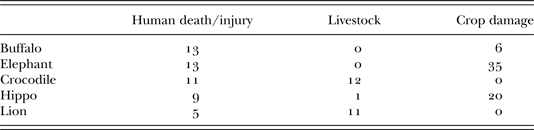
Political ecology perspectives have shifted ecology's focus on proximate drivers of human–wildlife conflict to the identification of a broader system of human-environment linkages in which environmental conflicts are understood as social struggles over access and control over natural resources (Watts Reference Watts, Johnston, Gregory, Pratt and Watts2000; Robbins Reference Robbins2012; Pienaar et al. Reference Pienaar, Jarvis and Larson2013). Central to political ecology analyses are the marginalisation of some resource users, natural resource governance, and the socially constructed meanings of the environment and how these shape resource use and outcomes of development interventions (Blaikie & Brookfield Reference Blaikie and Brookfield1987; Jones Reference Jones2006; Ogra Reference Ogra2009). Such a perspective appears highly relevant for our understanding of the lion attacks in the Mbire district. Unlike other animals that come into conflict with people, lions play an important role in the cosmology of the Shona-speaking peoples of Zimbabwe (Lan Reference Lan1985; Bourdillon Reference Bourdillon1987). Known as mhondoro or lion-spirits, lions are regarded as the carriers of the spirits of deceased chiefs and headmen and therefore also have significance in local politics. Lion attacks thus tend to attract more attention than attacks by other animals, even though the latter generally kill more people and livestock (Table I).
Incidents of human–wildlife conflict in Mbire district as reported to ZimParks, 2006–2009
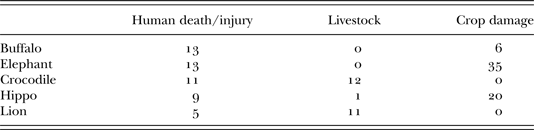
Source: ZimParks Mbire District Office problem animal control records.
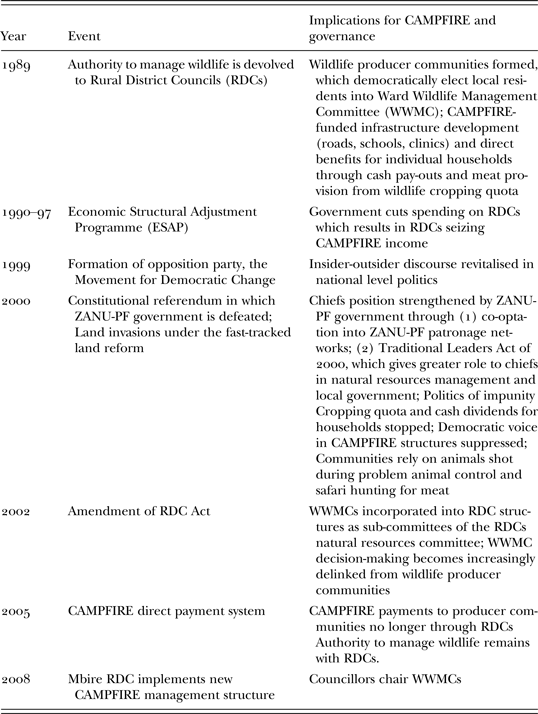
In this article we build on a political ecology approach to explore the complex dynamics of human–human conflict behind the human–wildlife conflict label in the context of Zimbabwe's CAMPFIRE programmes. In contrast to its success in the 1990s, CAMPFIRE has had disappointing results in the 2000s. This is often linked to how local governance and CAMPFIRE benefit-sharing arrangements changed as a result of national-level decision-making (see Table II) (Balint & Mashinya Reference Balint and Mashinya2006; Mapedza & Bond Reference Mapedza and Bond2006; Rihoy et al. Reference Rihoy, Chirozva and Anstey2007). Combined with a lack of management capacity within the RDC's Ward Wildlife Management Committees (WWMCs) and limited local experience with democratic processes, it has been argued, CAMPFIRE programmes have become vulnerable ‘to co-optation by traditional and political elites’ (Balint & Mashinya Reference Balint and Mashinya2008: 129). Thus, as Mapedza & Bond (Reference Mapedza and Bond2006) have shown for Gokwe district, councillors and chiefs could appropriate CAMPFIRE facilities and revenue and use their connections to ZANU (PF) to silence criticism.
Major political events and changes in CAMPFIRE management arrangements

Sources: Murombedzi (Reference Murombedzi1999), Mapedza & Bond (Reference Mapedza and Bond2006), Balint & Mashinya (Reference Balint and Mashinya2006), Rihoy et al. (Reference Rihoy, Chirozva and Anstey2007), Taylor (Reference Taylor2009b).
With the polarisation of the national political landscape following the formation of the Movement for Democratic Change (MDC) in 1999, this vulnerability of CAMPFIRE has become increasingly apparent. First, the ZANU-PF-led government changed the structure of WWMCs in 2002; elected committees consisting of ordinary villagers came to be led by ward councillors (GoZ 1988, 2002).Footnote 5 Ward councillors, who sit in RDC meetings as community representatives, also represent specific political parties. Local governance has thus taken on a party-political dimension, directly linking local wildlife management to national politics. Second, the post-2000 revival of the position of chiefs and headmen in local governance has been interpreted as a political survival strategy of the ZANU (PF) government in the face of mounting discontent about its rule (Makumbe Reference Makumbe, de Visser, Steytler and Machingauta2010). While it had sought to side-line traditional leaders immediately after independence, government substantially increased their material benefits, shoring up its local support through political patronage (Moyo & Yeros Reference Moyo and Yeros2007; Kriger Reference Kriger2012).
Zimbabwe's polarised political landscape has come with a political discourse that portrays the MDC as a party representing the interests of outsiders, particularly the former colonial master, Britain. Opposing government policies thus casts one as an MDC supporter, an outsider, and an enemy of the state (Kriger Reference Kriger2012). Thus, changes in politics and government structures have not only enabled elite capture of wildlife resources, but are also seen as closing down the space for local people to voice discontent about local governance or participate in wildlife management (Balint & Mashinya Reference Balint and Mashinya2006; Mapedza & Bond Reference Mapedza and Bond2006; Rihoy et al. Reference Rihoy, Chirozva and Anstey2007). This paper adds to this emergent political ecology perspective on CAMPFIRE, but argues that political change and the closing down of democratic local government structures in Zimbabwe have not silenced people. People continue to raise their concerns, but indirectly, using the powerful idiom of the mhondoro. What is striking about this idiom is that it builds strongly on an insider-outsider divide, just as the political discourse at national level does. Well-understood by those in power, people's use of the insider-outsider divide in the idiom of mhondoro serves to contest political hierarchies and define entitlements to local natural resources. Localised human–wildlife conflict, it is argued, is thus inextricably linked to the larger socio-political system that stretches beyond the local level.
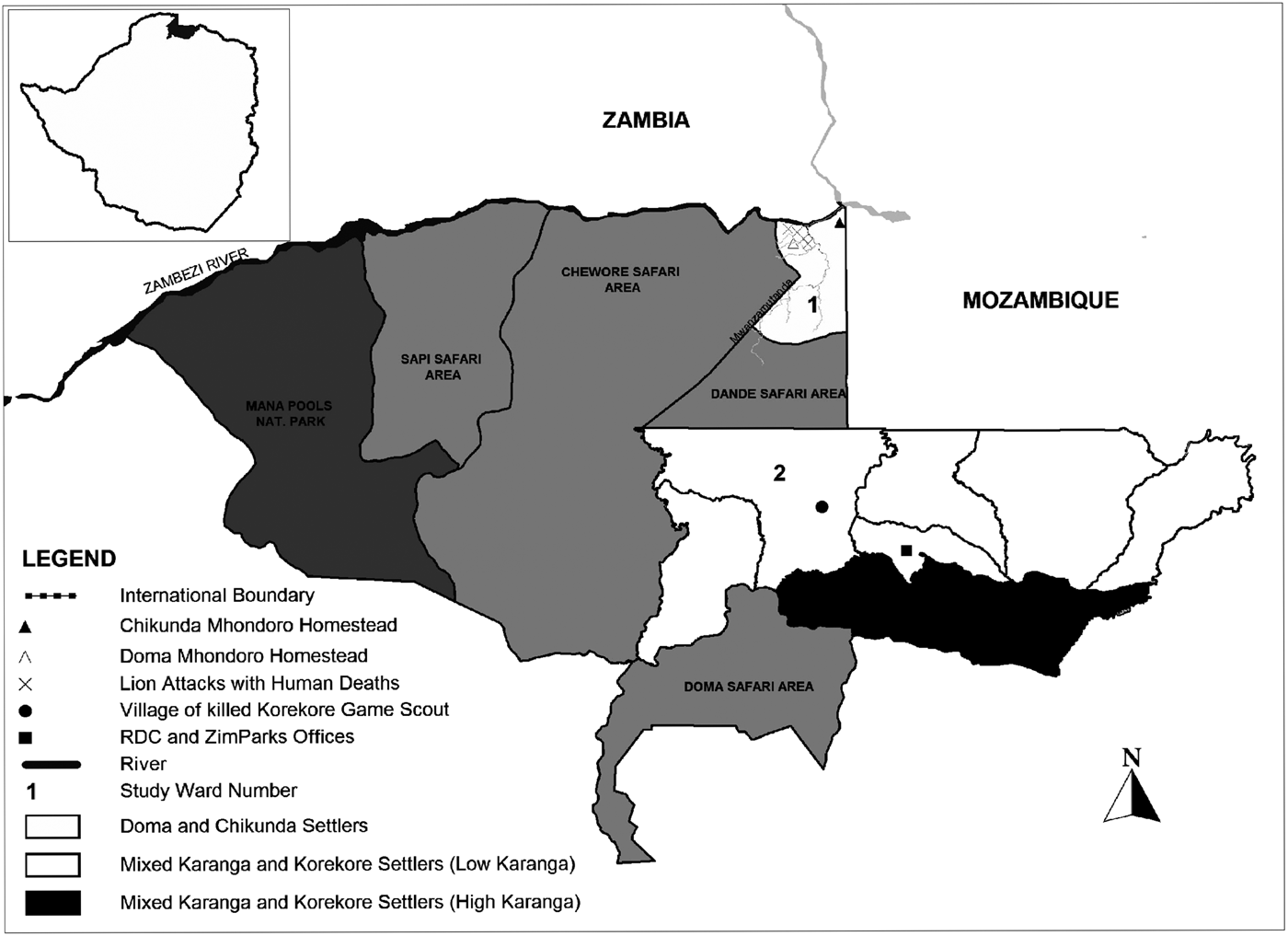
The study builds upon the anthropological case study method or situational analysis, in which detailed analysis of a single social situation, or limited number of events, provides an understanding that has wider applicability (Garbett Reference Garbett1970; Burawoy Reference Burawoy1998). Participant observation, open interviews, focus group discussions and a survey were used to explore the lion attacks and its social consequences. Written sources on the lion attacks included newspaper reports and local CAMPFIRE committee records. Fieldwork was undertaken from June 2010 to March 2012. We interviewed 81 households that had a member or livestock killed by lions (Figure 1). The selected households were drawn from the CAMPFIRE ward committees' or the ward councillor's records and thus reflect only reported cases. We also interviewed other stakeholders in wildlife management such as ZimParks officials, Mbire RDC officials, police officers, professional hunters, chiefs and mhondoro. One group discussion with local farmers was held in ward 2 in June 2011. All interviews focused on the (perceived) causes of the lion attacks. Records of the Mbire RDC meetings, and attendance in one meeting in October 2011, were a source of data on CAMPFIRE while data on human–wildlife conflict in Mbire were obtained from ZimParks records.
Map of the location of Mbire district in northern Zimbabwe, indicating the study sites, places of interest and geographic distribution of ethnic groups.

The article proceeds as follows: To understand the local interpretations of the lion attacks as expressions of political discontent, it is first necessary to elaborate on the symbolic significance of lions in local cosmology, customary governance arrangements and the management of natural resources. Thereafter, we expand on the link between customary governance arrangements and local state structures in rural Zimbabwe, as well as the growing importance of CAMPFIRE in districts like Mbire. This background is necessary to appreciate different stakeholders' dependence on natural resources, as well as their reactions to the lion attacks. The case study that follows highlights how local people and their leaders use the lion attacks to contest the current authorities in wildlife management. The analysis of the social dynamics behind the label human–wildlife conflict suggests that human–human interactions must be more thoroughly examined when evaluating human–wildlife conflict as it is embedded in the socio-political workings of Zimbabwean society.
MHONDORO, CHIEFS AND LOCAL GOVERNANCE
Among the Shona, chiefs are hereditary leaders of clans in an area (Mararike Reference Mararike2003). Deceased chiefs are believed to continue to guide the current inhabitants of their chiefdoms as mhondoro or ‘lion spirits’. As a result, the history of occupation or conquest of an area, translates into a hierarchy of mhondoro on top and the ruling chief and his (village) headmen at the lower end of this hierarchy. As lions are believed to carry the spirit of a deceased chief until it has found a suitable human host, a medium, to communicate to its descendants, the behaviour of lions may be interpreted as a mhondoro communicating with the inhabitants of his chiefdom (Garbett Reference Garbett, Stokes and Brown1963; Gelfand Reference Gelfand1974; Bourdillon Reference Bourdillon1987). When a medium is found and possessed by the ancestral spirit, people regard this as the mhondoro speaking, not the person acting as medium.
As mhondoro are seen as guardians of the land and its peoples, they have a meaning in local governance of both people and natural resources in their territory or spirit province (Garbett Reference Garbett, Stokes and Brown1963). For instance, mhondoro are believed to be able to withdraw their spiritual protection, resulting in environmental calamities such as droughts and pest plagues, when angered by their subjects' behaviour (Gelfand Reference Gelfand1974; Mawere & Wilson Reference Mararike1995; Mbereko et al. Reference Mbereko, Chimbari and Mukamuri2007). The mhondoro belief system may therefore be seen as a set of rites and taboos that serve to maintain social order (Bourdillon Reference Bourdillon1979). Simultaneously, it shapes the Shona polity. For instance, it is the mhondoro who approve a new chief (Bourdillon Reference Bourdillon1987). They may also advise and reprimand chiefs on issues of governance and thus challenge their leadership (Ricard & Muzeza Reference Ricard, Muzeza, Tonneau and Teyssier2001). Mhondoro can thus act as a countervailing power in local governance (Bourdillon Reference Bourdillon1979; Lan Reference Lan1985).
The mhondoro also shape the polity by defining who belongs and needs to follow local customs; they accept people of other clans (immigrants, who settled later) into the area, and may exclude outsiders from accessing local resources. Autochthons and immigrants (or ‘strangers’) are thus not defined by one's place of birth, but by the order of settlement of one's clan in the area. The distinction is maintained across generations: a descendant of an immigrant is also an immigrant/stranger, even if born in the area. The order of settlement and the autochthon-immigrant distinction are important as they define entitlements to local resources. Often it is strangers who are blamed by autochthons and their mhondoro for causing environmental calamities (Mawere & Wilson Reference Mawere and Wilson1995; Spierenburg Reference Spierenburg2005).
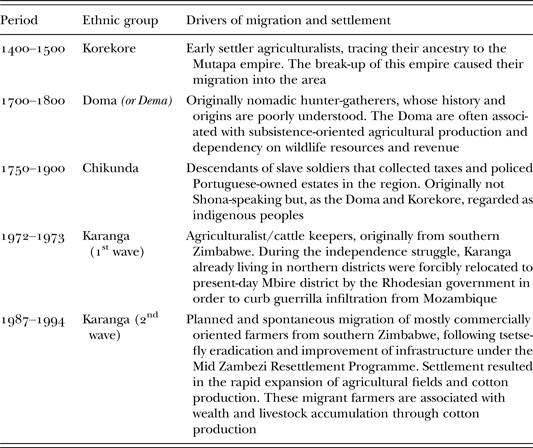
In the Mbire district, the Chikunda, Korekore and Doma are considered autochthons, whereas the Karanga are considered immigrants (see Table III). In contemporary Mbire district the ethnic categories do not only denote different origins of people, but often coincide with socio-economic differences and livelihood orientations; between commercially oriented farmers with cattle, and poorer, often food-insecure households that are more dependent on food assistance.
History of settlement of the Mbire district and livelihood orientations associated with locally used ethnic categories
Sources: Lan (Reference Lan1985), Hasler (Reference Hasler1996), Derman (Reference Derman1997), Spierenburg (Reference Spierenburg, de Bruijn, van Dijk and Foeken2001), Isaacman & Peterson (Reference Isaacman and Peterson2003), Mukamuri et al. (Reference Mukamuri, Chirozva, Matema, Matema, Nzuma, Andersson, de Garine-Witchatitsky, Cumming, Dzingirai and Giller2013).
Chiefs, colonial rule and the dualist structure of local governance
Unlike the mhondoro, chiefs and their headmen have been incorporated in local government structures since the early colonial period, when they became responsible for tax collection and labour mobilisation (Ranger Reference Ranger1982; Lange Reference Lange, Lange and Rueschemeyer2005). As colonial control at the local level expanded, chiefs and headmen became merely an extension of government under Native Commissioners, later District Commissioners (Richens Reference Richens2009; Gerring et al. Reference Gerring, Ziblatt, van Gorp and Arévalo2011). And although decentralisation in the late 1950s resulted in chief-led African Councils (Mutizwa-Mangiza Reference Mutizwa-Mangiza1990; Chatiza Reference Chatiza, de Visser, Steytler and Machingauta2010), their history of co-optation and collaboration caused chiefs to be distrusted by their subjects and the liberation movements' fighters during Zimbabwe's struggle for independence. As paid government employees, chiefs were considered sympathetic to the Rhodesian government (Kriger Reference Kriger1988). As a result, liberation war fighters aligned themselves with the mhondoro, who became symbols of resistance to colonial rule and guides of the war effort (Lan Reference Lan1985).
After independence, government stripped chiefs' powers because of the role many of them had played during the liberation war. Chiefly powers in the allocation of land and natural resources management were given to newly formed Rural District Councils (RDCs) (see below). Yet, in a number of areas chiefs and headmen continued to play an important role in local governance and natural resource management (Andersson Reference Andersson1999). Although the Traditional Leaders Act (2000) restored chiefs' land-allocating powers, the Rural District Councils' land-allocating powers were not revoked. This move by government strengthened the dualist structure – traditional and modern state – of local government in rural Zimbabwe. This dualist governance structure is further complicated by struggles between chiefs and mhondoro over who has jurisdiction over a particular area, its peoples, and natural resources such as wildlife. Although the mhondoro remain unrecognised by government as an authority over land, natural resources and people, their influence is often substantial as is evidenced by local people's deference to them on development issues (Ricard & Muzeza Reference Ricard, Muzeza, Tonneau and Teyssier2001; Sithole Reference Sithole2003; Spierenburg Reference Spierenburg2005).
LOCAL GOVERNMENT: INCREASED DEPENDENCE ON WILDLIFE RESOURCES
In contrast to the apartheid-like approach that underpinned earlier local government structures, Rural District Councils (RDC) formed in the early 1990s sought to establish development-oriented democratic structures at the local level (Roe Reference Roe1995; Mandondo Reference Mandondo2000; de Visser et al. Reference Visser, Steytler and Machingauta2010). As part of this development of local government structures, districts were sub-divided into wards. Ward Development Committees (WADCOs), headed by democratically elected councillors, were to develop ward development plans that incorporate the plans as developed by Village Development Committees (VIDCOs); village-level administrative organs headed by village heads. The WADCO coordinates local development programmes in line with the RDC's district development plan.
Other than a move to enhance participation in local governance, the re-organisation of local government also sought to reduce central government's spending on rural development (Roe Reference Roe1995). In the 1980s, district councils in former African-only areas such as the Zambezi valley had been largely funded by central government (GoZ 1988; Coutinho Reference Coutinho, Visser, de., Steytler and Machingauta2010). However, structural adjustment policies in the 1990s forced central government to limit its financial support to the newly formed Rural District Councils, resulting in most of these councils struggling to finance their operations and development plans (Coutinho Reference Coutinho, Visser, de., Steytler and Machingauta2010). In districts with abundant wildlife populations, safari hunting through CAMPFIRE became a major financial resource for local government (Coutinho Reference Coutinho, Visser, de., Steytler and Machingauta2010). Sharp economic decline after 2000 further increased this dependence on CAMPFIRE revenue. For instance, in the Mbire district, CAMPFIRE revenues now constitute 70% of the RDC's operational budget.Footnote 6 As a result of this increased financial dependence on CAMPFIRE, RDCs have become increasingly reluctant to devolve wildlife management to village communities (Rihoy & Maguranyanga Reference Rihoy and Maguranyanga2007).
CAMPFIRE revenues used to flow from the concessionnaires, that is, safari operators to the RDCs which distributed the share of the income due to the wildlife-producing communities. This procedure allowed RDCs to capture some of the funds due to communities (Rihoy & Maguranyanga Reference Rihoy and Maguranyanga2007). RDCs lost this control over CAMPFIRE revenue when a direct payment system was introduced in 2005. Since then, safari operators pay the community share, which is 50% of the revenue generated, directly to the WWMCs (Taylor Reference Taylor2009b). However, as the WWMCs had become sub-committees of the RDC (see Table II), the latter may still be able to capture the community's dividend. Conflicts between communities and the RDC about the use of revenue that were common before the direct payment system may thus resurface. At the same time, the introduction of the direct payment system has aggravated already existing tensions between local communities and the safari operators. Such tensions usually revolve around whether some or all sources of income, such as trophy fees and accommodation fees, should be shared (Personal communication, Mbire RDC official, Mbire district, 3.6.11).
In short, diminishing central state support for local government and economic decline has made local government increasingly dependent on the exploitation of local wildlife resources. But economic decline has also made local livelihoods increasingly dependent on local resources, including CAMPFIRE revenues and farming. It is in this context of converging political and local livelihood interests in local resource exploitation that the interpretations of the lion attacks should be understood.
THE 2010 LION ATTACKS: LOCAL REACTIONS AND INTERPRETATIONS
Lion attacks on livestock were widespread in Mbire district in 2010, but attacks on people were limited to Ward 1, where mostly native Chikunda and Doma people live (Figure 1). The first person killed, in the early morning of 1 January 2010, was a 22-year-old Doma fisherman who was attacked on his way home from fishing on the banks of the Zambezi River. There was no reaction from the Parks and Wildlife Management Authority and the Mbire Rural District Council (RDC) as the authorities suspected the man to have been a poacher (Senior Police Officer 2011 int.). Only after two more Doma men were killed, a 23-year-old canoe operator and a 52-year-old farmer, did the Mbire RDC send out a team of four game scouts to track and kill the man-eating lions. Lions attacked this team, which consisted of three Chikunda men from Ward 1 and a Korekore man from Ward 2, on 16 January. The game scout of Korekore origin was killed in this encounter.
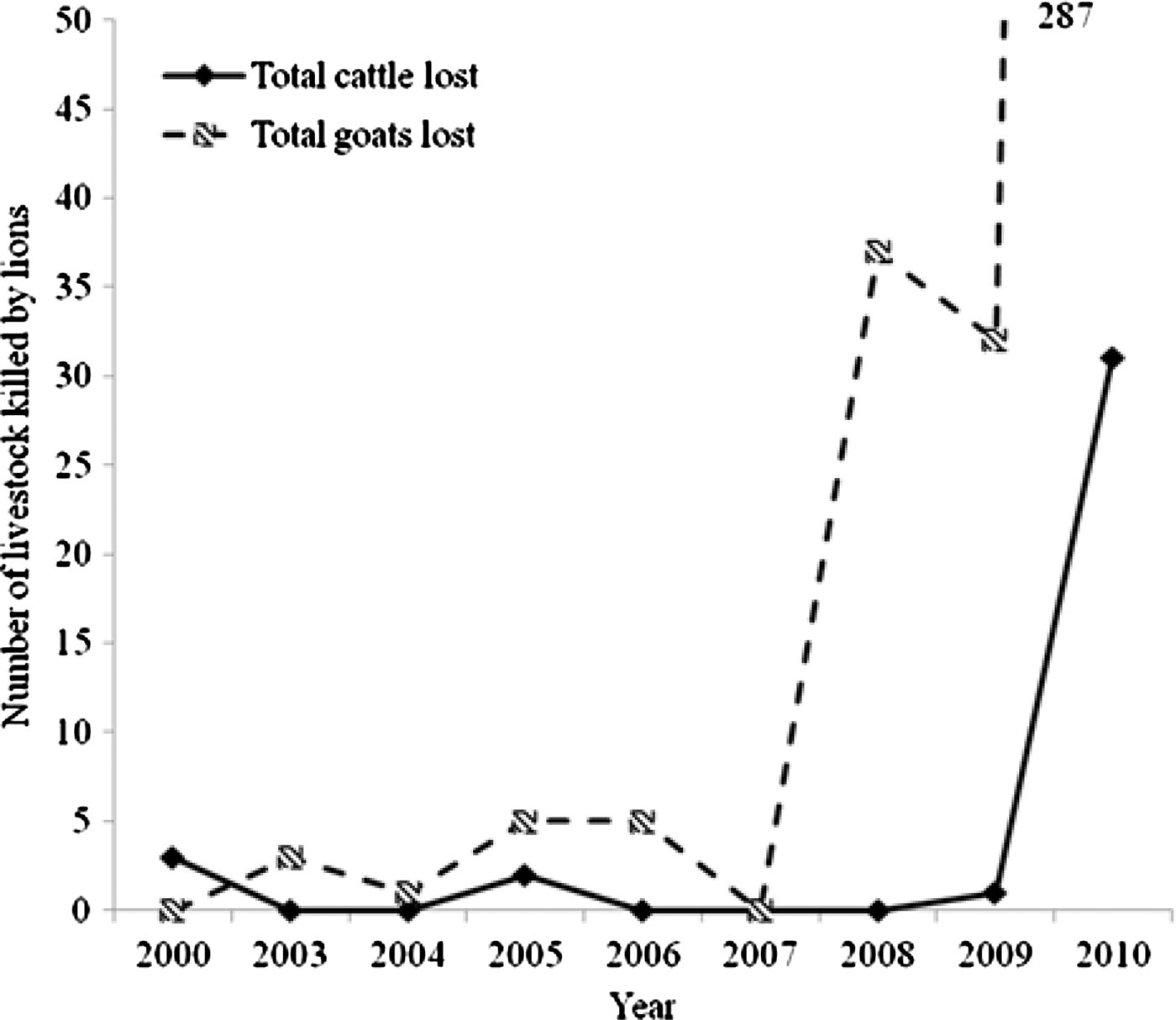
The events of early 2010 were at odds with trends in human–wildlife conflict in the preceding decade (Figure 2), and gave rise to multiple interpretations among residents and officials in the Mbire district. These are discussed below in relation to the social positions of those involved.
Graph indicating the number of cattle and goats lost from 2000 to 2010 based on recall by respondents (n = 81). The total for 2010 is for the month of January only.
Different epistemologies, shared problem definition
A salient feature of the interpretations of the lion attacks is that they build on distinct epistemologies. Autochthons and their leaders such as the mhondoro spirit mediums and chiefs often stressed the role of the local ancestral spirits in the lion attacks. For instance:
Lions killed people because some residents of Kanyemba (Ward 1) defiled two mhondoro shrines; human waste was found in one and people got intimate in the other. But the lions were ordinary lions, mabandupandu (violent dispersersFootnote 7), not lions from us. … As mhondoro we took advantage of the presence of these violent dispersers to punish people. (Chikunda mhondoro 2011 int.)
I consulted the mhondoro on what could have caused the lions to kill people. Chikwamba [a Doma mhondoro] said that some people had committed incest, which is taboo here. Just today, Kanyemba [Chikunda mhondoro] told the white hunters who were here that if they do not listen to what the mhondoro say, they could face the same consequences as the people killed here in January 2010. (Chikunda Chief 2011 int.)
These statements exemplify the common theme in Shona cosmology of mhondoro as the guardians of social and moral order. The mhondoro claims his authority by stating he directed the lions. However, such a claim is not frequently expressed in public (such as during the focus group discussion we conducted). Neither are the mhondoro's statements uncontested. As a Korekore woman during the focus group discussion argued: ‘Mhondoro do not operate like that, killing their own people.’
In contrast to the above-quoted traditional leaders, government officials and educated people tended publicly towards ecological explanations of the lion attacks:
As learned people we say something biological happened to the lions. I suspect that one of the lions was old and people are easy prey … This is a safari hunting area, so lions are disturbed during the hunting season, and poachers also disturb the lions. (Educated Chikunda man 2011 int.)
ZimParks officials buy our goats to use as bait when sport hunting lions [with safari operators]. Now that lions have tasted goat meat, they [lions] keep coming back because goat meat is tastier and tenderer than the meat of wild prey. (Goat-owner of Korekore origin 2011 group discussion)
We had a moratorium on the hunting of female lions. It is hunting of female lions, which negatively affects the lion population … I do not remember when we shot a lion as a problem animal. Each male lion needs a territory to rule as a king, thus as the population increases other males are chased away and the chased ones move into unoccupied territories. (Mbire RDC senior administrator 2011 int.)
Although building on scientific thinking, these interpretations are similar to the mhondoro's in stressing that the lion attacks are not merely a human–wildlife problem, but a social problem. Different epistemologies are thus neither in conflict, nor mutually exclusive (cf. Andersson Reference Andersson2002). Perhaps significantly, it is a chief – being educated and both a traditional leader and a government-employee – who renders the epistemological distinction between spirit-based and ecological explanations of the lion attacks immaterial:
These killings show that there is something traditionally wrong in the community, which caused the lions to eat people. But once the lions [kill and] eat people; they discover that people are weak prey. So, the environmentalists will say once the lions taste the blood of people, they develop a preference for people as prey. But the question is: ‘How did the lions come to taste the blood of people first?’ That is where environmental explanations work hand in hand with our tradition. (Chikunda Chief 2011 int.)
Interpretations of the lion attacks may thus build on distinct epistemologies, but both officials and local people invariably saw the apparent human–wildlife conflict foremost as a wildlife management problem. The interpretations of the lion attacks thus go beyond ecological cause-and-effect focused explanations. Instead, they raise the question of accountability; who is responsible for these attacks?
Natural resource-dependent livelihoods
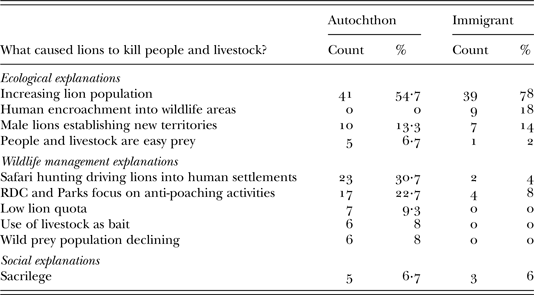
While different stakeholders regarded lion attacks as a wildlife management problem, autochthons and immigrants differed in their views. This distinction can be understood from their diverging dependence on wildlife resources. A household survey (n = 81) in the areas where the lion attacks occurred, showed that one third of the autochthon households partially depended on CAMPFIRE. Particularly CAMPFIRE-financed maize grain distributions and wildlife meat allocations during the (safari) hunting season contribute to these households' livelihoods, but in the past households also received cash pay-outs. By contrast, only a fifth of the immigrant household respondents ever received CAMPFIRE revenues in cash or kind. As the proportion of households benefiting from CAMPFIRE distributions has fallen from 80·3% (pre-2000) to 9·8% (post 2008), it is mostly CAMPFIRE-dependent autochthons that have been affected. Thus we may understand why especially autochthons linked the lion attacks to (wildlife) governance (Table IV):
Because of CAMPFIRE lions increased. Now they encroach upon human settlements. Before CAMPFIRE we controlled animals by hunting them, but now the law controls the animals. Because of CAMPFIRE we are also forbidden to harvest traditional foods that our ancestors ate, medicines and collecting good clay soils for pottery. (Man of Doma origin 2011 int.)
I last received [CAMPFIRE] cash dividends in 1997. We also used to get meat but buffalo is now used as bait when safari operators hunt lions, so no meat is given to the community. Only octogenarians, who are just 48 in number here, three spirit mediums, the chief, councillor and the bereaved, are getting free grinding mill services from the CAMPFIRE-purchased grinding mill that is run by the Ward Wildlife Management Committee. (Man of Chikunda origin 2011 int.)
Linkage of the lion attacks to wildlife management, Surveys 2010 and 2011
The autochthons thus hold the authorities accountable for the lion attacks, as well as their declining CAMPFIRE benefits and access to natural (wildlife) resources. They see the RDC and ZimParks as more concerned with protecting wildlife than with local people's livelihoods. A woman whose husband was killed by lions summarises the expectations of CAMPFIRE-dependent autochthons vis-à-vis local government:
My husband was not poaching. He was killed at home. Because my husband is dead, I do not have food, cannot afford school fees and clothes. The [Mbire Rural District] council must help because its lions killed my husband. (Woman of Doma origin 2011 Int.)
Immigrants, whose livelihoods hardly ever depended on CAMPFIRE, view wildlife management differently and their complaints are of a different nature. Attracted to the Mbire district by the availability of land and the prospect of profitable cotton farming in the 1980s and 1990s, immigrants' livelihoods mostly depend on farming. The vast majority of immigrants in the survey (82·6%) settled in Mbire for farming.Footnote 8 Immigrants also tend to have larger livestock herds than autochthons do; on average 4·8 heads of cattle and 8·6 goats compared with 1·1 heads of cattle and 6·5 goats among autochthons. Immigrants thus tend to lose more livestock to wildlife predation than autochthons do. During the lion attacks in the first month of 2010 they lost on average 1·6 head of cattle, while autochthons lost half that figure.Footnote 9 Unlike autochthons, who stressed loss of CAMPFIRE benefits, immigrants' complaints therefore focused on problem animal control (see also Table IV):
Lions in the grazing area killed my ox as I watched. I reported the incident to ZimParks the same day but there was no reaction. The ZimParks game scouts only came [to me] three days after I made the report, when the lion was already gone. (Cattle-owning Karanga immigrant 2011 int.)
Livestock owners complained that ZimParks' definition of a ‘problem animal’ resulted in their inaction. As one Karanga immigrant pointed out during the focus group discussion, ‘What is a problem animal? The RDC and Parks say it is an injured animal. As a result, [uninjured] lions are roaming freely’. The immigrant livestock owners thus hold ZimParks accountable for their livestock losses. These losses threaten their draught animal-dependent farming-based livelihoods. Replacing lost livestock has become increasingly difficult as cotton prices have declined.Footnote 10
Elite capture and the end of local participation
Unlike the ordinary inhabitants of Mbire, who linked interpretations of the lion attacks to CAMPFIRE and their daily survival, local leaders were more concerned with the politics of local government:
How do you deal with a situation whereby a councillor has served his term, but people still consider him or her as the best person to lead CAMPFIRE in the ward? [that is, to chair the WWMC]. Our councillor here has served the people well. It will be a pity to lose him, if he is voted out because of his party affiliation. (Chikunda Chief 2011 int.)
While councillors are elected for five years on a party-political basis, WWMC members may be re-elected every two years, and stay on for many years. With the new arrangement of party-affiliated councillors heading the WWMC's, the chief is concerned that not capability and popularity, but party nominations of candidates and local people's allegiance to specific political parties will thus determine who will be the WWMC chairperson.
Councillors chairing WWMCs not only means that local government structures become increasingly politicised along party-political lines. It also increases the RDC's control over the allocation of CAMPFIRE revenues, and extends CAMPFIRE benefits to a larger set of local-level leaders. As a WWMC member explains:
Having the councillor as chairperson of the WADCO and the WWMC makes the WADCO, VIDCOs and CAMPFIRE structures inseparable. As a consequence, village secretaries, village heads and headmen receive allowances from the CAMPFIRE fund each time they hold VIDCO and WADCO meetings. (WWMC treasurer 2011 int.)
When RDC and WWMCs structures were separated, participants of VIDCO and WADCO meetings did not receive such allowances from CAMPFIRE funds. Ordinary inhabitants cannot easily challenge such elite capture. Challenging the councillor may jeopardise one's livelihood security in years of famine, as councillors have a role in food relief distribution.
Survey respondents indicated that CAMPFIRE used to benefit them in the form of schools, clinics, cash dividends and meat. Cash dividends have stopped since 2000 and no new schools, clinics or other public services have been financed out of CAMPFIRE revenues since 2002 (Ward councillor 2012 int.). Only meat continues to be distributed, but only during the hunting season, when (international) safari hunters kill animals and keep only some parts as hunting trophy. The decline in benefits for local people is not the result of declining CAMPFIRE revenues as these have been steady over the years (Taylor Reference Taylor2009b).
As CAMPFIRE benefits have been reduced to meat, it is not surprising that current debates revolved around its distribution. Of particular concern among the local leaders was the scrapping of the ‘cropping quota’, an allocation by ZimParks to the RDC in order to provide local households with some wildlife meat. This meat used to be distributed by the RDC to communities through the WWMCs, but communities got side-lined by the RDC:
Shortly after giving the community management powers over the utilisation of the cropping quota, the RDC started unfounded allegations that the community was abusing the quota … ZimParks then stopped allocating the cropping quota. Instead, they included the animals on the hunting quota, look for clients from South Africa and make money. (Korekore Chief 2012 int.)
Both the chief and councillor suggest that higher-level government officials capture CAMPFIRE benefits:
At the moment there is no cropping quota. Instead of the quota for the community what we now have is the provincial governor's quota, which caters for national holiday functions such as Independence Day. It is the governor who decides how many animals should be killed for such functions. (Ward councillor 2011 int.)
The Dispol [Police Officer Commanding the District], the [provincial] governor and the senator; knowing that there is a cropping quota, present requests for meat to the RDC, which are all granted. … So at the end benefits such as meat, employment, projects and cash do not get to the people. (Korekore Chief 2012 int.)
This high-level capture of Mbire's CAMPFIRE benefits extends the marginalisation of local people in wildlife management to include local leaders such as councillors, the RDC and the chiefs. As a local chief emphasised:
If we had our own quota for meat, then as chief I could decide how to use that to give people meat as need arises. Here we spent one, two years, without any meat distributed to communities … It is unlike the past, when we had a cropping quota. … even I, as chief in this area, get no meat to eat unless there is a hunt … But if you go to the ZimParks camp, the game scouts there have plenty of meat. The people ask, ‘Why chief, these people are not the owners of these animals but they hunt for meat while us, the owners, have no meat’. (Chikunda Chief 2011 int.)
Thus, although some of these local actors are benefiting from the political patronage network through which CAMPFIRE benefits are now distributed, they have lost decision-making power in wildlife management to outsiders.
The impossibility of voicing protest in wildlife governance: The MDC idiom
The above-discussed changes in the organisation of local wildlife management and the appropriation of wildlife resources by higher-level government officials signify a progressive marginalisation of local communities in wildlife management. Protesting against such developments is difficult as national-level, party-politics now pervade local government structure and wildlife management. As one farmer explained: ‘At one time we got together to complain to ZimParks about their lack of response to problem animal attacks, but that does not work anymore. If you complain you are accused of being an MDC supporter.’ (Karanga immigrant 2011 group discussion). The local ZANU-PF senator, elaborates on the meaning of this labelling: ‘Here when we say someone is MDC … we do not literally mean that. It just means your views are different from those of the rest of the people. We are just saying you are a boorangoma (rebel)’ (ZANU-PF Senator 2012 int.).
Thus, even ZANU-PF councillors could befall the accusation of ‘being MDC’,
[When I] raise issues about transparency in the allocation of revenue from CAMPFIRE in council meetings, with the support of two other ZANU (PF) councillors, the other ZANU (PF) councillors said we act like MDC councillors. (Ward Councillor 2010 int.)
The quotes above highlight the appropriation of a national-level political discourse in local-level wildlife management as a means to close down protest. Nevertheless, local people continue to voice their discontent, using similar labels in their interpretations of the lion attacks.
The discourse of protest: the construction of outsiders
Building on the mhondoro idiom that also defines the Shona polity, the legitimacy of those in power is challenged:
Yes, lions are increasing in number, but they will not attack anyone, except people who do things that are against our culture and the people who do not follow what mhondoro say will always have problems with wild animals. The problem is Christianity; our people now follow the white man's religion. Who still follows our traditional seed sowing and rainmaking ceremonies? The government lets chiefs lead bira (traditional ceremonies), a preserve of mhondoro. The local chief knows little about our local customs because he grew up in the city. He is a city man. Problems will persist in this area if the situation continues like this. (Chikunda mhondoro 2011 int.)
The above quote reveals how authority is challenged: by constructing ‘outsiders’. For instance, the mhondoro claims his authority over people by referring to Christianity as a religion of non-indigenous people. Similarly, the mhondoro expresses his disapproval of government's recognition of chiefs as spiritual leaders, by disqualifying the chief as an urbanite. As guardian of local values, the mhondoro holds ‘outsiders’ interfering with the social and natural order in the area accountable for the lion attacks.
The chief deploys the same discourse when explaining why out of the four game scouts, only one was killed:
The game scout had just killed one of the lions. As a non-local [to Ward 1], the game scout was meddling in affairs that did not concern him. It was a warning to outsiders not to intervene in a local dispute. The other scouts were locals [of Chikunda origin] and they were not killed. So, if you think deeply about it, you ask yourself why the locals were not killed. (Chikunda Chief 2011 int.)
The chief's narrative makes the mhondoro's argument explicit; one does not interfere in other people's affairs. Like the mhondoro, he evokes sacrilege, that is, the killing of a spirit lion. Ignoring the other human casualties, all locals of Doma origin, the chief uses the incidence of the game scout to emphasise his disapproval of outsider interference in local governance. Since the scouts were sent by the RDC, the chief's comments may also be understood as an indirect attack on the RDC: they are undermining his authority.
The councillor, representing a third category of local leader, reasons in a similar vein. Building on the allegations that the Mbire communities do not receive their full share from the CAMPFIRE hunting revenues, he blames another category of outsiders:
The animals and the land are ours. The ancestors are angry [as shown by the killings] that we are recklessly allowing safari operators to be in control of our resources. Now it is the safari operators who know the secret places that are endowed with our valuable natural resources that should sustain our livelihoods. We will be surprised one day to find all the animals and other resources gone. (Ward Councillor 2012 Int.)
The quotes above bring out three salient features of the dominant political discourse in the Mbire district and Zimbabwe at large. First, it shows how deeply and quickly the CAMPFIRE philosophy was adopted by local people, and how it still resides under the surface today. Second, disruption of the existing order comes from outside, so outsiders are responsible for local ills. Third, raising the issue of accountability within the existing political order, that is, challenging those in power requires their reconstruction as (relative) outsiders. Analogous to the mhondoro belief system in which chiefly succession translates into a spiritual hierarchy headed by the original occupants of an area, authority is challenged by claiming seniority in the history of occupation of the area. Thus, we may understand better the chiefs' explanation of the governor's limited hunting successes in an area full of lions:
The governor and his team were here [sport] hunting lions. They killed two hippos to use as bait … instead of giving the [hippo] meat to the people as expected under CAMPFIRE. [As a result] they did not get the lions and the hippos got rotten. They tried buffalo as bait, but still no lion was caught. But there are many lions killing people in this area … Because they did not consult mhondoro they went back empty-handed. But if they come back and consult mhondoro they will get the lions. (Chikunda Chief 2011 int.)
By emphasising that outsiders will be provided for when they acknowledge the local authorities, the chief thus expresses his discontent about the growing outsider involvement in local governance, albeit not directly to the governor.
In contrast to the chief, who will understand that being labelled ‘outsider’ means a challenge to his authority, safari operators of European descent appeared unaware of the meaning of this mhondoro-based political discourse. Disputing local people's allegations that it is outsiders like them who are to blame for lion attacks, a safari hunter argued:
The local people are greedy. They ask for many lions from the mhondoro thinking that more lions can be shot during safari hunting. That way the local people think they will get more money from CAMPFIRE. When these lions turn on them they complain. I do not understand these people at all. (Professional hunter 2011 int.)
Although the quote above appears to strategically deploy the mhondoro belief system, the professional hunter's understanding of it is limited. First, the mhondoro cannot be requested to send lions; lions are incarnations of the mhondoro. Second, as the local people pointed out, if they could ask the mhondoro for more animals to be hunted, they would rather ask for elephant and buffalo, which contribute more to the total of CAMPFIRE revenues than do lions.Footnote 11
DISCUSSION: THE OUTSIDER DISCOURSE AND ZIMBABWEAN POLITICS
In Mbire, the question ‘who is to blame for the deaths of people and livestock?’ was the central issue in the 2010 lion attacks, and remains a topic of debate. While people's interpretations of the lion attacks may build on different epistemologies, these interpretations all viewed the apparent human–wildlife conflict in Mbire District simultaneously as a social problem, that is, as a question of accountability. Hence Taylor's (2009a: 93) understanding of the interconnectedness of the social and natural order is applicable: ‘disorders in the human realm will resonate in nature, because the very order of things is threatened’.
In their search for accountability, different actors construed powerful politicians and wildlife administrators as ‘outsiders’. This illustrates Dunn's (2009: 115) assertion that the insider-outsider discourse, ‘resonates deeply with populations longing for a sense of primary security in the face of uncertainty’. Uncertainties are all too real in Mbire; the 2000s saw rapid economic decline, diminishing returns on cotton production, a reorganisation of CAMPFIRE structure and a drying up of its revenues, and severe lion attacks in early 2010. Although different actors construct different outsiders who they hold accountable, a salient feature of the discourse on the lion attacks is that outsiders are to blame for the disruption of the local social and natural order.
In the discourse on the lion attacks, the insider-outsider dichotomy is associated with common oppositions such as rural and urban, ancestor worship and Christianity, order and chaos, etc., but also with the moral order. The understanding of lion attacks as triggered by people's immoral behaviour (sacrilege) is just one example of this. In the discourse on the lion attacks local people invariably presented themselves as morally upright. For instance, the Karanga immigrant emphasised that his ox was killed in the grazing area, implying that he was not trespassing in wildlife areas. Similarly, the Doma woman emphasised that her husband was killed by lions while at home and he therefore cannot be accused of poaching. With such statements, local people argue that they are meeting their obligations, as agreed upon under CAMPFIRE. In contrast, it is outsiders – the safari operators, ZimParks officials, etc. – that are seen as causing the increase in the number of lions, their subsequent dispersal into human settlements, and their switch from wild to domestic prey.
In Shona thinking about social organisation the insider-outsider opposition translates into a political hierarchy. Whereas autochthons' rights to local resources are automatic, outsiders can access these resources only through those who were there first, that is with the consent of the mhondoro, or their worldly representatives (chiefs), the owners of the land (Spierenburg Reference Spierenburg, de Bruijn, van Dijk and Foeken2001, 2005; Virtanen Reference Virtanen2005). If they do not, they are viewed as conquerors. However, even authochtons have to invest in their community membership, for instance through consultations with the ancestors, and by spending time on the soil of one's place of birth (cf. Andersson Reference Andersson2001; Mujere Reference Mujere2011). Thus we can understand why saying the chief ‘grew up in the city’ amounts to contesting his authority, or why Mbire people view the governor's failure to sight and shoot a lion as his failure to recognise this hierarchy.
The insider-outsider opposition which features prominently in the mhondoro discourse and interpretations of the lion attacks, is similar to the ZANU-PF – MDC opposition in Zimbabwean national (party) politics and the way in which the MDC is construed as representing outsider interests in order to silence criticism. But whereas opposition to (ZANU-PF dominated) government may result in retribution (Kriger Reference Kriger2005), the mhondoro discourse provides a protest voice without a body – it is the spirits speaking and the living cannot be held accountable. Unsurprisingly, it is local leaders who depend on central government for their livelihoods who mostly resort to the mhondoro discourse to hold government agencies and politicians – as outsiders – accountable for the lion attacks. For instance, chiefs and councillors, being government employees, may not openly complain or criticise the government for marginalising them in the local governance of wildlife for fear of victimisation through possible loss of benefits and positions.
In all interpretations of the lion attacks, labelling someone an outsider is a political strategy. The label ‘outsider’ thus goes beyond delineating traditional Shona communities: it is used strategically in a political sense in resource conflicts (Mukamuri Reference Mukamuri1995; Spierenburg Reference Spierenburg2005; Fontein Reference Fontein2006). In Mbire, the ‘outsider’ discourse was deployed to contest the emergent pattern of governance in which powerful outsiders are seen as appropriating local people's (wildlife) resources.
CONCLUSION
The case study presented above offered similar insights as recent studies of CAMPFIRE development in the 2000s; while revenues from wildlife exploitation may not have changed much during Zimbabwe's on-going economic crisis, changing governance arrangements enabling elite capture have caused local people's benefits to dry up (e.g. Mapedza & Bond Reference Mapedza and Bond2006; Rihoy et al. Reference Rihoy, Chirozva and Anstey2007; Balint & Mashinya Reference Balint and Mashinya2008). This analysis has added to these earlier studies, showing that elite capture in Mbire District has extended beyond the local level. In contrast to these earlier studies it was shown that in Mbire changes in local (resource) governance did not silence local voices; rather the way in which grievances/protest is expressed has altered. Aware of the changed political landscape both locally and nationally, local people have resorted to the discourse of the mhondoro to interpret the upsurge in lion attacks in early 2010, and to raise their protest about – wildlife-dependent – local governance. The disembodied voice of the mhondoro precludes retribution from an authoritarian state or its agencies in local governance, and subscribes to Mutekwa's (Reference Mutekwa2010) argument that spirit possession in Shona cosmology is a potent means to recover voices of the marginalised.
While the mhondoro discourse appears as apolitical, it strongly resonates with Zimbabwean political discourse at national level. For instance, President Robert Mugabe seems to mimic local perceptions in Mbire District about who owns wildlife resources and who is to blame for their mismanagement, when he argues:
The illegal economic sanctions imposed on Zimbabwe by the United States and the European Union … continue to inflict economic deprivation and human suffering on all Zimbabweans … . Our small and peaceful country is threatened daily by covetous and bigoted big powers whose hunger for domination and control of other nations and their resources knows no bounds. Shame, shame, shame to the United States of America. Shame, shame, shame to Britain and its allies. Zimbabwe is for Zimbabweans, so are its resources. (President Mugabe Reference Mugabe2013)
As Mugabe, local people in Mbire view outsiders with interests in local resources as conquerors. They are held responsible for local problems. Without due attention to this ‘outsider’ construction in Shona cosmology and Zimbabwean political discourse, an understanding of ‘resource conflicts', and the way they are talked about, is incomplete. As a consequence, solutions or mitigation of resource conflicts, including apparent human–wildlife conflicts, may be ill-informed.