




No CrossRef data available.
Article contents
Active players or just passive bystanders? The role of morphemes in spelling development in a transparent orthography
Published online by Cambridge University Press: 03 May 2005
Abstract
We investigated Finnish children's use of morphological knowledge in spelling. A spelling task and an oral morpheme manipulation task given to first-year children showed that, although morphological facilitation emerged in children's spelling by April of Year 1, this facilitation was not specifically connected to children's morphological knowledge despite a general relationship between spelling and morphological knowledge. Experiment 2, using pseudowords with endings analogous to case inflections, suggested that these caselike endings prompted morphological parsing during spelling. The results suggest that in the transparent Finnish orthography there is no specific connection between morphological knowledge and mastery of certain spelling patterns. Instead, the facilitation arises from the morpheme-based organization of the lexicon and the subsequent parsing of words into their constituent morphemes.
Information
- Type
- Articles
- Information
- Copyright
- © 2005 Cambridge University Press
There are several ways in which orthographies can represent morphemes (as reviewed by, e.g., Bryant, Nunes, & Aidinis, 1999). First, morphology can determine which of two possible spellings of a sound should be used. For example, the ending /ks/ in English is spelled as x when the word is a singular noun or an adjective, and as cks when the word is a plural noun or a present tense verb in third person singular. Second, spelling sometimes involves representing unpronounced morphological distinctions, like the apostrophe in English. Third, it is possible that the conventional spelling for a morpheme contradicts phonological sound–letter correspondence rules. For example, the English regular past tense ending can be pronounced /t/, /d/, or /Id/, but is always spelled -ed. The question of interest in the context of spelling development is how children learn to use their morphological knowledge appropriately in their spelling attempts.
Nevertheless, there are orthographies such as Spanish and Finnish that have very regular phoneme–grapheme correspondence rules that alone define the spelling of words. Thus, words are spelled as they are pronounced, and morphemes that are pronounced differently in different words are also spelled in different ways. For example, the Finnish morpheme marking the inessive case (semantically equivalent to the English preposition in) is pronounced as

in some words and as

in others (because of vowel harmony), and spelled as -ssa and -ssä, respectively. In such orthographies there is no default reason why knowledge of morphology should be connected to particular aspects of spelling. However, there is also no pressing reason why morphology should not be involved in learning to spell orthographies like this. Consequently, the interesting question is whether children employ morphological strategies in spelling even when the orthography does not directly require them to do so.
Several studies investigating children's morphological knowledge and their literacy skills have drawn attention to the connection between the two (e.g., Carlisle, 1995; Rubin, 1988). Moreover, several longitudinal studies in different languages have concentrated on children's mastery of spelling patterns that are based on morphological principles rather than grapheme–phoneme correspondences (e.g., Nunes, Bryant, & Bindman, 1997, in English; Bryant et al., 1999, in Greek; and Rego, 1999, in Brazilian Portuguese). Morphological knowledge was measured by oral tasks that require children to change the target word into an appropriate inflected/derived form according to the sentence context. Children's scores in these tasks were then related to their mastery of spelling patterns that require the use of morphological rules. Results from these different orthographies all indicate that children gradually discover the morphological basis of the spellings and that this understanding emerges relatively late, not until after a few years of spelling instruction. Common to all of these findings is that the orthographies in question necessitate the understanding and use of spelling rules based on morphology, because following the phoneme–grapheme correspondence rules alone will not lead to correct spelling. This suggests that one of the necessary conditions for the involvement of morphological knowledge in spelling is the structure of the orthography in question. What we do not learn from these studies is whether this is the only determining factor.
This work concentrated on investigating how children learn to apply their morphological knowledge to specific spelling patterns. Because of the nature of the morphological awareness tasks, morphological knowledge in this context is defined as the ability to manipulate the morphological structure of words. However, although this skill is one way to characterize morphological knowledge, there are other ways in which morphemes could influence literacy acquisition; they can also feature as units of processing and lexical organization on a more implicit, even prelexical, level. It is important to note that this processing of morphemes as linguistic units in the context of literacy activities is less likely to demand the explicit application of the morphological rules of the language.
The role of morphemes as processing units has mainly been considered in studies on word recognition processes in adult participants (e.g., Laudanna, Badecker, & Caramazza, 1992; Schreuder & Baayen, 1994; Taft, 1994; Taft & Forster, 1975). The central question posed by this work is whether words are accessed and/or stored as whole forms or whether reading and spelling involve the parsing of words to their constituent morphemes. Languages with rich morphology and few pseudoprefixes and pseudosuffixes, such as Italian or Finnish, would be especially likely to benefit from a parsing process. If all the words in the language can have numerous different inflectional forms, the representation of all word forms as unsegmented wholes would be extremely costly in cognitive terms and it would not be possible to recognize words inflected in forms not encountered before. Therefore, separate representations of stem and inflection morphemes would make good sense.
Caramazza, Laudanna, and Romani (1988) investigated Italian speakers' lexical decision performance for pseudowords with different structures. They found that the shortest response latencies occurred for nonwords containing no segments that could have been considered as morphemes, and pseudowords producing the longest reaction times were those that were composed of two real morphemes (but in an illegal combination). This suggests that the amount of morphological analysis involved in word recognition depends on the degree to which the word contains segments that can be interpreted as morphemes. Furthermore, this appears to apply to processing of pseudowords, too.
These effects have recently also been investigated in children's reading performance, by both a lexical decision and a naming task. Burani, Marcolini, and Stella (2002) gave Italian children aged 8–10 years pseudowords made up of real morphemes (but in a combination that does not exist in Italian) and pseudowords that did not contain morphological constituents. They found that pseudowords with a morphological structure were named faster and caused fewer reading errors than pseudowords that were not made up of real morphemes. These results were supported by children's error rates in a lexical decision task, as pseudowords consisting of morphological constituents caused higher error rates. Reaction times failed to support these findings, but this could be due to the unreliability of this measure in child data. Overall, the results suggest that morphemes are salient processing units, even for 8-year-old children whose literacy experience is limited, and that the lexicon is organized in roots and suffixes from early on.
Finnish, another richly inflected language, has also provided evidence that morphemes are important units of lexical processing. Recent research in Finnish, as reviewed by Laine, Vainio, and Hyönä (1999), has revealed that, compared to monomorphemic words, multimorphemic words produce longer first fixations, longer reaction times in lexical decision tasks, and higher error rates (Hyönä, Laine, & Niemi, 1995; Laine, Niemi, Koivuselkä–Sallinen, & Hyönä, 1995; Niemi, Laine, & Tuominen, 1994). This work on word recognition in different languages has highlighted the significance of morphemes as processing units in richly inflected languages and emphasized the importance of considering the differences in morphological structure between languages.
The developmental studies and the experiments on lexical processing differ somewhat in their approach to morphological processing. The developmental work has mainly been prompted by the structural characteristics of orthographies, that is, the types of spelling rules different spelling patterns involve. The central question has concerned children's understanding that they need to consider the morphological properties of words to spell them correctly. The involvement of morphology has been assessed with tasks in which children need to use the semantic context to work out which morphological form is the correct one to use. In contrast, the starting point of the research on lexical processing is the structure of the language, and word recognition is a tool to find out how morphologically complex words are represented in the lexicon. Furthermore, as Burani, Dovetto, Spuntarelli, and Thornton (1999) and Burani et al. (2002) have argued, morpheme-based reading (i.e., naming) does not necessarily mean that “the semantics of the new combination is activated as well,” because the interpretability of pseudowords in adult and child naming studies did not influence naming performance.
If spelling patterns based on morphology trigger morphological processing in spelling, we would not expect morphological awareness to be connected to performance with particular spelling patterns in orthographies that are based on phonology alone. In contrast, if morphological processing could be involved in spelling because of the way in which the lexicon of the language in question is organized, there is no reason why morphology should not be involved in the spelling acquisition of transparent orthographies, too.
Finnish is an interesting language for this type of study, because it has a very complex morphology and thus would be likely to benefit from the kind of morpheme-based processing that Caramazza and colleagues (1988) advocate. Finnish nouns, for example, can take the plural marker, case inflections, possessive suffixes, and several clitic particles, which are all attached to the ends of words (see Table 1). This makes Finnish a prime example of an agglutinative language, and also means that Finnish words, on average, are relatively long and have a vast number of different forms, about 2000 for each noun and more than 10,000 for each verb. However, the orthography has transparent phoneme–grapheme relationships and no spelling rules that are specifically based on morphology. Each phoneme corresponds to a specific letter and vice versa. Therefore, morphological knowledge is in theory not required in spelling and is not stressed in literacy instruction. Finnish children are taught letter sounds one by one and learn the letter corresponding to each sound simultaneously in reading and spelling. Approximately equal amounts of time are devoted to both literacy activities. By the end of the first school year, children are expected to have acquired basic decoding and spelling skills.

To investigate the role of morphological knowledge in spelling Finnish, we assessed children's oral morphological competence and their ability to spell different morphemes. First, we asked first-year children at the end of their first and second school terms to do a dictation task where the target clusters appeared either in word stems or in case inflections of two-morpheme words. The aim was to find out whether the morphological structure of words would influence children's spelling performance by comparing children's spelling scores for identical letter targets in word stems and case inflections. We predicted that if there was a connection between morphology and spelling, children should do better when the targets were in inflections than when they were in word stems. Second, children did a morphological awareness task, which required the inflection of pseudo-words in different sentence contexts. This gave a measure of the children's skill in using inflectional endings. We predicted that if morphological knowledge were specifically connected to children's ability to spell case inflections, we should find a stronger correlation between the morphology score and inflection spelling than the morphology score and stem spelling. In contrast, a general relationship between spelling skills and morphological knowledge would be implicated if the morphology score correlated equally well with both stem and inflection spelling.
EXPERIMENT 1
Method
Participants
Forty-three first-year children participated in the experiment, but we omitted the data for 1 child because of a hearing problem and for another because of a bilingual background. This left 41 children (15 boys, 26 girls), whose mean age was 7 years, 4 months (7;4, range = 6;8–7;11 years) at the first time of testing and 7;8 years (range = 7;0–8;3 years) at the second time of testing. The children came from a primary school in Espoo, Finland. The first time of testing was in December of the first school year (Time 1) and the second time in April of the same year (Time 2).
Task and procedure
DICTATION TASK
The aim of the dictation task was to examine whether the morphological structure of words in Finnish affects children's spelling of different types of letter clusters. We asked children to spell to dictation two-morpheme words in which target clusters appeared in different morphemes of the word, either in the word stem or in the case inflection. We chose case inflections for two reasons. First, we were interested in early spelling development, and studies have generally not found strong effects of the more complex derivational morphology (Carlisle, 1988; Tyler & Nagy, 1989). Therefore, inflections were a better target for our study than derivations. Second, case inflections are a prominent part of the Finnish morphology, because they are taken by nouns, adjectives, pronouns and numerals alike, and if knowledge of morphemes were to play a part in spelling Finnish, it would be more likely to happen for a central aspect of the morphological system. Case inflections were compared to stems because we wished to gain a measure of children's spelling of the target clusters in unbound morphemes that required no inflection or derivation. Because literacy development in Finnish is very rapid, the list of words that we gave the children to spell at Time 1 would have probably produced ceiling effects at Time 2. Therefore, at Time 2 we used a dictation task with a similar design but with words that were longer and less frequent and had a more complex phonemic structure than the words used at Time 1.
The dictation task contained 48 words. We used a variety of consonant and vowel target clusters, both doublets (ss/ll/aa/ee) and mixed clusters (st/lt/ai/ei). Finnish case inflections involve a variety of phonological structures, and therefore it was considered important to include variation in the test items, too. All the words were nouns and two or three syllables long at Time 1 or four to seven syllables long at Time 2. The task design and the experimental words are presented in Appendices A and B. There are no frequency counts for children's reading materials in Finnish, so it was not possible to take frequency into account in item selection.
The children were given the dictation task in groups of about 10. The words were dictated during two sessions, as the task was too long for a single session. The experimental words were arranged in two lists, which were given to different groups: the words in each list were arranged randomly. The experimental session started with the distribution of the worksheets and then the children heard the following instructions:
We will now do a dictation task, where I will say one word at a time and you should spell it on the sheet in front of you, one word on each line. Listen very carefully. I will say each word once and then repeat it, and say it again if you ask me to do so.
MORPHOLOGY TEST
This test was designed by Lyytinen (1988). It follows the format of Berko's (1958) “wug” test and requires children to inflect pseudowords in sentences. We used three subtests: adverb, comparative, and past tense verb (i.e., 15 items altogether). It would have been ideal to use a test based on case inflections, but the case inflection subtest only requires children to manipulate the inessive case (a locative case corresponding to the English preposition in). Because this is one of the easiest case inflections, we decided not to use it to avoid ceiling effects. All test items required transforming the base form to the inflected form. The test words are old Finnish words that are no longer in use, so they were unfamiliar to the children but adhered to the phonotactic rules of Finnish. The instructions preceding the test were as follows:
I've got some picture cards here. Shall we look at them together? In these cards things are talked about using funny words, which you might not have heard before, but that does not matter. Sometimes it is nice to play with unusual words. Each card has two or three different pictures. I will tell you what the first picture is about. Then you should tell me what happens in the second picture and always use the word that I say to you separately with each picture. Let's look at a few examples!
The picture cards were placed in front of the child, the picture side facing the table, so that s/he was able to pick one at a time. Thus, the items were presented in a randomized order. The experimenter showed the first picture and said a sentence that included the test word (e.g., Tiplaaminen on kovaa työtä). She then pointed at the second picture and said another sentence. (Nytkin tuo–.) The child had to complete the second sentence with the correct form of the test word (tiplaa). Other examples:
Tämä kynttilä on näin hiilunut, tuo on vielä— (hiiluneempi) ja tämä on kaikista—(hiilunein).
Hotiseminen on näistä hauskaa. Nytkin nuo—(hotisevat).
The morphology task was primarily designed for use with somewhat younger children, as 80% of the 6;6 year olds tested during test development had mastered the inflectional endings in the test. In pilot studies, several versions of the analogy-type test developed by Nunes et al. (1997) were used for Finnish children in Years 1–3 in school, but none of these tests proved reliable in testing the variety of the Finnish case inflections. Therefore, we decided to use the morphology test, because, despite the reservations about using it for school-age children, at least it is an established measure for determining the level of morphological development of young Finnish children.
Results
Because the items in the dictation task were different at Times 1 and 2, it was not possible to analyze these data simultaneously in one analysis of variance (ANOVA). The results are thus presented and analyzed separately.
Time 1
DICTATION TASK
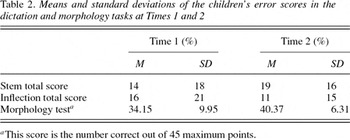
We scored the children's performance in the dictation task by counting the number of spelling errors for the target clusters in the stem and inflection conditions. We then calculated the error percentages by dividing each error score by the number of items in the condition (24). The reliability of the task was .957 (Cronbach's alpha). The overwhelming majority of the errors consisted of a missing letter. The means and standard deviations are presented in Table 2, which demonstrates that the error rates in the Stem and Inflection conditions did not differ considerably.

We inspected the error rates with a repeated-measures ANOVA, where position (stem/inflection) was the within-subjects variable. The difference between stem and inflection items did not turn out to be significant, F(1,40)=1.813, p=.186. Thus, it seems that at this point of development children have mastered stem and inflection spelling to the same degree.
MORPHOLOGY TEST
Our main hypothesis was that if Finnish children used their morphological knowledge specifically for certain spelling patterns, their ability to spell word inflections should be related to their skill at inflecting orally presented words. Consequently, the scoring scheme of the morphology test was adapted to this purpose. The original scheme allocates points depending on whether children make an error with the inflection, the stem, or both. However, this means that a sizable portion of variance in the morphology score should be due to children's competence in changing the stems appropriately. Therefore, we scored the task by only giving error points for errors in using the appropriate inflectional endings and disregarded the errors that children made in changing the stems of the words. The mean score is presented in Table 2. Because the maximum score was 45, there is still room for morphological development at this time.
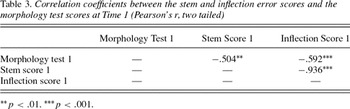
Our next step was to compute correlation coefficients between the morphological awareness and the stem and inflection spelling scores. The correlations are presented in Table 3.

The correlation coefficients show that the morphology scores do not correlate markedly better with the inflection scores compared to the stem scores (r = −.504 vs. r = −.592). Therefore, the results fail to provide convincing evidence that Finnish children at this point of development apply their skill to inflect words, specifically, to the spelling of inflectional endings. Instead, it seems that there is a general connection between morphological knowledge and spelling, which is hardly surprising given that they both are linguistic tasks.
Time 2
Children's performance in the dictation task was scored as before, and the means of the error percentages are presented in Table 2. The reliability of the dictation task used at Time 2 was .906 (Cronbach's alpha). This time, the means suggested that there was a difference between the stem and inflection conditions. This was confirmed by a repeated-measures ANOVA, with the within-subjects factor of position (stem/inflection). The dependent variables were children's error scores in the two conditions of the task. A significant main effect of position, F(1,40) = 21.580, p < .001, indicated that children were making more errors with stem words than inflection words (19 vs. 11%). Consequently, it seems that during the spring term children begin to spell target clusters better in case inflections than they do in word stems, which suggests emerging sensitivity to the morphological structure of words in spelling.
MORPHOLOGICAL AWARENESS AND SPELLING
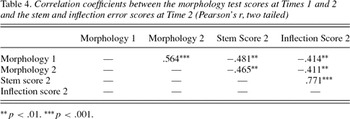
Again, we assessed children's morphological awareness by the morphology test, and the mean number of points children achieved in the task is presented in Table 2. We computed correlation coefficients for the stem and inflection scores and the morphology test scores at both times, which are presented in Table 4.

The correlation coefficients indicated that Time 1 and 2 morphology scores were no more strongly correlated with Time 2 stem than inflection scores (r = −.465 vs. −.411). Thus, the results provide no reliable evidence that the children's morphological awareness, as assessed by the morphology test, was specifically connected to their ability to take advantage of the morphological structure of the words.
Discussion
This experiment aimed to investigate two questions. First, we wished to see whether the morphological structure of words would affect first-year children's spelling performance at the end of their first and second terms at school. Second, we intended to find out whether children's ability to spell case inflections would be specifically connected to their skill in using appropriate case inflections in spoken sentences.
At Time 1, children spelled target clusters in word stems and case inflections about equally well, so morpheme type did not affect their spelling. The children's scores in the morphology test correlated significantly with their spelling of both stems and inflections, and there was no marked difference between these correlations.
By Time 2 the spelling scores showed a clear effect of morpheme type, because children were significantly better at spelling targets in case inflections compared to word stems. However, inspection of the correlations between the spelling and morphology test scores at Times 1 and 2 did not suggest that the facilitation observed in spelling would be specifically connected to children's morphological awareness. Therefore, although the results of the dictation task indicated that children gradually (between Times 1 and 2) become sensitive to the morphological structure of the words they are spelling, there is no reliable evidence suggesting that this development is systematically connected to and therefore possibly explained by children's developing morphological knowledge as assessed by the morphology test.
This lack of a specific relationship between morphological influences in spelling development and morphological awareness suggests that learning to spell the Finnish orthography does not appear to necessitate the use of morphological knowledge for specific spelling patterns. This is in contrast to results in orthographies such as English or Brazilian Portuguese, where morphological awareness specifically predicts the mastery of particular spelling patterns. Because the spellers we tested are relatively young compared to the studies in other orthographies, it would be tempting to suggest that maybe morphological knowledge will only start to affect spelling later on. However, this would still leave us with no morphological explanation for the facilitatory effect of inflection spelling observed at Time 2. The most obvious reason for the difference between orthographies is that Finnish can be spelled phonemically; thus, the use of morphological knowledge might provide an additional source of information, but, strictly speaking, it is not essential. Nevertheless, in Finnish there is a general connection between morphological knowledge and spelling performance, as indicated by the significant correlations between the morphology test and spelling in both the stem and inflection conditions.
Because specific morphological knowledge as measured by the morphology task does not explain why case inflections were spelled better than word stems, we need to look for alternative explanations. One possibility is that spelling of morphemes is influenced by the morphological structure of Finnish. This is a somewhat different approach to the developmental question of the connection between spelling and morphology. Research to date has mostly investigated children's skill at applying their morphological knowledge appropriately in spelling, whereas one can alternatively examine whether the way in which the lexicon is organized could make certain aspects of morphology salient for the types of learning strategies that children use in spelling acquisition. This was the aim of Experiment 2.
EXPERIMENT 2
The key characteristics of the Finnish morphology that could explain the findings of Experiment 1 are the separate representation of morphemes in the lexicon and the frequency of these morphemes. If morphemes are represented as separate units, as studies reviewed in the Introduction suggest, they could be useful in spelling by providing units for segmenting the typically long Finnish words. The number of case inflections (14) is low compared to the number of different stem morphemes in the language and each case inflection appears frequently. Thus, case inflections have a low type frequency but a high token frequency. This makes them amenable to frequency-based learning, which has been implicated in spelling development (e.g., Kemp & Bryant, 2003; Treiman, Kessler, & Bourassa, 2001). Consequently, it is possible that the effect of morpheme structure we found in Experiment 1 is due to the way in which the morphological structure of the language generates morpheme-based representations in the lexicon and the fact that inflections are good targets for frequency-based learning.
If this were the case, the difference between spelling of stems and inflections found in Experiment 1 could be due to the type of morphemes in the words to be spelled and their orthographic properties. It is important to note that the type of morphological processing involved in the two cases is very different. The use of morphological knowledge in the morphological awareness tasks requires both knowledge of the appropriate inflections and the ability to use the semantic context to work out which inflection is required. In contrast, morphological processing that would be based on lexical organization does not necessarily involve semantic processing or the use of morphological rules. Consequently, if the explanation of the results of the dictation task lies in the second type of morphological processing, we would expect to find similar spelling effects for pseudowords, because morphemic segmentation should be a general processing strategy rather than one that is specifically applied to some words only. Indeed, the effects that Caramazza et al. (1988) found were for pseudowords, and Laine et al. (1999) replicated this in Finnish.
Therefore, our next step was to test children's spelling of pseudowords that had target clusters either in the middle of words (i.e., like the stem words in Experiment 1) or at the end of words (i.e., like the inflection words of Experiment 1). The main question that we were interested in was whether the presence of an ending analogous to a case inflection would facilitate children's spelling of inflections in the absence of semantic information, revealing that the ending is an independent morpheme. If a facilitation effect also appeared for pseudowords, it would suggest that the results of Experiment 1 emerge due to the frequency properties of the different morphemes in the language. If we did not find the same effect for pseudowords, it would be necessary to postulate a more prominent role for the use of explicit morphological knowledge that also involves semantic processing of the words in question.
Method
Participants
The participants were 71 children from Years 1–3 in a primary school in Espoo, Finland. However, we omitted data from a first-year child whose first language was not Finnish and from another whose performance was too poor to be scored. This left 20 children (7 boys, 13 girls) in Year 1 (mean age = 7;7 years, range = 7–8;1 years), 24 children (9 boys, 15 girls) in Year 2 (mean age = 8;10 years, range = 8;5–9;5 years), and 25 children (13 boys, 12 girls) in Year 3 (mean age = 9;10 years, range = 9;4–10;3 years). The children were tested in April.1
Data of these children's phonological abilities have been reported elsewhere (Lehtonen & Bryant, 2004).
Task and procedure
The pseudoword dictation task was a modified version of the dictation task. The stimuli were pseudowords that either did or did not contain an inflection-like ending. Given the suggestion by Caramazza et al. (1988) and Laine et al. (1999) that inflections are separate processing units, we would expect the inflection-like endings to produce lower error rates for the target clusters that appear in case inflections. The targets were different consonant and vowel doublets and mixed clusters (ss/ll/st/lt/aa/ee/ai/ei) that appeared in two different position conditions:
- Stem condition: The target clusters appeared in the second syllable of four-syllable words, that is, in the equivalent position of the stem condition of the real words in the dictation task of Experiment 1.
- Inflection condition: The target clusters appeared in the last syllable of four-syllable words and were followed by the appropriate phonemes /a/ or /æ/, and so they were orthographically analogous to case inflections.
The pseudowords for the stem condition were constructed from real words in which enough phonemes were changed so that the original words could not be recognized. The words for the inflection condition were then formed from the stem words by rearranging the syllables in them, so that the words in the two conditions were equated as far as possible in terms of length and phonological properties. Sometimes, to make the word sound like a real Finnish word, it was necessary to insert a few phonemes or change the duration of a phoneme. Consequently, possible differences between conditions could not be attributed to systematic differences between the words in the two conditions. The 48 experimental words are presented in Appendix C.
Results
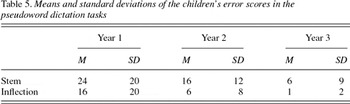
The aim of the pseudoword spelling task was to investigate whether the presence of an inflection-like ending in a pseudoword would facilitate children's spelling of the target clusters. The task was scored like the dictation task in Experiment 1, and the means of the error percentages are presented in Table 5. The reliability of the task was .927 (Cronbach's alpha).

The mean error rates were lower for the older children, but children in all groups made fewer errors in the inflection condition, as was the case for the real words at Time 2 of Experiment 1. The error types were also similar, and thus omission of letters was the most common error.
To inspect the error rates, we used a repeated-measures ANOVA, where year (1–3) was the between-subjects factor and position (stem/inflection) was the within-subjects factor. The dependent variable was the number of errors in the two conditions. Both the main effects were significant: position, F (1,66) = 42.556, p < .001, and year, F (2,66) = 10.845, p < .001. Thus, there were significantly more errors in stems than inflections (14 vs. 7%), and older children made significantly fewer errors than younger children. Importantly, there was no interaction between the two factors and, even though the third-year children were making very few errors, these were still much less frequent in the inflection condition.
Discussion
The results of Experiment 2 showed that even when children spell pseudowords they make fewer errors with target clusters that appear in case inflection-like endings than when the same clusters appear in the middle of words. This finding is similar to Caramazza et al.'s (1988) and Laine et al.'s (1999) results from adult lexical decision tasks: pseudowords, just like real words, are affected by the presence of morphological segments in the word. Caramazza et al. (1988) and Laine et al. (1999) suggested that if a word or a pseudoword contains segments that can be interpreted as morphemes, the word will be parsed into these morpheme-like units. Our findings agree with this and suggest that when children spell words containing segments that can be interpreted as morphemes, they parse the word into these segments instead of processing it as an unanalyzed whole. The similarity of the results for pseudowords in Experiment 2 and real words in Experiment 1 suggest that this is a general spelling strategy that children apply independently of the type of the word in question. Because new words are in effect the equivalent of pseudowords to young children, a strategy that is applied equally to both real and pseudowords provides a parsimonious explanation of the processes involved. The fact that there was no interaction between the position and year factors suggests that the tendency to use this particular parsing strategy in spelling remains quite stable across the first few school years.
GENERAL DISCUSSION
Our two experiments concentrated on two issues concerning spelling development and the role of morphology in this process. First, we were interested in whether Finnish children's spelling performance would be affected by the morphological structure of the word in question, and if this were the case, whether it could be due to children's developing ability to apply their morphological knowledge specifically in the spelling of particular morphemes. The results of Experiment 1 showed that an effect of morphological structure emerged in children's spelling at the end of the second, but not the first school term. Children were better at spelling target clusters when these appeared in case inflections than when they were in word stems. However, this facilitation effect was not specifically related to children's scores in the morphological awareness task that we used, although those scores did correlate with spelling in general.
Second, the aim of Experiment 2 was to investigate whether the morphological facilitation effect in the dictation task at Time 2 could be explained by the type of lexical organization that follows from the morphological properties of the Finnish language. It is possible that the facilitation in inflection spelling emerges because morphemes are represented in the lexicon as independent units and accessed as such. If this were the case, we would expect the facilitation effect also to appear for pseudowords containing segments that can be interpreted as morphemes. The results of Experiment 2 provided positive evidence for this, and therefore suggested that children process morphemes as independent spelling units and that this explains their spelling performance, rather than their ability to use their morphological knowledge specifically for spelling inflectional morphemes.
The first important finding was the developmental nature of the effect of morpheme structure on spelling. It only emerged at the second testing session in April, which suggests that at the beginning phases of spelling development children are not affected by the morphological structure of the word. This agrees with research in other languages (e.g., Bryant et al., 1999; Nunes et al., 1997), where morphological attributes begin to influence spelling performance only later on. Children in the early phases of development are still likely to largely use left to right phoneme–grapheme decoding (e.g., Ehri, 1995) instead of paying attention to larger chunks of letters, such as those forming morphemes. In general, however, morphology begins to influence Finnish children's spelling relatively quickly, because in the space of just 4 months they begin to show the facilitation effect for inflections. The reason for this rapid development is probably the transparent nature of the orthography, since children acquire the phoneme–grapheme correspondences fairly quickly and can thus start paying attention to units of sound (and meaning) beyond that.
The lack of connection between children's morphological awareness scores and the facilitatory effect that inflections had on their spelling is somewhat surprising, given that this relationship has been demonstrated in many other orthographies (e.g., Arnbak & Elbro, 2000; Bryant et al., 1999; Nunes et al., 1997; Ravid, 2001; Rego, 1999). However, the Finnish orthography, because of its transparency, provides no motivation for children to use their morphological knowledge specifically for spelling certain orthographic sequences but not others. This suggests that at least one of the factors prompting morphological processing in the context of spelling is the nature of the orthography. Thus, if the orthography contains no morphologically based spelling rules, children are less likely to apply their morphological knowledge when tackling specific spelling patterns.
However, because morphological awareness correlated significantly with both stem and inflection spelling, there seems to be a general relationship between morphological awareness and spelling in Finnish. This is consistent with Ravid and Gillis's (in press) view that the type of implicit linguistic knowledge children use in processing spoken language affects the processing strategies they use in spelling and other linguistic activities as well.
It is important to note that if the morphological measures had been taken earlier, the connection between morphological awareness and general spelling ability would probably have been stronger. This is because at an earlier time point, children's morphological skills would have been less advanced and the morphology test would have differentiated better between children of different abilities. Moreover, Lyytinen and Lyytinen (2004) found that children of dyslexic parents (who are at risk of developing dyslexia) produced shorter sentences at age 2 years than children whose parents did not have dyslexia. Additionally, at-risk children's inflectional morphology at age 2 predicted their language skills at age 5, whereas the corresponding predictive relationship was only found beginning from age 3;5 in the group not at risk of dyslexia. Although we do not have direct evidence of the relationship between the early inflectional abilities and the literacy development of these children, the results suggest a connection between early morphological skills and later development of language-related skills.
An important question to consider is the nature of the morphological knowledge that children use in spelling phonemic compared to morphophonemic orthographies. The morphological system of the Finnish language is very complex while the transparent nature of the orthography does not prompt the speller to elaborate on his/her knowledge of certain aspects of the morphology. In contrast, the English morphology is less complex but the orthography contains many conditional spelling rules that are based on morphology and are therefore important in spelling (e.g., Bryant, Nunes, & Bindman, 2000; Nunes et al., 1997). This means that in order to spell correctly, English spellers have to possess quite explicit knowledge of some aspects of morphology, for example of past tense verbs, to master morphologically based spelling patterns. Thus, it is possible that although Finnish children have to deal with more morphological complexity in their spoken language than English children do, the morphological knowledge that Finnish children possess remains relatively implicit with regard to spelling, because there is no reason for it to become more explicit. In contrast, the English morphological system requires the understanding of fewer parameters than the Finnish one does and the orthography provides a reason to develop some aspects of morphological knowledge to a more explicit level. This would in part explain the lack of a relationship between specific aspects of spelling and morphological awareness performance in Finnish compared to English.
The results of Experiment 2 agreed with the literature concerning lexical organization and its impact on reading processes reviewed earlier. The findings also suggest that children's processing is affected by the frequency properties of case inflections: their low type frequency and high token frequency, and their relatively stable word-final position. Exposure to these frequently appearing chunks of sound in speech and their corresponding orthographic patterns in writing would allow inflectional morphemes to become relatively independent spelling units for young children. This would enable children to process them separately from the word stem and spell them correctly without the need to do time-consuming phoneme–grapheme analysis. Thus, they would function as consolidated multiletter units advocated by, for example, Ehri (1995).
One concern regarding the facilitatory effect of case inflections is the effect of position. The targets in the stem condition are always in the middle of the word, whereas the targets in the inflection condition are always at the end of the word. It is possible that children do well in the inflection condition because spelling word endings is particularly easy. We have actually addressed this concern in another experiment (Lehtonen, 2002). In this study, in addition to the stem and inflection conditions we included a third one, where the target clusters were in case inflections but the word contained another inflection (e.g., possessive) that followed the case inflection (e.g., vyötäröLLänsä, vaatimukseSTani). Thus, the target clusters were not at the ends of words. The results revealed no significant differences between the inflection condition and the third condition. Thus, it appears that the facilitatory effect of inflections cannot be explained by their position at the ends of words.
In summary, Experiments 1 and 2 address two important issues concerning the role of morphology in spelling acquisition. First, when determining the relationship between spelling performance and morphological knowledge, it is necessary to take into account the characteristics of the orthography and the language in question. Morphological knowledge is more likely to be involved in the mastery of specific spelling patterns of the orthography if they require the use of morphologically based spelling rules than when the orthography contains no spelling rules based on morphology. Nevertheless, the results suggest that a richly inflected language such as Finnish can foster a connection between morphological knowledge and general spelling skills even though children do not appear to apply their morphological knowledge for specific spelling patterns.
Second, morphology can influence spelling in ways other than through children's ability to target their explicit morphological knowledge at particular spelling patterns. Thus, in addition to considering the structure of the orthography in question, it is also important to take into account how the characteristics of language might influence the representations of words, and how these could in turn affect spelling processes. This type of connection between morphology and spelling is not rooted in children's understanding of how the morphological system of their language works; instead, it is based on the way morphemes are represented in the lexicon and the characteristics that make them good targets for different types of learning, frequency-based learning being one example.
Our findings evoke several possibilities for future studies. In general, it would be important to replicate the findings in other orthographies that have no morphologically based spelling rules. We should also investigate whether the nature of the relationship between spelling and morphological knowledge depends on the type of morphological knowledge involved. The task employed in the present experiment required the inflection of pseudowords in a given sentence context; whereas a possible way in which morphology could be useful in spelling Finnish would be in segmentation, given the agglutinative nature of the Finnish morphology. Therefore, it would be important to find out whether children's ability to parse spoken words into their constituent morphemes would be related to their spelling skills at any point in the spelling acquisition process.
Additionally, the pseudoword dictation task should be replicated by varying the degree of morphological structure in the word as in the study by Caramazza et al. (1988), and also including the lexical decision and naming tasks. This would allow us to determine further the relationship between spelling and reading and how this is influenced by morphological organization of the lexicon in Finnish. The many possibilities for future work demonstrate well the interesting contribution that the study of morphological processing could make to spelling research.


ACKNOWLEDGEMENTS
The authors thank the head teachers and teachers who allowed this research to be carried out in their schools and the children who participated in the study. This research was funded by a grant from the Finnish Cultural Foundation awarded to the first author while she was a doctoral student at the University of Oxford.
References
Arnbak E., &
Elbro C.
2000.
The effects of morphological awareness training on the reading and spelling skills of young dyslexics.
Scandinavian Journal of Educational Research,
44,
229–
251.Google Scholar
Bryant P. E., &
Bradley L.
1978.
Difficulties in auditory organization as a possible cause of reading backwardness.
Nature,
271,
746–
747.Google Scholar
Bryant P. E.,
Nunes T., &
Aidinis A.
1999.
Different morphemes, same spelling problems: Cross-linguistic developmental studies.
In M. Harris &
G. Hatano (Eds.),
Learning to read and write: A cross-linguistic perspective
(pp. 112–
133).
Cambridge:
Cambridge University Press.
Bryant P.,
Nunes T., &
Bindman M.
2000.
The relations between children's linguistic awareness and spelling: The case of the apostrophe.
Reading and Writing,
12,
253–
276.Google Scholar
Burani C.,
Dovetto F.,
Spuntarelli A., &
Thornton A.
1999.
Morpho-lexical access and naming: The semantic interpretability of new root–suffix combinations.
Brain and Language,
68,
333–
339.Google Scholar
Burani C.,
Marcolini S., &
Stella G.
2002.
How early does morpholexical reading develop in readers of a shallow orthography?
Brain and Language,
81,
568–
586.Google Scholar
Caramazza A.,
Laudanna A., &
Romani C.
1988.
Lexical access and inflectional morphology.
Cognition,
28,
297–
332.Google Scholar
Carlisle J.
1988.
Knowledge of derivational morphology and spelling ability in fourth, sixth and eighth graders.
Applied Psycholinguistics,
9,
247–
266.Google Scholar
Carlisle J.
1995.
Morphological awareness and early reading achievement.
In L. Feldman (Ed.),
Morphological aspects of language processing
(pp. 189–
209).
Hillsdale, NJ:
Erlbaum.
Ehri L.
1995.
Phases of development in learning to read words by sight.
Journal of Research in Reading,
18,
116–
125.Google Scholar
Hyönä J.,
Laine M., &
Niemi J.
1995.
Effects of a word's morphological complexity on readers' eye fixation patterns.
In J. M. Findlay,
R. W. Kentridge, &
R. Walker (Eds.),
Eye movement research: Mechanisms, processes and applications
(pp. 445–
452).
Amsterdam:
Elsevier.
Kemp N., &
Bryant P.
2003.
Do beez buzz? Rule-based and frequency-based knowledge in learning to spell plural -s.
Child Development,
74,
63–
74.Google Scholar
Laine M.,
Niemi J.,
Koivuselkä–Sallinen P., &
Hyönä J.
1995.
Morphological processing of polymorphemic nouns in a highly inflected language.
Cognitive Neuropsychology,
12,
457–
502.Google Scholar
Laine M.,
Vainio S., &
Hyönä J.
1999.
Lexical access routes to nouns in a morphologically rich language.
Journal of Memory and Language,
40,
109–
135.Google Scholar
Laudanna A.,
Badecker W., &
Caramazza A.
1992.
Processing inflectional and derivational morphology.
Journal of Memory and Language,
31,
333–
348.Google Scholar
Lehtonen A.
2002.
Finnish or Finish? Learning to spell letter doublets in Finnish: Children's use of orthographic, morphological and phonemic knowledge in spelling acquisition.
Unpublished doctoral dissertation,
University of Oxford,
Oxford.
Lehtonen A., &
Bryant P.
2004.
Length awareness predicts spelling skills in Finnish.
Reading and Writing,
17,
875–
890.Google Scholar
Lyytinen P.
1988.
Suomen kielen taivutusmuotojen hallinta 2–9-vuotiailla.
[Proficiency of Finnish inflections of 2–9-year-olds.]
Jyväskylä:
Jyväskylän Yliopiston Monistuskeskus.
Lyytinen P., &
Lyytinen H.
2004.
Growth and predictive relations of vocabulary and inflectional morphology in children with and without familial risk for dyslexia.
Applied Psycholinguistics,
25,
397–
411.Google Scholar
Niemi J.,
Laine M., &
Tuominen J.
1994.
Cognitive morphology of Finnish: Foundations of a new model.
Language and Cognitive Processes,
9,
423–
446.Google Scholar
Nunes T.,
Bryant P., &
Bindman M.
1997.
Morphological spelling strategies: Developmental stages and processes.
Developmental Psychology,
33,
637–
647.Google Scholar
Ravid D.
2001.
Learning to spell Hebrew: Phonological and morphological factors.
Reading and Writing: An Interdisciplinary Journal,
14,
459–
485.Google Scholar
Ravid D., &
Gillis S. (in press).
Teachers' perception of spelling patterns and children's spelling errors: A cross-linguistic perspective.
In M. Neef,
A. Neijt, &
R. Sproat (Eds.),
Consistency in writing systems.
Tübingen:
Niemeyer.
Rego L.
1999.
Phonological awareness, syntactic awareness and learning to read and spell in Brazilian Portuguese.
In M. Harris &
G. Hatano (Eds.),
Learning to read and write: A cross-linguistic perspective
(pp. 71–
88).
Cambridge:
Cambridge University Press.
Rubin H.
1988.
Morphological knowledge and writing ability.
Language and Speech,
31,
337–
355.Google Scholar
Schreuder R. &
Baayen R.
1994.
Prefix stripping re-revisited.
Journal of Memory and Language,
33,
357–
375.Google Scholar
Taft M.
1994.
Interactive-activation as a framework for understanding morphological processing.
Language and Cognitive Processes,
9,
271–
294.Google Scholar
Taft M., &
Forster K.
1975.
Lexical storage and retrieval of prefixed words.
Journal of Verbal Learning and Verbal Behavior,
14,
638–
647.Google Scholar
Treiman R.,
Kessler B., &
Bourassa D.
2001.
Children's own names influence their spelling.
Applied Psycholinguistics,
22,
555–
570.Google Scholar
Tyler A., &
Nagy W.
1989.
The acquisition of English derivational morphology.
Journal of Memory and Language,
28,
649–
667.Google Scholar
Means and standard deviations of the children's error scores in the dictation and morphology tasks at Times 1 and 2
Correlation coefficients between the stem and inflection error scores and the morphology test scores at Time 1 (Pearson's r, two tailed)
Correlation coefficients between the morphology test scores at Times 1 and 2 and the stem and inflection error scores at Time 2 (Pearson's r, two tailed)
Means and standard deviations of the children's error scores in the pseudoword dictation tasks
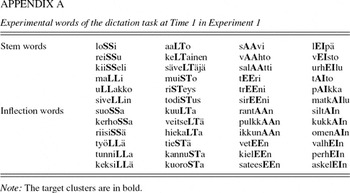
APPENDIX A
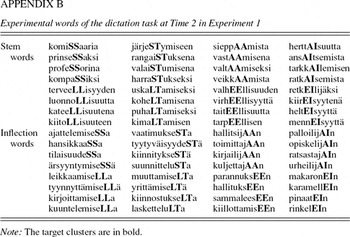
APPENDIX B
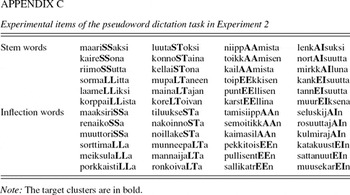
APPENDIX C
 You have
Access
- 33
- Cited by