Introduction
The aging of the population due to increasing life expectancy is leading to a rising proportion of dependent older people with extensive care needs and age-related diseases such as dementia. Worldwide, the number of people with dementia is currently estimated to be 44 million and expected to reach approximately 76 million by 2030 and 135 million by 2050 (Prince et al., Reference Prince, Guerchet and Prina2013). Currently, the majority of community-based care for people with dementia is provided informally by friends and family members (Colombo et al., Reference Colombo, Llena-Nozal, Mercier and Tjadens2011). The family care sector is sometimes referred to as a “hidden health system” (Levin et al., Reference Fillenbaum and Smyer1981) and constitutes a significant proportion of provision within long-term care systems (Spasova et al., Reference Spasova, Baeten, Coster, Ghailani, Peña-Casas and Vanhercke2018). Findings from the European Social Survey in 2014 estimate that the number of family carers is double the size of the formal long-term care workforce, with family carers providing over three-quarters of the total long-term care to dependent older people. Despite, or perhaps because of, their sizeable contribution to long-term systems, family carers report significant personal challenges including reconciling professional, personal, and caring responsibilities; accessing community-based services; financial constraints as a consequence of having to give up or reduce paid working hours; administrative problems accessing services; and low social recognition among healthcare professionals (Birtha et al., Reference Brennan, Lawlor, Pertl, O’Sullivan, Begley and O’Connell2017). Family carers also report adverse physical, emotional, and social outcomes attributable to their role as a family carer (Bastawrous, Reference Bastawrous2013; Brown et al., Reference Bastawrous2013).
In Ireland, the location of the current study, the 2016 Census of Population reported that 195,263 family carers provided 6,608,515 hours of care each week, averaging 38.7 hours per family carer (CSO, 2017). The majority of family carers are female (60.5%) and just over half of family carers were aged 40–59 years old. Although Census data do not provide information on who care is being provided to, it has previously been projected that 60,000 family carers care for people with dementia in Ireland (Gillespie et al., Reference Gillespie2013; O’Shea et al., Reference O’Shea2017). It is estimated that family care accounts for over half of the costs of care for people with dementia (O’Shea et al., Reference O’Shea2017). There is evidence that family carers of people with dementia may be more stressed, have more serious depressive symptoms, and experience more physical problems than family carers of people without dementia (Pinquart et al., Reference Leitner2003). In 2012, the World Health Organization (WHO) declared dementia as a public health priority and, in the same report, emphasized family carers’ need for additional support in order to avoid negative consequences associated with caring for a person with dementia (World Health Organisation, 2012). A large UK survey reported 16% of family carers of people with dementia had contemplated suicide more than once in the previous year (O’Dwyer et al., Reference O’Dwyer, Moyle, Zimmer-Gembeck and De Leo2016), a figure four times higher than that reported in a separate UK survey of family carers of people without dementia (Stansfeld et al., Reference Stansfeld2014). An Irish survey of 200 family carers of people with dementia carers of people with dementia (Brennan et al., Reference Brennan, Lawlor, Pertl, O’Sullivan, Begley and O’Connell2017) found that 37% of family carers reported clinically significant depressive symptoms, nearly three times the Irish national average (OECD/EU, 2018). In addition to these emotional and mental health considerations, the estimated economic cost of caring for a person with dementia in the USA (calculated based on Medicare, Medicaid, private insurance, out-of-pocket spending, and informal care) was 81% higher than providing care to an older person without dementia (Kelley et al., Reference Kelley, McGarry, Gorges and Skinner2015). Therefore, supporting family carers of people with dementia is important, in terms of both carer health and economic circumstances.
Clinical research in this field has suggested that clinical symptoms specific to dementia influence family carer well-being. Clinical studies exploring cortisol levels, a biomarker of stress, report a positive relationship between increased frequency of behavioral and psychological symptoms of dementia and elevated cortisol levels in family carers (De Vugt et al., Reference De Vugt, Nicolson, Aalten, Lousberg, Jolle and Verhey2005; Savla et al., Reference Savla, Granger, Roberto, Davey, Blieszner and Gwazdauskas2013). In a longitudinal study of family carers of people with mild cognitive impairment attending a memory clinic, researchers observed increased carer burden for family carers of people who developed dementia at 3-year follow-up. However, once controlled for, dementia-specific symptoms rather than dementia diagnosis predicted higher levels of carer burden (Connors et al., Reference Connors, Seeher, Teixeira-Pinto, Woodward, Ames and Brodaty2019). Research seems to suggest that behavioral and psychological symptoms associated with dementia, rather than stage of dementia, influence carer burden. However, given that most studies investigate family carers of people with moderate dementia where behavioral and psychological symptoms tend to be most severe, more research is required with family carers of people with mild and advanced stages of dementia (Cheng, Reference Cheng2017). Although under-represented in research, there is evidence which suggests that family carers of people with advanced dementia experience the highest levels of carer burden when compared with other stages (Mioshi et al., Reference Mioshi2013).
Carer burden can be both objective and subjective. The former refers to the physical or instrumental provision of aid, such as the number of hours of care provided, while “subjective burden” relates to the emotional or psychological toll that family carers experience, such as stress, anxiety, and depression (Montgomery et al., Reference Montgomery, Stull and Borgatta1985). Researchers in the Netherlands have reported that carer burden is lower when the informal network supporting the carer is stronger (Tolkacheva et al., Reference Tolkacheva, Van Groenou, De Boer and Van Tilburg2011). This is not surprising as the more extensive the network, the greater the likelihood of sharing caring workload and outlets for emotional support. The concern is that changing cultural expectations, increasing female labor force participation, and later retirement age are likely to shrink the informal carer resource pool, thereby increasing levels of carer burden in the coming years. Given that carer burden has been shown to be a significant predictor of family carer burnout and of long-term care placement of the person being cared for (Eska et al., Reference Eska, Graessel, Donath, Schwarzkopf, Lauterberg and Holle2013; Gaugler et al., Reference Gaugler, Kane, Kane and Newcomer2005), minimizing family carers’ experience of carer burden is emerging as a policy objective to protect informal care as a social and economic resource in the future.
Despite the increasing policy relevance of carer burden, there is limited comparative research on family carers’ direct experience of carer burden among different care groups in Ireland, especially between those caring for people with dementia and those caring for other categories of dependent older people. There is evidence that the physical, emotional, and social costs associated with family caring have led to significant carer burden for those caring for people with dementia (Brennan et al., Reference Brennan, Lawlor, Pertl, O’Sullivan, Begley and O’Connell2017; Brodaty et al., Reference Brodaty, Woodward, Boundy, Ames and Balshaw2014; Lafferty et al., Reference Lafferty, Fealy, Downes and Drennan2014). However, we do not know if the level of carer burden identified in these studies is higher for family carers of people with dementia than for those in the general population of family carers, or whether the distribution of carer burden varies across these populations. Previous literature has suggested that dementia-specific factors influence family carers’ experience of carer burden (Garre-Olmo et al., Reference Garre-Olmo, Vilalta-Franch, Calvó-Perxas, Turró-Garriga, Conde-Sala and López-Pousa2016; Lin et al., Reference Lin, Tsai, Wang, Hwang and Fuh2012; Liu et al., Reference Liu2018; Molyneux et al., Reference Molyneux, McCarthy, McEniff, Cryan and Conroy2008; Park et al., Reference Park, Sung, Kim, Kim and Lee2015). The current research builds on this previous evidence by empirically analyzing levels of carer burden in a nationally representative sample of family carers of older people in Ireland, with a particular focus on the relationship between carer burden and caring for older people with and without dementia. The study will inform policy in relation to whether general family carer supports are sufficient to address the needs of family carers of people with dementia, or whether this group of family carers requires additional, tailored supports to maintain their health and well-being.
Methods
Data
This study is based on secondary analysis of a nationally representative, cross-sectional dataset of family carers in Ireland in receipt of a government-funded Carer’s Allowance for care provided to an older person aged 65 years and older. The dataset contains information on full-time family carers caring for people with and without dementia, thereby enabling comparisons between the two groups. Full details of the original survey can be found in Lafferty et al. (Reference Lafferty, Fealy, Downes and Drennan2014). Data collection for this survey was facilitated by the Department of Social Protection (DSP) in Ireland, which administers the Carer’s Allowance scheme in the country (Citizens Information, 2019). The Department has responsibility for maintaining a national database of family carers who receive a means-tested Carer’s Allowance payment for the care they provide to a friend or relative. At the time of data collection in 2013, there were 24,484 family carers of older people in receipt of the Carer’s Allowance in Ireland. Of this cohort, 4,000 family carers were randomly selected to take part in the survey.
Data collection was conducted in three phases over the summer of 2013 to maximize response rates (Dillman, Reference Dillman2011). Phase 1 involved the DSP posting a pre-notice letter to the randomly selected sample of carers who met the survey’s eligibility criteria; Phase 2 involved sending a cover letter together with a questionnaire and a stamped-addressed envelope to the sample 1 week after the initial letter was posted; Phase 3 involved a second blanket mailing to all 4,000 carers with a cover letter, a replacement questionnaire, and a stamped-addressed envelope. Overall, 2,311 family carers completed the survey, yielding a 58% response rate; though in our analysis, we include only responses with complete information on carer burden and dementia status. This gives a final estimation sample of 1,992 observations.
This survey was designed to capture a wide range of information on family carers of older people including carers’ profile, carers’ health and well-being, care-related activities, caring experience, experience of conflict, experience of support and coping, and care recipients’ profile. Cognitive interviews were undertaken on the original questionnaire with Irish family carers to check for language issues, comprehension, cultural appropriateness, length, etc. (Lafferty et al., Reference Lafferty, Fealy, Downes and Drennan2014). The care recipient profile section of the questionnaire included a question asking whether the care recipient had a diagnosis of dementia. This single item facilitated our present analysis of exploring the experience of family carer burden for family carers of older people with and without dementia. Ethical approval to collect this data was granted by the second author’s institutional review board.
Variables
Dependent variable
The dependent variable in this study was carer burden, which was derived using the standardized 22-item Zarit Burden Interview (ZBI) (Zarit et al., Reference Zarit and Zarit1987). The ZBI presents survey participants with a list of items to capture carers’ affective responses to their caring role and responsibilities. Responses for each item ranged from 0 (never) to 4 (nearly always), aggregating to total potential scores of between 0 and 88, with higher scores indicating higher levels of burden. In this study, carer burden was categorized into four levels following recommended categorical cutoff scores by the original developers of the ZBI (Zarit et al., Reference Zarit and Zarit1987). Specifically, we considered an ordered variable of increasing carer burden as follows: low burden (0–21), mild burden (22–40), moderate burden (41–60), and high burden (61–88). Overall, the ZBI shows good retest reliability and high internal validity (Hébert et al., Reference Hébert, Bravo and Préville2000). Although the ZBI has not been specifically tested with an Irish population, it has been extensively validated internationally (Van Durme et al., Reference Van Durme, Macq, Jeanmart and Gobert2012) and frequently used within research and clinical settings in Ireland (O’Shea, Reference O’Shea2003).
Independent variables
Dementia diagnosis
The primary independent variable of interest in this study was whether the respondent was caring for a person with dementia or a person without dementia. This was a binary variable (0 = no diagnosis of dementia, 1 = diagnosis of dementia).
Sociodemographic variables
Carer sociodemographic details of interest included age, gender, marital status, and education level. Age and gender of the person being cared for were also included.
Care recipient physical dependency
The physical dependency level of the person being cared for was also measured, and the dependency level was calculated according to an activities of daily living (ADL) scale score with a range of 6–18 Higher scores on this scale indicate higher levels of dependency, and these scores were categorized into low, medium, and high dependency categories. Although this scale has not been specifically tested with an Irish population, it has been validated with older adult populations (Fillenbaum, Reference Fillenbaum1988; Fillenbaum et al., Reference Levin and Idler1981).
Context of caring variables
Several additional variables were included to capture the context of caring: the survey respondent’s relationship to the person being cared for, area of residence (rural or urban), hours spent caring per week, duration of caring in months, co-residence, and perceived quality of support in the caring role.
Statistical analysis
The dependent variable in our analysis, carer burden, is an ordered categorical variable and, as a result, an ordered response model was required. We estimated a multivariable ordered logit model to assess the independent relationship between carer burden and dementia status of the care recipient, controlling for a range of other variables relating to the care recipient, family carer, and context of caring. Using this approach allowed us to assess whether or not family carers of older people with dementia are, all else being equal, more or less likely to experience higher or lower carer burden than family carers of older people without dementia. The specific levels of carer burden considered are as described above, i.e. low, mild, moderate, and high. All of the independent variables included were carefully selected on the basis of previous existing literature on the determinants of carer burden and the set of variables available in our dataset. Model goodness of fit was assessed using the Akaike Information Criterion (AIC) test statistic. In sensitivity and robustness checks, we also estimated models with different subsets of control variables; these models are presented in the supplementary material (Appendix A1). In particular, we estimated models where we included only dementia status i.e. a univariate model (Model 1), as well as models where sets of care recipient variables, carer variables, and context of caring variables were incrementally added (Models 2, 3, and 4). We also estimated additional models (Models 5 and 6), which included variables relating to psychological abuse, physical abuse, and quality of relationship, but endogeneity issues raise concerns about their validity, relative to the preferred model (Model 4). For all models, we present estimated odds ratios (ORs). For our preferred model (Model 4), we also present a set of predicted probabilities and marginal effects relating to the dementia diagnosis variable. All statistical analyses were conducted using Stata version 15.1 (StataCorp, Reference Ali and Bokharey2017).
Results
Characteristics of participants
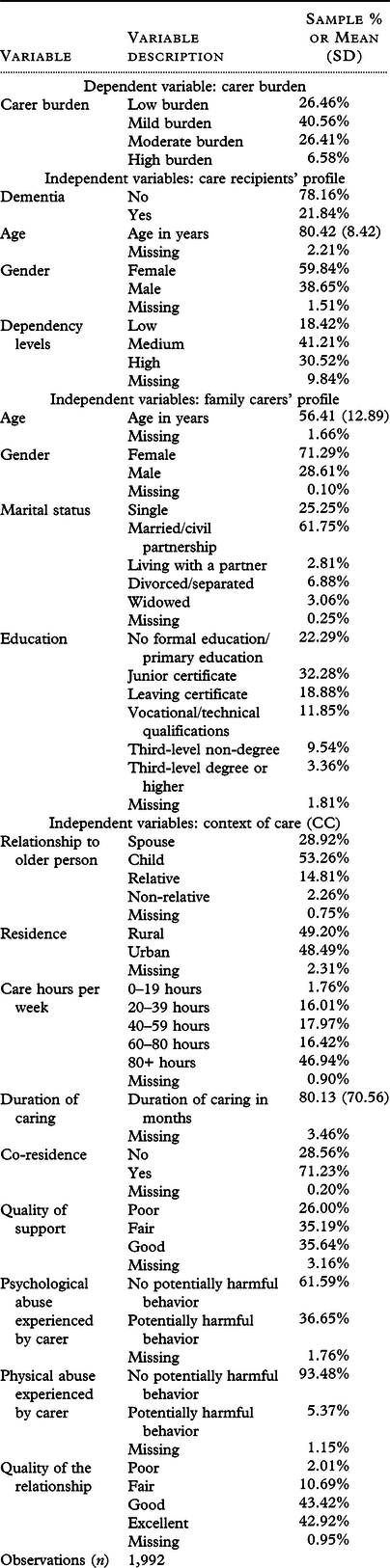
Table 1 presents sample descriptive statistics for the estimation sample of 1,992 observations for each of the variables included in our multivariable regression analysis. Overall, 26.46% of carers reported low burden, 40.56% reported mild burden, 26.41% reported moderate burden, and 6.58% reported high burden. In relation to the care recipient profile reported, just over one-fifth (21.84%) of the sample indicated that they were caring for a person with dementia. The majority of care recipients were female (59.84%) with a mean age of 80.42 years. Approximately, 71.73% of respondents were caring for a person with medium to high levels of dependency; this differed for carers of people with dementia (83.45%) and without dementia (68.47%). In relation to the family carers’ profile, respondents had a mean age of 56.41 years and most were female (71.29%). The majority of respondents reported no formal education/primary-level education or Junior/Intermediate Certificate (54.57%), while around 12.90% reported having a third-level qualification or higher. Most respondents were caring for a parent (53.26%), but sizeable proportions of the sample cared for a spouse (28.92%) or another relative (14.81%). Nearly half the respondents (49.2%) lived in a rural area, with 71.23% of the sample co-residing with the person they cared for. Most family carers reported having a good or excellent relationship with the person they cared for (86.34%).
Sample descriptive statistics

Multivariable analysis
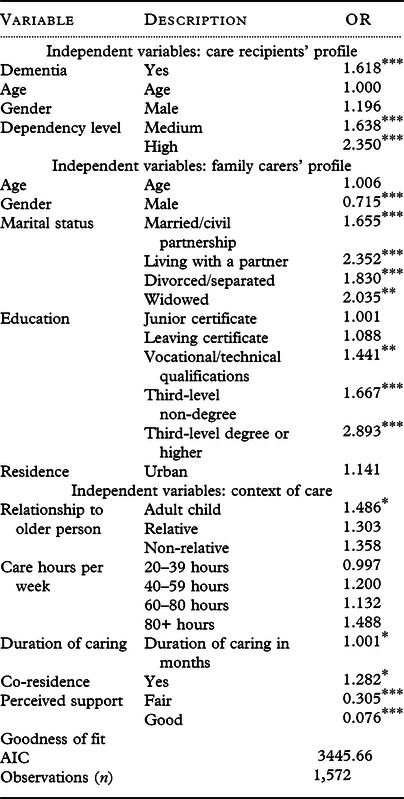
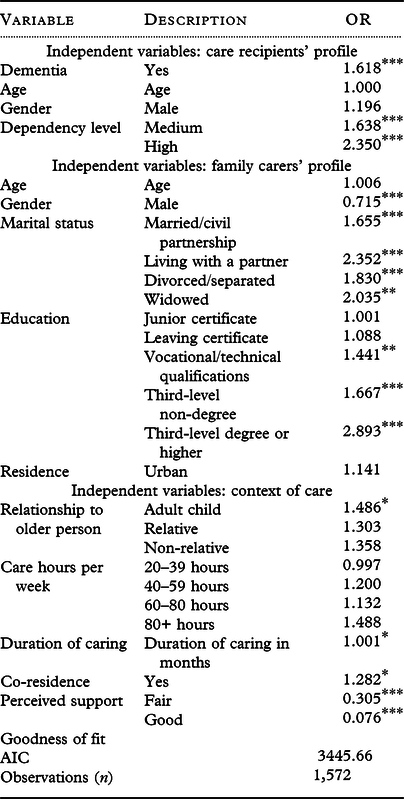
Results from our preferred multivariable ordered logit model are presented in Table 2 in the form of estimated ORs. A number of other models containing different subsets of independent variables are presented in the supplementary material (see Appendix A1). The preferred model suggests that the odds of increased carer burden are 1.62 times higher when caring for a person with dementia compared with caring for a person without dementia, controlling for the other variables included in the model. This estimate is statistically significant at a 1% level, though smaller than the estimated ORs in models 1–3 as set out in the supplementary material. It is important to note that the preferred model has fewer observations than models 1–3 as a result of a small amount of missing data on some of the control variables. Nonetheless, the sample size is still large, at n = 1,572. Alongside dementia, higher levels of dependency were also strongly associated with increased odds of carer burden.
Ordered logit model estimates (odds ratios)
***p < 0.01, **p < 0.05, *p < 0.1.
A number of other variables also showed a significant relationship with family carers’ experience of carer burden. The odds of increased carer burden for male family carers were lower than for female family carers. Analysis showed that the age of the family carer did not have a statistically significant independent relationship with carer burden. All levels of the variable marital status showed significant positive associations with carer burden relative to the base case of being single; family carers who were living with a partner or who were widowed were shown to have the highest odds of increased carer burden. While lower levels of educational attainment (secondary level education and below) were not significant relative to no formal education/primary, higher educational attainment beyond secondary level was positively associated with increasing levels of carer burden. The model did not find a difference between rural and urban dwelling family carers in relation to carer burden.
Relative to the base case of spouse, caring for a parent was associated with increased odds of carer burden. Duration of care (length of the time the carer has been providing care) was statistically significant, though care hours per week were not. The model suggests that the odds of increased carer burden are significantly higher for family carers co-residing with the person they care for. Having fair or good perceived support was negatively associated with carer burden in our model in relation to the base case of having poor perceived support.
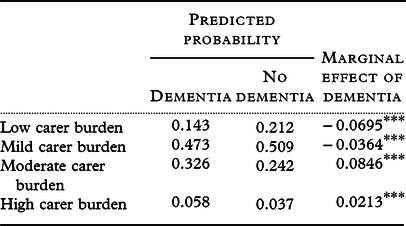
Given the ordered nature of the dependent variable, it was also possible to estimate the marginal burden of caring for a person with dementia at each of the four levels of carer burden. In particular, the estimated marginal effects presented in Table 3 show the estimated percentage point (ppt) change in the probability of reporting a particular level of carer burden, based on whether or not the older person being cared for had dementia, controlling for the other variables in the model.
Estimated probabilities and marginal effects of dementia diagnosis on carer burden

***p < 0.01, **p < 0.05, *p < 0.1.
The predicted probabilities and marginal effects highlight that, relative to carers of people without dementia, carers of people with dementia are 6.95 ppts less likely to report low carer burden, 3.64 ppts less likely to report mild carer burden, 8.46 ppts more likely to report moderate carer burden, and 2.13 ppts more likely to report high carer burden. Overall, these findings highlight a clear relationship between carer burden and caring for a person with dementia, while interestingly, the largest effects can be seen in the “low” and “moderate” levels of carer burden.
We also estimated two additional models controlling for psychological abuse, physical abuse, and quality of relationship (Models 5 and 6; see Appendix A1). Not surprisingly, both psychological and physical abuse variables were shown to have a strong significant positive relationship with carer burden. Similarly, a poor quality relationship between the family carer and care recipient was positively associated with increased odds of carer burden.
Discussion
Our analysis highlights that family carers of people with dementia are more likely to experience moderate to high carer burden and less likely to experience low to mild carer burden. Although research in this area is limited, our findings are consistent with recent research which suggested that dementia is associated with increased carer burden (Riffin et al., Reference Riffin, Van Ness, Wolff and Fried2019). Our estimated ORs suggest that the extra burden associated with caring for a person with dementia is significant, relative to caring for a person without dementia. The estimated marginal effects show that family carers of people with dementia are considerably more likely to experience moderate and high carer burden and are less likely to experience low and mild carer burden when compared with family carers of people without dementia. While limited research exists comparing carers of people with dementia with the general population of family carers, some research has found higher levels of carer burden among family carers of people with dementia when compared with family carers of people with depression (Leinonen et al., Reference Leinonen, Korpisammal, Pulkkinen and Pukuri2001), diabetes (Kim et al., Reference Molyneux, McCarthy, McEniff, Cryan and Conroy2008), and cancer (Harding et al., Reference Harding, Gao, Jackson, Pearson, Murray and Higginson2015). However, family carers of people with an acquired brain injury were shown to have higher levels of burden than carers of people with dementia (Harding et al., Reference Harding, Gao, Jackson, Pearson, Murray and Higginson2015).
This research confirms that family carers of people with dementia experience an additional set of challenges in their caring role. Caring for a person with dementia is complex, and unique situations may arise in several domains of a family carer’s life in addressing that complexity. For example, dementia is highly stigmatized, and qualitative studies have highlighted that negative attitudes toward dementia among family and friends may increase family carers’ burden levels through a reduction in social capital (Papastavrou et al., Reference Papastavrou, Andreou, Middleton, Tsangari and Papacostas2015). Family carers’ own stigmatized preconceptions of dementia may also contribute to maladaptive cognitions following diagnosis such as catastrophizing, overgeneralizing, or blaming (Ali et al., Reference Donnellan, Bennett and Soulsby2015). More generally, the positioning of symptoms of dementia, such as behavior or psychological aspects, as a main predictor of carer burden can sometimes overshadow other life stressors that are influenced by dementia, such as household finances, work and career, role changes, legal considerations, responsibility for future health decisions, and family stressors (Livingston et al., Reference Livingston2010).
Our model allowed us to consider associations between other variables and overall carer burden. We observed a strong and significant relationship between level of the care recipient’s physical dependency and carer burden, which was consistent with earlier studies (Garre-Olmo et al., Reference Garre-Olmo, Vilalta-Franch, Calvó-Perxas, Turró-Garriga, Conde-Sala and López-Pousa2016). Our ordered logit model showed a significant positive independent relationship between levels of carer burden and higher levels of education. Research on other diseases, for example cancer, has predominantly found that lower levels of education are related to poorer outcomes for family carers of people with the disease, including higher frequency of clinically significant anxiety and depression symptoms (Drageset et al., Reference De Vugt, Nicolson, Aalten, Lousberg, Jolle and Verhey2005). On the other hand, dementia-specific research conducted by Gaugler et al. (Reference Gaugler, Kane and Newcomer2007) found that higher levels of education were linked to reduced resilience and potentially higher carer burden for family carers of people with dementia. It may be that higher levels of education are associated with higher opportunity costs for family carers through loss of market workforce engagement (Mudrazija, Reference Mudrazija2019). This potential loss of higher earnings due to taking on partial or full caring roles may impact negatively on the burden experienced by carers.
Similar to previous work in the field (Chappell et al., Reference Chappell, Dujela and Smith2014), our analysis found that caring for a parent was associated with increased odds of carer burden in our sample once we controlled for other variables. However, spousal relationships were insignificant, in contrast to research conducted by Bruvik et al. (Reference Bruvik, Ulstein, Ranhoff and Engedal2013) who reported that spousal family carers of people with dementia were more likely to have higher levels of burden. Co-residence was significantly positively associated with carer burden, while there was no significant independent relationship between time spent caring and carer burden experienced. Similarly, Riffin et al. (Reference Riffin, Van Ness, Wolff and Fried2019) reported that, after accounting for provision of additional tasks, number of hours spent caring was no longer associated with carer burden, suggesting that additional caring responsibilities may be more taxing for carers than the time demand required to provide assistance.
Unsurprisingly, greater levels of perceived support were associated with lower levels of carer burden. Perceived support incorporates both formal and informal sources of support. Perceived quality of support often appears to be more important than the quantity of support received for the well-being of family carers (Shurgot et al., Reference De Vugt, Nicolson, Aalten, Lousberg, Jolle and Verhey2005). Therefore, policy makers and practitioners should consider perceived satisfaction with social support, as well as the presence or absence of social relationships (O’Rourke et al., Reference Hébert, Bravo and Préville2000). The importance of clubs, church groups, and support groups has been identified as important societal resources within which individual and community resources can be shared (Donnellan et al., Reference Donnellan, Bennett and Soulsby2015). Research has also shown that support groups can increase emotional and informational dimensions of support and reduce psychological distress, depressive mood, and burden (Han et al., Reference Han2014). Psychological abuse, physical abuse, and poor quality relationship variables were positively associated with increased odds of carer burden (Models 5 and 6; see Appendix A1). These results should, however, be treated with caution, as both psychological and physical abuse are reactive behaviors that are endogenous to the dementia itself (Cooper et al., Reference Cooper, Blanchard, Selwood, Walker and Livingston2010). Similarly, research has shown that a decreasing quality of relationship in the care dyad may be attributed to the symptoms of dementia, including poor understanding of the disease (Quinn et al., Reference Quinn, Clare, McGuinness and Woods2012).
In contrast with other national survey and clinical studies, just under 50% of family carers in this study lived in a rural area. Approximately, 37% of the Irish population lives in a rural area, while the percentage of family carers living in these same rural areas is higher at about 42% (CSO, 2017). Social exclusion, public transport limitations, and service provision gaps have been identified as major challenges for rural family carers in Ireland (Hughes, Reference Hughes2018). These challenges are not unique to Ireland; there are many examples of under-provision and fragmented delivery systems in other countries, particularly in rural settings (Innes et al., Reference Innes, Morgan and Kostineuk2011). Despite these challenges, our analysis highlighted that rurality was not significantly associated with carer burden. Rural communities can also be important sources of social opportunities and meaningful relationships (Keating et al., Reference Keating, Eales and Phillips2013). Despite fragmented formal support, family carers and people with dementia may draw on positive aspects of rural environments (Egdell et al., Reference Egdell, Bond, Brittain and Jarvis2010) to develop protective coping strategies even in difficult circumstances (Branger et al., Reference Branger, Burton, O’Connell, Stewart and Morgan2016). This may explain the absence of significance on the rural–urban variable in our study.
Awareness of the important role played by family carers in providing care to people with dementia is being increasingly recognized. However, the translation of this recognition into policy action has been slow and uneven. While many of the published national dementia strategies across Europe vaguely advocate supports for family carers, very few make specific policy action recommendations (Vasse et al., Reference Vasse2012). Some national dementia strategies, including Ireland’s, align their family carer specific aims and objectives with those of the corresponding national carer strategies. However, given the high care needs of people with dementia and the increased likelihood of experiencing higher carer burden, family carers of people with dementia may require additional supports to allow them to continue to provide good quality care. Considerable research exists regarding the development of services aimed at supporting family carers of people with dementia. Strong relational support and information networks, maintaining a good relationship with the person with dementia, fostering greater support with service providers, strengthening family carers’ psychological resources, and maintaining supports have been identified as areas which strengthen family carers’ resilience and reduce their experience of carer burden (Parkinson et al., Reference Parkinson, Carr, Rushmer and Abley2016). In light of our findings and previous research (Oliveira et al., Reference Oliveira, Zarit and Orrell2019), developing more effective psychosocial approaches to support family carers of people with dementia appears to be a particular consideration for policy makers.
In order to develop stronger support for family carers, the WHO published a global action plan on the public health response to dementia for 2017–2025 (World Health Organisation, 2017). The WHO plan calls for increased provision of accessible and evidence-based information, training programs, respite services, and other resources tailored to the needs of carers to improve carers’ knowledge and caring skills, enhance their coping with challenging behavior, prevent stress, and reduce burden and health problems. However, in Ireland, supports for family carers operate as a collaboration between familialism, i.e. policies which support a welfare system where families take responsibility for care provision and defamilialism, whereby policy seeks to reduce the burden on family through the provision of formal care services (Leitner, Reference Leitner2003). Support services for family carers of people with dementia, such as home care, day care, and respite care, are provided to the point that enables the family carer to effectively manage work, caring, and other responsibilities. However, the cost associated with managing multiple roles may lead to significant carer burden, especially for those caring for a person with dementia (Brennan et al., Reference Brennan, Lawlor, Pertl, O’Sullivan, Begley and O’Connell2017; Lafferty et al., Reference Lafferty, Fealy, Downes and Drennan2014).
To conclude, family carers of people with dementia are likely to experience higher levels of burden than those caring for people without dementia. Caring is not a homogenous task, so policy makers and support systems need to respond in different ways to different caring situations. While the role of behavioral and psychological symptoms of dementia has been well established within the carer burden literature, our study points to the need for a greater focus on other dementia-specific factors which may contribute to carer burden. This includes more emphasis on psychosocial factors, perceptions of formal and informal support among family carers, education levels, labor market participation rates, and co-residence arrangements. Caring for people with dementia presents unique challenges, and this needs to be reflected in the development of targeted social support systems and policies that serve to address and alleviate the source of additional burdens identified in this paper.
Limitations
The data used in this study are cross-sectional in nature and the analysis estimates independent associations rather than causal relationships. In relation to representativeness of the data, the study sample does not include data on family carers of people with young-onset dementia. Research has shown that family carers of people with young-onset dementia often face additional challenges as they are more likely to be working, have young children, and have greater financial responsibilities. They are also often less experienced, unprepared for the caregiving role, have access to fewer services, and experience more social isolation and higher carer burden as a result (Millenaar et al., Reference Millenaar, Bakker, Koopmans, Verhey, Kurz and de Vugt2016). In addition, the family carers who participated in this survey were all in receipt of a means-tested Carer’s Allowance payment. Given the low-threshold means-testing criteria for Carer’s Allowance in Ireland (Citizens Information, 2019), we can assume that the family carers taking part in this survey are a low-income population. At the time of data collection, family carers in receipt of this payment were also only permitted to work or study for a maximum of 15 hours per week. Consequently, higher income family carers and family carers who work more than 15 hours a week are not represented in this analysis. Finally, although the overall sample size for the survey was 2,311, 13.8% of respondents did not provide complete information on carer burden and/or dementia status. While missing data can undermine the power of statistical models, given our final estimation sample was still relatively large, this was not an issue for our analysis. However, the possibility of non-random missing data is acknowledged and this may impact our results.
Source of funding
This work was supported by the Health Research Board Ireland and the Irish Research Council. The original survey was funded by the Health Service Executive (HSE).
Description of authors’ roles
ÁT conceived and designed the analysis, performed the analysis, and drafted the manuscript. AL developed the study’s research design, collected the data, contributed to the conception and design of the analysis, and participated in drafting and revising the manuscript. JC contributed to the design and conception of the analysis methodology, provided guidance in the interpretation of the results, and participated in revising and drafting the manuscript. GF participated in developing the research design and the data collection and in drafting and revising the manuscript. EO’S contributed to the design and conception of the study analysis, provided input to the interpretation of the results, and participated in drafting and revising the manuscript.
Supplementary material
To view supplementary material for this article, please visit https://doi.org/10.1017/S1041610220000769